INTRODUCTION
The family Odontaspididae consists of two genera, Odontaspis Agassiz, 1838 and Carcharias Rafinesque, 1810 (Campagno, Reference Campagno2002). Three species are recognized for this family with the genus Odontaspis including the small-tooth sand tiger shark, Odontaspis ferox, and bigeye sand tiger shark, Odontaspis noronhai, while the genus Carcharias only has one species, the sand tiger shark, Carcharias taurus Rafinesque, 1810. While all species seem to have circumglobal distribution, the Odontaspis species are uncommon and rarely encountered (Campagno, Reference Campagno2002).
The sand tiger shark is a large coastal shark reaching a maximum size of 318 cm in total length and generally found in most subtropical and warm temperate seas (Compagno, 1984). Its known distribution extends from waters of the Atlantic, Indian and western Pacific Oceans, as well as the Mediterranean Sea (Gilmore et al., 1983; Campagno, Reference Campagno1984). Records of this species in the western Indian Ocean also extend to Yemen, Pakistan and India (Pollard & Smith, Reference Pollard and Smith2009). The sand tiger shark can occur as solitary individuals or in small to large aggregations and can generally be found inhabiting shallow bays, and around inshore rocky reefs and islands at up to 200 m depth (Campagno, Reference Campagno1984). Some populations of sand tiger sharks across the world have been severely depleted due to fishing pressures and their K-selected life history, which includes a low fecundity with only two pups per litter (Campagno, Reference Campagno1984; Pollard & Smith, Reference Pollard and Smith2009). It is therefore listed as ‘Vulnerable’ on the IUCN Red List (Pollard & Smith, Reference Pollard and Smith2009; Kyne et al., Reference Kyne, Carlson, Ebert, Fordham, Bizzarro, Graham, Kulka, Tewes, Harrison and Dulvy2012).
Located between the latitudes of 24 and 30°N and longitudes of 48 and 57°E (Figure 1), the Arabian/Persian Gulf (hereafter referred to as ‘the Gulf’), is a sub-tropical and semi-enclosed basin with extreme environmental conditions. This very shallow sea, with an average depth of 35 m, is connected to the Indian Ocean through the Strait of Hormuz. Its environmental extremes are characterized by high salinities which often exceed 45 parts per thousand as well as sea surface temperatures that can fluctuate between 12°C during the winter and over 36°C in the summer (Sheppard et al., Reference Sheppard, Price and Roberts1992). The complexity of the Gulf conditions may have affected the shark diversity in the region (Moore et al., 2012) and yet little information is currently available about many of these species in this body of water. In fact, from the years 1984 to 1997, only three records of the sand tiger shark were made in Gulf waters.
Map of the Arabian/Persian Gulf representing the geographical position (numbers as reported in Table 1) where specimens of the sand tiger shark (Carcharias taurus) have been recorded.

The absence of species specific reporting from the United Arab Emirates (UAE) shark fishery as well as other countries bordering the Gulf has resulted in a paucity of verified records for shark species in general. The present record represents the first documented occurrence of the sand tiger shark in the UAE waters as well as the first recorded occurrence of this species in the Gulf waters in the last 15 years. Data are discussed in the context of previous records and distribution of this species. These results contribute to the existing knowledge about the distribution of this species in the Gulf waters and suggest the need for its future management and a conservation strategy.
MATERIALS AND METHODS
On 18 March 2012, a sand tiger shark, Carcharias taurus, was caught approximately 1 km from Dalma Island in Abu Dhabi waters of the UAE. The by-catch of this shark occurred during the hauling of a gill net artisanal fishery in shallow waters, approximately 15 m in depth, around Dalma Island. The drifting gill net, locally known as hayal, is mostly used in winter to target species such as the narrow-barred Spanish mackerel, Scomberomorus commerson (Beech, Reference Beech2004). Taxonomic identification was confirmed by reference to Campagno (Reference Campagno1984). Total length was measured by the fisherman to the nearest centimetre using a measuring tape along the stretched body of the specimen. Sex was determined by the absence of claspers, but no observations were made of its internal organs and weight was not taken. The specimen was not preserved but photographs were taken; teeth and a tissue sample (stored in 95% ethanol and frozen) were collected.
RESULTS
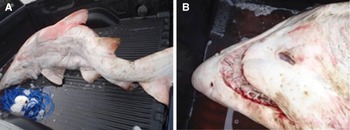
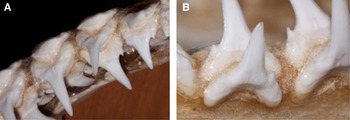
The sand tiger shark, Carcharias taurus, measuring 256 cm (Figure 2A, B) in total length, was dead when brought aboard. The identification of sand tiger shark was based on the typical diagnostic features of this species such as a head with a short conical snout, a long mouth which extends behind the eyes, characteristic long and thin non-serrated teeth protruding from the mouth with prominent single cusplets at either side of the main cusp (Figure 3A, B), anal and dorsal fins similar in size and broadly based, first dorsal fin origin behind the inner margins of the pectoral fins and darker brown spots scattered on the body (Campagno, Reference Campagno1984).
Female, Carcharias taurus, measuring 256 cm stretched total length with full body view (A) and lateral head view (B).

Teeth of the upper (A) and lower jaws (B).

Photographs confirmed that this specimen was a female but it was not possible to determine maturity. Unfortunately, further data could not be collected from the specimen because the fishermen sold the catch after collecting the data and photographing the specimen.
DISCUSSION
The incidental catch of the sand tiger shark, Carcharias taurus, described in this paper is the first documented record in UAE waters and the only reported capture since the last occurrence published for this species in the Gulf (Krupp et al., 2000; Moore et al., 2007). The historical dataset for the Gulf has indicated a very low abundance of sand tiger shark with only three records for this species historically. An annotated list of published records of this species in the Gulf is shown in Table 1.
Annotated checklist of historical records for the sand tiger shark, Carcharias taurus, in the Arabian/Persian Gulf.

The geographical distribution of this species remains relatively undocumented in the Gulf. Based on published records, this species seems to be concentrated along the southern part of the basin from Kuwait to Abu Dhabi waters of the UAE (Krupp et al., 2000; Moore et al., 2007, 2012). Campagno (Reference Campagno1984) stated that this species is highly migratory in parts of its range and undertakes northern migrations during the summer and equatorial movements in the autumn and winter months. It remains unknown if sand tiger sharks from the Gulf travel between the bordering countries or even through the Strait of Hormuz. Henderson et al. (Reference Henderson, McIlwain, Al-Oufi and Al-Sheili2007) reported the occurrence of one sand tiger shark from Dibba, Oman, which could suggest movements in and out of the Gulf. Since all specimens from the Gulf have been reported between the months of December and April, the existence of a seasonal migratory pathway can be hypothesized within this body of water where this species may be present at certain times of the year when the water temperatures are cooler. However, the paucity of information regarding the types of fishing gear used for each record does not allow determination of whether fishing gear characteristics and seasonality of gear could also be determining factors. On the other hand, Gubanov & Schleib (Reference Gubanov and Schleib1980) described this species from Kuwaiti waters and suggested that they were sometimes encountered during spring and summer months. However, Randall (Reference Randall1995) questioned this record based on several shark misidentifications in their book while Krupp et al. (Reference Krupp, Almarri, Zajonz, Carpenter, Almatar and Zetzsche2000) stated that there was no material to support these observations.
While this record provides additional information on the distribution of the sand tiger shark in this region, knowledge about these sharks in general remains very poor. Given the ‘Vulnerable’ IUCN conservation status of this species, more information is required to fully document its ecology, distribution range and status in the Gulf. In fact, the K selected life history of this species and its low annual rates of increase constrain its ability to withstand fishing pressure (Kyne et al., Reference Kyne, Carlson, Ebert, Fordham, Bizzarro, Graham, Kulka, Tewes, Harrison and Dulvy2012). According to Gilmore et al. (Reference Gilmore, Dodrill and Lindley1983), the specimen reported in this paper can be considered a mature female as it was greater than 220–230 cm in total length. Other large shark species are commonly by-caught or targeted by the artisanal fishery in the UAE and the Gulf (Moore, Reference Moore2012; Jabado, unpublished data) and the limited evidence suggests that by-catch of sand tiger sharks also occurs. The absence of species-specific fishery reports of shark landings along the Gulf makes it difficult to determine the abundance of this species in this body of water. Monitoring of fisheries and landings at fishing ports is likely to be one viable method of obtaining specimens and greatly improving knowledge about these and other shark species in the region as a whole. Furthermore, the records of this species from three countries in the Gulf suggest that future conservation measures would also require a regional coordination plan.
ACKNOWLEDGEMENTS
We thank the fisherman from Dalma Island for collecting information from the specimen and for providing the photographs. The United Arab Emirates University supported this work with a PhD scholarship to Rima W. Jabado.