Mayan-speaking humans were not the only pre-Columbian primates occupying the tropical forests of Guatemala, southeastern Mexico, and Belize. Monkeys were and still are an active part of the landscape where high forests survive: they clamber through the trees, dangle from branches, call to each other, and throw things at intruders. Simians played important roles in Maya belief systems, as is evident in creation myths and in representational art: monkey imagery appears in various Classic (ca. a.d. 200–950) and Postclassic (ca. a.d. 950–1525) media, including pottery, stone, bone, and hieroglyphic writing (see, for example, Baker Reference Baker1992, Reference Baker2014; Benson Reference Benson and Fields1994; Braakhuis Reference Braakhuis1987; Coe Reference Coe and Hammond1977; Danien Reference Danien2005; Grube and Nahm Reference Grube, Nahm and Kerr1994; Kerr Reference Kerr2015b; Miller and Peraza Lope Reference Milbrath and Lope2003; Mock Reference Mock1997; Ringle Reference Ringle1988; South Reference South2005; South and Ford Reference South and Ford2013; Stross Reference Stross2008).
Representations of animals in art vary in the degree to which they may be considered naturalistic, stylized, or abstract. If a culture's artistic styles and iconography are considered symbolic codes, a kind of visual communication by which a community orders experience and perceptions of social realities and the cosmos (Munn Reference Munn1966), then it is important to consider the social dimension of these monkey images. Different groups may emphasize different features of an animal, and those choices reveal “something about the way it was conceived of and understood through parts represented and contexts in which it is included” (Morphy Reference Morphy and Morphy1989:2; Saunders Reference Saunders1994:103–105, Reference Saunders1998:20). Analytically, the question becomes, What is being communicated by these codes, and to whom?
Our opening question here is, Which among the three genera and four species of monkeys occupying the lowland Maya area were represented on Classic-period pottery? Scholars have disagreed: Michael Coe (Reference Coe and Hammond1977) thought that howler monkeys were most common in Maya iconography, but Mary Baker (Reference Baker1992, Reference Baker2014) argued that it was instead the capuchin. Most incidental references seem to be to spider monkeys. The answers to these questions about genus/species and communication directions provide insights into how the Mayas conceived of and interacted with their ever-changing physical world. Thus the present essay contributes to the literature on monkeys in Mesoamerica through consideration of their representations—both attributes and contexts—on Classic-period lowland Maya pottery.
MONKEY BIOLOGY AND BEHAVIOR
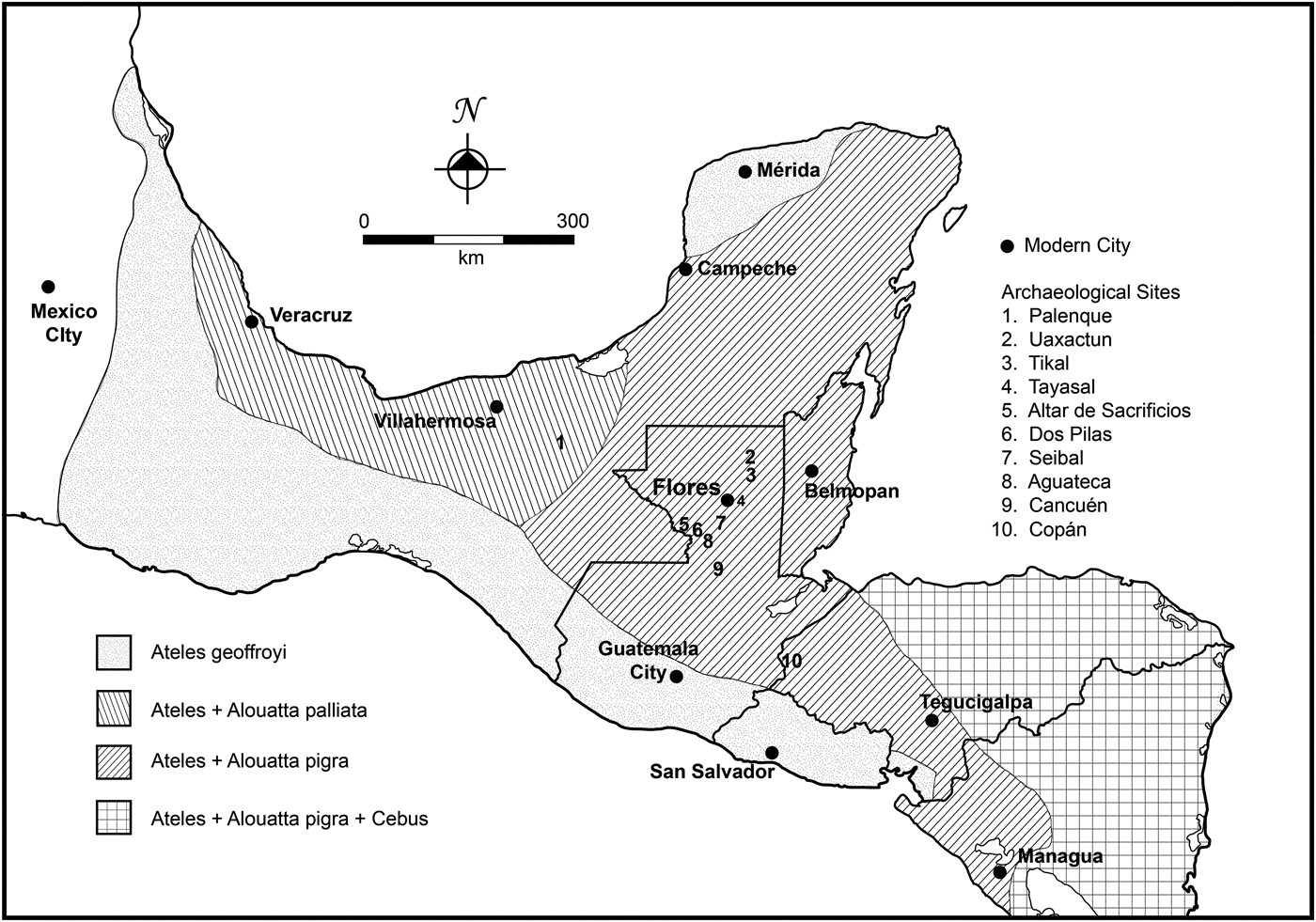
Three species of monkey are currently found in the Maya lowlands: two species of howlers (Alouatta pigra, Alouatta palliata) and the spider monkey (Ateles geoffroyi). A fourth species, the capuchin (Cebus capucinus), may have occupied the lowlands in the past, but it has a more restricted distribution today (Figure 1). In the mid-sixteenth century, Franciscan Bishop Diego de Landa (in Tozzer Reference Tozzer1941:5) reported in his well-known relación (report, account) that monkeys were hunted in the area between Tabasco (Gulf coastal Mexico) and Yucatán (presumably Campeche, on the west side of the peninsula), but that there were no monkeys in the Yucatán Peninsula itself. Doubtless he was referring to the relatively dry northwestern area around Mérida where he resided.
Distributions of monkey genera in the Maya region and upper Central America (after Bruner and Cucina Reference Bruner and Cucina2005:Figures 1-a, and Rylands et al. Reference Rylands, Mittermeier, Hines, Garber, Estrada, Pavelka and Lueke2006:Figures 3, 5–7), showing some of the places mentioned in the text. Alouatta palliata may extend farther south in Guatemala than shown here.

Howler Monkeys (Alouatta pigra and A. palliata mexicana) (formerly sometimes A. villosa)
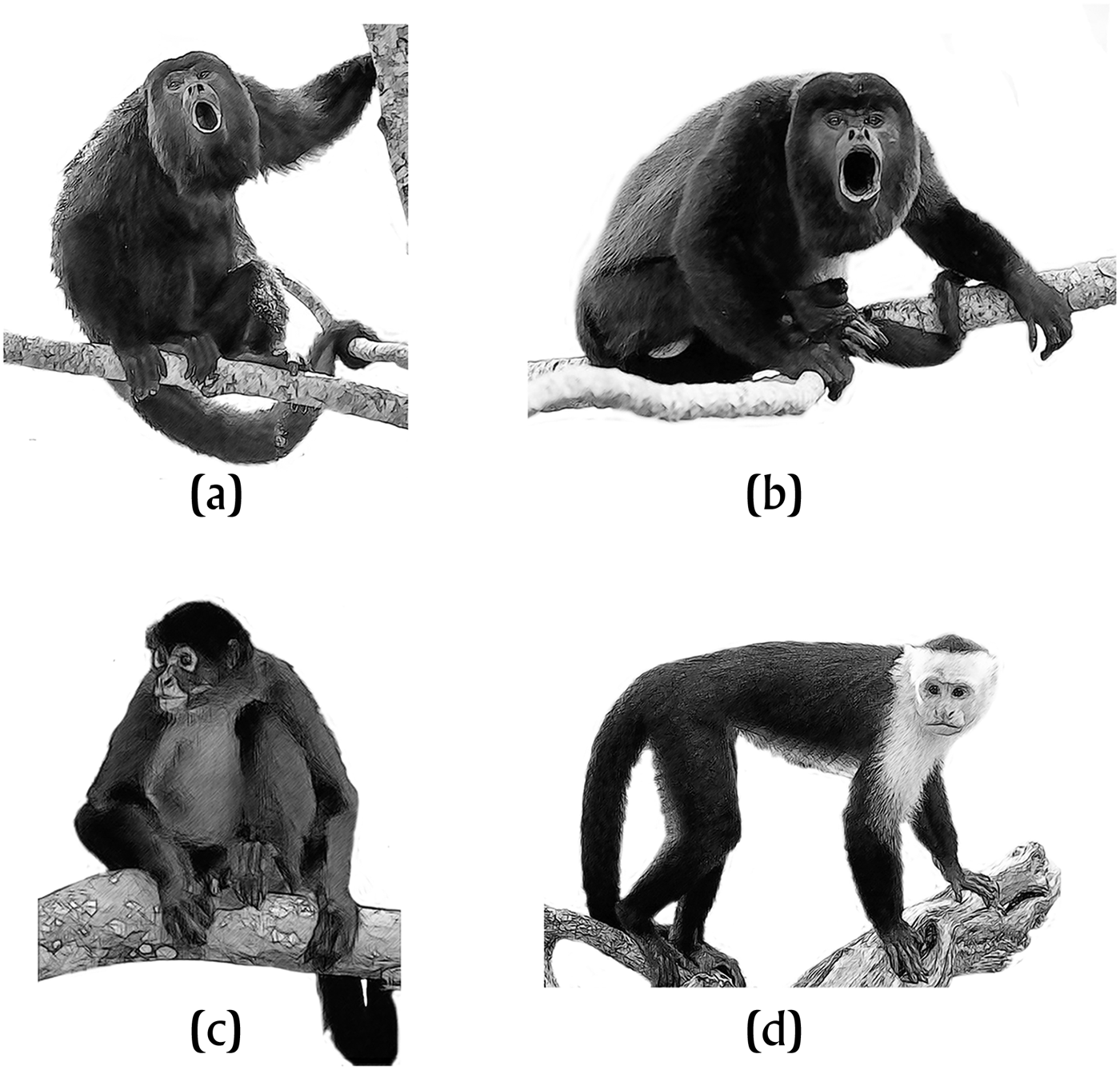
The Central American black howler monkey (Figure 2a), is also known as the Mexican, Guatemalan, or Belizean black howler. A. pigra and A. palliata mexicana, the Mexican mantled howler (Figure 2b), are the largest of the three primates of the Maya lowlands. Both species are black, but A. palliata has a mantle or saddle of yellow, brown, or buff guard hairs over the lower back. A. pigra is larger and heavier than the mantled howler and both species are sexually dimorphic, with the female smaller than the male (Kelaita et al. Reference Kelaita, Dias, Aguilar-Cucurachi, Canales-Espinosa and Cortés-Ortiz2011: Table 1).
Monkeys: (a), Alouatta pigra (drawing by Don Rice after photograph by J. K. Partyka; http://blogg.uio.no/mn/ut-i-verden/files/37000); (b), Alouatta palliata (drawing by Don Rice after photograph by D. Tipling; http://www.arkive.org/mantled-howler-monkey/alouatta-palliata/image-G132241.html); (c), Ateles geoffroyi (drawing by Don Rice after photo by Dr. Lloyd Glenn Ingles © California Academy of Sciences in Calphotos Photo Database; http://calphotos.berkeley.edu/cgi/img_query?enlarge=0091+3183+0989+0115); (d), Cebus capucinus (drawing by Don Rice after photograph @duanrevig.com/Nature divers; http://www.duanrevig.com/Nature%20divers/Mamiferes/Cebus%20capucinus%20Capucin%20joyeur.JPG).
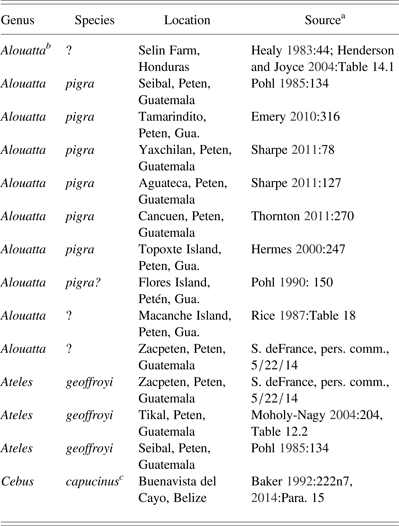
Monkey Remains Recovered in Archaeological Excavations at Lowland Maya Sites
a Carolyn Freiwald (personal communication, May 31, 2014) informed us about many of these sources.
b Reported as palliata in the Appendix to the edited volume (Emery Reference Emery2004:265) but not in the article.
c It is not certain that this mandible, unpublished and with the genus attribution based only on a secondhand verbal description (Baker Reference Baker2014:Paragraph 15), is genuinely that of a capuchin.
Faces are dark and prognathous with a low forehead and large mandible, and adult males have a thick “beard.” Forepaws or “hands” are schizodactylous: the thumb and index finger are opposable to the other three fingers (Baker Reference Baker1992:220). A. pigra lives in small groups averaging 4–8 individuals, whereas A. palliata groups are larger, with about 8–23 individuals of both sexes (Kelaita et al. Reference Kelaita, Dias, Aguilar-Cucurachi, Canales-Espinosa and Cortés-Ortiz2011:180). The prehensile tails of howler monkeys have a hairless pad underneath and fairly restricted uses, primarily for support during suspension (Bergeson Reference Bergeson1996). Howlers are diurnal and enjoy a diet of primarily leaves but also fruit and flowers, which varies seasonally. With mobility limited due to hindgut fermentation relating to their leafy diet, howlers are typically found in a hunched seated position (Bergeson Reference Bergeson1996). They appear to prefer quadrupedal locomotion (Gebo Reference Gebo1992).
One summary of the current distribution of the two howler species suggests that they are segregated by the volcanic highlands of southern Guatemala and the adjacent Sierra Madre de Chiapas: A. pigra is found north of this barrier and A. palliata to the south (Baumgarten and Williamson Reference Baumgarten and Williamson2007). The species overlap in the mountain ranges and also in the Gulf coastal area of Tabasco and Campeche. Another discussion of current howler distribution finds an east-west distribution (see Figure 1), with A. palliata to the west in Chiapas, Veracruz, and Tabasco and A. pigra to the east (Bruner and Cucina Reference Bruner and Cucina2005:111). A. pigra of the lowlands is listed as endangered and is not found today in the heavily populated northwestern part of the Yucatán Peninsula (http://maps.iucnredlist.org/map.html?id=914); the mantled howler in the higher elevations of the south is of “least concern” in terms of endangerment status.
The current status of A. pigra is likely to be at least partly a consequence of a 1956 epidemic of sylvatic (jungle) yellow fever in eastern and central Guatemala, decimating populations of howler monkeys near the Guatemala–Mexico border (Galindo and Srihongse Reference Galindo and Srihongse1967:151). Howlers are particularly susceptible to the infection, whereas spider monkeys and particularly capuchins are more resistant and rarely die from yellow fever (Galindo and Srihongse Reference Galindo and Srihongse1967:152–153). Jungle yellow fever was brought to the Americas from Africa through the colonial slave trade (Bryant et al. Reference Bryant, Holmes and Barrett2007). A passage from the indigenous history known as the Book of Chilam Balam of Chumayel (Yucatán) was thought to allude to pre-Columbian yellow fever, referring to “such a pestilence that … [was] a time of great death among the wild animals,” possibly between 1480 and 1493 (Edmonson Reference Edmonson1986:54n112, 68n428; Roys Reference Roys1967:122, 133n11, 142). But yellow fever affects only primates. It is doubtful that this would have been a one-time event, however, and other epidemics likely occurred even earlier, although the degree to which they might have had similar effects on animal or human populations is debated (see Shimkin Reference Shimkin and Culbert1973:283–284; Wilkinson Reference Wilkinson1994).
Black-handed Spider Monkey (Ateles geoffroyi yucatanensis)
Spider monkeys are characterized by their long thin limbs (especially arms), protruding bellies, and elongated, tapering tails that are fully prehensile, furred on the upper side and with a fleshy pad below (Figure 2c). They exhibit little sexual dimorphism and female spider monkeys have an elongated clitoris resembling the male penis (Chapman Reference Chapman1990). Ateles have black, brown, or reddish fur on their upperparts and undersides are white or light colored, with dark brown or black forearms, lower legs, and feet (Emmons Reference Emmons1997). A pale mask of unpigmented skin surrounds the eyes and nose. The hands of geoffroyi have a hook-like appearance with curved, elongated fingers; a “thumb” is only vestigial (Baker Reference Baker1992).
Large groups of 35–40 spider monkeys may fission into smaller groups of 3–5 individuals that travel and forage together (Chapman Reference Chapman1990), a social pattern that may relate to the patchy distribution of their largely frugivorous diet (Fedigan et al. Reference Fedigan, Fedigan and Chapman1985; Strier Reference Strier1992). Suspension is a primary positional behavior, and the monkeys traverse their ranges by suspensory locomotion (brachiation) as well as by quadrupedal running on branches. In comparison to howlers, spider monkeys have higher activity levels and a greater range of locomotor behaviors, and spend more time on the ground (Bergeson Reference Bergeson1996; Cant Reference Cant1986). They are considered endangered today because of major population reductions resulting from habitat loss (http://www.iucnredlist.org/details/2290/0).
White-faced Capuchin Monkey (Cebus capucinus)
A third New World monkey genus, Cebus, is found today primarily south of Mesoamerica in Central and South America (see Figure 1; Rylands et al. Reference Rylands, Mittermeier, Hines, Garber, Estrada, Pavelka and Lueke2006). The northern limits of the capuchins’ range are not known. There has never been a reliably confirmed sighting in the Maya lowlands, although anecdotally they are said to be in southern Belize (Baker Reference Baker1992, Reference Baker2014). Cebus may have occupied a greater part of the lowland area in the past or individuals may have been brought in by trade for pets at court (Baker Reference Baker1992; [see also Thornton Reference Thornton2011]).
Capuchins, the smallest of the four species considered here, are distinguished by black upperparts and pale undersides except for their white or buff neck, shoulders, and upper arms (Figure 2d; Baker Reference Baker1992:220–221). The pelage of the head is white to buff with a black cap that comes to a V in front, and the face is pink or tan, giving them their common names “white-faced,” “white-throated,” and “white-headed.” Living in groups of 10–15 individuals, capuchins enjoy an omnivorous diet of fruit, insects, eggs, and small vertebrates.
Capuchins’ hands and feet are black, and their pseudo-opposable thumbs permit a precision grip, allowing for tool use and “fur-rubbing”: stroking their fur with parts of plants having medicinal or insect-repellent benefits (Baker Reference Baker1996). The capuchin's long and thickly furred tail is only partly prehensile. It is primarily used for balance, typically curved over the back, and because the tail is not as strong as that of howler or spider monkeys, capuchins rarely position themselves in suspensory mode. Locomotion is primarily quadrupedal movement on branches (and also on the ground) and leaping, aided by long hind legs (Gebo Reference Gebo1992; Janson and Boinski Reference Janson and Boinski1992).
Monkey Remains from Excavations
Osseous remains of monkeys have not been widely recovered archaeologically in the Maya lowlands or they are not widely reported (Table 1). At the large site of Caracol in western Belize, for example, no monkey bones were recovered among nearly 68,000 fragments weighing 8.45 kg (Teeter and Chase Reference Teeter and Chase2004:Table 2).
At Tikal in Peten, northern Guatemala, a complete skeleton of A. geoffroyi was recovered in Burial 162, an Early Classic interment in Structure Group 7 F–1, directly south of the Temple of the Inscriptions (Hattula Moholy-Nagy, personal communication to Prudence M. Rice, 2014). The skeleton was found with “the primary (?) burial of a middle-aged woman and the secondary burial of a child” in a chultun, a pit excavated into bedrock. The burials were accompanied by an unusual straight-sided pot with applique decoration (Culbert Reference Culbert1993:Figure 36b), a large Spondylus shell fragment, and probable domestic refuse. The adult female may be the individual referred to as “Woman of Tikal,” also portrayed on Stela 23, who ruled Tikal in the early sixth century (Haviland Reference Haviland and Ashmore1981:107–110; Martin and Grube Reference Martin and Grube2008:38–39).
Interestingly, the remains of both Alouatta and Ateles recovered at the Postclassic site of Zacpeten were primarily phalanges (Carolyn Freiwald, personal communication 2014). Zacpeten occupies a peninsula in Lake Salpeten, separated from the much larger Lake Peten Itza to the west by a narrow isthmus and the entrepôt site of Ixlu (Rice and Rice Reference Rice and Rice2016). At Tamarindito (Petexbatun, western Peten), the A. pigra fragment was a middle phalanx. In western Belize, a possible capuchin mandible (see Table 1:Note c) was recovered in a pipe drain in a palace complex at Buenavista del Cayo with an associated Terminal Classic radiocarbon date. Among the Lacandon Mayas of Chiapas, J. Eric Thompson (Reference Thompson1970:301) reported that a howler monkey bone was placed in the hands of the deceased before burial. Elsewhere this fragment is identified as a “monkey jaw bone,” for the deceased to toss to any dogs that might be encountered on the journey to the afterlife (Borremanse Reference Borremanse1998:93). Dogs frequently accompany humans on journeys, as illustrated on the Ratinlixul vase (Danien Reference Danien1997).
MYTH AND TEXT
Before turning to the images of monkeys on Maya pottery, it is helpful to establish a cultural context for their appearance. Monkeys are central characters in numerous Maya creation myths, highland and lowland (see Braakhuis Reference Braakhuis1987:31–33; Bricker Reference Bricker1973; Gossen Reference Gossen1974:181; Holland Reference Holland1963:71; Hunt Reference Hunt1977:80; Thompson Reference Thompson1970; Warkentin and Whittaker Reference Warkentin and Whittaker1965:55–57). In most of these, monkeys represent early efforts at creating humans but the creatures were fatally flawed. They were punished or destroyed by natural processes, sometimes by a great flood.
The depiction of monkeys on pottery vessels of the Classic Maya lowlands (and elsewhere) is generally interpreted in light of the creation myth known as Popol Vuh (‘council book’). The Popol Vuh was originally recorded by sixteenth century highland K'iche’ Maya scribes in the K'iche’ language, using the Roman alphabet. With multiple translations beginning with Francisco Ximénez's early eighteenth century Spanish (Christenson Reference Christenson2003; Edmonson Reference Edmonson1971; Recinos Reference Recinos1947; Saravia E. Reference Saravia E.1970; Schultze-Jena Reference Schultze-Jena1944; Tedlock Reference Tedlock1985, Reference Tedlock1996), this mythic history may have originated in the lowlands and some elements may be pan-Mesoamerican and date to Preclassic times. The text lexically distinguishes howler and spider monkeys, and thus establishes the context for certain aspects of our interpretations.
Creation Myth: The Popol Vuh
The Popol Vuh begins by describing the origins of the world—“the sowing and the dawning” (see Tedlock Reference Tedlock1996:225–226)—in terms of the separation of earth and water and sky, and the creatures who inhabit these realms. The identities of the multiple creator gods or spirits are unclear, but they include Sovereign Plumed Serpent and Heart of Sky, also called Hurricane (Huracan). They were dissatisfied with the “deer and birds”—a merismus referring to all the creatures of earth and sky (and presumably of water)—because they could not speak, pray, or “keep the days,” that is, they could not behave like humans, predictably and according to a calendar. So the creator spirits then tried to create articulate beings of clay, followed by creatures of wood. But these were also unable to speak, pray, and keep the days, and the latter were viciously destroyed, their “mouths and faces” removed. The “monkeys in the forests today are a sign of this … . So this is why monkeys look like people: they are a sign of a previous human work … mere manikins, mere woodcarvings” (Tedlock Reference Tedlock1996:73). Success was finally achieved by shaping creatures of ground corn or masa dough (Zea mays; [see Christenson Reference Christenson2003:197n483]), and the resultant humans finally could speak intelligibly and pray to the deities according to the rhythms of their calendars.
The explanation of the creation of humans in the Popol Vuh is interrupted, still in mythic time, by the stories of three generations of male twins, the last known as the Hero Twins. The first twins, One Hunahpu and Seven Hunahpu, were gamers, blowgun hunters, and ballplayers. One Hunahpu married Egret Woman and they bore the second generation of twins, Hun Batz or One Monkey and Hun Chuwen, One Artisan.
One day the senior twins, One and Seven Hunapu, were summoned by One Death and Seven Death, the lords of Xib'alb'a (the Maya Underworld), who were angered by their noisy ballplaying, to play the game down below. There the two Hunahpus were subjected to various trials and trickery, after which they were sacrificed and buried. Significantly, however, the head of One Hunahpu was removed from his body and placed in the fork of a calabash tree. When a maiden, Xquic or Blood Moon, stood peering at the head/calabash, it spit into her hand and thereby impregnated her. Escaping the wrath of her father (possibly God L) she fled from Xib'alb'a to give birth in the upper world. Blood Moon gave birth to the third generation of twin sons: the Hero Twins.
The Hero Twins were named Hunahpu and Xbalanque. The name Hunahpu begins with hun ‘one’ and ah ‘master, lord,’ but it is not clear if pu references “blowgun” (pub) or “cattail reed” (see Christenson Reference Christenson2003:94; Tedlock Reference Tedlock1996:238–239). Xbalanque is generally thought to be derived from b'alam ‘jaguar’ with the x or ix diminutive prefix. The suffix que may come from either kej ‘deer’ or q'ij ‘sun, day’ (Christenson Reference Christenson2003:94–95). The young Hero Twins lived with their grandmother, Egret Woman, and their older half-brothers, One Monkey and One Artisan. The elder brothers were musicians (flautists, singers), dancers, writers, painters, carvers, jewelers, jade-workers, and metalworkers as well as blowgun-hunters (Coe Reference Coe and Hammond1977:328; Tedlock Reference Tedlock1996:91). They were very jealous of their younger brothers and hounded them mercilessly. In response, the young Hero Twins developed a magical retaliatory plan: they sent their older brothers up a constantly growing tree to bring down some birds they had shot. When the brothers became stranded in the tree they were transformed into monkeys: a howler (b'atz’, Hun Batz) and a spider monkey (chuen, Hun Chuwen).
Like their father(s), Hunahpu and Xbalanque were summoned to the Underworld where they used clever ruses to survive many trials and defeat the Xib'alb'ans in ballgame play. Their ordeal in the Underworld ended with a miraculous performance before a crowd: they sacrificed a dog, a human, and Hunahpu himself, then brought them all back to life. After this enthusiastically received display they sacrificed the Xib'alb'an lords at their request, first One Death and then Seven Death, but did not bring them back to life. This ended the power of the lords of death. Before returning to the earthly world, the Twins tried to revive the buried corpse of Seven Hunahpu but were unsuccessful, and could only promise that “human beings will keep his day … [and still today] Hunahpu days are set aside for the veneration of the dead” (Tedlock Reference Tedlock1996:43).
Lexicality
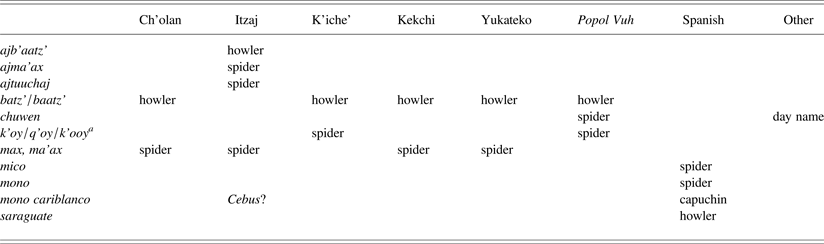
Several lexemes in highland and lowland Mayan languages today refer to howler and spider monkeys (Table 2), but it is not known if the pre-Columbian Mayas verbally discriminated the two howler species or if they distinguished capuchins.
Words for Monkeys in Various Languages and Contexts
Source: Baker Reference Baker1992:Table 1, Reference Baker2014:Table 1; Stross Reference Stross2008:Tables 1–4.
a Found in multiple highland Maya languages and Mixean; Stross Reference Stross2008:Table 4.
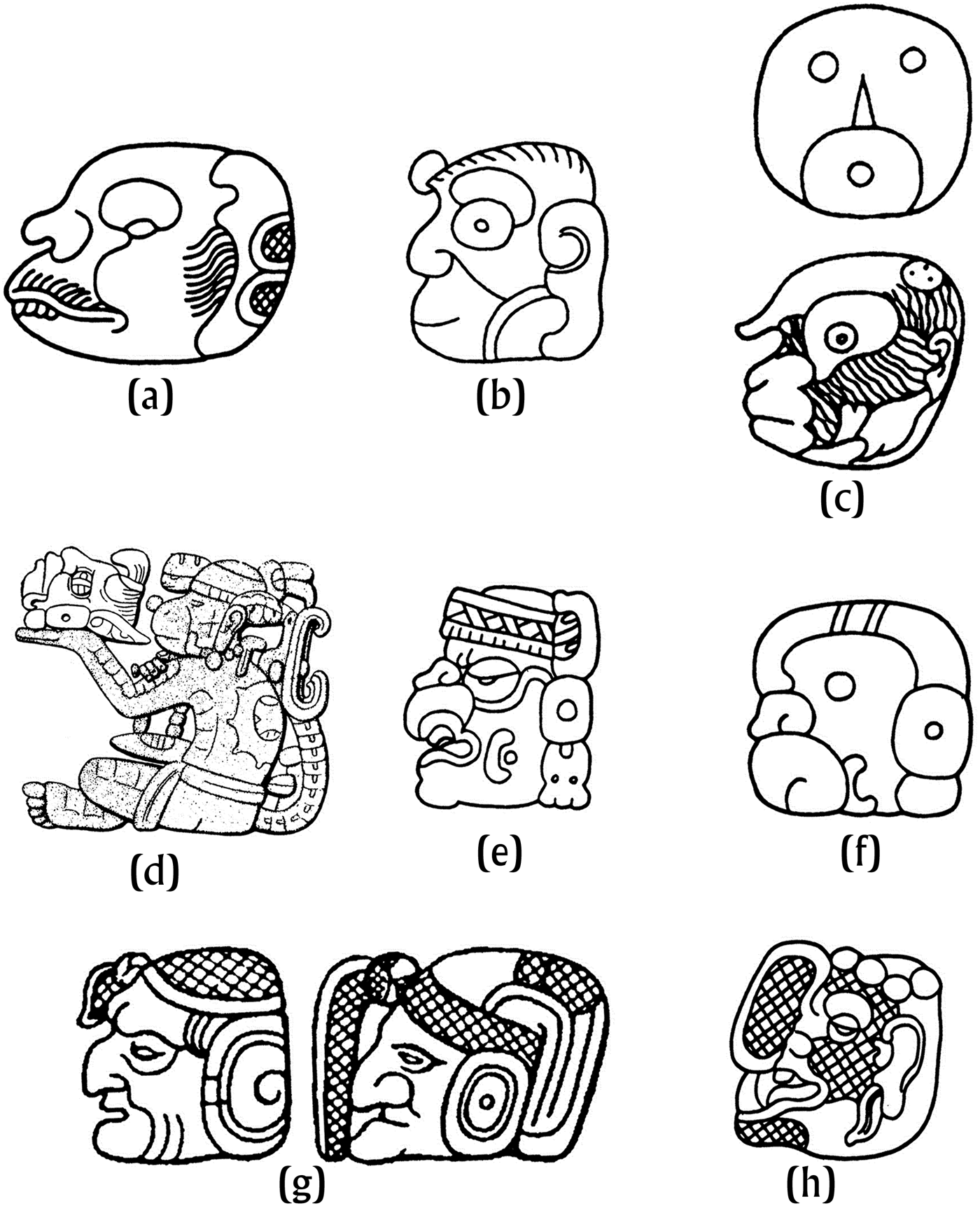
In the Yukatekan and Ch'olan lowland Maya languages, the howler monkey is b'aatz’ or b'atz’, respectively (Figure 3a), and in Spanish it is called mono aullador or saraguate. The spider monkey is ma'ax/max in Yukatekan and Ch'olan (Figure 3b); in Spanish the spider monkey may be referred to as mono or mico, the latter a diminutive.Footnote 1 In Itzaj Mayan, an endangered language spoken in the western basin of Lake Peten Itza, the spider monkey is known as both ajma'ax and ajtuuchaj. The latter is related to the term xtuch in Yucatan (Baker Reference Baker1992:Table 1, citing Luna Kan [Reference Luna Kan1945:261] and Solís Alcala [Reference Solís Alcala1949]). Among Itzaj speakers, a third kind of monkey is identified by a Spanish term, mono cariblanco, a common name for capuchins farther south in Central America. Yet another word, chuen (chuwen, chouen, choven), refers to a spider monkey in the Popol Vuh. Several Mayan languages, including Lacandon, include special ceremonial terms for various animals; in the case of monkeys, the Lacandon differentiate the howler and spider monkeys “on the basis of gender and on ceremonial versus everyday names” (Stross Reference Stross2008:14n5).
Representations of monkeys in Maya glyphs (Macri and Looper Reference Macri and Looper2003): (a), Chuwen (b'atz’) howler monkey day glyph (Macri and Looper Reference Macri and Looper2003:72); (b), ma'ax, màax, max, spider monkey (Macri and Looper Reference Macri and Looper2003:71); (c), Ajaw day glyph (Macri and Looper Reference Macri and Looper2003:29); (d), full-figure glyph for k'in, ‘sun, day’ (Thompson 1962:fig. 29-10); (e), glyph for itz'aat, scribe (also k'in) (Macri and Looper Reference Macri and Looper2003:72); (f), God C glyph; also k'uul/ch'uul (‘holy’)(Macri and Looper Reference Macri and Looper2003: 70); (g), netted or “spangled” headdress in the aged God N (Pawatun)(Macri and Looper Reference Macri and Looper2003:147); (h), pa clown glyph (Macri and Looper Reference Macri and Looper2003:179).
A few of these terms have homophones in various Mayan languages that reveal the indelible association of monkeys with artisans and artisanship and also with writing, music, and entertainment per the Popol Vuh. For example, in Colonial Yukateko chuwen meant “artisan” (Barrera Vásquez Reference Barrera Vásquez1991:110). K'oy means “incise or engrave” and also semen in Yukateko, and in Proto-Mixe-Zoquean it means “to paint” (Stross Reference Stross2008:Table 4). In Tojolabal Mayan (Chiapas) a homophone for batz’ is batz'a, meaning “paint, daub, smear, anoint” (of interest in light of capuchins fur-rubbing) and in K'iche’ batz’ means “thread, yarn, spin” (Stross Reference Stross2008:Table 1, 10).
Monkeys also played a role in Maya astronomy and calendrics in the Classic and Postclassic periods, associated with the sun, Venus as morning star, and Mars (Milbrath Reference Milbrath1999:92–94, 173, 219). Chuwen/B'atz’—a melding of both genera (that is, both monkey twins)—names the eleventh of 20 days in the 260 day divinatory almanac and its sign is a profiled monkey head (Figure 3a). Chuwen is one of eleven day names that “seem to have substantially the same meanings in all [Mesoamerican] calendars from Olmec times onward,” suggesting a very ancient development of this instrument (Edmonson Reference Edmonson1988:169; see Stuart Reference Stuart2011:141–142). It has been proposed that the Popol Vuh recapitulates the development of the two Maya calendars, the almanac of 260 days and the solar-year calendar of 365-days (Rice Reference Rice2007:67–74; [see also Tedlock Reference Tedlock1992:231]).
In Classic Maya hieroglyphic script, a frontally depicted monkey face is the sign for the day Ajaw (‘lord’; Figure 3c), the last of the 20 days, and a full-figure (howler) monkey glyph represents k'in ‘day/sun’ (Figure 3d). A profiled monkey head or “head variant” glyph forms the main sign of many words, including those for artist/scribe (Figure 3e) as well as for ma'ax/spider monkey and b'atz’/howler, and can substitute for the Ajaw glyph as both a day name and a term for a human lord or ruler (see Macri and Looper Reference Macri and Looper2003:70–72). The profiled monkey face glyph, with a curled nose and occasionally a beard, is also the sign for an entity initially identified as God C (Figure 3f; Milbrath Reference Milbrath1999:225–226). Further scholarship has revealed that God C is not a specific deity at all; rather it is an icon for the concepts of sacred/holy and deity in general, the glyph having the phonetic value k'u/ch'u (Miller and Taube Reference Miller and Taube1993:146; Ringle Reference Ringle1988; Stross Reference Stross2008; Taube Reference Taube1992:27–31). This meaning may reveal very early contacts between Mayan-speakers and speakers of Mixean in the Isthmian region, among whom a homophone for monkey (ma'ax) is maax, meaning “sacred, holy, divine, blessed” (Stross Reference Stross2008:4, 5).
The presence of brief hieroglyphic texts on painted or incised pottery vessels aids in the identification of the monkey genera depicted. For example, in the sample considered below three monkeys are identified as ma'ax and one is b'atz’; a Chochola carved vessel, not recorded here, identifies a monkey as chuwen. In addition, 17 vessels in our sample carry the text known as the Primary Standard Sequence (PSS) or Standard Dedicatory Formula (Boot Reference Boot2006). The PSS/SDF is a highly formulaic five-part announcement, usually in a band below the rim of a vessel, that “refers to the dedication of a vessel, its method of adornment, the shape class of vessel [bowl, etc.], its use and contents [for example, cacao drink], and sometimes the owner or artisan” (Grube Reference Grube and Kerr1990:320). The last or “closure” section sometimes includes a “hand-monkey” glyph—a profiled monkey head with a hand in front (left)—read kelem ‘youth’ (MacLeod and Reents-Budet Reference MacLeod, Reents-Budet and Reents-Budet1994:120, 161n19).
METHODS AND MATERIALS: ANALYSIS OF IMAGES ON POTS
Several studies have investigated images of primates in Maya art (Baker Reference Baker1992, Reference Baker2014; Braakhuis Reference Braakhuis1987; Bruner and Cucina Reference Bruner and Cucina2005; Coe Reference Coe and Hammond1977; South Reference South2005) and most call attention to the presence of spider monkeys. The features used to identify this species include “long legs and arms, small body (slim thorax, rounded abdomen), bipedal attitude, suspended and long tail, small head, muzzle reduction, [and] facial and periorbital mask” (Bruner and Cucina Reference Bruner and Cucina2005:113).
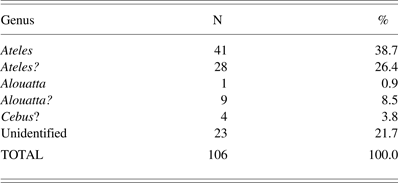
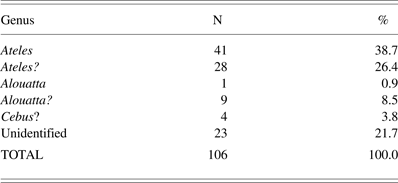
This study began with Katherine South's (Reference South2005; South and Ford Reference South and Ford2013) four-field anthropological approach to interpreting monkey imagery on Maya pottery. South analyzed 106 representations of monkeys on 67 Maya plates, bowls, and vases, primarily those in the on-line collection of rollout photographs by Justin Kerr (Kerr Reference Kerr2015b) on the website of the Foundation for the Advancement of Mesoamerican Studies, Inc. (FAMSI; www.famsi.org). The pottery bearing these images is largely unprovenienced but likely from tombs. The monkeys’ physical attributes as depicted in the painted (and also incised or modeled) representations—pelage markings, tail position and proportions, limb proportion relative to torso size, and positional behavior—were examined in an effort to identify their genus. Other traits, such as the monkeys’ accessories and settings, were also noted.
South's analysis resulted in confident (for example, Ateles) and tentative (for example, Ateles?) identifications of the genera of 83 (88 percent) of the monkey images (Table 3). In addition, it was found that behaviors associated with the primate images tended to fall into four categories: scribal activities, ritual activities associated with offerings, processions often incorporating dancing and musical instruments, and the handling of cacao pods. A chi square test (χ2) indicated that statistically significant associations exist between scribal activities and howler monkeys, and between spider monkeys and rituals, processions, and cacao handling (p = 0.0003) (South and Ford Reference South and Ford2013).
Initial Identification of 106 Monkey Images on 67 Maya Pots
Source: South Reference South2005:Appendix B.
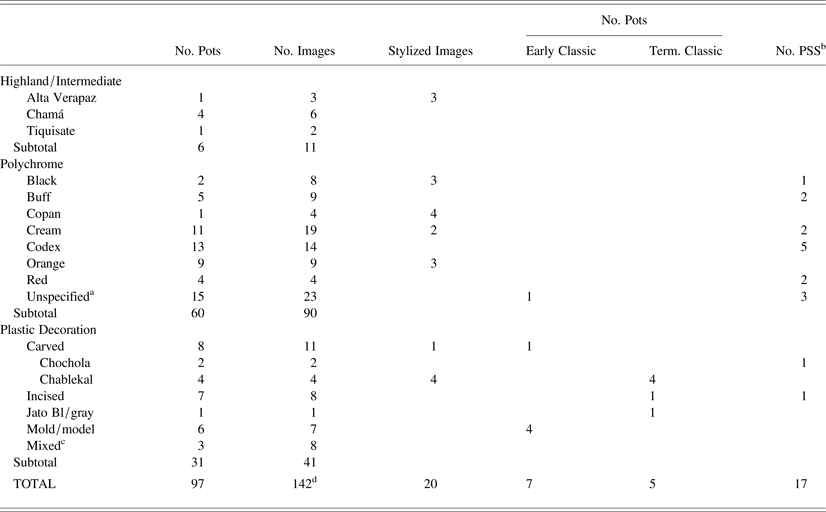
For the present study, South's original study was expanded to include more images, especially those from authorized excavations, bringing the total to 142 monkey representations on 97 vessels from minimally ten lowland sites. This was not a randomized sample of all Maya pots with monkey images, but rather a sample of convenience. We used only images depicting monkeys qua monkeys or the monkey scribes, and excluded images of the human Hero Twins. Additional variables were entered into an EXCEL spreadsheet, including more facial (n = 11) and appendage (n = 5) characteristics as well as adornments, other animal, human, or deity figures, and kind/location of the scene (n = 13 variables). Also, more information was added on the color, form (vase, plate, bowl), and type or style of the pottery on which the monkey images appeared (Table 4).
Types/Styles of Pottery Used in the Analyses (Late Classic Lowlands Except as Indicated)
a Illustrations in black-and-white.
b Presence of Primary Standard Sequence/Standard Dedication Formula text.
c Combinations of incising plus impressing and painting.
d On three vessels multiple monkeys were shown in a circumferential decorative band, and these were not tallied separately.
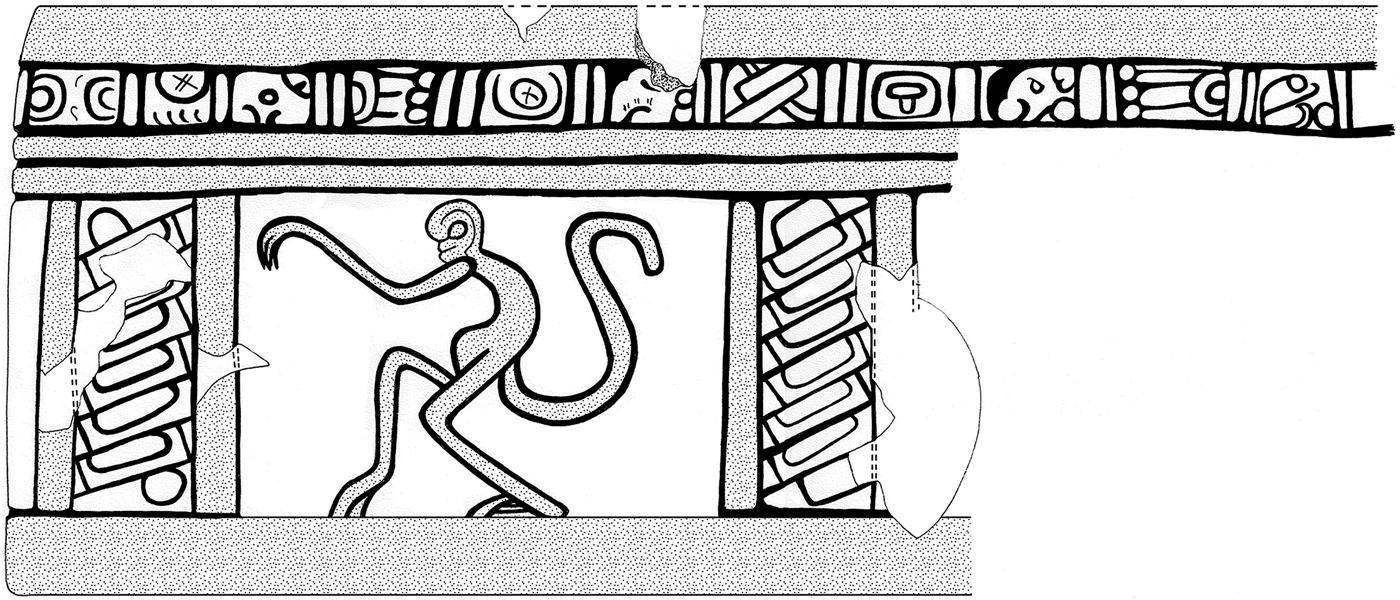
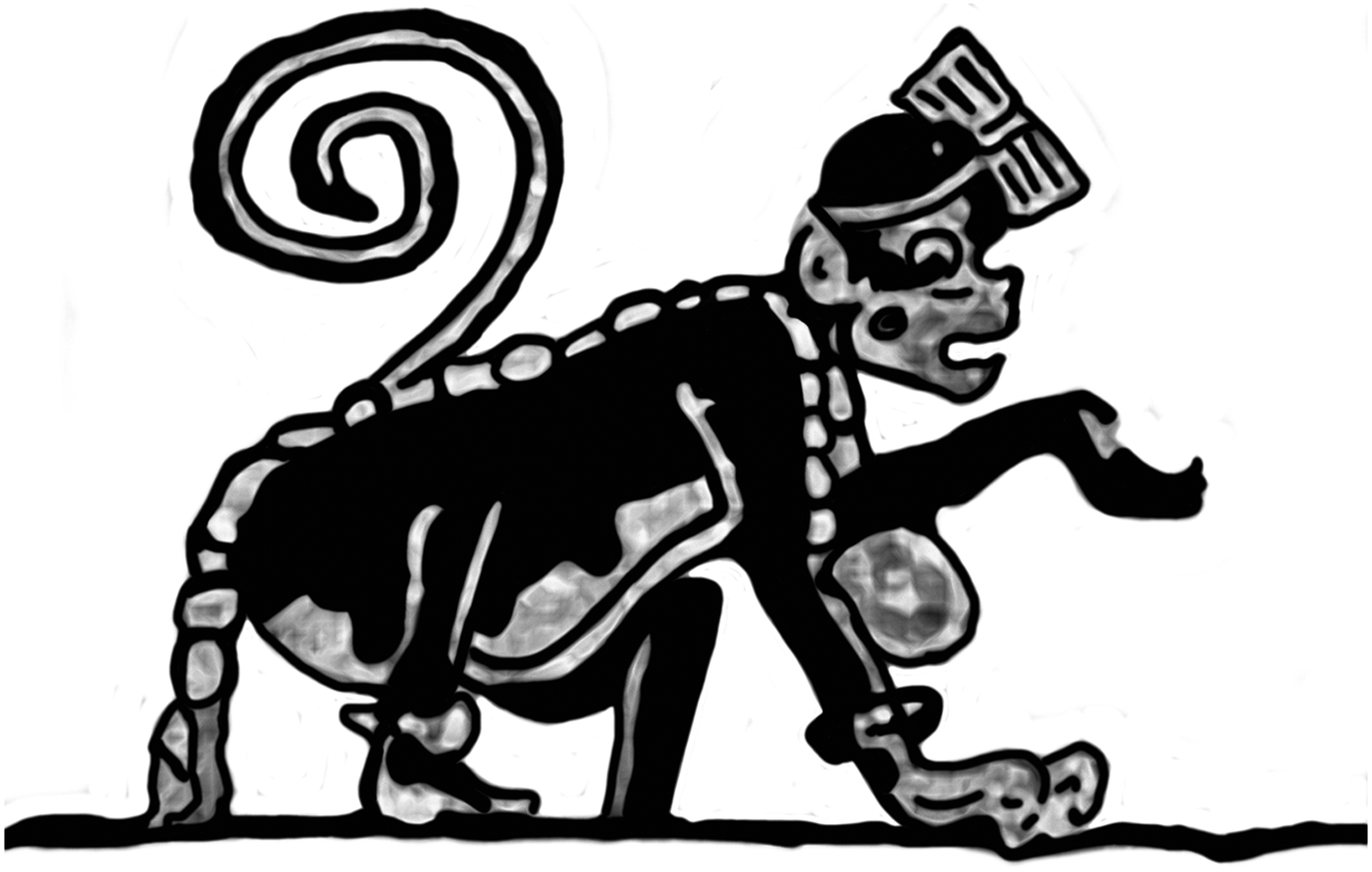
The 97 vessels analyzed vary in date from Early Classic (ca. a.d. 200–600) to Terminal Classic (ca. a.d. 800–950), and the images were created by painting, incising, carving, modeling, molding, or a combination of these techniques. Excluding 11 images (6 vessels) from the highlands or intermediate area (for example, Verapaz/Chama; see Danien Reference Danien1997, Reference Danien2005), of the remaining 131 images from the lowlands 90 (68.7 percent) were painted and 41 (31.3 percent) were incised, carved, modeled, or decorated with some combination of these and painting (usually black) (for example, Figure 4).
Terminal Classic Jato Black-on-gray (and incised) vase excavated at Tayasal, Petén, Guatemala, showing a dancing spider monkey; note hook hand and S-curve tail. Monkey, pseudo-glyph band, and mat panels painted black.
Genus and Species Identifications
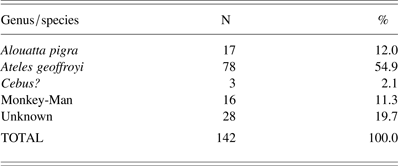
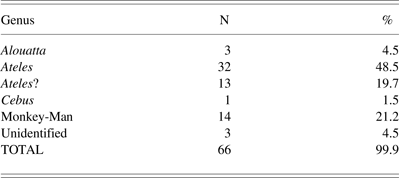
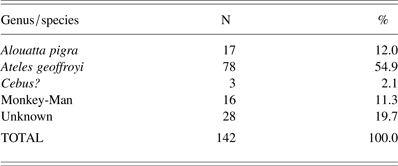
In our study of 142 images, the genus was tentatively identified for 97 (68.3 percent) monkey representations (Table 5) by inspection of the spreadsheet and supplemented, in five cases, by glyphic text. Slightly more than half of the portrayals were considered definitely or probably spider monkeys (Ateles). Distinguishing species among the howler monkey images, and identifying capuchins, was far more difficult. Mantled howlers might be identified by colored patches on the back or side of six images, but these are not separated here. Only three possible capuchins were noted. Sixteen images were “Monkey-men,” typically resembling Alouatta in physical characteristics and discussed further below. As noted in Table 4, 20 images were stylized, but only seven were so stylized as to preclude identification; the others were seven Alouatta and six Ateles.
Visual Identifications of 142 Monkey Images on 97 Pots
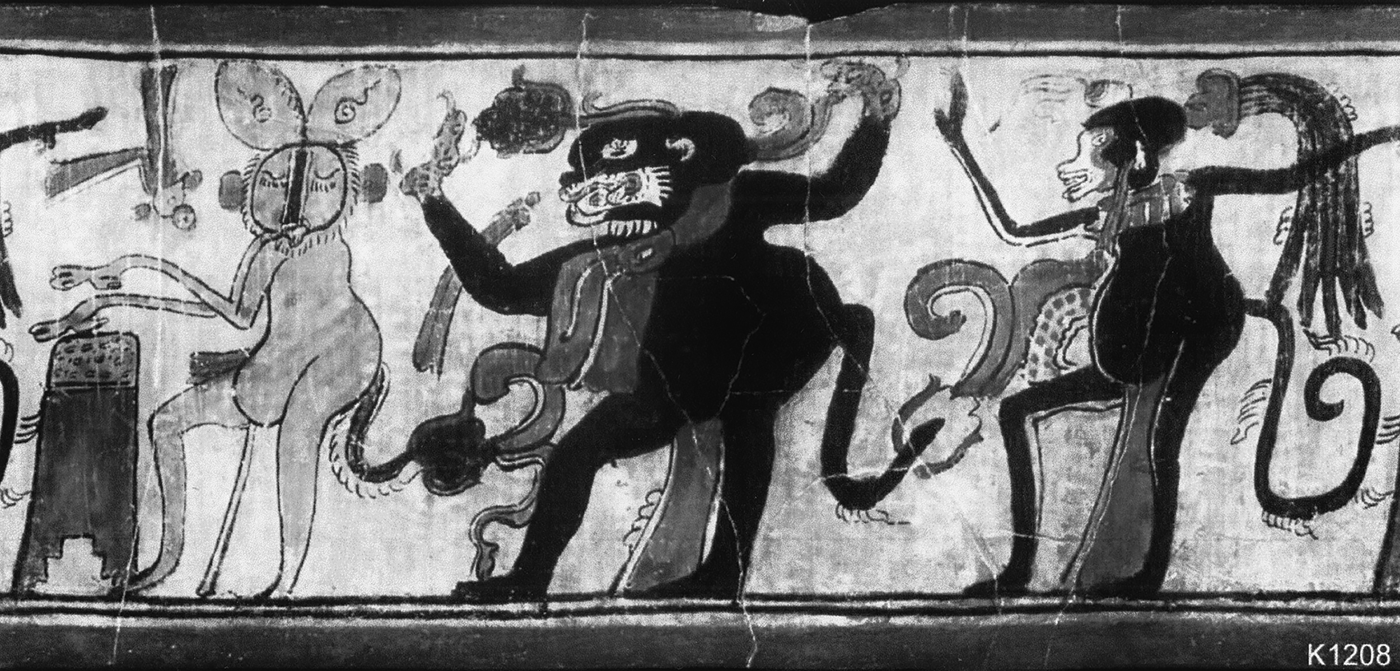
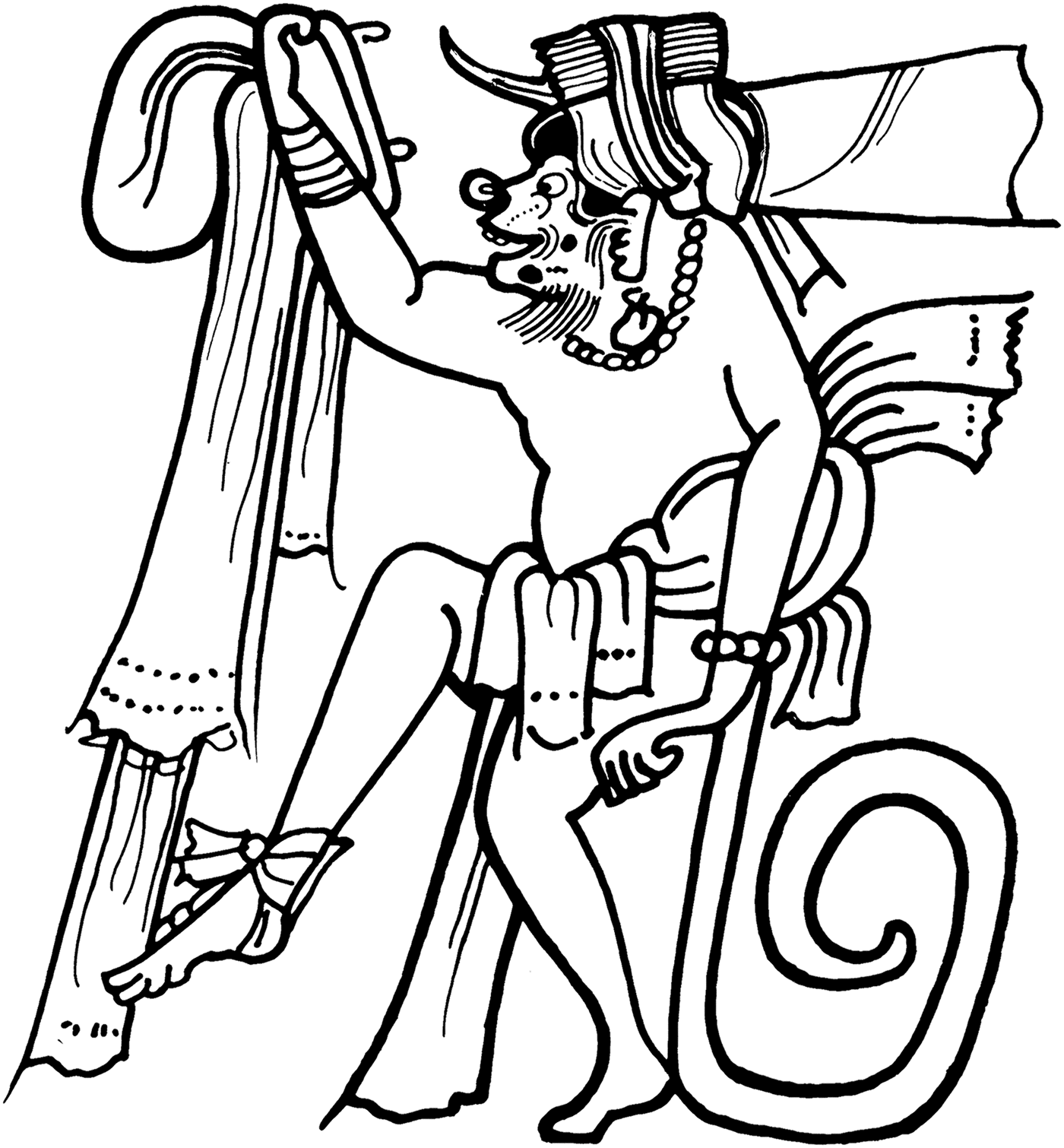
Many vessels depicted pairs of monkeys, which is unsurprising given the emphasis on monkey and artisan twins in Maya mythology and a general emphasis on complementary dualities in Mesoamerican cosmovision. We suggest that two vessels (Kerr Maya Vase Database designations: K1208, K1491; see Figure 5) depict a spider and a howler together. Where three or more monkeys are shown on a single pot, they are often stylized, appearing in a circumferential band.
A buff-polychrome vase (K1208) showing two dancing monkeys and a rabbit playing a drum. The left monkey appears to be a howler; note beard, red scarf, proportional limbs, short hook tail, and jaguar mittens. On the right is a spider monkey; note white face, long thin limbs, protruding belly, cloth ear ornament, collar (red), and furry spiral-3 tail.
Characteristics of the Monkeys
Seen through a cultural lens, an animal representation is a bundle of attributes and meanings that is defined by, and exclusive to, a particular cultural group (Saunders Reference Saunders1994:103–105, Reference Saunders1998:20). What are the attributes and meanings particular to the Classic lowland Maya?
Positional Behavior
For primatologists, positional behavior is an important characteristic of different species. Study of the postures of the monkey images (Table 6) revealed six positions: sit, stand, crouch, walk, dance, and “other” (for example, swinging, crawling, supine/prone, carried). The displays of bipedalism—standing, walking, dancing—in 42 images (29.6 percent) are of interest because the four primate species rarely exhibit bipedal locomotion on the ground. Dancing was indicated, as it is among Maya human figural representations, by an upraised foot or heel and bent knee (see Figures 4, 5). Several scenes show processions, and the “walking” designation for these might equally be classed as dancing. According to one study, only spider monkeys are shown dancing (Braakhuis Reference Braakhuis1987:47n16), although the howler monkey on the left in Figure 5 is likely dancing to the rhythm of a drum.
“Hands”
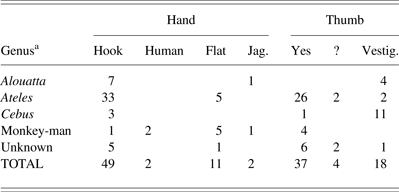
One key anatomical feature of these simians, highlighting their human-like qualities, is their dexterous forepaws or hands. Each genus differs in the opposability of the thumb to the fingers: howlers have the thumb and forefinger opposed to the other three digits, spider monkeys have only a vestigial thumb, and capuchins have semi-opposable thumbs (see Figure 2d). In our sample (Table 7), 49 images had the forepaw depicted as a claw- or hook-like curve (for example, Figure 4); 59 images had some sort of thumb-like digit (for example, Figure 5, right). Two characters wore jaguar mittens (for example, Figure 5, left).
Tails
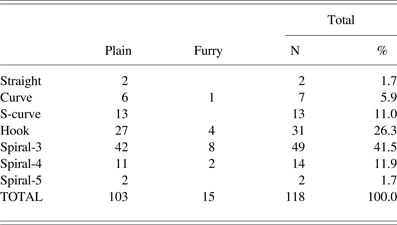
Monkeys use their long tails in varied activities, and different species use and carry their tails in different ways. Spider and howler monkeys’ tails lack fur on the underside; spiders’ tails are fully prehensile and howlers use their tails primarily for support during suspension. Capuchins’ tails are thickly furred and only partially prehensile, curved over their bodies and used primarily for balance. A total of 118 tails in the monkey images were coded into five categories (Table 8). These were subdivided in several ways: spiral tails, for example, representing slightly more than half the sample, were coded as coiling three, four, or five times. It was also noted if the tails were depicted as “furry.”
Tail Characteristics of 118 Monkey Imagesa
a Total images exclude those 11 in which the lower part of the animal is not shown or the tail is absent or indistinguishable (13).
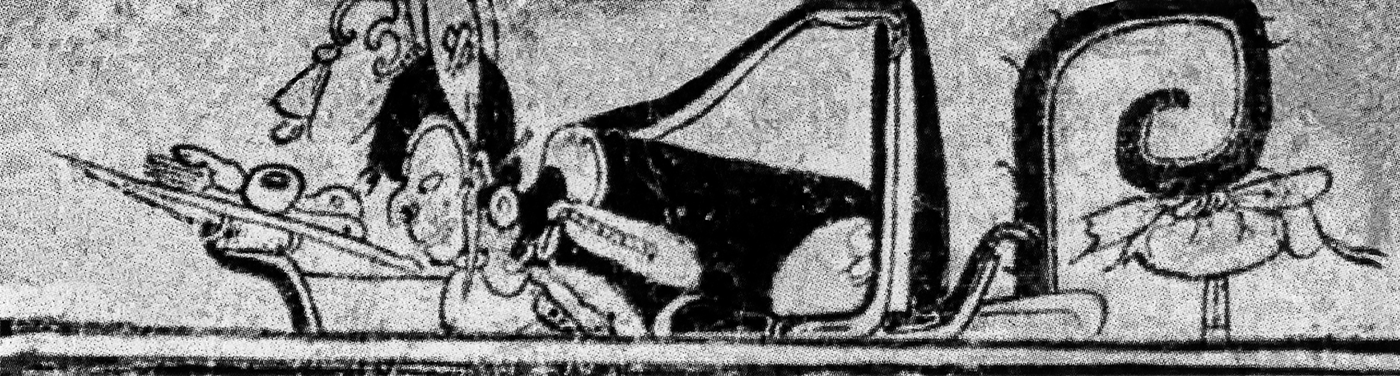
With respect to the identified genera, two of the three possible capuchins had Spiral-3 tails, and the third (K0626; Figure 6) was Spiral-4 over the back, in a typical position for Cebus. Spider monkeys were most often depicted with tails coiled in a spiral: Spiral-3 (n = 34; for example, Figure 5, right), Spiral-4 (11), and Spiral-5 (2). Other positions included Hook (15) and S-curve (7; for example, Figure 4). Only four howler monkey tails exhibited a spiral (Spiral-3), the others primarily having hooks (7; Figure 5, left) and curves or S-curves (4). Of the 16 Monkey-men images, half (8) had no tail and the others had a Hook (2), S-curve (2), Spiral-3 (3), Spiral-4 (1).
A probable Cebus capucinus on a buff polychrome vase featuring a mythical scene following the resurrection of the Maize god (redrawn by Don Rice from K0626). The capuchin wears the aj k'uhun headdress of a bundle of quills and a long pendant necklace. Note proportional limbs, wristlet and anklet, and Spiral-4 tail curled over the back.
Head and Facial Characteristics
The heads and faces of the monkey images exhibit varied traits that, on the basis of simple visual examination of the spreadsheet, did not reliably indicate species despite obvious facial distinctions among living creatures (compare faces on Figure 2 with those on vessel illustrations). Identification is even more difficult because, except for the in-the-round modeled monkey heads, the heads and faces are shown in profile. Eighty-nine heads exhibited varying degrees of prognathism, 33 of them having pronounced snouts. Teeth were depicted in 45 of these images. Snouts and teeth were particularly common on Monkey-men (for example, Figure 7).
A singing and dancing “Monkey-Man” with mirror, from a red polychrome vase (redrawn by Don Rice from K0505). Note scribal quill-bundle on top of large paper(?) headdress, spots on face, beard, necklace, and ear and wrist ornaments. The character has a Spiral-3 tail, proportional limbs, a knotted loincloth, and a tied anklet or sandal on the raised right foot.
Male howler monkeys have a shaggy beard, and we noted some kind of whiskers or beard on 18 monkeys in our sample. Four of these were on identified Alouatta (for example, Figure 5, left), two Ateles, and five Monkey-men images. On at least ten of the polychrome images, the monkeys’ lips were painted red; these included one Cebus and two Monkey-men, the remainder being Ateles.
Monkeys, along with several other Maya characters such as supernaturals and the God C glyph (Figure 3f), often have black spots on the lower face (n = 31) or elsewhere on the body. Sometimes three spots are arranged in an inverted triangle, which has varying interpretations. One interpretation is that they are “death spots” relating to One Hunahpu, whose severed head was put in a calabash tree in the Underworld, or to that of Seven Hunahpu, who the Hero Twins tried to bring back to life. Another relates the spots to patches of jaguar skin on Xbalanque's face and body (Tedlock Reference Tedlock1996:77, 127). Still another is that the triangles are “god markings” identifying the creatures as supernaturals (Coe Reference Coe and Hammond1977:337) or as “holy” individuals after the God C glyph (Kerr Reference Kerr2015a). This latter may be supported by the resemblance of these three dots to the eye-and-mouth circles of the frontal-faced ajaw glyph (Figure 3c).
Accessories and Accompaniments
The monkey images on these pottery vessels were adorned with various kinds of accessories. For example, 30 wore wristlets or bracelets of some sort, and 11 wore anklets (for example, Figures 6, 7). A neck accessory or jewelry was evident on 52 images: 6 wore a pendant (Figure 6) and 6 wore beads; 17 had a collar (for example, Figure 5, right) on three monkeys on two pots the collar had “death eyes”); 9 wore a scarf, sometimes called a sacrificial scarf (Reents-Budet Reference Reents-Budet and Reents-Budet1994:242); and 6 images had a shawl over the shoulders. Eleven of the neck accessories were red.
Ear ornaments were also worn by 31 of these simians. Most (n = 17) appeared to be cloth or ribbons (Figures 5, right, 8) or a feather through a pierced earlobe. Eight ear ornaments were round, two were “dangles,” and one was a rod.
Headdresses were, among the Mayas and commonly throughout the world, key diagnostics for identity expression. A total of 45 monkey images wore some kind of headdress of which two are most distinctive: elaborately folded paper or cloth (n = 9) and netted or “spangled” (Figure 3g), that is, covered with small ornaments (n = 5). Both kinds are also worn by other characters. These and other headdresses worn by the monkeys in our pottery sample were often elaborated with elements indicating their scribal affiliations (see below)—deer ears (n = 27, Figure 8; one had a deer hoof) and pens or quills (n = 6; Figures 6, 7)—as well as feathers (n = 3) and deer antlers (Figure 8; n = 7). Netted or spangled headdresses are particularly associated with scribes and other officials (itz'aat , learned person, sage) in the Maya court, and pens and quills are particular tools of scribes, as are ink pots or paint pots formed of a halved conch shell (see Coe and Kerr Reference Coe and Kerr1997; Kerr Reference Kerr1994).
The och maax monkey way or nagual on a Codex style bowl (redrawn by Don Rice from K1203). Note the long, thin limbs and long, furry Spiral-3 tail of the spider monkey. Typical accessories of this way character include a deer ear with crossed bands, deer antlers in the headdress, a bundle on the tail, and a plate carrying a human hand and other body parts. Note the knotted scarf and cloth ear ornament. This bowl bore a band under the rim with the formulaic PSS/SDF text, not shown.
CLUSTER ANALYSIS
Of 46 polychrome images originally analyzed by South (Reference South2005) and in a later largely duplicative study by Baker (Reference Baker2014:Table V), the two authors agreed on only 23 (50 percent) genus identifications. Most of the agreement was on identifying spider monkeys; both authors agreed on only one image (K0505) as a probable howler and one (K0626) likely a capuchin (Figure 6). In an effort to improve our interpretation of genus/species as well as clarify the simians’ roles, the final step of our investigation was an analysis of primate data by the statistical grouping algorithms (procedures) known as cluster analysis (CLUSTAN; Wishart Reference Wishart2004).
For this phase, we restricted our study to Late Classic and Terminal Classic lowland polychrome-painted vessels. These painted vessels exhibit complex variations in colors and shading that distinguish different parts of the body and accessories, which we hoped would contribute to better biological and cultural interpretations. Images on the incised, carved, and modeled vessels generally provided far less detail than those that were painted, and so were omitted. In addition, on numerous pots, particularly those dating to the Late–Terminal Classic transition, the monkeys were highly stylized and/or crudely depicted, sometimes incised (for example, Chablekal Gray) or painted as repetitive images on bands, rather than being portrayed with realistic details. Thus these stylized icons, along with highland and Early Classic images, were eliminated as well, for a total of 76 images (53.5 percent) omitted.
Characteristics of faces and heads, including headdresses, are among the most important for revealing identities of both humans and animals. Maya artists devoted considerable effort to detailing these traits on their painted vessels, although most of the monkey heads are presented in profile. Accordingly, characteristics of the face, head, and headdresses were recorded in our database. For example, living howler monkeys have black faces; spider monkeys have pale skin around the eyes; capuchins have “white” faces. Upper and lower face coloration was recorded, along with observations on teeth, eyes, hair, and neck and ear ornaments, among other traits.
One problem that dogged us throughout our analysis, but most acutely in this step, is that of missing data. Part of this problem arose from the Maya artisans’ choices of how to portray the monkeys. If they were depicted in a seated position, for example, we were unable to code attributes of their legs and feet (although even when feet where shown, they generally were not given careful attention). Another part of the problem was erosion of the vessel surfaces from the burial environment, frequently obliterating details of small body parts such as eyes and hands. A third difficulty stems from the use of online images and photographic reproductions (many black-and-white), which are obviously poor substitutes for evaluating the vessels in person.
In the end, we coded 19 variables (17 of physical characteristics and 2 pertaining to garb) on 66 images (63 polychrome, two incised, and one carved), representing 43 vessels, for clustering (Table 9). Two clustering solutions were reached, both based on average linkage clustering, and we identify them here for discussion purposes as A and B. Solution A clustered 55 images into three large clusters, A1, A2, and A3, with A2 and A3 having two subdivisions. The remaining 11 images were “outliers,” dissimilar to the others. Solution B formed three large (six small) clusters, with 16 images in three outlier groups.
Visual Identifications of 66 Monkey Images Used in Cluster Analysis
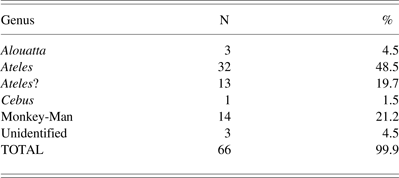
The clustering solutions were disappointing in terms of clarifying distinctions among species and roles. The only such differentiation came in terms of limbs: inspection of the image spreadsheet revealed that the monkeys in clusters A1 and A2 were characterized by what we assessed as “proportional” limbs (that is, limbs roughly proportional to body size), whereas the limbs in cluster A3 were decidedly long and thin. This distinction was replicated to a certain extent in clusters B1 and B2–1 versus the other B clusters. Unsurprisingly, the proportional-limbed images—especially those in B1—were those we believed to be either Alouatta or Monkey-men, and those with long, thin limbs were those we identified as spider monkeys. More specifically, nine of the images in clusters B1, B2–1, and B2–2a were identified as Ateles? and six were those to which we gave a tentative secondary identification as Alouatta palliata.
There were few other consistent clusterings on the basis of position, physical features, or accessories. Facial features were unreliable, particularly in terms of appropriate clustering with limbs. Cluster B3 and some outliers of B2 tended to have scarves or shawls, particularly red; “deer ears” were conspicuously absent among the 12 images in cluster A3–2 and A3o (outliers). In addition, inspection of the spreadsheet revealed no consistent associations of clusters with vessel form or type/style (for example, Codex-style). The reasons for this overall unsatisfactory (or non-explanatory) clustering might be methodological (poor choice of methods, abundant missing data) or the high degree of idiosyncratic variability and anthropomorphization among the images in terms of their physical characteristics and accessories, especially relative to the overall sample size used for clustering.
Of 17 vessels bearing multiple monkey images, two or more images were placed in the same clusters in A and B solutions on 10 vessels. That is, each clustering solution judged the two images on a vessel to be the same species. On the remaining seven vessels, the images were grouped into different clusters, in some cases (as in K1208; Figure 5) supporting our identification of depictions of two species on a single vessel or our questions about the identity of one or more images (for example, K3413, K4992, K8575).
TEXTS AND IMAGES: INTERPRETING THE MONKEYS
Monkeys in Maya culture are typically discussed in terms of the roles of scribe and entertainer or trickster but, as discussed below, they had other, broader associations. In interpreting their images on pottery, it is important to mention that although polychrome painted pottery is recovered from Classic households of virtually all ranks, the subclass of figural polychromes—those showing humans and animals, as opposed to geometric or stylized decoration—tend to be more restricted to elite contexts, often mortuary. These vessels depict, with exquisite detail, mythological, palace, and warrior scenes, especially on cylindrical vases used for drinking chocolate or other beverages. Figural scenes with simians are primarily mythological, but monkeys also appear in more stylized form on more simply decorated polychrome vessels.
Monkeys and Scribes
In light of the Popol Vuh creation myth, it is unsurprising that monkeys played significant symbolic and cosmological roles throughout the Maya area. The identities of many of the monkey and human representations on Classic Maya pots have been interpreted in the context of this myth and its key characters. In particular, Hun Hunahpu, the monkey twins One Monkey and One Artisan, and especially the Hero Twins Hunahpu and Xbalanque, are depicted.
For example, monkeys—especially howlers—are often depicted as scribes, their scribal identities revealed by various accessories typically found in the headdress. One is a writing implement or “pen”—typically a brush or feather quill—which may be held in the hand on worn in the headdress. Small bundles of quills also may appear tucked behind the ear or in the headdress of what is called an ajk'uhuun (priestly scribe? see Jackson Reference Jackson2013:13; also Coe and Kerr Reference Coe and Kerr1997:148). Another typical accessory is an elongated adornment on the head or headdress referred to as an “extra ear” or stylized “deer's ear” (Coe Reference Coe and Hammond1977:336–337; Kerr Reference Kerr1994). Scribes sometimes hold a sabak kuch, a container for ink or paints made from half of a longitudinally cut conch shell (Strombus), which also may be shown in a headdress (see Kerr Reference Kerr1994; Coe and Kerr Reference Coe and Kerr1997:145–152).
“Monkey-men” (Figure 7) are scribal gods with simian heads and facial features but typically lacking tails (see Coe Reference Coe and Hammond1977:337; Coe and Kerr Reference Coe and Kerr1997:106). They represent One Monkey and One Artisan, the evil older brothers of the Hero Twins. They often wear a “fierce” expression, with prominent snouts, open mouths exposing large teeth, beards, and spots on the cheek. In addition to the presence of pens or quills and a conch inkpot, Monkey-men typically wear the spangled turban headdress of an itz'aat with a “deer's ear” that may have an infixed question mark-like “god-marker” element (Coe Reference Coe and Hammond1977:336; Kerr Reference Kerr1994). They may also wear a bulky cloth wrapped around their hips and are usually, but not invariably, seated in pairs, sometimes with a folded codex between them. On three vessels, the two Monkey-men are differentiated by color: one darker red-brown or black, and the other lighter red-brown or tan.
Rather surprisingly, only five of the 97 pots examined here depicted codices: three with Monkey-men, one with Ateles, and one with Cebus?. In the Postclassic period, Monkey-man scribes continue to be depicted, either painted on screenfold books (codices) or modeled and painted as a figure on an effigy incense burner (Milbrath and Peraza Lope Reference Milbrath and Lope2003). They have similar snouty, toothy faces and the “Number Tree,” a scrolling element resembling a computer printout that unfurls from the armpit of human scribes in Classic art (Coe and Kerr Reference Coe and Kerr1997:105).
Coe (Reference Coe and Hammond1977:341, 346) identifies the Monkey-man as One Monkey or Hun Batz’, that is, a howler monkey, specifically the mantled howler Alouatta palliata. In our sample, of the 16 images representing Monkey-men, five had the beards associated with male howlers, and eight had tails (for example, Figure 7). Facial hair (beards or whiskers) was noted on a total of 18 images, including some thought to portray spider monkeys. The monkeys with cheek whiskers on two vessels (K4947, K9240) may represent Xbalanque in his jaguar (b'alam) manifestation, in which he may also sport jaguar skin patches and mittens.
Monkeys as Entertainers/Tricksters
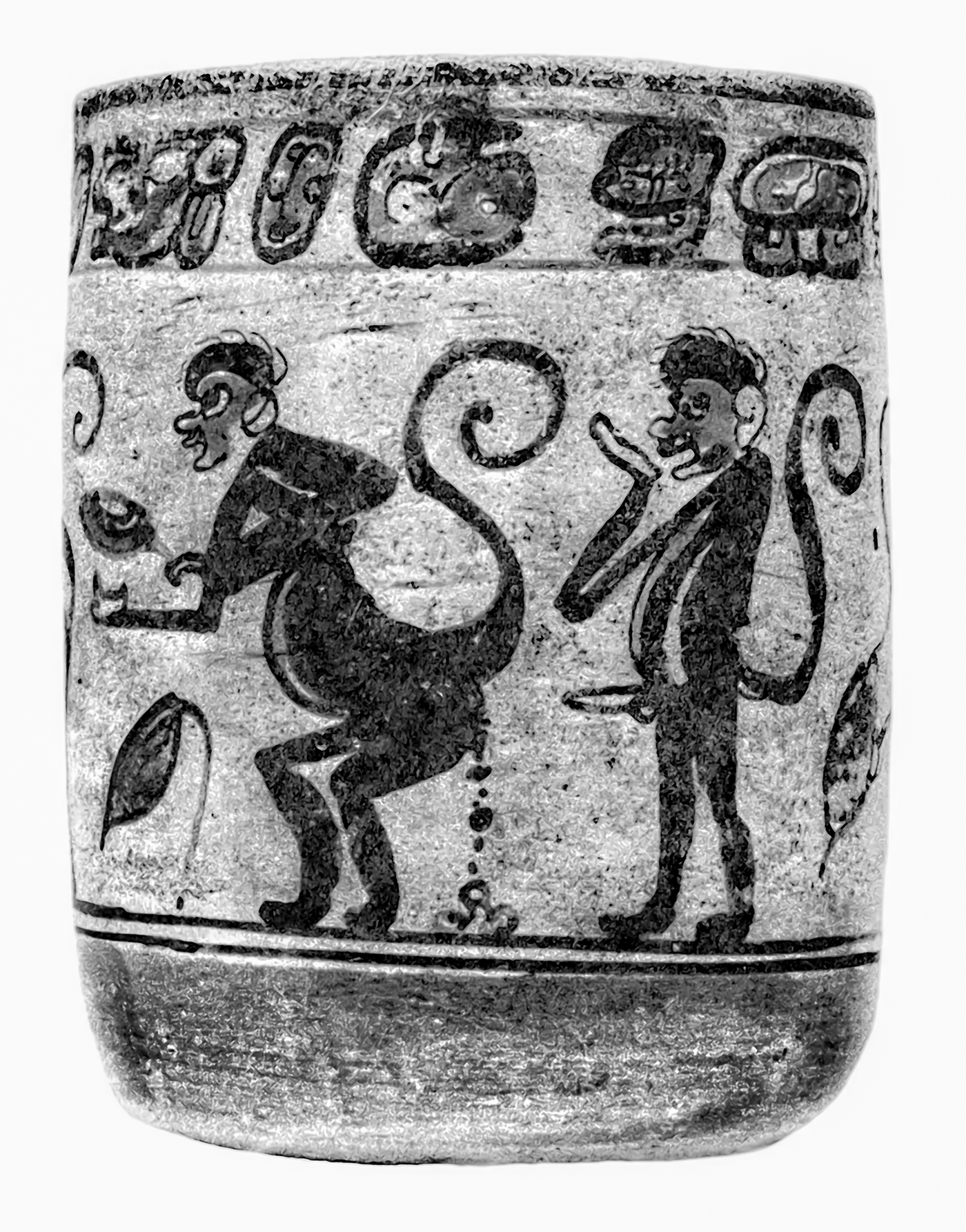
The monkey twins and the Hero Twins are portrayed as quintessential entertainers: they sing, they dance, and they perform miracles. But monkeys are also viewed negatively as tricksters (Mock Reference Mock, Brown and Stanton2003:251), doubtless due to their playful child-like behavior and underscored by their magical stratagems to elude the traps set for them in Xib'alb'a. Monkeys are also associated with drunkenness, licentiousness, violation of mores, and ritual humor in mocking political positions and office-holders (Taube Reference Taube, Hanks and Rice1989). In the decorative band on a plate from Uaxactun, a monkey gropes a woman's breast (Smith Reference Smith1955:Figure 2f); on another vessel a squatting monkey is defecating (Figure 9). Similarly at Chich'en Itza, the “Gallery of the Monkeys” (Structure 5C6) shows standing monkeys that drop something from their backsides (Schmidt Reference Schmidt, Kowalski and Kristan-Graham2010:147, Figure 36).
Two spider monkeys on a polychrome vase (after Hellmuth Reference Hellmuth1978:183). Left monkey holds a clyster (enema) device and is defecating. Right monkey has a flat hand to the face (perhaps laughing or reacting to the odor), and groin area may show the left flat hand or an erect penis. Note furry crown of head, long skinny arms, white hands and black feet, and Spiral-3 tails. Pod-like details may represent cacao.
In the Classic period, a similar simian character is a “personified glyph” for pa (T1023; Figure 3h): a monkey head, typically with crosshatching over the head and face except for the eye area and mouth (Taube Reference Taube, Hanks and Rice1989:360–363). The Maya pa character is “not simply a monkey, but a ceremonial buffoon” (Taube Reference Taube, Hanks and Rice1989:360), one of several clown-like figures in Maya ritual and contemporary festivals. Similar cross-hatching also appears in the spangled or “net” headdress (pa) worn by scribes.
Monkey characters play salient cultural roles in modern festivals throughout the Maya region (for example, Bricker Reference Bricker1981; Mock Reference Mock, Brown and Stanton2003:248). Disguised by masks and other costumes, and “through inversion and antisocial behavior, these characters sharply define what is correct and what is not” (Taube Reference Taube, Hanks and Rice1989:377). Phrased differently, “They are allowed to do what humans cannot do” (Bruner and Cucina Reference Bruner and Cucina2005:114). In addition, the late Chilam Balam of Chumayel uses the term max/maax, spider monkey, to refer to peasants and to periods of illegitimate or non-noble rulership: “He of the two-day mat, He of the two-day throne, The monkey lordship, The monkey katun” (Edmonson Reference Edmonson1986:78, 180, 298). Some of these pejorative connotations might have been added or emphasized in early Christian teaching (see Aguilar Moreno Reference Aguilar-Moreno and McNeil2006:279–280; Carter and Carter Reference Carter, Carter, Dolhinow and Fuentes1999:271).
The entertainment value of spider monkeys and capuchins has led to the suggestion that these animals might have been kept as pets in both royal courts and rural commoner households. The former might be indicated by the recovery of the possible capuchin mandible in a palace at the Buenavista site. The many vessels, however, in the Kerr database categorized as “in-palace” scenes of royal courts, naturalistic monkeys are rare, although other animals—including birds, dogs, deer (usually with women; possibly pets), possibly a kinkajou (K4096; see note 1), and rodents—are represented.
Monkeys and Astronomy
Monkeys have long-standing associations with astronomy and time-keeping (Figure 3a,c,d) in Maya cosmology and myth. Aside from the day name Chuwen (see above), monkeys may be associated with the moon (Bruce Reference Bruce1979:141), the planets Mars, Jupiter, and Venus (Milbrath Reference Milbrath1999:37, 223–227; Tedlock Reference Tedlock1996:351), and the sun. With respect to the sun, Coe (Reference Coe and Hammond1977:341) links monkeys and especially Monkey-men with the sun god, particularly the “full-figure” glyph for k'in ‘day, sun’ (see also Laughlin Reference Laughlin1977:253; Milbrath Reference Milbrath1999:92; Pruess Reference Preuss1988:13–14).
Associations with the planet Venus as morning star are widespread, particularly for howler monkeys and perhaps in the dry season (Coe Reference Coe and Hammond1977:342–345; Milbrath Reference Milbrath1999:10, 94, 295). Howler monkeys are especially vocal at sunrise, heralding—as does Venus as morning star, the “sun carrier”—the emergence of the sun (or sun god) from its nightly journey through the Underworld (Tedlock Reference Tedlock1996:295). Monkeys—and particularly spider monkeys—may also be associated with the setting sun, its entry into the Underworld followed by the appearance of Venus as evening star (according to a Mopan Maya account), and a count of the passage of days beginning at dusk (see Laughlin Reference Laughlin1977:253; Milbrath Reference Milbrath1999:92, 223, 226).
Monkeys as Companion Spirits
Glyphs also appear on some vessels depicting monkeys and other creatures in non-naturalistic representations that combine anthropomorphic and zoomorphic features and postures. Such a creature is known as a way (plural, wayob’): the animal companion spirit or nagual of a human, often a ritual specialist such as a shaman or sorcerer (Grube and Nahm Reference Grube, Nahm and Kerr1994). The accompanying brief texts may identify the human, often a lord or ajaw of a place identified by an Emblem Glyph, with which the way is identified. Wayob’ are frequently shown in processions where they may be dancing (see Grube Reference Grube1992:214–215). Dancing among the Mayas was not simply an enjoyable secular pastime; rather, for kings and members of the royal court it was a transformative, often shamanic, ritual performance.
One monkey way is yuch’ maax ‘head louse spider monkey’ (maax), shown scratching his head (on vessel K1211); another is k'in…b'atz’, or howler monkey (K5070). A third monkey way is och maax, identified by deer (Odocoileus virginianus) antlers in a headdress, crossed bands in the deer ears, a bundle hanging from the tail, and holding a plate that contains a hand and other body parts (Figure 8; Grube and Nahm Reference Grube, Nahm and Kerr1994:695–696). This way is a conflation of the spider monkey twin One Artisan with the Hero Twin Xbalanque, supporting the identification of ”-que” with kej ‘deer.’ Unfortunately, the toponyms associated with these wayob’ were unidentifiable. Seven images in our analyzed sample have deer antler headdresses, two of which have the bands in the ears and tail bundles.
The monkeys on these pots were often depicted with deities, particularly Itzamna (God D), but also Gods A, A’, K, N, the Maize God, the Rain God, and on one vessel (K9064) a God L impersonator. Some of these supernaturals are particularly associated with scribal arts as patrons (Coe and Kerr Reference Coe and Kerr1997:101–107): Itzamna was considered the inventor of writing and “first scribe”; God N wears the netted scribal headdress (Figure 3g). The Young Maize God is One Hunahpu, father of the Hero Twins.
Monkeys and Cacao
A further association of interest in these polychrome images is the representation of monkeys with the pods of cacao trees: Theobroma cacao, the fruit of the tree from which chocolate is made (see Young Reference Young2007; [for the Maya lowlands see McAnany Reference McAnany, Feinman and Nicholas2004]). Growing best in warm, moist areas under taller leguminous shade trees (“madre de cacao”), the cacao tree sprouts elongated fruit pods along its trunk and branches. These pods, which do not fall from the tree after ripening, encase a thick, white, edible pulp and almond-sized bitter seeds that, after roasting, grinding, and other processes, make chocolate. Both howler and spider monkeys live in modern cacao plantations.
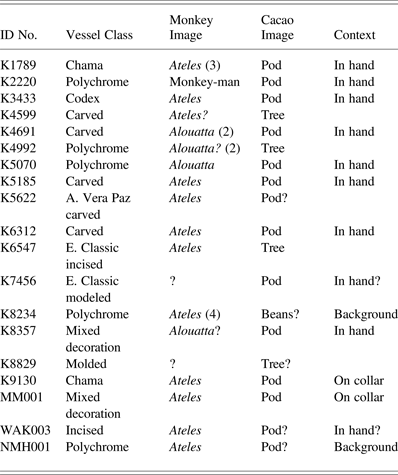
Monkeys appear with cacao pods on pottery and other media throughout pre-Columbian Mesoamerica, with the creatures holding a pod in a forepaw or with the pods adorning their bodies (Ogata et al. Reference Ogata, Gómez-Pompa, Taube and McNeil2006:87). On Flores Island, construction fill yielded a mold for a figurine depicting a monkey with cacao pods. In our pottery sample, cacao imagery—pods, possible beans, and trees—appeared on 19 pots. On most of these vessels the images were depicted by carving, incising, or modeling; only eight pots were polychrome-painted (Table 10).
Associations of Monkey and Cacao Imagery
These images may have several meanings with respect to the association of monkeys and cacao. One is seen in the PSS texts, which, as noted, may include reference to the contents of the vessel: that content is frequently a cacao beverage (MacLeod and Reents-Budet Reference MacLeod, Reents-Budet and Reents-Budet1994:115–119, 127–128), particularly associated with cylindrical vases assumed to be drinking vessels. Another relates to the depiction of monkeys carrying cacao pods: many scenes “explicitly portray spider monkeys as the providers and bringers of cacao” (Ogata et al. Reference Ogata, Gómez-Pompa, Taube and McNeil2006:87). Perhaps monkeys were trained to help harvest the cacao pods from the trees because they do not drop to the ground when ripe.
There may have been a concern about monkeys eating the seeds, which were effectively “commodity money”: a medium of exchange, at least in Postclassic times. But like many frugivorous arboreal species, monkeys may aid production by spreading the seeds and fertilizing the soil with their feces (Ogata et al. Reference Ogata, Gómez-Pompa, Taube and McNeil2006:87). This is reported at a modern cacao plantation in Los Tuxtlas, Mexico, where both howler and spider monkeys live in the trees (and may be alluded to on the vessel showing a spider monkey defecating). Apparently only spider monkeys eat the beans and the sweet pulp of the cacao pods; howlers primarily consume the leaves and pods of the shade trees (see Aguilar-Moreno Reference Aguilar-Moreno and McNeil2006:280–281; Estrada Reference Estrada2005, Reference Estrada2006; Estrada and Coates-Estrada Reference Estrada and Coates-Estrada1996; Muñoz et al. Reference Muñoz, Estrada, Naranjo and Ochoa2006; Young Reference Young2007:106–107; Zarate et al. Reference Zárate, Andresen, Estrada and Serio-Silva2014). Capuchins, on the other hand, reportedly are viewed as pests (Wolfheim Reference Wolfheim1983).
Monkeys and Merchants
Rather vague connections can be drawn between monkeys and merchants. The supernatural patrons of Maya merchants or travelers are referred to as Gods L and M, or Ek Chuah (see Gillespie and Joyce Reference Gillespie and Joyce1998:282–286; Bernatz Reference Bernatz, Werness-Rude and Spencer2015). Both are colored black (ek’) in Classic and especially Postclassic imagery, with God M distinguished by a “Pinocchio nose” and sometimes portrayed with a tumpline. Similarly, the two monkeys on K0774 are black and shown with tumplines. The connections between monkeys and merchants or merchant patron gods may help explain the occurrence of monkey phalanges at the sites of Zacpeten and Tamarindito. Merchants are said to have “considered a monkey's hand to be a talisman of good luck” (Miller and Taube Reference Miller and Taube1993:118). A merchant connection may also relate in some way to the role of cacao: transporting cacao beans as tribute or trade goods from Classic through Colonial times.
God L typically is depicted with a distinctive owl headdress, a fringed shoulder cape, a beaded necklace, spots around the mouth, jaguar mittens or other characteristics, and knotted or net bundles, and he also has associations with Venus as morning star (Taube Reference Taube1992:79–85). Except for the headdress, these characteristics also pertain to monkey representations, especially spider monkeys and the Hero Twins. For example, monkeys often appear with facial spots, bundles appear on the tail of the och ma'ax way character (Figure 8), Xbalanque sometimes wears jaguar mittens, and Hunahpu is associated with Venus as morning star (Tedlock Reference Tedlock1996:344; see also Coe Reference Coe and Hammond1977:345). God L might be the father of Blood Woman (Xquic), the mother of the Hero Twins (Kerr Reference Kerr2015a). On vessel K9064, probably painted at Naranjo, a monkey dances with a God L impersonator; on a Chochola vessel from northwestern Yucatan God L appears with a monkey-scribe (Ardren Reference Ardren1996:7).
Monkey Images and Mortuary Contexts
It is known from PSS/SDF texts on Classic polychromes that many of the vessels were painted by royal scribes/artists and sent to other lowland cities, where they are often recovered as burial furniture (Kerr Reference Kerr, Coe and Kerr1997:62; MacLeod and Reents-Budet Reference MacLeod, Reents-Budet and Reents-Budet1994). Thus the 17 polychrome vessels with PSS text examined here arguably could have come from mortuary contexts, as could vessels with God L impersonators (for example, K9064). In addition, our analysis includes nine vessels from known proveniences that were reported to have been recovered in burials. Three are from Tikal, including two Late Classic Saxche Orange Polychrome barrel-shaped vessels with bands of crawling monkeys recovered in problematical deposit (P.D.) 134, the lower fill in a destroyed tomb chamber in Structure 5D–22–1st in Tikal's Central Acropolis (Coe Reference Coe1990, II:399–403; Culbert Reference Culbert1993:Figure 146c, d). As noted above, a spider monkey skeleton was recovered in the burial of a woman and child south of the Temple of the Inscriptions. And at least two incised bones found with Burial 116 in Temple 1 show a canoe bearing the Maize God and several other creatures including a monkey, maneuvered by the “Paddler Gods” and sinking to the Underworld. Relatedly, a codex-style vase (K3433) shows two monkeys in a canoe. Perhaps monkeys were thought to ease the journey to Xib'alb'a.
A polychrome bowl with a monkey image from Topoxte Island, which we believe on stylistic grounds to be Late or Terminal Classic rather than Postclassic, held a child's burial (Hermes Reference Hermes and Wurster2000:106, Figure 151–1). Three vessels bearing monkey images at Caracol, only one of which was included in this analysis, came from burials, one Early Classic and two dating to the Late-Terminal Classic (www.caracol.org). One vessel (K7007) in our sample bears two incised images of monkeys in odd poses: semi-prone with limbs outstretched as if they are swimming. They are vaguely reminiscent of the “danzante” figures in early Oaxaca and their eyes, not clearly shown in the image, may be closed. If so, these monkeys may be dead. A different kind of “death” is associated with monkeys in north coastal Belize, where fragments of Late-Terminal Classic Palmar Orange Polychrome plates with bands of stylized monkeys were scattered over monumental structures as part of ritual termination and abandonment (Mock Reference Mock1997:179).
An association of monkeys and death is not far-fetched in light of the Popol Vuh creation myth. Both the senior twins and the Hero Twins spent time in the Underworld realm of Xib'alb'a, ruled by lords One Death and Seven Death, and the latter's mother and possibly their maternal grandfather were Underworld denizens. In addition, the Hero Twins’ time in the Underworld included their own deaths and revivals, ending with a spectacular show of public sacrifice and magical resurrection followed by their sacrifice of the Underworld lords. The Hero Twins, in other words, defeated death. Perhaps it was with this death-and-resurrection meme in mind that pots with monkey decoration were placed with the deceased.
Monkeys in the Terminal Classic Period
Monkey depictions became more stylized or standardized in pottery dated to the Late to Terminal Classic transition and the Terminal Classic period itself (ca. a.d. 790–950 in the southern lowlands; the Florescent or late Epiclassic in the north). Apart from the much-debated transformations occurring within lowland Maya social, economic, and political institutions during this interval (see, for example, Aimers Reference Aimers2007; Demarest et al. Reference Demarest, Rice and Rice2004; Webster Reference Webster2002), the forest setting itself was likely severely diminished from the expansion of cities and agricultural activities, putting stresses on primate populations. With respect to ceramics, figural polychromes (palace scenes, etc.) ceased to be produced, polychrome painting in general decreased and became more simplified, and new monochrome forms and wares began to be manufactured and exchanged.
A new emphasis during this period is production of gray-surfaced (slipped or unslipped) pottery, including Chablekal Fine Gray ware in the eighth century. Bowls and dishes of Chablekal and other Late and Terminal Classic types (especially black-slipped) may display incised or painted seated or reclining monkeys, especially in the western and southwestern lowlands. The monkeys are typically seated or reclining, with one forelimb stretched forward and the other, if shown, curled behind the head or scratching the back. The loose posture of some may indicate dancing (Eppich Reference Eppich2007).
At El Peru-Waka’, Chablekal monkey vessels were recovered in burials (Eppich Reference Eppich2007). At Piedras Negras, local painted and incised gray ware types (for example, Hutzijan Incised) dating a.d. 740–850 often featured these monkeys, and the motif is thought to have emulated Chablekal decoration (Muñoz Reference Muñoz2002:9). And at least one Chablekal monkey vessel was from a burial at Cancuen (Callaghan et al. Reference Callaghan, Hill, Castellanos, Bishop, Laporte, Arroyo, Escobedo and Mejía2004:326, 335).
CONCLUSIONS
As we noted in the introduction, different cultures may highlight different traits and contexts of an animal in their artistic representations, and these can reveal understandings of how the animals are viewed (Morphy Reference Morphy and Morphy1989:2; Saunders Reference Saunders1994:103–105, Reference Saunders1998:20). With respect to the monkey images on Classic lowland Maya polychromes, some are stylized and others are more naturalistic, but all can be considered symbols or icons—visual images or representations. The study of icons, referred to as iconography, addresses the relations between the imagery and their “meaningful referents” (Knight Reference Knight2013:3, 176). The underlying aims of the present study were to try to isolate those meaningful referents behind the simian representations and to decipher the symbolic code behind the styles, in terms of the “meanings” they communicate. These meanings may be multilayered and interpretable on several levels, beginning with the creatures’ genus and species identifications according to Western science and extending to Maya mythic histories, but also including the varied uses of the pottery on which they appear. At all levels, however, it is useful to ask, Whose meaning? The painter's intended meaning? The viewer's inferred meaning?
The present essay focused first on Western scientific viewers’ meanings in an effort to equate monkey images on lowland Maya pottery with their scientific genus and species classifications. Several circumstances complicate such an enterprise, however. One issue relates to Maya cosmology and epistemology: supernatural and mythological entities are polythetic sets and may have multiple and complexly interrelated identities or avatars represented with overlapping iconographic codes and symbols (Gillespie and Joyce Reference Gillespie and Joyce1998).
A second complicating factor is time: more than a millennium has passed since these pictorial polychrome vases and bowls were painted by Late Classic artisans and modern species distributions are not necessarily isomorphic with ancient ones. During these centuries, forest habitats were lost and restored, then lost again. Zoonotic epidemics may have periodically run rampant, with species’ ranges constricting in response to these stressors. In this regard it is interesting to return to Bishop Landa's statement that there were no monkeys in the Yucatan Peninsula (or perhaps in the Merida area in particular). Their apparent absence may have been a consequence of the epidemic alluded to in the Chilam Balam of Chumayel, probably in the late fifteenth century; Chumayel lies about 70 km southwest of Merida. Much earlier, however, monkeys appear on Late Classic Chochola Carved pottery, believed to have been produced in this same general northwestern area of the peninsula just southwest of Merida (Ardren Reference Ardren1996; Tate Reference Tate, Robertson and Fields1985). The two monkey-bearing Chochola specimens in our sample (K0954, K8740) show Monkey-men, typically considered howlers, which are not found in the area today, although spider monkeys are.
Third, languages change, and it is entirely likely that names for different species or subspecies of monkey were lost. Species distinctions between howler/b'atz’/saraguate and spider/ma'ax/mono are certainly still attested lexically, but terms for others—such as capuchins—may have disappeared as the animal itself withdrew southward. Simian terminology is particularly interesting among the remaining Itzaj-speaking Mayas in the western Lake Peten Itza basin. They visually recognize, but do not distinguish lexically, two color variants within the Spanish category mico ‘small monkey’ (spider monkey): black and brown (Hofling and Tesucun Reference Hofling and Tesucún1997:134, 613). Perhaps ajtuuchaj/xtuuch discriminated one or the other from ajma'ax, or it may be a ceremonial term.
Another category of mico among Itzaj-speakers is “mono cariblanco,” probably referring to a “white-faced monkey” (Charles Hofling, personal communication, May 21, 2014). A common term in southern Central American countries, it is a Spanish introduction to Itzaj and may either refer to the pale face of spider monkeys or replace a lost indigenous word—perhaps a ceremonial name?—for the white-faced capuchins. If the latter, this Spanish term might have been adopted because, until the 1697 conquest, the Itzas remained relatively isolated deep in the forests of central Peten, and so may have retained indigenous fauna and faunal terminology longer than groups that were earlier subjugated. Also, at the time of conquest the Itzas reportedly exerted some degree of control over cacao-growing areas in southeastern Peten (Caso Barrera and Aliphat Reference Caso Barrera and Aliphat2006) where, on the basis of anecdotally reported sightings, Cebus capucinus might have survived longer. It seems unlikely that the Itzas would retain a word in their vocabulary for an animal with which they had never had any familiarity, however, and “mono cariblanco” may simply designate a spider monkey.
Acknowledging the foregoing complications in framing the question of simian identifications “etically,” that is, biologically, through comparisons with the physical characteristics of the animals, we reframed the issue culturally in terms of context-based meanings. It is evident that howlers appear more frequently in association with scribal imagery, and spider monkeys appear more frequently in performance-related scenes and processions, or carrying objects. This suggests that the Mayas saw a duality in simian roles, indicating a cultural distinction between the biological Alouatta and Ateles genera.
One particularly striking physical-contextual finding concerns the negligible recovery of monkey remains at archaeological sites. Given the increasingly common analyses of lowland archaeofaunal assemblages by well-trained specialists, the lack of these remains cannot simply be explained by careless field excavations (see Emery Reference Emery2004). Rather, during the Classic period the Mayas may not have captured/killed monkeys and brought them from the forest to population centers—as they did with other forest creatures, whether to be eaten, or kept as pets, or for some other usage including ritual. Alternatively, if monkeys were brought to cities and villages, the remains were not disposed of in the locations, such as middens and burials, commonly explored through the archaeological field strategies that recover other faunal assemblages. Each possibility raises intriguing questions about the role of monkeys in Maya life.
Our approach to understanding the meanings of Maya monkeys was primarily through the contexts in which their images were painted and viewed on Classic-period pottery. This, too, may be problematic. Maya artistic conventions include a preference for left-facing profiles and distortions to fit decorative spaces. In addition, the Mayas anthropomorphized many animals (for example, jaguars), meaning that some of these creatures may be humans with monkey attributes and others may be monkeys with human attributes. The latter include representations of monkeys in bipedal positions, dancing and walking. Moreover, in vessels other than pictorial polychromes, the monkey icons are often stylized, apparently symbols (of post-death resurrection and renewal?) rather than naturalistic creatures.
Iconographic studies of animal representations often neglect the natural behavioral setting. The Mayas appear to have emically assigned monkey genera to different performative domains, incorporating keen observations of the creatures’ different behaviors. Clearly, qualities observed in nature were reflected in the cultural meanings ascribed to primates in Maya iconography on pottery. Behaviorally, spider monkeys exhibit fluid motion as they swing through the trees and cavort on the ground, characteristics that are key elements of the dancing and music of Maya ritual performances, Classic and modern. Although this trait is captured on pottery images, the biological black-handedness of Ateles is not: their forepaws are often pale or shown in white. Howlers, by contrast, are relatively sedentary and their hunched or crouching postures are similar to those of scribes toiling over their codices. Monkey-men are usually shown with open mouths, likely reflecting the highly vocal Alouattas, and their human-like “hands” are often depicted with care. These primate images embody the dualities so pervasive in Maya worldview: in the case of the monkeys, the dualities encompass on the one hand the role of dancer and entertainer full of mischievous tricks and, on the other, the role of learned practitioner of scribal and related pictorial arts.
Nisao Ogata and co-authors (2006:87) mention that the pottery scenes of monkeys with cacao pods “explicitly portray spider monkeys as the providers and bringers of cacao, which is their true role in the natural world.” But monkeys are also frequently shown on the pots with extended arms holding or bringing offerings of varied sorts—pots or bundles, even carrying a deer (K7152)—along with manipulating scribal implements (pen, polisher, conch-shell inkpot) and musical instruments, and sometimes wearing tumplines (K0774).
“Providing and bringing” could also be a metaphor for the roles of traveling merchants conveying desired goods to consumers, whether cacao, maize, or other items such as the aromatic seeds of the allspice tree (pimienta; Pimienta dioica) used in cacao beverages and for medicine (for example, K3038; [see Weiss-Krejci Reference Weiss-Krejci2012:Figure 7]). The bundles shown with monkeys, often on their tails, are particularly important. Often labeled /i-ka-tzi/ or ikaatz in courtly scenes on polychrome vessels, ikaatz bundles may represent tribute goods such as cacao, or elite goods such as jewelry, gifts, or other preciosities (Stuart Reference Stuart, Guernsey and Reilly2006; Tokovinine and Beliaev Reference Tokovinine, Beliaev, Hirth and Pillsbury2013:174).
Further indicators of the role of monkeys as “bringers” come from the incised bones from Tikal Burial 116, where a monkey sits with other creatures in a canoe; the monkey is a traveler bringing the deceased to the Underworld. The same role is also evident in the associations between monkeys and Venus: the howler monkey as morning star helps resurrect the sun, or bring it out of the Underworld to renew its light and warmth, and the spider monkey as evening star escorts the sun back into its nightly journey.
The quasi-subservient role of “bringer” may be underscored by the presence of cloth or ribbon ear ornaments on twenty of the monkey images (Figure 5, right, and Figure 8). Among the Mayas, cloth or ribbon ear adornments are typically worn by humans in submissive roles and postures, including semi-naked sacrificial captives (Baudez and Mathews Reference Baudez, Mathews, Robertson and Jeffers1979:33), and they also appear on the pa clown glyph (Figure 3h). Perhaps this accessory can be interpreted in terms of liminality, worn by individuals and creatures charged with transcending realms: low statuses interacting with higher statuses; offering sacrificial blood from the human world to the supernatural world; bringing goods over geographical or cultural distances; accompanying the deceased to the Underworld; bringing the sun out of the Underworld; or inverting social norms between the acceptable and the unacceptable. Certainly monkeys (or maybe only Ateles?), the gods’ failed attempt at creating proper humans, and many of their diverse representations on Maya pottery can be interpreted in this light.
The origins of this simian role—of bringing, providing, carrying, bearing burdens—can be identified in the Popol Vuh. The Hero Twins were at first the “bringers” of birds (food) for their grandmother and older brothers to eat. Eventually they hatched a plot to send the vexatious brothers up an ever-growing tree to “bring” back the birds they had shot, but instead turned the brothers into monkeys: “Just as [the brothers] wished [the Twins] to be slaves, so they themselves were brought low.” That is, the Twins turned their brothers into monkeys who would forever be servants … carrying and bringing things for humans.
As is often the case, this analysis has raised additional questions that cannot be answered with present data: Why, for example, were Monkey-men depicted with “fierce” expressions? Is that merely a Western assessment of their appearance, or do the naturalistic open mouths depicting teeth indicate that the howler scribes were speaking? Perhaps there were astronomical elements of the original myth that were lost over time. Or, perhaps other mythical traditions circulated among the Classic period elites who both painted these images and were recipients of the finished vessels as gifts, and among whom the symbolic content of the imagery was easily decoded. Unfortunately, few details of these or other possible “meaningful referents” for these monkey icons survived to be written by sixteenth-century Maya scribes.
RESUMEN
En tiempos prehispánicos cuatro especies de monos pueden haber ocupado la región de los mayas en Mesoamérica: dos del saraguate o mono aullador (Alouatta palliata; A. pigra), el mico o mono (Ateles geoffroyi) y posiblemente el mono cariblanco (Cebus capucinus), que hoy en día vive solamente más al sur en Centroamérica. Los monos tuvieron un papel importante en el mito de creación Popol Vuh y en la cosmología maya, y están representados con frecuencia en ambos la cerámica y los textos jeroglíficos (sobre todo en glífos calendáricos). Los arqueólogos, historiadores del arte y antropólogos físicos se mantienen en desacuerdo sobre la identificación de cuales especies están apuntadas. Aquí, presentamos los resultados de un análisis de 142 imágenes de simios en 97 cerámicos, con un foco especial en los vasijas polícromos de las tierras bajas del período Clásico. Varios característicos físicos de los monos están considerados, como la postura, sus extremidades y “manos,” su cabeza y cara y sus colas. Además consideramos rasgos culturales, como detalles de su ornamentación (collares, tocados) y más, para establecer los contextos biológicos y culturales, y las convenciones artísticas, necesarios para interpretar los imágenes de los monos. En adición a sus papeles bien conocidos como escribanos (atribuidos a los saraguates y hombres-monos o “Monkey-Men”), concluimos que los simios comúnmente están representados en papeles pictóricas y no-pictóricas en que están llevando o trayendo cosas, como tributo o cacao. En otros contextos de liminalidad, por ejemplo el mono como la planeta Venus como Estrella de la Madrugada, o en los bailes y carnavales, los simios están frecuentemente cargados en trascender las esferas naturales y sociales.
ACKNOWLEDGMENTS
We gratefully acknowledge the assistance of Arlen Chase, Susan deFrance, Carolyn Freiwald, and Hattula Moholy-Nagy in providing information on pottery with monkey images and monkey osseous remains, Susan Ford for advice on primatological details, and Andy Hofling for linguistic insights. Special thanks go to Don S. Rice and his computer drawing skills for preparing the figures.