INTRODUCTION
Much of the research on the children's acquisition of consonant clusters has focused on word-initial position in English (e.g. Templin, Reference Templin1957; see Kirk & Demuth (Reference Kirk and Demuth2005) for review). In contrast, relatively little attention has been paid to children's developing abilities with word-final clusters. Studies that have addressed this issue report that in German and English, word-final clusters are typically produced before word-initial clusters (e.g. English – Kirk & Demuth, Reference Kirk and Demuth2005; German – Lleó & Prinz, Reference Lleó and Prinz1996). However, a study of Dutch-speaking children found variation within the same language, with some children producing word-initial clusters before word-final clusters, and others showing the reverse pattern (Levelt, Schiller & Levelt, Reference Levelt, Schiller and Levelt2000). Finally, cross-sectional findings from a study of French indicate that word-initial clusters are more accurately produced, suggesting earlier acquisition (Demuth & Kehoe, Reference Demuth and Kehoe2006). This raises the question of what factors influence the production of clusters at the beginnings and ends of words, and why these production patterns vary from language to language, or even between speakers within a language. Issues such as markedness, the relative frequencies of clusters, morphological content, segmental content and syllable structure constraints have all been raised as possible explanations for the various patterns found.
The first objective of this paper is to examine how individual French-speaking children's development of word-initial and word-final clusters develops in spontaneous speech, with the goal of verifying the cross-sectional, elicited production findings of Demuth & Kehoe (Reference Demuth and Kehoe2006). The second objective is to better understand the possible mechanisms underlying the development of clusters in different positions within the word. To do this, we first review the methods and results from previous studies of word-initial versus word-final cluster acquisition. We then discuss the literature on French syllable structure, and the implications this has for children's acquisition of clusters. Finally, we examine two French-speaking children's longitudinal development of word-initial obstruent-/ʁ/ (OR-) clusters and word-final -OR and -RO clusters, the highest-frequency clusters in French. The results provide support for the previous French findings, showing that word-initial clusters are the first to be produced, and that word-final clusters tend to be truncated to an obstruent. The roles of markedness, input frequency, morphology, segmental factors and syllable structure are discussed.
THE DEVELOPMENT OF WORD-INITIAL VERSUS WORD-FINAL CLUSTERS
Recent research on the acquisition of phonology has revived Jakobson's notion that the first structures to be acquired will be those that are unmarked, or more widely found in the world's languages. Thus, it is generally assumed that syllable-initial onset consonants are less marked than syllable-final (coda) consonants, and that children will acquire CV structures before acquiring CVC structures (e.g. Demuth, Reference Demuth and Beckman1995; Gnanadesikan, Reference Gnanadesikan, Kager, Pater and Zonneveld2004). One might then also expect syllable structure complexity to develop first in syllable-initial as opposed to syllable-final position. Indeed, Bantu languages like Sesotho do not permit syllable-final consonants, but do permit some complexity in the syllable onset (though there are languages, such as Finnish, that exhibit the reverse pattern).
In light of these general markedness expectations, it is therefore interesting that the literature on the acquisition of word-initial versus word-final clusters presents a much more diverse picture. This suggests that factors other than markedness must play an important role in determining where and when syllable structure complexity will begin to appear in children's early productions. Some of the factors that are known to influence patterns of acquisition in other domains include the frequency of the relevant structure in the input children hear, morphological content, segmental/articulatory problems and syllable structure constraints (see Demuth, in press, for review).
Previous studies of children's production of consonant clusters have used a variety of different methods. We suspect that this may have led to different conclusions about the development of word-initial and word-final clusters across languages. In this section we review some of these studies, identify some of the factors that may have influenced their results, and discuss the implications for understanding of the development of clusters in French.
The acquisition of Dutch word-initial versus word-final clusters
Levelt et al. (Reference Levelt, Schiller and Levelt2000) examined the acquisition of syllable structures in a longitudinal study of twelve Dutch-speaking children (1 ; 0–1 ; 11 at the outset of the study). They found that the order of acquisition closely matched the frequency with which those syllable structures occurred in child-directed speech. Other researchers have also found that the frequency of various structures, including the segmental content of singleton word-final consonants, plays an important role in determining the order in which these are acquired (e.g. Stites, Demuth & Kirk, Reference Stites, Demuth, Kirk, Brugos, Micciulla and Smith2004; Zamuner, Gerken & Hammond, Reference Zamuner, Gerken and Hammond2004). Interestingly, the Dutch-speaking children exhibited variability in the development of word-initial versus word-final consonant clusters, with nine children producing word-initial cluster CCVC structures first, and three children producing word-final cluster CVCC clusters first. Levelt et al. (Reference Levelt, Schiller and Levelt2000) suggested that this pattern of development was due to the fact that initial and final clusters occur with equal frequency in Dutch. It is interesting, then, that when frequency was not a factor, the majority of the Dutch-speaking children produced consonant cluster complexity in initial position before final position, suggesting that markedness factors may have been at work. However, no information was provided regarding the segmental content of the clusters. It is therefore possible that segmental or sonority factors may also have influenced the Dutch results.
The acquisition of English word-initial versus word-final clusters
In an effort to control for some of these sonority/structural issues, Kirk & Demuth (Reference Kirk and Demuth2005) conducted a cross-sectional elicited production (picture identification) study with twelve English-speaking two-year-olds (range 1 ; 5–2 ; 7, mean 2 ; 1). They found that children were more accurate at producing word-final obstruent+/s/ clusters compared to word-initial /s/+obstruent clusters (e.g. cups vs. spoon). However, children performed less accurately on word-final clusters with the same segmental content but reversed segmental sequence (e.g. wasp), and many of these forms were metathesized (e.g. waps). Two possible mechanisms were suggested to explain these results. First, word-final consonant clusters with obstruent+/s/ sequences are much more frequent in English than are /s/+obstruent sequences. This suggests that, as in the case of Dutch, frequency may play an important role in understanding the development of English clusters. However, most word-final obstruent+/s/ sequences in English also contain an inflectional morpheme. Thus, although there are a few monomorphemic final clusters ending in -s (e.g. box /bɔks/), most of the English word-final clusters young children hear and produce are morphemic (e.g. socks /sɔks/). This suggests that both input frequency and morphological status may influence the rate at which different consonant clusters are acquired.
The acquisition of French word-initial versus word-final clusters
Again controlling for segmental issues, Demuth & Kehoe (Reference Demuth and Kehoe2006) conducted a study of obstruent-liquid (OL) clusters in French to determine if word-initial or word-final clusters would be earlier acquired (e.g. bras ‘arm’ /bʁɑ/ or livre ‘book’ /livʁ/). The participants were fourteen monolingual French children, ranging in age from 1 ; 10 to 2 ; 9 (mean of 2 ; 4). In an elicited production (picture identification) task, subjects correctly produced 53% of word-initial clusters, whereas accuracy on word-final clusters was only 36%. The researchers concluded that French-speaking children acquire word-initial clusters earlier than word-final clusters, contra findings from languages like English. They also found that, when errors occurred word-finally, obstruents were typically preserved and liquids omitted.
In a corpus analysis of the adult input it was found that the distribution of all OL clusters was similar across positions within the word (56% for word-initial OL- clusters versus 44% for word-final -OL clusters). It was therefore thought unlikely that frequency factors influenced the results. Furthermore, the role of morphology in French final clusters is minimal. Thus, the cross-sectional French findings suggest that when frequency and morphological factors are controlled, language learners will exhibit syllable structure complexity at the beginnings of words prior to developing similar abilities at the ends of words. The results were interpreted as supporting markedness proposals, where complexity in the onset was acquired before complexity in the coda. However, only a limited set of word-final clusters were included in the study, and word-final liquid-obstruent (-LO) clusters (e.g. porte ‘door’ /pɔʁt/), which have the same segments but a different sonority profile and syllable structure, were not examined. These issues, and a fuller discussion of French syllable structure, are discussed below.
FRENCH SYLLABLE STRUCTURE
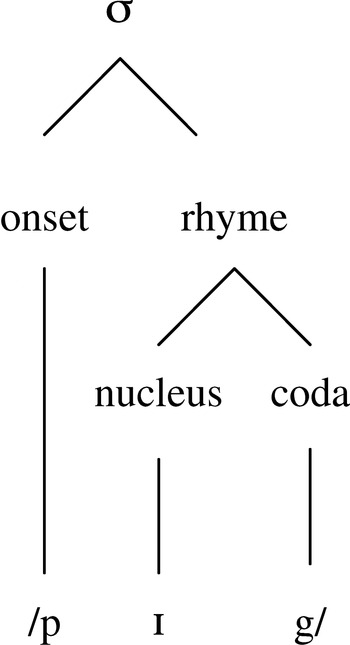
In general, syllables are composed of an optional onset consonant and a rhyme. The rhyme is composed of a nucleus (typically a vowel), and may also contain a coda consonant, depending on the language. This simple CVC syllable structure, as in the word pig, is illustrated in Figure 1.
Basic syllable structure (pig).

In some languages, these positions may be filled with more than one segment, resulting in a more complex, branching structure. For example, in English the nucleus may contain a diphthong (time /taɪm/). English also permits branching onsets and codas, which are often called consonant clusters. All three are illustrated for the word blind in Figure 2.
Branching onset, nucleus and coda (blind).

While the inventory of consonant clusters permitted in a given language may vary, such clusters typically obey the Sonority Sequencing Principle (SSP), where sonority peaks in the nucleus and decreases toward the edges of the syllable (Clements, Reference Clements, Kingston and Beckman1990). This is captured by the Sonority Hierarchy in (1), where each speech sound is categorized as one of seven manners of articulation that are ranked according to their degrees of sonority (Ladefoged, Reference Ladefoged1993). In accordance with the SSP, more sonorant segments tend to fill the nucleus of the syllable, and less sonorous segments tend to fill onset and coda positions. In the case of a branching structure, sonority must fall from the nucleus outward. For example, in the word blind /blaɪnd/, /aɪ/ is a vowel and /b/ and /d/ are stops; /l/ is a liquid, which falls between a stop and a vowel, and likewise for /n/, a nasal.
(1) The Sonority Hierarchy
Stops>Affricates>Fricatives>Nasals>Liquids>Glides>Vowels
least sonorant→most sonorant
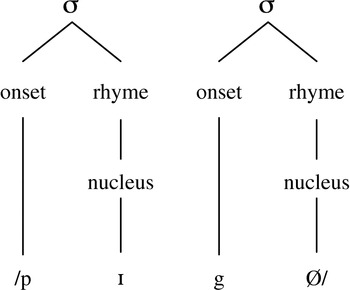
This account of syllable structure is fairly straightforward. However, some researchers propose that, rather than being syllabified in the coda of a syllable (CVC), word-final consonants actually appear in the onset of a syllable that does not contain phonetic material in its nucleus (e.g. CV.CØ, where the period indicates a syllable boundary). Some researchers propose that this type of structure is universal, or that it holds for at least some languages (Kaye, Reference Kaye1990; Piggott, Reference Piggott1991). Some also suggest that the initial stages of child language contain such ‘empty-headed’ syllable structures (Goad & Brannen, Reference Goad, Brannen, van de Weijer, van Heuven and van der Hulst2003), since many early CVC targets in English are produced with heavy aspiration or even an epenthetic vowel. Under such an analysis, the structural representation for the word pig would be as shown in Figure 3.
Word-final consonant for pig syllabified as the onset to an empty-headed syllable.

One piece of evidence for the proposed empty-headed syllable is the existence of word-final clusters that rise in sonority. Consider, for example, the final cluster of French autre ‘other’ /otʁ/, which violates the SSP because /ʁ/ is more sonorant than /t/. For French, however, there has been persistent debate not only about the syllabification of rising sonority word-final clusters, but also about the structural status of word-final singleton consonants more generally.
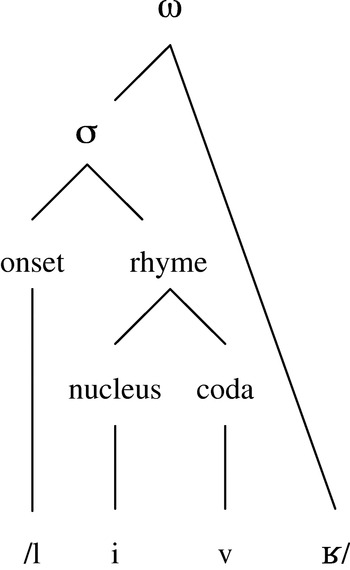
Traditional approaches to French syllable structure have assumed that word-final singleton consonants are syllabified in the coda (e.g. Tranel, Reference Tranel, Amastae, Goodall, Phinney and Montalbetti1992). Rialland (Reference Rialland and Keating1994) suggests that the first consonant of a final cluster is syllabified in the coda, whereas a subsequent consonant is ‘extrasyllabic’, or prosodified outside the syllable (CVC<C>) at the higher level of the prosodic word, as show in Figure 4.
Word-final extrasyllabicity (livre).

Plénat (Reference Plénat1987) and Féry (Reference Féry2003) further propose that French rhymes are maximally bipositional, with limitations on the consonants that can appear in coda position. They suggest that only a sonorant consonant may be syllabified in the coda (beurre ‘butter’ /bœʁ/), whereas an obstruent must be syllabified in the onset of an empty-headed syllable (truc ‘thing’ /tʁy.kØ/). Furthermore, when an obstruent is followed by a sonorant consonant word-finally (thereby violating the SSP), they suggest that the sequence forms a branching onset to an empty-headed syllable (autre ‘other’ /o.tʁØ/). However, when the sequence does not violate sonority, the sonorant consonant appears in the coda and only the obstruent is syllabified as the onset to the empty-headed syllable (transporte ‘transports’ /tʁ s.pɔʁ.tØ/). This has the advantage of capturing similar restrictions word-medially, where the consonant sequence in transporter ‘to transport’ is syllabified across syllables (/tʁs.pɔʁ.te/).
Other researchers of French claim that all word-final consonants are onsets to empty-headed syllables. For example, Charette (Reference Charette1991) suggests that the only coda consonants permitted are those that occur word-internally, as in partir ‘to leave’ /paʁ.ti.ʁØ/ or forte ‘strong’ /fɔʁ.tØ/. In these cases, the sonorant /ʁ/ is syllabified in coda position, and the /t/ serves as an onset to either a standard syllable or to an empty-headed syllable, respectively. As support for this proposal, Charette (Reference Charette1991) shows that vowel lengthening and diphthongization can only occur in syllables lacking her definition of codas in Quebec French, suggesting that the rhyme is maximally bipositional. This is illustrated in (2).
(2) Diphthongization and lengthening in Quebec French (from Charette, Reference Charette1991)
bête ‘stupid’ [bεː.t] > [bait]
sable ‘sand’ [saː.bl] > [saubl]
forte ‘strong’ [fɔʁ.tØ] > *[fɔːʁt]
Dell (Reference Dell1995) concurs with this analysis on the basis of phonotactic restrictions on ‘compound rimes’ such as in perdre ‘to lose’ /pεʁdʁ/, which can be easily syllabified as a nucleus and a singleton coda followed by a branching onset to an empty-headed syllable (e.g. /pεʁ.dʁØ/). This is similar to Plénat's (Reference Plénat1987) analysis, except that here word-final singleton sonorants are syllabified as an onset to an empty-headed syllable (beurre ‘butter’ /bœ.ʁØ/). Crucially, both analyses syllabify final clusters in the same way, with a singleton sonorant coda followed by a singleton onset to an empty-headed syllable in the case of porte ‘door’ /pɔʁ.tØ/, but a branching onset to an empty-headed syllable in case of autre ‘other’ /o.tʁØ/.
The ongoing debate regarding syllable structure in French raises many questions about how and when children acquire word-final consonant clusters in French, and the possible syllable structures these may have (cf. Kehoe, Hilaire-Debove, Demuth & Lleó (Reference Kehoe, Hilaire-Debove, Demuth and Lleó2008) for discussion of related issues in onset position). Although a definitive answer to this question goes beyond the scope of this paper, the results of the present study shed some light on these issues, identifying areas for further research. We review below what is known about the acquisition of French syllable structure more generally, and then make predictions regarding our study.
THE ACQUISITION OF FRENCH SYLLABLE STRUCTURE
The acquisition of French word-final singleton consonants
Rose (Reference Rose2000), in a study of two Quebec French-speaking children's longitudinal acquisition of segments, found that one child (Clara) began to produce most word-final consonants at 1 ; 7, but exhibited much later acquisition of word-final /ʁ/, even though she could produce this segment earlier in word-medial position. He suggested that Clara's representation of medial and final /ʁ/ was that of a coda consonant, in contrast to her other word-final consonants, which Rose (Reference Rose2000) claims are onsets to empty-headed syllables. This suggests that, for some French-speaking children, the structural status of word-final /ʁ/ is a coda.
Demuth & Johnson (Reference Demuth and Johnson2003), in a diary study of another child (Suzanne), likewise found that the first word-final consonants were produced at 1 ; 7. Thus, one might expect that for many French-speaking children, singleton word-final consonants begin to emerge around 1 ; 7. However, as in English, there appears to be some individual variation in when word-final consonants begin to appear. For example, the French-speaking children in the present study, Tim and Marie, produced their first word-final consonants at 1 ; 3 and 1 ; 8, respectively. Much like Clara, Marie also exhibited segmental problems with /ʁ/. This was revealed by her frequent omission of simple word-initial /ʁ/ (rouge ‘red’ /ʁuʒ/ >[uz]), or its realization as /l/ (rose ‘rose’ /ʁoz/ >[loz]), and her reduction of word-initial clusters (prend ‘take’ /pʁ/ >[p]). In addition, both Tim and Marie showed a word length effect, producing word-final consonants in disyllabic words approximately two months later than those in monosyllabic words (see Demuth, Culbertson & Alter (Reference Demuth, Culbertson and Alter2006) for similar findings for English). Both children also showed a tendency to resyllabify word-final consonants that were followed by vowel-initial words, though they showed little in the way of epenthesis or aspiration with CVC words in other contexts. Taken together, these findings indicate that many French-speaking children begin to produce word-final singleton consonants around 1 ; 7, and are producing most of these by the age of 2 ; 0, even in disyllabic words. Evidence from two of these children (Clara and Marie) also indicates segmental problems with /ʁ/ – an issue that will become relevant for investigating the development of clusters in French.
Factors affecting the development of word-initial versus word-final clusters in French
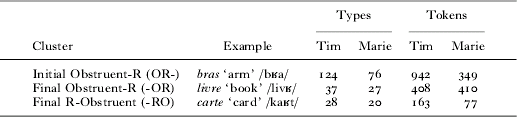
Given the results of the above studies, we now consider the factors that could play a role in determining the development of French word-initial and word-final clusters. First, unlike English, word-final clusters in French are typically tautomorphemic. Morphology will therefore not play a prominent role in providing French learners with a word-final cluster advantage. We then considered cluster input frequency by examining the cluster characteristics that the children in our study (Tim and Marie) heard from their mothers. An examination of all child-directed speech to Tim and Marie from 1 ; 0–2 ; 6 found a total of 22 588 words containing clusters, 70% of which were in word-initial position (see Methods section below for further detail). Overall, then, we might expect a frequency advantage for word-initial clusters. However, we then examined the frequency of different cluster types as a function of sonority class. Excluding word-initial clusters with glides, the three most frequent clusters were those examined in this study, totaling 9885 tokens: word-initial OR- (4236 tokens), word-final -OR (3136, tokens), and word-final -RO (2513 tokens). Thus, although word-initial OR- clusters are more frequent than either of the word-final clusters when compared individually, it is not clear that the relative frequency differences are strong enough to influence the order of acquisition. We therefore expected that the results of our study would not be explained by cluster frequency alone.
However, the results could be affected by segmental effects. Liquids are often acquired late in English, and the same is true for some French-speaking children (e.g. discussion of Clara and Marie above). In addition, French /ʁ/ is subject to much phonetic variation. Numerous sources claim that, over the past several decades, its place of articulation for has shifted from apical to uvular in both France and Canada (Côté, Reference Côté2004; Delattre, Reference Delattre1969; Hallé, Best & Levitt, Reference Hallé, Best and Levitt1999). Others claim that it is dorsal (Rose, Reference Rose2000), pharyngeal (Delattre, Reference Delattre1969) or inherently placeless (Rose, Reference Rose2000). There is even less agreement about its manner of articulation: while earlier works label /ʁ/ as a trill (Delattre, Reference Delattre1969; Malmberg, Reference Malmberg1969), more recently it has been classified as a fricative, at least prevocalically (Côté, Reference Côté2004) or when devoiced (Hallé et al., Reference Hallé, Best and Levitt1999). Another suggestion is that /ʁ/ is an approximant, at least underlyingly (Côté, Reference Côté2004; Hallé et al., Reference Hallé, Best and Levitt1999). While /ʁ/ is generally voiced, it devoices when preceded by a voiceless obstruent in a word-initial cluster (Delattre, Reference Delattre1969; Rose, Reference Rose2000), or when preceded by most obstruents in a word-final cluster (Malmberg, Reference Malmberg1969). Just as the voicing of /ʁ/ is sensitive to phonetic context (Hallé et al., Reference Hallé, Best and Levitt1999), other aspects of its production are sensitive to regional and social factors (Malmberg, Reference Malmberg1969). Overall, the acoustic and articulatory characteristics of French /ʁ/ are subject to variability, both between speakers and in the productions of a single speaker. It is not surprising, then, that individual children might also show variability in the acquisition of French /ʁ/. We therefore expected that Marie, who has segmental problems with /ʁ/ more generally, would exhibit high instances of /ʁ/ truncation in clusters.
In light of the phonetic variability reported for /ʁ/ in the literature, we wanted to determine if this was also manifest in child-directed speech. Although the acoustic and segmental properties of child-directed speech even in languages like English remain to be fully investigated, some studies suggest that child-directed speech is clearer and has fewer segmental reductions than adult-directed speech (e.g. Bernstein Ratner, Reference Bernstein Ratner1984). We therefore conducted a pilot acoustic analysis of /ʁ/ using two hours of Tim's and Marie's mothers' speech directed to them at 1 ; 6 years. Excluding the high-frequency lexical item regarde ‘look’ (which often exhibits truncation), there were a total of 131 tokens (50 word-initial OR-, 61 word-final -OR and 20 word-final -RO). Any acoustic evidence of /ʁ/ (such as frication) was classified as /ʁ/ production. Deletion rates for /ʁ/ in word-initial position were very low (0% for Tim's mother, and 3% for Marie's mother). Neither mother deleted /ʁ/ in final -RO clusters (though there were few tokens for this cluster type). In contrast, Tim's mother deleted /ʁ/ in 69% of final -OR clusters, and Marie's mother deleted /ʁ/ in 75% of these contexts. Thus, there is a great deal of /ʁ/ deletion in word-final -OR clusters in some French child-directed speech. We might therefore expect that French final -OR clusters would be ‘later acquired’ because they are phonetically reduced in the input the children hear.
Predictions
Given the foregoing discussion, we can now make some predictions about the mechanisms underlying the development of clusters in French. If children exhibit truncation to obstruents in all three types of clusters (as reported in Demuth & Kehoe, Reference Demuth and Kehoe2006), this may be due to syllable structure and/or segmental constraints. On the other hand, if learners exhibit earlier acquisition of word-initial OR- clusters and later acquisition of word-final -RO clusters, this might be due to subtle cluster frequency effects. However, if children selectively truncate word-final -OR clusters to an obstruent, this would indicate that the variable input they hear may influence children's representation of these forms. Alternatively, if word-initial clusters are acquired earlier than both types of word-final clusters, this would suggest that syllable structure and/or markedness issues (such as empty-headed syllables) may play an important role in determining the course of consonant cluster acquisition.
METHOD
Participants
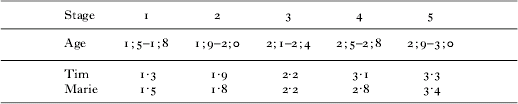
The participants in this study were Tim and Marie, two normally developing French-speaking children from the Lyon Corpus (Demuth & Tremblay, Reference Demuth and Tremblay2008) (http://childes.psy.cmu.edu/data/Romance). For the purposes of this study, the children's speech productions were investigated between the ages of 1 ; 5 and 3 ; 0, the range during which there were sufficient numbers of target words with consonant clusters. The children had no apparent neurological, motor control, language or hearing deficits at the time of the recordings, and French was the only language they heard in their environment. In order to avoid sparse data effects, the sessions examined were grouped into four-month intervals according to the children's age. As shown in Table 1, both children were comparable in terms of Mean Length of Utterance (MLU) calculated in words at each of these points in development. For convenience, we refer to these as ‘stages’ 1–5.
Subjects' MLU (in words) at different stages in development

Data collection, transcription and preparation
The children and their parents (usually the mother) were video-recorded in their homes in Lyon for approximately one hour every two weeks with a Panasonic PV-DV601D-K mini digital video recorder placed on a tripod. Each wore a wireless Azden WLT/PRO VHF lavalier radio microphone pinned to the collar. The child's radio transmitter was placed in a child-sized backpack. Since the microphones were wireless, the child and parent could move freely about.
The recordings were then downloaded onto a computer, and both child and parent utterances were orthographically transcribed by trained French-speaking transcribers using CHILDES conventions (MacWhinney, Reference MacWhinney2000). The child speech was also phonetically transcribed using broad phonemic transcription. A combination of linguistic context, phonetic match and visual information from the video was used to identify the child's target words (see Vihman & McCune (Reference Vihman and McCune1994) for similar procedures). Only the target words for which the transcriber had at least a 95% confidence level were included in the present analysis. A second transcriber phonetically re-coded at least 10% of each child's utterances for each one-hour session. The average between-coder phoneme-for-phoneme reliability was 91% for Tim and 89% for Marie. The Lexique (New, Pallier, Ferrand & Matos, Reference New, Pallier, Ferrand and Matos2001) and BRULEX (Content, Mousty & Radeau, Reference Content, Mousty and Radeau1990) online dictionaries were used to determine which target words contained clusters. Due to concerns about word length effects, only monosyllabic and disyllabic words (according to traditional dictionary classification) were included in the analysis.
Coding
The majority of clusters used in French everyday speech contain the segment /ʁ/ (69% of all clusters in our sample of French child-directed speech, excluding word-initial sequences with glides). Although there are numerous clusters in French that do not contain /ʁ/ (e.g. table ‘table’ /tabl/), in this corpus there were not enough to analyze separately. Thus, the focus of this study was on the acquisition of obstruent-/ʁ/ (OR) and /ʁ/-obstruent (RO) clusters. All final clusters followed by a vowel-initial word were excluded due to the likelihood of the final consonant being syllabified as the onset to the following word. Such cases constituted approximately one-fifth of the word-final cluster contexts. The high-frequency word regarde ‘look’ was also excluded since it is usually reduced in mothers' and children's speech (/ʁəɡaʁd/>[ʁəɡaʁ]). Also eliminated from the analysis were proper names, immediate identical repetitions of the same word and cases in which it could not be determined to which lexical item a segment belonged (e.g. the /ʁ/ of autre raison ‘other reason’ /otʁεz / could be part of the final cluster of autre ‘other’ /otʁ/ or part of the onset of raison ‘reason’ /ʁεz/). The remaining tokens of the three types of clusters examined in this study, and the total number of word tokens and word types analyzed for each, are shown in Table 2.
Types of clusters examined

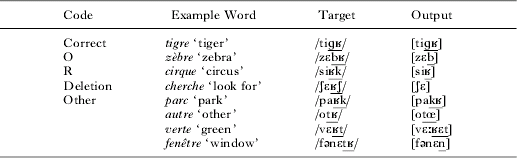
For each cluster targeted, the child's production was coded as outlined in Table 3. This included the entire cluster produced (Correct), only the obstruent produced (O), only the /ʁ/ produced (R), the entire cluster deleted (Deletion), and Other. For Correct and O, the production of any obstruent, not just the target obstruent, was accepted; changes in manner and consonant place of articulation were not frequent. Changes in voicing were not penalized, as young speakers often have difficulty controlling voicing in an adult-like manner (Macken & Barton, Reference Macken and Barton1980). For Correct and R, the production of /ʁ/ or /l/ for target /ʁ/ was accepted, as rhotic production is challenging, and both children exhibited some /l/ substitution in singleton onset contexts. This type of change was also not frequent. Finally, some productions did not fall into any of the previous categories (metathesis, epenthesis and substitutions other than those described above). These were few, and were coded as ‘Other’.
Coding of how target clusters were produced

RESULTS
Overall cluster production patterns
The children's overall cluster production patterns, and the types of errors made, are provided in Tables 4 and 5. Both children exhibited high accuracy on initial OR- clusters. In contrast, the production of final -OR clusters was not as good. A χ2 analysis revealed that the difference in accuracy between the two was significant for both children (Tim, χ2(1, N=1350)=69·373, p<0·001; Marie, χ2(1, N=759)=310·561, p<0·001). Marie was especially poor in her production of final -OR clusters, deleting the final /ʁ/ in 63% of her attempts. As with Clara, we suspect that this is due to Marie's more general problems with /ʁ/. We return to this issue in the Discussion section.
Tim's total number (percent) of clusters produced as correct, truncated or deleted

Marie's total number (percent) of clusters produced as correct, truncated or deleted

The children's performance on final -RO clusters was also low. Interestingly, though Tim showed no difference in the production of final -OR and -RO clusters (χ2(1, N=571)=0·046, p>0·05), Marie showed significantly better performance on final -RO clusters than on final -OR clusters (χ2(1, N=487)=24·592, p<0·001). Thus, word-final /ʁ/ seems particularly vulnerable for Marie. Finally, both children performed significantly better on initial OR- clusters than on final -RO clusters (Tim, χ2(1, N=1105)=43·618, p<0·001; Marie, χ2(1, N=426)=52·344, p<0·001). In sum, the two children in this study provide support for the Demuth & Kehoe (Reference Demuth and Kehoe2006) findings that initial clusters are produced more accurately than word-final clusters in French. In the following section, we examine these children's acquisition of clusters over time to determine if the same patterns are found developmentally.
Developmental cluster production patterns
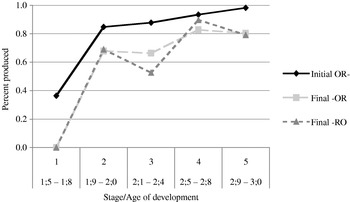
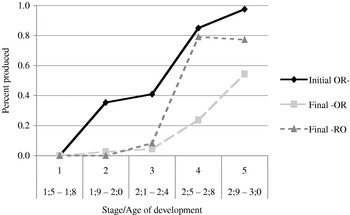
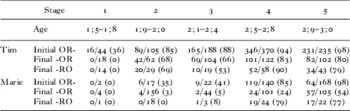
In this section we examine the acquisition of each of the three cluster types over time. Based on the results from Demuth & Kehoe (Reference Demuth and Kehoe2006) and the overall results discussed above, we expected earlier production of word-initial compared with word-final clusters. As shown in Figures 5 and 6, this is expectation is correct, with word-initial consonant clusters being the first to appear. The developmental data are shown in Table 6.
Tim's cluster production.

Marie's cluster production.

Number/total (percent) of initial versus final clusters produced developmentally

We begin with a developmental comparison of initial and final OR clusters. Although Tim performs well in both positions, recall that he is significantly less accurate on final -OR clusters overall. Indeed, at each of the four stages for which we can calculate χ2 statistics (i.e. for which there are five or more tokens expected in each cell), Tim's final -OR productions are significantly worse than their initial counterparts (Stage 2, χ2(1, N=167)=6·678, p<0·01; Stage 3, χ2(1, N=292)=19·300, p<0·001; Stage 4, χ2(1, N=492)=12·704, p<0·001; Stage 5, χ2(1, N=337)=34·477, p<0·001). Similarly, Marie produced initial OR- clusters with significantly greater accuracy than final -OR clusters during Stages 4 and 5 (χ2(1, N=241)=91·189, p<0·001 and χ2(1, N=273)=78·688, p<0·001, respectively), the only stages with sufficient tokens for a χ2 analysis. This is despite the fact that her performance on both was quite low compared with Tim's.
Recall that the overall difference in production accuracy between initial OR- and final -RO clusters was significant for both Tim and Marie (Tables 4 and 5). Tim shows a trend in this direction developmentally, though there were not enough tokens at each point to demonstrate this statistically. Marie's performance shows a similar trend, with better production of initial OR- compared with final -RO clusters once she starts to produce clusters, though again, there were was not enough data show this statistically.
Recall that we also expected that final -RO clusters might be acquired before final -OR clusters, since the latter are marked, either for violating the SSP or for forming the onset to an empty-headed syllable. In contrast, final -RO clusters, under some analyses, can be syllabified as the branching coda, incurring no sonority-related markedness violation. There were not enough relevant tokens for Tim in Stage 1 to perform a χ2 analysis. However, for the last four stages of his development, Tim's accuracy in producing final -RO and -OR clusters is not significantly different. Marie, on the other hand, does show an overall difference in final cluster production, exhibiting only 54% accuracy on her final -OR clusters by the end of the study, but up to 78% accuracy on her final -RO clusters at Stage 4. This difference is significant at Stages 4 and 5 (χ2(1, N=125)=26·378, p<0·001 and χ2(1, N=127)=3·953, p<0·05) respectively, though insufficient numbers of tokens made a χ2 analysis impossible for her first three stages. Clearly, her trend in acquisition differs from Tim's, likely due to Marie's difficulties with final /ʁ/. Though Marie's pattern fits with a syllable structure markedness explanation, her segmental difficulties make it difficult to determine if her later acquisition of final -OR clusters is actually due to structural or segmental effects.
Overall, the data from these two children confirm that initial clusters are more accurately produced before word-final clusters in French, regardless of the sonority status of the latter. In the next section we examine the findings as a function of word length to determine if length and/or stress factors may have influenced the results.
Word length and syllable prominence
As mentioned previously, English onset and coda consonants are more likely to be produced in monosyllabic words than in disyllabic words, and in the stressed and final syllables of disyllabic words (e.g. Echols & Newport, Reference Echols and Newport1992; Kirk & Demuth, Reference Kirk and Demuth2006; Demuth et al., Reference Demuth, Culbertson and Alter2006). Since French syllable prominence is phrase-final, we might expect initial cluster production to be more accurate in monosyllabic as compared to disyllabic words, as only the former occur in the stressed syllable. Indeed, both children performed better overall on initial clusters in monosyllables than in disyllables (Tim, χ2(1, N=942)=14·447, p<0·001; Marie, χ2(1, N=349)=10·220, p<0·01). Thus, increased word length, plus the lack of first syllable prominence, may actually have lowered production accuracy on initial clusters in disyllables.
Of greater interest is the possible effect of word length on word-final clusters, since these are later acquired. Unfortunately, Marie does not have enough tokens to evaluate possible word length effects on final -OR clusters. However, she produces final -RO clusters equally well in both monosyllables and disyllables (χ2(1, N=77)=0·041, p=0·839). Furthermore, Tim shows no word length effects for either word-final cluster (-OR, χ2(1, N=408)=0·351, p=0·554); -RO, χ2(1, N=163)=0·445, p=0·505). Thus, unlike these children's acquisition of simple word-final consonants, word length does not appear to be a factor for the production of word-final clusters. This could be due to the fact that children's sentences (as measured by MLU) are longer at the point where word-final consonant clusters are being acquired, thereby reducing the possible durational advantage conveyed by phrase-final lengthening (since fewer words will be in phrase-final position). Note, however, that this does not explain why word-initial clusters exhibit word length effects. This suggests that an experimental study, where cluster type, lexical frequency, word length and utterance length are all controlled, may be needed to more fully understand the possible impact of word length on French cluster production. Critically, however, for the purposes of the present study, issues of word length do not appear to influence the earlier production of word-initial compared to word-final clusters.
Word-medial consonant sequences
In addition to the word-initial and word-final clusters analyzed above, French also contains both OR and RO sequences word-medially. An examination of children's production patterns on these medial consonant sequences might provide additional evidence regarding their cluster production abilities and syllabification strategies. For example, following the SSP, we would expect that medial -OR- sequences would be syllabified as a true onset cluster (citron ‘lemon’ /si.tʁõ/), whereas medial -RO- sequences would be syllabified across a syllable boundary as a coda.onset sequence (garçon ‘boy’ /gaʁ.sõ/). We therefore conducted a separate analysis to investigate this issue. We found that, overall, 144/161 (89%) medial -OR- sequences were correctly produced by Tim and that 135/158 (85%) were correctly produced by Marie. In accord with these expectations, children's word-medial -OR- clusters were produced with the same high level of accuracy as initial OR- clusters, and were significantly more accurate than final -OR clusters (Tim, χ2(1, N=569)=19·682, p<0·001; Marie, χ2(1, N=568)=197·583, p<0·001). This suggests that the children's word-medial -OR- clusters are indeed being syllabified as complex onsets.
Since medial -RO- clusters can be syllabified as a coda and onset, we might expect these to be easier for the children to produce than final -RO sequences. Tim correctly produced 187/281 (67%) medial -RO- targets, while Marie produced 149/212 (70%). In support of this prediction, Marie performed better overall on medial -RO- sequences than on final -RO clusters (χ2(1, N=289)=12·170, p<0·001), suggesting that she can produce /ʁ/ as a coda consonant word-medially, but not word-finally. Note that this is similar to the pattern reported for Clara (Rose, Reference Rose2000). In contrast, Tim's performance on medial and final RO sequences was equally good. This could imply that both his medial and final RO clusters are syllabified across a syllable boundary (-R.O-), resulting in an onset to an empty-headed syllable word-finally. This could also be interpreted in terms of his better performance with clusters in general. Thus, for both children, it appears that word-medial -OR- clusters syllabify as onsets, whereas word-medial (and perhaps word-final) RO sequences are syllabified as part of two separate syllables.
Analysis of syllable-structure markedness and segmental effects
Many studies have pointed to the important role of markedness in explaining early patterns of acquisition (e.g. Demuth, Reference Demuth and Beckman1995). This is also true for the acquisition of syllable structure, where it has been frequently observed that less sonorant consonants tend to be preserved in syllable onsets, whereas more sonorant consonants tend to be preserved in syllable codas (cf. Barlow, Reference Barlow and Eddington2005; Gnanadesikan, Reference Gnanadesikan, Kager, Pater and Zonneveld2004; Goad & Rose, Reference Goad and Rose2003). We would then expect the emergence of unmarked structures to be evidenced in the acquisition of French clusters, as well. With respect to processes of cluster reduction, this appears to hold in initial position, where clusters were reduced to the obstruent. However, the prediction for final position is less clear. We expected final -OR clusters to be truncated to the obstruent, which they do, since it is likely that the entire cluster is syllabified as an onset to an empty-headed syllable. In contrast, we expected final -RO clusters might truncate to the more sonorant /ʁ/, remaining in coda position. However, these also tended to reduce to the obstruent, raising questions about how final -RO clusters are syllabified. Unfortunately, there was not enough data to explore segmental effects on the reduction of these final clusters.
We therefore examined the segmental content of those clusters that were accurately produced. With respect to initial OR- clusters, the majority of targets and productions for both children included cases where the obstruent was a stop. Since there were insufficient target fricative onsets, it was not possible to conduct statistical analysis in this position. As shown in Tables 4 and 5, final -RO and -OR clusters both tended to truncate to the obstruent. However, we expected more accurate -RO production when the obstruent was a stop rather than a fricative, since the sonority profile at the end of the word indicates that the obstruent may be syllabified as an onset (to an empty-headed syllable). There was a trend in this direction for both children, and this reached significance for Tim (χ2(1, N=163)=9·546, p<0·01). Interestingly, the opposite pattern was found for final -OR clusters, where both children showed a trend toward being more accurate when the obstruent was a fricative. This reached significance for Marie (χ2(1, N=410)=41·677, p<0·001). Although not expected, a possible explanation for this finding is that children's final -OR clusters are syllabified as a complex onset to an empty-headed syllable. Since /ʁ/ often surfaces as a fricative, it may enhance shared manner features with the obstruent as part of the syllable onset (cf. similar processes in adult and child English (e.g. train /ʧʁeɪn/)).
Thus, although there is not enough data to fully explore the role of segmental effects on cluster truncation, there is some suggestion that the children in this study treat final -OR clusters and the obstruent of final -RO clusters as onsets to empty-headed syllables. This would provide independent acquisition support for proposals that suggest a limited role for coda consonants in French.
In sum, the findings from this study confirm the cross-sectional results from Demuth & Kehoe's (Reference Demuth, Culbertson and Alter2006) study showing that, for both children, initial clusters were produced before final clusters. In addition, these children's initial clusters reach higher levels of accuracy earlier than word-final clusters. These findings hold even though the segmental/sonority content of these clusters was controlled, and despite the fact that Marie exhibited obvious segmental problems with /ʁ/. This contrasts with findings reported for German and English, where the reverse pattern is found (albeit with different segments). In the following section we discuss possible explanations for these findings, and the implications for language learning more generally.
DISCUSSION
In the Introduction to this study, we identified both cluster frequency and morphological structure as being two factors that might enhance the earlier acquisition of final clusters in English. However, it is also possible that syllable structure/sonority factors may selectively disadvantage the early acquisition of onset clusters in English and final clusters in French. For example, /s/-obstruent onset clusters in English (e.g. stop) violate the SSP. It has therefore been suggested that the /s/ of such a sequence is prosodified not as part of an onset or coda cluster, but as an appendix. It has long been known that word-initial /s/-clusters pose a particular challenge for many language learners (though apparently not for some Dutch learners (Fikkert, Reference Fikkert1994), and there have been many attempts to explain the cluster simplification patterns that occur (cf. papers in Goad & Rose, Reference Goad and Rose2003). If initial /s/-clusters were excluded from the English data, the order of cluster acquisition might be different. Thus, perhaps English presents a ‘special’ case, where initial /s/-clusters, which do not have the frequency/morphological advantages of final /s/-clusters, present a special challenge for learners, resulting in later acquisition.
This study has shown that final -OR clusters in French also violate the SSP if they are syllabified as part of the coda. However, in many languages, including English, /ʁ/ and other sonorant consonants can be syllabic, forming the nucleus of a syllable (e.g. letter /lε.t /). Perhaps, the final /ʁ/ of French -OR sequences is a syllable in and of itself. However, French does not allow sonorant consonants such as /ʁ/ to appear in the nucleus (lettre ‘letter’ /lεtʁ/) (Féry, Reference Féry2003). Thus, it is unlikely that French-speaking children go through a stage of development where they treat final /ʁ/ as syllabic.
It might have been thought that French-speaking children would begin to add a schwa to the ends of words, providing an epenthesized vowel to final consonants so that these are easier to produce as an onset to the following syllable (see Goad & Brannen (Reference Goad, Brannen, van de Weijer, van Heuven and van der Hulst2003) for such a proposal for English). However, this was not the case. First, schwa realization in French depends greatly on context and dialect (Dell, Reference Dell1985). Second, the Lyon dialect examined in this corpus contains few word-final schwas, and we found few in children's productions. Furthermore, as mentioned in the Coding section, any final cluster followed by a vowel-initial word was eliminated from the analysis, and any final cluster produced with a following full vowel that was not in the target was coded as ‘Other’. As seen in Tables 4 and 5, such productions were few. Thus, it is unlikely that the development of word-final clusters can be accounted for by appealing to vowel epenthesis. Rather, we suggest that the later acquisition of word-final consonant sequences in French is due to the syllabic markedness and/or segmental/articulatory challenges such structures present.
If, as many suggest, French does not permit word-final codas or clusters, then perhaps the later acquisition of French final consonant sequences is due to the later acquisition of onsets to empty-headed syllables (contra proposals by Goad & Brannen (Reference Goad, Brannen, van de Weijer, van Heuven and van der Hulst2003) and Rose (Reference Rose2000)). One possibility is that empty-headed syllables are ‘marked’ since they contain no phonetic content in the nucleus, resulting in later acquisition. Another possibility is that onsets to empty-headed syllables are articulatorily difficult to produce, and therefore later acquired. Thus, perhaps the more marked and/or articulatorily challenging structure of French final consonant sequences, with no frequency or morphological advantage, helps to explain the later emergence of these structures in children's productions. This suggests that further investigation of the articulatory mechanisms underlying the production of consonant sequences of different sonority types would provide an interesting comparative cross-linguistic study.
CONCLUSION
This study examined the longitudinal development of obstruent-/ʁ/ and /ʁ/-obstruent clusters in two French-speaking children between the ages of 1 ; 5 and 3 ; 0. Although one child was slower to develop overall, both showed the same patterns of development, with word-initial clusters produced earlier than word-final clusters. These results are consistent with previous cross-sectional findings of French (Demuth & Kehoe, Reference Demuth and Kehoe2006), but contrast with findings from English (e.g. Kirk & Demuth, Reference Kirk and Demuth2005), raising questions about the factors that influence the course of cluster development across languages.
Languages such as English have both a frequency and morphological advantage for final clusters, perhaps biasing learners to focus early on complexity at the ends of words. On the other hand, the syllabification of some French final clusters as onsets to empty-headed syllables may present representational and/or articulatory challenges for the French learner. This may be further exacerbated by the variable realization of final /ʁ/ in the input children hear. Future study of cluster acquisition in languages such as Russian and Polish, which also contain word-final obstruent-liquid clusters, may provide further insight into the factors that play the most important role in determining patterns of cluster acquisition. Important to any such study, however, would be an acoustic investigation of the input children hear, and the possible impact this may have on the development of children's morphemic and non-morphemic clusters. If French-speaking adults frequently omit /ʁ/ from their final obstruent-/ʁ/ sequences, our evaluation metric for children may be too high. The field of language acquisition is only now beginning to acknowledge the importance of understanding the nature of the input learners hear, and the potential impact this has on the process of language acquisition. A fuller investigation of these issues, including a closer analysis of both adult and child productions at the phonetics/phonology interface, is long overdue.