Introduction
Rheumatic mitral stenosis is the most common acquired valve disease in women of childbearing age and remains to be the most common cause of maternal mortality from cardiac causes worldwide.Reference Elkayam, Goland, Pieper and Silversides1–Reference Elkayam and Bitar3 Studies from sub-Saharan Africa also revealed that rheumatic valvular disease in pregnancy is associated with high maternal morbidity and adverse fetal outcomes.Reference Diao, Kane and Ndiaye4,Reference Nqayana, Moodley and Naidoo5 One recent study from Ethiopia showed a high proportion of rheumatic heart disease with mitral valve involvement among pregnant mothers occurring in 2.3% of women attending antenatal care.Reference Bacha, Aberra, Adem, Taddesse and Bekele6 Pregnancy in women with severe mitral stenosis is associated with unfavourable fetal outcome, leading to increased incidence of intrauterine growth restriction, prematurity, and decreased birth weight.Reference Hameed, Karaalp and Tummala7
The management of mitral stenosis during pregnancy is challenging because of the potential impact on the fetus related to drug therapy and the exposure to ionising radiation associated with the therapeutic procedure of percutaneous mitral valve balloon commissurotomy, as well as the effect of anaesthesia and cardiopulmonary bypass in the case of cardiac surgery.Reference Elkayam and Bitar3,Reference Regitz-Zagrosek, Blomstrom Lundqvist and Borghi8 Percutaneous mitral valve balloon commissurotomy is safe and effective and preferable for the fetus, compared with mitral valve surgery during pregnancy.Reference de Souza, Martinez and Ambrose9 Several studies strongly recommend percutaneous mitral valve balloon commissurotomy as the treatment of choice for symptomatic severe mitral stenosis with favourable valve anatomy, and the reported results are similar to the outcome in the non-pregnant patients with mitral stenosis.Reference de Souza, Martinez and Ambrose9–Reference Norrad and Salehian11
There is a paucity of published data on the safety and outcomes of percutaneous mitral valve balloon commissurotomy in pregnant women with severe and symptomatic rheumatic mitral stenosis in resource-limited settings. Therefore, the current study aimed to assess the immediate maternal and fetal outcomes following Percutaneous mitral valve balloon commissurotomy procedure which was done to treat severe symptomatic rheumatic mitral stenosis at the Cardiac Center of Ethiopia, Addis Ababa.
Methods
Study setting, design, and participants
The study was conducted at the Cardiac Center of Ethiopia, found in Addis Ababa. Included in the study were all pregnant mothers who underwent percutaneous balloon mitral valve commissurotomy during the period from April, 2014 to December, 2020 for the treatment of symptomatic severe mitral stenosis due to rheumatic heart disease. Data were collected through chart abstraction, and the centre’s patient database was used to retrieve the charts of pregnant mothers who underwent percutaneous mitral valve balloon commissurotomy. Demographic, clinical, and procedural-related information of the patients were collected by using a structured questionnaire. Additionally, a phone call was made to assess the pregnancy outcome of the patients. The study was approved by the Institutional Review Board (IRB) of St Paul’s Hospital Millennium Medical College.
Procedural technique and protocol
Pre-procedure evaluation
The following diagnostic evaluations were routinely being done in the centre for all patients before percutaneous mitral valve balloon commissurotomy procedure: basic laboratory test (such as complete blood count), surface electrocardiogram, and complete echocardiography within 24–48 hours prior to percutaneous mitral valve balloon commissurotomy. Mitral valve anatomy was assessed according to Wilkin’s criteria.Reference Wilkins, Weyman, Abascal, Block and Palacios12 Mean trans-mitral diastolic gradient was assessed by continuous wave Doppler. Mitral regurgitation was semi-quantitatively graded from 0 to 4 by colour flow mapping. The degree of commissural pathology was evaluated (in a parasternal short-axis view). Severe mitral valve stenosis was diagnosed when the mitral valve area was ≤1.5 cm2. After the procedure (within the first 24 hour), the commissures, mitral valve area, and Doppler data were examined by using echocardiography. Patients with the following condition were excluded from the procedure (percutaneous mitral valve balloon commissurotomy): left atrial cavity thrombus seen on echocardiography, moderate to severe mitral regurgitation, bi-commissural calcification, mitral valve area >1.5 cm2, and patients who had previous mitral valve surgery.
Procedure
We employed the Inoue balloon catheter which has been used internationally as the first choice for significant mitral stenosis for over 30 years because of its high technical feasibility and excellent results.Reference Inoue13 The procedure was performed in the cardiac catheterisation laboratory using fluoroscopy under local anaesthesia, and the gravid uterus was covered by a lead shield. All the procedures were performed aseptically through the right femoral vein approach with surgical backup. Patients were adequately heparinised during the procedure. Antibiotic prophylaxis was given to all patients. The septal puncture was performed using the Brockenbrough technique.Reference Earley14
Trans-septal puncture was the first and most crucial step of the procedure while monitoring arterial pressure by placing a pigtail catheter at the aortic sinus through the right femoral artery, usually through a 5-French sheath. Placing pigtail catheter at the aortic sinus serves as a trans-septal puncture guide and it is the preferred method of guiding septal puncture in our centre. After accessing the femoral vein, 8.5 French Mullins sheath was passed over an exchange length wire of 0.032-inch diameter into the superior vena cava. The Teflon guidewire was removed and Brockenbrough septal puncture needle was advanced in the Mullin’s dilator. We preferred to use the right anterior oblique and/or left anterior oblique views assisted by transthoracic echo for septal puncture. As soon as the whole assembly enters the left atrium, atrial entry was confirmed by recording the waveform of the left atrial pressure, or by injection of contrast into the left atrium. After confirming entry to the left atrium, 70–100 units of heparin per kilogram of body weight were given to minimise the risk of thrombosis, and the gradient across the mitral valve was measured by recording the left atrial pressure.
A self-positioning single balloon (Inoue balloon)Reference Inoue13 was used for the commissurotomy in all patients. Criteria for successful completion of the procedure includes mitral valve area > 1.5 cm2 or doubling of valve area, drop in trans-mitral mean gradient by half, complete commissural opening in at least one commissure, and absence of an increase mitral regurgitation greater than grade 2/4.
After the procedure was completed, all haemodynamic measurements were done in the Cath lab and repeated using echocardiography within the first 24 hours after the procedure. The severity of the resultant mitral regurgitation, the peak, and mean trans-mitral gradient including pulmonary artery pressures were also measured routinely.
Post-procedure follow-up
Following the percutaneous mitral valve balloon commissurotomy procedure, the pregnant mothers had regular follow-up by the obstetrician. The cardiologists who did the procedures were making contact over the phone with the obstetricians who were following the index pregnant mothers, and the cardiologists were able to collect and document the labour and delivery outcomes of the mothers.
Statistical analysis
Data were entered into a computer using excel and exported to STATA software version 13.0 for analysis. Data were summarised using the mean, median, and standard deviation for continuous variables, and frequency tables for categorical variables. A Wilcoxon signed-rank was used to compare the mean differences of haemodynamic variables before and after valvuloplasty. A p-value ≤0.05 was considered statistically significant.
Results
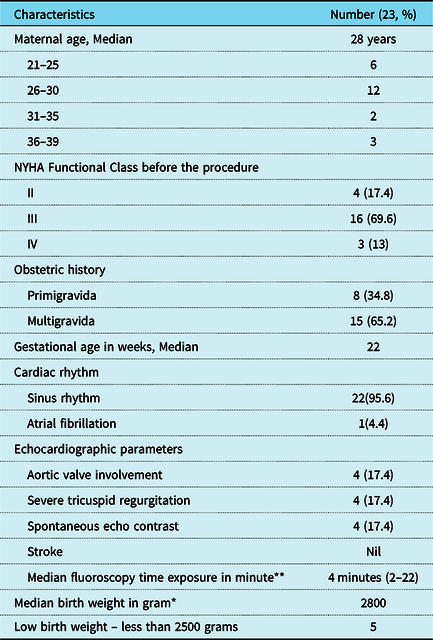
A total of 23 pregnant mothers underwent percutaneous mitral valve balloon commissurotomy in the Cardiac Center of Ethiopia(CCE) during the 6-year period. The median age of the study population was 28 years with the youngest and oldest mothers being 21 and 39 years, respectively. Gravidity of the mothers during the index pregnancy was as follows: 8 (34.8%) mothers were primigravid, 8 (34.7%) mothers were gravida two, and 7 (30.4%) mothers were gravida three and above. Of the total patients, 16 (69.4%) of them were aware of their cardiac disease before the index pregnancy. All but one pregnant mother was in the second trimester of their pregnancy during the percutaneous mitral valve balloon commissurotomy procedure.
As per the NYHA functional status classification, before the percutaneous mitral valve balloon commissurotomy procedure, 16 (69.6%) mothers had class III symptoms, 3 (13.0%) mothers had class IV symptoms, and 4 (17.4%) had class II symptoms. Out of the 23 patients, 4 (17.4%) of them had concomitant mild to moderate rheumatic aortic valve disease and one patient had atrial fibrillation. Functional severe tricuspid regurgitation was detected in three patients. There was no stroke history but four mothers had spontaneous echo contrast during transthoracic echocardiographic evaluation. Medication wise, 19 (82.6%) mothers were taking B-blocker, 11 (47.8%) mothers were taking Furosemide, and 3 (13.0%) mothers were taking Digoxin before the percutaneous mitral valve balloon commissurotomy (Table 1).
Baseline clinical and echocardiographic characteristics of pregnant women who underwent PMBC

* Data for 22 patients.
** Data for 17 patients
The median fluoroscopy exposure time of 17 pregnant mothers was 4 minutes (ranges 2–22). There were no immediate adverse fetal outcomes in the form of fetal distress, or fetal death documented on obstetric ultrasound within 24 hours following the procedure.
Pregnancy outcomes of the study population were as follows: 19 (82.6%) were term deliveries of healthy babies and 4 (17.4%) preterm deliveries occurred of whom one was twin delivery where there was intrauterine fetal demise of one of the twins. One patient had a stillbirth in the third trimester due to eclampsia. Seventeen mothers delivered through spontaneous vaginal delivery and six underwent caesarean section for obstetric indication. There was no maternal death or abortion during the index pregnancy.
The median birth weight was 2800 g. The smallest birth weight was 1700 g. Out of 22 newborns who had documented birth weight, 17 (77.3%) newborns had normal weight at delivery while 5 (22.7%) of them had low birth weight. Two low birth weight babies were admitted to the Neonatal Intensive Care Unit (NICU) for observation and discharged in stable condition. One neonate who was born at term gestation and who had normal birth weight died on the fifth day of her postnatal age at home; the cause of death was unknown. No obvious harmful effects due to the use of radiation were observed in the neonates in the early follow-up report (Table 1).
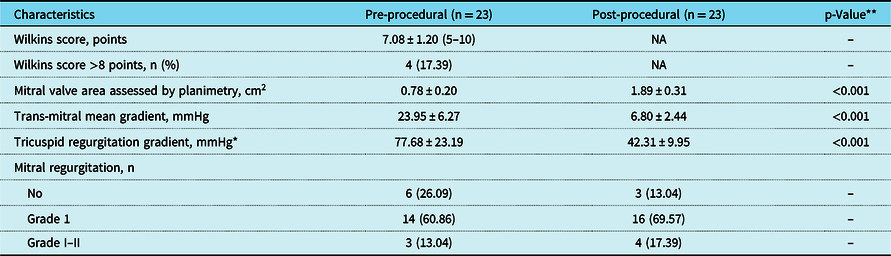
Before the procedure, the lowest and highest values of the mitral valve Wilkin’s score of the study population were 5 and 10, respectively. Following the percutaneous mitral valve balloon commissurotomy procedure, the mean mitral valve area of the study population increased from 0.78 ± 0.20 cm2 to 1.89 ± 0.31 cm2 (p < 0.001). Also, the trans-mitral gradient decreased from 23.95 ± 6.27 mmHg to 6.80 ± 2.44 mmHg (p < 0.001). The drop in the mean value of the peak pulmonary artery pressure of the study population, as measured by taking the peak systolic tricuspid valve regurgitation gradient, was also statistically significant [dropped from 78 mmHg to 42 mmHg (p < 0.001)] (Table 2). There were no embolic events, pericardial tamponade, and an increase in mitral valve regurgitation by two grades, or death during and within 24 hours after the procedure.
Pre- and post-procedural echocardiographic characteristics of the study population
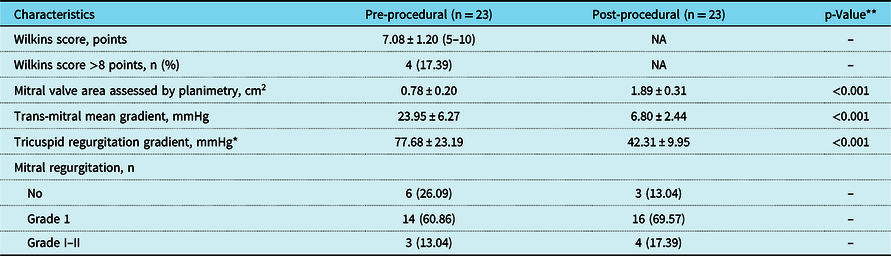
n = Number of patients; NA = not applicable.
* Data are available for 22 patients.
** Wilcoxon signed-rank test.
Discussion
The current study aimed to describe the fetal and maternal outcomes following percutaneous mitral valve balloon commissurotomy procedure that was performed for 23 pregnant mothers with symptomatic severe rheumatic mitral stenosis. There was no procedure-related fetal or maternal death, and the percutaneous mitral valve balloon commissurotomy procedure resulted in statistically significant improvement of haemodynamic conditions and favourable change in the mitral valve profiles of the pregnant mothers,
In the current study, although two-third of the patients knew their cardiac illness before they were pregnant, the fact that most of them (83%) were having either class III or class IV heart failure symptoms might tell us their late presentation. However, pregnancy-related haemodynamic changes can also contribute to the worsening of symptoms in pregnant patients with mitral stenosis. Rheumatic mitral stenosis is known to be the most common cardiovascular disease complicating pregnancy in developing countries.Reference Soma-Pillay, Seabe and Sliwa15 Mitral stenosis during pregnancy is less well tolerated than mitral regurgitation, and it is an independent predictor of poor fetal and maternal outcomes.Reference French and Poppas16 Haemodynamic changes of pregnancy, such as increased stroke volume, and cardiac output have the potential to unmask asymptomatic mitral stenosis during pregnancy.Reference French and Poppas16 Such marked haemodynamic changes and the increased cardiac output have adverse effects during pregnancy and can lead to worsening of symptoms in late gestation, and during labour and delivery.
Our finding indicated that all the patients except one were in sinus rhythm and one patient was in atrial fibrillation. Atrial fibrillation is common among patients with rheumatic mitral stenosis, and it is known to worsen the haemodynamic condition of the patients with increased risk of thromboembolic events.Reference Iung, Leenhardt and Extramiana17 The low prevalence of atrial fibrillation in pregnant women presenting with mitral stenosis in our study is similar to other studies where a similar finding was reported.Reference Salomé, Dias, Ribeiro, Gonçalves, Fonseca and Ribeiro18 This could be explained by the younger age of our patients at presentation.
In the current study, post-procedure mitral valve profiles and haemodynamic assessment findings of the study population indicated that the procedure was successful. One of the main reasons for the procedure to be successful was the favourable mitral valve profile of the patients (mean Wilkin’s score was 7.3) indicating that most of the patients had a low-risk valve for complications during balloon dilatation. Percutaneous mitral valve balloon commissurotomy performed during pregnancy was reported to be effective in providing symptomatic relief and improve the haemodynamic condition of the patients.Reference Vinayakumar, Vinod, Madhavan and Krishnan19
There was no procedure-related maternal or fetal death identified during the current study. Closed mitral valvotomy has a mortality rate of less than 2%, fetal mortality of 1.2 to 8%, and a miscarriage rate of 5 to 15%.Reference Pavankumar, Venugopal and Kaul20 In contrast, open valvulotomy has a fetal mortality rate of 37.9% and in general, studies have shown that surgical procedures during pregnancy are associated with an increased risk of unfavourable maternal and fetal outcomes.Reference Elkayam and Bitar3,Reference de Souza, Martinez and Ambrose9,Reference Sivadasanpillai, Srinivasan and Sivasubramoniam21 Maternal death among pregnant patients with cardiac disease is reported to be associated with the presence of mitral stenosis, presence of severe tricuspid regurgitation, having NYHA functional class III or IV, and presence of symptoms of heart failure at admission.Reference Diao, Kane and Ndiaye4 Given the high morbidity and mortality rate associated with the open surgical procedures, percutaneous mitral valve balloon commissurotomy has become the preferred treatment modality in pregnant women who have valve anatomy suitable for balloon dilatation.Reference de Souza, Martinez and Ambrose9 In view of the hyperdynamic circulation that happens during pregnancy, medical management alone is not expected to provide adequate symptomatic relief or prevent an adverse outcome in patients with severe symptomatic MS.
The dramatic immediate reduction in pulmonary artery systolic pressure from 78 mmHg pre-procedure to 42 mmHg post-procedure in our patient population is noteworthy. Elevated pulmonary artery pressure is the expected finding among patients with rheumatic mitral stenosis, and a previous study that was conducted among patients with rheumatic mitral stenosis showed a significant proportion of the patients who required valvuloplasty were observed to have elevated systolic pulmonary pressure of more than 50–60 mmHg. Although mitral stenosis may lead to fibrosis in the pulmonary arterioles and permanent pulmonary hypertension, the elevated pulmonary artery pressures are more likely to be reversible if the mitral valve pathology is corrected at an earlier age.Reference Maeder, Weber and Buser22
The increase in the mitral valve area size among our study population following the procedure was another interesting finding. After the procedure, the mean mitral valve area of the study population increased from 0.7 cm2 of pre-procedure size to 1.82 cm2 post-procedure. A similar finding of a significant increase in the mitral valve area following the procedure was reported by a study conducted elsewhere. Mitral valve area <1.5 cm2 during pregnancy is poorly tolerated, and percutaneous mitral valve balloon commissurotomy is recommended if the patient remains to be symptomatic under medical management.
Vaginal delivery with the assisted second stage of labour is the preferred mode of delivery for patients with mitral valve stenosis. Adequate pain control, avoidance of tachycardia, and excess preload during labour and delivery have to be the goal of management for patients with mitral stenosis.Reference Tsiaras and Poppas23 The caesarian delivery is generally reserved for obstetric reasons. Except for six, all the patients in the current study delivered through a spontaneous vaginal delivery route.
In our series, all the percutaneous mitral valve balloon commissurotomy procedures had successful immediate outcomes. No patient warranted emergency or elective mitral valve replacement and also no maternal mortality or abortion occurred during or within 24 hours of the procedure. However, there was two fetal death during delivery which was not directly related to the procedure. The first patient had eclampsia in early third-trimester pregnancy and the pregnancy was terminated. The second was a co-twin fetal death for which the cause was not exactly known. Twin pregnancy by itself increases fetal and maternal complications such as premature labour and thus higher perinatal mortality than single pregnancy.Reference D’Alton and Breslin24 Vijayakumar et al. also reported a procedure success rate of 95.6% and an excellent symptomatic improvement.Reference Vinayakumar, Vinod, Madhavan and Krishnan19
In the current study, the magnitude of low birth weight (22.7%) and preterm delivery (17.4%) were higher than the prevalence of low birth weight (17.3%)Reference Endalamaw, Engeda, Ekubagewargies, Belay and Tefera25 and preterm delivery (10.5%)Reference Muchie, Lakew and Teshome26 that was reported from the general population in Ethiopia, and the higher prevalence of such bad pregnancy outcome in our study population can be explained by the effect of the mitral stenosis on pregnancy.
The current study showed the success of percutaneous mitral valve balloon commissurotomy in pregnant patients. However, the procedure is technically complex and carries significant risk. Therefore, it is recommended that the procedure has to be attempted only in centres that have extensive experience with percutaneous mitral valve balloon commissurotomy. The procedure is best done after the period of organogenesis (>20 weeks) but prior to mid to late third trimester in which case the gravid uterus can interfere with catheter access and haemostasis with the femoral approach. In our study, the median gestational age was 22 weeks at the time of the percutaneous mitral valve balloon commissurotomy procedure. The radiation dose was minimised by using abdominal and pelvic shielding, by keeping exposure times as short as possible with collimation and by using echo guidance whenever possible. The median fluoroscopy time was monitored for the majority of patients during the procedure and the median time was 4 minutes and fluoroscopy was used only when absolutely necessary. Data suggest that no increase in the incidence of congenital malformation or abortion occurs if fetal radiation exposure is <5 rads.Reference Williams and Fletcher27 Thus, with proper precautions, the radiation exposure to the fetus can be kept quite small. The risk of even this small amount of radiation to the fetus, however, must be considered unknown, and long-term follow-up of these children is needed.
The limitations of the current study include the small number of the study population and the shorter follow-up period. Our finding may lack generalizability due to the small size of the study population. Also, our finding is only about the immediate outcome following the percutaneous mitral valve balloon commissurotomy procedure and did not address the long-term effect of the procedure both on the mother and the baby born.
Conclusion
In conclusion, percutaneous mitral valve balloon commissurotomy that was performed in our setting during the second trimester of pregnancy was successful. There were no immediate adverse outcomes observed both on the mother and the fetus following the procedure. This is an important finding since rheumatic mitral valve stenosis is common among pregnant women in developing countries such as ours, and the percutaneous mitral valve balloon commissurotomy procedure can be used to save the life of those needy populations. We recommend planners and policymakers to make the percutaneous mitral valve balloon commissurotomy procedure better available by giving attention to manpower training and by building the capacity of those centres that have the potential to perform percutaneous mitral valve balloon commissurotomy procedures.
Acknowledgement
The authors would like to thank Mr. Ali A/Hakim who is a statistician and who did the statistical work.
Financial support
This research received no specific grant from any funding agency, commercial, or not-for-profit sectors.
Conflicts of interest
None.