Though scholarly disagreements abound over how much citizens need to know about politics to make representative democracy work, an unspoken premise is shared: citizens need to know something; it is hard to imagine meaningful elections in which citizens vote entirely arbitrarily. Whether, how, and under what circumstances citizens acquire political information are, therefore, core questions facing observers of contemporary democracies. One immediate answer has been that citizens learn what they need to know by talking with each other. From stable two party elections in the United States of the 1940s, to foundational elections in Africa in the 2000s, opinion leaders have been shown to transmit knowledge, norms, and vote preferences to the people they encounter in the course of their daily lives.Footnote 1 This emphasis on interpersonal learning is both intuitively and normatively appealing. Not only does it resonate with those who sense that democracy is fundamentally social, but it explains how learning occurs even absent access to formal education or media, and it provides the possibility of deliberative movement toward the common good.
Spatial and social inequality complicate this relatively rosy picture, though. In contemporary urban environments, like cluster with like: low-education citizens tend to live in some places, high-education citizens in others. If opportunities for social learning are largely determined by the supply of information in the immediate environment, people whose daily activities involve little contact with the information-rich are disadvantaged. This could exacerbate political inequality, as information accrued to some urban spaces and networks but not others. Ultimately, this would threaten the equality of votes, rendering votes cast in some places noisier signals than votes cast in others.
Yet a more optimistic scenario is possible. Discussion is a helpful medium of political communication for the lowest in education, given its convenience and low cognitive costs, and discussants’ ability to contextualize information and to elicit attention. When information is factual, simple, and intensively diffused by media, conversations can further diffuse it to relatively isolated nodes in urban networks. Thus, I hypothesize that everyday conversations ameliorate spatial inequalities in information that is simple and broadly diffused, but exacerbate gaps in more complex information.
I test these hypotheses by examining a four and a half year period including two presidential elections in the mid-2000s in Brazil. Since Brazil’s democratic transition in the mid-1980s, democracy and the party system have become increasingly consolidated. With currency stabilization in the mid-1990s and the commodity boom of the 2000s, economic growth has lifted millions out of poverty. Still, despite moderate declines, inequality remains among the highest in the world and educational levels remain low. In 2006, 56.2 percent of the electorate had less than a fourth grade education.Footnote 2 Thus, over half of voters may have found it difficult to read a basic newspaper article during the campaign. At the same time, the electoral and party systems remain complex, confusing even sophisticated readers. In this context social influences are particularly powerful guides for political behavior, but low-income Brazilians’ urban networks also perpetuate poverty.Footnote 3 Thus, everyday social interactions could substantially benefit low-education neighborhoods and improve democratic quality; or they could exacerbate political inequalities.
Data come from an ambitious six-wave panel survey conducted between 2002 and 2006 that asked respondents about political discussion habits in each wave. Interviews were clustered in fifty neighborhoods in two cities, enabling scholars to examine how neighborhood characteristics and social context shaped political behavior. The length of the panel survey and the richness of the data thus provide an unprecedented opportunity to grasp the neighborhood level determinants and consequences of political discussion.
Results are striking. Multilevel models reveal that citizens in low-education neighborhoods learn substantially more in basic factual and campaign information from political discussion than do those in high-education ones. Citizens in high-status neighborhoods discuss politics more frequently, but the net result is that preexisting gaps in basic campaign information close over the course of campaigns. However, gaps in general, socially perceived knowledge widen as a result of political discussion.
POLITICAL DISCUSSION, LEARNING, AND INEQUALITY
A robust body of studies shows that in daily life social interactions shape democratic behavior – not only knowledge, but ideology, candidate preferences, and ‘correct’ voting.Footnote 4 Discussions between disagreeing partners are seen as an informal setting for deliberation, increasing understanding of opposing viewpoints and correcting errors in reasoning.Footnote 5 Interpersonal discussions differ from lectures; they are two-way, individually tailored dialogues interspersed with emotion, humor, and the stuff of daily life that situates politics within ordinary concerns. On the ‘receiving’ end, social and emotional bonds, accountability pressure, and shared collective identities make individuals more likely to pay attention to, accept, and remember information their family, friends, and neighbors provide.Footnote 6 On the ‘sending’ end, individuals rehearse political information, practicing responses later elicited in the survey situation.
Political discussion is expected to be both plentiful and influential in Brazil. Brazilians are often garrulous; discussions pop up at bakeries, neighborhood bars, or bus stops. In between gossip about football, family, and the weather, acquaintances may discuss recent news. During campaigns, they might chat about daily television advertisements for candidates or local rallies. Outside election season, they might touch on the latest corruption scandal. Studies show Brazilians to be collectivists, prioritizing in-group over individual interests.Footnote 7 Collectivism has pervasive effects on social and ethical behaviors, and it may lead Brazilians to be aware of and responsive to information from discussants.Footnote 8
Political conversation could be especially helpful for citizens who start out at an information disadvantage. Downs argued that socially supplied information provides a cheap and efficient way for a rational voter to acquire the minimum information needed to make a satisfactory vote choice.Footnote 9 Information held by acquaintances effectively expands the individual’s resources; small amounts of information stored in many heads go a long way when shared.Footnote 10 This low cost makes discussion especially useful for those low in personal resources; one does not need a television, a newspaper, a smart phone, or an internet café. Though the quality of social capital varies, social connections are arguably distributed in a more egalitarian fashion than most political media; regardless of socioeconomic status, most people have family members, friends, or neighbors.
Political conversation is convenient but it can help those low in resources in other ways. Disadvantaged adults may lack cognitive skills and background knowledge to make full sense of news broadcasts, much less of more challenging media such as newspapers. In everyday encounters, they find informants of similar backgrounds, who ‘speak their language’ and contextualize new information in a framework related to daily life. Emotional connections may help overcome resistance to learning.
A large body of research examines how knowledge differentials between high- and low-education citizens widen or shrink during campaigns. In a seminal study, Tichenor, Donohue and Olien showed that Americans with high educational levels typically learned most and quickest, yet later work found this pattern to be contingent and variable.Footnote 11 Whether low-education citizens learn more or less than high-education ones depends on several factors. First, gaps tend to widen for more complex knowledge items.Footnote 12 Secondly, style of presentation and intensity of diffusion matter. Some media increase gaps, and others decrease them; high emotional content and contextual information in news broadcasts help those with lowest education.Footnote 13 Intense diffusion also helps; knowledge gaps shrank during local campaigns in Minnesota characterized by high social conflict and interaction.Footnote 14 Thirdly, attention and motivation strongly affect gaps; when low-education citizens are highly motivated, gaps often decline.Footnote 15 In a lab-based study, high education respondents exhibited greater physiological arousal when watching news, and gaps grew.Footnote 16 Outside the United States, one study found knowledge gaps in Mexico, Russia, and Brazil grew over campaigns, but shrank among those highest in political interest.Footnote 17
Until now, the impact of political discussion on knowledge gaps is little explored. Still, there are reasons it should reduce gaps. First, news provided by cognitively less demanding media tend to ameliorate gaps. Information communicated by family or friends will be cognitively simpler to process even than television news, and often accompanied by emotional and contextual information facilitating understanding. Secondly, chatting with family and friends should command greater attention, especially among citizens lowest in education. Though television news might elicit greater physiological arousal among the highly educated, the ‘arousal gap’ likely disappears in conversation. Thus, a few studies find that political conversation most strongly affects the least informed; in Brazil, studies show that deliberative conversations among disadvantaged citizens can lead to democratic socialization.Footnote 18
Nonetheless, there is a counter-argument: those with more resources are likely to start out with more knowledgeable discussants, especially given residential segregation.Footnote 19 This could produce self-reinforcing patterns: not spirals of silence reinforced by fear of disapproval, but spirals of information or misinformation reinforced by the availability of informed discussants. If political conversation helps to close knowledge gaps between low and high education citizens, neighborhoods will spiral closer to each other as social capital in low-education neighborhoods incrementally improves. But if conversation patterns exacerbate knowledge gaps, neighborhoods will spiral apart. In lab-based discussion experiments, Ahn et al. found that the unequal distribution of expertise across groups imposed additional costs on the disadvantaged, who had to seek information in other groups.Footnote 20 This ultimately led to political biases in favor of the information-rich. What could happen in large cities, however, is different: members of disadvantaged groups may not even be aware of inequalities in expertise, or may be incapable of seeking it in other groups. In such a situation, resulting political biases would be more severe. Neighborhoods falling further behind in information during campaigns would ultimately have lower turnout. Among citizens who voted, electoral choices would contain a greater ratio of noise to signal, especially given the low value of party heuristics in Brazil.Footnote 21
Still, the advantage conveyed by high-sophistication discussants will be most critical when information is complex and not broadly diffused through the media. Political knowledge items that are factual, simple, and relevant will be easier for low-education informants to communicate, and for low-education learners to grasp. Types of knowledge involving ideological reasoning or requiring political sophistication to process may travel less effectively through very low-education networks. In addition, when information is broadly diffused through the media, it is more likely to reach even relatively low-information networks, and to be sufficiently salient to be discussed.
Brazilian politics provides such conditions. Though understanding of the electoral and party systems is very low,Footnote 22 basic information on politicians is broadly and intensively diffused through many sources. Campaigns are highly personalistic, with vote brokers and politicians seeking connections to voters.Footnote 23 In cities, campaigns are noisy, busy affairs involving prominent public displays of candidate information, from advertisements on sandwich boards, to parades, to millions of small flyers (santinhos) handed out at high traffic locations. On TV, the horário eleitoral gratuito gives every candidate access to a free daily period of political advertising, and the Superior Electoral Tribunal runs public information advertisements. Outside of elections, broadcast television news provides ample coverage of politicians’ identities and of political scandals. In addition, compulsory voting laws will boost political attention among the disadvantaged. Though education is correlated with turnout even under compulsory voting, the great majority of low-education voters know they will vote before campaigns begin.Footnote 24 Gordon and Segura show that political sophistication varies cross-nationally by compulsory voting.Footnote 25 When voters know from the outset that they will go to the polls, they may be more motivated to become informed.
In the sections that follow I test two sets of hypotheses. First, I expect that Brazilians’ everyday discussions of politics between 2002 and 2006 equalized preexisting individual-level knowledge gaps in basic, factual political information that was broadly diffused through the media, and that this led to closing knowledge gaps across neighborhoods. Secondly, I hypothesize that political discussions exacerbated individual-level and neighborhood-level knowledge gaps in general, socially perceived knowledge.
THE STUDY, MEASURES, AND ANALYTICAL METHODS
The analysis is based on panel data collected in fifty neighborhoods across two medium-sized Brazilian cities, Juiz de Fora (state of Minas Gerais) and Caxias do Sul (state of Rio Grande do Sul), between 2002 and 2006.Footnote 26 While the two cities have similarities – populations of half a million each, and manufacturing-based economies – they are politically quite distinct. Juiz de Fora, like many Brazilian cities, has weakly organized parties and voted strongly for Lula, the eventual winner of both elections. Caxias do Sul features greater party organization, with the Workers’ Party (PT) representing the left and the PMDB organizing a right-of-center block. Voters in Caxias do Sul defied national trends, largely voting against Lula in both 2002 and 2006.
There are limits to a study of two cities; urban networks may function differently from ones in rural areas, particularly in the less developed North and Northeast. Still, 81 percent of Brazilians lived in urban areas in 2000, and the percentage urban continued to increase in the ensuing decade. More importantly, the large samples at the neighborhood level enable a deeper understanding of neighborhood and personal social context.
The panel study took place over six waves. The first was conducted in April 2002, prior to that year’s presidential election campaign; the second in July, just prior to the period of federally mandated free television advertisements; and the third in October, between the first and second round presidential elections. One and a half years later, in April 2004, the same people were revisited for the fourth wave. The fifth and sixth waves took place during August and October of 2006, at the beginning and end of that year’s campaign. Over the course of the project, 6,950 people were interviewed, split evenly between the cities; 1,401 in all six waves. The analysis is based on all 21,177 interviews across the study.Footnote 27
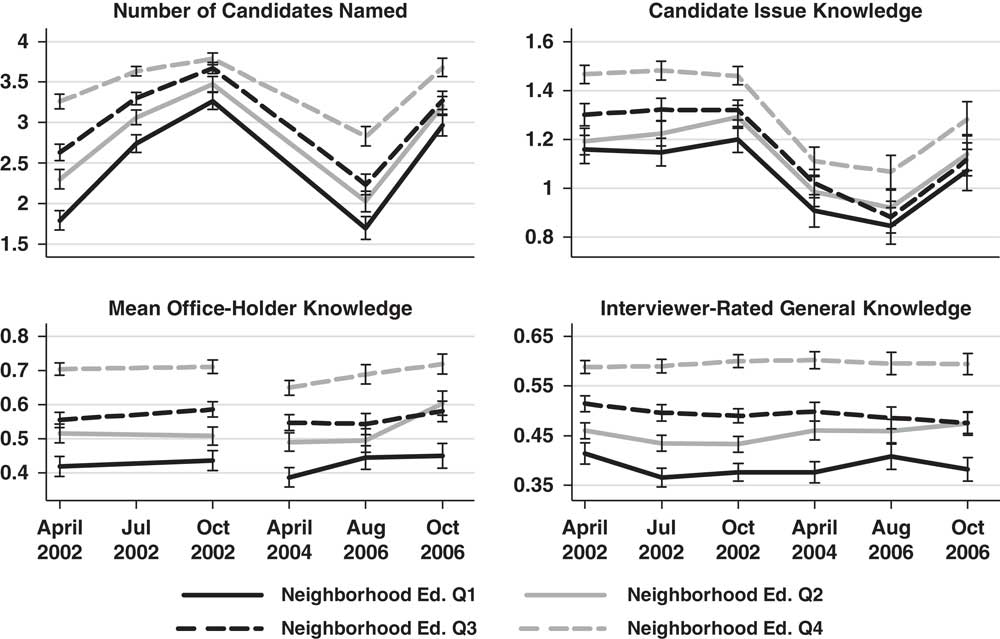
Four measures of political knowledge serve as dependent variables. The first is the number of presidential candidates spontaneously named in reply to an open prompt. This variable is missing from the fourth wave, between election years. While this variable technically has a maximum value of 6 in 2002 and 7 in 2006, counting minor candidates on the survey held by the interviewer, almost no one named all candidates in either year.Footnote 28 Only 2 percent of respondents in October 2002 named more than five candidates, and only 4 percent did so in October 2006. As a result, as the first panel of Figure 1 (see the next section) indicates, the distribution is relatively constant between October 2002 and 2006.
Political Knowledge by Quartile of Neighborhood Education in the 2002 and 2006 Presidential Campaigns

The second measure is that of candidate issue knowledge. In every wave, respondents were asked about Lula’s stances on privatization and land reform, issues historically associated with his Workers’ Party. In each wave, I code indicators for those identifying Lula as ‘opposed’ or ‘strongly opposed’ to free trade, and ‘in favor’ or ‘strongly in favor’ of land reform. They are summed to create a variable running from 0 to 2. As the second panel of Figure 1 indicates, ability to place Lula on the left on these issues varies a good deal over time. It drops between 2002 and 2004, as Lula takes office and moves to the center, and rises again in the final weeks of the 2006 campaign.
The third measure utilizes responses in Waves 1, 3, 4, 5, and 6 to a battery of multiple choice questions asking about key facts regarding prominent politicians.Footnote 29 Across four and a half years, the items varied. In the first and third waves, I create an index from responses regarding the party of incumbent Fernando Henrique Cardoso, and the name of the vice president.Footnote 30 In Waves 4–6, I draw on questions about the vice president (who had changed since Wave 3, and was easier to identify than the previous office-holder); the names of senators from the respective states; and the president of the Chamber of Deputies. The third panel of Figure 1 reveals that despite changes in items, average responses were relatively constant over time, with some learning between 2004 and 2006.
The fourth measure reflects interviewers’ ratings of respondents’ general political knowledge on a five-point scale, recoded from 0 to 1.Footnote 31 As indicated by the last panel of Figure 1, these ratings are highly stable over time. Such ratings indicate not only overall knowledge but also respondents’ socially perceived utility as informants outside their personal circles. After controlling for other measures of knowledge, the interviewer ratings are slightly but significantly associated with interviewer-rated co-operativeness and the interviewee’s income, gender, and race. Nonetheless, apparent biases may also reflect respondents’ articulateness and grasp of more abstract, complex, and ideological political ideas.
These four forms of political knowledge, I argue, are affected by two types of context: the political moment and the urban environment, or in very broad terms time and space. As Gelman and Hill discuss, this implies a non-nested multilevel model, with random effects for both the wave and the neighborhood context.Footnote 32 For an individual i in wave t living in neighborhood n, the level of political knowledge Y itn is theorized as:
 $${\rm Y}_{{itn}} = \beta _{{0tn}} {\plus}\beta _{{1n}} conversation_{{itn}} {\plus} {\rm X}_{{itn}} \beta _{2} {\plus}e_{{itn}.} $$
In this model, both conversation
itn
and the row vector of other traits
 ${\rm X}_{{itn }} $
are time-varying characteristics of the respondent. However, the coefficient
 $\beta _{{1n}} $
is conditioned by the mean level of education in the neighborhood,
 $$\beta _{{1n}} =\gamma _{{11}} mean\_education_{n}. $$
The outcome equation’s intercept
 $\beta _{{0tn}} $
varies by both wave and neighborhood:
 $$\beta _{{0tn}} = \gamma _{{00}} {\plus} \gamma _{{01}} election\,month_{t} {\plus} \gamma _{{02}} mean\_education_{n} {\plus}u_{t} {\plus}v_{n}. $$
where u t and v n are normally distributed random error terms centered on 0. Thus, the level of political knowledge of a particular person in a particular place and time depends on the political calendar; on neighborhood education; on the individual’s own characteristics; on the interplay between personal characteristics and neighborhood education; and on idiosyncratic aspects of places, times, and people captured in the three error terms.Footnote 33
Neighborhood context is measured using mean education from the 2000 census. In twelve neighborhoods where census data were unreliable, values are imputed.Footnote 34 In multivariate analysis, the variable is recoded from 0 to 1; in bivariate figures it is coded in quartiles. The models also include a contextual variable for election months; and random effects for neighborhood and wave.
The key independent variable is an index of political conversation. In each wave, respondents described how frequently on a four-point scale (from ‘never’ to ‘frequently’) they talked about politics with family, with friends, and at work or school. Responses were transformed to run from 0 to 1 and averaged to create an index, with higher values indicating more frequent discussion.Footnote 35
The analysis includes a number of other personal-level variables, all rescaled from 0 to 1. Personal education was originally reported on a 0–15 scale. Television news and newspaper frequency are based on the days per week the respondent reports news from each source. Income is based on reported monthly household income in reais (R$); this is logged and then rescaled. I control for several demographic factors. Women and those from disadvantaged racial groups may have lower knowledge.Footnote 36 Age is coded in groups; political knowledge is expected to rise over the life course but drop for respondents over seventy, for whom voting is not legally compulsory. I also measure circumstances that may affect access to informed discussants: employment and student status, church attendance, and residence in an apartment building (a marker of the upper middle class in Brazil). Finally, I control for interviewer-rated cooperativeness, since cooperative interviewees may work harder to respond to knowledge questions.
It is important to acknowledge the difficulty of establishing causality in studying social influence. In the real world, political attributes such as knowledge must surely affect the opportunity and motivation to discuss politics, even as discussion in turn shapes those attributes. This problem of mutual influence has been tackled in several ways. Experimental designs demonstrate clearly that social stimuli affect behavior, yet raise concerns about external validity, particularly when studying the consequences of discussion for urban inequality.Footnote 37 Longitudinal studies make it possible to control for time-varying and invariant personal factors potentially associated with rising or falling political knowledge.Footnote 38 A third approach involves instrumental variables, yet the difficulty of finding adequate instruments for social stimuli has limited such attempts.Footnote 39 Though developing appropriate instruments for conversation is difficult in these data, exploratory fixed-effects instrumental-variables models indicate that an exogenized measure of conversation is positively associated with candidate mentions and issue knowledge at p<0.05, and with interviewer-rated knowledge and ‘quiz’ responses at p<0.1 (one-tailed).Footnote 40
RESULTS AND DISCUSSION
The key hypotheses are that neighborhood education and political conversation interact to affect political learning, shaping knowledge gaps. Before testing these hypotheses, though, I present two figures: the first displays the over-time relationship between political knowledge and neighborhood education and the second the over-time relationship between conversation and neighborhood education. These serve as a starting point for understanding how knowledge gaps opened or closed, and the possible role of conversation. I then present regression analysis examining how political conversation interacted with personal education in determining knowledge. Finally, I test hypotheses regarding the interaction between neighborhood education and political conversation.
Figure 1 shows that political knowledge is distributed unevenly across space. At the beginning of the study, in April 2002, the average respondent in neighborhoods in the top educational bracket could name more than three pre-candidates, while the average respondent in the lowest education neighborhoods could name just a little over half as many. There was also a sizeable gap between neighborhoods in issue knowledge: at the beginning of the study, the average respondent in a high-education neighborhood could identify about 0.3 more issues correctly. Moreover, ‘quiz’ scores on office-holder knowledge in the highest education neighborhoods were consistently more than 50 percent higher than those in the lowest education neighborhoods. Finally, interviewers rated the knowledge of average respondent in a high-education neighborhood nearly 50 percent higher than the knowledge of the average respondent in a low-education neighborhood.
The extent to which these gaps grew or shrank over the course of the study varies by the type of knowledge being examined. Campaigns helped respondents in the lowest education neighborhoods ‘catch up’ in knowledge of who the candidates were; in October 2002 the gap between the lowest and the highest education neighborhoods had narrowed to just 0.5 candidates, and at the same point in 2006 the gap was 0.7 candidates. However, gaps were large over time for the other three measures of knowledge. Respondents in all neighborhoods grew in office-holder knowledge between 2004 and 2006, as they learned more about their currently elected representatives.
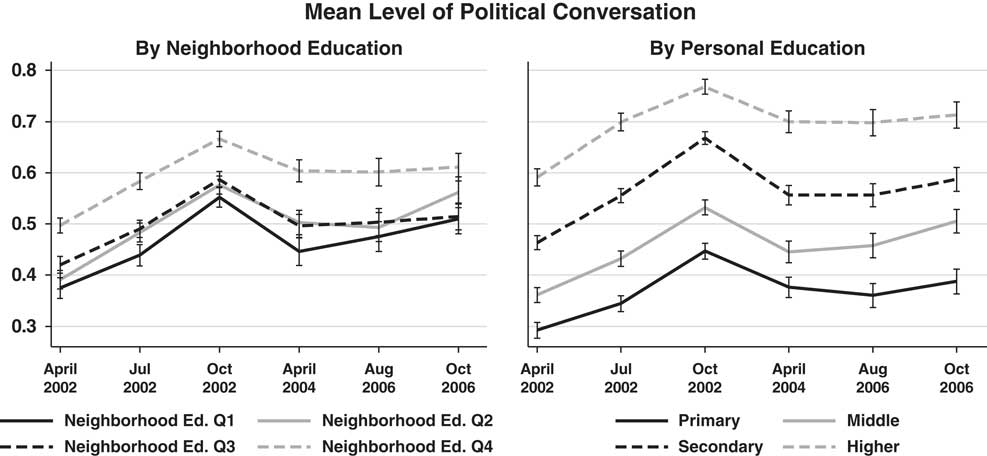
Could greater political conversation in low-education neighborhoods have helped to close gaps in candidate mentions? In Figure 2, I examine levels of political discussion over time, by personal and neighborhood educational level. Neighborhood education is not strongly associated with political discussion, though neighborhoods in the top quartile of education do discuss politics more; personal education strongly shapes discussion.Footnote 41
Mean Levels of Political Conversation, by Personal and Neighborhood Education

Thus, the shrinking gap in candidate knowledge clearly did not result from more frequent conversation in low education neighborhoods. But perhaps low-education citizens learned more than others when they took part in political conversations. If differences in conversation’s impact were sufficiently large, knowledge in low-education neighborhoods would have grown more rapidly. As stores of knowledge grew, residents would have had progressively improving stocks of human capital, further facilitating learning. Thus, relatively similar levels of conversation across neighborhoods could have led to greater learning in low-education neighborhoods, in the aggregate.
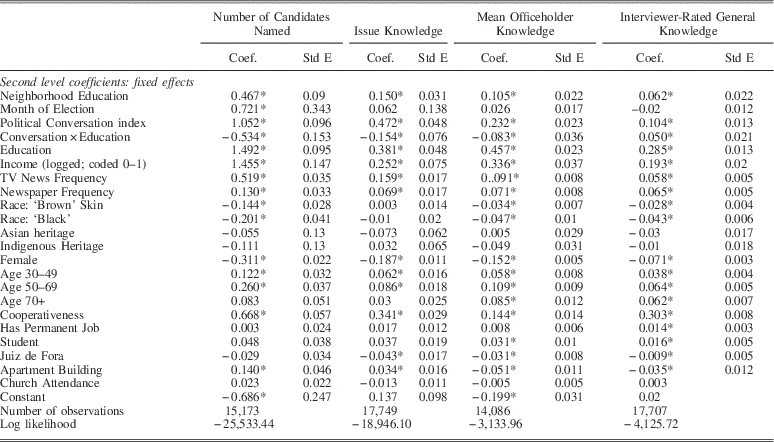
I begin by examining conversation and knowledge gaps at the individual level, and then at the neighborhood level. In Table 1, I present non-nested multi-level models assessing how political discussion was associated with four knowledge measures.Footnote 42 Several key findings stand out. First, when political conversation rises, so does political knowledge. Reading the non-interacted coefficients and moving from the minimum (0) to the maximum (1) levels of political conversation, this variable is associated with a one candidate rise in candidate recall, with an ability to place 0.5 more candidate issues, with a rise of 23 percentage points in scores on the office-holder information ‘quiz’, and with a 0.1 unit rise in interviewer-rated political knowledge, on a 0–1 scale.
Non-nested Multilevel Models: Determinants of Political Knowledge

Note: Models include random effects for all six waves, and for neighborhood education. All independent variables are coded to run from 0 to 1. Dependent variables are coded 0–3, 0–2, 0–1, and 0–1, respectively. Coefficients are significant at *p<0.05.
Secondly, though, political conversation’s effect on knowledge varies in statistically significant ways by education. The impacts just discussed are only valid for those with no formal schooling. Political conversation is most strongly associated with the three specific forms of knowledge among those lowest in education. However, the opposite pattern is found for general, interviewer-rated political knowledge; political conversation is associated with a larger rise in this form of knowledge among those highest in education. In this group, frequent political conversation may have been associated with articulateness as well as a sophisticated use of ideological concepts and political principles.
Looking at the interaction another way, personal education is strongly associated with all four forms of knowledge, but its effect on the three specific and factual forms is lower among who regularly talk politics. In other words, conversation partially substitutes for education; the schools of daily life help compensate for a lifetime of educational deficits. Nonetheless, this pattern is reversed for socially perceived general knowledge. Here, political conversation only augments pre-existing disparities.
Thirdly, note that neighborhood education shapes what citizens know, even after controlling for citizens’ own personal education. For instance, moving from a very low to a very high education neighborhood is associated with nearly a half-candidate rise in candidates named. These effects again suggest that neighbors affect what one knows.
A fourth key finding is that income is also strongly associated with knowledge; moving from its minimum to maximum levels has an effect similar to that of education. Controlling for other characteristics, a person with maximum education and income who never talks about politics is predicted to know nearly three more candidate names, to place Lula on the left on 0.63 more issues, to have 79 percent higher ‘quiz’ scores, and to be 0.48 points higher in general knowledge than a person with no education or income who never talks politics. Income indicates aspects of educational quality insufficiently captured in years of schooling. With the expansion of democracy, state capacity, and programs for social inclusion, public school enrollment has risen dramatically. Still, the real quality of a middle school or a high school education varies dramatically by the type of school, which is largely determined by family income.
Other results bear mentioning. First, exposure to television news is strongly associated with candidate knowledge, while reading newspapers is less important; neither, however, matters as much as simply talking with other people. Both forms of news consumption have lower associations with other forms of political knowledge. In addition, those coded as ‘brown’ or ‘black’ by interviewers have somewhat lower levels of political knowledge, even controlling for education, income, and neighborhood, which are all themselves associated with race. Gender has a much larger independent effect on each knowledge measure than skin color. Finally, with respect to age, we do find evidence that political information grows over the life course; however, senior citizens’ information levels only drop significantly for campaign-related knowledge. Finally, other aspects of life circumstances – employment and student status, church attendance, and residence in an apartment building are largely unrelated to levels of political knowledge.
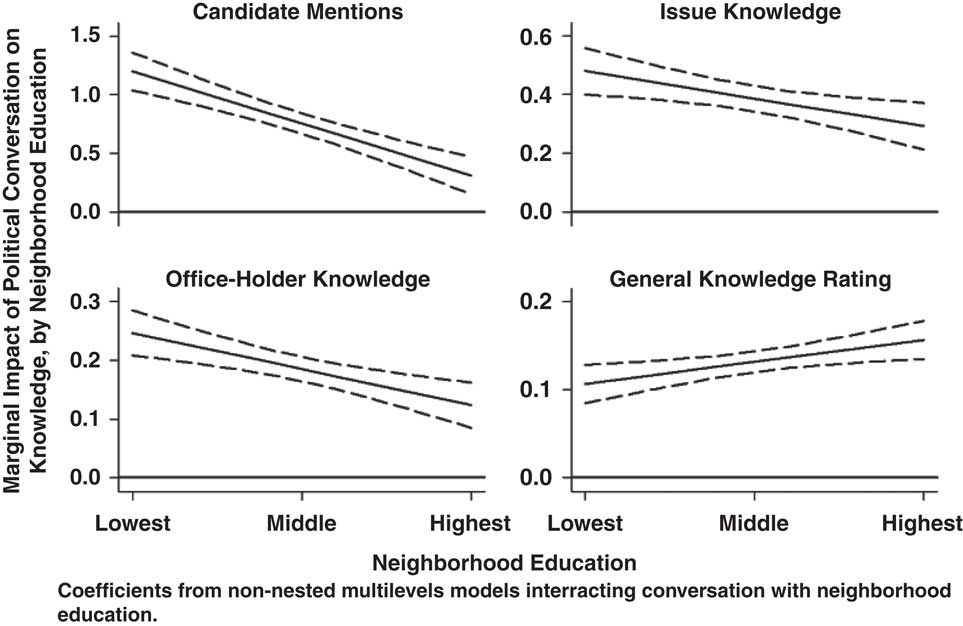
How does political conversation shape knowledge gaps across neighborhoods? In Figure 3, I present coefficients from a multilevel model in which neighborhood education is interacted with political conversation.Footnote 43 In all four models I find interactive effects. In the lowest education neighborhoods, going from the minimum to the maximum level of political conversation is associated with more than a one-candidate rise in candidate mentions, a half-issue rise in identification of Lula’s policy positions, a 25 percent rise in scores on the ‘quiz’ of officeholder knowledge, and a 0.10 unit rise in interviewer-rated general knowledge. In the highest education neighborhoods, conversation is associated with changes in each of the three specific and factual forms of political knowledge that are half or less of that size. However, the impact of political conversation on general, interviewer-rated political knowledge is about 50 percent higher in the highest-education neighborhood.
The Association between Four Types of Political Knowledge and Conversation, by Neighborhood Level of Education

Thus, political conversation’s impact on knowledge varies across neighborhoods. For conversation actually to help close gaps, though, the extra ‘boost’ per unit of conversation, so to speak, in low-education neighborhoods must balance out the somewhat higher levels of conversation in high education neighborhoods. To understand how the differential levels and effectiveness of political conversation shape knowledge gaps, let us take the cases of the very lowest and the very highest education neighborhoods in the sample. The former, which we will call Neighborhood A, is a high density pocket of poverty clinging precariously to a steep hillside; the latter, which we will call Neighborhood B, is on level ground in a valley, within walking distance if one chose of downtown, a home to prominent politicians and business people.
At the height of the 2002 campaign, the mean level of political conversation in Neighborhood A was 0.45, on the 0–1 scale; in Neighborhood B, it was 0.73. Given these levels of conversation and coefficient estimates from Figure 3, political conversation in Neighborhood A contributed to the average person knowing the name of about 0.54 more candidates, to being able to place Lula’s position on about 0.22 more issues, to a 0.11 boost in office-holder knowledge, and to a 0.05 increment in interviewer ratings. In Neighborhood B, political conversation contributed to the average respondent knowing the name of about 0.23 more candidates, to being able to place Lula’s position on about 0.21 more issues, to a 0.09 rise in office-holder knowledge, and to a 0.11 increment in interviewer ratings of political knowledge. Thus, gaps in candidate knowledge closed over the course of the campaign, yet there was little change overall in gaps in other forms of political knowledge. At the same time, it is also apparent that when citizens regularly discuss politics, gaps in factual knowledge across educational groups and neighborhoods will tend to close, yet gaps in general, socially perceived knowledge will widen.
DISCUSSION AND CONCLUSION
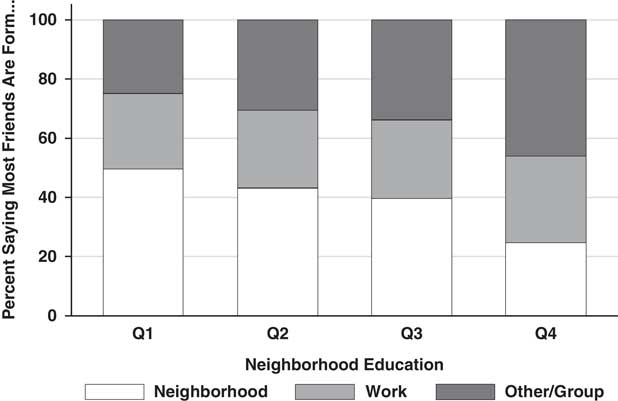
During election campaigns, some people actively seek out political information – they read the newspapers or tabloids; they follow political scandals; they stop what they are doing to watch political advertisements on television. Such people may naturally become opinion leaders, sharing their opinions with anyone they can trap into a conversation. Most people, however, are not political junkies, and many may not particularly like or be interested in politics. For this larger group, the supply of discussants may matter a great deal. Some members of this second group will naturally encounter a great deal of useful information through the people they run into in the course of their daily lives, over a campaign becoming more motivated and secure in their vote choices; others may encounter no such stimuli. In the Brazilian case studied here, as Figure 4 indicates, social class is strongly associated with patterns of socialization; residents of low-education neighborhoods may be particularly affected by neighborhood information deficits.
Socialization within and outside Neighborhoods, by Personal Levels of Education

If citizens in disadvantaged neighborhoods systematically encounter social information deficits, the result will be widening political inequality. At the same time, such citizens are especially likely to benefit when they do encounter political information through daily social contacts. Political conversation may be more egalitarian in its impacts even than televised news; relative to other sources of political communication, conversation is convenient, cheap, attention-inducing, and cognitively simple to process. Hence, when political information is relatively diffuse across networks throughout an urban area, conversation can contribute to greater learning in less advantaged networks.
Both the type of political knowledge and the broader information environment will condition whether political conversation equalizes or stratifies political knowledge. Ahn et al. found that initial disparities in information across groups led to political biases in favor of the initially advantaged groups. Such outcomes are more likely, however, when information is complex and not widely diffused through other media during the information search process.Footnote 44 Even networks comprised of low-sophistication informants may get access to basic and intensively publicized political facts, such as the identities of candidates and office-holders. When information is simple, broadly diffused, and salient, not only is it more likely someone in one’s social network will know it, but the information is more likely to pop up in conversation even when no one really wants to talk about politics. More complex, abstract, and ideological types of political knowledge are much less likely to be communicated through low-education networks.
In this four and a half year period in Brazil, basic political information was indeed broadly diffused through the media and by personalist elites. This included the kind of information needed to make a minimally informed vote choice: the names of candidates and office-holders; the positions of the most prominent candidates on important issues of the day. Even citizens without formal schooling, living in neighborhoods with few educational opportunities, were highly likely to know someone who could convey the information needed to make a basically informed voting decision. Compulsory voting may have helped to motivate information searches. Thus, through relatively simple social processes unfolding within the daily lives of many tens of millions of citizens, Brazilians were able to learn at least some of what they need to know to cast a vote.
While the case studied here is one where we would expect political conversation to help those in relatively low-education neighborhoods and networks, Brazil is not unique. Across developing democracies, personalist politicians, local leaders, and widely diffused public information campaigns aim to make available the information very low-education citizens need to make vote choices. When efforts succeed, it is likely in large part due to the multiplier effect of personal conversation. A country-wide civic education campaign during Kenya’s 2002 democratic transition was found to trigger millions of post-workshop conversations across the country, leading to greatest gains in political knowledge and democratic orientations among those lowest in education.Footnote 45
Still, there are obvious limits to the extent to which social processes can ameliorate social and political inequality. In the case studied here, conversations did not convey to low-education citizens the political sophistication interviewers valued when rating overall political knowledge; conversation actually contributed to growing gaps in general, socially perceived political knowledge. And even when measuring basic political facts, urban geography and personal education are still related to what one knows about politics at the end of a campaign. Further, campaigns are time-limited; between one campaign and the next political information levels ‘reset.’ Ultimately, rising educational levels and improving media access are most likely to contribute to the long-term leveling of disparities in political information. It is thus important that Brazilians’ educational and literacy levels have been rising rapidly in recent decades. Nonetheless, those familiar with Brazilian public education will know that much work remains.