In modern presidential democracies, a president's popularity is important to both the president and president watchers. Greenstein (Reference Greenstein and Barber1977: 121–2) defines presidential approval rating in terms of four basic psychological functions of ‘what the president means to a country’: (1) a symbol of the nation; (2) a way of feeling about one's country; (3) a cognitive aid and a single individual to symbolize the complexity of government; and (4) a means of vicarious participation through which people identify with the president and feel more a part of events occurring around them. A president's approval rating not only demonstrates public opinion of the president's administration, but also makes him/her accountable for his/her governance. High presidential approval ratings not only represent a green light for what he/she has done so far, but also fuel his/her governance in the future. Contrarily, a low approval rating might cripple the president and force him/her to adapt his/her policy to public opinion.
On 22 March 2008, the Kuomintang (KMT) candidate Ying-jeou Ma defeated the ruling Democratic Progressive Party's (DPP) candidate Frank (Chang-ting) Hsieh in the Republic of China's 12th presidential election. Ma won the presidency with 59% of the vote, and brought about the second turnover of power in the process of Taiwan's democratization. According to a post-election telephone survey, when Ma took office in May 2008, 82% of citizens were optimistic and supported his administration.Footnote 1 The KMT's super-majority in the Legislative Yuan together with Ma's high popularity should have fueled Ma's governance and enabled him to successfully fulfill his campaign platform, which emphasized rehabilitating Taiwan's economy. While each president more or less faces a gradual decrease in his/her presidential popularity after taking office, a telephone survey in July, however, showed that Ma's approval rating experienced an unusually steep decline to 30%.
Ma's decreasing presidential approval rate was mainly attributed to the dramatic decline in Taiwan's national economy. Among the promises Ma made during his campaign, the most attractive was the 633 Plan, which called for an economic growth rate of 6%, an unemployment rate of less than 3%, and per capita income of more than US$30,000. Nevertheless, right after Ma's inauguration, Taiwan's economy experienced a historic recession. According to the Directorate-General of Budget, Accounting and Statistics, Executive Yuan, Taiwan's annual economic growth rates plummeted from 5.38% to –0.8% in the third quarter and to –8.36% in the forth quarter. Together with the plunge in the economic growth rate, the high unemployment rate (6.13%) and high consumer price index (4.78%) contributed to a high misery index (7.5) not seen in 28 years. In Figure 1, we incorporate Ma's approval and disapproval ratings with the Taiwan Weighted Stock Index (TWSI). The stock market reflected Taiwanese citizens’ high expectations of Ma's economic policy and rose from 7673 points in February to 9000 in March. Meanwhile, Ma's approval rating rose from 50% to 80%. Nevertheless, as the stock index declined from 9309 on 20 May to 5641 on 19 September 2008, Ma's approval ratings plummeted from 82% to 19% and the disapproval ratings rose from 10% to 59% in six months. The dramatic decline in Ma's popularity put his administration on alert.
Ma's approval rations and Taiwan Weighted Stock Index (TWSI)

The plunge in Ma's approval rating merits empirical investigation. First, the dramatic decrease in presidential popularity occurred within the first three months of Ma's presidency. Such a rapid decline in the approval rating has rarely been observed during a president's honeymoon period. In addition, according to Hsieh et al. (Reference Hsieh, Lacy and Niou1998), retrospection on economic conditions, both national and pocketbook, is not associated with Taiwanese voters’ voting decisions. Nevertheless, the simultaneity between the plummeting stock index and Ma's popularity provides counter evidence, showing that economy matters. Last but not least, because Ma just assumed office in May and was still learning the ropes, voters actually had no reference point from which to judge the performance of his administration. Retrospective voting theory does not completely apply in Ma's case. Thus, studying Ma's case helps us understand why voters update their evaluations of a new president and what might affect the change in their opinions. We develop an expected service-perceived service gap model and assert that due to attractive promises a president makes during a presidential campaign and the favorable reports about him/her in the mass media, his/her supporters generally have high reliance on the new president, which is positively correlated with their initial evaluations of the president (Mueller Reference Mueller1977). When citizens’ anticipations for the president are not met, they automatically update their assessments of him/her. In the Taiwanese case, while Ma's discommenders consistently held low opinions of him, the supporters were discouraged by their feeling of disappointment over Ma's incapacities. As a result, the drastic decrease in the evaluation of Ma mainly came from the supporters with high expectations for him, instead of from the opposition camp. To provide empirical support for our hypotheses, we incorporate a theoretical model with Taiwan's Election and Democratic Study (TEDS) panel survey data, which was collected after the 2008 legislative and presidential elections. The statistical results evince that the change in citizens’ evaluations of President Ma were not only significantly associated with the gap between respondents’ expectations for and perceptions of the national economy, but also the gap between their expectations for and perceptions of Ma's attitude toward unification and independence.
1. Theory of approval/disapproval
Since Mueller first explained the fluctuations in presidential popularity, studying presidential approval rating has become popular in political science due to its significance (Mueller, Reference Mueller1970). Scholars examine the change in presidents’ approval ratings and try to figure out the factors that are consistently and significantly associated with the increases and decreases in presidential popularity. Among various factors, time is generally considered to be the most important one affecting a president's approval rating. Mueller (Reference Mueller1970: 22) and Stimson (Reference Stimson1976) both argued that a president's popularity diminishes after his/her inauguration. Kernell (Reference Kernell1978) examined monthly opinion surveys which began in the mid-1930s and found that every US president, except Eisenhower, left office less popular than when he entered. In addition to time, political scientists found that economic prosperity (Brace and Hinckley, Reference Brace and Hinckley1991; Fuchs and Klingemann Reference Fuchs, Klingemann, Klingemann and Fuchs2003; MacKuen, Reference MacKuen1983), foreign affairs, and special events, including wars, peace treaties, and international military actions, also determine presidential popularity (Brace and Hinckley, Reference Brace and Hinckley1991: 1002; Mueller, Reference Mueller1970: 20–2; Kernell, Reference Kernell1978: 512).
Conventional studies of presidential approval shed light on the studies of citizens’ evaluations of presidents and vertical accountability. Associating monthly reports of presidential popularity published by Gallup with time-series analytical techniques, scholars have examined how exogenous factors, such as economic conditions and foreign affairs, together with endogenous factors, namely past presidential approval, affect a president's current popularity. Their findings not only point out the public issues that concern citizens the most, but also provide presidents and their administrations with practical suggestions for their governance. Despite their significant contributions, political scientists admit that conventional studies of presidential popularity have determined very little about which factors might affect presidential approval (Edwards III et al., Reference Edwards III, Mitchell and Welch1995: 109). Although the length of time in office has a strong correlation with the president's monthly public approval ratings, conventional studies simply demonstrated how a president's past approval rating affects his/her current popularity, but failed to provide a systematic theory for interpreting this finding. In addition, since political scientists mainly investigated the impact of various factors on presidential approval (Mueller, Reference Mueller1970: 24; Kernell, Reference Kernell1978; Hibbs, Reference Hibbs1982; Monroe, Reference Monroe1984: 43–70; Ostrom and Simon, Reference Ostrom and Simon1985), their conclusions were constrained by the span of time-series data they had in hand. Therefore, we should not be surprised that a war might have different impacts on two different presidencies.Footnote 2 Third, conventional studies assumed that as circumstances change, citizens’ support for a president also changes. In fact, these studies did not investigate citizens’ perceptions of government performance, but simply replaced their perceptions with the aggregate-level data and failed to notice that the aggregate-level variables could not be directly inferred from respondents’ personal perceptions of, and their satisfaction with, government performance at the individual-level.
To address these questions, we investigate individual evaluations of a president from a psychological perspective instead of relying on aggregate-level approval ratings. We employ the concept of ‘the expected service–perceived service gap’ and assert that a new president's initial popularity reflects citizens’ expectations of him/her and that the change in citizens’ assessments is a measure of how well government performance matched their expectations. In addition to the gap between voters’ expectations and perceptions, we also claim that citizens exposure to the media is also a determinant of their evaluations of a president at any particular point in time.
2. Expectations, perceptions, and evaluations
In a modern democracy, the government offers public goods and services to satisfy citizens’ demands. Citizens, on the other hand, provide their support, material and non-material, as well as their requests for what they want the elected officials to do (Easton, Reference Easton1965: 19). Before a new president assumes office, citizens can hardly assess his/her performance since the president has not yet started to fulfill his/her campaign promises. Given the lack of information on his/her administration, citizens focus on the personal qualities of the president to gain important information about the characteristics relevant to assessing how he/she will perform in office (Popkin et al., Reference Popkin, Gorman, Phillips and Smith1976; Shabad and Andersen, Reference Shabad and Andersen1979). Therefore, citizens’ initial appraisals of a new president are highly associated with their voting choices, which are influenced by the president's personal traits,Footnote 3 his/her policy platforms, attitudes toward crucial public issues, and partisanship. For those who voted for the president, they not only agree with his/her policies, but also believe that he/she can fulfill the promises made on the campaign trail. Contrarily, for those who voted for other presidential candidates, they have relatively low confidence in the president due to their disagreement with the president's policies or their doubts about his/her capabilities to fulfill campaign promises. In short, citizens’ initial estimates of a new president are not only aligned with their voting decisions, but also reflect their expectations for the president's performance (cf. Kopalle and Lehmann Reference Kopalle and Lehmann1995; Parasuraman and Berry Reference Parasuraman and Berry1985; Smith and Houston Reference Smith, Houston, Berry, Shostak and Upah1982). As the celebration of his/her commencement ends, the new president begins to face the realities of governing. When citizens perceive that government performance meets their expectations, they strengthen their support for the president, and withdraw their support when their expectations are not met.
The expected service-perceived service gap helps us explain new presidents’ high popularity at their inaugurations. Studies show that presidents rely on their relations with the press because the media can exert a positive influence on citizens’ evaluations of a president's performance (Ragsdale, Reference Ragsdale1984; Kernell, Reference Kernell1986; Grossman and Kumar, Reference Grossman and Kumar1981: 35–7). When a president takes office, due to his/her appealing platform during the election campaign and the rhetoric and imagery of the election celebration broadcast by the mass media (Brace and Barbara Hinckley, 1991: 996), the new president and his/her administration are highly promoted. Even though his/her speeches, activities, and performances (good and bad) are in the spotlight, in general the new president receives affirmative treatment from the public (Brody, Reference Brody1991: 59) and the media (Hughes, Reference Hughes1995; Grossman and Kumar, Reference Grossman and Kumar1981). Due to the complimentary reports in the mass media, the public has a relatively clear idea about the president in the weeks following his/her inauguration – the so-called ‘honeymoon period’ (Dominguez, Reference Dominguez2005: 64). This mechanism thus generally shapes presidents’ high standing in the opinion polls in their first year year, as citizens generally have high expectations for new presidents’ leadership (Brace and Hinckley, Reference Brace and Hinckley1992: 997–1001; Brody, Reference Brody1991: 32–4).
Although citizens’ foremost support for a new president shapes his/her high popularity at the time of taking office, it also delimits the extent of the change in their evaluations of the president. In contrast to the probability of maintaining his/her high popularity, a president is more likely to encounter a gradual decrease in his/her presidential approval after the inauguration. First of all, the new president has to face the reality of governing and there is no guarantee that he/she will be able to fulfill his/her promises (Rose et al., Reference Rose, Mishler and Haerpfer1998: 147). In addition, public policy cannot possibly please everyone, and apparently meeting citizens’ high expectations is not an easy task. In Figure 2, we roughly distinguish citizens with high expectations and support for a president from those with low expectations. In contrast to people with low expectations for the new president, citizens with high expectations are harder to please. As shown in Figure 2, while citizens with low confidence are satisfied with the government's fair performance and raise their evaluations of the president accordingly, citizens with high hopes lower their opinions of him/her because he/she fails to meet their expectations. As a result of this political reality, citizens update their evaluations of the new president, and the higher the confidence citizens initially had in the president, the more disappointed they may be (Craig Reference Craig1980, Reference Craig, Niemi and Silver1990; Gamson Reference Gamson1968; Ostrom and Simon, Reference Ostrom and Simon1985). Eventually, the artificially high popularity generally starts to decline after the end of the honeymoon period (Cronin, Reference Cronin1980: 46; Heclo and Salamon, Reference Heclo and Salamon1981).
Citizens’ expectations, government performance and their evaluations of a new president
3. Government performance on salient issues
As discussed above, citizens’ initial high expectations of a president and their perceptions of government performance affect their assessments of the president. Nevertheless, because government provides a great variety of public goods, it is unreasonable to assert that citizens give equal weight to all pubic issues. The more a pubic issue concerns citizens, the greater the affect of government performance on the president's approval rating (Edwards III et al., Reference Edwards III, Mitchell and Welch1995: 109). Scholars of presidential popularity generally concur that economic prosperity is the most important exogenous factor that constrains presidents and significantly impacts presidential approval. Since Mueller (Reference Mueller1970, Reference Mueller1973: 2–4) and Kramer (Reference Kramer1971), political scientists have shown that economic prosperity not only affects government popularity (e.g. Kenski, Reference Kenski1977; Kernell, Reference Kernell1978; Edwards III, Reference Edwards III1983: 50–2; Arcelus and Meltzer, Reference Arcelus and Meltzer1975; Owens and Olson, Reference Owens and Olson1980; Hibbing and Alford, Reference Hibbing and Alford1981), but also has a powerful effect on incumbents’ election outcomes (Erikson, Reference Erikson1989: 567–73; Lewis-Beck and Lockerbie, Reference Lewis-Beck and Lockerbie1989; Fiorina, Reference Fiorina1981; Lewis-Beck and Bellucci, Reference Lewis-Beck and Bellucci1982; Markus, Reference Markus1988; Sigelman, Reference Sigelman1979), and citizens’ estimations of incumbent presidents.Footnote 4 This argument not only empirically holds in the United States, but also does so in Great Britain, France (Lewis-Beck, Reference Lewis-Beck1980: 306–23), Italy (Lewis-Beck and Bellucci, Reference Lewis-Beck and Bellucci1982), and the former West Germany (Baker et al., Reference Baker, Dalton and Hildebrandt1981). To sum up, we can simply argue that the stronger the performance of the economy, the higher the public approval rating of the president, and vice versa (Norpoth and Yantek, Reference Norpoth and Yantek1983).
In addition to economic prosperity, foreign affairs and special events, such as wars, bombing raids, summit meetings, international military actions, and peace treaties, also influence presidential popularity (MacKuen, Reference MacKuen1983). A president is the leader of a country and his/her diplomatic performance not only represents the country's status and prestige in the international community, but also affects the country's international relationships with others, including its international economy and security. MacKuen (Reference MacKuen1983: 174) found that Jimmy Carter's announcement of a peace agreement between Israel and Egypt in 1978 and Richard Nixon's announcement of a formal end to the Vietnam War in 1973 both caused a surge in their popularity. Similarly, after the 9/11 attacks in 2001, George W. Bush's approval ratings immediately surged from 51% to 90% due to his declaration of war on terrorism.Footnote 5 The studies above point out that a president's diplomatic achievements significantly impact his/her popularity.
Based on the discussion above, we argue for a positive relation between voters’ expected service–perceived service gap and the decrease in their evaluation of a president. The greater the gap between citizens’ expectations of and their perceptions of government performance on economic development and international relations, the more likely they are to update their support for the president accordingly.
4. Mass media exposure and evaluation
Assessing presidents requires citizens to equip themselves with an awareness of salient public issues and information about government performance. Nevertheless, whether or not an issue is important to the public, and citizens’ attitudes toward that issue, it is to some degree affected by the media. Studies of political communication have proven that the mass media has a great impact on public perceptions of salient issues (Mutz, Reference Mutz1992: 498–9; Becker et al., Reference Becker, McCombs, McLeod and Chaffee1975; McLeod et al., Reference McLeod, Becker and Byrnes1974). As Edelman has pointed out: ‘For most people most of the time, politics is a series of pictures in the mind, placed there by television news, newspapers, magazines, and discussions’ (Edelman, Reference Edelman1964: 5). In modern democracies, the information about the government's service and performance is mainly transmitted to the public via the mass media. Brody and Page (Reference Brody, Page and Wildavsky1975: 140) studied the relationship between the valence of news coverage and the popularity of President Johnson and President Nixon. They asserted that the media plays a critical role in transmitting the information necessary for evaluating presidential performance. Scholars found that Reagan experienced an immediate and severe dip in his approval ratings when the media began covering the Iran–Contra affair (Krosnick and Kinder, Reference Krosnick and Kinder1990; Iyengar, Reference Iyengar1991: chapter 8). Edward III et al. (Reference Edwards III, Mitchell and Welch1995: 118–24) analyzed the relationship between the content in media coverage of issues and presidential popularity, and concluded that the salience of issues to the public directly affects their impact on the publics’ opinions of the president. In short, scholars have argued that the standards people use in evaluating a president and what they feel is important in his/her performance are influenced by the news they watch on television (Iyengar et al., Reference Iyengar, Peters and Kinder1982). Thus, following previous studies of presidential popularity, we assert that changes in presidential approval do not merely pertain to the substantial deviations of government performance from voters’ expectations, but also can be associated with growing media coverage of public issues and citizens’ awareness. Citizens’ familiarity with political issues is closely related to the amount and duration of attention they pay to political information in the mass media (Page and Shapiro, Reference Page and Shapiro1992: 12–13), and the way the media influences the issues the public views as important (Graber, Reference Graber and Bishop1978; Iyengar et al., Reference Iyengar, Peters and Kinder1982; MacKuen and Coombs, Reference MacKuen and Coombs1981: chapters 3–4; Winter and Eyal, Reference Winter and Eyal1981; West, 1991; Bartels, Reference Bartels, Butler and Ranney1992). The more citizens receive political information from the mass media, the more attentive they are to a president's unanticipated outcomes and the more capable they are of judging government performance.
5. Data and analysis
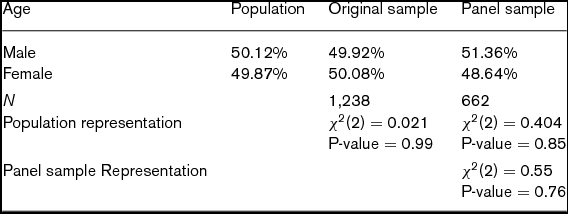
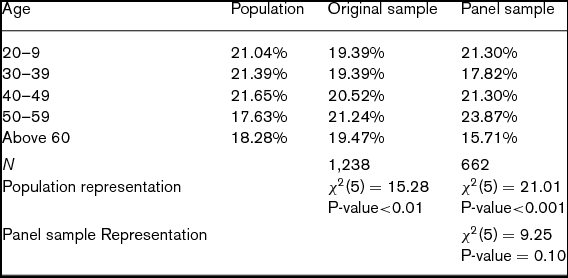
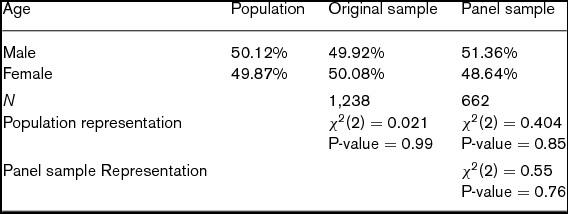
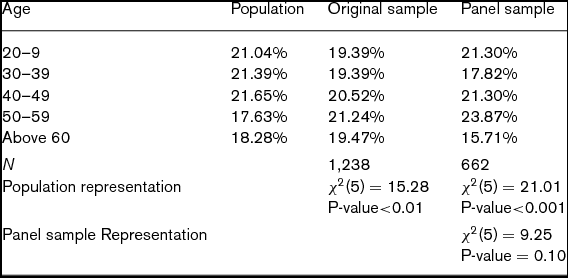
To test our expectation–perception gap hypothesis, as mentioned at the outset we investigate the change in respondents’ evaluations of President Ying-jeou Ma. We apply the TEDS 2008 Legislative Election and the TEDS 2008 Presidential Election panel survey data. The latter survey randomly drew on 1238 respondents from the former survey and successfully re-interviewed 755 of them. To avoid panel bias (Bartels, Reference Bartels1999), we examine the representativeness of panel data. While the chi-square test on Table 1 shows that both surveys are representative of the gender distribution of the population, the test on Table 2 shows that the two surveys slightly over-represented elder citizens and under-represented younger voters. To deal with the under-representativeness of younger interviewees in the samples, in addition to the original survey data, we also weigh data by respondents’ age and gender when examining our theoretical hypotheses.
Test for sample representative (gender)
Source: TEDS 2008L and TEDS 2008 P.
Test for sample representative (age)
Source: TEDS 2008L and TEDS 2008 P.
5.1 Dependent variables and the analytical model
The major dependent variable is the change in respondents’ evaluations of Ma. In both surveys, respondents were asked to evaluate the extent to which they like or dislike Ying-jeou Ma by assigning a score between 0 and 10. Because the former survey was held between January and March 2008, prior to the presidential election that year, it can be viewed as a pre-presidential election survey. Respondents’ evaluations of Ma in this survey, denoted by Mat, reflect their expectations of him. The post-presidential election survey, conducted between June and August 2008, then recorded respondents’ evaluations of Ma (Ma t + 1) after his inauguration. In order to measure how citizens updated their opinions, we analyze the change in their evaluations of Ma, namely (Ma t + 1 − Mat). Because the change in the evaluation is between –10 and 10, we simply apply the ordinary least square (OLS) model to analyze the dependent variable.
5.2 Independent variables
According to the TEDS data, among all the public issues, economic conditions and foreign affairs concerned the Taiwanese electorate the most. Among the respondents, 33.6% asserted that the economy and their livelihood were the most important issues, and 30.3% of them emphasized international and cross-strait relations as most important. Based on the empirical data, to investigate how citizens assess a president's achievements and to provide empirical support for our theoretical hypotheses, we employ respondents’ expectations and perceptions of economic conditions and their attitudes toward cross-strait relations to measure the expected service–perceived service gap of government performance.
The ‘expected service-perceived service gap’ model: economic evaluations and cross-strait relations
To measure respondents’ anticipations and perceptions of economic conditions, in the pre-presidential election survey we first asked respondents to give their expectations for the economic conditions a year from now (denoted by Econt) and used them as the estimates of their expectations for the president elected in 2008 and his economic performance.Footnote 6 In the post-presidential election survey we recorded their perceptions of the changes in the economic conditions over the last year (denoted by Econ t + 1). We then subtract the former from the latter to generate the gap between the perceived and expected economic conditions, i.e. Econ t + 1 − Econt. According to the expected service–perceived service gap model, for the change in respondents’ evaluations of Ma, it should be positively associated with the gap between their economic expectations and economic evaluations, i.e.Econ t + 1 − Econt.
Hypothesis 1:As the gap between voters’ expectations of economic prosperity and their perceptions of economic reality increased, they would lower their opinions of Ma.
To estimate respondents’ attitudes toward cross-strait relations, we asked each respondent to state the extent to which he supported independence or unification before the presidential election. Their replies were denoted as IndUnit, and an increase in the value of this variable indicates that the respondent leaned toward supporting unification.Footnote 7 To measure respondents’ perceptions of cross-strait relations after Ma's inauguration, we asked respondents to give their perceptions of Ma's attitude toward independence and unification and denoted their replies byIndUni t + 1. Based on the configuration above, we can further apply (IndUni t + 1 − IndUnit) to indicate the gap between interviewees' perceptions and expectations for cross-strait relations. While Ma's mainlander background and his emphasis on improving cross-strait relations had garnered popularity from the pro-unification supporters, his insistance on pursuing neither unification nor independence in his inaugural speech might have disappointed them. For most die-hard supporters of unification with high initial assessments of Ma, they might have been disappointed if they perceived that Ma leaned toward no-unification and no-independence. Contrarily, although Ma claimed no independence in his term, his declaration of no unification might have ameliorated die-hard separatists, who originally had low evaluations of Ma due to his unification tendency. In short, according to the ‘expected service–perceived service gap’ model, we derive our hypothesis as follows:
Hypothesis 2:As the gap between voters’ expectations of cross-strait relations and their perceptions of Ma's attitude toward the independent–unification issue increases, the change in their opinions of Ma would increase accordingly.
Media exposure
We further measure the degree of exposure by respondents to the media by asking them how much time they spent on the election news on TV, the radio, the Internet, and in the newspaper during the presidential campaign period. We then added up their answers to these four questions to generate respondents’ extent of media exposure. According to the studies of presidents’ popularity, scholars generally agree that mass media is in favor of new presidents, but turns critical when the honeymoon period is over. Therefore, we expect that the more respondents received electoral news during the electoral campaign, the more they were aware of the gap between Ma's campaign promises and government performance in reality, and would therefore become more critical of Ma and his administration. Based on the discussion above, we assume a negative relationship between media exposure and the change in their evaluation of Ma.
Hypothesis 3:The more voters exposed themselves to electoral news, the more critical they were of government performance; that is to say, the lower the change in their opinions of Ma.
Control variables
In addition to the explanatory variables above, we include voters’ party identification as a control variable, which helps us understand who are more likely to lower their opinions of Ma. Given the polarization between the dominant and opposition camps in Taiwan politics, we roughly classify voters as pan-blue (the dominant coalition), including the Kuomintang (KMT), the People First Party (PFP), and the New Party (NP), or as pan-green (the opposition coalition), including the Democratic Progressive Party (DPP) and Taiwan Solidarity Union (TSU). For those who did not feel close to any party, we code them as independent voters. According to recent studies, partisanship not only affects people's political decisions, but their judgment of government performance (cf. Evans and Andersen, Reference Evans and Andersen2006; Malhotra and Kuo, Reference Malhotra and Kuo2008; Healy and Malhotra, Reference Healy and Malhotra2013). Therefore, in contrast to the opposition supporters, pan-blue supporters should be more willing to give Ma more time to improve his performance and were less harsh towards his administration. Nevertheless, according to the expected service–perceived service gap model, because of their high initial expectation of Ma before his inauguration, pan-blue supporters are more likely to be disappointed with his performance and hence update their assessment of him accordingly.
Moreover, in order to examine the robustness of our hypotheses, we control for respondents’ background factors, including, gender, education level (from elementary school and below to university and above), household income level, and employment status (employed or unemployed). Nevertheless, the more control variables we include in the model, the more missing cases we have in our analysis. For the household income question in particular, about one-fourth refused to reply. To compensate for the missing values, we apply multiple chain imputation to retrieve missing values of all independent variables. The statistical results are shown in Tables 3 and 4.
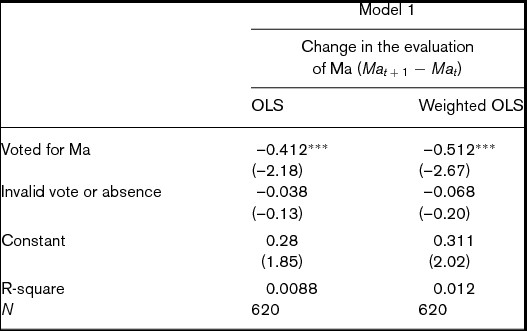
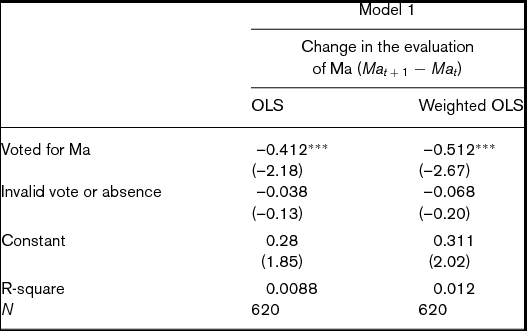
The decline in the evaluation of Ma from his supporters
Source: TEDS 2008 L and TEDS 2008 P.
Note: Numbers in the parentheses are t scores.
* <0.05 (one-tailed) **<0.05 (two-tailed).
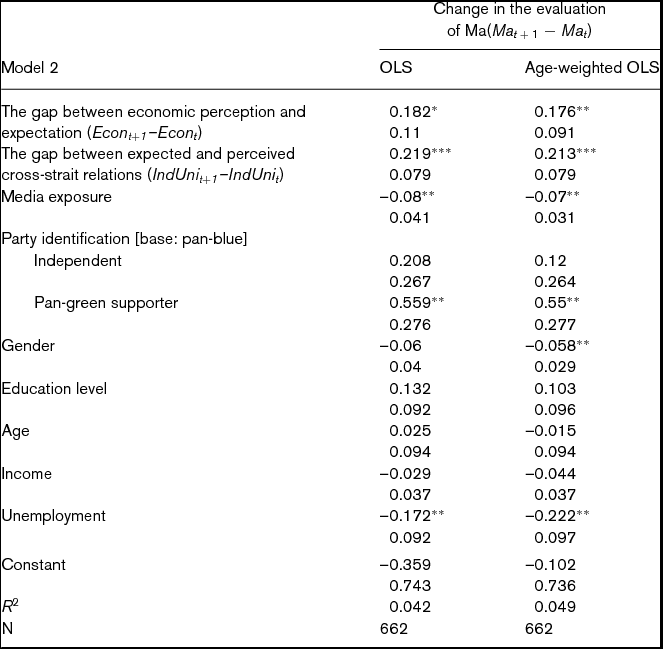
The effects of perceived government performance and political attitudes on the change in citizens’ evaluations of Ma
Source: TEDS 2008 L and TEDS 2008 P.
Note: * <0.05 (one-tailed), **<0.05 (two-tailed), *** <0.001 (two-tailed).
6. Statistical results
6.1 Test of expectation–perception gap
Table 3 first examines whether and how voting decisions affect assessments of Ma and the change in the assessments. Recalling that the change in the evaluations of Ma is (Ma t + 1 − Mat), a positive score indicates that respondents raised their post-election evaluation from their pre-election evaluation of Ma and vice versa. Unlike mass media predictions, Table 3 shows that in contrast to Hsieh's voters, Ma's voters had an additional 0.412-unit decrease in the predicted change in their evaluations of Ma. This result should not be surprising. As asserted above, Ma's supporters had relatively higher expectations for his presidency. When they found that Ma's performance did not meet their high expectations, the supporters lowered their opinions of Ma. Compared to Ma's voters, Hsieh's supporters initially had low confidence in Ma. Therefore, the degree to which their support for Ma decreased was relatively limited, although they observed his poor performance.
In Table 4, we investigate further what factors might influence the change in respondents’ evaluations of Ma, namely (Ma t + 1 − Mat), and test the expected service-perceived service gap model. Controlling for other factors, Table 4 shows that a one-unit increase in the gap between respondents’ perceived economic conditions and their economic expectations, namely (Econ t + 1 − Econt), is positively associated with a 0.182-unit increase in the average change in their assessments of Ma. Similarly, Table 4 shows that all other things being equal, as interviewees’ perception of Ma's attitude toward unification increased by one-unit from their expectation of Ma's attitude on the independence–unification spectrum, they raised their post-election evaluation 0.219 units on average from their initial evaluation of Ma. As discussed above, pro-unification supporters loyally voted for Ma and the KMT and had high initial opinions of him because they conjectured that Ma's election would accelerate improvements in the cross-strait relationship, as well as the process of unification. While they perceived that Ma's China policy was distant from their presumption of unification, the disappointment drove them to downgrade their opinions of Ma. In contrast to KMT supporters, DPP supporters stereotyped Ma as pro-unification and generally had low initial evaluations of him. After Ma took office, they perceived that his China policy was to maintain the status quo, which was better than their initial expectations of him. Therefore, they raised their evaluations of Ma accordingly. In short, Model 2 in Table 4 evidences our expected service–perceived service gap hypotheses, showing that while Ma's performance on economic growth and cross-strait relations failed to meet voters’ expectations, voters accordingly updated their evaluations of Ma.
6.2 Media exposure
In addition to the expected service–perceived service gap model, we find that citizens’ media exposure is also in line with our theoretical hypothesis. As asserted, Table 4 shows that all other things being equal, a one-unit increase in the extent of media exposure is associated with a 0.08 unit decrease in the average change in respondents’ evaluations of Ma. Recalling studies of new presidents’ inaugurations, scholars generally find that mass media tends to be in favor of new presidents (Dominguez, Reference Dominguez2005). Therefore, right after Ma's inauguration, respondents’ evaluations of him might be influenced by reports favorable to the new government. For instance, in the China Times and Commercial Times,Footnote 8 over 90% of reports were highly favorable of Ma in the first two weeks following his inauguration. As the total number of reports related to Ma declined from June to August, the percentage of positive reports of Ma also declined. When the global financial crisis impacted Taiwan and the stock market plummeted by 28% in July, the reports in the mass media became less favorable to Ma. Citizens started to pay attention to government performance and were more aware of the incapacity of Ma and his administration. Thus, the more political information they received, the greater the decrease in their evaluations of Ma.
Table 4 also shows that in contrast with pan-blue and independent voters, pan-green supporters, as predicted by the expectation–perception gap model, were less likely to lower their evaluation of Ma. If we assume that pan-blue supporters voted for Ma, this finding is consistent with Table 3, showing that Ma's voters are more likely to modify their high appraisal. In addition to party identification, we find that gender and unemployment status are also statistically significant in the weighted OLS model, which is similar to the OLS model. In contrast with male and employed subjects, female and unemployed people are more likely to reduce their evaluations of Ma. The vulnerability of women and unemployed people in an economic downturn provides a reasonable explanation for our findings. While recessions and severe financial crises produce a general disruption in the daily lives of millions of people, males, protected by sexism and seniority, might be free from some of the worst effects of the exacerbating economic conditions (Cummings, Reference Cummings1987: 835). When an industry is compelled to reduce its workforce, it is conceivable that women and less-educated workers may be more vulnerable to layoffs, terminations, and work reductions. Aware of their disadvantages and economic vulnerability, women and unemployed voters are thus more sensitive to economic recession, and are more likely to express their dissatisfaction through lowering their evaluations of Ma.
Finally, we examine how well our theoretical model fits the observations. The low R-squared value in Table 4 demonstrates that the model merely explains 4.9% of the variations in the changes in respondents’ replies. We are not surprised with such a dramatic decline in the goodness of fit of the model. In the TEDS panel survey, when respondents were asked to reevaluate Ma after the presidential election, they were not reminded of their previous evaluation. Since respondents had no exact recollection of their answers in the pre-election survey, our model can only capture the tendency instead of the exact variations within the random change in respondents’ evaluations of the president. In addition, in this model we simply address respondents’ expectations for the economy and cross-strait relations. Citizens might have diverse expectations and perceptions about different aspects. Recall that the post-presidential survey took place between June and August 2008, but respondents were asked to evaluate the change in the economic conditions over the previous year. Thus, even though respondents perceived a decline in the economy over the previous year, they did not necessarily blame Ma as being fully accountable for the economic recession. Some respondents might have partially attributed economic failure to the former DPP government, and thus this would affect the change in their opinions of Ma. Finally, employing more variables in the model would definitely raise the R-square value; however, it distracts us from a theory-driven approach and provides no theoretical contribution to the studies of presidential popularity. In fact, the low R-squared value does not necessarily indicate the theoretical invalidity of the study and its poor model fit (Berry and Feldman, Reference Berry and Feldman1985; King, Reference King1986; Achen, Reference Achen1982), but rather cries out for further research.
7. Discussion and conclusion
In traditional democracies, elections are the only mechanism that enables citizens to influence the government. Voters are encouraged to vote against incumbents if elected officials’ performances are lower than public expectations and to reward them with their votes if a government has performed well. In modern democracies, in addition to the electoral mechanism, approval ratings provide a means of vertical accountability and enable citizens and civil society to seek and enforce standards of good performance on officials in non-election periods. While this study was inspired by the dramatic decline in President Ma's approval ratings, we do not limit ourselves to the Taiwanese case and proceed with a data-driven approach. Instead, to better understand citizens’ evaluations of a new president, we propose a theoretical model and emphasize that citizens’ evaluations are not only associated with the political circumstances surrounding them, but also their political abilities and attitudes. Such a configuration enables us to link citizens’ evaluations with their perceptions of government performance and their abilities and political attitudes. We strongly believe that the theoretical model can also be applied to analyze the rapid decline in successive Japanese premiers’ approval rating right after their inauguration.
We then test our theoretical model with the TEDS data. The individual-level empirical tests confirm conventional studies of presidential approval and show that the decline in citizens’ evaluations of a new president is mainly due to the gap between their expectations and perceptions of government performance. Unlike the general stereotype that assumes that the decline in Ma's popularity resulted mainly from the polarization of Taiwanese politics and the DPP's hostility, we find that those who voted for Ma were more likely to lower their post-election evaluations because his performance did not meet their high expectations. We further incorporate the concept of the expected service–perceived service gap with government performance and citizens’ evaluations. The empirical survey data not only confirm economic development and cross-strait relations as the two public issues that concern Taiwanese citizens most, but also shows that citizens’ high expectations for and perceptions of economic prosperity and unification shaped Ma's high popularity. As the national economy and Ma's China policy did not meet citizens’ expectations, they became disappointed and lost their faith in him.
In addition to the gap between their expectations and perceptions of governance, we assert that judging a president's administration requires citizens to consistently pay close attention to the political information about their government. Thus, we hypothesize that citizens’ media exposure also determines how they evaluate presidential performance. The empirical findings show that interviewees’ access to political information and election news affected the change in their opinions of Ma.
As stated at the outset of this paper, in a modern democracy, a monthly report of presidential popularity becomes an important indicator to measure public satisfaction with government performance and is a reference for presidents and their administrations. This paper examines the black box of presidential evaluations from a psychological perspective and empirically investigates the rapid decline in Ma's approval ratings right after his inauguration. Our analysis shows that the gap between respondents’ expectations for and perceptions of Ma's performance on economic growth and cross-strait relations is the reason behind the drastic decline in his popularity.
Despite the poor performance of his administration and his low popularity, Ma has gradually regained support and was eventually reelected in the 2012 presidential election. How he revived his public approval ratings and successfully defeated the DPP candidate, Ing-wen Tsai, seems a more interesting and challenging question. Nevertheless, due to the lack of panel data during this period, this topic awaits future exploration.
About the authors
Alex Chang is an assistant research fellow of the Institute of Political Science, Academia Sinica, Taiwan. He received his Ph.D. from University of Iowa in 2007. One of his research interests is party–legislator relationships, especially focusing on party switching. In addition to party switching, he also introduces new quantitative methods to social science and applies them to cross-national studies. His publications appear in prominent journals such as Journal of Democracy, Issues and Studies, Taiwan Journal of Democracy, Journal of Contemporary China, and Japanese Journal of Political Science.
Yen-chen Tang received her Ph.D. from National Taiwan University in 2014 and now serves as a lecturer in the Department of Political Science. Her research interests include electoral systems and party politics, electoral behaviour, comparative democratization, and political communication. Her publications appear in the Journal of US–China Public Administration and Japanese Journal of Political Science.
Appendix
Pre-presidential election survey (the post-legislative election survey)
Duration: January 2008–March 2008
1. Economic Expectation
Question: Would you say that in the forthcoming year, the state of the economy of Taiwan will get better, stay about the same, or get worse?
Alternatives: (1) get worse (2) about the same (3) get better
2. Position on Unification and Independence
Question: Concerning the relationship between Taiwan and mainland China, which of the following six positions do you agree with:
Alternatives: (1) immediate independence (2) maintain the status quo forever (3) maintain the status quo, move toward independence in the future (4) maintain the status quo, decide either unification or independence in the future (5) maintain the status quo, move toward unification in the future (6) immediate unification.
Post-presidential election survey
Duration: August 2008–September 2008
1. Economic Evaluation
Question: Would you say that over the past year, the state of the economy of Taiwan has gotten better, stayed about the same, or gotten worse?
Alternatives: (1) get worse (2) about the same (3) get better
2. Position on Unification and Independence
In our society people usually discuss the issue about unification with China and Taiwan independence. Some people argue that Taiwan should claim independence immediately and other people assert immediate unification. Still others are in-between. If 0 represents immediate independence and 10 is immediate unification, which side do you feel President Ma is close to?
3. Media Exposure
A. Question: During this year's presidential election campaign, some people spent a lot of time paying attention to all kinds of media news stories about the election, while others didn't have time to pay attention. On average, how much time did you spend each day on election campaign news on TV?
B. What about election news on the radio?
C. What about election news on the internet?
D. What about election news in the newspapers?
Alternatives: (0) None at all (1) Every once in a while (2) Less than 30 minutes (3) 31–60 minutes (4) 60–90 minutes (5) 90 minutes to 2 hours (6) More than 2 hours.
4. Internal Political Efficacy
Question: People like me don't have any say about what the government does.
Alternatives: (1) Strongly agree (2) Agree (3) Disagree (4) Strongly disagree.