1. INTRODUCTION
It is widely agreed that exploitation involves taking unfair advantage.Footnote 1 Of course, as Richard Arneson points out, this is not a particularly helpful analysis of the concept since there will ‘be as many competing conceptions of exploitation as theories of what persons owe to each other by way of fair treatment’ (Arneson Reference Arneson and Becker1992: 350). Informative analyses must go further. Some accounts do so, in part, by arguing that exploitation involves a failure to exercise constraint in light of others’ disadvantage – regardless of the cause of disadvantage.Footnote 2 According to these accounts, our duties to protect the disadvantaged and vulnerable are what I will call ‘come-what-may’ duties. In this article I will argue that this approach is misguided; accounts of exploitation based on ‘come-what-may’ duties are either self-frustrating or over-demanding. I consider two possible solutions to these problems and conclude that the most promising is to omit self-caused disadvantage from the scope of these duties. That is, we exploit others when we fail to exercise constraint in light of others’ disadvantage only if this disadvantage is the result of an injustice for which the disadvantaged is not responsible.Footnote 3
In the following section I outline two accounts that include versions of these ‘come-what-may’ duties: Ruth Sample’s (Reference Sample2003) degradation-based account and Robert Goodin’s (Reference Goodin and Reeve1987) vulnerability-based account. In section three, I present a case that creates problems for both accounts. In section four I consider two possible solutions to these problems, argue that omitting self-caused disadvantage from the domain of exploitable disadvantage is the best solution, and finally I address a general tension between fairness and come-what-may duties.
2. COME-WHAT-MAY DUTIES
Before outlining two approaches to exploitation that include come-what-may duties, I want to briefly clarify a potential confusion about the use of the word ‘advantage’. There are three senses of ‘advantage’ implied by the claim that exploitation involves taking unfair advantage, each of which denotes a different concept: advantage as use, advantage as lack of vulnerability, and advantage as gain. When A exploits B, A takes advantage (i.e. uses) B’s disadvantage (i.e. vulnerability) to acquire some advantage (i.e. gain) for himself at B’s expense. Using ‘advantage’ to denote each of these features quickly becomes confusing. Thus, in the arguments that follow I will use ‘advantage’ and ‘disadvantage’ to refer only to advantage as lack of vulnerability. I will use ‘gain’ (or occasionally benefit) to refer to advantage as gain and ‘use’ to refer to advantage as use.Footnote 4 Additionally, I will assume that the slogan ‘exploitation involves taking unfair advantage’ is equivalent to the expanded slogan, ‘exploitation involves unfairly using another’s disadvantage for gain’.
While many of the exploited are also disadvantaged,Footnote 5 the following two accounts of exploitation distinguish themselves from more restrictive accounts through their claims that mere disadvantage can generate exploitation, ‘regardless of the particular source’ of disadvantage (Goodin Reference Goodin and Reeve1987: 187). For these accounts, the historical source of disadvantage is – to some degree – irrelevant when determining whether a transaction is exploitative; for some transactions non-historical properties of a transaction itself are sufficient to ground exploitation claims.Footnote 6
2.1. Goodin’s Account
Of the two accounts, Goodin’s implies the widest scope for our duties to the disadvantaged (as we will see below, Sample’s ‘come-what-may’ duties are already restricted to a sub-domain of disadvantage). According to Goodin, we exploit a person when we unfairly make use of one of their attributes and, he claims, exploitation in general involves ‘playing for advantage[-as-gain] in situations where it is inappropriate to do so. . .[it] consists in playing games of strategy in circumstances which render them somehow inappropriate’ (Goodin Reference Goodin and Reeve1987: 184, emphasis in original). Furthermore, all cases where playing for strategy is inappropriate are ‘manifestations of one particular kind of wrong’, namely, a failure to honour the moral norm of ‘protecting the vulnerable. . .regardless of the particular source of their vulnerability’ (Goodin Reference Goodin and Reeve1987: 187). Thus, for Goodin, exploitation occurs when we use others’ vulnerabilities to secure for ourselves some form of benefit in games of strategy, no matter the source of these vulnerabilities.
Taken at face value, Goodin’s norm of protecting the vulnerable seems to make exploitation pervasive. It appears to render exploitative any transaction in which one transactor uses his or her advantage for gain. This seems odd, since (i) nearly all economic transactions involve unequal bargaining power and (ii) unequal bargaining power, ordinarily, seems to be a form of vulnerability. Yet, (iii) many ‘ordinary’ transactions do not appear unfair. It seems that Goodin should provide an explanation of this oddness. He might either address (iii), showing why we should consider most transactions unfair, or provide a response to (ii), explaining why the conception of vulnerability that he has in mind is narrower than our ordinary notion of vulnerability and thus explaining why mere inequality in bargaining power is not sufficient for his notion of vulnerability. That is, though he claims that any form of vulnerability is potentially exploitable, perhaps Goodin’s account of vulnerability is less inclusive then our ordinary conception.
Goodin provides an account of vulnerability in his book Protecting the Vulnerable, where he writes
Vulnerability is a relational notion: a full specification will tell us who is vulnerable to whom with respect to what. . . .[Vulnerabilites are] also relative. A is more vulnerable to B (1) the more control B has over outcomes that affect A’s interests and (2) the more heavily A’s interests are at stake in the outcomes that B controls. (Goodin Reference Goodin1986: 118)
Thus, for Goodin, B is vulnerable to A with respect to x when A has the ability to control x and x has an impact on B. The scope of this conception of vulnerability does not appear narrower than the scope of vulnerability in ordinary use. In lieu of a restriction of the scope of vulnerability, Goodin must provide a convincing argument for why we should believe most transactions are exploitative. And indeed, Goodin does provide such an argument, albeit one that I will argue is not fully convincing. However, before considering Goodin’s defence of his relatively expansive conception of exploitation (in section 4.2) I want to consider the come-what-may duties that appear in Sample’s account and an outline of the problems these duties create for both accounts.
2.2. Sample’s Account
According to Sample’s account of ‘exploitation as degradation’, exploitation involves ‘interacting with another being for the sake of advantage[-as-gain] in a way that degrades or fails to respect the inherent value in that being’ (Sample Reference Sample2003: 57). She claims these failures of respect take three general forms. We can fail to show proper respect for – degrade – the value of another by:
-
D1 ‘Taking advantage[-as-use] of an injustice done to him.’
-
D2 ‘Neglecting what is necessary for that person’s well-being or flourishing.’
-
D3 ‘Treating as a fungible object of market exchange, an aspect of that person’s being that ought not to be commodified’ (Sample Reference Sample2003: 57, lettering added).
The first form of degradation, D1, involves disadvantage caused by historical injustice: ‘If a person is in a weaker bargaining position because of a past injustice, we stand to gain disproportionately in virtue of that injustice’ (Sample Reference Sample2003: 82). For example, if C steals B’s wallet and A uses the disadvantage created by this theft to gain more than he otherwise would have in a transaction with B, A exploits B.
The second form of degradation involves a form of disadvantage that is ahistorical. Here Sample claims that well-being or flourishing are best captured by what she variously calls ‘basic needs’ and ‘capabilities’.Footnote 7
She argues that transactions can be degrading when ‘the [impoverished] capabilities of our interactors are ignored in the pursuit of our own advantage[-as-gain]’ (Sample Reference Sample2003: 81).Footnote 8 Though these first two forms of degradation often coincide, neither implies the other. While B’s basic needs may be unmet because of a past injustice committed by another person, D2 implies that failing to properly consider B’s basic needs may generate exploitation even when the reason B’s basic needs are not unmet does not involve a past injustice. Note that the existence of D2 as a separate source of exploitation-generating degradation requires cases that fall within the scope of D2 and outside the scope of D1.
Finally, Sample’s D3 implies that the exchange of certain goods may be intrinsically degrading. Here too there may be overlap with the first and second forms of degradation. Prostitution is often considered a paradigmatic example of this third form of transaction. When A pays for sex with B, B may transact only because she has been previously unjustly disadvantaged. A may also fail to give proper weight to B’s well-being or flourishing. But Sample’s inclusion of this ‘anti-commodification condition’ as a separate condition implies that even if D1 and D2 are not satisfied, the transaction may be exploitative. Again, in order for D3 to operate as a separate source of degradation, there must be cases of D3 that do not fall within the scope of either of the first two domains.
Like Goodin’s account, Sample’s account faces some ‘face value’ difficulties, in particular, a version of what Rawls calls the ‘priority problem’ (Rawls Reference Rawls1971: §8). The presence of separate degradation-generating principles means that it is theoretically possible for these principles to conflict. If these principles also conflict in practice, then absent either a single principle to guide action or a weighting between the three forms of degradation, Sample’s account of exploitation appears to provide conflicting guides to action. However, unlike the prima facie problem of scope for Goodin’s account, Sample’s priority problem is not caused by the presence of a come-what-may duty. Nevertheless, as we will see, the inclusion of a come-what-may duty causes its own problems for Sample.
Come-what-may duties enter Sample’s account through her inclusion of the basic needs condition, D2. She claims that when A transacts with B and fails to ensure B’s basic needs are satisfied, he degrades and exploits her. Conditions like D2 are threshold conditions; conditions that claim exploitation occurs when B’s post transaction outcome falls below a certain threshold level.Footnote 9 In Sample’s case, B is exploited when, post-transaction, her basic needs remain unmet. Threshold conditions, when not embedded as a subset of more restrictive conditions like D1, generate come-what-may duties. When B’s basic needs are unmet pre-transaction, if A chooses to transact with B, then he must satisfy the constraints implied by D2 and this is so regardless of the reason that B’s pre-transaction basic needs were unmet.Footnote 10
In the next section I present a case that exemplifies the over-demandingness problem for Goodin’s account and that forces a conflict of duties for Sample’s account. I show that both problems can be resolved by abandoning the broad come-what-may duties contained in each account. However, before doing so I want to briefly comment on Sample’s non-commodification condition, D3.
The arguments that follow pertain to the problems that arise from Sample’s inclusion of cases that lie in D2, but not D1. D3 is excluded from the criticism because, without denying that they may be degrading or disrespectful, I am unconvinced transactions falling only within Sample’s D3 are exploitative. When A buys sex from B, if the transaction is degrading for only the reason that sex ought not be commodified, then it seems that both A and B are degraded by the transaction. Neither is relatively disadvantaged with respect to the other. Yet, if exploitation involves taking unfair advantage-as-use of another’s vulnerability, then it must be the case that one of A or B is relatively disadvantaged. While it seems natural to say that A – the buyer – is the advantaged party in cases of prostitution, the belief that A is unfairly advantaged is likely due to our belief that it is unfair (for reasons stemming from either D1 or D2) that B is in a position in which she must sell her services as a prostitute. If neither D1 nor D2 hold and A and B are equals in terms of power, resources, etc., and B is not disadvantaged through past injustice, it is not clear that either party is relatively disadvantaged.Footnote 11 If neither is relatively disadvantaged, there can be no exploitation. Indeed Sample makes just this point when she writes, ‘I reject the idea that a person could be exploited if no vulnerability is made use of’ (Sample Reference Sample2003: 83). She claims that when D1 and D2 are not violated but a person ‘nonetheless chooses to transact in a way that would violate a putative restriction on exchange, [they are] not exploited. . .however, [they] may be degraded if the appropriate case against commodification can be made’ (Sample Reference Sample2003: 83). These arguments, along with Sample’s own claims, indicate that D3 is not a separate source of exploitation, but rather falls within D1 and D2. Its inclusion as a separate form of degradation plays only a rhetorical role.
3. TWO PROBLEMS FOR COME-WHAT-MAY DUTIES
In some contexts Goodin’s and Sample’s claims appear plausible. In sweatshops, labour firms fail to constrain their bargaining advantage when employing the severely disadvantaged. These are paradigmatic cases of exploitation and their being so is not, so it seems, dependent on the source of these workers’ disadvantage. When workers are extremely vulnerable, using this vulnerability for self-enrichment seems to be a clear case of exploitation, regardless of how the workers became vulnerable. Despite this initial plausibility, as we saw above, both accounts appear to face certain difficulties and these difficulties appear more clearly in the following case.
3.1. The Sequential Game Case
Consider the following sequential game, Γ1.
Stage 1. Consider the following two lotteries, L 1 and L 2. Suppose that A is presented with a choice between the lotteries, but B is (for whatever reason) committed to L 2.
-
L 1 (
 $p=\frac{1}{2},\ \$100$
; 1 − p, $0)
-
L 2 (p = 1, $50)

Stage 2. A and B face each other in the labour market. The wealthier is the employer, the less wealthy the employee. If they are equally wealthy they may work cooperatively, splitting revenue equally. Suppose the values for revenue, wages, and profit are as follows: R = $11, ω = $5, π = 6. The revenue from cooperating is
 $\frac{\$11}{2}$
, or $5.50. Finally, suppose the following constraint, embodying Sample’s particular approach to D2, holds:
-
BN If a player chooses to transact with another, then both players’ outcomes must be ⩾ $10. Suppose $10 is what is necessary for an individual’s well-being.
Constraint BN operationalizes Sample’s D2, the claim that we degrade others when we neglect what is necessary for their well-being. Sample argues that ‘if we can interact with persons so that their basic needs are taken into account through the transaction, we ought to’ (Sample Reference Sample2003: 75). Thus, employers should pay their employees enough to ensure their basic needs are met. In Γ1, this amount is set at $10, but the problem that the case presents does not depend on the particular value given to BN.Footnote 12
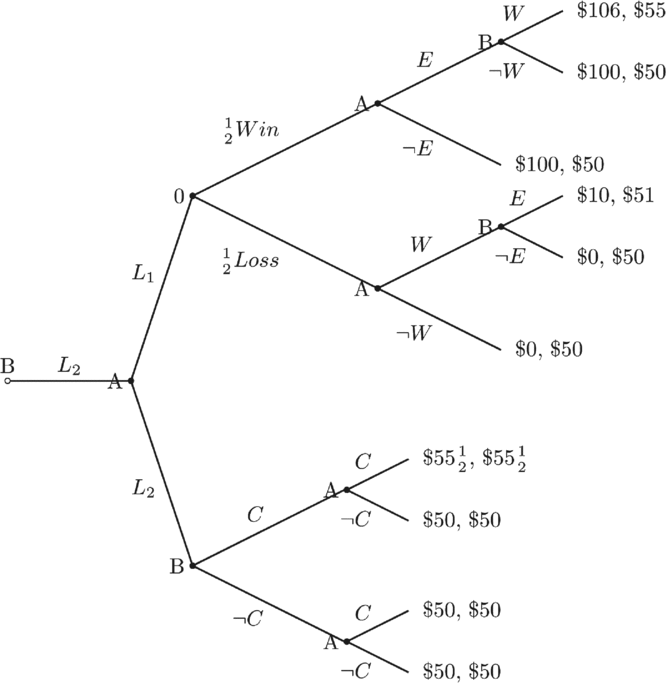
In the strategic form of Γ1 shown in Figure 1 below, ‘A’ and ‘B’ denote the players, ‘0’ a chance node, and ‘C’, ‘W’, and ‘E’ represent the options ‘cooperate’, ‘work for’, and ‘employ’ respectively.
Γ1 in Extended Form

When B is committed to L 2, which lottery should A (rationally) choose? We can answer this question using backward induction. First, consider the bottom branch of Figure 1, supposing A chooses L 2. In this case, the players will be equally wealthy, each receiving $50. They may choose to form a cooperative venture or refrain from cooperating, but clearly it is in the interest of each to cooperate, so the outcome of A choosing L 2 is ($55.50, $55.50).Footnote 13
Suppose A chooses L
1. Then, there are two equiprobable possibilities: either A will win the lottery, or A will lose the lottery. Suppose A loses. Then after the lottery A will be poorest. He can choose to work for B or to remain unemployed and B can choose whether to employ A, but it is in the interest of both to choose employment. Since post-lottery A has $0, BN holds. B must pay A $10 in wages, but she may keep $1 for herself. The outcome of a lottery loss is thus ($10, $51). Suppose A wins the lottery. Here A is the wealthiest player. And again, it is rational for both players to choose employment. This time A is the employer and, since both players’ holdings are greater than $10, BN doesn’t apply. A will pay B $5, keeping $6 for himself in profits. Thus, the outcome of a lottery win is ($106, $55). Since a lottery win and a lottery loss are both equally likely, the expected value of choosing L
1 is
 $\frac{1}{2}$
the outcome of a win and
 $\frac{1}{2}$
the outcome of a loss, or ($58, $53). Since the expected value of L
1 is greater for A than the expected value of L
2, A will rationally choose L
1.
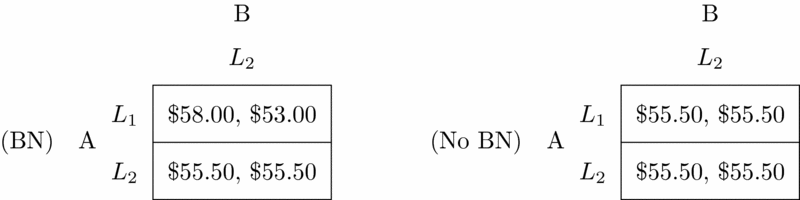
Now consider a variation of Γ1 where BN is absent. Without BN, the outcome of A choosing L 1, losing the lottery, choosing work, and B choosing employ changes to ($5, $56), making the expected value of L 1 ($55.50, $55.50). Thus, if BN does not hold, the expected value for both A and B of A’s choice of either L 1 and L 2 is equivalent. The tables in Figure 2 summarize the expected value of each lottery for A and B with, and without, BN. When BN holds, if A chooses L 1, A does better and B worse. In particular, A gains $2.50 of expected value at B’s expense. With BN in place, A has an incentive to choose L 1 over L 2. Without BN the outcomes for each player are the same regardless of whether A chooses L 1 or L 2. With these facts in mind, let us return to the two accounts of exploitation outlined above, this time beginning with Sample’s account.
Expected values in Γ1 with and without BN

3.2. Sample’s Self-Frustration Problem
Consider Γ1 in the context of Sample’s account. According to Sample, if A chooses L 1 and loses, then if B chooses to employ A, but does not respect BN, B exploits A. When B fails to ensure A’s basic needs are met when she interacts with him, B engages in the form of degradation specified by D2, and thus exploits A.
However, pre-theoretically it also seems natural to say that the reverse is true, that is, A exploits B. There are two senses in which A extracts benefits from B in Γ1. First, A gains ex ante from BN – at B’s expense – through the increase in expected value that BN gives to A’s choice of L 1. Second, when A chooses L 1, loses, and then works for B, he receives ex post benefits in the form of the BN subsidy: his wages increase from $5 without the subsidy to $10 with the subsidy.
If either of these gains are also unfair, then in a pre-theoretical sense, A exploits B. Note that because A receives these benefits at separate times, the locus of the exploitative act (assuming the gains are, in fact, unfair) depends on whether the ex post or ex ante perspective is adopted. This leaves us with three questions:
-
Which perspective on gain – ex post or ex ante – is morally relevant for exploitation?
-
Are the gains received in either perspective unfair?
-
If so, is the resulting exploitation problematic for Sample’s account?
Unfairness
It is easiest to begin with the second question: are either ex ante or ex post gains unfair. First consider A’s ex ante gains. There are three features of A’s ex ante gain that, taken together, motivate the claim that it is unfair.
First, A’s pre-choice feasible set contains the option in B’s (L 2), plus the risky option L 1. According to Sample’s own preferred capabilities-based approach to welfare, A’s pre-choice welfare is greater than B’s.Footnote 14 Second, the presence of BN means that if A chooses L 1, regardless of whether he wins or loses the lottery, B will do worse than she would have done had A chosen L 2. If A wins the lottery, then in the second stage B will work for A and B’s outcome will be $55; if A loses the lottery, then B will employ A but, because she must respect BN, her outcome will only be $51. Both outcomes are less than the $55.50 B would receive if A chose L 2. Finally, because BN increases the expected value of L 1 it creates a moral hazard that incentivizes risk-taking. This occurs because, for A, BN is costless. Although the constraint requires B to subsidize A’s losses, it does not require that A share his gains with B. In other words, BN requires B to provide A with insurance for which A does not pay. When A, who is already better off than B, chooses L 1 he unfairly uses the moral hazard created by BN in order to (attempt) to enrich himself at B’s (certain) expense. It seems clear that A’s ex ante gain is unfair to B.Footnote 15
Now consider ex post gain. Suppose A chooses L 1 and loses. Although he was better off than B before the lottery, he is now worse off. Having lost the lottery, is his ex post benefit – his actual receipt of the subsidy – really unfair? Sample clearly thinks not. Respecting other persons should, so the argument goes, commit us to ensuring that our interactors’ basic needs are in fact met, not that they might have been met had things gone differently. To claim the latter offers no consolation to the person who is starving now. Although this line of reasoning is, perhaps, initially attractive, it should be resisted. If A’s ex ante gain is unfair, then A’s ex post gain must also be unfair. This is so because the unfairness of the ex ante gain derives from the fact that A is in a position in which he could receive a subsidy for which he does not pay. If it is unfair for A to knowingly to put himself in a position where this might happen, it must also be unfair for him to actually accept the subsidy. Therefore, both A’s ex ante and his ex post gains are unfair.
Two Problems
Consider the third question: when A gains unfairly at B’s expense – in either the ex ante or ex post sense – does Sample’s account encounter problems? The short answer is yes. To see why, let’s start again with ex ante gain.
A receives unfair ex ante gain from B when he chooses L 1. If exploitation involves the impermissible use of others’ disadvantage to gain unfairly from them, then it is impermissible for A to choose L 1. The reason L 1 is impermissible is that it is unfair to B. Further, this obligation to refrain from choosing L 1 does not depend on how valuable L 1 is to A. Suppose A’s choice is not between L 1 and L 2, but between L 3, where p = 0.99, $500; 1 − p, $0, and L 2. L 3 is a very attractive lottery from which A stands to gain much ($500) with little risk of calamity (1%). I argued three facts make it unfair for A to receive ex ante benefits when he chooses L 1: (i) pre-choice A is better off than B, and yet (ii) his choice of L 1 harms (the less well-off) B and (iii) the requirement that B subsidize A with BN means that A receives insurance (BN) at B’s expense for which he does not pay. These three facts apply also to L 3. Indeed, under L 3 (i), the inequality in pre-choice welfare, is much greater. Not only is it unfair for A to receive ex ante benefits from B when faced with the L 1 lottery, A must refrain from taking a risk that leads to his being subsidized by B even when this risk is very prudent. Therefore, if the relevant form of gain for exploitation is ex ante gain, Sample’s account is over-demanding.
But perhaps ex ante gain is not the form of gain involved in exploitation. Suppose then, that exploitation involves unfair ex post gain. Here too Sample’s account faces a problem. If the relevant form of gain is ex post gain and, as I have already argued, such gain is unfair, then A exploits B when he receives the BN subsidy. However, according to Sample’s own account, B exploits A if she fails to pay the subsidy: B’s failure to ensure A’s basic needs are met violates D2. If A exploits B when he receives BN and B exploits A if she fails to pay BN, then in order for each to avoid exploiting the other, they must allow themselves to be exploited. And conversely, in order to avoid exploitation, they each must allow the other to exploit. In this case, Sample’s account is self-frustrating because it implies conflicting obligations. In a discussion of a related case, Hillel Steiner writes, both A and B ‘are each obligated to employ all available measures necessary to remove the obstacle constituted by the other person’s [not exploiting]. And this obligation persists until the point where either (i) one of them has actually prevailed. . .and the other is incapable of further ‘attempting’, or (ii) both are [so] incapable. . .’ (Steiner Reference Steiner1994: 197–198). Sample’s account provides no way of determining who should concede. There is no way to adjudicate between either party’s attempt to not exploit. If ex post gain is unfair, then Sample’s account implies a self-frustrating moral code that, again quoting Steiner ‘makes [non-exploitative] performances obligatory and, at the same time,. . .requires (in certain circumstances) the deliberate frustration of any [non-exploitative] performance for the sake of no other principle or value’ (Steiner Reference Steiner1994: 199, emphasis in original).Footnote 16 Note that self-frustration is not the same as mutual exploitation. The claim is not that both A and B exploit the other. Rather, A’s exploiting B and B’s exploiting A in Γ1 are mutually exclusive actions. The performance of one action precludes the other.
So, Sample’s account encounters problems regardless of whether the form of gain relevant to exploitation is ex ante gain or ex post gain. In the case of the former, her account is over-demanding; in the case of the latter it is self-frustrating. Before I address the problem that Γ1 creates for Goodin’s account, I will consider the final question: which form of gain is relevant to exploitation.
Moral Relevance
Suppose A chooses L 1 and receives unfair ex ante gain at B’s expense. If exploitation involves unfair ex ante gain, then having chosen L 1, A uses the disadvantage BN creates for B to extract unfair gain at B’s expense. That is, A has exploited B. But now suppose that though A initially intends to accept BN, upon losing the lottery he has a change of heart and rejects the subsidy. Though A has received unfair ex ante gain, it does not seem that any exploitation has occurred because A has not received any actual benefit. A’s choice of L 1 is akin to attempted exploitation.Footnote 17 Although his disregard for the unfair effects of his choice of L 1 on B likely makes this choice wrongful, the choice of L 1 is not itself exploitation. The issue here is not one of permissibility, but of classification. Since (actual) maldistribution is necessary for exploitation and this only occurs when A accepts BN, the form of gain morally relevant for exploitation is ex post gain. And, this, along with my arguments above, means that the problem Sample’s account faces is one of self-frustration.
Revisiting the Priority Problem
In my outline of Sample’s account I indicated that absent either a metaprinciple or a weighting of the three forms of degradation Sample’s principles could conflict. While I trust the self-frustration problem I have identified is itself straightforward, it is perhaps less clear how self-frustration is related to the priority problem. There are two possible sources of confusion.
The first concerns the way the priority problem is related to self-frustration. The self-frustration problem involves the following conflicting claims:
-
F1 B exploits A if she fails to provide A with the BN subsidy.
-
F2 When A chooses the risky option, loses, but nevertheless accepts the subsidy from B, A exploits B.
While D2 implies F1, it is not clear that any of Sample’s existing three forms of disrespect imply F2. In this case, Sample’s account cannot suffer from an internal self-frustration problem. The conflict would instead involve D2 and an external principle. If this claim is true it does not spell the end for Sample’s problems. A’s actions in F2 are a paradigmatic form of exploitation that Sample should want to capture. If her account cannot account for F2, then it seems that it is incomplete because it fails to capture a case of taking unfair advantage: free-riding on moral hazards. Regardless of whether the problem is an internal problem of self-frustration or an external problem of scope the case presented in Γ1 is problematic for Sample’s account.
However, of these two possibilities, I believe the internal conflict is a more accurate, and indeed, more charitable description of the problem that Sample’s account faces. While F2 may not be prohibited by any of the existing three forms of disrespect, it does appear to be implied by Sample’s general claim from which she derives these three forms of disrespect. Sample writes ‘exploitation involves interacting with another being for advantage[-as-gain] in a way that degrades or fails to respect the inherent value in that being’ (Sample Reference Sample2003: 57). Surely using others’ commitment to obligations like BN for self-enrichment at the others’ expense involves a serious failure of respect both for their person and for the spirit of the moral commitment. If this is so, then a fourth form of disrespect is implied by Sample’s general claim that exploitation involves disrespect or degradation and in this case, her account faces a problem of self-frustration: D2 implies F1 and the fourth form of disrespect, D4, implies F2.Footnote 18
The second possible source of confusion concerns the way Sample’s principles conflict. Initially it might seem that conflict is not possible. Perhaps D1, D2 and D3 are all (along with some structural conditions) sufficient for exploitation. If multiple forms of degradation were present in a transaction, then the exploitation would simply be over determined; if A were guilty of D1 and B of D2, then they would mutually exploit each other.
It is true that D1–D3 need not conflict, but it is not true that they cannot conflict. If B desperately sells a kidney to A because all of her possessions were stolen and after the sale her basic needs remain unmet, all three forms of degradation are satisfied. However, the problem presented by the conflicting claims F1 and F2 is different. In cases like that just described, all forms of degradation coincide with one person. But in cases like Γ1 one person is degraded by one of Sample’s domains of disrespect and the other by another domain. It is in this type of case that potential conflicts can arise. In order to avoid exploiting B, A must ensure he does not disrespect her and vice versa. But if these avoidances of disrespect require mutually exclusive actions, then exploitation cannot be avoided and the account is self-frustrating.
3.3. Goodin’s Over-demandingness Problem
I now turn my attention to the problems Γ1 creates for Goodin’s account. Recall that for Goodin exploitation involves a failure to respect the duty to protect the vulnerable, ‘regardless of the particular source of their vulnerability’ (Goodin Reference Goodin and Reeve1987: 187). We exploit others when we use their vulnerabilities to secure for ourselves some form of benefit in a game of strategy. The vulnerable are ‘those whose interests are strongly affected by our actions and choices’ (Goodin Reference Goodin and Reeve1987: 191). Further, Goodin argues that the responsibility to protect the vulnerable falls upon ‘whoever has the “last clear chance” to prevent harm. . .regardless of the causal history up to that point‘ (Goodin Reference Goodin1986: 129).
According to Goodin then, if A chooses L 1, loses, and decides to work for B, A is vulnerable to B. If B fails to protect A when she transacts with him, she exploits him by failing to honour the moral norm of protecting the vulnerable. On Goodin’s account, determining whether B has protected A is less straightforward because, unlike Sample, Goodin does not appeal to a particular baseline (such as basic needs) by which we can judge whether B has discharged her duty to protect A. Nevertheless, Goodin is clear that A’s vulnerability places some constraints on B; she cannot simply ignore A’s plight. In the absence of an explicit protection criteria, I will assume these constraints are captured by the level stipulated by the BN condition, though in section four I will consider alternative operationalizations of what it means for persons to ‘protect’ others. Using the BN constraint as a baseline for B’s protection of the vulnerable A, it follows that when B does not respect the BN constraint, B exploits A.
This will strike those who are convinced by my prior claims about the fairness of A’s gains as the wrong result. Rather than B exploiting A, it seems that A exploits B. A case involving a spiteful A who hoped to lose the lottery in order to worsen B’s outcome makes an even stronger case for the claim that it is A who exploits B. However, Goodin’s position not only entails that B exploits A when she fails to subsidize him, it also entails that A exploits B in Γ1 when he chooses L 1. If, as Goodin claims, the vulnerable are those whose interests are affected by our choices, then B is vulnerable to A with respect to A’s choice of L 1, since A’s potential loss will negatively affect B’s interests. Goodin’s account allows us to claim that when A chooses L 1, A exploits B.Footnote 19
Though it is possible to conclude from Goodin’s account that A exploits B and that B exploits A, his account is not self-frustrating. The account implies only that A exploits B when he chooses L 1 and that B exploits A at a later time, when she fails to subsidize him. Since these acts are temporally distinct and not mutually exclusive, Goodin’s account avoids the self-frustration problem.
Nevertheless, there is something odd about the application of Goodin’s account to the case. When A loses the lottery and works for B, A is vulnerable to B because he is now impoverished – this kind of vulnerability is fairly ‘typical’ in cases of exploitation. However, B’s vulnerability to A’s choice of L 1 is an odder sort. It is a vulnerability that is itself created by Goodin’s come-what-may duty to protect the vulnerable. Since B must constrain his actions towards A if A loses the lottery, this obligation makes him vulnerable to A’s choice of the risky lottery. And were A to choose the certain option (L 2), B would not be required to constrain his actions towards A because A would not be vulnerable to B. Thus, it is the presence of the unconditional duty to protect (here operationalized as BN) that generates B’s vulnerability. So, although Goodin’s account is not strictly self-frustrating, it is self-undermining. It prohibits an act (A’s choosing L 1) because a possible outcome of this act (A’s loss) implies an obligation (BN) that the theory, at an earlier stage, repudiates. That a theory is self-undermining is not necessarily a reason for abandoning it, though in Goodin’s case it erodes support for an obligation that is already suspect.
Setting this issue aside though, the primary problem for Goodin’s account is that it is over-demanding in the way that Sample’s account would have been, had it implied A’s choice of L 1 was impermissible. As with Sample’s account, the features of Goodin’s account that make A’s choice of L 1 exploitation apply also to any case in which A faces a gamble between a choice that offers him an attractive outcome and one that leaves him vulnerable to B. For even in the case of the prudent lottery L 3, B is vulnerable to A’s choice. If A chooses L 3 and loses, then Goodin’s duty to protect the vulnerable regardless of the source of their vulnerabilities requires that B constrain herself when transacting with A. Since B is vulnerable to A, then according to Goodin, A has a duty to do ‘whatever [he] can to prevent anyone (ourselves or others) from taking unfair advantage of [B’s] vulnerabilities’ (Goodin Reference Goodin and Reeve1987: 189). Thus, A must refrain from choosing the (very prudential) lottery L 3. Indeed, in many cases quite reasonable and morally uncontroversial actions (driving, hunting, playing sport) carry very small probabilities of catastrophic vulnerable outcomes that oblige others to do whatever they can to help us and, thus make these others vulnerable to our choices. Not only is the prohibition of these prudent risks over-demanding, the self-undermining property of the account means that this prohibition is motivated by the obligation to avoid a consequence that Goodin’s own theory obliges.
4. SOLUTIONS AND RESPONSES
Both the over-demandingness of Goodin’s account and the self-frustration of Sample’s are caused by the approaches’ come-what-may duties. Broadly speaking, both Sample’s and Goodin’s accounts claim:
-
S1 certain states of disadvantage generate dutiesFootnote 20 to aid and
-
S2 exploitation involves a failure to discharge these duties.
When the states of disadvantage in S1 are unconstrained and imply obligations like BN, then the claim in S2 that a failure to discharge these obligations amounts to exploitation encounters either the self-frustration problem or the over-demandingness objection. These two problems can be solved by altering either S1 or S2. We might abandon Goodin’s claim that any source of vulnerability can generate duties by limiting the states in S1 or the duties they imply. Or we might accept the accounts’ claims about the obligating states and the reach of come-what-may duties, but deny S2’s claim that a failure to discharge these duties amounts to exploitation. In this section I will consider these possibilities alongside Goodin’s defence of come-what-may duties.
4.1. Abandoning Self-caused Disadvantage
If exploitation involves taking unfair advantage, then in order for A to exploit B, A must have some kind of relative advantage over B; that is, B must be relatively disadvantaged compared with A. In a broad sense, there are three possible sources of disadvantage. B may be disadvantaged because of her own actions (self-caused disadvantage), the actions of others (other-caused disadvantage), or a natural event involving no human action (natural disadvantage). Though there are three historical sources of disadvantage, there are many different manifestations of disadvantage. B may be disadvantaged because she lacks material goods, because she is malnourished, because she has stronger (or weaker) preferences than A, and so on. The states of disadvantage in S1 that generate duties to others can be limited by restricting the historical sources of disadvantage, by restricting the manifestations of disadvantage, or by restricting both.
Goodin’s account limits neither the sources, nor the manifestations of disadvantage. His claim that exploitation involves a failure to protect the vulnerable ‘regardless of the particular source’ of their vulnerability is an explicit rejection of limits on the sources of vulnerability (Goodin Reference Goodin and Reeve1987: 187). That Goodin also places no limits on vulnerability’s manifestations follows from his account of vulnerability. As we saw above, Goodin claims that B is vulnerable to A with respect to x when A has the ability to control x and x has an impact on B. Goodin’s account of exploitation places no explicit limits on x. Exploitation involves a failure to protect others from any manifestation of vulnerability. Unlike Goodin, Sample does provide a restriction on the manifestations of disadvantage. Her D2 condition restricts the exploitable manifestations of disadvantage to cases in which a persons’ basic needs are unmet. However, Sample does not limit the sources of disadvantage and her restriction on the manifestations of disadvantage does not succeed in avoiding the self-frustration problem.
Perhaps the most obvious solution to both self-frustration and over-demandingness is to omit self-caused disadvantage as a possible source of exploitation. If self-caused disadvantage did not generate obligations, then in Γ1 B would not be required to provide A with some form of subsidy and thus, would not be vulnerable to A’s choice of L 1. If B is not vulnerable to A’s choice of L 1, then on Goodin’s account A is no longer obliged to refrain from choosing the risky option. And when A is no longer obliged to refrain from choosing the risky option, the over-demandingness objection disappears.
Similarly, Sample’s claim that disrespect may be caused by a failure to ensure a transactor’s basic needs are met, regardless of the reason that they are unmet, includes self-caused disadvantage as a form of exploitable disadvantage. In the context of Sample’s account, B’s failure to subsidize A in Γ1 is a case of exploitation because B degrades A by failing to ensure his basic needs are met when she transacts with him. Recall that self-frustration involves the following conflicting claims:
-
F1 B exploits A if she fails to provide A with the BN subsidy.
-
F2 When A chooses the risky option, loses, but nevertheless accepts the subsidy from B, A exploits B.
If self-caused disadvantage is excluded as a form of exploitable disadvantage, then F1 is false. B is not obliged to respect the BN constraint when A is responsible for his basic needs going unmet. In this case, B does not exploit A when she fails to subsidize him and the conflict between F1 and F2 disappears.
4.2. Defending Come-what-may Duties
Goodin acknowledges that the ‘main alternative to assigning responsibility for protecting the vulnerable to those people to whom they are vulnerable’ is to modify S1 by omitting self-caused disadvantage, that is, in Goodin’s own words, ‘to assign responsibility for the task of getting people out of a jam to those who were causally responsible for getting them into that jam in the first place’ (Goodin Reference Goodin1986: 125). Thus, if people are vulnerable to themselves, then they are responsible for protecting themselves.
However, Goodin raises two interrelated objections to this solution, which provide a defence, not only of the come-what-may duties in his account, but also of Sample’s D2. First, he notes, that ‘ “causal responsibility” is not the unambiguous, technical term it seems. The ascription of causal responsibility for an outcome represents. . .the conclusion of a moral argument, not the premise of one’ (Goodin Reference Goodin1986: 126). Second, he argues that ‘causal responsibility and task responsibility [the substantive responsibility to aid] really are quite distinct notions. They merge in their practical implications only in those (possibly rare) circumstances wherein those who were, in the past, in a position to cause harm will, in the future, remain in a position to provide help’ (Goodin Reference Goodin1986: 127). As an illustration Goodin offers the following case: ‘a speedboat racing past two sailboats produces a wake that, after a minute or two, causes one to capsize. The responsibility for helping the capsized crew surely rests with the crew of the other sailboat still afloat, rather than with the speedboat that is by now long gone’ (Goodin Reference Goodin1986: 126).
Though these claims are (mostly) unobjectionable, they do not establish the conclusion Goodin wishes to defend. Consider the first. It is true that establishing causal responsibility is difficult and depends on moral claims about the scope of responsibility, but it is not true that it is never clear which parties are causally responsible for others’ vulnerabilities – indeed, an implication of the boating case is that the motorboat is causally responsible for the capsizing. Goodin’s second claim is also largely true. Suppose that B is disadvantaged because of a past theft and that the thief is now dead. Clearly the thief, though causally responsible, cannot be responsible for protecting B’s vulnerability when she transacts with A. This responsibility devolves, presumably, to A. However, one can object to Goodin’s claim that responsibility to aid varies directly with ability to aid. Of course, at the limit – when the causally responsible has, one way or another, departed – they cannot be responsible for the task of aiding. But when both the causally responsible and a third party are able to aid, it seems objectionable to claim that the responsibility for aiding falls on the third party if they are better able to aid. This brings us to the primary problem with Goodin’s argument. The difficulty of establishing causal responsibility and the separateness of task responsibility do not entail that when causal responsibilities can be established and those causally responsible are present they are not responsible for the task of aid, even if others are better able to aid. I doubt many would argue with Goodin’s claims in cases where causal responsiblity cannot be determined, or where they are unavailable to provide aid. If anyone should aid in these cases, who else could aid the vulnerable but the person they are now interacting with? However, though Goodin’s principle might provide a heuristic that tells us what we already know about cases involving the two difficulties he outlines, he does not provide an argument for the general adoption of his principle in uncomplicated cases.
Nevertheless, this does not establish that A must bear responsibility for his choice of L 1 in Γ1. In Γ1 although he is causally responsible for his condition, A is unable to aid himself. While the difficulty involved in finding the causally responsible party does not apply to Γ1, Goodin’s second difficulty does apply. In Γ1 the causally responsible is not in a position to provide aid. So while Goodin’s principle may be objectionable when neither of these problems arises, it may still be attractive in the case of Γ1; over-demandingness notwithstanding. Marc Fleurbaey writes about a similar case of Bert the motorcyclist who is fully responsible for head injuries he sustains while riding his motorbike recklessly. Bert’s life can be saved only through a costly operation that Bert, who is uninsured, cannot afford. Like A, Bert is causally responsible for his situation, but he is unable to aid himself (Fleurbaey Reference Fleurbaey1995: 40).Footnote 21 Though Fleurbaey grants that Bert bears full responsibility for his injury, he argues few ‘would agree with the “no transfer” verdict’ that holding Bert responsible would mandate (Fleurbaey Reference Fleurbaey1995: 40). Goodin agrees, arguing ‘[o]nce all their opportunities for self-help have passed. . .the situation is beyond their control. Others, however, may still be able to act so as to avert harm to them. To suggest that those others should (or even that they may) stand idly by and watch people reap the bitter fruits of their own improvidence is surely absurd’ (Goodin Reference Goodin1986: 129, emphasis in original).
These objections to the ‘no transfer verdict’ in the cases where vulnerabilities are self-caused and where the vulnerable cannot aid themselves are versions of what Zofia Stemplowska has called the ‘unacceptable outcomes objection’ to luck (i.e. responsibility-sensitive) egalitarianism which claims that ‘the luck egalitarian embrace of responsibility implausibly justifies leaving people without assistance in thoroughly bad situations if they are responsible for bringing them about’ (Stemplowska Reference Stemplowska2009: 251). Stemplowska believes the objection should be resisted. She reminds us that it ‘applies only to situations in which a person is responsible for his or her disadvantage due to his or her conduct unreasonably privileging his or her interests over those of others. . .and there are enough resources equally to assist others who find themselves in similar situations’ (Stemplowska Reference Stemplowska2009: 252). Stemplowska notes that in such cases, the resources used to rescue Bert (or A) could also be ‘used by others on their own pursuits’ (Stemplowska Reference Stemplowska2009: 253). She concludes that to say the disadvantaged’s claim on resources always wins is to endorse the implausible view that they have a claim of justice even in spiteful cases, where they become disadvantaged ‘on purpose’ (Stemplowska Reference Stemplowska2009: 253).
With a number of positions in the air, it is perhaps best to pause for a moment to take stock. In section three I outlined two problems for Sample’s and Goodin’s come-what-may duties. So far in the present section I have suggested that modifying S1 by eliminating self-caused disadvantage from the sources of disadvantage that generate exploitation can solve both of these problems. I have also outlined Goodin’s response that, since ascribing causal responsibility can be difficult, and since the causally responsible party cannot always aid the disadvantaged, the duty of aid should fall on those to whom the disadvantaged are vulnerable. I argued that Goodin’s principle seems incorrect for many cases. When we can locate the causally responsible and they can aid, they, and not the person to whom the disadvantaged are vulnerable, should be responsible for aiding the disadvantaged. Nevertheless, this is not the case for Γ1. There the causally responsible are the vulnerable and as such, they are unable to provide themselves with aid. The final paragraphs of this section have considered whether persons in B’s position are, as Goodin and Fleurbaey claim, or are not, as Stemplowska argues, obliged to aid A. If Stemplowska is correct that there is no duty to aid in cases of self-caused disadvantage, then both self-frustration and over-demandingness can be avoided by excluding self-caused disadvantage from S1. However, there is another solution that does not require an answer to the unacceptable outcomes objection.
4.3. Abandoning Exploitation Ascriptions
We can accept Goodin’s principle that those best able to aid the disadvantaged are obliged to do so and avoid over-demandingness and self-frustration if we reject the claim in S2 that a failure to discharge duties to the disadvantaged amounts to exploitation. Suppose that though A chose L 1, he lost the lottery, and his basic needs are now unmet. Let us also grant Fleurbaey and Goodin the claim that B is obliged to provide A with some form of subsidy (BN) as aid. Though this concession means that B must aid A, it does not also entail that the proper classification of his failure to do so is appropriately called ‘exploitation’. We may claim that B is obliged to subsidize A despite the fact that when she subsidizes A she allows him to treat her unfairly. We do not need to abandon the intuition that what A does is unfair in order to claim that B is obliged to provide aid. B’s helping A may be grounded in something other than a concern for fairness.
However, if B’s obligations to A are grounded in something other than fairness, then Goodin’s and Sample’s obligations of aid cannot be based on concerns about exploitation – at least insofar as exploitation is a matter of ‘taking unfair advantage’ (as both they and I presuppose). To put the point another way, if we want to maintain unconstrained forms of the claim in S1 that certain states of disadvantage generate duties to aid, then we must abandon the claim in S2 that a failure to discharge these duties involves unfairness, and by extension, exploitation. B may be obliged to aid A, but not in the name of exploitation.
Applying this insight to Goodin’s account, we may say B is obliged to provide A with BN, not because BN is owed to A as a matter of fairness. Rather, if we agree with Goodin that there is such an obligation, this obligation is justified by an appeal to a concern for A’s welfare. Similarly, for Sample, we no longer need to maintain the counterintuitive claim in F1 that B takes unfair advantage of A if she fails to ensure his basic needs are met when she transacts with him. Instead we can claim that if B fails to meet A’s basic needs, she fails to treat him with respect, even though, in so respecting A, she allows A to exploit her. Since both accounts’ obligations to aid can be grounded in concerns other than fairness, there is no need to use the concept of exploitation to explain the obligation, especially since there is a cost to each theory for doing so: self-frustration and over-demandingness.
Nevertheless, this solution has its own problems. The most serious is that if the goal is to provide an analysis of the concept of exploitation, then abandoning S2 is no solution at all. Abandoning S2 involves abandoning the claim that a failure to discharge duties to the vulnerable in cases like Γ1 is exploitation. If this failure does not amount to exploitation, then the attempt to analyse the concept in these terms fails. However, if the goal is instead to give an account of our duties to others when we engage in mutually beneficial transactions with them, the S2 solution may be attractive (though the wrongdoing must be relabelled).
Note that even if the goal is the latter, there are reasons to be sceptical about abandoning S2. If Goodin and Sample’s obligations to aid are intended to fall within the domain of justice, then, since performing the just act in Γ1 would require B to allow A to take unfair advantage of her, exploitation (as taking unfair advantage) must be only pro tanto unjust. It cannot be unjust from an all-things-considered perspective. In this case exploitation (and by extension fairness) are values that can be traded off against considerations such as welfare, and this, in turn, implies that justice for Sample and Goodin involves more than – and sometimes even undermines – fairness.Footnote 22 On the other hand, if the obligation is not intended to fall within some other domain of morality, then either the obligation trumps the obligations of justice, which is also undesirable, or it is trumped by the obligations of justice, and as such, is impotent.
5. EXPLOITATION, DISADVANTAGE AND RESPONSIBILITY
The analysis of Γ1 and the two solutions outlined above, provide concrete arguments for a conflict that, perhaps, in a more general form we have known all along: there is a tension between unconditional, ‘come-what-may’ duties and fairness. When a moral principle specifies duties of aid to others that are behaviour-insensitive, these duties create moral hazards. Of course, in many cases – e.g. the welfare state – the cost of these moral hazards is outweighed by the benefits that the baselines installed by such duties bring. But this is merely a practical point. Even if the number of those who free ride undermine the practicality of implementing unconditional ‘safety nets’, this does not erode the theoretical entitlement to aid of those who do not.
However, Goodin and Sample would go further. They would extend the theoretical entitlement to all disadvantaged (or, for Sample, all persons whose basic needs are unmet) by arguing that those who are in a position to aid have a duty to aid the disadvantaged even if their disadvantage is self-caused. Goodin’s response to the claim that this imposes unfair burdens on those who would aid is that ‘duties and responsibilities are not necessarily. . .things that you deserve. More often than not, they are things that just happen to you’ (Goodin Reference Goodin and Reeve1987: 133). Perhaps this is true of some cases, but in Γ1 these duties do not ‘just happen’ to B, they are caused by A’s use of the moral hazard BN creates. Nevertheless, as I claimed in the discussion of the S2 solution, we may accept Goodin’s arguments about a duty to aid all forms of vulnerability without also claiming that a failure to aid is unfair. When disadvantage is self-caused it is not the failure to aid that is unfair, but the duty to aid. We may agree that other concerns override the unfairness, but to claim the unfairness runs in the opposite direction is absurd. Indeed, neither Goodin nor Sample provide any argument against the claim that A takes unfair advantage of B. If B does not treat A unfairly by failing to give him BN in Γ1, she does not exploit him because she does not take unfair advantage of him. So, while Sample’s D2 and Goodin’s duty to protect the vulnerable may be plausible accounts of the duties of aid we have to vulnerable others, they cannot provide the basis for an account of exploitation.
In fact, a second general lesson of the preceding analysis is that quite the opposite is true. If we accept Goodin’s and Sample’s claims we must tolerate the possibility of unfairness, and, by extension, exploitation – at least as we ordinarily understand the term. Come-what-may obligations to aid the vulnerable, whether in the domain of justice or personal morality, conflict with, and provide incentives for, exploitation.
ACKNOWLEDGEMENTS
Versions of this paper were presented at the LSE; Aarhus University’s Vejle II workshop; the Decisions, Games and Logic workshop at KTH, Stockholm; and the University of Pavia. I thank those present for their comments. I also thank Paul Bou-Habib, Susanne Burri, Conrad Heilmann, Sebastian Kohler, Alice Obrecht, Serena Olsaretti, Tim Scanlon, Hillel Steiner, Roberto Veneziani, Nicholas Vrousalis and an anonymous referee for Economics & Philosophy for helpful suggestions.