Introduction
Since the early 1990s, it has become apparent that smoke is an important environmental cue that results in the promotion of seed germination in a post-fire environment (Van Staden et al., Reference Van Staden, Brown, Jäger and Johnson2000). In a landmark study, De Lange and Boucher (Reference De Lange and Boucher1990) were able to demonstrate that cooled smoke could promote the germination of the threatened monotypic fynbos species Audouinia capitata (Bruniaceae). In addition, they also showed that smoke solutions could be prepared by bubbling smoke through water. When applied to seeds, this smoke-water was as effective as either direct smoking of the soil, or a gibberellic acid treatment, in promoting the germination of A. capitata.
Following this significant discovery by De Lange and Boucher (Reference De Lange and Boucher1990), numerous other species, mainly from South African fynbos (Brown, Reference Brown1993; Brown et al., Reference Brown, Van Staden, Daws and Johnson2003), Western Australia (Roche et al., Reference Roche, Dixon and Pate1997; Bell, Reference Bell1999) and Californian chaparral (Keeley and Fotheringham, Reference Keeley and Fotheringham1998), have been tested for a germination response to treatments using aerosol smoke or smoke-water. It has now been established that seeds of many species from these fire-prone environments germinate in response to smoke treatments. Other studies have also shown that several weed species, many from non-fire-prone regions, respond to various smoke treatments (Adkins and Peters, Reference Adkins and Peters2001).
Some vegetable seeds also respond positively to smoke treatments (Drewes et al., Reference Drewes, Smith and Van Staden1995; Thomas and Van Staden, Reference Thomas and Van Staden1995; Sparg et al., Reference Sparg, Kulkarni and Van Staden2006). Of particular interest, was the observation that smoke-water was able to induce the germination of Grand Rapids lettuce achenes in the dark, achenes which usually have a light requirement for germination (Drewes et al., Reference Drewes, Smith and Van Staden1995). Thus, Grand Rapids lettuce achenes were used as an ideal biological test system for the isolation of the major germination cue found in smoke-water (Drewes et al., Reference Drewes, Smith and Van Staden1995; Van Staden et al., Reference Van Staden, Jäger, Light and Burger2004).
Bioactivity-guided fractionation of smoke-saturated water, using Grand Rapids lettuce achenes, has led to the isolation of a butenolide compound, 3-methyl-2H-furo[2,3-c]pyran-2-one, from plant-derived smoke (Van Staden et al., Reference Van Staden, Jäger, Light and Burger2004). Similarly, Flematti et al. (Reference Flematti, Ghisalberti, Dixon and Trengove2004) were able to isolate the identical compound from smoke obtained from burning cellulose. It is of importance that this butenolide-type compound is active in promoting germination at concentrations as low as 10− 9 M (Flematti et al., Reference Flematti, Ghisalberti, Dixon and Trengove2004; Van Staden et al., Reference Van Staden, Jäger, Light and Burger2004). Thus, the action of smoke in promoting the germination of seeds of many species is mainly attributed to the presence of this compound. An additional study on the post-germinative growth of tomato seeds has shown that the butenolide compound increases the hypocotyl growth of tomato seeds to the same extent as observed with a smoke-water treatment (Jain and Van Staden, Reference Jain and Van Staden2006).
We have previously conducted several studies on the germination response of Grand Rapids lettuce achenes to smoke in an attempt to determine the mechanism of smoke-induced germination. These studies have looked at the interaction between smoke, light and phytohormones (Van Staden et al., Reference Van Staden, Jäger and Johnson1995), the effect of smoke, N6-benzyladenine and gibberellic acid on thermodormancy (Strydom et al., Reference Strydom, Jäger and Van Staden1996), and the effect of ethylene, octanoic acid and smoke (Jäger et al., Reference Jäger, Strydom and Van Staden1996). Furthermore, we examined whether smoke substituted for red light by affecting gibberellin metabolism (Gardner et al., Reference Gardner, Dalling, Light, Jäger and Van Staden2001) and measured the soluble sugars in achenes treated with red light, gibberellic acid and smoke-water (Jäger and Van Staden, Reference Jäger and Van Staden2002).
In order to gain a deeper understanding of the mode of action of smoke in inducing seed germination in Grand Rapids lettuce achenes, we used the technique of fluorescent differential display (FDD) to determine differential gene expression. The effects of smoke treatment on gene expression patterns were examined at different time intervals and compared to water controls. The candidate genes were then validated by real-time polymerase chain reaction (PCR), and the full-length clones were sequenced and analysed in silico.
Materials and methods
Plant material and germination conditions
For RNA isolation, achenes of Lactuca sativa L. cv. ‘Grand Rapids’ (150 mg) were germinated in an illuminated or dark environmental chamber (20°C) on tissue paper placed in Petri dishes. One batch of achenes was treated with 3 ml water (control) and the dishes were wrapped in aluminium foil (dark) or kept in continuous light (100 μmol m− 2 s− 1). The other batch was treated with 3 ml 1000 × diluted smoke extract and then wrapped (dark). The smoke extract was prepared from burnt Themeda triandra Forssk. (Poaceae), according to the method outlined in Baxter et al. (Reference Baxter, Van Staden, Granger and Brown1994). Samples were harvested 3, 5, 7, 9, 12 and 24 h after treatment, and the germinated achenes were not removed from the Petri dishes. Identical conditions were applied for the germination time-course tests, except that four replicates of 200 achenes were used.
RNA isolation
Total RNA was isolated from germinating Grand Rapids lettuce achenes (germinated achenes were not removed from samples prior to extraction of RNA) using the Qiagen RNeasy Plant Mini Kit (Qiagen, Hilden, Germany). RNA was then treated with RNase-free DNase I (Promega, Madison, Wisconsin, USA) and mRNA was cleaned up using Oligotex mRNA Mini Kit (Qiagen), according to the manufacturer's instructions. The concentration of RNA was determined with a Nanodrop ND-1000 spectrophotometer (Thermo Fisher Scientific, Asheville, North Carolina, USA).
Fluorescent differential display reverse transcriptase PCR (FDD)
FDD was performed as described previously in the RNAimage protocol (GenHunter, Nashville, Tennessee, USA) with some modifications. First-strand cDNAs were synthesized from each mRNA sample (200 ng) using three different fluorescein-labelled 3′-anchored oligo(dT) primers (5′-fluorescein-GT12N-3′, where N = G, C or A) and the Revertaid First Strand cDNA Synthesis Kit (Fermentas, Lithuania). Dilutions (10 × ) of cDNAs were amplified by PCR using combinations of fluorescein-labelled anchored and arbitrary primers (HAP 1-20; Genhunter). The conditions for PCR were as follows: 94°C for 3 min, followed by 40 cycles of 94°C for 30 s, 40°C for 2 min, and 72°C for 1.5 min, with an additional extension step at 72°C for 5 min. Electrophoresis was carried out using a sequencing gel apparatus (Thermo Fisher Scientific). Samples were run for 2 h at constant 75 W and detection of the PCR products was performed with the Typhoon Trio+imager (GE Amersham Biosciences, Chalfont St. Giles, UK). In order to facilitate the exact excision of bands of interest, the gel was stained with silver nitrate. The 6% polyacrylamide gel was placed in 10% acetic acid for 20 min with gentle shaking. The gel was washed with water three times, each for 2 min, and stained in a solution containing 0.1% silver nitrate and 0.15% formaldehyde for 30 min. After a quick rinse with water the patterns were revealed by adding the developer (3% sodium carbonate, 0.15% formaldehyde, 0.1% sodium thiosulphate). The reaction was stopped in 10% acetic acid and the gel was washed with water three times and dried at room temperature. Differentially displayed bands were excised and eluted into distilled water, purified and then re-amplified by PCR with the appropriate pairs of primers. Products of re-amplification were purified with a PCR purification kit (Qiagen) and subcloned into the pGEM-T vector (Promega). For each re-amplified fragment, several Escherichia coli colonies were chosen, and inserted fragments from these colonies were amplified by PCR. The sizes of inserts were determined by comparison of mobilities with the isolated band of the original FDD samples. Several independent clones with inserts of the expected size were selected, gel purified (Qiagen) and sequenced (ABI 3100 Genetic Analyzer; Applied Biosystems, Foster City, California, USA).
Real-time PCR
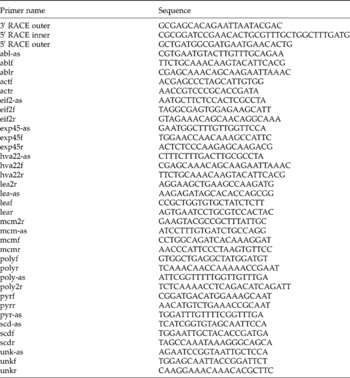
The mRNAs (200 ng) were reverse transcribed with the RevertAid first-strand cDNA synthesis kit (Fermentas). Real-time PCR was performed with an Applied Biosystems 7500 real-time PCR system using SYBR Green detection chemistry (Applied Biosystems) and gene-specific primers. The experiment consisted of three independent biological replicates and all reactions were performed in quadruplicate. Gene-specific primer pairs used for the experiments were: ablf, ablr; unkf, unkr; hva22f, hva22r; exp45f, exp45r, scdf, scdr; eif2f, eif2r; mcmf, mcmr; leaf, lear; polyf, polyr; pyrf, pyrr; respectively (Table 1). Confirmation of specific product amplification was done by Tm analysis using the Dissociation Curve option (ABI PRISM 7700 Sequence Detection System, Applied Biosystems). PCR efficiency (derived from the log slope of the fluorescence versus cycle number in the exponential phase of each amplification plot) for all primer pairs ranged from 95.5 to 98.0%. Lettuce actin (AY260165) and glyceraldehyde-3-phosphate dehydrogenase (GAPDH) (AF162202) were also selected as potential internal controls and their expression was checked using PCR and microarray data (data not shown). Based on the preliminary findings, actin was selected and used in further experiments. The relative ratios of threshold cycle (Ct) values between the actin and the specific gene and their standard deviations were calculated for each sample. The 3-hour light sample was used as a calibrator.
Gene-specific primers used for the real-time PCR and RACE experiments

RACE
To obtain full-length clones, RNA ligase-mediated rapid amplification of cDNA ends (RLM-RACE) was performed according to Schaefer (Reference Schaefer1995) with several modifications. Dephosphorylation of RNA samples (200 ng) was carried out by CIAP (Invitrogen, Carlsbad, California, USA). The samples were purified (PCR Purification Kit; Qiagen) and decapped enzymatically using 2,5 U TAP (Epicentre, Madison, Wisconsin, USA). The oligoribonucleotide 5′-GCUGAUGGCGAUGAAUGAACACUGCGUUUGCUGGCUUUGAUGAAA-3′ adapter was ligated to the decapped RNA samples by RNA ligase (Epicentre) and the samples were reverse transcribed (RevertAid First Strand PCR Kit; Fermentas) using random hexamers or oligo(dT) primers. Nested PCR reactions were performed using 1 μl of RACE template, 1.25 U SuperTaq Plus polymerase (Ambion, Foster City, California, USA), and 400 nM each of the 5′ RACE outer primer and a gene-specific outer reverse primer (the same as for the real-time PCR experiments) in a final volume of 50 μl. The following standard thermal profile was used for all RACE PCRs: 94°C for 3 min; 35 cycles of 94°C for 30 s; 59°C for 30 s; and 72°C for 75 s; then 72°C for 7 min. A second nested RACE-PCR was then performed applying the same conditions as above, except with 1 μl of the first-round RACE-PCR product as template and the 5′ RACE inner primer and a gene-specific inner antisense primer. Gene-specific RACE primers applied were: abl-as; unk-as; hva22-as; exp45-as; scd-as; eif2-as; mcm-as; lea-as; poly-as; pyr-as; respectively (Table 1).
To obtain the 3′ ends of the fragments, mRNA (100 ng) was reverse transcribed (RevertAid First Strand PCR Kit; Fermentas) using a 3′ RACE adapter (5′-GCGAGCACAGAATTAATACGACTCACTATAGGT12VN-3′), then 1.5 μl of each RACE template was amplified with gene-specific primers (mcm2r, lea2r, poly2r) (Table 1) and 3′ RACE outer primer. The PCR reaction conditions were the same as described in the 5′ RACE protocol.
PCR products were cloned into pGEM (Promega) or pBluescript vector (Stratagene, Santa Clara, California, USA) and transformed into E. coli JM-109 cells (Promega). Single colonies were isolated, plasmid DNA sequenced (ABI 3100 Genetic Analyzer; Applied Biosystems), and the resulting sequences organized into contigs to obtain the full-length sequences.
In silico analysis of the sequences
Sequence alignments were performed with the ClustalW module of EBI server (http://www.ebi.ac.uk). To assemble contigs, the BioEdit 7.0.5.3 built-in CAP assembly program was used (Hall, Reference Hall1999). Protein domains, possible signal peptide or membrane-anchoring domains were predicted from various servers as follows: CBS prediction servers (http://www.cbs.dtu.dk/services/), EBI servers (http://www.ebi.ac.uk) and Expasy proteomics server (http://expasy.org/). Subnuclear localization signal prediction was made using ProcLoc server (Huang et al., Reference Huang, Tung, Huang, Hwang and Ho2007). Prediction of Golgi-localized transmembrane proteins was done according to Yuan and Teasdale (Reference Yuan and Teasdale2002). Protein domain schematic drawings were generated using DomainDraw (Fink and Hamilton, Reference Fink and Hamilton2007; http://domaindraw.imb.uq.edu.au./).
Results
Germination time course
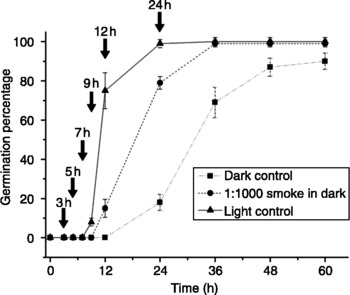
The most rapid germination response was detected in the achenes germinated in water and exposed to continuous light (light control). After 12 h, ~75% of the achenes in the light control had germinated (Fig. 1). From 12 h onwards, a steady increase in germination was observed in the smoke-treated achenes, while the dark control achenes showed very low germination (~20%), even after 24 h.
Germination rate (%) of Grand Rapids lettuce achenes germinated in smoke-water (in the dark) or water (in continuous light or dark) at 20°C. Black arrows indicate sample time points. At 9, 12 and 24 h, the samples contained both germinating and germinated achenes.

Isolation of smoke-induced and repressed genes
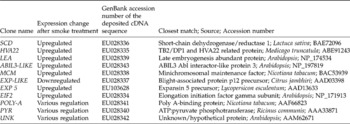
A differential display approach was used to isolate genes from germinating Grand Rapids lettuce achenes whose transcription is affected by smoke treatment. The cDNA fingerprints of the smoke-treated germinating lettuce achenes were compared with those of water-treated achenes placed either in continuous light or in the dark. Samples were harvested 3, 5, 7, 9, 12 and 24 h after treatment. First-strand cDNA produced from the RNA extracted from the samples was amplified with a combination of arbitrary primers (H-AP 1–16) and 12-nucleotide anchor primers (H-T11-N, where N = G, C or A). The smoke-water versus light control samples resulted in identical expression patterns or indistinguishable differences between the two treatments. After thorough inspection, no bands were observed which would have referred to differential expression (data not shown). By contrast, in the smoke-water versus dark control samples, a total of 19 cDNA fragments were detected, cloned and sequenced, based on their consistent differential expression on three replicate differential display gels (DD gel). Eight of the clones showed no significant homology to known sequences using BLASTX and TBLASTX. The remaining 11 clones were selected for further study (Table 2), 10 of which showed significant homology to known genes or gene families, and the other having similarity to an unknown Arabidopsis gene (UNK). Several cDNA fragments contained regions lacking enough information to predict their functions. In order to obtain information about the domain organization, full-length cDNA clones of the candidate genes were isolated using the RACE approach. The majority of fragments identified by differential display corresponded to known genes, with functions related to cell wall expansion (expansin-like, expansin 5), abscisic acid (ABA) regulation (HVA22, short-chain dehydrogenase/reductase), regulation of translation (EIF2 gamma translation initiation factor, Poly-A binding protein), cell division cycle (ABIL3-LIKE, minichromosome maintenance factor), carbohydrate metabolism (pyruvate kinase) and water homeostasis (late embryogenesis abundant). The full-length and partial cDNA sequences were deposited in the GenBank database.
Clones with homology to known genes/gene families

In subsequent work, we validated the results by real-time PCR. Interestingly, three of the genes expressed differentially in the smoke-water versus dark control experiment showed altered expression in the smoke-water versus light control experiment. The relative transcript abundances of the HVA22, LEA and SCD genes were higher in smoke-treated samples, although no differences were detected on the DD gel.
Expression pattern of the candidate genes and the characterization of the deduced amino acid sequences
Short-chain dehydrogenase/reductase (SCD)
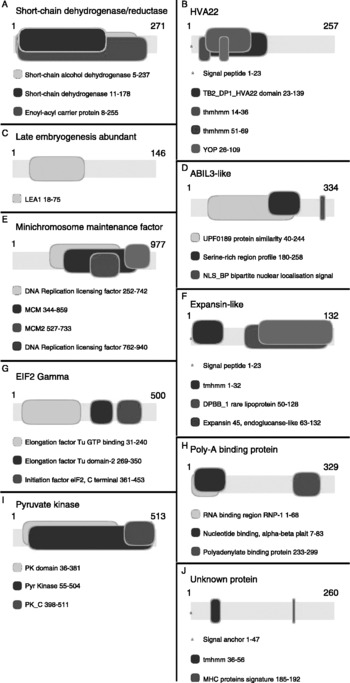
The 271 amino acid (aa) long sequence represents a member of the short-chain dehydrogenases/reductases family (Supplementary Fig. S1; available online only at http://journals.cambridge.org/ssr). The deduced amino acid sequence consists of an adh_short, short-chain dehydrogenase domain (PF00106) and an enoyl-acyl-carrier-protein domain (COG0623) (Fig. 2A).
Domain topology of the predicted amino acid sequences. Conserved domains identified in the predicted proteins are highlighted in different shading. Graphs were generated using DomainDraw (http://domaindraw.imb.uq.edu.au./). (A) SCD; (B) HVA22; (C) LEA; (D) ABIL3-LIKE; (E) MCM; (F) EXP-LIKE; (G) EIF2 GAMMA; (H) POLY-A; (I) PYR; (J) UNK.

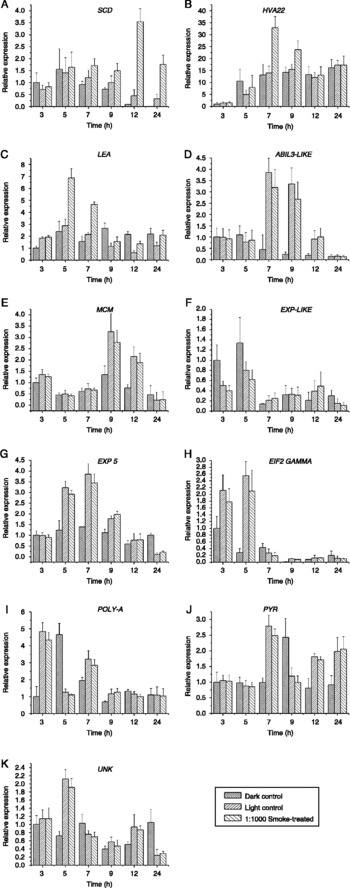
For both control samples and smoke-treated achenes, SCD expression was similar after 3 and 5 h (Fig. 3A). The dark control declined following this, such that 24 h after treatment only a negligible amount of SCD transcript was detectable in the control achenes. After 12 h, there was a sharp increase in transcript abundance which then declined by 24 h, while the expression in the light control samples was lower.
Expression analysis of the corresponding genes in response to smoke treatment. Relative transcript abundance was calculated and normalized with respect to the actin transcript level. The 3-hour light control was set as calibrator. Data shown represent mean values obtained from four independent amplification reactions (n = 4). The experiment was repeated three times with similar results. At 9, 12 and 24 h, samples contained both germinating and germinated achenes. (A) SCD; (B) HVA22; (C) LEA; (D) ABIL3-LIKE; (E) MCM; (F) EXP-LIKE; (G) EXP 5; (H) EIF2 GAMMA; (I) POLY-A; (J) PYR; (K) UNK.

HVA22
The 257 aa long deduced amino acid sequence of HVA22 shared strong identities with TB2_DP1_HVA22 family proteins found in plants (Supplementary Fig. S2; available online only at http://journals.cambridge.org/ssr). The deduced amino acid sequence contains a signal peptide, a characteristic TB2_DP1_HVA22 domain (PF03134) and several predicted transmembrane helices on the N-terminal (Fig. 2B).
HVA22 expression increased in the controls and smoke-treated achenes in the first 5 h (Fig. 3B). After 7 h, the relative amount of the transcript in the smoke-treated achenes exceeded that of both control treatments, even in the light control samples. From 9 h onwards, the relative transcript levels were similarly high in all treatments compared to the calibrator (Fig. 3B).
Late embryogenesis abundant (LEA)
The short 146 aa long deduced amino acid sequence of LEA shared identities with LEA1 family proteins (PF03760) found in plants (Supplementary Fig. S3; available online only at http://journals.cambridge.org/ssr). Its deduced amino acid sequence consists of a LEA1 domain (Fig. 2C).
The LEA expression was higher in smoke-treated achenes 5 and 7 h after treatment than that of both controls. The relative transcript level was slightly higher in dark control achenes at 9 and 12 h but was the same after 24 h (Fig. 3C).
ABIL3-LIKE
The 334 aa long deduced amino acid sequence of ABIL3-LIKE showed similarity to different ABIL proteins found in plants (Supplementary Fig. S4; available online only at http://journals.cambridge.org/ssr). The deduced amino acid sequence contains a domain similar to yeast ymdB protein (UPF0189), a serine-rich region profile and the NLS_BP bipartite nuclear localization signal (Fig. 2D).
In smoke-treated achenes, the ABIL3-LIKE expression was parallel to the control samples kept in light, so it increased two- to threefold 7, 9 and 12 h after the treatment and decreased to a similar low abundance as in the dark control achenes 24 h after treatment (Fig. 3D).
Minichromosome maintenance factor (MCM)
The relatively long 977 aa MCM shared identities with the MCM protein family members found in plants (Supplementary Fig. S5; available online only at http://journals.cambridge.org/ssr). The deduced amino acid sequence contains a nuclear localization signal, a DNA replication licensing factor domain (pthr11630) and the MCM (SM00350) and MCM2 domain (PS50051) with DNA-binding properties (Fig. 2E).
The MCM transcript abundance was similar 3, 5 and 7 h after all treatments (Fig. 3E). At 9 h, there was an increase in both the light and dark controls and the smoke-treated achenes, although this was more pronounced in the light controls and smoke-treated achenes. These levels declined after 12 h, although the smoke-treated and light control achenes still showed much higher levels at 12 h than in the dark control achenes (Fig. 3E).
Expansin-like (EXP-LIKE) and expansin 5 (EXP 5)
The 132 aa long deduced amino acid sequence of EXP-LIKE showed similarity to expansins (Supplementary Fig. S6A; available online only at http://journals.cambridge.org/ssr). The nucleotide sequence of EXP 5 clone shared identities (95%) with expansin 5 gene (AF059489) of L. esculentum (Supplementary Fig. S6B; available online only at http://journals.cambridge.org/ssr). The deduced amino acid sequence of EXP-LIKE consists of a signal peptide, an endoglucanase-like expansin 45 domain (PS54842), a DPBB_1 RARE LIPOPROTEIN domain (PF03330) and a predicted transmembrane region on the N-terminal end (Fig. 2F). EXP 5 shares a similar domain structure (data not shown).
The relative abundance of the EXP-LIKE transcript was slightly downregulated in the first 5 h in the smoke-treated and light control achenes compared to the dark control. In the later stages, the EXP-LIKE transcript level was similarly low in all treatments (Fig. 3F). The expression pattern of EXP 5 was quite the opposite to that of EXP-LIKE. For EXP 5, the transcript abundance was higher in smoke-treated and light control achenes in the first 7 h, after which it was similar to the level measured in the dark control samples (Fig. 3G).
EIF2 Gamma translation initiation factor (EIF2 GAMMA)
The 500 aa long deduced amino acid sequence of EIF2 GAMMA proved to be highly similar to the elongation initiation factor gamma subunit (EIF2 Gamma) proteins (Supplementary Fig. S7; available online only at http://journals.cambridge.org/ssr). The deduced amino acid sequence consists of an elongation factor Tu GTP binding domain (PF00009), an elongation factor Tu domain-2 (PF03144) and an initiation factor eIF2 gamma, C terminal domain (PF09173) (Fig. 2G).
After 3 and 5 h following treatment the EIF2 GAMMA expression increased two- to fourfold in smoke-treated and light control achenes compared to the dark control. Later the relative transcript abundance was similarly low in all treatments (Fig. 3H).
Poly-A binding protein (POLY-A)
The 329 aa long deduced amino acid sequence of POLY-A shared identities with the Poly-A binding proteins (Supplementary Fig. S8; available online only at http://journals.cambridge.org/ssr). The deduced amino acid sequence consists of a RNA binding region RNP-1 recognition motif (PS50102), a polyadenylate binding protein domain (PF00658) and a nucleotide binding, alpha-beta plait (PF3.30.70.330) (Fig. 2H).
At 3 h after treatment, the POLY-A transcript abundance was high in smoke-treated and light control achenes. After 5 h, however, the POLY-A levels in the dark control increased, while a sharp decline in both the smoke-treated and light control achenes was observed. Following this, at 7 h, the opposite trend was observed, with a decline in the dark control, and an increase in the smoke-treated and light control achenes. At the later stages, expression levels were similar in all treatments (Fig. 3I).
Pyruvate kinase (PYR)
The 513 aa long deduced amino acid sequence of the PYR is highly similar to pyruvate kinases found in plants (Supplementary Fig. S9; available online only at http://journals.cambridge.org/ssr). The amino acid sequence consists of a Pyr kinase domain (PTHR11817), a PK domain (PF00224) and a PK_C domain (PF02887) (Fig. 2I).
The PYR transcript level was similar in the first 5 h in all treatments. At 7 h, however, the relative transcript abundance was higher in smoke-treated and light control achenes compared to the dark control. The dark control achenes showed a similar level of PYR transcript, but only after 9 h, at which time the levels in the other experiments had declined to the levels observed at 3 and 5 h. After 9 h, the PYR levels in the dark control decreased, whereas the smoke-treated and light control achenes showed a steady increase (Fig. 3J).
Unknown protein (UNK)
The 266 aa long deduced amino acid sequence of UNK showed similarity to unknown and hypothetical proteins found in various plant species (Supplementary Fig. S10; available online only at http://journals.cambridge.org/ssr). The sequence contains a signal anchor, a transmembrane region and a major histocompatibility complex protein (MHC) signature (PS00290) (Fig. 2J).
The expression pattern of UNK transcript fluctuated in all treatments during the time course of the experiment. At 5 h, the transcript abundance was higher in smoke-treated and light control achenes, following which it declined to a minimal level at 9 h, increasing again at 12 h and decreasing by 24 h (Fig. 3K).
Discussion
The expression pattern of germinating smoke-treated achenes is similar to that of light-induced controls
It has been reported that smoke can substitute to varying degrees for the requirement of red light for the germination of the achenes of light-sensitive Grand Rapids lettuce achenes (Van Staden et al., Reference Van Staden, Jäger and Johnson1995). Earlier results showed that smoke-promoted germination can be prevented by far-red light treatment, implying that smoke action is partially phytochrome-dependent (Gardner et al., Reference Gardner, Dalling, Light, Jäger and Van Staden2001). The identical expression patterns of the water-treated control kept in light and the smoke-treated samples tend to support this idea; however, this does not necessarily indicate that smoke acts exclusively through the phytochrome system. The obvious difference in the timing of smoke-induced germination compared to the achenes germinated in continuous light indicates that the modes of action of the two treatments differ in some way (Fig. 1). In addition, the real-time PCR validation showed that three genes (SCD, HVA22, LEA) were differentially expressed in the smoke-water versus light control samples, although no difference was detected on the DD gel. The apparent identity of the expression pattern can be attributed to the limitations of the differential display technique (Lievens et al., Reference Lievens, Goormachtig and Holsters2001), which – despite any shortcomings – is an important and effective tool of gene expression studies when there is insufficient preliminary information about the genome. Evidence has been presented that aberrant priming at both the 5′ and 3′ ends results in competition in the PCR, precluding detection of messages – even those that are abundantly expressed (Ledakis et al., Reference Ledakis, Tanimura and Fojo1998). Probably, the early events in the gene expression cascade during the light and smoke-induced germination cannot be displayed properly on the DD gel because of the relatively small changes. The application of lettuce microarray slides, currently under development, may shed light on the molecular background of the presumed difference. However, the present data clearly indicate that smoke action somehow interacts with the phytochrome system and smoke-water treatment does not differ significantly from normal light imbibition.
In the present experiments, we compared achene populations at the same time points, which do not necessarily correspond to the same developmental stages (Fig. 1). Certainly, before 9 h, when radicle emergence can be observed in the light control, germinating achenes are morphologically indistinguishable from non-germinating ones. The majority of the well-pronounced changes in the gene expression pattern occurred in this period, except for SCD, for which transcript abundance was higher after 12 and 24 h, while the expression levels were lower in the controls.
We checked the corresponding genes and their closest homologues against publicly available Arabidopsis germination specific microarray data deposited in the TAIR database (http://www.arabidopsis.org/; data not shown). All the genes found showed altered expression patterns at the onset of imbibition, thus indicating their involvement in the germination process.
Smoke induced ABA-related genes in achenes germinating in the dark
Smoke treatment induced the differential expression of several genes that are regarded as ABA-related genes. The abundance of these transcripts was significantly higher in the smoke-stimulated achenes than in the control samples (Fig. 3A, B and C), indicating that they are smoke-specific, although they are expressed during Arabidopsis germination (http://www.arabidopsis.org/; data not shown). One of the candidate genes proved to be a short-chain dehydrogenase/reductase which is a pivotal regulatory point through which glucose signalling may interact with ABA synthesis and function (Cheng et al., Reference Cheng, Endo, Zhou, Penney, Chen, Arroyo, Leon, Nambara, Asami and Seo2002). However, proteome analysis has revealed that purified oil bodies of rapeseed contain short-chain dehydrogenase/reductase which could be involved in stored lipid mobilization in germinating seeds (Katavic et al., Reference Katavic, Agrawal, Hajduch, Harris and Thelen2006), suggesting that SCD may also have a role in degradation of lipid reserves during germination.
The expression of the HVA22 gene is induced by various environmental stresses and ABA, but its role in stress responses is not yet fully understood. HVA22 protein could be a negative regulator of vesicle trafficking (Yang et al., Reference Yang, Matern and Gallwitz1998). The deduced amino acid sequence contains a signal peptide showing that HVA22 is a predicted Golgi Type II membrane protein destined for the Golgi apparatus, confirming the assumption that HVA22 is targeted to the Golgi vesicles similarly to its yeast counterparts. HVA22 was previously identified as an ABA-induced message of barley aleurone (Shen et al., Reference Shen, Chen, Brands, Pan and Ho2001) and may affect the secretion of hydrolytic enzymes from the aleurone layer, or membrane lipid delivery, by blocking vesicle membrane fusion to the plasmalemma. HVA22 expression is highly confined to early seed development (Becerra et al., Reference Becerra, Puigdomenech and Vicient2006), and its promoter contains an abscisic acid response complex (ABRC) (Shen and Ho, Reference Shen and Ho1995). The same ABRC unit can be found in the promoter region of the third ABA-related candidate gene, encoding a hydrophylic LEA protein which accumulates in the late phase of embryogenesis, concomitant with the onset of seed desiccation tolerance (Shen et al., Reference Shen, Zhang and Ho1996). LEA proteins play an essential role in seed survival and control of water uptake during seed desiccation, imbibition and germination. In smoke-treated achenes, LEA protein could act as a protectant of temporal desiccation.
Our data clearly show that smoke treatment resulted in the upregulation of genes which are linked to ABA (Fig. 3A, B and C). Although the transcript abundance of SCD, HVA22 and LEA increased slightly, even in the light control achenes, their expression levels were higher or the same during the time course of the experiments. However, the significant decrease in ABA content in smoke-treated seeds of Nicotiana attenuata (Schwachtje and Baldwin, Reference Schwachtje and Baldwin2004) suggests that the upregulation of these genes might be independent from the endogenous ABA level. Other studies showed that a short time window exists during which the germinating seeds are supposed to recapitulate at least a part of a maturation programme of seed development (Lopez-Molina et al., Reference Lopez-Molina, Mongrand, McLachlin, Chait and Chua2002; Rajjou et al., Reference Rajjou, Gallardo, Debeaujon, Vandekerckhove, Job and Job2004; Holdsworth et al., Reference Holdsworth, Finch-Savage, Grappin and Job2008). In Arabidopsis, this postgermination developmental arrest checkpoint is mediated by ABA and requires the ABI5 transcription factor (Lopez-Molina et al., Reference Lopez-Molina, Mongrand, McLachlin, Chait and Chua2002). The maturation drawback implies the expression of LEA and seed storage proteins (Rajjou et al., Reference Rajjou, Huguet, Robin, Belghazi, Job and Job2006), allowing the germinating seeds to reinforce the capacity to withstand environmental stresses. Besides, ABA-treated germinating seeds accumulate high levels of sucrose from the breakdown of storage lipid, suggesting also that ABA may have a large effect on seedling development and vigour (Pritchard et al., Reference Pritchard, Charlton, Baker and Graham2002). Similarly, an increase in the amount of sucrose and other soluble sugars can also be detected in smoke-treated Grand Rapids lettuce achenes (Jäger and Van Staden, Reference Jäger and Van Staden2002). Smoke not only promotes germination, but its effect can extend beyond germination stimulation, by enhancing seedling vigour (Sparg et al., Reference Sparg, Kulkarni, Light and Van Staden2005, Reference Sparg, Kulkarni and Van Staden2006). These results, together with our previous findings, suggest that smoke has a dual effect. On the one hand, the concerted upregulation shows that smoke could induce genes linked to ABA and stresses in the germinating achenes. On the other hand, it promotes a higher germination rate by inducing a similar pattern of gene expression as light treatment. These genes showed completely parallel expression patterns in the smoke-water versus light control experiment, although the relative abundance of their transcripts were higher in the light control achenes. Most of these transcripts are regarded as germination-related messages, indicating that smoke has indeed a direct effect on germination-related gene expression which is quite similar to light-induced expression.
Smoke treatment induced germination-specific genes
Smoke and light treatment affected the expression of genes involved in the cell division cycle. The ABIL (Abelson interactor-like) proteins are part of the WAVE repressor/activator complex responsible for the regulation of actin polymerization (Uhrig et al., Reference Uhrig, Mutondo, Zimmermann, Deeks, Machesky, Thomas, Uhrig, Rambke, Hussey and Hulskamp2007). According to a subnuclear localization prediction, ABIL3-LIKE is targeted to the heterochromatin, and thus may play a role in chromatin remodelling throughout the cell division cycle. In eukaryotes, the MCM (minichromosome maintenance factor) protein complex plays an essential role as a replicative helicase (Ishimi, Reference Ishimi1997). Abundance in the expression of MCM genes has been correlated with cell proliferation throughout vegetative plant and seed development (Holding and Springer, Reference Holding and Springer2002). As the resumption of cell cycle activity is a specific feature of early germination (De Castro et al., Reference De Castro, Van Lammeren, Groot, Bino and Hilhorst2000), the MCM and ABIL3-LIKE overexpression in smoke-treated and light control achenes could be the point through which smoke and light may positively affect cell division and therefore facilitate embryo growth and thus the germination processes. In tomato seeds, flow cytometric studies showed that DNA synthesis of seeds treated with the smoke-derived butenolide precedes that of the control (Jain and Van Staden, Reference Jain and Van Staden2006).
The expression pattern of the expansin genes indicates a divergent contribution to the germination processes of smoke-treated and light control achenes. Expansins are known to have cell wall loosening activity in a pH-dependent manner, and to be involved in cell expansion and other developmental events during which any cell wall modification occurs (Sampedro and Cosgrove, Reference Sampedro and Cosgrove2005). The localization signal of EXP-LIKE shows that the mature protein is secreted into the cell wall. It can be concluded that the smoke and light-induced downregulation of EXP-LIKE and upregulation of EXP 5 could result in cell wall loosening in specific tissues, which may facilitate embryo protrusion and, as such, can induce enhanced germination.
The expression of genes involved in translation regulation was found in both the smoke-treated and light control achenes. The translation initiation factor IF2 gamma subunit functions to transport the initiator methionyl-tRNA to the ribosome. The Poly-A binding proteins (PAPB) are essential factors in the determination of mRNA stability. Footitt et al. (Reference Footitt, Slocombe, Larner, Kurup, Wu, Larson, Graham, Baker and Holdsworth2002) showed that translational control has a key role in the regulation of germination-related gene expression.
In both the smoke-treated and light control achenes, expression of pyruvate kinase, a key enzyme of glycolysis, was upregulated. It seems likely that the upregulation of pyruvate kinase genes by smoke compounds and light may positively affect carbohydrate metabolism of the seed and therefore accelerate the germination processes.
The expression of a poorly characterized gene was found in both the smoke-treated and light control achenes (Fig. 3K). The deduced amino acid sequence of the unknown protein contains a membrane spanning domain and a signal sequence, suggesting that the matured protein is localized in the plasmalemma. The presence of the major histocompatibility complex (MHC) signature raises the question of whether the UNK protein is involved in cell adhesion and the inherent signalling processes of the cell wall linked to growth and development. Such an MHC motif can be found in vacuolar protein sorting-associated protein 41 homologue (UniProtKB/Swiss-Prot entry P93043), required for vacuolar assembly and vacuolar trafficking, and wall-associated receptor kinase-like 14 (UniProtKB/Swiss-Prot entry Q8RY67), a serine/threonine-protein kinase that may function as a signalling receptor of extracellular matrix components and be involved in cell expansion (Verica et al., Reference Verica, Chae, Tong, Ingmire and He2003).
Conclusion
This study presents the first report on smoke-induced gene expression in seed germination and provides insight into the molecular events elicited by smoke treatment. After a serious evaluation of the physiological aspects of smoke action in our previous studies, we were able to separate smoke-induced genes of germinating lettuce achenes. The results indicate that smoke has a dual effect. On the one hand, smoke can induce genes that can be linked to ABA action, whereas, on the other hand, it elicits a faster germination rate by inducing a similar pattern of gene expression as in normal germination in the light. Thus, smoke effects are manifested mainly through the induction of the cell division cycle, cell wall extension and storage mobilization.
Acknowledgements
This work was supported by the Hungarian–South African Intergovernmental S&T Cooperation Programme, the Hungarian Scientific Research Fund (OTKA – F16066), the Baross Gábor Projekt and the National Research Foundation, Pretoria, South Africa.