Implications
Bacitracin, as feed additive, has been banned from livestock diets (EU 1831/2003) because its widespread use would increase pathogen resistance. Moreover, bacitracin is not innocuous in metabolic terms given that altered protein metabolism observed here for lactating does.
Introduction
Zinc bacitracin is the most common antibiotic used in rabbit husbandry to control digestive pathologies induced by intestinal micro-organisms, although collateral effects on nutrient absorption (Abecia et al., Reference Abecia, Balcells, Fondevila, Belenguer and Calleja2005) or intestinal mucosa development (King, Reference King1980) have been also described. Bacitracin is a polypeptide antibiotic, produced by Bacillus licheniformis, that acts by interfering with the formation of lipid-linked sugars and thus disrupting the synthesis of peptidoglycan in bacterial cell membranes (Storm and Strominger, Reference Storm and Strominger1973 and Reference Storm and Strominger1974). These lipid-linked sugars are intermediates in the biosynthesis of several glycoproteins and polysaccharides not only in bacteria (Waechter and Lennarz, Reference Waechter and Lennarz1976) but also in plants (Ericson et al., Reference Ericson, Gafford and Elbein1978) and animals (Herscovics et al., Reference Herscovics, Bugge and Jeanloz1977). Moreover, bacitracin has been shown to impact on both isolated cells and subcellular organelles, through inhibiting the degradation of substances that influence protein synthesis, including thyrotropin, luteinising hormone-releasing factors (McKelvy et al., Reference McKelvy, LeBlanc, Laudes, Perrie, Grimm-Jorgensen and Kordon1976), insulin (Roth et al., Reference Roth, Conaway, Sanders, Casali and Boyd1980) and β-endorphin (Patthy et al., Reference Patthy, Gráf, Kenessey, Székely and Bajusz1977). Collateral effects of bacitracin on nutrient absorption (King, Reference King1980; Abecia et al., Reference Abecia, Balcells, Fondevila, Belenguer and Calleja2005) may be exerted through protein metabolism, either by blocking synthesis of specific cell wall peptidoglycane or altering the hormonal environment of protein metabolism. During lactation, protein metabolism is enhanced (Baracos et al., Reference Baracos, Brun-Bellut and Marie1991) due to the metabolic activity of the mammary gland and thus may be particularly sensitive to any undesirable action of the antibiotic.
The aim of this study was to investigate the impact of the antibiotic on protein synthesis in lactating does using litter size as a tool to modify intake.
Material and methods
Animals and diets
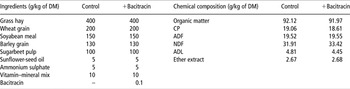
Protocols, animal handling and infusion procedures used in this experiment were approved by the Comité Etico de Experimentación Animal of the University of Zaragoza. Sixteen New Zealand White doe rabbits in the third pregnancy and a similar body weight (BW), (4.3 ± 0.42 kg) at the beginning of the experiment were randomly divided into two groups that were fed from late pregnancy (2 to 3 days before parturition). Ingredients and chemical composition of experimental diets were described in Table 1.
Ingredients (g/kg of DM) and chemical composition (g/kg of DM) of both experimental diets

DM = dry matter.
Vitamin mineral mixture composition: Co (CoSO4·7H2O), 200 parts/million (ppm); Cu (CuSO4·5H2O), 3000 ppm; Fe (FeSO4·H2O), 20 000 ppm; Mn (MnO2), 8000 ppm; Zn (ZnO), 30 000 ppm; Se (Na2SeO3), 30 ppm; I (KI), 500 ppm; vitamin A, 270 mkat (4 500 000 IU)/kg; vitamin D3, 33 mkat (550 000 IU)/kg; vitamin E, 1100 ppm; vitamin B1, 250 ppm; vitamin B2, 1500 ppm; vitamin B6, 100 ppm; vitamin B12, 6000 ppm; vitamin K, 500 ppm; Dpantothenate, 5000 ppm; niacin, 12 500 ppm; choline chloride, 100 000 ppm.
Experimental design
Less than 12 h after birth, the litter size of four does within each dietary treatment was adjusted by cross-fostering either to five (LS5) or nine (LS9) pups. The females were housed separately from their offspring in individual metabolism cages and pups were allowed to suckle for 10 min every morning. Daily milk yield was recorded by weighing the does immediately before and after suckling. On day 26 after parturition the does were weighed, a manual milk sample (5 to 10 ml) obtained and then they were suckled by their offspring. Afterwards the females were fitted with two indwelling catheters: one in the auricular artery [20G 11/4″;1.1 × 32 mm] and the other in the marginal vein [22G 1″; 0.9 × 25 mm; Braun Medical S.A, Rubi, Barcelona) of the contralateral ear, for infusion and sampling, respectively. Surgery was performed under sterile conditions in an appropriately equipped operating room. To insert the catheters, the ears were anesthetised using a commercial topical cream (EMLA, Astra-Zeneca Farmaceutico S.A., Madrid, Spain).
Infusion protocol and tissue sampling
A flooding dose of phenylalanine (set at 15 times the size of the body free phenylalanine pool), 40% of which was as [ring-2H5]phenylalanine (Cambridge Isotope Laboratories IL, Inc., Miamisburg, OH, USA), dissolved in sterile saline (9 g NaCl/l) was infused over a 10-min period into the artery. The amount of total phenylalanine infused per doe averaged 400 mg. Venous blood samples (1 ml) were withdrawn at −10 min (for background natural abundance) and at 12, 15, 20, 25, 30 and 40 min after the start of the infusion. Therefore, isotope was infused and sampled during 40 min to obtain an equilibrium of the isotope distribution into the plasma pool but avoiding the return of bounded–[2H5] phenylalanine. These samples were used to define the temporal kinetics of plasma free phenylalanine enrichment. After the last plasma sample a small volume of milk (2 to 5 ml) was taken manually and then does were killed by lethal injection of sodium thiopental (Braun Medical S.A, Rubi, Barcelona). In order, tissue samples (2 to 3 g) from the liver, semitendinosus muscle, mammary gland and duodenum were rapidly dissected, washed in cold saline and frozen in liquid nitrogen until analysis. The remainder of the liver and mammary gland were then extracted and weighed.
Analytical procedures
Dry matter (DM), organic matter, nitrogen (N) and fibre in feed and faeces and N in urine were determined by standard procedures of AOAC (Association of Official Analytical Chemists, 1995). Casein in defatted milk samples (2 ml) was determined after cool-casein coagulation using chymosin (CHR Hansen, Madrid, Spain) and calcium chloride followed by centrifugation (15 000×g, 1 h at 4°C). N was determined in both the supernatant (serum protein) and casein-precipitated fractions.
Isotope determination
Free phenylalanine extracts from both plasma, obtained from centrifugation of blood at 1000×g for 15 min at 4°C, and tissues were obtained, converted to t-butyldimethsilyl derivatives and isotopic enrichments measured by gas-chromatography mass spectrometry as described previously (Connell et al., Reference Connell, Calder, Anderson, McNurlan and Garlick1997) and calculated as mole percent excess (MPE). Protein-bound phenylalanine from the tissues was enzymatically converted to phenylethylamine and the enrichments determined as the heptafluorobutyryl n-butyl ester as described previously (Calder et al., Reference Calder, Anderson, Grant, McNurlan and Garlick1992).
Calculation and statistics
Fractional rates of protein synthesis (FSR; percentage of the tissue protein pool synthesised per day) in the different tissues were calculated using the equation developed by Garlick et al. (Reference Garlick, McNurlan and Preedy1980) for the ‘flooding’ dose technique:

where Sb is the isotopic enrichment of the phenylalanine bound to tissue protein above natural abundance (assumed to be the same as in plasma protein) at time t (per day), the time of tissue removal. Sa is the calculated area under the curve (AUC) for the isotopic enrichment of the free phenylalanine pool, between time = 0 until t, calculated by trapezium-based analysis for each doe and tissue. The AUC was calculated from the plasma data, extrapolated to the time of tissue excision, and this then corrected by the ratio of the terminal tissue-free pool : extrapolated plasma phenylalanine enrichments.
Absolute rate of protein synthesis (ASR, g/day) in liver and mammary gland was calculated according to the equation:

results were examined by ANOVA as a 2 × 2 factorial design, considering the diet (C v. B) and the litter size (LS5 v. LS9) as main effects. When comparisons between tissues FSR were performed, rabbit was taken as a random factor. All statistical analyses were carried out using the GLM Procedure of the Statistical Analysis Systems computer software package, version 8 (SAS Institute Inc., 2000). Significance was taken as P < 0.05.
Results
No major incidents were registered during the experiment and no apparent differences in behaviour were observed among does eating either the control or the medicated diet.
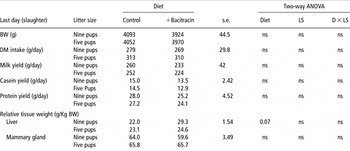
Production data from the last day of experiment (to match with isotope kinetics) are shown in Table 2. On the terminal day no treatment differences were observed for BW (4011 (s.e. = 40.35) g), DM intake (293 (s.e. = 13.57) g/day) or milk yield (242 (s.e. = 17.98) g/day). In addition, no significant changes were detected in either protein (107.7 g/kg of milk) or casein (57.6 g/kg) concentration in milk between experimental treatments, the latter constituted 54% of total milk protein.
BW (g), DM intake (g/day), milk yield (g/day), protein yield and casein yield (g/day) of 16 does on the last day of the experiment (slaughter day) together with liver and mammary gland contribution to final BW in lactating does fed on a conventional diet either supplemented (+bacitracin) or not (control) with zinc bacitracin (100 ppm) and nurturing five or nine pups (s.e. for diet comparison)

DM = dry matter; LS = litter size; D = diet.
ns, P > 0.05.
The relative and absolutes weights of the mammary gland averaged 63.8 (s.e. = 2.24) g/kg BW and 255.7 (s.e. = 14.38) g, respectively, and were neither influenced by diet nor litter size. In contrast, the relative weight of the liver tended to be greater in those females receiving the B diet (27 v. 22.5 g/kg BW; P < 0.07). Liver weight was independent of litter size.
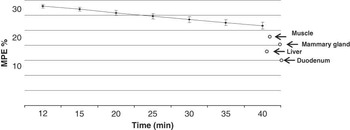
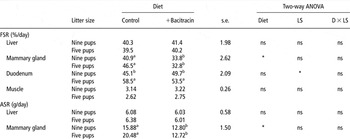
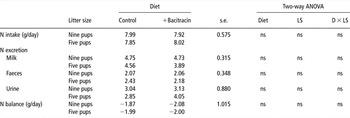
Temporal changes in plasma enrichment of free phenylalanine are presented in Figure 1, together with terminal enrichments of free phenylalanine recorded for the different tissues. The FSR for the different tissues are presented in Table 3. The highest mean values were found for the intestinal mucosa (duodenum; 51.7%/day) followed by mammary gland and liver (38.29 and 40.2%/day) as showed in Table 3. Protein contents in muscle, mammary gland and liver were 17.0 (s.e. = 0.68), 15.2 (s.e. = 1.05) and 15.8 (s.e. = 0.57) g CP/100 g wet tissue, respectively. Bacitracin lowered FSR in the mammary gland by 23% (P = 0.024) and this was independent of litter size. Similar changes were observed when ASR was considered. In contrast, protein synthesis in the duodenum was not affected by antibiotic treatment but was reduced (−15%, P = 0.021) for the larger litter size. No significant changes in FSR or ASR were detected for liver or muscle. Data from N balance are presented in Table 4. Feed N input (g/day) averaged 7.9 (s.e. = 0.29) whereas output in urine (3.26 (s.e. = 0.13)), faeces (2.12 (s.e. = 0.16)) and milk (4.54 (s.e. = 0.24)) totalled 9.92 g/day, so the does were in a negative daily balance of 1.9 g/N, equivalent to 12.1 g/protein, even at this stage of late lactation.
Plasma enrichment (molar percent excess (MPE)) of free phenylalanine (average, n = 16) in plasma after 12, 15, 20, 25, 30 and 40 min of isotope infusion and in tissues after slaughtering, in rabbit does supplemented or not with bacitracin (100 mg/kg DM) and adjusted by cross-fostering at five or nine pups.

FSR in liver, duodenum, mammary gland and muscle together with ASR of liver and mammary gland in 26 days lactating does fed on a conventional diet either supplemented (+bacitracin) or not (control) with zinc bacitracin (100 ppm) and nurturing five or nine pups (s.e. for diet comparison)

FSR = fractional synthesis rates; ASR = absolute synthesis rates; LS = litter size; D = diet.
a.bMeans with different superscripts are significantly different at P < 0.05.
ns, P > 0.05; *, P < 0.05.
Nitrogen balance in lactating does (day 17 to day 24) fed on a conventional diet either supplemented (+bacitracin) or not (control) with zinc bacitracin (100 ppm) and nurturing five or nine pups

LS = litter size; D = diet.
ns, P > 0.05.
Figure 1 shows enrichment (MPE) of free phenylalanine in plasma. Liver was the first tissue sampled followed by muscle due to the relatively easy access to both of them. However to take mammary gland and duodenum samples longer time was consumed.
Discussion
The experimental animals formed part of a larger study (Abecia et al., Reference Abecia, Balcells, Fondevila, Belenguer, Holtrop and Lobley2008) but experimental constraints, including availability of metabolic cages, meant that only 16 does could have kinetics measurements performed. The limited numbers meant that some production data (discussed below) did not show the treatment differences reported earlier (Abecia et al., Reference Abecia, Balcells, Fondevila, Belenguer, Holtrop and Lobley2008). Nevertheless, the main objective focused on protein metabolism in responses to bacitracin was demonstrated.
Diet inclusion of bacitacin reduced FSR and ASR in the mammary gland and tended to increase the relative weight of the liver. Bacitracin intake has been shown not to affect either the caecotrophy process (Abecia et al., Reference Abecia, Balcells, Fondevila, Belenguer, Holtrop and Lobley2008) or the bacterial caecum population (Abecia et al., Reference Abecia, Fondevila, Balcells, Edwards, Newbold and McEwan2007) and, therefore, the responses in mammary protein synthesis and liver weight probably reflect the direct effect of bacitracin on metabolism of the doe.
During lactation, protein synthesis is crucial not only in the mammary gland but also in those organs involved in nutrient supply to the gland (e.g. liver and gut mucosa). All these tissues demonstrate higher protein synthesis rates during lactation (Baracos et al., Reference Baracos, Brun-Bellut and Marie1991) and thus may be particularly sensitive to modifiers of protein synthesis, including bacitracin.
The flooding-dose method proposed initially by Garlick et al. (Reference Garlick, McNurlan and Preedy1980) is suitable for short-term measurements in high turnover tissues or longer term analyses of slower turnover tissues. Ideally, at the end of the flood dose period the enrichments of free phenylalanine in plasma and the tissue should be similar so that the plasma dynamics can be extrapolated confidently to the tissues. As shown in Figure 1, this is the case for muscle and, to a lesser extent, for the mammary gland (final values 8% lower than plasma). Terminal values for liver and duodenum were, respectively, 25% and 31% lower than plasma, however, due to dilution of the labelled phenylalanine by amino acid released by protein degradation within the tissue. For these tissues FSR calculated based on the plasma AUC would be under-estimated while values corrected for the terminal tissue value may be over-estimated.
Liver weight was higher in does fed on bacitracin but hepatic FSR was unaffected by bacitracin. The heavier liver may be due to a reduced fractional degradation rate of constitutive hepatic protein or, alternatively, be related to bacitracin effects in lipolytic activity, as demonstrated in vitro (Heckemeyer et al., Reference Heckemeyer, Solomon, Barker and Duckworth1982). The authors are not aware of data on the effect of bacitracin on liver FSR but the values in this study and the relationship between tissues agrees well with literature reports related to rabbits (Nicholas et al., Reference Nicholas, Lobley and Harris1977), rodents (Garlick et al., Reference Garlick, Millward and James1973) and ruminants (Attaix et al., Reference Attaix, Aurousseau, Manghebati and Arnal1988). The greater hepatic FSR (40.2%/day) compared with younger rabbits (14.8% to 31.7%; Nicholas et al., Reference Nicholas, Lobley and Harris1977) is probably technique related since the flood dose technique would incorporate hepatic export proteins while these would be mainly excluded from the continuous infusion approach (Nicholas et al., Reference Nicholas, Lobley and Harris1977). Export proteins have been proposed to account for approximately 30% of liver synthesis (Waterlow, Reference Waterlow1991). In addition, lactation causes an increase in the whole-body protein turnover, including across the mammary gland, liver and gastrointestinal tract (Millican et al., Reference Millican, Vernon and Pain1987), with hepatic metabolism elevated to provide more nutrients and protein for milk production.
Bacitracin intake did not modify muscle FSR. The current values (2.92%/day) are similar to those reported previously for adult rabbits, using either a decay protocol (Signoret et al., Reference Signoret, Vigneron and Moretti1973) or a continuous infusion method (Nicholas et al., Reference Nicholas, Lobley and Harris1977). Higher values (5 and 10%/day, respectively) have been observed for young males of either up to 1.4 kg (Palmer et al., Reference Palmer, Robins and Lobley1980) or 2 to 2.5 kg BW (Laurent, Reference Laurent1982). FSR is known to be closely related to animal development (Laurent, Reference Laurent1982) and decreases with age (Millward et al., Reference Millward, Garlick, Stewart, Nnanyelugo and Waterlow1975; Lobley, Reference Lobley1993) and the multiparous does used in this study are considered adult animals. Lactation has a clear effect on mammary and liver tissues (Sampson et al., Reference Sampson, Hunsaker and Jansen1986), but effects on muscle are not yet confirmed. In other species, muscle protein synthesis (FSR) can even be reduced in order to redirect amino acids towards those tissues involved in milk precursor synthesis (Baracos et al., Reference Baracos, Brun-Bellut and Marie1991).
Protein synthesis within the mammary gland comprises mainly export protein, including caseins and the whey acidic proteins (WAP), plus minor endogenous tissue turnover. In addition, some proteins are synthesised in other tissues (mainly liver) and then transported via plasma to the mammary gland. The gland synthesises mostly αs1-casein and β-casein plus some other proteins, relevant in ruminants but of minor importance in lagomorphs (Grabowski et al., Reference Grabowski, Le Bars, Chene, Attal, Malienou-Ngassa, Puissant and Houdebine1991). The absolute synthesis of protein (15.06 g/day; Table 3) exceeds the secreted casein (13.9 g/day) but when allowance is made for WAP, reported to comprise 10% of total protein synthesised in milk (Grabowski et al., Reference Grabowski, Le Bars, Chene, Attal, Malienou-Ngassa, Puissant and Houdebine1991), then much of the synthesis can be accounted. In support of previous reports in other species (Sampson et al., Reference Sampson, Hunsaker and Jansen1986; De Santiago et al., Reference De Santiago, Hernandez Montes, Flores-Huerta and Villapando1991), the mammary gland had a higher FSR than liver. Nevertheless, mammary gland FSR was not affected by litter size, but in practice, this did not lead to a significant change in daily milk yield at this late stage of lactation, but rather the amount of milk available to each pup altered. Under condition of unchanged milk output, there would be no need to increase the rate of protein synthesis. Interestingly, however, bacitracin decreased mammary gland protein FSR. As there were also no changes in the size of the mammary gland this meant that absolute synthesis was also decreased (P < 0.03). Although this was not accompanied by any significant changes in milk volume output during the complete lactation cycle (Abecia et al., Reference Abecia, Balcells, Fondevila, Belenguer, Holtrop and Lobley2008), there were numerical changes in both protein and casein yield (Table 2) in the period just prior to the kinetic measurements and these were of comparable magnitude to the reduced protein synthesis. The mechanism behind such action remains obscure. Enhanced sensitivity compared with other tissues is one possibility, as are impacts on hormonal regulation, especially as a known action of bacitracin is the inhibition of degradation of a number of polypeptide hormones, including insulin, linked in some cases to reduced internalisation within cells (Bonser et al., Reference Bonser, Garcia-Webb and Bhagat1983) and this may lead to repartitioning of nutrients away from the mammary gland.
Acknowledgements
There were no conflicts of interest among authors of this study. L. Abecia was funded by a doctoral fellowship (Programa de Formación de Investigadores del Departamento de Educación, Universidades e Investigación del Gobierno Vasco) and by a Marie Curie Training site award (HPMTCT-2001-00409) during her stage at the Rowett Institute of Nutrition and Health. This work was supported by the Dirección General de Aragón (DGA) through the Research Project reference PM 095/2006. Part of this work was funded by the core grant to RINH from the Rural and Environment Research Analysis Directorate (RERAD) of the Scottish Government. The technical assistance of Miss Susan Anderson for mass spectrometry analysis was invaluable.