At calving in pasture-based dairy systems, approximately 10% of cows experience clinical mastitis (CM), with approximately 75% of the cases caused by infection with Streptococcus uberis (McDougall, Reference McDougall1998). Previous research has focused on the mechanisms by which contagious pathogens (e.g. Streptococcus agalactiae) migrate into the mammary gland (Grindal & Hillerton, Reference Grindal and Hillerton1991), but much less is known about how Str. uberis, an environmental pathogen, invades the mammary gland (Lacy-Hulbert & Hillerton, Reference Lacy-Hulbert and Hillerton1995). Host defence mechanisms, such as the teat canal, operate to prevent successful invasion of the mammary gland by pathogens, while immune responses are activated once bacteria gain entry to the mammary gland, and may eliminate any infection occurring.
Measurement and description of physical characteristics of the teats and gland may provide a means of determining a cow's potential resistance or susceptibility to mastitis. For example, non-pendulous udders that are higher off the ground appeared more resistant to mastitis, while low-hanging udders had higher somatic cell counts (SCC) and more mastitis (Seykora & McDaniel, Reference Seykora and McDaniel1985). Lacy-Hulbert & Hillerton (Reference Lacy-Hulbert and Hillerton1995) reported that the probability of becoming infected by Str. agalactiae was greater in cows with shorter teat canals. Additionally, Lopez-Benavides et al. (Reference Lopez-Benavides, Williamson, Walters and Hickford2004) reported that Str. uberis infections were positively associated with the degree of teat pigmentation.
The diameter of the teat canal may be involved in resistance or susceptibility to mastitis. Peak milk flow rate is related to the diameter of the orifice; wider teat canals enable a higher milk flow rate (Baxter et al. Reference Baxter, Clarke, Dodd and Foot1950). However, there are conflicting reports as to whether greater resistance to mastitis is associated with high or low flow rates (Seykora & McDaniel, Reference Seykora and McDaniel1985; Grindal & Hillerton, Reference Grindal and Hillerton1991; Lacy-Hulbert & Hillerton, Reference Lacy-Hulbert and Hillerton1995; Waage et al. Reference Waage, Sviland and Odegaard1998). Teat canal keratin, providing a physical barrier to the entry of bacteria into the udder, has also been postulated as protective. Cows with low amounts of recoverable keratin have a greater susceptibility to Str. uberis mastitis (Lacy-Hulbert & Hillerton, Reference Lacy-Hulbert and Hillerton1995). Calcium affects closure of the teat sphincter, and may affect bacterial penetration through the teat canal (Paulrud, Reference Paulrud2005) and incidence of mastitis.
Some cows appear to have an inherent resistance to mastitis, as a considerable proportion of cows avoid obvious mastitis. Phenotypes are poorly defined, e.g. it is unclear how teat skin, the teat canal and the immune system specifically affect any resistance. This study had two aims: (i) to determine whether cows with no apparent history of infections by Str. uberis (apparently uninfected; AUI) resist infection in an experimental Str. uberis challenge; and (ii) to determine phenotypic characteristics differing between AUI cows and those with a known infection history (historically infected; HI), and between those cows that became infected following experimental Str. uberis challenge (infected) and those that did not (uninfected).
Materials and methods
These studies were approved by the Ruakura Animal Ethics Committee (RAEC 11871 and 12012).
Animals and experimental design
Determination of mastitis histories
Since 1997, routine bacteriology sampling has been conducted on the DairyNZ Lye Farm herd (Hamilton, New Zealand) and results saved in a database. Quarter milk samples were collected aseptically at calving, twice during lactation and at dry-off, and on detection of CM. Bacteriological analysis was performed using standard procedures (Hogan et al. Reference Hogan, Gonzalez, Harmon, Nickerson, Oliver, Pankey and Smith1999). This database was interrogated to find apparently uninfected (AUI) and infected cows (historically infected; HI) during a minimum of 1½ lactations and including two calving periods. AUI cows were those that had no recorded isolation of a major mastitis pathogen (Str. uberis, Staphylococcus aureus, Str. dysgalactiae). HI cows were those that had one or more recorded cases of CM due to Str. uberis, or two or more samples from which Str. uberis was isolated.
Animal selection
Fifty three cows (Holstein-Friesian HF; n=28, Jersey; n=2, and HF-Jersey crossbred; n=23) were enrolled. Average age of the cows was 5·4±2·2 and 7·1±2·4 years, with a range of 3–10 and 3–11 years for the AUI and HI groups respectively. Cows were 63±20 d in milk (DIM) at the first challenge. Twenty-six cows had no history of mastitis (AUI) and 27 had a history of Str. uberis infection (HI). Of the 27 cows in the HI group, 75% had their first recorded incidence of mastitis in their first or second lactation (13/20 in the first lactation, 2/20 in the second, 5/20 in subsequent).
Experimental design
Cows were exposed to Str. uberis in three successive steps: dipping teats in a bacterial suspension (DIP); by teat-canal inoculation (TCI) (Newbould & Neave, Reference Newbould and Neave1965); and an intramammary challenge (IC). The DIP exposure was performed for a total of 6 weeks. All teats of all cows were dipped in skim milk containing approximately 5×10⁷ cfu/ml of Str. uberis SR115 (a CM isolate, previously used in bacterial inoculation studies; McDougall et al. Reference McDougall, Parker, Swift, Harcourt and Sutherland2004), following cup removal after milking. Infective pressure on the cows was increased over the 6-week period by increasing dipping frequency after week 1 (from once daily to twice daily; for the remainder of the experiment) and reducing milking frequency to once a day at week 4, for the remainder of the experiment. During week 6, at the usual time of an a.m. milking, cows' teats were stimulated by hand until letdown had occurred, and then the teats were dipped in the bacterial suspension but not milked. At the p.m. milking, the cows were milked as normal, before being dipped following cup removal.
Sixteen weeks after completion of the DIP study, cows (n=33; average DIM=211±21) that did not develop a Str. uberis infection during the DIP study (n=8), or developed an IMI caused by any other pathogen in the intervening 16 weeks (n=12) were inoculated (TCI). Cows were excluded if two or more quarters were infected with any bacteria or they had suffered CM caused by another pathogen. TCI was performed by infusing 500 cfu of Str. uberis SR115 once 3 mm into the teat canal of all quarters following an a.m. milking on day 1 of the experimental period using a Newbould inoculator (Newbould & Neave, Reference Newbould and Neave1965).
Two weeks following the TCI, cows that did not develop an infection during the 2 weeks between TCI and IC (n=7; average DIM=222±29) were infused with bacteria (1 ml of skim milk containing 500 cfu Str. uberis) using a blunt ended cannula, directly into the teat sinus (IC) of two quarters (1 fore and 1 hind) of each cow.
Preparation of Str. uberis cultures
For the DIP study, stock suspensions of Str. uberis (SR115) were prepared weekly. For the TCI and IC, stock suspensions of Str. uberis (SR115) were prepared prior to the inoculations. For all inoculations, a single colony from a stock culture of Str. uberis was taken from an aesculin blood agar plate and inoculated into 10 ml of brain-heart infusion broth and grown for 8 h at 37 °C using a shaking incubator. Following incubation, bacterial cells were pelleted by centrifugation, washed three times with 0·1% proteose-peptone then re-suspended to the original volume in proteose-peptone. A 1-ml volume of this suspension was inoculated into 500 ml of sterile skim-milk (DIP) or 10 ml sterile skim milk (TCI and IC) and incubated for 18 h at 37 °C using an shaking incubator. Following incubation, serial dilutions were prepared in proteose-peptone, and a 0·1-ml aliquot was plated onto aesculin blood agar. Plates were incubated for 24 h at 37 °C and colonies counted to obtain the microbial concentration. The skim-milk suspension was then adjusted by dilution to give a final concentration of 5×10⁷ cfu/ml of Str. uberis (DIP), approximately 500 cfu in 3 μl of skim milk (TCI), or approximately 500 cfu in 1 ml of skim-milk (IC). Final suspensions of the skim-milk broth were prepared and stored at −20 °C for up to 1 week prior to thawing before use (DIP) or prepared and adjusted for bacterial concentration on the day preceding inoculation and stored overnight at 4 °C (TCI and IC).
Procedures
Diagnosis of infection
Throughout each experimental period, single foremilk samples were collected aseptically from all quarters, twice weekly for bacteriological analysis (Hogan et al. Reference Hogan, Gonzalez, Harmon, Nickerson, Oliver, Pankey and Smith1999) and SCC using automated cell counting (Fossomatic 5000; Foss Electric, Hillerød, Denmark). CM was diagnosed by hand stripping all quarters of each cow at each milking and identifying clinical signs (i.e. clots in stripped milk, swelling or heat), with infection confirmed by isolation of ⩾100 cfu/ml of the inoculated pathogen in foremilk samples. Diagnosis of infection (IMI) was on the basis of two consecutive quarter foremilk samples showing isolation of ⩾100 cfu/ml of the inoculated pathogen and/or a SCC above 2·5×105 cells/ml.
Treatment of infections
Those quarters showing clinical signs during the course of the trial were treated with intramammary antibiotics (Orbenin LA, Pfizer Animal Health, Auckland) and an anti-inflammatory drug (Rimadyl LA, Pfizer Animal Health) when deemed necessary. Following the last sample collection (7 d after the last inoculation) all quarters of all cows were treated with a combined course of intramammary (Orbenin LA, 200 mg cloxacillin; Pfizer Animal Health) and parenteral antibiotics (Masticillin, 15 million IU micronised penicillin G; Stockguard Animal Health Ltd, Hamilton) to cure any existing infections.
Measurement of physical characteristics
Physical characteristics of teats were measured during the period between the DIP and TCI studies. They included measurements of teat length (mm) and height of the teat tip from the ground (cm; Bakken, Reference Bakken1981) and teat skin pigmentation (Lopez-Benavides et al. Reference Lopez-Benavides, Williamson, Walters and Hickford2004). Teat canal length (mm) was determined on all four quarters (Grindal et al. Reference Grindal, Walton and Hillerton1991). Measurements were made twice, 4 d apart. Averages for each quarter on each cow were used. The amount of keratin that could be removed from each teat canal using a 14 G tapestry needle was determined (Bright et al. Reference Bright, Bitman, Capuco, Wood and Miller1990). Keratin was removed, immediately prior to an a.m. milking on two occasions, 2 d apart.
Individual milk yields were measured at each milking (GEA Farm Technologies, Oelde, Germany). Milk fat and protein concentrations were determined for each cow in composite samples collected during a consecutive p.m. and a.m. milking, once a week, using an infrared technique (FT120, Foss Electric, Hillerød, Denmark). Fat and protein yields were calculated from the composition data and the averages of the weekly milk yields. SCC was obtained from weekly samples collected as for milk composition, 1 week prior to the DIP or TCI.
For the duration of the study, peak and average milk flow rates for each cow were measured at each milking, and milking duration at the p.m. milkings (Dairy Plan, GEA Farm Technologies, Oelde, Germany). Values were averaged over the 7 d prior to the DIP or TCI studies.
A blood sample was collected after the a.m. milking, from each cow via the coccygeal vein, 1 week prior to the start of the DIP. The samples were placed on ice and transported to a commercial veterinary pathology laboratory (Gribbles Veterinary, Hamilton, New Zealand), where the serum was analysed for calcium concentrations using a colourimetric assay (Gindler & King, Reference Gindler and King1972).
Statistical analysis
The outcome of experimental Str. uberis challenge was compared between AUI and HI cows by analysing the proportion of cows infected which was obtained from analysis at the individual animal level using generalised linear models with binomial error distribution and logit link. Age group (3 vs. 4 vs. 5+ years) breed (Friesian vs. Jersey) and historical group (AUI vs. HI) were included as fixed effects and calving date as a covariate (GenStat, 2011). The phenotypic characteristics (teat and teat canal, milking, milk production and biochemical characteristics) were compared between AUI and HI cows using linear models including the same fixed effects in the model. A quadratic term for each variable was originally included in the model, to check for linearity. However, no quadratic term proved significant in the presence of a significant linear effect and so quadratic terms were omitted from the final model.
Associations between the outcome of experimental Str. uberis challenge following each of the bacterial inoculation experiments and each phenotypic characteristic were determined one by one by analysing the proportion of cows infected using generalised linear models with binomial error distribution including age, breed, calving date and phenotype cow covariate as fixed effects. Owing to the low number of cows in the IC stage of the experiment, these results have not been analysed statistically, and are presented as descriptive data.
Results
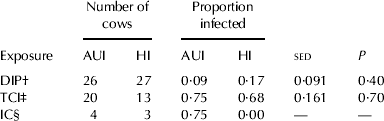
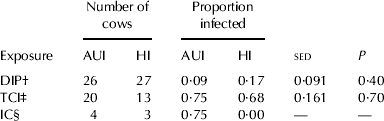
The proportion of cows that became infected was 8/53 by DIP, 24/33 by TCI and 3/7 cows by IC. There was no association between history of infection and response to DIP or TCI (Table 1). Of the 26 AUI and 27 HI cows that underwent DIP, 2 and 6 cows respectively became infected over the 6-week period, with detection of infections distributed evenly through the experimental period (1 in week 1, 2 in week 3, 2 in week 4, 1 in week 5 and 2 in week 6). The average age of the 8 cows that became infected was 7·4±2·1 years; while the average age of the 45 that remained infection free was 6·1±2·5 years. During DIP, 2·4% of quarters on AUI and 4·3% of quarters on HI cows became infected. Of the 20 AUI and 13 HI surviving cows that underwent the TCI, 15 and 9 respectively became infected. The average age of the 24 cows that became infected was 5·8±2·4 years, while the average age of the 9 cows that remained uninfected was 6·3±2·2 years. During TCI, 44% of quarters of AUI and 47% of quarters of HI cows became infected. Of the 4 AUI and 3 HI cows that survived to the IC, 3 AUI cows became infected.
Proportion of apparently uninfected (AUI) and historically infected (HI) cows that became infected during each of the experimental periods
† Dipping of the teat end
‡ Teat-canal inoculation
§ Intramammary challenge (no statistical analysis owing to low numbers)
To calculate an overall survival rate for the whole experiment, corrected for cows excluded owing to infection by other pathogens in the periods between challenge steps, the observed infection rates for TCI and IC steps were used to calculate predicted survival rates for the TCI (12/45 cows) and IC (7/12 cows) steps. A predicted overall survival rate of 13% (7/53) of cows was determined.
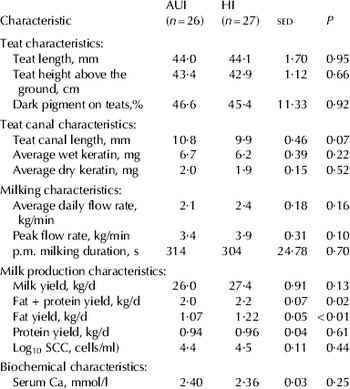
Cows with a previous history of Str. uberis infection produced more milk fat (1·07 vs. 1·22 kg/d; P<0·01) than AUI cows (Table 2). AUI cows tended (P=0·07) to have longer teat canals (10·8 vs. 9·9 mm) but there were no other phenotypic differences evident between AUI and HI cows.
Association between characteristics of the cow and history of infection. Apparently uninfected (AUI); historically infected (HI). Physical udder characteristics were measured on all cows during the period between the DIP (dipping of the teat end) and teat-canal inoculation (TCI). Peak and average milk flow rates and milk production for each cow were averaged across the 7 d prior to the DIP. SCC was measured 1 week prior to the DIP. A blood sample was collected after the a.m. milking, 1 week prior to the start of the DIP, to determine serum Ca concentrations

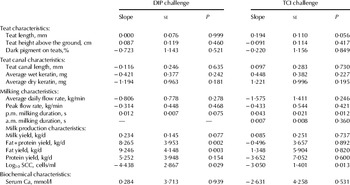
There was a positive association between proportion of cows infected during DIP and milk fat yield (P<0·01) and a negative association with SCC (P<0·05; Table 3). There was also a tendency (P=0·08) for a positive association with milk yield and p.m. milking duration. Cows that became infected during DIP produced more milk fat (1·32 vs. 1·11 kg/d) and had lower SCC (4·2 vs. 4·5 log10 SCC/ml) than uninfected cows prior to challenge. Those cows that became infected tended to have higher milk yields (28·6 vs. 26·3 kg/d), and a longer p.m. milking duration (347 vs. 302 s) than uninfected cows.
Associations between characteristics of the cow and infection results following teat dip (DIP; uninfected n=45; infected n=8) or teat canal inoculation (TCI; uninfected n=9, infected n=24) challenge with Str. uberis. Physical udder characteristics were measured on all cows during the period after the DIP (dipping of the teat-end) and prior to the commencement of the teat-canal inoculation (TCI). Peak and average milk flow rates and milk production for each cow were averaged across the 7 d prior to the DIP or TCI. SCC was measured 1 week prior to the DIP or TCI. A blood sample was collected after the a.m. milking, 1 week prior to the start of the DIP, to determine serum Ca concentrations. Slope is given on the logit scale with a positive slope indicating a positive relationship with infection. Estimates are multivariable adjusted for age, breed and calving date and associations were tested one by one

There was a negative association between the proportion of cows infected during TCI and SCC (P<0·05) and a positive association with p.m. milking duration (P<0·05; Table 3). There was also a tendency (P=0·06) for a positive association with teat length. Cows that became infected following TCI had lower SCC (5·1 vs. 5·5 log10 SCC cells/ml) and a longer p.m. milking duration (265 vs. 235 s), and tended to have longer teats (44·9 vs. 41·6 mm) than cows that remained uninfected. No other associations were detected.
Discussion
This study examined, apparently for the first time, whether a cow's past history of infection relates to her response to exposure to experimental infection. The results indicated that a cow's response to experimental challenge did not reflect her past susceptibility to Str. uberis mastitis. However, characteristics differed between cows that became infected or remained uninfected to the challenge model. Cows, with or without a previous history of mastitis, also showed different characteristics.
The infection rates achieved in this study for the DIP (3·8% of quarters) and TCI (44–47% of quarters) are consistent with those previously reported. In various DIP studies, 1–38% of quarters were infected (Pankey & Philpot, Reference Pankey and Philpot1975; Galton et al. Reference Galton, Peterson and Merrill1988; Galton, Reference Galton2004), while following TCI the infection rate was higher with 40% of quarters becoming infected in response to Str. uberis (Lacy-Hulbert, Reference Lacy-Hulbert1993; Lacy-Hulbert & Hillerton, Reference Lacy-Hulbert and Hillerton1995). In contrast, the 36% infection rate achieved in the IC is well below the near 100% (Finch et al. Reference Finch, Hill, Field and Leigh1994; Hillerton & Kliem, Reference Hillerton and Kliem2002; Rambeaud et al. Reference Rambeaud, Almeida, Pighetti and Oliver2003; McDougall et al. Reference McDougall, Parker, Swift, Harcourt and Sutherland2004; Bannerman et al. Reference Bannerman, Paape, Goff, Kimura, Lippolis and Hope2004) or 70% (Lacy-Hulbert et al. Reference Lacy-Hulbert, Woolford, Nicholas and Stelwagen1996; Sanders et al. Reference Sanders, McDougall, Stanley, Johnson, Spelman and Harcourt2006) infection rates previously reported. Since the cows used in the current study had already ‘survived’ DIP and TCI, it is likely that they were more ‘resistant’ than a random selection of cows.
The current study supports the distal teat canal as the main barrier to a Str. uberis IMI, as demonstrated by the low infection rates in DIP compared with TCI. Only a small number of quarters exposed to DIP became infected after the 6-week experimental period, despite increasing the intensity of the exposure, using reduced milking frequency or manual stimulation of the teat. The infection rate appeared unaffected by these measures, as infections were spread evenly throughout the period.
Parity is often described as a risk factor for mastitis. Older cows would be expected to be at more risk of having become infected simply owing to their time in the herd. Supporting this premise, Zadoks et al. (Reference Zadoks, Allore, Barkema, Sampimon, Wellenberg, Grohn and Schukkent2001) report that Str. uberis IMI incidence is lower in first and second parity cows than in third or higher. Further, Jayarao et al. (Reference Jayarao, Gillespie, Lewis, Dowlen and Oliver1999) report that Str. uberis IMI was higher in cows with four or more lactations. In selecting cows for the initial AUI and HI groups, cows' past history of infection (or not) were examined. It could be argued based on the difference in age between the HI and AUI groups (7·1 years vs. 5·4 years) that qualifying for the HI group was simply a case of longevity. However, most of the cows in the HI group had their first recorded infection in their first or second lactations. In contrast the youngest AUI cows, at a minimum, had to ‘survive’ their first lactation (and second calving period) to become eligible for the AUI group. The udder health database compiled from routine bacteriology of heifers and cows since 1997 shows that heifers in the herd, from which the cows for this study were selected, have much higher infection rates at calving that mature cows (21 vs. 12%). Compton et al. (Reference Compton, Heuer, Parker and McDougall2007) report that bacteria involved and the IMI prevalence in pasture-grazed peripartum heifers differs from those in other production systems. Heifers have also been reported to have higher incidence of CM with Parker et al. (Reference Parker, Compton, Annis, Weir and McDougall2007) reporting that 13·6% of heifers developed a clinical infection during the first 4 months of lactation, compared with 9% of cows. This suggests that survival of a ‘heifer lactation’ without any Str. uberis infections could be important in ‘resistance’ to Str. uberis mastitis.
During the dip challenge, the average age of the infected group was higher. While there was an imbalance in the numbers in each of these groups (8 in the infected group, 45 in the uninfected group), this suggests that ‘surviving’ older cows are more likely to become infected.
Cows recovered from an experimental Str. uberis may be protected against a subsequent infection in that lactation (Hill, Reference Hill1988b). In contrast, Zadoks et al. (Reference Zadoks, Allore, Barkema, Sampimon, Wellenberg, Grohn and Schukkent2001) reported that quarters with a natural Str. uberis infection had a higher rate of re-infection than quarters previously uninfected. Results from the present study indicate that there is no difference between AUI and HI groups of cows in their response to either a DIP or TCI challenge, supporting the premise that previous infection status does not determine the response to challenge.
There was a lack of association between history of infection and many of the characteristics previously associated with susceptibility to mastitis, such as teat pigmentation (Lopez-Benavides et al. Reference Lopez-Benavides, Williamson, Walters and Hickford2004), udder conformation (Seykora & McDaniel, Reference Seykora and McDaniel1985), quarter peak milk flow rates (Grindal & Hillerton, Reference Grindal and Hillerton1991; Lacy-Hulbert & Hillerton, Reference Lacy-Hulbert and Hillerton1995; Waage et al. Reference Waage, Sviland and Odegaard1998) and recoverable keratin (Lacy-Hulbert & Hillerton, Reference Lacy-Hulbert and Hillerton1995). Direct comparison of the current study with these studies is confounded as many of the associations were based on experimental challenge models or comparisons between infected and uninfected cows. Further, a number of these studies focused on infection by contagious pathogens such as Str. agalactiae which is known to colonise the teat canal, and not with the environmental pathogen, Str. uberis as used here. As demonstrated by Lacy-Hulbert & Hillerton (Reference Lacy-Hulbert and Hillerton1995), different traits may be associated with resistance to different pathogens. In addition, factors such as different prevalence and types of IMI occurring in pasture-grazed vs. indoor-housed cows (Compton et al. Reference Compton, Heuer, Parker and McDougall2007), different production levels and milk flow rates of Holstein-Friesian cows of different origins (Kolver et al. Reference Kolver, Napper, Copeman and Muller2000; Roche et al. Reference Roche, Berry and Kolver2006) will also confound comparisons between studies conducted in different countries. Contradictory results between studies was also highlighted in the review of factors involved in mastitis resistance by Seykora & McDaniel (Reference Seykora and McDaniel1985) who conclude that different breeds, milking procedures, measures of mastitis and statistical procedures may also account for different conclusions between studies. Therefore, association of phenotypic characteristics with infection risk appears to be strongly related to the method of infection (natural challenge vs. experimental challenge), and pathogen type (environmental vs. contagious), supporting a difference in mechanism of entry into the mammary gland between contagious and environmental pathogens (Grindal & Hillerton, Reference Grindal and Hillerton1991; Lacy-Hulbert & Hillerton, Reference Lacy-Hulbert and Hillerton1995).
There was, however, an association between history of infection and two characteristics previously described as being associated with susceptibility. Cows with a previous history of infection (HI) had higher milk fat yields than AUI cows. Parker et al. (Reference Parker, Compton, Annis, Weir and McDougall2007) reported a positive relationship between proportion of heifers with CM and the average combined milk fat and protein lactation yields (referred to as milk solids production) in a 250-farm survey-based study although fat yield was not reported independently. Lacy-Hulbert & Hillerton (Reference Lacy-Hulbert and Hillerton1995) reported that the probability of infection with Str. uberis increased with a decrease in teat canal length, supporting the results of this current study which show that teat canal length tended to be longer in the AUI cows than in the HI group. Of the characteristics measured in the current study, high milk fat yield showed the strongest association with susceptibility to Str. uberis infection.
Cows that became infected after challenge had some different characteristics significant for DIP and TCI from those that remained uninfected. For example, following the DIP, there was a positive association with milk fat production while following the TCI there was a positive association with p.m. milking duration. This supports the concept that different defence mechanisms are operating, and therefore different indicators of susceptibility will become apparent, once bacteria have breached the teat canal.
The protective effect of a mildly elevated SCC prior to experimental challenge (DIP, TCI) has been observed previously. Sanders et al. (Reference Sanders, McDougall, Stanley, Johnson, Spelman and Harcourt2006) reported a protective effect by a SCC >100 000 cells/ml for cows receiving an intramammry inoculation with Str. uberis, while Schukken et al. (Reference Schukken, Mallard, Dekkers, Leslie and Stear1994) reported protection against an intramammary inoculation with Staph. aureus. In the current study, cows with a higher SCC were less likely to become infected following the DIP and TCI, further supporting the protective effect of an elevated SCC prior to infection.
Across a successive series of exposures (DIP, TCI, IC) a predicted survival rate of 13% of cows was calculated. This could be considered the proportion of a population of cows that appear highly resistant to Str. uberis. While it is difficult to compare cow infection rates with published reports, as most present quarter infection rates, the predicted survival rate of 13% of cows in the present study was similar to the 5% (1/20) and 11% (2/18) of cows that resisted infection following experimental intramammary inoculations with Str. uberis (Hill, Reference Hill1988a; Lacy-Hulbert, Reference Lacy-Hulbert1993). This study confirms that a minority of animals have highly resistant phenotypes and are of interest for genetic studies of Str. uberis mastitis.
Overall, these results indicate that the outcome of experimental bacterial challenge, whereby Str. uberis is deposited either on the outside of the teat, or 3 mm into the teat canal does not indicate whether a cow is likely to become infected. However, a population of cows was detected that is extremely difficult to infect and these animals may comprise a resistant phenotype.
The authors would like to acknowledge the statistical assistance of Barbara Dow. The study was funded by the Ministry of Business, Innovation and Employment (MBIE) and by New Zealand dairy farmers through DairyNZ Inc.