Introduction
The streaked prochilod Prochilodus lineatus (Prochilodontidae; Characiformes) is a native fish species to South America, accounting for up to 50–90% of the total fish biomass in the lower stretches and in the flood plain lagoons of the Paraná River basin (Cordiviola de Yuan, Reference Cordiviola de Yuan1992). This species has great potential for aquaculture and has been used in restocking programs through artificial propagation (Carolsfeld et al., Reference Carolsfeld, Godinho, Zaniboni Filho and Harvey2003). During the spawning season (October to February), this species migrate to spawning sites in a phenomenon known as ‘piracema’. As artificial reproduction methods are well established and prolificacy is high, P. lineatus has been used as a model species for research in a number of studies addressing genetic diversity, health, nutrition and reproduction (Orfão et al., Reference Orfão, Maria, Nascimento, Isaú and Viveiros2010).
The cryopreservation of fish sperm provides a tool by which reproduction is optimized, improving breeding and fish conservation programs (Kopeika & Kopeika, Reference Kopeika, Kopeika, Alavi, Cosson, Coward and Rafiee2008). Sperm cryopreservation facilitates procedures for artificial reproduction, as, with viable sperm stored in liquid nitrogen, it is necessary to induce spawning and collect gametes only from females. Cryopreserved sperm may be kept in germplasm banks for an indefinite period, which allows the establishment of breeding programmes, eliminates the problem of asynchronous reproductive activity between males and females, and enables maintenance of fewer male broodfish (Viveiros & Godinho, Reference Viveiros and Godinho2009). The cryopreservation technology can be divided in different steps namely: initial sperm quality, freezing medium (extender plus a cryoprotectant agent), dilution ratio, cooling, thawing, and evaluation of post-thaw sperm quality. For most reported studies, the dilution ratio of sperm to final volume ranged from 1:2 to 1:10, including Neotropical fish species (Viveiros & Godinho, Reference Viveiros and Godinho2009). It has been suggested that, depending on the species, a high dilution ratio reduces the motility and viability of cryopreserved sperm (Cabrita et al., Reference Cabrita, Robles, Cuñado, Wallace, Sarasquete and Herráez2005). This has been attributed to the dilution of several proteins (Suquet et al., Reference Suquet, Dreanno, Fauvel, Cosson and Billard2000) and anti-oxidative stress compounds (Cabrita et al., Reference Cabrita, Ma, Diogo, Martínez-Páramo, Sarasquete and Dinis2011) present in the seminal plasma that protect the viability of sperm during the freezing and thawing processes. However, there is a lack of standardization in sperm cryopreservation of aquatic organisms, which is one of the main reasons for inconsistency observed among various studies (Dong et al., Reference Dong, Huang and Tiersch2007; Rosenthal et al., Reference Rosenthal, Asturiano, Linhart and Horvath2010). Therefore, there is a necessity of more accurate investigations in all steps of the cryopreservation process. Although many studies have been performed on P. lineatus sperm cryopreservation (Viveiros et al., Reference Viveiros, Orfão, Maria and Allaman2009; Viveiros et al., Reference Viveiros, Nascimento, Orfão and Isaú2010; Viveiros et al., Reference Viveiros, Nascimento, Leal, Gonçalves, Orfão and Cosson2015b, among others), the dilution ratio of sperm to final volume was mostly set at 1:10, without detailed investigation. Thus, the aim of this study was to evaluate the effects of dilution ratio on post-thaw sperm motility and velocity of Prochilodus lineatus.
Materials and Methods
Fish handling, sperm collection and sperm features
All fish were handled following the guidelines for animal experimentation described by Van Zutphen et al. (Reference Van Zutphen, Baumans and Beynen2001). Prochilodus lineatus males (n = 10; mean of 1.1 kg of body weight) were selected from earthen ponds at the Fish Culture Station of the Minas Gerais Power Company (CEMIG) in the city of Itutinga (21°17′36′′S; 44°37′02′′W), state of Minas Gerais, Brazil, during the spawning season (December to January). Males with detectable running sperm under soft abdominal pressure received two intramuscular doses of catfish pituitary extract (Destiny Land Enterprise Company Ltd, Taiwan; 0.4 and 4.0 mg kg−1 BW), with a 12-h interval between injections. After 8 h at ~26–27°C, the urogenital papilla was carefully dried, and approximately 2 ml of sperm were hand stripped directly into glass tubes. Sperm collection was carried out at room temperature (~25°C) and contamination with water, blood, feces or urine was carefully avoided.
Immediately after collection, 5 μl of each sample were placed on a glass slide, motility was triggered in an activating agent (98 mOsm NaCl) and subjectively evaluated using a light microscope (Eclipse E200; Nikon, Tokyo, Japan) at ×400 magnification. All samples possessed a motility rate above 90% and were thus used for the experiment described below. Sperm concentration was determined using a Neubauer-type hemacytometer chamber (Boeco, Hamburg, Germany). Osmolality (Semi-Micro Osmometer K-7400, Knauer, Berlin, Germany) and pH (Digimed DM-22-V1.0, São Paulo, Brazil) of the seminal plasma were measured after the centrifugation of sperm at 2000 g for 10 min (MiniStar CM-610, Shanghai, China). All analyses were carried out in duplicate.
Sperm cryopreservation
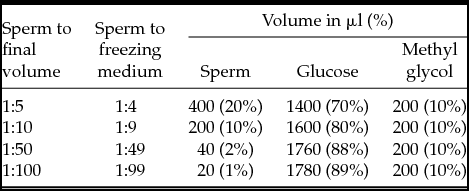
A glucose solution (Glucose, Glucose Anidra P.A. ACS, (C6H12)6, Vetec Química Fina Ltda™, Duque de Caxias, RJ, Brazil) at 315 mOsm/kg (~5%) and pH adjusted to 7.6, combined with the cryoprotectant agent methyl glycol (CH3O (CH2)2OH, Vetec Química Fina Ltda™, Duque de Caxias, RJ, Brazil), always at 10% of the final volume, were used as freezing medium for P. lineatus sperm, according to our previous studies (Viveiros et al., Reference Viveiros, Orfão, Maria and Allaman2009, Reference Viveiros, Nascimento, Leal, Gonçalves, Orfão and Cosson2015b). Within 10 min after collection, sperm was diluted in this freezing medium at four different ratios (sperm to final volume): 1:5; 1:10; 1:50 and 1:100. Because in some studies dilution ratio is reported as sperm to freezing medium, rather than sperm to final volume, we have given a detailed description of this methodology in Table 1. Diluted sperm was then drawn into 120 unsealed 0.5-ml straws (n = 3 replicate straws × 4 dilution ratios × 10 males) and, immediately, without equilibration time, frozen in nitrogen vapour (dry vapour shipper, Cryoport Systems, Brea, CA, USA) at approximately –170°C. Dilution, loading and freezing took about 10 min. Within 24 h, all straws were transferred to a liquid nitrogen vessel (MVE XC 34/18, New Prague, MN 56071, USA) for storage.
Proportion of sperm and freezing medium (315 mOsm/kg glucose plus methyl glycol) used in each dilution ratio, for each male

Post-thaw sperm analysis
A few months later, straws were thawed by immersion in a water bath (Water Bath MA 127, Marconi, Piracicaba, SP, Brazil) at 60°C for 8 s and sperm motility rate and velocities (curvilinear = VCL, average path = VAP and straight line = VSL) were determined using the CASA system (Computer-Assisted Sperm Analyzer) following the methodology described by Viveiros et al. (Reference Viveiros, Gonçalves, Di Chiacchio, Nascimento, Romagosa and Leal2015a). Briefly, sperm motility was triggered in an activating agent (98 mOsm NaCl), at room temperature, directly in a Makler® counting chamber (Sefi-Medical Instruments ltd, Haifa, Israel), placed under a phase contrast microscope (Nikon™ ECLIPSE E200, Tokyo, Japan) at ×100 magnification with a green filter and pH 1 position. The final ratio of sperm to final volume was 1:500. The microscope was connected to a video camera (Basler Vision Technologies™ A602FC, Ahrensburg, Germany) generating 100 images/s; video recording started at 10 and at 40 s post-activation, in order to follow motility decrease after activation. Each image was analyzed using the standard settings for fish by Sperm Class Analyzer™ software (SCA™ 2010, Microptics, S.L. Version 5.1, Barcelona, Spain). To determine motility rate and velocities, each individual sperm (a mean of 449 spermatozoa per field) was followed throughout the images and sperm trajectory was calculated. Evaluations were made in triplicates. Furthermore, the actual sperm concentration per straw was also calculated.
Statistical analysis
All values were expressed as means ± standard deviation (SD). Statistical analyses were conducted using the R software program version 2.9.0 (R Development Core Team, 2010). Sperm motility and velocity parameters were tested for normal distribution using the univariate procedure; all parameters showed a normal distribution. Data were tested for significant differences using analysis of variance (ANOVA), followed by the Scott–Knott test, when applicable. The level of significance for all statistical tests was set at 0.05.
Results
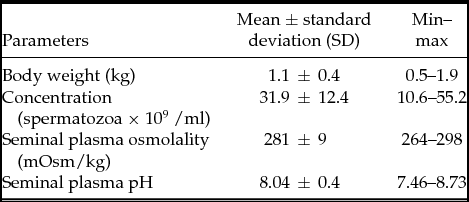
The 10 males used in this experiment as sperm donors possessed a mean concentration of 31.9 × 10⁹ ± 12.4 × 10⁹ spermatozoa/ml; the seminal plasma had an osmolality of 281 ± 9 mOsm/kg and pH of 8.04 ± 0.4 (Table 2).
Body weight and some fresh sperm features of Prochilodus lineatus (n = 10 males; mean ± standard deviation; minimum–maximum values) after pituitary extract treatment

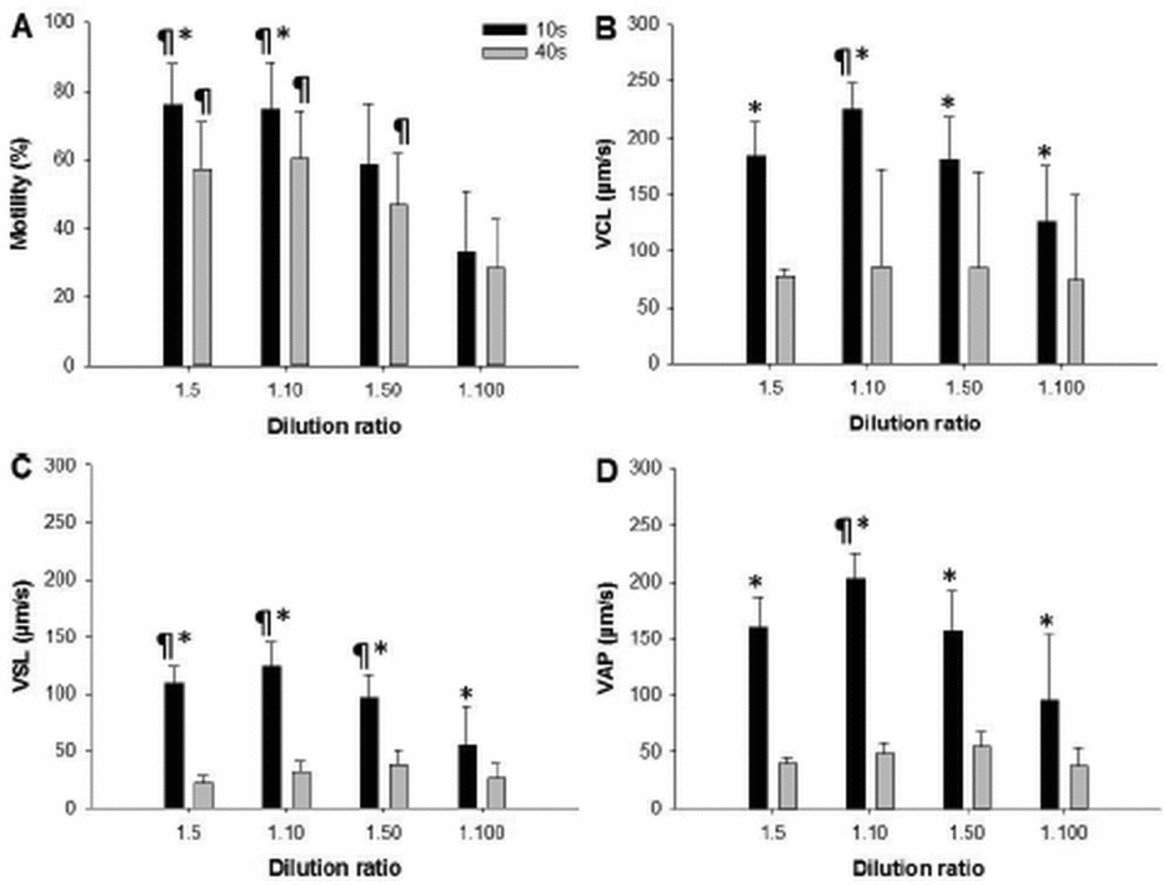
Post-thaw motility rates were higher when samples were frozen at a ratio of 1:5 (76%) and 1:10 (75%), compared with 1:50 (59%) and 1:100 (33%). When motility rate was evaluated again 30 s later, the values decreased significantly in samples frozen at a ratio of 1:5 (57%) and at 1:10 (61%). At a ratio of 1:50 and 1:100, the decrease observed after 40 s was not significant (Fig. 1 A).
Post-thaw motility rate (A), curvilinear (VCL; B), straight-line (VSL; C) and average path (VAP; D) velocities of P. lineatus sperm frozen at four dilution ratios (sperm to total volume; 1:5, 1:10, 1:50 or 1:100). Post-thaw motility and velocities were evaluated at 10 s and 40 s post-activation. Each column and error bar represents mean ± standard deviation (SD) (n = 3 replicate straws × 10 males). ¶Differences among dilution ratios (P < 0.05; Scott–Knott); *differences between analysis time (P < 0.05; ANOVA); values followed by a symbol are significantly higher.

The highest post-thaw VCL (225 μm/s) and VAP (203 μm/s) were observed when sperm was frozen at a ratio of 1:10. VSL, on the other hand, was similar among samples frozen at a ratio of 1:5 (109 μm/s), 1:10 (124 μm/s) and 1:50 (97 μm/s). When velocities was evaluated again 30 s later, the values decreased significantly in all samples regardless of dilution ratio, and varied from 75 to 85 μm/s of VCL, from 38 to 53 μm/s of VAP and from 25 to 39 μm/s of VSL (Fig. 1 B–D).
The average concentration measured in each straw at a dilution ratio of 1:5 was 6.4 × 10⁹ ± 2.5 × 10⁹ spermatozoa/ml, at 1:10 it was 3.2 × 10⁹ ± 1.2 × 10⁹ spermatozoa/ml, at 1:50 it was 0.6 × 10⁹ ± 0.3 × 10⁹ spermatozoa/ml and at 1:100 it was 0.3 × 10⁹ ± 0.1 × 10⁹ spermatozoa/ml.
Discussion
Over the past decade, our research group has been studying the different aspects of cryopreservation on P. lineatus sperm, such as extender composition (Viveiros et al., Reference Viveiros, Orfão, Maria and Allaman2009, Reference Viveiros, Nascimento, Orfão and Isaú2010), cryoprotectant agent (Viveiros et al., Reference Viveiros, Nascimento, Leal, Gonçalves, Orfão and Cosson2015b), straw volume, thawing temperature and activating agent (Viveiros et al., Reference Viveiros, Orfão, Maria and Allaman2009). However, the dilution ratio was always set to 1:10. In the present study, the dilution ratio was taken into consideration during the freezing of P. lineatus sperm, and was tested from 1:5 up to 1:100.
In this study, sperm cryopreserved at lower dilution ratios (and thus at higher sperm concentration) displayed higher post-thaw motility rate and velocities, compared with those at higher dilution ratios and mostly at 1:100. In general, P. lineatus sperm possessed higher velocities when frozen after dilution at 1:10, compared with those frozen at 1:5, 1:50 and 1:100. With these results, we can state that too many or too few spermatozoa inside one straw leads to a suboptimal condition for freezing and thawing sperm, and that the ratio of 1:10 seems to fulfill this condition, at least for P. lineatus.
It has been demonstrated that high dilution ratio reduces the motility and viability of frozen sperm (Cabrita et al., Reference Cabrita, Robles, Cuñado, Wallace, Sarasquete and Herráez2005) mainly due to the dilution of several proteins (Suquet et al., Reference Suquet, Dreanno, Fauvel, Cosson and Billard2000) and anti-oxidative stress compounds (Cabrita et al., Reference Cabrita, Ma, Diogo, Martínez-Páramo, Sarasquete and Dinis2011) present in the seminal plasma that protect sperm viability during the freezing and thawing processes. This may explain why we observed the lowest values for motility rate and velocities when P. lineatus sperm was frozen at 1:100, at a mean concentration of 0.3 × 10⁹ spermatozoa/ml. From the practical point of view, the use of such a low sperm concentration (and thus a high dilution ratio) demands large volumes of diluted sperm to be loaded in an increased number of straws, as well as to meet sufficient thawed sperm for fertilization (Ciereszko et al., Reference Ciereszko, Dietrich, Nynca, Liszewska, Karol and Dobosz2013), as it is well known that a higher number of post-thaw sperm is required for fertilization when compared to fresh sperm. This creates a significant problem related to the handling of high number of straws, especially during short-time procedures such as freezing, thawing and fertilization (Lahnsteiner et al., Reference Lahnsteiner, Mansour and Weismann2002).
Conversely, an increased number of sperm inside each straw when a low dilution ratio is used, may change the conditions of cryopreservation and decrease post-thaw sperm quality (Ciereszko et al., Reference Ciereszko, Dietrich, Nynca, Liszewska, Karol and Dobosz2013). This phenomenon was observed for Pacific oyster Crassostrea gigas (Dong et al., Reference Dong, Huang and Tiersch2007), when agglutination of sperm was found at samples frozen at higher concentrations. Although we have not observed the agglutination phenomenon, when sperm was frozen at a concentrated ratio of 1:5, VCL and VAP were lower compared with those samples frozen at 1:10. Similarly, sperm of the salmoniforme whitefish, Coregonus lavaretus frozen at a very concentrated ratio of 3:1 (sperm to freezing medium) yielded similar motility rate and VSL, and lower VCL and VAP, compared to sperm frozen at a recommended ratio of 1:3 (Ciereszko et al., Reference Ciereszko, Dietrich, Nynca, Liszewska, Karol and Dobosz2013). Despite the lower results, these authors emphasized the necessity of packing a higher concentration of sperm into the same vessel, by improving the equilibration step and developing cryopreservation technology that is better suited to the cryopreservation of higher concentrations of sperm.
In order to follow motility decrease after activation, sperm quality was evaluated twice with a 30-s interval between analyses. Post-thaw motility rate decreased significantly when evaluated at 40 s compared with at 10 s post-activation, but the values were still above 50% at the concentrated ratios of 1:5 and 1:10, which is a high rate considering frozen sperm. Velocities, however, were all low at 40 s post-activation, with less than 30% of the values observed during the first analysis. Similar decrease of sperm quality was observed when motility rate and motility quality score were subjectively evaluated 30 s after the first analysis, in both P. lineatus and B. orbignyanus (Gonçalves et al., Reference Gonçalves, Nascimento, Costa, Leal and Viveiros2013). Thus, the artificial fertilization using post-thaw sperm should be a short-time procedure, while sperm still possesses high motility rate and fast velocities to find and enter the oocyte micropyle.
P. lineatus sperm should be frozen at a ratio of 1:10 (sperm to final volume), at which both the number of loaded sperm per straw and the quality after freezing and thawing procedures are maximized.
Acknowledgements
The authors thank D. Rossetto and P.A. Piana for statistical support, T.S. França for assistance during sperm analysis and J. Cosson for revising the manuscript.
Financial support
This study received funding from the Brazilian fostering agencies CNPq (A.T.M.V., grant number PQ 302434/2011–9; project 474001/2013–0), and FAPEMIG (A.T.M.V., grant number PPM 00038–13), (M.C.L., grant number CVZ BPD 00167–12; project APQ 01068–12).
Statement of interest
None.
Ethical standards
The authors assert that all procedures contributing to this work comply with the ethical standards of the relevant national and institutional guides on the care and use of laboratory animals.