On 28 December 1955, two days before the chief minister of Malaya left for the United Kingdom to discuss independence with the British and eight years before Malaya became the new nation of Malaysia in 1963, a schoolroom in northern Malaya became a historic site. What would come to be known as the ‘Baling talks’ was a unique attempt to seek peace between the British colonial government and the Malayan Communist Party (MCP) and an end to the Malayan emergency that began in 1948.Footnote 1 The Baling talks took place two years before Malaya's independence in 1957. Around this time, the British had begun making concessions towards self-government and eventual independence for Malaya and Singapore. In 1955, elections were held for the first time in Malaya, and the international media would frame the Baling talks as a meeting between leaders of soon-to-be independent nations and Chin Peng, the most wanted man in the British Empire and beyond.Footnote 2 Chin Peng, the secretary general of the MCP since 1947, left the jungle and arrived in Baling to attend a two-day negotiation with Tunku Abdul Rahman and David Marshall, the chief ministers of Malaya and Singapore respectively, to iron out a possible ceasefire and political settlement.Footnote 3
This article focuses on Mark Teh's long-term investigations, as a researcher and theatre director for Kuala Lumpur's Five Arts Centre, into this historically significant event. It examines the 2015 staging of Baling that I attended at the opening festival for the Asian Arts Theatre in Gwangju, South Korea, as an exemplary documentary theatre piece that participated in the ongoing process of rewriting the history of South East Asia after the Second World War.Footnote 4 Situated at the intersection of performance, politics and engaged citizenship, Baling involved different modes of representation and revealed the continuing efforts of artists and curators from South East Asia to build notional histories contesting dominant official narratives and colonial knowledge systems through a wide range of research methodologies, as well as digital and analogue tools. I examine the aesthetically diverse forms that Mark Teh appropriated in order to question the role of history and the colonial archive in the solidification of Malay nationalist ideology and the production of identity binaries (Fig. 1).
Faiq Syazwan Kuhiri in Baling at Fast Forward Festival 5, Onassis Stegi, Athens, 2018. Photograph by Kiki Papadopoulou/Onassis Stegi.

A present out of joint
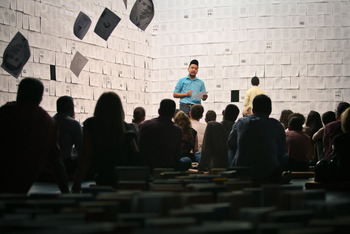
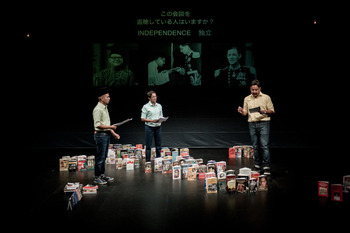
‘Be ready to change position and perspective.’ The 2015 staging of Baling in South Korea welcomed the audience with this instruction by Fahmi Fadzil, a performer and playwright, and the communications director and deputy chief of youth for the People's Justice Party, a leading opposition party at that time. Fadzil's Brechtian opening sentence urged the spectator to ‘look at the play's situations from such an angle that they necessarily became subject to his criticism’.Footnote 5 Spectators were literally and conceptually invited to constantly reconsider their position in relation to the performers. By entering the theatre space designed by Wong Tay Sy, the audience were placed in the middle of a three-dimensional archive of walls papered with photocopied transcripts and hanging images of Chin Peng. Books in English, Malay and Chinese related to Malaysian history were arranged on the floor. A coffee machine indicated the freedom of audience members to prepare themselves a drink at any time during the performance. The smell of coffee emanating from the machine and the materiality of the archive engaged spectators in an intimate interaction with the performers, but also with other members of the audience, creating the feeling of a public forum rather than a performance.
The narration was structured around key concepts such as loyalty, independence, surrender, nation, violence and reconciliation, without a linear development of events. By disrupting chronological linearity and dismantling the singular point of view, the performance reimagined the relationship between the Baling talks and their representation. Teh considered archival, visual and oral traces, not simply as records of the event, but as a replacement for the event that questioned the limits and functions of documents.Footnote 6 In his important essay ‘Archive Fever: Uses of the Document in Contemporary Art’, Okwui Enwezor argued that, for nearly a century, ‘artists have turned to the photographic archive in order to generate new ways of thinking through historical events and to transform the traditional ideas surrounding the status of the photographic document’.Footnote 7
Teh transformed the entire performance space into a dynamic historical site that occupied a notional shared space between history and storytelling, between private and collective memory. According to Brecht,
historical incidents are unique, transitory incidents associated with particular periods. The conduct of the persons involved in them is not fixed and ‘universally human’; it includes elements that have been or may be overtaken by the course of history, and is subject to criticism from the immediately following period's point of view.Footnote 8
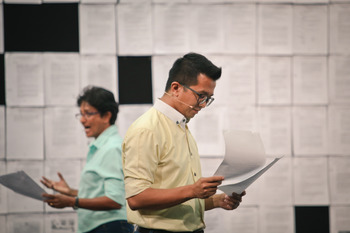
Teh emphasized the alienation effect inherent in the Brechtian technical device of historicization, in order to disrupt the hegemony of essentialist definitions of nation and region. His long-term critical investigations into the urban and rural areas of Malaysia reclaimed a non-fixed form of representation precisely because of their ‘incessant evolution’, as Brecht would say. I would argue that Baling and Teh's other works, including his more recent projects A Notional History and Version 2020, participated in his objective of rehistoricizing what had been left out of the state's master narrative by exploring ‘the possibilities and the potential for producing complex representations of that which may have remained invisible or been misrepresented and over-simplified’ in Malaysia's post-war history.Footnote 9 At the same time, by continuing to work with multiple official and unofficial archives, as well as oral histories, Teh brought into view what Dipesh Chakrabarty characterized as the disjointed nature of any particular ‘now’ we inhabit.Footnote 10 Teh appropriated the theatrical frame not in order to bring the MCP into the mainstream discourse of history, but in order to make visible the disjuncture of the present with itself and, thus, with the plural facets of modern Malaysian identity (Fig. 2).
Imri Nasution and Anne James in Baling at Fast Forward Festival 5, Onassis Stegi, Athens, 2018. Photograph by Kiki Papadopoulou/Onassis Stegi.

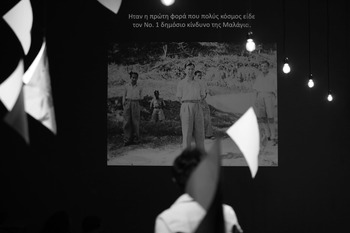
In the 2015 staging of Baling in South Korea, the performance was divided into sessions. They unfolded in well-designed narrative clusters that were interconnected by the common thread of movement. As the actors moved, the audience had to move as well. In addition to Fahmi Fadzil, the narration was delivered by performer Anne James, filmmaker Imri Nasution and theatre practitioner Faiq Syazwan Kuhri. The four performers were dressed in shirts and jeans and engaged in direct dialogue taken from the transcript of the Baling talks. The staging also presented images and footage of Chin Peng (whose real name was Ong Boon Hua), including the January 1946 photograph of him receiving the Burma Star from Louis Mountbatten, supreme Allied commander of South East Asia, in the post-Second World War victory procession; a mugshot that appeared on emergency-era posters and in newspapers offering 250,000 dollars for him dead or alive; footage of him emerging from the jungle to negotiate an end to the emergency at the failed 1955 Baling talks; then nothing for thirty-four years until 1989 when he appeared as an elderly man to sign the Haadyai Peace Accord between the MCP and the governments of Malaysia and Thailand, which formally marked the end of the communist insurgency and the disbanding of their armed units. The historical facts were contextualized by the performers’ diverse ethnic and cultural backgrounds. More importantly, they questioned the legacy of the Baling talks in Malaysian society through references to their real-life experiences, continuing to weave their personal interpretations and involvement into historical archives (Fig. 3).
Chin Peng emerging from the jungle to negotiate an end to the emergency at the failed 1955 Baling talks. From Baling at Fast Forward Festival 5, Onassis Stegi, Athens, 2018. Photograph by Kiki Papadopoulou/Onassis Stegi.

Another side of history
Assuming the role of researcher and curator, Mark Teh explored the Malayan emergency period (1948–60) because it marked the beginning of the Cold War in Asia and intersected with decolonization processes, new nationalisms and inter-regional relationships. However, Teh also questioned the legacy of the emergency in criminalizing the cross-racial Socialist Front as both leftist and Chinese-dominated, with ‘Chinese’ read as ‘communist’. As Meredith Weiss underlines, the Cold War's legacy permeated Malaysian politics and civil society:
what has left a deeper stain is less the Malayan Communist Party per se than how these battles sculpted the ideological, demographic, legal, and security landscape: a largely Chinese, internationally vilified, anticapitalist movement at a formative period in Malaysian sociopolitical development helped to delegitimate ideological alternatives and bolster a strong, centralized, specifically communal and capitalist state, nested in a significantly depoliticized society.Footnote 11
Mark Teh re-empowered theatre as a social practice in an attempt to question Malaysia's problematic relationship with colonialism, but also to build a temporary platform for reimagining citizenship beyond the binaries created by the official interpreters of national history and the representatives of alternative histories. As Helen Ting has explained, ‘The designated “Other” against whom the Malay nationalist movement proliferated was not the British but the non-Malays and, in particular, the local Chinese population.’Footnote 12 A critical investigation of the MCP was not treated as a hidden, minor history that needed to be discovered, but rather as an ‘open secret’ known long before the declassification of the Baling Talks Archive.Footnote 13 Teh's research on the Baling talks also reflected a time when under-researched narratives of the emergency years started surfacing. After the MCP signed the peace treaty, Chin Peng waged a campaign to publicize his version of events. His controversial life history was followed, in 2004 and 2005, by numerous memoirs, dialogues and interviews with top leaders and members of the MCP, such as Abdullah CD, Rashid Maidin, Suriani Abdullah and trade unionist Lim Chin Siong, as well as memoirs in Malay, English and Chinese by other leftist leaders and former political prisoners, including those, as Mark Teh noted, who were avowedly and comfortably Malay, Muslim and communist. At the same time, an offensive was launched by the state, with the production of emergency-focused documentary programmes on national television and the release of ‘countermemoirs’ by ministers, leaders and members of the security forces.Footnote 14 By working with Chin Peng's autobiography, as well as with other memoirs such as Han Suyin's And the Rain My Drink, one of the earliest accounts of the emergency in English delivered by a Eurasian leftist intellectual, Teh further problematized the ‘truth of one's own history’ and the social conditioning of any narrative.Footnote 15
With Baling, Teh echoed Ariella Azoulay's arguments on the urgent need to undo the violent binaries of any archive in order to disengage from the unquestioning use of political concepts:
Our approach to the archive cannot be guided by the imperial desire to unearth unknown ‘hidden’ moments. It should rather be driven by the conviction that other political species were and continue to be real options in our present. We should not seek to discover but to join with others. Unlearning the past guarded by the archive and recognizing the archive as the institution through which the imperial condition is maintained is necessary in order to be able to come together as allies with those who have been relegated to the past.Footnote 16
As Teh demonstrated through the multiple forms of his process-based project, the allies in the Malaysian case were not the MCP, but a plurality of narratives that involved Chinese, Indian and Malay people. Teh's approach to the official state narrative was not driven by his desire to reveal hidden stories. Unlearning the national history became a moral imperative as it allowed the ‘other’ communities to come together.
At the same time, Teh distanced himself from the popular tradition of re-enactment and from any ambition to narrate minority histories by a process of dramatization. Taking the theatre as more than a tool for social change, Teh engaged his collaborators and his audience in a pedagogical process of unlearning any fixed memory. Teh's process of unlearning the official history did not commemorate the past in search of an ‘alternative history’, nor did it reactivate the archive in an attempt to ‘democratize’ its material substance. Commemoration, as Achille Mbembe noted, was part of the ritual of forgetting, as its ultimate objective was to bid farewell to the desire or the willingness to repeat an original act and thus any desire for justice and reparation.Footnote 17 The performative reappropriation of the ‘primary fact’ of the Baling talks subverted the commodification of Malaysian history and called on the audience to similarly engage in a process of unlearning.
By building his dramaturgy on the contradictions and the lacunae of the emergency period, Teh took advantage of the disruptive power of theatre in order to expand what Michelle Antoinette called ‘the critical potential’ of South East Asian regionalism.Footnote 18 His collaboration with activists, performers, filmmakers and journalists within the frame of the Five Arts Centre transgressed not only the limits of the Euro-American documentary tradition, but also any cultural territorialization, or any ‘presumed fixity of culturalist inscriptions’.Footnote 19 Teh debated the importance of Malaysia's historical specificity ‘as an organizing principle, particularly given its geo-political genesis in the post-war period and as a tool of cold-war politics’, and thus he opened up possibilities for ‘rewording’ the region's past, present and future histories with the tools of art and culture.Footnote 20
Teh appropriated discontinuous narratives and diverse ways of storytelling in order to undo the state rhetoric of unity through Islamic principles and the identification of one ethnic group with the national identity, disregarding the existence of non-Muslim indigenous populations.Footnote 21 Helen Ting has argued that this Malay nationalist ideology was a historical legacy of British colonialism. Indirect British rule in the name of the traditional Malay rulers required the maintenance of this political myth as a matter of political expediency. The same ethnically divisive tactic was also used during the Second World War by the Japanese military regime to control one section of the population through another, setting the stage for post-war inter-ethnic confrontation.Footnote 22
By criticizing powerful state binaries such as migrant/indigenous, Teh aimed to deconstruct the myth of indigeneity as the basis of the nation.Footnote 23 He ‘translated’ the transcripts of the Baling talks through the identities of the performers. By doing so, Teh problematized the very notion of autobiography that may be understood, according to Mark Freeman, as ‘re-writing the self’, which could not but culminate in fictions given the impossibility of ever telling my story.Footnote 24
At the same time, Teh built a rhizomatic dramaturgy that defied any vertical system of thought and interaction while implying a relationship with the Other. Baling contributed to the long decolonization of British and communist histories by intertwining perspectives from both sides of the divide, however fragmentary and opaque they may be.
Baling's dramaturgy deconstructed intra-national racial ideas of ‘indigenous’ and ‘non-indigenous’ people that have shaped Malaysian politics and civil society since the Cold War, but also Vision 2020, the national vision of Malaysian society united as one nation and one race by the year 2020.Footnote 25 Then prime minister Mahathir Mohamad elaborated this vision in the early 1990s, consolidating cultural essentialism in South East Asia.Footnote 26 Teh attempted to disrupt the artificial homogenization of Malaysian society by bringing onstage an ethnically diverse cast and an irreducible multiplicity of personal perspectives, in order to create a notional shared space that overcomes racial binaries while questioning the divide-and-rule dictum of the post-Cold War era. ‘Privileging the homeland/immigrant master narrative’, wrote Antoinette, ‘not only eclipses a critical appraisal of the impact of colonial legacy, it also results in a troubling articulation of the contradictory relationships between native/immigrant and anti-colonialism’.Footnote 27 The inversion of attributed historical roles in the state's presentation of the 1948 MCP insurrection was a case in point: the imperial British regime was regarded as the ‘protector’, whereas the anti-colonial MCP was depicted as the ‘subversive movement’.Footnote 28
The Brechtian moment
Baling emerged from the Five Arts Centre's long exploration of Malaysian identity, characterized by diversity and equality. The Five Arts Centre was founded in 1984 in Kuala Lumpur as a collective of artists with diverse backgrounds in dance, drama, literature and visual art, who created a theatre movement for the empowerment and liberation of the masses against national authoritarian regimes and dogmatic discourses on national identity.Footnote 29 The collective integrated the pedagogical concept of theatre for social change that was developed in the late 1960s and early 1970s in several Asian communities under the influence of Brechtian aesthetics, Paulo Freire's pedagogical methods, and Augusto Boal's theatre of the oppressed. On a different level, these grass-roots exercises in democracy became ‘a powerful instrument for communal therapy’ that could assist ‘a community in creatively expressing defeats or in celebrating its victories’.Footnote 30
Teh drew on Boal and Brecht from the first elaboration of the Baling project. The reading of the full transcript of the two-day 1955 Baling talks, performed by a diverse cast of human rights lawyers, journalists, actors, students, educators and intellectuals, was part of the Re:Search Re:Source sessions at the Emergency Festival in 2008.Footnote 31 Co-curated by visual artist Wong Tay Sy; designers Grey Yeoh and Norman Teh; filmmaker Fahmi Reza; and theatre practitioners Fahmi Fadzil, Hariati Azizan and Mark Teh, the Emergency Festival was an eleven-day project on the Malayan emergency, presenting an exhibition, two theatre productions, film screenings, performances, presentations and participatory projects. It was staged on the sixtieth anniversary of the beginning of the Malayan emergency.Footnote 32
A few years earlier in 2005, Teh staged Baling (Membaling), his first performance on the declassified Baling transcripts. The piece was devised by Teh and three non-actors – Chang Yoong Chia, Fahmi Reza and Imri Nasution – who worked in their preferred languages, a common practice at the Five Arts Centre. The play was first staged in June 2005 at the Director's Workshop 5 in Kuala Lumpur, curated by Krishen Jit and facilitated by Chee Sek Thim. It was restaged in January 2006 as part of the Krishen Jit Experimental Workshop Series at eleven colleges and universities and two futsal centres, ‘where people wouldn't naturally want to watch this’.Footnote 33
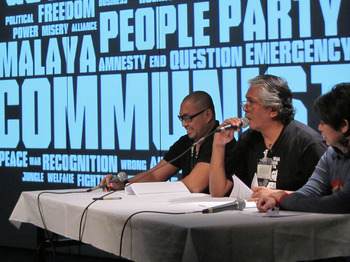
Besides extracts from the Baling talks, Baling (Membaling) included familial experiences and memories of the performers during the emergency, as well as extracts from the political memoir by Said Zahari, who covered the talks in 1955 as a young journalist and became known as the second-longest political detainee in Singapore's history (seventeen years) (Fig. 4).
Noor Effendy Ibrahim, Haris Ibrahim and Neo Swee Lin in the reading of the 1955 Baling talks transcript at SOTA Gallery, Singapore Arts Festival, Singapore, 2011. Photograph by June Tan.

This first iteration echoed civil society movements in Malaysia advocating for change, primarily BERSIH (Coalition for Clean and Fair Elections), a people's movement that has called for political and electoral reform in Malaysia since 2005.Footnote 34 At a regional level, the project's interaction with audiences outside the art circuit echoed the pedagogical strategies of the Philippines Educational Theatre Association (PETA), a key pioneer of the People's Theatre, a movement that advocated theatre for the liberation of the masses in South East Asia in the late 1960s and the 1970s. Established in Manila in 1967, PETA conducted workshops in the provinces, impoverished townships, rural settlements and tribal areas, in an attempt to politicize people at the request of church parishes, elementary schools, factory workers and university students, but also to demystify a history controlled by the Marcos regime.Footnote 35 Adhering to a Brechtian notion of theatre as a tool for direct social change, PETA disseminated their methodology throughout South East Asia. Brecht and more specifically the Brechtian concept of historicity, the idea that theatre should show that economic and political structures are transient and determined by people's actions, influenced PETA's repertory work util 1974.Footnote 36
In 1975, Krishen Jit, a founding member of the Five Arts Centre, made his first research tour to Thailand, Indonesia and the Philippines, one of the earliest attempts at an extensive study of contemporary theatre in neighbouring countries by a Malaysian practitioner. It is probable that Jit observed practices of People's Theatre in the three countries, which were the epicentres of the movement at that time and informed teater kontemporari back in Malaysia.Footnote 37 As Mark Teh remarked, Krishen Jit often worked with the strategies of casting against gender and race, as well as employing multiple languages in his productions. In the 1980s, this was perceived as alienating because Malaysian plays were primarily performed only in one language: English, Malay or Mandarin. Some of the other founders of Five Arts experimented with what could be termed Brechtian strategies, but perhaps not in an overly self-conscious way.Footnote 38 Inspired by the practice of Krishen Jit and others of that generation, Mark Teh was not preoccupied with reinforcing art forms indigenous to Malaysian culture. Instead, he wanted to use the social power of theatre to repoliticize Malaysian society and to question state-driven models of the authorship and ownership of history.Footnote 39
Although the Five Arts Centre could not be fully categorized as People's Theatre, because they emphasized transforming the very idea of the ‘nation’ through a multiracial coalition, both echoed Brecht in their search for critical forms of representation that transcended the field of theatre aesthetics and foregrounded social contradictions. Mark Teh inherited these unique characteristics of Brechtian theatre and PETA's ambition to achieve social transformation, and activated the decolonization of the Malayan emergency period, while reinforcing art's pedagogical function. Teh had never actually witnessed any PETA works or plays, but he was influenced indirectly by their aesthetic through the BITAW (Basic Integrated Theatre Arts Workshop) manuals, which were used in many community and applied theatre contexts across South East Asia, as well as recollections from older members of the Five Arts Centre.Footnote 40
The first project Teh undertook after joining the Five Arts Centre was a community art project in a working-class area of Kuala Lumpur, aimed at rethinking how to tackle issues of poverty, immigration and racial conflict through workshops with local children aged ten to sixteen, ‘where we envisioned the city as the classroom’.Footnote 41 Teh noted,
Brecht's ideas and the lineage of documentary theatre that departs from him have been a source of inspiration for me. In all of our performances since our early twenties, the performers always declared their names, identity card numbers, official race or religion, etc. I had come across Brecht's writings in my late teens and had been influenced by some of the ideas and tactics, attempting them in early performances as well as a number of community arts projects conducted from 2002–2005. We also adapted ideas from Augusto Boal, MAYA Thailand, as well as PETA's integrated arts workshop manuals, which were filtered through the theatre practice of Malaysian arts education specialist, children's theatre director and sociologist Janet Pillai.Footnote 42
By appropriating Brecht's dialectical theatre, Teh unveiled the social contradictions and lacunae of collective memory: the audience engaged in ‘complex seeing’ exercises and were invited to reconstruct the narrative by incorporating the archival material shown (e.g. films, newspapers and pictures) while listening to the performers reading excerpts from the Baling talks.Footnote 43 The device of reading and the alternation in the subjects invited the audience to escape any identification with the performers. Teh multiplied the dramaturgical ‘epic interruptions’ by introducing biographical elements and fragments from the performers’ personal stories and documents. The historical facts were contextualized by the performers’ ethnic and cultural backgrounds. Through references to their real-life experiences, the performers questioned the legacy of the Baling talks in Malaysian society, continuing to weave their subjective interpretations and involvement into historical archives, while reclaiming their co-ownership of collective memory. In the 2005 performance, Imri Nasution told the story of communist soldiers threatening his uncle's family by leaving a live grenade on their dinner table during the emergency. Fahmi Fadzil attended Chin Peng's funeral in 2013, and Anne James happened to be born in 1955, in the state of Kedah, where the Baling talks took place (Fig. 5).
Fahmi Fadzil, Anne James and Faiq Syazwan Kuhiri in Baling at Kyoto Experiment, Kyoto, 2016. Photograph by Yoshikazu Inoue.

By introducing their own ‘truths’ and speculations, the performers created a hyper-archive that exposed the vulnerability of its ‘inescapable materiality’.Footnote 44 At the same time, by contesting dualisms such as fact versus fiction, they questioned how world history is archived, articulated and represented. Rather than creating a judicial platform for the emergency in search of another truth, Teh suggested a ‘democratic’ model of dramaturgy that remained open to contradictions, disagreements and failures, while unlocking inclusive modes of interaction with the audience.
Teh kept a critical distance both from the Cold War orthodoxy that the Malayan emergency was a result of instructions from Moscow translated into action by the MCP and from the revisionist historiography that argued that local factors such as increasing British repression precipitated violence.Footnote 45 His critical endeavour was reflective of the larger oral history projects that have been undertaken in Malaysia since the 1998 Multimedia Act, which prohibited Internet censorship and allowed non-government-controlled platforms and independent organizations to emerge alongside the mainstream media.Footnote 46 Teh collaborated with radical publishers such as Gerakbudaya, as well as with independent organizations such as the People's History Centre, which focused ‘on the collation, classification and preservation of records – written, oral and visual – of personalities, groups and communities, events and struggles, particularly those which have not been recorded, or which have been neglected, sidetracked or vilified in the official historiography’ in cooperation with social activists, academics, scholars and researchers from both Malaysia and Singapore.Footnote 47
A theatre of social transformation
Toward the end of his life, Chin Peng made known his wish to return to Malaysia, and for his remains to be dispersed in the cemetery where his parents were buried, in his home town of Sitiawan. In 2009, Malaysia's high court ruled that Chin Peng had lost his original birth certificate, his citizenship could not be confirmed and he could never return. The final chapter of Baling focused on Imri Nasution's interview with Chin Peng in Bangkok in 2010. The interview took place in the frame of Revolution ’48 (Revolusi ’48), the unfinished documentary by Fahmi Reza on another political history of Malaysia.Footnote 48
Nasution narrated how he went along with Reza and the film's sound person to Thailand, where Chin Peng lived in exile:
We had great expectations – this could be the definitive interview to complete the documentary. Chin Peng is the final piece of the puzzle … But what I wasn't prepared for was the state of the man himself. It seemed to me that this man had lost most of his memory. He had trouble completing his sentences, searching for words, oftentimes keeping quiet, while we waited. We waited for him to answer, to remember, to speak.Footnote 49
In this last known video interview with the man whom the British once considered ‘public enemy number one’, the audience of Baling witnessed the uncanny presence of a very old man, who was fairly taciturn and stared blinkingly off camera. The only time he said more than a few words was when he lamented being unable to return to Malaysia, to die and be buried there. His final wish would never be granted by the Malaysian government, making this final video all the more moving and poignant. Nasution's narration was troubling: ‘We went looking for Chin Peng, but we found Ong Boon Hua instead. This is a record of Ong Boon Hua speaking his thoughts.’Footnote 50 The infamous bogeyman of Malaya could only return to his real self at the end of his life, when he had lost his ability to rewrite himself as Chin Peng.
The public exposure of Chin Peng's impossibility, or what Giorgio Agamben calls ‘impotentiality’, of bearing witness in the final act of his life radicalized Teh's appropriation of Malaysia's history in a way that escaped both memory and forgetting, while participating in the ‘historical process of the inhuman becoming human’.Footnote 51 Subject to a dehumanizing process of non-citizenship and deterritorialization, Chin Peng bore witness to the impossibility of speaking as Chin Peng. According to Agamben, testimony always contains a lacuna: ‘The value of testimony lies essentially in what it lacks; at its center it contains something that cannot be borne witness to and that discharges the survivors of authority.’Footnote 52
The appearance of Chin Peng as Ong Boon Hua in Baling's final scene not only initiated a rehumanization process that transcended the binaries of the archival material that the audience investigated in previous scenes; it also functioned as a metaphor for the ‘unsayables’, ‘unspeakables’ and ‘unwritables’ of history itself and the limits of any archive. Testimony, insisted Agamben, guaranteed not the factual truth but rather the un-archivability of a statement, ‘its exteriority with respect to the archive’.Footnote 53 Chin Peng had been dispossessed of his national identity, and displaced from Malaysian national history and the state archives. It was exactly this displacement that provided his trajectory with additional content, allowing space for the imaginary to emerge.
The sphere of remains
As Mbembe wrote, the displacement of a narrative affected the materiality of the archive, but not its power and its capacity to function as an ‘instituting imaginary’. Any attempt to dislocate the archive and inter it in the sphere of what shall remain unknown, anaesthetized or invisible would lead to inscribing the memory of the event in a double register: that of the imaginary and that of the spectral. While providing the archive with additional content, these realms cannot be destroyed or consumed by the constitutive state as they are both unreal and immaterial. Mbembe continued, ‘The destroyed archive haunts the state in the form of a spectre, an object that has no objective substance, but which, because it is touched by death, is transformed into a demon, the receptacle of all utopian ideals and of all anger, the authority of a future judgement.’Footnote 54 Teh brought Chin Peng back to history by reintegrating him into the cycle of time not as a commodified memory but as a spectre. As someone who belongs to the sphere of ‘remains’, Chin Peng finally returned to his native land after his death in the uncontained form of a spectre infiltrating the public sphere within and beyond Malaysia through the theatre stage. In the last scene of Baling, the spectre of Chin Peng, who had been visualized in Baling as a floating head, was now present as a talking head reminding us that a politicized civil society could be imagined on the condition that its spectres do not remain silent.
Teh did not restage the Baling talks in order to present an alternative history of the emergency as a counterhegemonic method of resistance to the homogeneous state-driven history of the Malaysian ‘nation’. Instead, Teh tried to engage with all ethnicities as equal political actors who continue to shape and question Malaysian politics and knowledge systems on a trans-local and inter-regional level. Mark Teh made theatre a common space between histories and a metaphor for storytelling where remains could be reassembled and spectres could continue to express themselves, not in order to legitimate any truth but in order to create the conditions for unlearning history.