Implications
Phytase is routinely added to broiler diets, but all current available enzymes are histidine acid phosphatases (HAP) phytases. This study shows that purple acid phosphatase (PAPhy) phytase within HIGHPHY wheat stays functional in broiler mash feed and that HIGHPHY wheat significantly improves coefficients of Ca and P digestibility compared with both conventional wheat and conventional wheat supplemented with standard commercial levels of exogenous phytase. This study adds fundamental, initial data into the use of acid phosphatase phytase in broilers, and the use of plant breeding to improve phytase activity of grains.
Introduction
Around 70% of total seed P and 2% to 4% of the cereal seed dry weight is represented by phytate (Lott et al., Reference Lott, Ockenden, Raboy and Batten2000). In order for phytate bound P to be bioavailable in non-ruminant diets it needs to be hydrolysed. Phytases (myoinositol hexakisphosphate 3- and 6- phosphohydrolase; EC 3.1.3.8 and EC 3.1.3.26) are phosphatases that can initiate the stepwise hydrolysis of phytate (InsP6, myoinositol-(1,2,3,4,5,6)-hexakisphosphate). Unfortunately, non-ruminant animals have limited phytase activity in their digestive tract (Morgan et al., Reference Morgan, Walk, Bedford and Burton2015) so it is common practice to add an exogenous phytase source to most poultry and pig feeds (Dersjant-Li et al., 2015). Moreover, the mature grain phytase activity (MGPA) of cereal seeds varies considerably between species (Brinch-Pedersen et al., Reference Brinch-Pedersen, Madsen, Holme and Dionisio2014). Non-triticeae tribe cereals like maize and oats have low MGPAs ranging from 15 to 42 FTU/kg in maize and oats, respectively (Eeckhout and De Paepe, Reference Eeckhout and De Paepe1994). Seeds of these species provide basically no contribution to phytate digestion in non-ruminant feed. In contrast, due to an evolutionary gene duplication and neo-functionalisation of the major phytase gene, triticea tribe cereals have much higher MGPAs, ranging from 582 FTU/kg in barley (Hordeum vulgare L.), 1193 FTU/kg in wheat (Triticum aestivum L.) and tangible 5130 FTU/kg in rye (Secale cereale L.) (Eeckhout and De Paepe, Reference Eeckhout and De Paepe1994; Madsen et al., Reference Madsen, Dionisio, Holme, Holm and Brinch-Pedersen2013). However, efficacy of intrinsic cereal phytase faces three challenges to efficacy in the gastrointestinal tract: high temperatures used in broiler feed processing (60°C to 105°C) (Silversides and Bedford, 1999), degradation of the enzyme by pepsin secretions and the highly acidic pH of the proventriculus. It is therefore common practice to supplement the feed with an extrinsic enzyme selected for high efficacy under these conditions. Broiler diets are supplemented at a standard inclusion level of 500 FTU/kg, with the activity being based on the standard measurement at pH 5.5 (Association of Official Analytical Chemists, 2000), although recent evidence suggests further benefits may be derived through increasing the dose to 1500 FTU/kg (Walk et al., 2013). As alternative to supplementing the diet with phytase, the MGPA of the feed crop can be increased. This was achieved through in planta expression of microbial phytase in transgenic crops (Brinch-Pedersen et al., Reference Brinch-Pedersen, Sørensen and Holm2002). Soyabean expressing Aspergillus niger phytase and maize expressing Escherichia coli phytases both improved P digestibility when evaluated in broiler and pig feeding studies, respectively (Denbow et al., Reference Denbow, Grabau, Lacy, Kornegay, Russell and Umbeck1998; Nyannor et al., Reference Nyannor, Williams, Bedford and Adeola2007).
Currently, all phytases used for feed supplementation are microbial enzymes belonging to the group of HAP (Lei et al., Reference Lei, Porres, Mullaney and Brinch-Pedersen2007). Similarly, microbial HAP phytases have been favoured for increasing MGPA through transgene overexpression. However, scientific initiatives in recent years have led to a substantially increased knowledge base on the complement of phytases in cereals. Cereals contain HAP phytases, but the bulk of MGPA can be attributed to phytases belonging to a completely different group of phosphatases, the PAPhy (Dionisio et al., Reference Dionisio, Holm and Brinch-Pedersen2007 and Reference Dionisio, Madsen, Holm, Welinder, Jorgensen, Stoger, Arcalis and Brinch-Pedersen2011). So far, experiences with this type of phytase (PAPhys) in animal feed are very limited (Brejnholt et al., Reference Brejnholt, Dionisio, Glitsoe, Skov and Brinch-Pedersen2011). In addition to being able to hydrolyse phytate, a successful feed phytase must be able to function under feed relevant conditions. This includes sufficient proteolytical resistance in the digestive tract and relevant pH and temperature profiles. For wheat grain PAPhy, the pH optimum is 5.5±0.14 and the temperature optimum curve is quite broad, with optimum at 55°C±1.8°C. With phytate as substrate, the Km for wheat grain PAPhy is 35 µM (Dionisio et al., Reference Dionisio, Madsen, Holm, Welinder, Jorgensen, Stoger, Arcalis and Brinch-Pedersen2011). These biochemical parameters are in comparable range with two out of seven commercial phytase products evaluated in broiler feed simulation studies, the A. niger-based phytase, Natuphos (BASF, Mt Olive, NY, USA) and the Peniophora lycii phytase, Ronozyme MP (DSM Nutritional Products Inc., Parsippany, NJ, USA) (Menezes-Blackburn et al., Reference Menezes-Blackburn, Gabler and Greiner2015). Both products are today commonly used in broiler diets, although new generation commercial phytase additives tend to be derived from E. coli or Buttiauxella spp. (Plumstead et al., 2012). So far, the potentials of wheat PAPhy have been supported using purified and recombinant PAPhy in feed simulations and by using standard wheat in broiler feeding trials (Brejnholt et al., Reference Brejnholt, Dionisio, Glitsoe, Skov and Brinch-Pedersen2011; Morgan et al., Reference Morgan, Walk, Bedford and Burton2015). Unfortunately, the level of MGPA in standard wheat until recently has been too limited for efficient phytate P utilisation in broiler feed.
In the recent years, increased MGPAs were achieved in cisgenic barley holding extra copies of barley PAPhy and in the wheat HIGHPHY mutant (Brinch-Pedersen et al., Reference Brinch-Pedersen, Madsen, Dionisio and Holm2012; Holme et al., Reference Holme, Dionisio, Brinch-Pedersen, Wendt, Madsen, Vincze and Holm2012). In cisgenic barley, the MGPA was increased to ~3500 FTU/kg but in HIGHPHY wheat, MGPA was increased to ~6200 FTU/kg, leading to increased interest in the viability of this cultivar as a feed wheat. In vitro investigation into heat stability of phytase in HIGHPHY grains has been previously estimated by incubating fine flour at 80°C in 100% relative humidity for 10, 20 and 40 min. In this setup, residual activity after 10, 20 and 40 min were 70%, 42% and 22%, respectively (Brinch-Pedersen et al., Reference Brinch-Pedersen, Madsen, Dionisio and Holm2012). Although this finding indicates PAPhy in HIGHPHY wheat fulfils the requirement for heat stability of commercially viable phytase enzymes, it is also vital to establish whether the PAPhy fulfils the second criteria of resistance to proteolytic degradation in the upper intestine before undertaking large-scale evaluation of PAPhy efficacy in HIGHPHY wheat. Therefore, the aim of this study was to investigate the impact of substituting standard wheat with HIGHPHY wheat in broiler diets on phosphorus release from phytate in diets containing marginally low levels of available phosphorus.
Material and methods
Wheat materials
Wheat grains used in the feeding trial were standard field grown wheat T. aestivum L. cv Skagen with a phytase activity on 1060 FTU/kg and HIGHPHY T. aestivum L. with a phytase activity on 6196 FTU/kg.
Birds and husbandry
Institutional and UK national NC3R ARRIVE (Animal research: Reporting of in vivo experiments) guidelines for the care, use and reporting of animals in research (Kilkenny et al., 2010) were followed and all experimental procedures involving animals were approved by the University’s College of Arts and Science ethical review committee.
Male Ross 308 broilers (n=180) from a 43-week-old breeder flock were obtained from a commercial hatchery at day of hatch. Chicks were placed in groups of four per pen, bedded on clean wood shavings and randomised by weight across treatment groups. Birds were allowed ad libitum access to the treatment diets and water for the duration of the trial. The room was thermostatically controlled to produce an initial temperature of 32°C on day 1 and reduced to reach 21°C by day 14 based on bird behaviour. The lighting regime was set to 23 h on day 1 and reduced by 1 h/day until day 6, where 18 h of light (in two blocks, including an uninterrupted 4-h stretch of darkness) was maintained for the remainder of the study. All birds sampled were euthanised by cervical dislocation on day 21 post-hatch.
Dietary treatments
Birds were fed mash diets from day 0 to day 21. Diets were commercially formulated by a UK-based specialist nutrition solution company, using a matrix based on the Avian Ross 308 guidelines. The five dietary treatments were based on a control diet containing a putative marginally low P supply with standard wheat, no added phytase and no HIGHPHY wheat. A phytase containing, positive control was added to allow comparison with commercial standards, which provided an easily adequate P supply through use of standard wheat, with 500 FTU/kg Quantum Blue phytase (AB Vista, Marlborough, UK) but again with no HIGHPHY wheat. Three further diets were as per control but with replacement of standard wheat with HIGHPHY wheat at either 33%, 66% or 100%. There were nine replicate pens per diet.
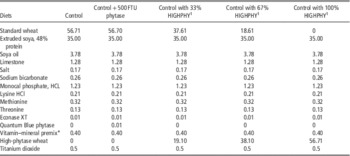
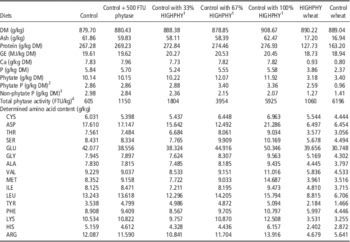
Diet formulations are presented in Table 1. Diets were mixed in house using a ribbon mixer. Titanium dioxide was added to all diets at 5 g/kg inclusion as an inert marker for digestibility measures. All diets were analysed for dry matter (DM) and protein content (calculated as nitrogen multiplied by 6.25) by the Association of Official Analytical Chemists (AOAC) standard methods (930.15 and 990.03, respectively) and gross energy (GE) (via bomb calorimetry; Robbins and Firman, 2006). Amino acid content of diets and protein sources was determined using a Biochrom 30 amino acid analyser (Biochrom, Cambridge, UK) based on ion exchange chromatography. In brief, samples were oxidised with performic acid before acid hydrolysis with nor-leucine added as an internal standard, and then analysed against prepared standards. P, Ca and titanium dioxide content of the diets were analysed by inductively coupled plasma-optical emission spectroscopy (ICP-OES) following an aqua regia digestion step (AOAC 985.01: Morgan et al., 2014). Analysed values for protein, amino acids, DM, energy and mineral content are shown in Table 2. Total phytate content was analysed by a K-Phyt assay kit (MegazymeTM, Wicklow, Ireland) which quantitatively measured available phosphorus release from the samples. In brief, inositol phosphates were acid extracted followed by treatment with a phytase specific for IP6 to IP2 and alkaline phosphate added to ensure release of the final phosphate from myo-inositol phosphate (IP1). The total phosphate released was measured using a modified colorimetric method and expressed as grams of phosphorus/100 g of sample material. Phytase activity was analysed according to the method of Engelen et al. (2001). Dietary phytase levels were ~600, 1050, 1800, 4000 and 6000 FTU/kg (Table 2). The diets had total phytate levels ranging from ~10 to 12 g/kg DM (Table 2), dietary Ca levels of ~7.8 g/kg DM (as dicalcium phosphate and limestone) (Table 1) and non-phytate P levels of ~2.48 g/kg DM (Table 2).
Dietary formulations (%)

* Supplied per kilogram of diet: manganese, 100 mg; zinc, 80 mg; iron (ferrous sulphate), 20 mg; copper, 10 mg; iodine, 1 mg; molybdenum, 0.48 mg; selenium, 0.2 mg; retinol, 13.5 mg; cholecalciferol, 3 mg; tocopherol, 25 mg; menadione, 5.0 mg; thiamine, 3 mg; riboflavin, 10 mg; pantothenic acid, 15 mg; pyroxidine, 3.0 mg; niacin, 60 mg; cobalamin, 30 µg; folic acid, 1.5 mg; and biotin 125 mg.
1 Percentage standard wheat replaced with HIGHPHY wheat (based on 570 g/kg wheat in total diet).
Analysed content of diets and grain

DM=dry matter; GE=gross energy.
1 Percentage standard wheat replaced with HIGHPHY wheat (based on 570 g/kg wheat in total diet).
2 Phytate P was calculated as 28.2% of phytate (Tran and Sauvant, 2004).
3 Non-phytate P was calculated as the difference between total P and phytate P.
4 Total phytase activity was analysed by a colorimetric enzymatic method and calculated as: (net optical density at 415 nm×dilution volume)/(slope of standard curve×mass×incubation time) (Engelen et al., 2001).
Response variables
Birds were weighed by pen on arrival and days 7, 14 and 21 and fed from individual bags to allow feed intake to be measured.
On day 21 birds were euthanised and ileum digesta contents from all birds per pen were collected by gentle digital pressure into one pot per section of tract per pen. Digesta samples were freeze dried and ground to a fine powder before analysis. Calcium, phosphorus and titanium dioxide content of the digesta was determined by ICP-OES following aqua regia digestion as previously discussed for the diets. The following equation was then used to calculate total Ca, P or Ti content:
 $$\eqalign{ \left( {{\rm Ca},\,{\rm P}\,{\rm or}\,{\rm Ti}\,{\rm in}\,{\rm sample}\,\left( {{\rm mg/l}} \right)} \right){\times}\cr \,\,\,\,\,\,\,\,\,\,\,\,\left( {{\rm volume}\,{\rm of}\,{\rm sample}\,\left( {{\rm ml}} \right){\rm /weight}\,{\rm of}\,{\rm sample}\,\left( {\rm g} \right)} \right){\rm /}1000.$$
The apparent ileal digestibility coefficient was calculated by:
 $$\eqalign{ \left( {\left( {{\rm Ca}\,{\rm or}\,{\rm P/TiO}_{{\rm 2}} } \right)\,{\rm diet}\,{\minus}\,\left( {{\rm Ca}\,{\rm or}\,{\rm P/TiO}_{{\rm 2}} } \right)\,{\rm ileum}} \right){\rm /}\cr \quad\quad\left( {{\rm Ca}\,{\rm or}\,{\rm P/TiO}_{{\rm 2}} } \right)\,{\rm diet}{\rm .}$$
GE content of the digesta was measured as described previously for diets and apparent ileal metabolisable energy (AME) was calculated by the following equation:
 $${\rm GE}\,{\rm diet}\,{\minus}\,{\rm (GE}\,{\rm digesta}{\times}({\rm TiO}_{{\rm 2}} \,{\rm in}\,{\rm the}\,{\rm diet/TiO}_{{\rm 2}} \,{\rm in}\,{\rm digesta}){\rm )}{\rm .}$$
Nitrogen content of the digesta was analysed by Dumas method and metabolisable nitrogen was calculated using the following equation:
 $${\rm Diet}\,{\rm N}\,{\minus}\,{\rm Digesta}\,{\rm N}{\times}\left( {{\rm Diet}\,{\rm Ti/Digesta}\,{\rm Ti}} \right){\rm .}$$
Apparent ileal metabolisable energy was also corrected to zero N balance (AMEn) using the figure of 34.4 kg/g N retained as detailed by Hill and Anderson (Reference Hill and Anderson1958).
Tibia bones (separated at the tibiotarsal junction and the tibiofemoral junction) were collected from the left leg of three birds per pen. Flesh and adherent tissue was carefully removed by hand leaving the cartilage caps intact. Bone strength of all tibia bones was analysed using a TA.XT plus texture analyser (Stable Micro Systems, Guildford, UK) setup with a 50 kg load cell and three point-bend fixture. The texture analyser was set to measure force in compression with the test speed set at 1 mm/s, and trigger force set at 7 g (0.069 N). Supports of the fixture were set at 26 mm to accommodate for the bone length. The texture analyser was calibrated using a 5 kg weight. The defleshed bone was placed on the fixtures, a test was run and the peak force in Newtons was recorded.
Following analysis for breaking strength, the tibias were defatted by the Soxhlet method for 6 h (Soxtherm; C Gerhardt UK Ltd, Brackley, UK). The defatted tibias were oven dried at 105°C for constant weight. The dried samples were then cooled and weighed into a pre-weighed ceramic crucible, ashed in a muffle furnace for ~14 h at 650°C, cooled in a desiccator and then reweighed. Bone ash was calculated as ash weight as a percentage of dry bone weight.
Calculations
Statistical analysis of data
Statistical analysis was carried out using SPSS v.22. After Kolmogorov–Smirnov testing to confirm normality, data were analysed using one-way ANOVA to test the equality of the means to investigate the effect of dietary treatment on performance, tibia strength and mineralisation, ileal Ca and P digestibility and phytate hydrolysis. Statistical significance was declared at P<0.05. Duncan post hoc testing was used to elucidate differences between diets.
Results and discussion
In the current study, the high-phytase wheat, HIGHPHY was evaluated in a broiler feeding experiment. The mature grain phytase activity of HIGHPHY and conventional control wheat derives from the PAPhy phytase PAPhy_a gene expressed during wheat grain development. Here for the first time, increasing levels of plant-derived PAPhy phytase are evaluated and compared with a standard wheat supplemented with commercial HAP phytase, supplied via the enhanced E. coli HAP phytase product Quantum Blue.
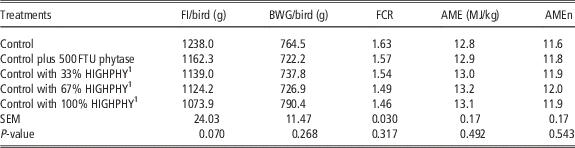
Mortality across the trial was 1.1% (two birds), with no losses from any diet containing the HIGHPHY wheat, indicating there is no overall negative effect of the novel wheat cultivar on bird health. The feed intake, BW gain and feed conversion rate (FCR) were evaluated weekly and cumulatively after 21 days of feeding and provide further evidence (Table 3) that the HIGHPHY wheat has no detrimental effect on health. The performance values recorded are poorer than would be expected for the age and strain of bird, due to the diets being fed as mash, increasing the feeding time for the same quantity of diet (Amerah et al., Reference Amerah, Ravindran, Lentle and Thomas2007). This reduction in performance may also effect bone size and strength, although bone ash was corrected for dry tibia weight, and mineral content calculated as a proportion of tibia ash to reduce the effect of any discrepancies. Relatively large differences in FCR did not elicit a significance when analysed, as the small number of birds per pen, reduces the power of the facility when determining performance measures. However, although not significant, bird weight gain was highest for broilers fed diets where 100% of the standard wheat was replaced by HIGHPHY wheat, and FCR was incrementally improved with increasing inclusion of HIGHPHY.
Feed intake (FI), BW gain (BWG) and feed conversion ratio (FCR), apparent ileal metabolisable energy (AME) and AME corrected to zero N balance (AMEn) from birds fed varying replacement levels of HIGHPHY wheat from days 0 to 21

1 Percentage standard wheat replaced with HIGHPHY wheat (based on 570 g/kg wheat in total diet).
Determination of AME and AMEn (of digesta, see Table 3) did not reveal any significant differences between diets. Dietary analysis indicated nutritionally relevant differences in protein and phosphorus levels between the two wheats which may be shown to be impactful over longer feeding periods. As IP6 reacts with dietary proteins to form aggregates which are less accessible to proteases (Cheryan, Reference Cheryan1980), protein digestion can be adversely affected by the presence of phytate (Vaintraub and Bulmaga, Reference Vaintraub and Bulmaga1991). Therefore, the high protein content of the HIGHPHY wheat is worthy of further investigation via amino acid digestibility assessment. However, the analysed amino acid composition of the diets were very variable in this study, particularly for ASP, which was lower than would have been expected for the 67% HIGHPHY diet. The analysed lysine was also notably low for the 33% HIGHPHY diet which may have compromised bird performance on this treatment. These values require further investigation in any future studies.
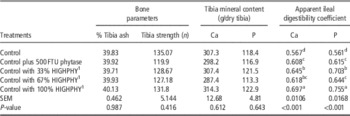
Interestingly, diet had no effect on tibia bone length, width, weight, strength or tibia mineral content (Table 4). This indicates that the level for marginally adequate phosphorus provision used can be set lower in experimental settings and that the study does not reveal the full potential of the experimental diets. Differences in individual bird BW may have compromised these strength and size measures, as the larger birds would be expected to have larger and stronger bones, increasing the number of birds analysed would potentially reduce this variability and therefore elucidate differences in bone strength. However, Table 4 shows that coefficients of digestibility for both Ca and P were significantly improved by all phytase-containing diets over the non-phytase control diet. The data presented in Table 4 shows that the HIGHPHY MGPA has a significant, positive impact on the amount of both Ca and P digested in the ileum at day 21. The wheat PAPhy is functional in the broiler digestive tract and significantly more P and Ca were digested in birds fed diets containing 100% HIGHPHY wheat compared with those fed any other diet (Table 4). In a comparison of the two wheats, the ileal Ca and P digestibility coefficients for the 100% HIGHPHY wheat diets are 22.9% and 35.6% higher, respectively, than for the control diet. Furthermore, 33% HIGHPHY replacement of conventional wheat, significantly improved Ca and P digestibility over the exogenous phytase-supplemented diet. This finding may be explained by the phytase activity levels within each diet: Table 2 shows 33% replacement of conventional wheat with HIGHPHY results in a substantially higher phytase activity levels than the diet containing exogenous HAP phytase (1804 v. 1150 FTU). However, it is important to note that the diets in this study were not formulated to be ideal for the exogenous phytase, as phytate can form insoluble salts in the ileum when Ca is higher, as it is in this study. Further improvements in phosphorus digestibility when phytase level is increased beyond the commercial level of 500 FTU (‘super-dosing’) are well established in poultry (Walk et al., 2013). Full replacement by HIGHPHY gives 14.6% and 22.8% higher ileal digestibility coefficients for Ca and P, respectively, than for feed supplemented with exogenous HAP phytase. Strangely, although the intermediate replacement level (66% HIGHPHY) improves Ca and P digestibility over the control diet, it does not improve Ca and P digestibility compared with either the 33% HIGHPHY diet (lowest replacement level), or the diet supplemented with exogenous HAP phytase. These results require further investigation.
Tibia bone measures and mineral content and coefficient of apparent ileal digestibility of Ca and P in birds fed varying replacement levels of HIGHPHY wheat at day 21

1 Percentage standard wheat replaced with HIGHPHY wheat (based on 570 g/kg wheat in total diet).
Superscript letters denote significance at P<0.05.
The pH optimum for wheat grain PAPhy, is 5.5 which is higher than the optimum pH for exogenous phytase used in this study (pH optima 4.5). It has been suggested that 60% of phytate remains after the gizzard and may be hydrolysed further along the gastrointestinal tract (Morgan et al., Reference Morgan, Walk, Bedford and Burton2015), and a higher pH optima may facilitate this phytate breakdown in the small intestine where the pH tends to be higher. It may be that this PAP phytase will have a synergistic effect on phytate degradation when fed in conjunction with a traditional HAP phytase.
The in vitro investigations previously investigating temperature optimum curve of PAP phytase (Brinch-Pedersen et al., Reference Brinch-Pedersen, Madsen, Dionisio and Holm2012) are not directly comparable with heat treatments during feed production but indicate that HIGHPHY phytase activity can resist certain temperature and moist treatments. When considered alongside findings from the current study, there is evidence to justify further experiments establishing heat stability during feed production for HIGHPHY to enable its full incorporation into pelleted pig and poultry diets.
Improvement of P and mineral digestibility in feed and food are challenging tasks. However, given the severity of phosphate resource problem, environmental problems with leaching of undigested phytate P and micronutrient deficiencies, the task can easily be justified. Scientific initiatives in recent years have led to a substantially increased knowledge base on the complement of phytases in cereals that can form the basis for integrating nutrition, breeding, molecular biology and genetics. In the current article, we have evaluated wheat with high MGPA in a broiler diet and found that that just 33% replacement of standard wheat with HPW is required to significantly improve Ca and P digestibility coefficients compared with conventional supplementation with exogenous phytase. Replacement of standard wheat by 100% HIGHPHY further improved both Ca and P digestibility. This indicates that in planta plant PAPhys has a promising potential for improving P and mineral digestibility in animal feed, particularly where there are barriers to the use of genetically modified plants or supplements.
Acknowledgements
The authors would like to thank Steve Wilson for critical reading of the manuscript and Dr Francisco Barro de Losada of IAS-CSIC for producing the wheat. Technicians Lis B. Holte and Ole B. Hansen are acknowledged for their assistance in multiplying the HIGHPHY wheat. Funding was gratefully received from Plant Bioscience Limited for this study.