Management Implications
Selective Schinus terebinthifolia (Brazilian peppertree) control in mangrove communities is extremely challenging for land managers. Individual plant treatment approaches are problematic due to the difficulty in applicators moving through mangrove communities, the geographic isolation, and the sensitivity of mangroves to common S. terebinthifolia herbicides. Three recently developed auxin herbicides were tested to assess both S. terebinthifolia control and mangrove sensitivity. Aminocyclopyrachlor controlled S. terebinthifolia but severely injured all mangroves tested, whereas aminopyralid controlled S. terebinthifolia and was highly selective on Avicennia germinans (black mangrove) and partially selective on Rhizophora mangle (red mangrove). Florpyrauxifen-benzyl did not control S. terebinthifolia and severely injured all mangroves tested. Results with aminopyralid appear extremely promising to address S. terebinthifolia where A. germinans is the predominant mangrove species. This work could support a 24(c) special local need label for an aminopyralid product for controlling S. terebinthifolia in and around A. germinans.
Introduction
Mangrove forests are globally important coastal ecosystems throughout the tropics and subtropics (Tomlinson Reference Tomlinson1994). The term “mangrove” describes a group of halophytic woody species from multiple families. These species are well-adapted to frequent inundation from tidal and freshwater influences, as well as the broad salinity gradient that results from these hydrologic conditions (Snedaker and Lahmann Reference Snedaker and Lahmann1988; Tomlinson Reference Tomlinson1994). Mangroves provide a wide array of ecosystem services; for example, they buffer wave action, trap sediments, stabilize coastal areas, and serve as a food source and habitat for numerous species (Laegdsgaard and Johnson Reference Laegdsgaard and Johnson2001; Nagelkerken et al. Reference Nagelkerken, Blaber, Bouillon, Green, Haywood, Kirton, Meynecke, Pawlik, Penrose, Sasekumar and Somerfield2008; Thayer et al. Reference Thayer, Colby and Hettler1987).
Generally, mangrove species are divided into the categories of “true mangroves” and mangrove associates based on salt tolerance, morphology, and habitat range (Wang et al. Reference Wang, Mu, Li, Lin and Wang2011). There are three true mangrove species in Florida: black mangrove [Avicennia germinans (L.) L.], white mangrove [Laguncularia racemosa (L.) C.F. Gaertn.], and red mangrove (Rhizophora mangle L.). Combined, these three species provide more than 200,000 ha of mangrove habitat in Florida (Odum and McIvor Reference Odum, McIvor, Myers and Ewel1990). A fourth species, buttonwood mangrove (Conocarpus erectus L.), is a mangrove associate that can be found in the most upland portion of mangrove habitats. These species are present along much of the coast of Florida but dominate the southern coastal areas of the peninsula (Boyer Reference Boyer2006; Chen and Twilley Reference Chen and Twilley1999; Odum and McIvor Reference Odum, McIvor, Myers and Ewel1990).
Despite their importance, mangrove ecosystems are in decline worldwide (Alongi Reference Alongi2002; Farnsworth and Ellison Reference Farnsworth and Ellison1997). The combination of human development, subsidence, sea-level rise, and invasive species represents a growing threat to many mangrove systems (Mytinger and Williamson Reference Mytinger and Williamson1987). Consequently, mangroves are protected species in Florida. While this limits their removal by development, mangrove communities in the state remain highly susceptible to invasive plant species such as Brazilian peppertree (Schinus terebinthifolia Raddi), Australian pine (Casuarina equisetifolia L.), shoebutton ardisia (Ardisia elliptica Thunb.), and latherleaf [Colubrina asiatica (L.) Brongn.] (Langeland et al. Reference Langeland, Cherry, McCormick and Craddock Burks2008). Of greatest concern is S. terebinthifolia, a member of the Anacardiaceae. Although this species has largely invaded freshwater wetlands throughout the state, it exhibits considerable tolerance to brackish conditions and has thus far invaded more than 12,000 ha of mangrove habitat in southwest Florida (Ewe and Sternberg Reference Ewe and Sternberg2007; Jones and Doren Reference Jones, Doren, Brock, Wade, Pysek and Green1997).
Management of S. terebinthifolia is inherently difficult due to its complex canopy structure, which forms near-impenetrable thickets and possesses a sap that is toxic to some individuals (Langeland et al. Reference Langeland, Cherry, McCormick and Craddock Burks2008). These management difficulties are exacerbated within mangrove communities, where dense brace roots, tangled canopies, and hidden pneumatophores create near-impossible conditions for ground crews conducting control operations. In addition to the logistical challenges of management within these communities, there is also concern for non-target herbicide damage to mangrove species from the primary herbicides used, including triclopyr, imazapyr, and glyphosate (Doren and Jones Reference Doren, Jones, Simberloff, Schmitz and Brown1997). For example, aerial applications would allow managers to avoid many of the challenges faced by ground crews, but the lack of selective herbicide options has precluded these treatments in mangrove communities. However, developments in auxin herbicide technology over the last two decades have resulted in three novel herbicides that vary in selectivity: aminocyclopyrachlor, aminopyralid, and florpyrauxifen-benzyl.
Aminocyclopyrachlor and aminopyralid are primarily non-crop herbicides that can be used in seasonally dry wetlands and to the water’s edge in natural areas (Anonymous 2017, 2018a). Aminopyralid is selective among dicots (Mikkelson and Lym Reference Mikkelson and Lym2013), while aminocyclopyrachlor is generally less selective but is effective in controlling resilient woody species (Enloe et al. Reference Enloe, Loewenstein, Streett and Lauer2015; Sperry et al. Reference Sperry, Dias, Prince, Ferrell and Sellers2020). Recent research has demonstrated that both herbicides are highly effective on S. terebinthifolia when applied as individual plant treatments (e.g., cut stump and stem injection) (Bell Reference Bell2019). However, little is known of S. terebinthifolia response to foliar applications of aminopyralid or aminocyclopyrachlor. In addition, florpyrauxifen-benzyl is registered for selective weed control in a range of settings, including rice (Oryza sativa L.) and aquatic systems (Anonymous 2018b; Richardson et al. Reference Richardson, Haug and Netherland2016). Recent research on florpyrauxifen-benzyl has demonstrated a high level of activity on problematic wetland species in Florida, including Old World climbing fern [Lygodium microphyllum (Cav.) R. Br.] and Uruguay water primrose [Ludwigia grandiflora (Michx.) Greuter & Burdet ssp. hexapetala (Hook. & Arn.) G.L. Nesom & Kartesz] (Enloe and Lauer Reference Enloe and Lauer2017; Glueckert and Enloe Reference Glueckert and Enloe2019). However, there are no published studies evaluating the impacts of florpyrauxifen-benzyl on S. terebinthifolia or mangrove species.
There is a need for more selective tools for S. terebinthifolia control in mangrove communities in order to minimize the logistical challenges of managing this species while limiting off-target effects. To this end, foliar applications of three auxin herbicides (aminocyclopyrachlor, aminopyralid, and florpyrauxifen-benzyl) were evaluated at maximum and one-half maximum labeled rates on Florida’s native mangrove species and S. terebinthifolia in a greenhouse experiment.
Materials and Methods
Two greenhouse experiments were conducted from July 2018 through January 2019 at the University of Florida’s Center for Aquatic and Invasive Plants in Gainesville, FL (29.721542°N, 82.417300°W). Schinus terebinthifolia plants were grown from seed collected in Largo, FL (27.882833°N, 82.811725°W) along a roadside approximately 3.9 km from the coast. All four mangrove species were purchased from a local native plant restoration nursery (Florida Native Plants Nursery, Sarasota, FL, USA). Mangrove species (and family) included: A. germinans (Avicenniaceae), C. erectus (Combretaceae), L. racemosa (Combretaceae), and R. mangle (Rhizophoraceae).
All five species were transplanted into 11.3-L pots containing a commercial bark/peat/vermiculite mix (Sungrow® Metro-Mix® 510, Sun Gro Horticulture, Agawam, MA, USA). Pots were placed in 51-L tubs and subirrigated with well water (0.2 ppt salinity). Water levels were maintained at a depth of 2 to 3 cm within the tubs for S. terebinthifolia, C. erectus, and L. racemosa, while R. mangle and A. germinans were maintained at a depth of 4 to 5 cm. Across all species, plants were 2- to 3-yr-old, well-established saplings at the time of treatment, approximately 80 cm in height, with a root collar diameter of approximately 1.7 cm.
The first and second experimental runs were established on July 18 and 24, 2018, respectively. Aminopyralid, aminocyclopyrachlor and, florpyrauxifen-benzyl were derived from the commercial formulations: Milestone® (Corteva Agriscience, Wilmington, DE, USA), Method® 240 SL (Bayer Environmental Science, Cary, NC, USA), and ProcellaCOR™ SC (SePRO, Carmel, IN, USA), respectively. Each herbicide was applied at 0.5X and 1.0X the maximum labeled rate: aminopyralid at 120 and 240 g ae ha−1; aminocyclopyrachlor at 160 and 320 g ae ha−1; and florpyrauxifen-benzyl at 30 and 60 g ai ha−1. All treatments, including the nontreated controls, included a methylated seed oil adjuvant at 1.0% v/v. Herbicide treatments were applied with a CO2-pressurized backpack sprayer equipped with three TeeJet® 11002 DG nozzles spaced 45 cm apart (TeeJet® Technologies, Spraying Systems, Wheaton, IL, USA) calibrated to deliver 187 L ha−1 at 276 kPa. The boom height was maintained at 45 cm above the target canopy (∼125 cm from the ground). To avoid non-target drift and cross contamination, plants were staged outside to air-dry before being returned to the greenhouse. Greenhouse temperatures (max/min) were approximately 29/24 C throughout both experimental runs.
Visual evaluations of injury were conducted at 14, 30, 60, and 90 d after treatment (DAT) on a scale of 0% to 100%, where 0% indicated healthy stems, green leaves, and no defoliation, chlorosis, browning, or auxin symptoms, while 100% indicated complete defoliation. Quantitative estimates of plant health were made at 180 DAT to determine total leaf count (number plant−1), leaf area (cm2 plant−1), live cambium height, and plant survival. Leaf area was quantified by harvesting all leaves from each experimental unit and analyzing with a leaf area meter (LI-3100C, Li-Cor Biosciences, Lincoln, NE, USA). Live cambium height was determined by gently scraping the bark of each species with a razor blade, starting at the terminal bud and moving downward toward the main stem and soil line. The distance from the root collar to the maximum height of live cambium was then measured. For all species, live cambium was green and clearly distinct from brown dead cambium. Survival (%) was determined using injury and cambium data; plants with 100% injury and no live green cambium were recorded as dead, all others were determined to have survived the herbicide treatments.
Statistical Analysis
The experiment was a completely randomized design with a factorial arrangement of treatments. Factors consisted of species (A. germinans, C. erectus, L. racemosa, R. mangle, or S. terebinthifolia), herbicide (aminopyralid, aminocyclopyrachlor, or florpyrauxifen-benzyl), and rate (0.5X or 1X) as factors (plus a nontreated control for each species). Each treatment had a minimum of three and a maximum of four replications, as there were insufficient experimental units for four replicates per treatment. Percent injury (14, 30, 60, and 90 DAT), percent of height with green cambium, and percent survival data (180 DAT) were arcsine square-root transformed, and leaf count and leaf area data (180 DAT) were square-root transformed to meet ANOVA assumptions. These transformations were based on graphical examination of normality and homogeneity of variance (Snedecor and Cochran Reference Snedecor and Cochran1989). However, data are presented as back-transformed means for clarity.
Data were subject to ANOVA using PROC GLIMMIX (Littell et al. Reference Littell, Milliken, Stroup, Wolfinger and Schabenberger2006) in SAS® v. 9.4 software (SAS Institute, Cary, NC 27513). Treatments and species were included as fixed effects, while run and replication (nested in run) were considered random effects (Blouin et al. Reference Blouin, Webster and Bond2011). Treatment effects were partitioned by species into tests of herbicide (differences among the three active ingredients), rate (maximum labeled rate vs. one-half maximum labeled rate), and herbicide by rate interactions along with a test that herbicide treatments differed from the nontreated control. An overall test of species was performed along with tests of species interactions with treatment effects. Species-level herbicide means (average of the two rates) were compared with each other (three tests) and with the nontreated control (three tests) using the Bonferroni adjustment for multiplicity (α = 0.05).
Results and Discussion
There was a significant species by herbicide interaction and significant main effects of species and herbicide for all variables tested. These interactions indicated that treatment efficacy was dependent on species. The ANOVA was partitioned to conduct tests of herbicide, rate, herbicide by rate interaction, and comparisons to nontreated control for each species. While there were significant herbicide by rate interactions for percent injury at 14 DAT for S. terebinthifolia, C. erectus, and L. racemosa, and for percent injury at 60 and 90 DAT for A. germinans and R. mangle, these data are not presented here, as the main effects provide a clear understanding of injury related to each herbicide treatment for each species. Herbicide by rate interactions for R. mangle live cambium height, survival, leaf count, and leaf area at 180 DAT were also found.
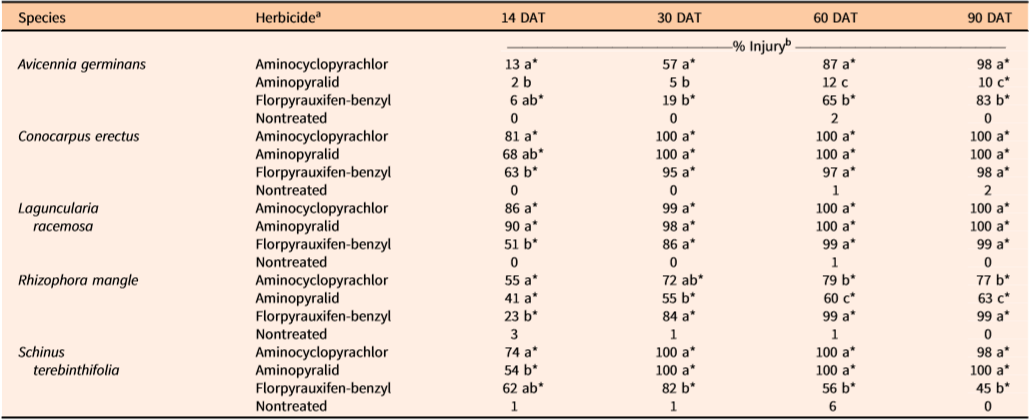
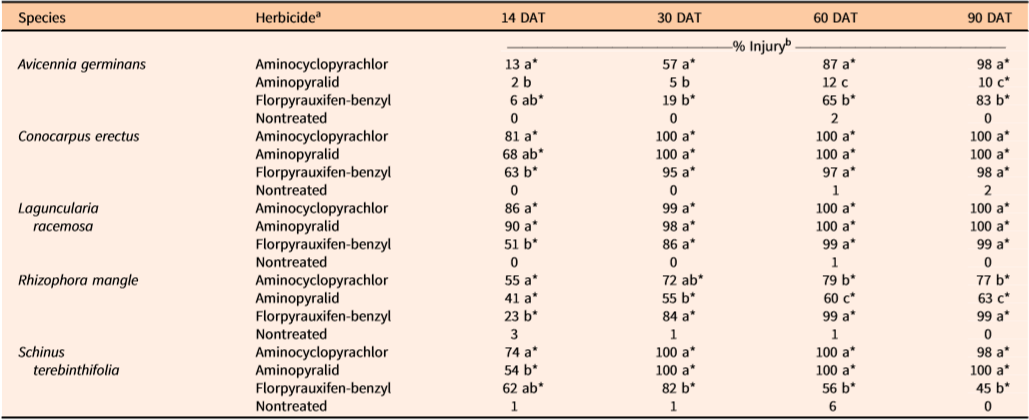
For the main effect of herbicide treatment, aminocyclopyrachlor and florpyrauxifen-benzyl treatments resulted in significant injury to A. germinans at each sample date compared with the nontreated control (Table 1). These were most severe at 90 DAT, where aminocyclopyrachlor and florpyrauxifen-benzyl resulted in 98% and 83% injury, respectively. In contrast, aminopyralid did not injure A. germinans at 14, 30, and 60 DAT and only resulted in 10% visual injury at 90 DAT. This indicated considerable tolerance of the species to aminopyralid compared with aminocyclopyrachlor and florpyrauxifen-benzyl. However, C. erectus and L. racemosa responded similarly among herbicides from 30 to 90 DAT (Table 1). Both species exhibited severe injury from all three herbicides tested. Plants treated with florpyrauxifen-benzyl were slower to exhibit injury symptoms compared with those treated with aminocyclopyrachlor. For example, injury at 14 DAT was 18% and 35% lower from florpyrauxifen-benzyl treatments compared with aminocyclopyrachlor in C. erectus and L. racemosa, respectively. By 90 DAT, both species were defoliated to ≥98% regardless of active ingredient, thus indicating extreme sensitivity to all three auxin-type treatments.
Injury of four mangrove species and Schinus terebinthifolia after treatment with one of three herbicides (pooled over 0.5X and 1X maximum labeled rate) at 14, 30, 60, and 90 d after treatment (DAT) from greenhouse experiments conducted in Florida in 2018 and 2019.
a Pooled 0.5X and 1X maximum labeled rates for each herbicide include the following: aminocyclopyrachlor, 160 and 320 g ae ha−1; aminopyralid, 120 and 240 g ae ha−1; florpyrauxifen-benzyl, 30 and 60 g ai ha−1.
b Means within columns and species followed by the same letter are not different according to the Bonferroni adjustment for multiplicity (α = 0.05). Means with an asterisk (*) are significantly different from the nontreated control for that species using the Bonferroni adjustment for three comparisons.
For R. mangle, all three herbicides resulted in significant but varying levels of injury across all sample dates (Table 1). As with C. erectus and L. racemosa, plants treated with florpyrauxifen-benzyl exhibited lower injury at 14 DAT compared with those treated with either aminopyralid or aminocyclopyrachlor; however, by 90 DAT, plants treated with florpyrauxifen-benzyl exhibited 99% injury, which was greater than injury observed with aminocyclopyrachlor and aminopyralid treatments. Likewise, aminocyclopyrachlor treatments resulted in greater R. mangle injury than aminopyralid at 60 and 90 DAT.
All three herbicides resulted in a higher level of injury in S. terebinthifolia than in the nontreated control at 14, 30, 60, and 90 DAT (Table 1). Aminocyclopyrachlor resulted in significantly greater injury than aminopyralid at 14 DAT, but by 30 DAT, 100% injury was observed for trees treated with both herbicides. Plants treated with florpyrauxifen-benzyl reached their maximum injury (82%) at 30 DAT and began to recover thereafter. By 90 DAT, injury had declined to 45%, with plants showing considerable regrowth. Florpyrauxifen-benzyl resulted in lower injury than the other herbicides at all sample dates after 14 DAT.
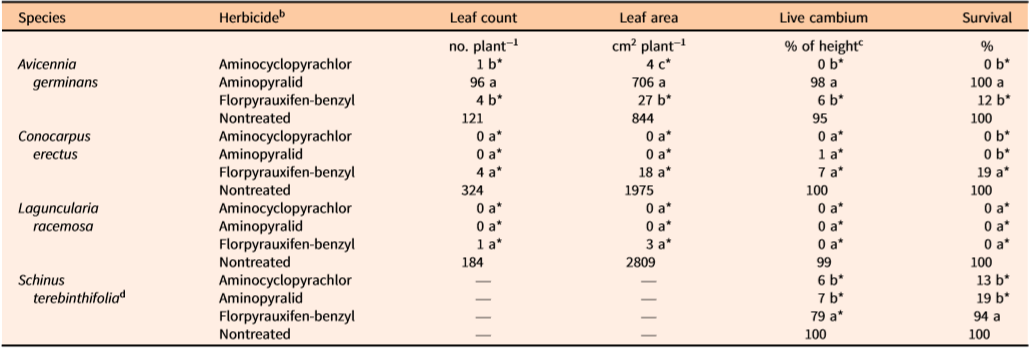
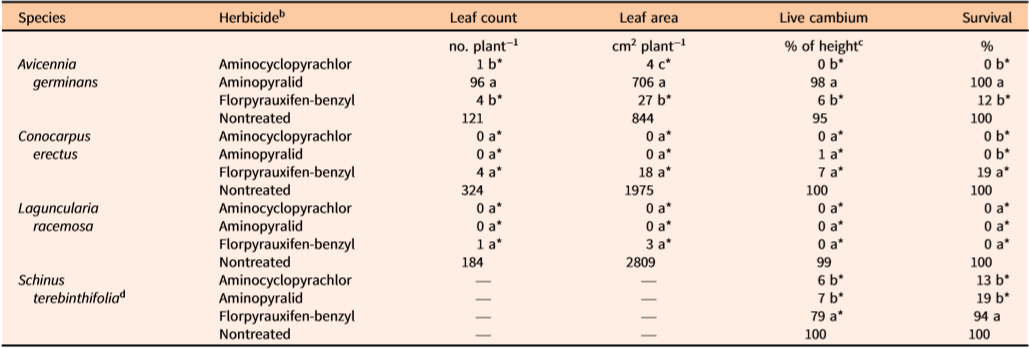
Quantitative data collected at 180 DAT provided a clear indication of potential longer-term impact for each species and herbicide combination. For A. germinans, data collected at 180 DAT (Table 2) were similar to injury patterns at 90 DAT (Table 1). Compared with the nontreated control, aminocyclopyrachlor and florpyrauxifen-benzyl reduced leaf area 99% and 97%, respectively (Table 2). A similar pattern was also observed for live cambium height and percent survival. These reductions caused by aminocyclopyrachlor and florpyrauxifen-benzyl translated to plant survival frequencies of 0% and 12%, respectively. In contrast, aminopyralid, did not significantly impact leaf count, leaf area, or live cambium height, which resulted in 100% A. germinans survival.
Herbicide impact on leaf count, leaf area, percent of total height with live cambium, and percent survival at 180 d after treatment from greenhouse experiments conducted in Florida in 2018 and 2019.a
a Means followed by the same letter within each species are not different according to the Bonferroni adjustment for multiplicity (α = 0.05). Means with an asterisk (*) are significantly different from the nontreated control for that species using the Bonferroni adjustment for three comparisons.
b Pooled 0.5X and 1X maximum labeled rates for each herbicide include the following: aminocyclopyrachlor, 160 and 320 g ae ha−1; aminopyralid, 120 and 240 g ae ha−1; florpyrauxifen-benzyl, 30 and 60 g ai ha−1.
c Live cambium percent of height was calculated as the percent of the live pretreatment height.
d Leaf count and leaf area data for S. terebinthifolia were not collected due to time constraints.
Both C. erectus and L. racemosa were extremely sensitive to all three herbicides at 180 DAT and exhibited severe reductions in leaf count (99% to 100% reduction), leaf area (99% to 100% reduction), and live cambium height (93% to 100% reduction) compared with the nontreated controls (Table 2). In C. erectus, florpyrauxifen-benzyl resulted in greater percent survival (19%) than either aminopyralid or aminocyclopyrachlor, which resulted in 0% survival. For L. racemosa, there were no differences between herbicide treatments for any of the measured characteristics, and all three herbicides resulted in 0% survival.
Rhizophora mangle was the only species to exhibit an herbicide by rate interaction at 180 DAT (Table 3). A rate response for aminocyclopyrachlor appeared to be the primary driver for all quantified variables; in each case, the maximum label rate of aminocyclopyrachlor (320 g ae ha−1) resulted in no survival, while the one-half maximum label rate (160 g ae ha−1) resulted in 100% survival. For leaf count and leaf area, R. mangle treated with a foliar application of aminopyralid had more leaves than plants treated with florpyrauxifen-benzyl at one-half the maximum rate for each herbicide. However, there were no differences for live cambium height or percent survival. Overall, these interactions, while statistically significant, were not biologically meaningful, as the general level of injury to R. mangle by all three herbicides would be considered unacceptable.
Interaction of herbicide and rate on Rhizophora mangle leaf count, leaf area, live cambium height, and survival at 180 d after treatment from greenhouse experiments conducted in Florida in 2018 and 2019.a

a Means within columns and herbicides followed by the same letter are not different according to the Tukey-Kramer adjustment for multiplicity (α = 0.05).
b Live cambium percent of height was calculated as the percent of the live pretreatment height.
Aminocyclopyrachlor and aminopyralid reduced S. terebinthifolia live cambium height to 6% and 7% of the pretreatment height, respectively, while florpyrauxifen-benzyl reduced live cambium height to 79% of the pretreatment height (Table 2). Schinus terebinthifolia survival was reduced from 100% in the nontreated control to 13% and 19% for aminocyclopyrachlor and aminopyralid, respectively. Conversely, survival after foliar florpyrauxifen-benzyl treatment was 94%.
This study provides a better understanding of the efficacy of novel auxin-type herbicides on the invasive S. terebinthifolia and selectivity toward four native mangrove species. Both aminocyclopyrachlor and aminopyralid provided strong reductions in S. terebinthifolia growth parameters. Field studies should be conducted to better understand foliar treatment performance on mature, well-established S. terebinthifolia to complement previous research on other individual plant treatment methods evaluated by Bell (Reference Bell2019). In contrast, florpyrauxifen-benzyl did not control the target species and is not recommended as a stand-alone tool for management of S. terebinthifolia. Further research would be needed on florpyrauxifen-benzyl application rates, tank mixes, and retreatment intervals in order to ascertain any utility as a foliar treatment for S. terebinthifolia.
Aminocyclopyrachlor and florpyrauxifen-benzyl severely injured all four species of mangrove. These data suggest that these active ingredients would result in higher levels of off-target injury if used in aerial foliar treatments within mangrove communities. While aminopyralid also severely injured C. erectus and L. racemosa, the species A. germinans exhibited strong tolerance to this active ingredient. Foliar applications of aminopyralid may therefore provide selective control of S. terebinthifolia in A. germinans communities, which could be extremely useful for land managers who struggle with this specific complex of species, and further research is needed to validate this under field conditions.
These results also provide some reference to historical work on herbicides and mangroves. The auxin-type herbicides picloram, 2,4-D, and 2,4,5-T were used extensively during the Vietnam War to reduce the dense jungle cover that greatly hindered U.S. operations (Westing Reference Westing1972). Between 1961 and 1971, approximately 0.1 to 0.2 million hectares of coastal mangrove forests were treated with combinations of these products known as Agent Orange and Agent White (Westing Reference Westing1972). Posttreatment observations from areas that contained mangroves within the genera Rhizophora and Avicennia consistently demonstrated extremely high levels of damage (Westing Reference Westing1971). Although not directly comparable, the current work is in agreement on the general sensitivity of mangroves to the newer auxin-type herbicides as previously exhibited by the older auxin chemistries. Our work is also in agreement with research conducted in southern Florida in the mid-1970s regarding some variation in dose sensitivity of mangroves to auxin herbicides. Avicennia germinans was found to have a higher tolerance to picloram and 2,4-D than R. mangle, both of which were more tolerant than L. racemosa (Teas Reference Teas1976). Our results from aminopyralid, which is structurally related to picloram, followed a somewhat similar tolerance pattern, while aminocyclopyrachlor and florpyrauxifen-benzyl both resulted in low survival of A. germinans, L. racemosa, and C. erectus.
This research is another revelation about the challenges of invasive plant management. In this case, there are newer auxin herbicide options that are highly effective on S. terebinthifolia, but practically prohibitive as a foliar application due to the high potential for collateral non-target injury and damage to these protected mangrove species. Given the increasing problem of S. terebinthifolia in mangrove communities, advancements in herbicide selectivity may come with improvement in individual plant treatment techniques such as herbicide ballistic technology, which has been effectively employed by helicopter in Hawaii (Leary et al. Reference Leary, Gooding, Chapman, Radford, Mahnken and Cox2013). This approach might be well suited, given the difficulties in accessing mangrove communities by ground. Additionally, an emphasis should be placed upon continued efforts for biological control of S. terebinthifolia. The recent approval and release of Pseudophilothrips ichini (Hood) (Insecta: Thysanoptera:Phlaeothripidae) shows some promise, as it has been shown to reduce S. terebinthifolia biomass (Manrique et al. Reference Manrique, Diaz, Erazo, Reddi, Wheeler, Williams and Overholt2014). However, the potential effectiveness of this insect is unknown in mangrove communities, where hydrology may limit its success due to pupation in the soil (Manrique et al. Reference Manrique, Diaz, Erazo, Reddi, Wheeler, Williams and Overholt2014).
Acknowledgments
The authors would like to thank Colette Jacono for assistance in mangrove propagation and maintenance; and Jessie Solomon, Kenzie Bell, and Matt Shinego for assistance in treatment and data collection. This project was funded by the U.S. Department of Defense through the U.S. Army Corps of Engineers under agreement number W9126G-18-2-0065. The authors declare no conflicts of interest in this research.