The intestine is a primary organ responsible for digestion, absorption and immunity. However, it is usually immature and underdeveloped in piglets, which can easily lead to nutrient absorption reduction, pathogenic bacteria infection and even death. Therefore, nutritional strategies can help improve intestinal function to reduce piglet mortality in pig production(Reference Huting, Middelkoop and Guan1).
Fatty acids (FAs) are major components of oil and play an important role in intestinal immunity(Reference Qiu, Ma and Qiu2). Previous studies have reported that n-3 PUFA have a positive effect on decreasing inflammation response(Reference Liu and Kim3,Reference Siriwardhana, Kalupahana and Moustaid-Moussa4) . However, a balanced n-6/n-3 PUFA ratio is better than n-3 PUFA intake for preventing inflammation(Reference Yang, Song and Yin5). An imbalance of n-6/n-3 PUFA ratio in diet had a negative effect on reproductive performance(Reference Oliva, Santillán and Ryan6). Kafantaris et al. found n-6/n-3 PUFA ratio of 6:1 was better than 10:1 for the performance in piglets(Reference Kafantaris, Stagos and Kotsampasi7). Duan et al. reported that n-6/n-3 PUFA ratio of 5:1 and 1:1 was best for growth performance and muscle mass in pigs, respectively(Reference Duan, Li and Li8). However, compared to pigs fed dietary n-6/n-3 PUFA ratios of 5:1 or 3:1, Nong et al. found pigs receiving ratio of 8:1 exhibited the highest feed conversion(Reference Nong, Wang and Zhou9). Therefore, the balanced n-6/n-3 PUFA ratio in diet may be more important(Reference Pélissier, Bourdet and Marques-Dossou10).
Similarly, inappropriate unsaturated fatty acids/SFA (UFA/SFA) ratio also has negative effects on growth performance. Excess UFA induces lipid peroxidation. Like LPS, it stimulates the TLR4 pathway(Reference Mutoh and Ueda11). Similarly, excessive uptake of SFA can cause metabolic disorders because of its toxicity to cells(Reference Piccolis, Bond and Kampmann12). Therefore, there has been a growing interest in optimising the dietary ratio of UFA/SFA. Chen et al. reported that better performance was observed in the pigs fed the diet with UFA/SFA ratio of 1:1(Reference Chen, Li and Liu13). However, Sun et al. found that when the UFA/SFA ratio was 1·0–1·3, the fat digestion rate decreased linearly, whereas when the ratio exceeded 1·5, the digestion rate increased(Reference Sun and Huang14). In addition, UFA/SFA ratios of 2·5:1 and 5:1 have no effect on the performance, but may improve meat quality in finishing pigs(Reference Tartrakoon, Tartrakoon and Kitsupee15).
In summary, a balanced FA profile, with n-6/n-3 PUFA ratio ranging from 5:1 to 8:1, and UFA/SFA ratio exceeding 1·5:1, might have better effects on growth performance and intestinal health in piglets. However, soybean oil is well-known as a major dietary source of linoleic acid and α-linolenic acid. Both palm oil and coconut oil are rich in SFA. They are both poor in n-3 PUFA content, which is the main content in fish oil and flaxseed oil. Hence, a single oil could not meet the recommended FA requirements for piglets.
The small intestine is the main site for emulsifying, hydrolysing and ingesting lipids(Reference Ye, Xu and Liu16). Therefore, this study was conducted to study the effects of the blended oils composed of glyceryl butyrate, soybean oil, coconut oil, palm oil and fish oil with an appropriate n-6/n-3 PUFA ratio of 6 and unsaturated/SFA ratio of 2·5 on growth performance and small intestinal health in LPS-challenged piglets.
Material and method
Animal and experimental design
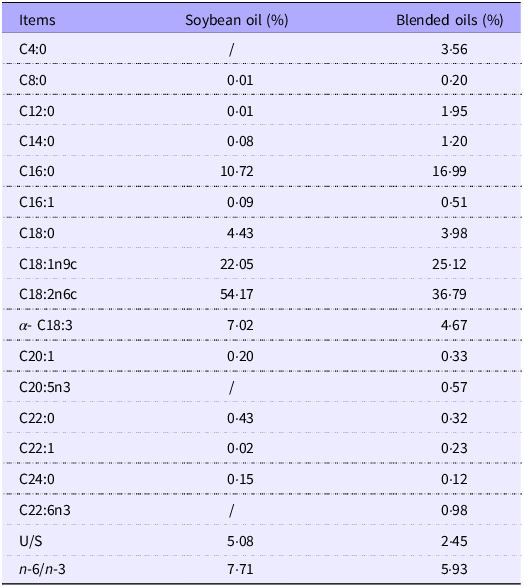
The Animal Care and Use Committee of Wuhan Polytechnic University approved the animal use protocol for this research (EM20230707001). One hundred and twenty crossbred castrated barrows (Duroc × Large White × Landrace; 8·47 ± 0·85 kg; 35 ± 1 d of age) were selected and randomly assigned to two treatments based on their initial body weight. Each treatment had six pens, and each pen had ten piglets. Piglets were fed a corn-soybean diet with 2 % soybean oil (Yihai Kerry Arawana Holdings Co., Ltd., Wuhan, China) or 2 % blended oils. The composition of the blended oils included glyceryl butyrate (3 %), soybean oil (66 %), coconut oil (4 %), palm oil (20 %) and fish oil (7 %). The experiment lasted for 28 d. The weight of piglets and feed intake were measured on days 1, 14 and 28, respectively, for calculation of average daily gain, average daily feed intake and feed conversion. On day 28, the experiment was conducted as a 2 × 2 factorial arrangement of treatments, including dietary treatment (2 % soybean oil v. 2 % blended oils) and LPS (Escherichia coli (E. coli) serotype 055: B5, Sigma Chemical) challenge (saline v. LPS). Twelve piglets in each dietary treatment were selected and injected intraperitoneally with either E. coli LPS at 100 μg/kg body weight or the equivalent amount of sterile saline(Reference Liu, Chen and Odle17). The basal diet is formulated to meet the nutrient requirements of the National Research Council(18) (Table 1). The FA composition of the blended oils is shown in Table 2. In the whole experimental period, all pigs were housed individually in pens (3·00 m × 4·00 m) and maintained in good health. The ambient temperature was maintained at 22∼25℃ and the living environment was in accordance with animal welfare guidelines.
Ingredient composition of diets (as fed basis)

* The premix (defatted rice bran as carrier) provided the following amounts per kg of complete diet: retinol acetate, 2700 μg; cholecalciferol, 62·5 μg; dl-α-tocopheryl acetate, 20 mg; menadione, 3 mg; vitamin B12, 20 μg; riboflavin, 4 mg; niacin, 40 mg; pantothenic acid, 15 mg; choline chloride, 400 mg; folic acid, 0·7 mg; thiamine, 1·5 mg; pyridoxine, 3 mg; biotin, 0·1 mg; Zn, 170 mg (ZnSO4·7H2O); Mn, 63 mg (MnSO4·5H2O); Fe, 83 mg (FeSO4·H2O); Cu, 21 mg (CuSO4·5H2O); I, 0·75mg.
† Calculated.
The composition of fatty acids in soybean oil and blended oils (%)

Sample collection
Four hours after injection of LPS or sterile solution(Reference Liu, Chen and Odle17,Reference Wu, Zhou and Wu19) , all selected pigs were slaughtered under anaesthesia with an intravenous injection of pentobarbital sodium (80 mg/kg BW), and a segment of the intestine was harvested from the same site of the jejunum and ileum, and stored in 4 % formaldehyde for morphological measurement. Other portions of the jejunum and ileum were opened, and mucosal samples were collected, mixed and snap-frozen in liquid nitrogen and then stored at −80℃ until further analysis.
Intestinal morphology
The fixed jejunum and ileum sections were embedded in paraffin, sectioned (5 μm) and stained with haematoxylin and eosin for morphological examinations. Then, the villus height and crypt depth were measured in a blinded manner using Olympus Cell Sens Standard 1.18 software.
DNA, RNA and protein contents in the intestine
The protein concentration of intestinal mucosa homogenates was determined according to the published paper(Reference Lowry, Rosebrough and Farr20), and bovine serum albumin was used as the reference standard. Mucosa DNA content was evaluated by a fluorometric assay(Reference Labarca and Paigen21). Mucosa RNA level was measured by ultraviolet absorption at 232 nm and 260 nm(Reference Storch, Heilmayer and Hardewig22).
Disaccharidase activities in the intestine
The disaccharidase activities in intestinal mucosa homogenates were determined by the commercial assay kits (Nanjing Jiancheng Bioengineering Institute, Nanjing). The absorbance of the solution was measured spectrophotometrically at 505 nm via a microplate reader (iMarkTM, Bio-Rad, USA). Glucose solution (1·85 mmol/l) was a reference standard.
mRNA expression analysis by quantitative real-time PCR
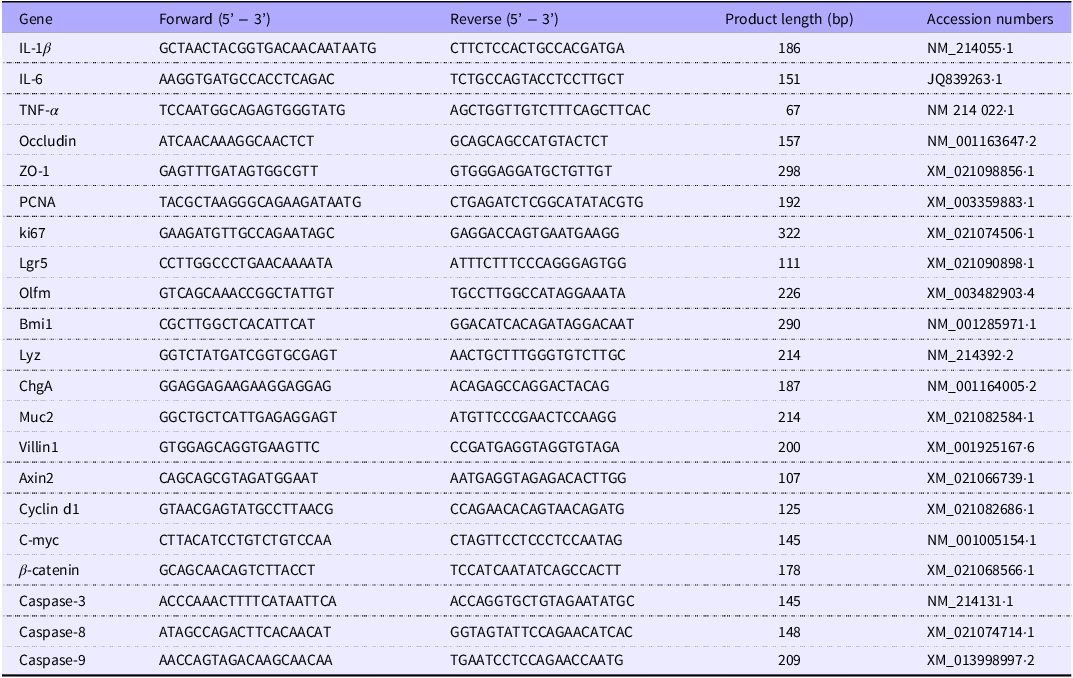
mRNA expression analysis was conducted according to the previous study(Reference Zhu, Wang and Wang23). Briefly, total RNA was extracted from intestinal mucosa using TRIzol reagent, and then the total RNA was reverse transcribed into cDNA and real-time PCR analysis for gene expression was performed. The primer sequences are listed in Table 3. The mRNA abundance of the target genes was calculated by the 2–ΔΔCT method of Livak and Schmittgen(Reference Livak and Schmittgen24).
Primer sequences used for real-time PCR

IL-1β, interleukin 1β; IL-6, interleukin 6; TNF-α, tumour necrosis factor-α; ZO-1, zonula occluden-1; PCNA, proliferating cell nuclear antigen; Lgr5, leucine-rich repeat-containing G protein-coupled receptor 5; Olfm, olfactomedin; Bmi1, B cell-specific moloney murine leukaemia virus integration site 1; Lyz, lysozyme; ChgA, chromogranin A; Muc 2, mucins 2.
Statistical analyses
All data were analysed with SPSS 17.0 software. The performance data were performed by independent t test, and other data were analysed as a 2 × 2 factorial design by ANOVA using the general linear model procedures. The statistical model included the effects of LPS challenge (saline or LPS), diet (soybean oil or blended oils) and their interactions. Data were presented as means and SEM. When there was a significant interaction between LPS and diet, post hoc testing was conducted using Duncan’s multiple comparison tests. Differences were considered to be significant if P < 0·05. Instances in which 0·05 < P ≤ 0·10 were discussed as trends.
Results
Growth performance
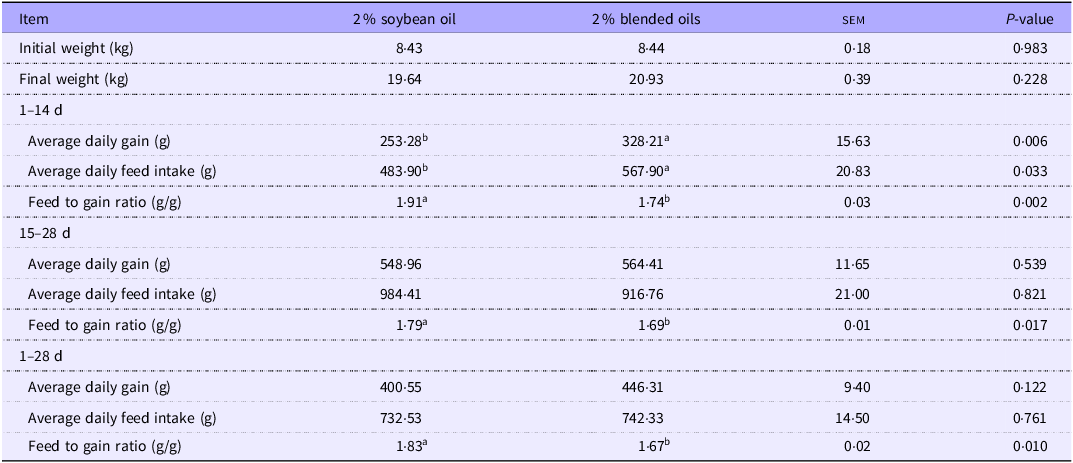
Compared with soybean oil, the blended oils supplementation increased average daily gain, average daily feed intake and feed to gain ratio during 1–14 d (P < 0·05). The blended oils reduced feed to gain ratio in the whole experimental period (P < 0·05) (Table 4).
Effects of blended oils on growth performance in piglets

Values are means, n 6 (10 pigs/pen). abLabeled means in a row without a common letter differ, P < 0·05.
Intestinal morphology
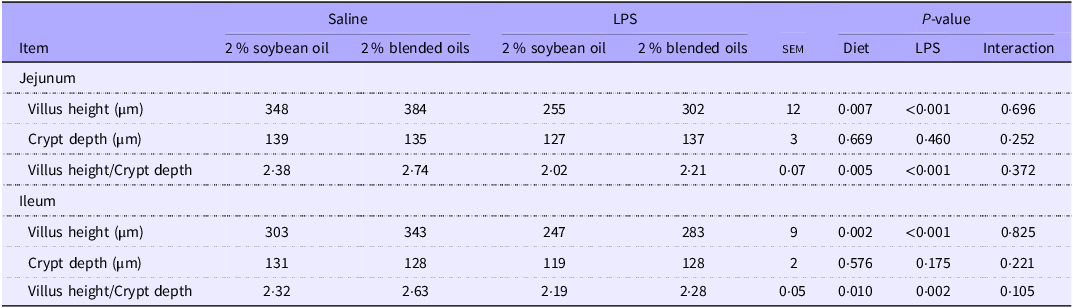
The results of the blended oils effect on intestinal morphology are shown in Table 5. LPS challenge reduced villus height and the ratio of villus height and crypt depth in jejunum and ileum (P < 0·05). However, the blended oils supplementation improved intestinal morphology in both saline-treated and LPS-challenged piglets (P < 0·05). Histological examinations revealed that LPS challenge induced villous structural abnormalities and damage. Additionally, massive epithelial cell loss and inflammatory infiltration were observed. Compared to soybean oil, the blended oils alleviated LPS-induced intestinal injury (Figures 1 and 2).
Effects of blended oils on intestinal histology in piglets after LPS challenge

LPS, lipopolysaccharide. Values are means, n 6 (1 pig/pen).
Effects of soybean oil or blended oils supplementation on ileal mucosal histological morphology (haematoxylin and eosin staining) in the weaned piglets after Escherichia coli lipopolysaccharide (LPS) challenge. Original magnification 100×. Scale bars = 200 μm. (a) Piglets fed a soybean oil diet and injected with sterile saline; (b) piglets fed a blended oils diet and injected with sterile saline; (c) piglets fed a soybean oil diet and injected with LPS; (d) piglets fed a blended oils diet and injected with LPS.

Effects of soybean oil or blended oils supplementation on jejunal mucosal histological morphology (haematoxylin and eosin staining) in the weaned piglets after Escherichia coli lipopolysaccharide (LPS) challenge. Original magnification 100×. Scale bars = 200 μm. (a) Piglets fed a soybean oil diet and injected with sterile saline; (b) piglets fed a blended oils diet and injected with sterile saline; (c) piglets fed a soybean oil diet and injected with LPS; (d) piglets fed a blended oils diet and injected with LPS.

DNA, RNA and protein contents in jejunum and ileum
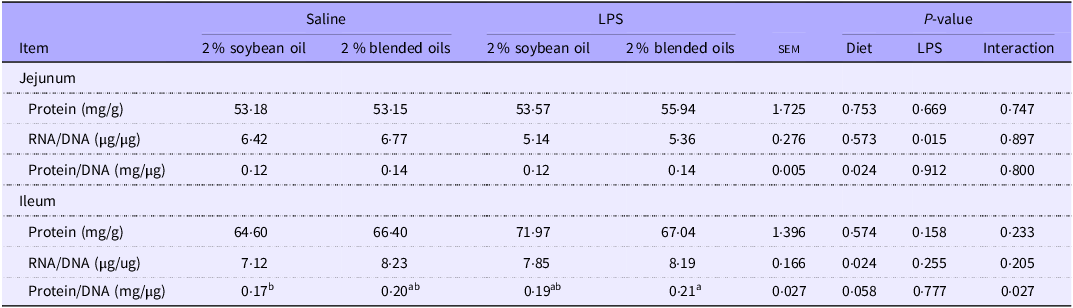
DNA, RNA and protein contents in the intestine are presented in Table 6. LPS challenge reduced RNA/DNA ratio in jejunum (P < 0·05). The blended oils supplementation increased protein/DNA ratio in both jejunum and ileum (P < 0·05), and increased RNA/DNA ratio in ileum in both saline-injected and LPS-treated piglets (P < 0·05).
Effects of blended oils on disaccharidase activities in the intestine of piglets after LPS challenge

LPS, lipopolysaccharide. Values are means, n 6 (1 pig/pen). abLabeled means in a row without a common letter differ, P < 0·05.
Disaccharidase activities in jejunum and ileum
As shown in Table 7, LPS challenge reduced maltase and sucrase activities in jejunum (P < 0·05), and the blended oils supplementation increased sucrase activity (P < 0·05) and had a tendency to increase maltase activity in jejunum (P < 0·10). In addition, the blended oils increased sucrase activity in ileum (P < 0·05). There was a LPS challenge × diet interaction observed for maltase activity in ileum (P < 0·05). The blended oils had no effect on maltase activity in saline-treated piglets; however, the blended oils increased their activity in piglets after LPS challenge (P < 0·05).
Effects of blended oils on DNA, RNA and protein contents in the intestine of piglets after LPS challenge

LPS, lipopolysaccharide. Values are means, n 6 (1 pig/pen). abLabeled means in a row without a common letter differ, P < 0·05.
Intestinal interleukin-1β, interleukin-6 and tumour necrosis factor α mRNA expression
As shown in Table 8, a LPS × diet interaction was observed for interleukin-6 mRNA expression in jejunum and tumour necrosis factor α mRNA expression in ileum (P < 0·05). The blended oils had no effect on these mRNA expressions in saline-treated piglets; however, they reduced these mRNA expressions in piglets after LPS challenge (P < 0·05). In addition, the blended oils supplementation had a tendency to reduce tumour necrosis factor α mRNA expression in jejunum (P < 0·10).
Effects of blended oils on intestinal IL-1β, IL-6 and TNF-α mRNA expressions in piglets after LPS challenge

IL-1β, interleukin-1β; IL-6, interleukin-6; TNF-α, tumour necrosis factor α; LPS, lipopolysaccharide.
Values are means, n 6 (1 pig/pen). abLabeled means in a row without a common letter differ, P < 0·05.
Intestinal tight junction mRNA expression
LPS reduced occludin and zonula occluden-1 mRNA expression in jejunum; however, its challenge increased these mRNA expressions in ileum (P < 0·05). There was a LPS challenge × diet interaction observed for occludin mRNA expression in ileum (P < 0·05). The blended oils supplementation reduced occludin mRNA expression after saline injection (P < 0·05); however, it increased its mRNA expression after LPS challenge (P < 0·05) (Table 9).
Effects of blended oils on intestinal tight junction mRNA expressions in piglets after LPS challenge

ZO-1, zonula occluden-1; LPS, lipopolysaccharide.
Values are means, n 6 (1 pig/pen). abcd Labelled means in a row without a common letter differ, P < 0·05.
Intestinal proliferation-related gene expression
As shown in Table 10, LPS challenge reduced proliferating cell nuclear antigen (PCNA), Ki67 and villin mRNA expressions, and increased leucine-rich repeat-containing G-protein-coupled receptor 5 (Lgr5) mRNA expression in jejunum (P < 0·05). The blended oils increased PCNA and mucins 2 mRNA expressions in jejunum (P < 0·05). There was an interaction between LPS challenge and diet for chromogranin A expression in jejunum (P < 0·05). The blended oils had no effect on chromogranin A mRNA expression in saline-treated piglets; however, their supplementation reduced chromogranin A mRNA expression after LPS challenge (P < 0·05). In ileum, LPS challenge reduced PCNA expression, and increased Ki67, olfactomedin 4, lysozyme, chromogranin A and mucins 2 mRNA expression (P < 0·05). The blended oils supplementation increased Ki67 expression, and had a tendency to increase PCNA expression (P < 0·05). There was a LPS challenge × diet interaction observed for Lgr5 expression in ileum (P < 0·05). The blended oils had no effect on Lgr5 mRNA expression in saline-treated piglets; however, the blended oils increased their mRNA expression in piglets after LPS challenge (P < 0·05).
Effects of blended oils on intestinal cell proliferation related genes mRNA expressions in piglets after LPS challenge

Table 10 Long description
The table presents data on the effects of blended oils on intestinal cell proliferation-related genes mRNA expressions in piglets after LPS challenge. It is divided into two main sections: Jejunum and Ileum, each with multiple rows and columns. The columns are labeled with different conditions: 2 percent soybean oil with saline, 2 percent blended oils with saline, 2 percent soybean oil with LPS, and 2 percent blended oils with LPS. The rows are labeled with different genes: PCNA, Ki67, Lgr5, Olfm4, Bmi1, Lyz, ChgA, Muc2, and Villin. Each cell contains a numerical value representing the expression level of the corresponding gene under the specified condition. The table also includes P-values for Diet, LPS, and Interaction, indicating the statistical significance of the observed effects. Notable trends include the reduction of PCNA, Ki67, and villin mRNA expressions in the jejunum due to LPS challenge, and the increase in Lgr5 mRNA expression. The blended oils increased PCNA and mucins 2 mRNA expressions in the jejunum. There was an interaction between LPS challenge and diet for chromogranin A expression in the jejunum. In the ileum, LPS challenge reduced PCNA expression and increased Ki67, olfactomedin 4, lysozyme, chromogranin A, and mucins 2 mRNA expressions. The blended oils supplementation increased Ki67 expression and had a tendency to increase PCNA expression. There was an interaction between LPS challenge and diet for Lgr5 expression in the ileum.
PCNA, proliferating cell nuclear antigen; Lgr5, leucine rich repeat containing G protein-coupled receptor 5; Olfm, olfactomedin; Bmi1, B cell-specific Moloney murine leukaemia virus integration site 1; Lyz, lysozyme; ChgA, chromogranin A ; Muc, mucins LPS, lipopolysaccharide.
Values are means, n 6 (1 pig/pen). abLabeled means in a row without a common letter differ, P < 0·05.
Wnt signalling pathway-related gene expression
As shown in Table 11, LPS challenge increased Axin2, Cyclin d1 and β-catenin mRNA expressions in jejunum, and Axin2, Cyclin d1, C-myc and β-catenin mRNA expressions in ileum (P < 0·05). There was an interaction between LPS and diet interaction observed for C-myc mRNA expression in jejunum, and Axin2 and Cyclin d1 mRNA expressions in ileum (P < 0·05). The blended oils had no effect on C-myc mRNA expression in jejunum, and Axin2 and Cyclin d1 mRNA expressions in ileum in saline-treated piglets; however, the blended oils supplementation reduced C-myc mRNA expression in jejunum and increased Axin2 and Cyclin d1 mRNA expressions in ileum in LPS-challenged piglets (P < 0·05).
Effects of blended oils on intestinal Wnt signalling pathway in piglets after LPS challenge

LPS, lipopolysaccharide. Values are means, n 6 (1 pig/pen). abc Labelled means in a row without a common letter differ, P < 0·05.
Intestinal apoptosis signalling pathway-related gene expression
LPS challenge increased caspase-9 mRNA expression in jejunum and caspase-3 and caspase-8 mRNA expressions in ileum (P < 0·05), and the blended oils supplementation decreased caspase-3 mRNA expression in both jejunum and ileum (P < 0·05) (Table 12).
The effects of the blended oils on intestinal apoptosis signalling pathway in piglets after LPS challenge

LPS, lipopolysaccharide. Values are means, n 6 (1 pig/pen).
Discussion
The intestine is important for metabolism and immunity, and it is usually immature and underdeveloped in piglets. FAs play an important role in intestinal immunity(Reference Qiu, Ma and Qiu2). However, the consumption of a single vegetable oil cannot meet the recommended allowances of various FAs(Reference Rabail, Shabbir and Sahar25). Therefore, the balanced FA profile would be more important(Reference Pélissier, Bourdet and Marques-Dossou10).
Different oils have highly contrasting FA profiles and hence have different aims of health protectiveness. Soybean oil, palm oil and coconut oil are widely consumed edible oils in the world. Among them, soybean oil has more PUFA. Whereas, palm oil is usually limited in use because of its high amount of SFA(Reference Glencross26). Coconut oil also has high SFA content, and its fatty acid composition is usually modified to obtain a product with some of the health benefits(Reference Kanprakobkit, Kielarova and Wichai27). Therefore, blended oils could avoid the negative impact of single oil, because of the complementary effects in the FA profile of different oils. According to the previous studies, the balanced FA profiles, with n-6/n-3 PUFA ratio ranging from 5:1 to 8:1, and the UFA/SFA ratio exceeding 1·5:1, might have a better effect on the performance and health of piglets. Duan et al. found growth performance of growing-finishing pigs fed the diet with an n-6/n-3 PUFA ratio of 5:1 was the best(Reference Duan, Li and Li8). In the current study, we found that the blended oils with n-6/n-3 PUFA ratio of 6:1, and UFA/SFA ratio of 2·5:1 increased average daily gain in early-stage piglets, and decreased feed/gain ratio throughout the whole experimental time. These results indicate that the blended oils exerted more beneficial effect on growth performance in piglets than soybean oil.
Intestinal morphology and intestinal disaccharidase activity are crucial for intestinal function. Disturbances of FA status may relate to inflammatory bowel disease(Reference Figler, Gasztonyi and Cseh28). Yang et al. found that fish–palm–rice oil mixture or coconut-palm–rice oil mixture could improve digestibility and intestinal epithelium functions, and reduce inflammatory cytokines in the weaned piglets(Reference Yang, Jiang and Yu29). In the current study, we found that blended oils had a positive effect on intestinal morphology and disaccharidase activity, likely due to the complementary effects among the different oil components. Additionally, Wang et al. found the lower n-6/n-3 PUFA ratio (5:1) diet inhibited bacteria growth and improved gut health in pigs(Reference Wang, Nong and Zhou30). Diets with n-6/n-3 PUFA ratios of 1:1 and 5:1 significantly decreased the expression levels of inflammatory cytokines interleukin-1β, tumour necrosis factor α and interleukin-6(Reference Duan, Li and Li8). These findings are consistent with our results, which demonstrated a reduction in inflammatory cytokine mRNA expression following supplementation with the blended oils. It suggests that n-6/n-3 PUFA ratio of 6:1 may have a positive effect on alleviating inflammation response in the intestine. Certainly, the LPS model is suitable for rapid assessment of anti-inflammatory effects, but it cannot fully replicate the complex microenvironment of chronic inflammation. While natural infection models better reflect real farming conditions, they require more stringent control of variables, which can be challenging. Therefore, further studies can be conducted to evaluate the effects of blended oils on intestinal health under normal production conditions.
In addition, protein/DNA ratio can be a measure of protein concentration(Reference Petersson, Hultman and Andersson31) and cell size(Reference Enesco and Leblond32). RNA/DNA ratio provides a measure of synthetic capacity of cell and indicates the capacity of protein synthesis(Reference Li, Zlabek and Grabic33). Higher RNA/DNA ratio shows the increased ability to synthesise intracellular RNA and protein(Reference Moretti, Nordi and Lima34). In this study, the blended oils increased protein/DNA ratio in intestine. Our results showed that the blended oils could have a greater efficacy in increasing protein synthesis in intestine.
PCNA serves as a marker for stem cell activity, while Lgr5 plays a critical role in intestinal epithelial regeneration. Ok et al. found olive oil or soybean oil lipid emulsions enhanced PCNA expression and promoted liver regeneration in rats(Reference Ok, Yilmaz and Karaküçük35). Coconut oil increased PCNA expression in aortic tissue; however, this expression was significantly reduced or normalised when flaxseed oil was supplemented in the diet(Reference Dupasquier, Dibrov and Kneesh36). In addition, Ki-67 is usually used to identify proliferating cells. Pélissier et al. found that cell turnover was reduced, evidenced by the decreased Ki-67 after soybean supplementation but not after palm oil supplementation(Reference Pélissier, Bourdet and Marques-Dossou10). In this study, compared to soybean oil, the blended oils had no effect on Lgr5 mRNA expression before LPS challenge, whereas the mixture increased its mRNA level in the intestine after LPS treatment. This suggests that the blended oils may stimulate intestinal epithelial regeneration and intestinal cell proliferation, which is further supported by the increased PCNA and Ki67 mRNA expression.
Apoptosis is critical for development and tissue homeostasis in animals. Caspase-3 is the most important terminal shear enzyme in the process of apoptosis. LPS treatment can activate caspase-3(Reference Useinovic, Maksimovic and Liechty37). In addition, the Wnt signalling pathway plays an important role in the homeostasis of tissue and intestinal stem cells(Reference Kyun, Kim and Lee38,Reference Dudhwala, Drew and Howarth39) . Axin2 is an important regulator in Wnt/β-catenin signalling pathway, and its expressing cells are responsible for epithelial regeneration in vivo(Reference Syed, Kumar and Ghosh40). In this study, the blended oils reduced caspase-3 mRNA expression and increased Axin2 mRNA expression, which indicated the blended oils could have protective effects against intestinal injury by decreasing cell apoptosis and stimulating cell repair.
In conclusion, compared with soybean oil, the blended oils with the n-6/n-3 PUFA ratio of 6:1 and the UFA/SFA ratio of 2·5:1 improved growth performance in piglets and exerted beneficial effects on intestinal histology and development. The effects may be attributed partially to stimulating intestinal cell proliferation, activating the Wnt signalling pathway, and suppressing apoptosis in the intestine.
Acknowledgements
This research was financially supported by Key R&D Program of Hubei Province (2023BBB047) and Hubei Provincial Science and Technology Program (2025CSA037).
The authors declare no conflict of interest.
The authors contributions are as follows: Y. L. and P. K. designed research; Y. L., P. K., B. S., P. X., Q. W., M. S., F. S., Q. G., Y. C., J. W., S. C. and D.W. conducted research. Y. L., P. K. and B. S. analysed data and wrote the paper. Y. L. had primary responsibility for final content.