Although much is now known about how children acquire language, their achievements, especially in the early years, continue to fascinate developmental researchers and parents alike. Between the second and third year of life, children exposed to one language more than triple the number of words they know (e.g., Bloom, Reference Bloom1973; Dromi, Reference Dromi1987). Even more impressive are the accomplishments of bilingual children, who presumably have twice as much to learn as their monolingual peers (Kovacs & Mehler, Reference Kovacs and Mehler2009). One might expect that bilingual children would be slower in the language acquisition process, but researchers now agree that young bilingual children reach the language development milestones at the same age as monolingual children (Nicoladis & Genesee, Reference Nicoladis and Genesee1997; Pearson, Fernández & Oller, Reference Pearson, Fernandez and Oller1993; Werker & Byers-Heinlein, Reference Werker and Byers-Heinlein2008).
One explanation of how bilingual children learn language at the same rate as monolinguals comes from a long-standing line of research that has shown that bilinguals tend to be more flexible when processing language, which generally results in a heightened metalinguistic awareness, or the conscious ability to analyze and manipulate language structures (Cazden, Reference Cazden, Bruner, Jolly and Sylvia1976). Moreover, by being exposed to two languages, bilingual children have greater experience in learning from mixed input (Kovacs & Mehler, Reference Kovacs and Mehler2009), which further requires them to constantly switch between the two languages. In the process, bilingual children may become more efficient in the language learning process, especially in terms of vocabulary acquisition. There is increasing evidence that while the overall conceptual vocabulary size of bilingual children is equivalent or larger than that of monolinguals (Nicoladis & Genesee, Reference Nicoladis and Genesee1997; Pearson et al., Reference Pearson, Fernandez and Oller1993), bilingual children know fewer words in each of their languages than monolinguals (Marinova-Todd, Zhao & Bernhardt, Reference Marinova-Todd, Zhao and Bernhardt2010; also see Oller & Eilers, Reference Oller and Eilers2002 for a review). Vocabulary size has been identified as a good predictor of future reading achievement in monolingual children (Snow, Burns & Griffin, Reference Snow, Burns and Griffin1998), and also in English language learners, who are emerging bilinguals (Carlisle, Beeman, Davis & Sphraim, Reference Carlisle, Beeman, Davis and Sphraim1999; Proctor, Carlo, August & Snow, Reference Proctor, Carlo, August and Snow2005). Therefore, the smaller vocabulary size of school-age bilingual children, especially in the language of instruction, could jeopardize their academic performance. It is, thus, important to consider whether bilingual children could benefit from their more flexible approach to language learning, especially when acquiring word meanings from verbal context. On a theoretical level, this type of research would expand the domains in which bilingual children have been shown to have an advantage over monolinguals, by focusing on an area of language that has not been systematically examined in bilingual populations. On an applied level, showing that bilingual children are better at abstracting word meaning from verbal context could inform educational practice, thus possibly leading to vocabulary instruction at schools which is tailored to the strengths and weaknesses of bilingual children.
Research evidence over the past 50 years, starting with the seminal paper by Peal and Lambert (Reference Peal and Lambert1962), consistently has shown that bilingual children have better cognitive and linguistic abilities in certain areas, namely concept formation and metalinguistic awareness, relative to their monolingual peers. The better performance by bilinguals has been explained with their greater symbolic flexibility (Ben-Zeev, Reference Ben-Zeev1977; Hakuta & Diaz, Reference Hakuta, Diaz and Nelson1985; Peal & Lambert, Reference Peal and Lambert1962) and earlier awareness of the arbitrariness of language (Cummins, Reference Cummins1978; Leopold, Reference Leopold and Saporta1961; Slobin, Reference Slobin, Sinclair, Jarvella and Levelt1978). Subsequent research has shown that bilinguals develop earlier and/or demonstrate higher levels of metalinguistic awareness across various domains, such as awareness of phonemes, words, and grammatical structures (Bialystok, Reference Bialystok1986, Reference Bialystok1988, Reference Bialystok1997; Bialystok & Majumder, Reference Bialystok and Majumder1998; Bruck & Genesee, Reference Bruck and Genesee1995; Campbell & Sais, Reference Campbell and Sais1995; Galambos & Goldin-Meadow, Reference Galambos and Goldin-Meadow1990; Galambos & Hakuta, Reference Galambos and Hakuta1988; Ricciardelli, Reference Ricciardelli1992; Rubin & Turner, Reference Rubin and Turner1989).
Leopold (Reference Leopold and Saporta1961) hypothesized that one of the reasons for the cognitive and linguistic skill advantages of bilingual children is their ability to separate words from their referents, which ultimately could lead to more abstract levels of thinking. This hypothesis was later tested by Ianco-Worrall (Reference Ianco-Worrall1972), who asked a group of English–Afrikaans bilingual children between the ages of four and nine years, and two groups of monolingual children of each language and of the same age, whether or not the names of things could be changed arbitrarily. She found that the bilingual children were more inclined to state that in principle, the names of objects could be changed, while the monolingual children more often indicated the opposite. Further evidence that bilinguals are more aware of the arbitrary nature of words and their referents comes from more recent studies showing that bilinguals are better at estimating the length of a word independent of the size of its referent (Yelland, Pollard & Mercuri, Reference Yelland, Pollard and Mercuri1993), better at understanding that a printed word always refers to the same object, even when the object is placed next to a different word (Bialystok, Reference Bialystok1997), and are more willing to accept new meanings for words that they already know (Ben-Zeev, Reference Ben-Zeev1977; Bialystok, Reference Bialystok1988; Cummins, Reference Cummins1978; Edwards & Christophersen, Reference Edwards and Christophersen1988), all of which indicates that bilingual children are aware that the meaning of a word is conventional and based on mutual agreement, rather than universal truth (Bialystok, Reference Bialystok2001).
Conversely, there are studies that have not found advantages for bilinguals on lexical arbitrariness. Ricciardelli (Reference Ricciardelli1992) reported that although the mean scores of balanced Italian–English bilinguals on two tasks that required a separation of words from their referents were higher than those of monolinguals, the differences were not statistically significant. Similarly, Nicoladis and Genesee (Reference Nicoladis and Genesee1996) found no advantages for bilingual children on word segmentation and word judgment tasks. Rosenblum and Pinker (Reference Rosenblum and Pinker1983) found no difference between bilinguals and monolinguals on their ability to substitute a nonsense word for a real word, or one real word with another, indicating that both groups of children were able to separate an object's name from its attributes. However, they found differences in the explanations children gave for the relationship between a word and its referent. Monolingual children were more likely to rely on the physical properties of an object when justifying a new name for it (e.g., it is acceptable to call a giraffe truck, because both have four legs/wheels, and thus are similar, but for very similar reasons, it is not acceptable to call a boat cow, because it does not have four legs). Bilingual children, on the other hand, were more likely to rely on shared knowledge with their interlocutors as a result of the social context in which the naming occurred (e.g., you can call a boat cow “because it is in our game”). Rosenblum and Pinker (Reference Rosenblum and Pinker1983, p. 779) argued that “these responses are perfectly consistent with what the child must deduce about word meanings when he or she learns words”, and while both monolingual and bilingual children share the experience of using a variety of names for the same object in order to emphasize its different properties, only bilingual children must learn that an object could have two different names (one in each language) as a result of the various social contexts in which the object is named.
It has often been hypothesized that bilingual children, as a result of their exposure to two languages, become more flexible learners, but this hypothesis was not formally tested until very recently. Kovacs and Mehler (Reference Kovacs and Mehler2009) were interested in explaining why bilingual children pass the language development milestones at the same rate as monolingual children, and set out to test the hypothesis that preverbal 12-month-old bilingual infants are already flexible enough to deal efficiently with the input from two different languages and learn both simultaneously. They used an eye-tracking procedure to follow where the infants looked first after hearing a new speech item. In each trial the infants listened to a tri-syllabic speech item of two possible structures (e.g., ABA structure such as “lo-vu-lo” or AAB structure such as “lo-lo-vu”), after which a toy appeared on either side of a computer screen. The location of the toy on the screen was predicted by the speech item's structure, so that after an ABA structure, the toy would appear on the right side of the screen, and on the left side following a speech item with AAB structure. Their results showed that on average, bilingual infants were able to look in the correct direction for both structures, while monolingual infants were only able to learn one structure, and not the other. Kovacs and Mehler concluded that the bilingual infants in their study were more flexible learners of multiple structural regularities than monolingual infants, and this flexibility was likely due to the greater ability of bilinguals to learn two structures simultaneously, or their greater ability to avoid interference between the two structures, which ultimately makes them more efficient language learners. Bilingual exposure was also found to facilitate subsequent language learning (particularly in the domain of vocabulary acquisition) with adult populations (Kaushanskaya & Marian, Reference Kaushanskaya and Marian2009; Papagno & Vallar, Reference Papagno and Vallar1995; Van Hell & Mahn, Reference Van Hell and Mahn1997).
The bilingual children's flexibility at learning language is particularly relevant to providing new insights about vocabulary acquisition, since the question of how infants learn new words is still largely unanswered in the field of language development. If bilingual children learn words differently than monolingual peers, one could conclude that bilingualism per se, or language experience, influences how children learn new words, rather than maturation or social experience. A line of research comparing bilingual and monolingual children on how they map new words onto novel objects/referents, a process also known as disambiguation (Merriman & Bowman, Reference Merriman and Bowman1989) has provided strong evidence for bilingualism as a key factor in the process of vocabulary acquisition. In particular, studies of preschool and school-aged children have reported that bilinguals are significantly less inclined to use the principle of mutual exclusivity (an assumption that each object should have a single label (Markman, Reference Markman, Gunna and Maratsos1992; Markman & Wachtel, Reference Markman and Wachtel1988) than do monolinguals (Davidson, Jergovic, Imami & Theodos, Reference Davidson, Jergovic, Imami and Theodos1997; Davidson & Tell, Reference Davidson and Tell2005). Similar results were also observed in infants (Byers-Heinlein & Werker, Reference Byers-Heinlein and Werker2009), thus indicating that early language experience (e.g., exposure to more than one language) influence the development of disambiguation. Byers-Heinlein and Werker (Reference Byers-Heinlein and Werker2009) compared three groups of 17- and 18-month-old infants: English monolinguals, bilinguals and trilinguals of various language combinations, on their ability to disambiguate novel nouns. Their results indicated that while the monolinguals showed strongest disambiguation, the bilingual infants were marginal, and the trilingual infants showed no disambiguation preference in their responses. Therefore, from early on in the process of learning new words, bilingual/multilingual infants approach the task differently than monolingual children, thus later leading to the bilinguals’ greater flexibility in the process of disambiguation, as a result of their exposure to two languages (Davidson & Tell, Reference Davidson and Tell2005).
The studies discussed above focused on examining the disambiguation of novel nouns, which tend to have more concrete referents; however, very little is known about how young children learn the meanings of new verbs, which tend to have less obvious referents, which are not easily acquired from observation alone. In a seminal paper, Lila Gleitman (Reference Gleitman1990) argued that when semantic bootstrapping (i.e., the procedure of meaning acquisition from observation) is insufficient, children rely on the linguistic (syntactic) contexts in which the new verbs occur (a procedure she referred to as syntactic bootstrapping) to aid them in the process of meaning acquisition. Ultimately, she argued that “the wise child, should, and probably does, make use of both [procedures]” (Gleitman, Reference Gleitman1990, p. 51) when acquiring the meanings of new words. Empirical evidence utilizing the process of syntactic bootstrapping comes from a classic study by Werner and Kaplan (Reference Werner and Kaplan1950a, Reference Werner and Kaplanb), which examined the word meaning acquisition of both nouns and verbs of 125 English monolingual children between the ages of 82 months and 132 months. Werner and Kaplan proposed that children learn the meanings of words in two different ways: explicitly (e.g., an adult names a thing or defines a word for the child) and implicitly (e.g., through experience with hearing the word in concrete and/or verbal contexts). For the purpose of their study, Werner and Kaplan developed the Word–Context Test, which consists of 12 nonsense words that denote either objects or actions (for a complete list of the words see Appendix). Each of the nonsense words was presented within the context of six different sentences. The results of Werner and Kaplan's study indicated that the correctness of children's responses increased with age, such that the oldest children were best able to determine the exact meaning of the words from the context provided by the sentences. In the present study, the Werner and Kaplan paradigm was utilized as the main method for comparing the abilities of monolingual and bilingual children to abstract word meanings from linguistic context, or in other words, when relying on syntactic bootstrapping alone.
In summary, recent research has confirmed that bilingual children are more flexible when learning language than their monolingual peers, due to their exposure to two languages. Moreover, young bilingual children approach the task of word learning differently than monolingual children, and utilize language principles, such as the principle of mutual exclusivity, differently. Finally, there is now evidence that bilinguals, both young children and adults, are more efficient language learners, particularly in the domain of lexical acquisition. What is less known, however, is how school-age children continue to learn new words, particularly from verbal context, and whether bilingual children continue to utilize their flexibility to their advantage in the process of word leaning in academic contexts.
In light of the research discussed above, the present study considered the analysis of word meanings from verbal context. Based on the research showing that bilinguals are more flexible in learning language structures, and have greater experience with unfamiliar words, it was hypothesized that they would be better at analyzing word meanings from context. Werner and Kaplan's Word–Context Test was used in order to answer the following research question: Are bilingual children at an advantage in the analysis of likely word meanings when compared to monolingual children of the same age?
Method
Participants
The participants in this study were 40 third-grade children, of whom 20 were bilingual and 20 were monolingual. The average age of the monolingual children in the sample was 8.5 years (ranging between 8 years and 9 years and 6 months) and that for the bilingual children was 8.3 (ranging between 7 years and 11 months, and 9 years and 1 month), corresponding to the youngest group in Werner and Kaplan's (1950a) study. The choice of this age range reflected concern that the test might prove too difficult for children younger than eight, balanced against the expectation that any advantage for bilingualism would be most pronounced at the younger ages. There were 18 boys and 22 girls and they were equally distributed among the bilingual and monolingual groups.
The bilingual children were recruited from two third-grade classes from a French/English bilingual school in the USA. The monolingual subjects were selected from two third-grade classes from a school in the same neighbourhood as the bilingual school, thus assuring that both groups of children came from families with equivalent levels of socio-economic status (middle-class/professional families) and ethnic background. All children in the bilingual group had been exposed to French for at least three years, and thus had experience in encountering new words in their second language and have had the opportunity to practice analyzing word meaning from verbal contexts.
Thirteen out of the 20 bilingual children were being raised in bilingual homes, where at least one of the parents spoke French on a daily basis. Ten of these children were exposed to English from birth, while the other three were born in France, and moved to the USA at the age of two or three years. The remaining seven children were exposed to French only at school. Since the children's French oral proficiency was not formally measured in this study, the French teacher was interviewed with regard to the French proficiency of the bilingual children in the sample and she stated that all children's proficiency in French was at the third-grade level at the school or above. The English teacher was also interviewed and she reported that all the children in the sample have also grade-appropriate skills in English.
Materials
The Peabody Picture Vocabulary Test – Revised (PPVT-R) (Dunn & Dunn, Reference Dunn and Dunn1981) was used as a standardized measure of the subjects’ vocabulary size in English. It was used as a measure of the degree of proficiency in English of the bilingual children in order to assure that the bilingual children were not at a disadvantage due to a lower proficiency in English, the language of testing.
The main testing procedure used in this study was based on the Word–Context Test used in Werner and Kaplan (Reference Werner and Kaplan1950b). The same 12 nonsense words (see Appendix) were presented in six different sentences with decreasing degree of abstractness. The first sentence was most vague (e.g., “A CORPLUM may be used for support”), while the last sentence was most concrete (e.g., “The painter used a CORPLUM to mix his paints”). Each sentence was typed on a different card in a legible font and the nonsense word was highlighted in bold typeface. In contrast to Werner and Kaplan's study, the 12 words were divided into two groups and each child was presented only with six words (three nouns and three verbs). The same order of the six words in each set was presented to each child. However, the presentation of the two sets of words was counterbalanced within the bilingual and monolingual groups, so that equal numbers of children in each group received either the first or the second half of the nonsense words. This shortening of the test was necessary in order to keep the testing period fairly short (about 20 minutes) because a pilot study revealed that due to the children's young age, they tired by the end of the sixth word and some expressed desire to stop the testing.
Procedure
The testing was done individually in a quiet room provided by the schools. The children were told that they would be presented with six words that they had never heard or seen before, and each word would appear in six different sentences, and it was made clear that the word meant the same thing throughout all sentences. The experimenter concluded with instructions borrowed from Werner and Kaplan (Reference Werner and Kaplan1950b, p. 7): “I want you to try and find out what these words mean. I will show you one sentence at a time. After you read the sentence tell me what you think the word may mean. Tell me everything you are thinking”.
The subjects were asked to read the sentence out loud and if they had difficulty reading it, the experimenter assisted them with their pronunciation and made sure that the children understood the meaning of the sentence. If necessary, the experimenter read the sentence again to the child. The complete session with each child was audiotaped for accurate scoring and the tapes were used as a source of more detailed information.
Scoring
In order to determine which children were better able to identify the correct meanings of the words, the following scoring system was developed for evaluating the children's responses. Each response (i.e., for each sentence) was given points from 0 to 5, where:
0 – no answer/missing response
1 – word meaning which does not fit the context of the particular sentence (e.g., “You cannot fill anything with a contavish [a hole]”, child's answer: a cup)
2 – word meaning appropriate for the context of a single sentence, but not similar to the meaning of the target word (e.g., “Corplums [a stick, piece of wood] may be used to close off open places”, child's answer: a door or a lock)
3 – word meaning appropriate for most sentences (e.g., wood for corplum [a stick], or bad for soldeve [faded, unclear])
4 – a word meaning that is roughly a synonym of the target word and could be applied to all sentences, but was not as good an option for all contexts as the target word (e.g., a problem for ashder [obstacle, obstruction], or not to tell the truth for prignatus [to deceive, to lie])
5 – a word meaning which exactly matches the target word
Reliability of the coding system was assessed on 30% of the data (12 randomly selected children, six monolingual and six bilingual). The percentage of agreement between two coders was 91% and the Cohen's Kappa percentage that adjusts for chance was 88%. There were no systematic deviations between the two coders, and the reliability measure was fairly high, thus no adjustments were made in the scoring system when used in the remainder of the sample.
Finally, the children's responses were counted in several ways, resulting in the following dependant variables:
(i) Total score. This score was derived by summing up all points from all 36 sentences (six sentences per word, for six words in total) for each child (the highest possible score would be 5 × 36 = 180). A higher total score reflected a child's ability to more closely approximate the meanings of words.
(ii) Proportion score. This score was derived by averaging all the scores that were different from zero across all 36 sentences. In other words, for each child, the scores other than zero were summed and then divided by their number. For example, if a child did not give a definition on two out of the 36 sentences, the scores over the 34 sentences were summed up and then divided by 34. This score was created to account for the fact that non-answers (scored with zero) do not necessary reflect lack of knowledge and allowed for comparisons between groups only on words for which children provided a definition. The proportion score reflects on the children's quality of definitions in terms of how closely they approximate the target meaning of the words.
(iii) Number of words correct. This score was derived by counting the number of words for which the children were able to deduce correctly the meanings. This score could vary between 0 (a child did not provide a correct definition on any word) and 6 (a child provided correct definitions on all six words). The selection criteria for these words were based on the following premises: (a) by design, the sixth sentence provided the most concrete definition, thus it was expected that the children would be most likely to give a correct definition; and (b) in order to be sure that the child deduced the correct definition, and chose it as the appropriate response for more than one context, it was important to choose words for which the same definition or a close synonym was given by the children on more than one sentence. Therefore, those words on which the child gave a definition that was scored with 4 or 5 on the fifth sentence or earlier, with all subsequent responses also scored by 4 or 5, were counted as correctly defined words for this analysis. The rationale for including both scores of 4 and 5 was based on the young age of the subjects and the concern that they may not have been familiar with all of the target words. Thus, if they provided words, which were roughly synonymous in meaning to the target words (scored with 4), they were judged able to abstract the meaning of the target words.
(iv) Rate of reaching the correct definition. This variable identified, for each word, the number of the sentence (1–6) at which the child gave a correct definition (scored with at least 4) and followed by responses all scored by 4 or 5. Therefore, a lower score on this variable suggests a better performance, because it indicates that the child deduced the correct meaning of the word sooner.
Subgroup effects
A preliminary analysis of the effects of gender and word set (set A or set B) was performed. There was no significant difference in test scores between boys and girls on the PPVT (t(38) = –0.40, p = .70, d = 0.13) and the Word–Context Test (t(38) = –0.18, p = .86, d = 0.06). Likewise, there was no significant difference on children's performance on the two sets of the Word–Context Test (t(38) = –0.09, p = .93, d = 0.03).
Results
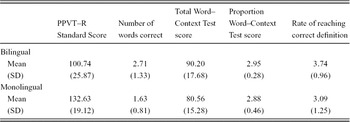
The descriptive statistics on the standard scores from the PPVT–R and the outcome variables from the Word–Context Test that were used in the subsequent analyses are presented in Table 1. Overall, the bilingual children had a PPVT–R score exactly at the mean for an English speaking population, while the monolingual children had an impressive mean PPVT–R score which was more than 2 standard deviation above the population mean. On the different outcome variables of the Word–Context Test, the bilingual children tended to have higher average scores than the monolingual children. A t-test, which compared the standard scores on the PPVT–R for the two groups of children, t(38) = 4.11, p = .0002, d = 1.40, confirmed that the monolinguals had higher vocabulary scores in English than the bilinguals. However, both groups of children had a mean score at or above the standard mean, indicating that the children's English vocabulary size was appropriate for their age, thus the bilingual children were all proficient enough in English to perform the subsequent language task in English.
Descriptive statistics on the standard scores from the Peabody Picture Vocabulary Test – Revised and the outcome variables from the Word–Context Test used in the analyses (N = 40).

The t-test, t(38) = –2.97, p = .006, d = 1.02, comparing the two groups on the number of words which meanings were successfully derived, was significant, indicating that on average, the bilingual children were able to deduce the correct meaning for more words in the Word–Context Test than the monolingual children. This was also true when the scores on the sixth (most concrete) sentence were examined alone for each word. The t-test, t(38) = –2.24, p = .03, d = 0.75, comparing the two groups was also significant, and the bilingual children (M = 3.60, SD = 1.27) again deduced the correct meaning of more words by the final sentence than the monolingual children (M = 2.69, SD = 1.14).
In order to examine the quality of the children's definitions in terms of how closely they approximated the target meanings of the words, first, the groups’ performance on the total score of the Word–Context Test was compared with a t-test, t(38) = –1.72, p = .09, d = 0.58, indicating that there was no difference in the total scores of the bilingual and monolingual children. Since the vocabulary size of the two groups was significantly different, an analysis of covariance was performed to examine the subjects’ performance on the Word–Context Test when controlling for the effect of the covariate vocabulary size. The analysis revealed that when controlling for vocabulary size, the effect of group was significant, F(1,37) = 4.18, p = .04, ηp 2 = 0.11, where bilingual children had higher total scores on the Word–Context Test than the monolingual children. Next, scores with zero were excluded and the same analysis was carried out on the proportion score. The t-test, t(38) = –0.50, p = .62, d = 0.35, was not significant, indicating that when children ventured to provide a definition, there was no difference between the groups in the quality of their definitions, and this difference remained not significant after controlling for vocabulary size, F(1,37) = 2.71, p = .11, ηp 2 = 0.08.
It was also expected that due to the more flexible approach to word meanings the bilingual children would reach the target definition of a word more quickly (from the less concrete context of fewer sentences) than the monolingual children. The t-test, t(38) = –1.74, p = .09, d = 0.59, was not significant, indicating that there was little difference in the rate with which the children in the two language groups provided the correct definitions of the words. This difference between the two groups remained not significant after controlling for vocabulary size (F(1,37) = 0.35, p = .56, ηp 2 = 0.01).
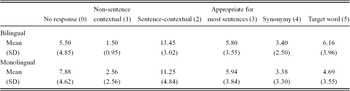
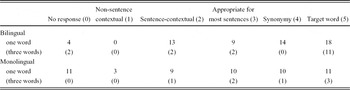
Finally, the types of definitions provided by the children in each group were examined. The descriptive statistics for each type of definition, which corresponds to the scores from 0 to 5 on the scoring system, are provided in Table 2. There were no differences between groups on the different types of definitions. Overall, children gave similar number of definitions from all types. Monolingual children just as often did not provide a definition (22% of the time) as they provided the correct definitions (scored with either 4 or 5), whereas the bilingual children less often failed to give a definition (15% of the time) and more often produced the correct definitions (27% of the time). These findings were further supported by the differences in the number of children who provided the different types of definitions by the sixth and most concrete sentence. As it is apparent from Table 3, there were no big differences in the number of children from each group who provided definitions scored with 1–3 on at least one of the words. However, the differences are quite obvious at the two extremes. While more than half of the monolingual children failed to provide a definition on at least one word, only about a quarter of the bilingual children did that. The differences are even more striking at the other end. While only half of the monolingual children provided the correct definition (scored with either 4 or 5) of at least one word, at least three quarters of the bilingual children did the same, and almost all of them provided the exact definition (scored with 5). Moreover, the number of children who provided a particular type of definition on at least three words was also presented, to show that generally, children did not give the same type of definition by the sixth sentence across all words or even most words. As it could be seen in Table 3, very few children in both groups gave the same type of definition on at least three of the words, but more than half of the bilingual children gave the exact definition for at least three words, and only four of the monolingual children provided a correct definition on at least three words.
Descriptive statistics on the average frequency of the types of definitions provided by the two groups of children across all words and sentences (N = 40).

The number of children who provided the type of definition by the sixth (or most concrete) sentence on AT LEAST one word, but not more than two words, and the number of children who provided the type of definition by the sixth sentence on AT LEAST three words is presented in brackets.

Discussion
The hypothesis for the current study predicted that bilingual children would be better able than monolingual children to deduce the correct meanings of nonsense words presented within the context of a sentence, due to their greater flexibility when processing language and greater experience learning new words. Generally, the hypothesis was confirmed by the results in the study. Although the bilinguals were not faster than the monolinguals at reaching the target meanings of the words, and the quality of their definitions was generally similar to that of the monolingual children, they were more successful at deducing the correct meanings of more words than were monolingual children. This difference between the two groups indicates that in the analysis of word meanings, bilingual children may have advantages over monolingual children, despite their smaller vocabularies. Moreover, while the bilingual children were more willing to guess at the meanings of the words, the monolingual children more often did not provide an answer, indicating possible differences in how the two groups approached the task.
The discrepancy observed here between the bilingual children's receptive vocabulary scores and their skills at abstracting word meanings from verbal context are consistent with the “profile effects” reported by Oller, Pearson and Cobo-Lewis (Reference Oller, Pearson and Cobo-Lewis2007). They argued that “low [vocabulary] scores do not indicate that bilingual children are poor vocabulary learners, but that some of the vocabulary processed by bilingual children is encoded in the L1 [the first language], but not the L2 [the second language], and vice versa” (Oller et al., Reference Oller, Pearson and Cobo-Lewis2007, p. 192). Similarly, in the current study, despite lower receptive vocabulary scores, the bilingual children proved to be more efficient vocabulary learners than their monolingual counterparts.
There are three possible explanations of the main findings reported here. First, the results are in line with previous research (Ben-Zeev, Reference Ben-Zeev1977; Bialystok, Reference Bialystok1997; Hakuta & Diaz, Reference Hakuta, Diaz and Nelson1985; Kovacs & Mehler, Reference Kovacs and Mehler2009; Peal & Lambert, Reference Peal and Lambert1962) indicating that bilingual children are more flexible when processing different language structures, whereby they are able to suppress competing information and focus on the task at hand. Bilinguals may also make better use of syntactic bootstrapping (Gleitman, Reference Gleitman1990), thus deducing correctly the meanings of more words that were solely presented in the context of sentences.
Second, bilingual children may be more efficient vocabulary learners because they are more practiced vocabulary learners. Research with adult language learners has shown that bilingual adults are better able to suppress the interference of their native language when learning new words (Kaushanskaya & Marian, Reference Kaushanskaya and Marian2009) in their second language, and having learned a second language makes the learning task easier for any subsequent languages (Papagno & Vallar, Reference Papagno and Vallar1995; Van Hell & Mahn, Reference Van Hell and Mahn1997). It is now established (see Oller & Eilers, Reference Oller and Eilers2002 for review) that the conceptual vocabularies of bilinguals are equivalent to, or larger than, those of monolinguals, it is also possible that as a result of their larger conceptual vocabularies, bilingual children in this study have richer semantic networks into which new words can be more easily included, thus making them better at deriving the meanings of new words. Future studies that measure the vocabulary sizes of bilingual children in both of their languages, and formally estimating the size of their conceptual vocabulary would shed light on this hypothesis.
Finally, it is possible that the observed advantage of the bilingual group is not due to bilingualism per se, but by the fact that they are being raised bilingually. It is possible that the home environment fostered by the parents of these children favours a more flexible cognitive style in general, thus these parents chose to enroll their children in bilingual French–English programs in the USA, possibly with the goal to enrich their children's academic experience. Therefore, future research should study the word-meaning acquisition of more homogeneous groups of bilingual children in terms of their first language and amount of exposure to each language, that also come from various language backgrounds and reside in different countries, in order to determine whether any observed advantages are due to bilingualism per se or to other family and/or ethno-linguistic factors.
There is an alternative interpretation of the results from this study that is supported by the present data, namely that the bilingual children were simply more willing to guess the meanings of unfamiliar words than the monolingual children. A secondary qualitative analysis of the children's individual responses revealed that monolingual children, compared to bilingual children, more often chose not to give a definition to a word when they were unsure about its meaning. Three of the monolingual children admitted that they refused to guess the meanings of the words unless being absolutely sure that they were correct. They would usually indicate that they had an idea of the meaning, but they did not want to volunteer their response until they were able to confirm after a few more sentences whether they thought it was the correct answer or not. These three children and three additional ones for a total of six (or 30% of the monolingual sample) did not provide many responses but only occasionally replied with a meaning fairly close to the meaning of the target words. For example, the successive guesses of a monolingual child on the word contavish “a hole” were as follows:
(1) sound (in response to the sentence “You cannot fill anything with a contavish”)
(2) — (in response to the sentence “The more you take out of a contavish, the larger it gets”)
(3) — (in response to the sentence “Before the house is finished, the walls must have contavishes”)
(4) — (in response to the sentence “You cannot feel or touch a contavish”)
(5) — (in response to the sentence “A bottle has only one contavish”)
(6) a hole (in response to the sentence “John fell into a contavish on the road”)
On the other hand, some of the bilingual children (eight children or 40% of the sample) tended to be more adventurous and, perhaps due to their greater experience in encountering unfamiliar words, were more willing to provide possible definitions than the monolingual children, even if they were not close to the target definition. These children tended to guess meanings of words based on the individual contexts of the different sentences. They would adapt their answers according to the context. Even in cases when they guessed the target meaning of the word correctly, they would keep changing the meaning according to the particular context. For example, the successive guesses of a bilingual child for the word “bordick” (a problem, a fault) were as follows:
(7) — (in response to the sentence “People with bordicks are often unhappy”)
(8) fault, defect (in response to the sentence “A person who has many bordicks is not well liked”)
(9) boring (in response to the sentence “The plan to build a house was a bordick because it costs too much”)
(10) things that people do (in response to the sentence “People talk about the bordicks of others and do not like to talk about their own”)
(11) disobedient (in response to the sentence “A person has many bordicks because he does not listen to wise people”)
(12) wrong note (grade), mistake (in response to the sentence “If you are smart and work hard your work will not have a bordick”)
Due to the greater caution of monolingual children in providing guesses as to the meanings of the different words, they may have been slower to reach the correct meanings of the target words. However, the results of the study indicated that there was no difference in the rate of reaching the target definitions between the two groups. Thus, while the bilingual children were more willing to guess, they did not come up with the correct meanings any faster than the monolingual children. However, this more “flexible” approach to the task could be a result of the bilingual children's different processing of word meanings from context, which ultimately may be a more efficient approach, since on average, these children were able to successfully define more words than the monolingual children. As previous research has shown (Byers-Heinlein & Werker, Reference Byers-Heinlein and Werker2009; Davidson et al., Reference Davidson, Jergovic, Imami and Theodos1997; Davidson & Tell, Reference Davidson and Tell2005), bilingual children, as a result of their experience with more than one language, develop different word-learning strategies than monolingual children, and their less cautious approach to the Word–Context Test could be considered as another possible example of a word-learning heuristic typical of bilingual children. Davidson and Tell (Reference Davidson and Tell2005, p. 42) argued that “greater flexibility in the use of language principles may result in both advantages and disadvantages for bilingual children”. In addition to the obvious advantages for word leaning, Davidson and Tell pointed out that greater flexibility in word learning could lead to greater difficulties for bilingual children resulting from them being less confident when applying language principles. However, the current study did not show this to be the case; the bilingual children were more successful in the word-definition task, and were not disadvantaged or confused by a more “flexible” approach to the task.
A continuation of this study may consider the developmental progression in word meaning acquisition for both monolingual and bilingual children similar to Werner and Kaplan (Reference Werner and Kaplan1950a). Such research may reveal any potential differences in development between the two groups of children and also indicate the period during which bilingual children are at an advantage over the monolingual children and whether and when the monolingual children may eventually catch up with their bilingual counterparts. In order to emphasize the potential of the method used in this study to reveal effects of bilingualism in particular, a future version should include target meanings that are not already lexicalized in English, which is ultimately the challenge with which children are faced when they encounter unfamiliar words. Finally, an update of some of the items included in the Word–Context Test would be desired, since a couple of the sentences from Werner and Kaplan (Reference Werner and Kaplan1950b) contained information which was semantically or structurally ambiguous, and both groups of children had the lowest scores on them. For example, in the sentence “Before the house is finished, the walls must have contavishes” the children had to know how houses are built, and if they did know the sequence of steps when building a house (e.g., holes for windows are likely framed first in the structure, rather than after the wall sheeting is applied), they may have found this sentence confusing. Also, the sentence “You cannot fill anything with a contavish” provides a structurally ambiguous context for the children, which is not very easy to imagine or understand.
The results from this study led to the conclusion that bilingual children are more successful at abstracting word meaning from verbal context. Nagy and Herman (Reference Nagy, Herman, McKeown and Curtis1987) quoted studies on monolingual children that suggest that written context may be quite ineffective at providing information about word meanings and that more formal and explicit forms of vocabulary instruction are more effective than inferring meaning from context. However, the results from the current study showed bilingual children to be more skilled at utilizing verbal context for analyzing word meanings. On the other hand, they also tended to have smaller vocabularies in English. Thus, it is important to consider this advantage of the bilingual children when developing methods for more intensive vocabulary instruction in the schools. When considering these potential benefits of bilingual children in the process of word meaning acquisition, it is important to emphasize the necessity of an appropriate instructional technique that would utilize the strengths of bilingual children and focus on increasing their vocabularies in both languages. From this study it is apparent that bilingual children have some unique skills which, when appropriately used, would likely benefit them in increasing the effectiveness of their vocabulary acquisition.
Appendix. Nonsense words used in the study
The words in italics are meanings that we considered correct, but were not included in the original Word–Context Test by Werner and Kaplan (Reference Werner and Kaplan1950a, Reference Werner and Kaplanb).