Introduction
Early life experiences could affect brain and behavioral development.Reference Branchi and Cirulli 1 An impoverished/stressful environmental condition during early life periods could predispose to myriad dysfunctions, such as psychopathologies.Reference Romeo, Patel, Pham and So 2 In experimental studies, the environment is enriched in order to provide positive experiences and improve the animals’ quality of life.Reference Baroncelli, Braschi and Spolidoro 3 Neurotrophic factors are likely to mediate the effects of the experience on brain structures and function.Reference Branchi, Francia and Alleva 4 Brain-derived neurotrophic factor (BDNF) is the most widespread neurotrophic factors in the mammalian central nervous systemReference Park and Poo 5 that is produced in a neuronal activity-dependent manner and protects neural connections.Reference Levi-Montalcini 6 BDNF has a central role in psychiatric disorders.Reference Boulle, Van den Hove and Jakob 7
Amygdala is associated with several neurodevelopmental disorders.Reference Schumann, Bauman and Amaral 8 The amygdala in vulnerable animals shows stronger BDNF responses to stressful condition.Reference Mosaferi, Babri, Mohaddes, Khamnei and Mesgari 9 The effect of the early experiences on the amygdala basal BDNF levels are rarely investigated. In a recent study, post-weaning environmental enrichment enhanced central amygdala BDNF levels of trait anxiety rats.Reference Ravenelle, Santolucito, Byrnes, Byrnes and Donaldson 10
Serum BDNF levels are considered as a possible biomarker for brain healthReference Leckie, Oberlin and Voss 11 and psychiatric disorders.Reference Sen, Duman and Sanacora 12 In clinical depression, serum BDNF levels show a positive association with improved quality of life, and successful antidepressant treatment raises serum BDNF.Reference Vinogradov, Fisher and Holland 13 Moreover, physical activity increases messenger RNA for BDFN in rat brain.Reference Neeper, Gomez-Pinilla, Choi and Cotman 14 We have recently demonstrated a stronger serum BDNF responses following inescapable foot shocks in enriched rats, 14 weeks after cessation of manipulation period.Reference Mosaferi, Babri, Mohaddes, Khamnei and Mesgari 9 Just after manipulation period, the effect of rearing condition on the serum BDNF levels has not yet been investigated.
Here, we have investigated whether differential rearing condition from weaning to adulthood alters amygdala – and serum – BDNF levels in male rats.
Methods
Animals
In total, 32 male Wistar rats from six different litters obtained from our own laboratory breeding colony were weaned at postnatal days 21 and semi‐randomly assigned to one of three rearing conditions: (1) isolated condition (IC), (2) standard condition (SC) in laboratory cages and (3) enriched condition (EC). It is noteworthy that post-weaning period in rodents is relevant to human childhood which is emphasized more than infancy in the literature.Reference Fa, Xia, Anunu, Kehat, Kriebel, Volkmer and Richter-Levin 15
The differential rearing condition was the same as our previous study.Reference Mosaferi, Babri, Ebrahimi and Mohaddes 16 Briefly, IC composed of a singly housed rat in a plastic translucent small cage (13.5×22.5×16.5 cm). Animals of SC were kept in plastic translucent standard laboratory cage (20×45×30 cm) under group housing (four rats per cage). Animals in the EC lived in a large cage (88×82×63 cm) in a group of five (see environmental enrichment). They were maintained in a noise‐isolated, air‐conditioned animal room with constant temperature (22±2°C) under a regular 12 h light/dark cycle (lights on at 0700 h) until the end of the experiment (young adulthood: postnatal days 119). Bedding was changed once weekly for all animals. IC rats were kept in the upper slides of the racks, and they received minimal contact. The minimal number of animals were used and particular care was taken to reduce their suffering. The protocol and procedures of this work were approved by the Regional Ethics Committee of Tabriz University of Medical Sciences (No. 91/2‐2/3) and are in accordance with the guide for the care and use of laboratory animals of the National Institute of Health (NIH; Publication No. 85-23, revised 1985).
Environmental enrichment
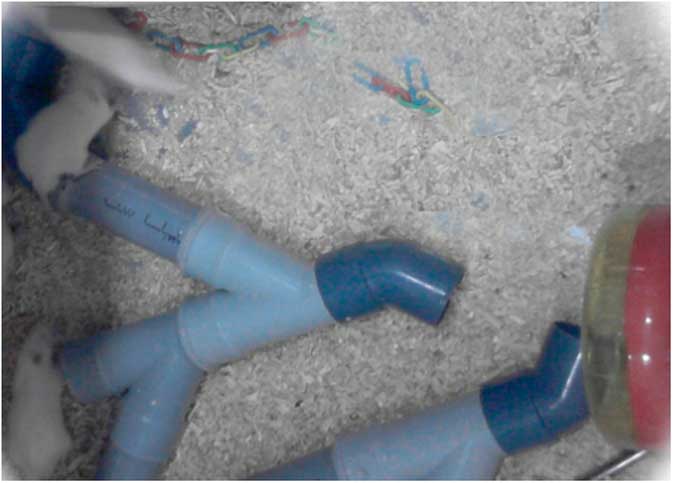
The procedure for environmental enrichment was as we have previously described.Reference Mosaferi, Babri, Ebrahimi and Mohaddes 16 Briefly, the EC cages were equipped with two running wheels, two food dispensers and two water bottles, and were enriched with a variety of toys (Fig. 1). The internal configuration of the cages was changed every week; creating different spaces with several types of stairs and plastic polyvinyl chloride pipes that the rats could move into or climb over. Novel objects made of hardly chewable plastic including balls, rings and a block of plate with predrilled holes as well as easily chewable objects such as ropes and paper nestles were provided and changed weekly. All enriched cages were receiving the same assortment of objects each time.
Big cage with a variety of toys were used to enrich the environment.

Tissue sampling and organ weights
At the end of the experiment, the rats (eight per group) were anesthetized with ketamine (60 mg/kg, i.p.) and xylazine (12 mg/kg, i.p.) between 8 am and 2 pm. The body weight of the offspring was measured. They were promptly decapitated. Trunk blood were immediately collected into anticoagulant-free sampling tubes. Brains were extracted excluding the olfactory bulb, and excluding parts of the brainstem posterior to the cerebellum. Brain wet weights was measured. The right whole amygdala were dissected free, using rat brain atlas of Paxinos and Watson, on an ice-cold petri dish within 3 min. The amygdala samples were stored at −70°C until used. The blood in sampling tubes were kept at room temperature to coagulate for 1 hReference Vedovelli, Silveira and Velho 17 before centrifugation at 3000 rpm during 10 min at 4°C. The extracted serum was, then, divided into aliquots and stored at −70°C until the time of BDNF measurements.
BDNF measurement
BDNF levels were determined with a commercial sandwich ELISA kit (ChemiKine, Catalogue No. CYT306; MERCK MILLIPORE, Germany). ChemiKine BDNF kit, according to the manufacture, is designed to measure the amount of BDNF in cell culture supernatants, tissue homogenates and biological fluid (serum, plasma and serum-free) samples from human and rat. The amygdala samples were homogenized in ice-cold homogenate buffer solution suggested by the manufacturer. Then, the amygdala and serum samples were separately diluted (1/10 v/v) with the ice-cold homogenate buffer solution. The homogenate buffer consisted of 100 mmol/l Tris/HCl, pH 7, 1 mol/l NaCl, 2% bovine serum albumin, 4 mmol/l EDTA-Na2, 0.1% NaN3, 2% Triton X-100 and the protease inhibitors (Sigma) 0.157 mg/ml benzamidine, 5 mg/ml aprotinin, 0.5 mg/ml antipain, 0.1 mg/ml pepstatin in 10% acetic acid in methanol and 17 mg/ml phenylmethyl-sulphonyl fluoride in 100% ethanol. Samples were centrifuged (14,000 g for 30 min). The diluted amygdala homogenate and serum samples were again diluted (1/10 and 1/2 v/v, respectively) directly on the plate with sample diluent solution provided by the kit. A standard curve (0–500 pg/ml) was prepared with standard BDNF and sample diluent solution. The rest of the procedure was performed according to the manufacturer’s claim instructions. Optical density in each plate was measured at 450 nm using an ELISA plate reader (Stat fax 2100, Awareness, USA). According to the manufacturer’s claim, the sensitivity of the assay was 7.8 pg/ml of BDNF, and the cross-reactivity with other related neurotrophic factors (nerve growth factor, neurotrophin-4/5 or neurotrophin-3) was nil. All samples were measured in the same assay, and were run in duplicate form.
Data analysis and statistics
Results are expressed as means±s.e.m. Between group differences were analyzed using one-way analysis of variance (ANOVA). For statistically significant comparisons, post-hoc analyses were performed using least significance difference test, only where explained. A linear regression model was also used to test for any predictive effects of the amygdala BDNF levels on the serum BDNF levels. Body weight was investigated as a covariate in brain weight with a univariate analysis of the effect of environmental condition with one-way model analysis of covariance (ANCOVA), using rearing condition as random factor, and body mass as a covariate. In this case, the Bonferoni post-hoc test was used. Statistical significance is reported at the α level of 0.05.
Results
BDNF levels
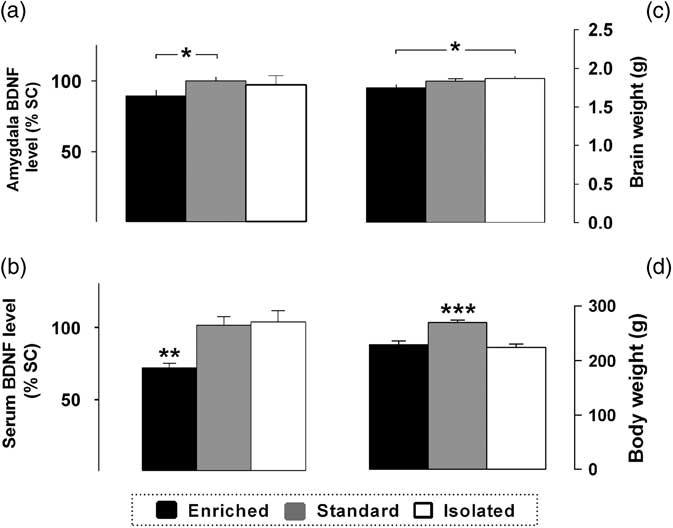
Post-weaning rearing condition influenced BDNF levels of the amygdala [F(2, 19)=3.56, P=0.04] and serum [F(2, 19)=10.02, P=0.001] in adult (Fig. 2). Enriched animals showed significantly less BDNF levels in the amygdala (Fig. 2a) compared with SC rats (P=0.02). Moreover, enriched animals showed marginally less BDNF levels in the amygdala than IC rats (P=0.05). Parallel with these results were the smaller serum BDNF levels in EC rats (Fig. 2b) compared than those of both SC (P=0.002) and IC (P=0.001) animals. The linear regression analysis showed that the amygdala BDNF level predicted 24% variance in serum BDNF level (adjusted R 2=0.24, P=0.01).
Effects of post-weaning rearing condition on amygdala (a) and serum (b) brain-derived neurotrophic factor (BDNF) levels as well as brain (c) and body (d) weights in young adulthood. Results are expressed as means±s.e.m. The BDNF data are represented as relative to the standard condition group (%SC). The lines upon the bars indicate significant differences among groups, which were omitted when one group differed from the both other groups at the same significance level: *P⩽0.02, **P⩽0.002, ***P=0.001.
Body and brain weights
The animals were achieved differential final body weights in different environmental conditions [F(2, 19)=16.87, P=0.001]. Animals in standard rearing condition showed higher body weights (Fig. 2d) compared with those of both EC (P=0.001) and IC (P=0.001) rats. Environmental enrichment also led to decreased brain weights [F(2, 19)=3.34, P=0.05; Fig. 2c] compared with the isolated rearing condition (P=0.02). Since brain weight depends partly on body weight, the effect of the latter was removed by ANCOVA. ANCOVA also revealed a significant main effect of rearing condition [F(2, 18)=5.28, P=0.01]. However, this did significantly alter the primary effects indicated by the ANOVA, making the brain weight of EC animals significantly lower than SC rats (P=0.04), but only marginally lower than IC animals (P=0.08).
Discussion
Post-weaning environmental enrichment led to lower amygdala and serum BDNF levels in early adulthood. Moreover, enriched animals showed less brain weights compared to animals reared in impoverished conditions.
Enriched rats showed less amygdala BDNF levels compared with the SC animals. Consistently, we have shown previously that post-weaning EC reduces amygdala BDNF responses to foot shocks compared with the SC animals, 14 weeks after cessation of the enriched period.Reference Mosaferi, Babri, Mohaddes, Khamnei and Mesgari 9 However, in a recent study, post-weaning EC increased BDNF levels in central amygdala of trait anxiety rats.Reference Ravenelle, Santolucito, Byrnes, Byrnes and Donaldson 10 These apparently contradictory results merit comment. The discrepancy can be easily explained if one keeps in mind that the amygdala consists of several nuclei,Reference Chareyron, Banta Lavenex, Amaral and Lavenex 18 while the current study have measured the BDNF levels in the whole amygdala. Chronic restraint stress paradigm leads to a lasting increase in the amygdala BDNF levels, which is associated with hypertrophy of this brain region and increased anxiety-like behavior.Reference Lakshminarasimhan and Chattarji 19 The environmental enrichment might reduce amygdala BDNF levels by providing the animals with high-quality and/or less stressful condition.Reference Mosaferi, Babri, Mohaddes, Khamnei and Mesgari 9 Overall, current data suggest the existence of a critical age window during post-weaning period for tuning adult amygdala BDNF levels.
The current study, for the first time, demonstrated less serum BDNF levels in enriched rats compared with both SC and IC animals. The regulation of the BDNF levels in the peripheral blood is not yet fully understood.Reference Gass and Hellweg 20 The brain is considered as a major source of circulating BDNF.Reference Rasmussen, Brassard and Adser 21 Accordingly, the amygdala BDNF levels predicted 24% variance of the serum BDNF levels in current study. Indeed, stress impairs BDNF signaling in limbic areas.Reference Du, Wu and Hill 22 It is likely that the stressful conditions in IC and SC rearingReference Barnard and Hou 23 , Reference Würbel 24 have led to enhanced neuronal activity in some limbic areas, such as the amygdala, and then resulted in higher serum BDNF levels. In consistent, elevated serum BDNF levels in some animal models of depression have been reported in other studies.Reference Luo, Hong and Liou 25 , Reference Elfving, Plougmann and Muller 26 It is noteworthy that there are some discrepancies between serum and brain levels of BDNF, and serum BDNF may not accurately reflect BDNF concentrations in the brain.Reference Zhao, Alam and San 27 However, current findings, similar to the amygdala BDNF levels, suggest the existence of a critical age window during post-weaning period for tuning adult serum BDNF levels. As the implication of BDNF signaling in stress responses is gender-specific,Reference Autry, Adachi, Cheng and Monteggia 28 further research to investigate the effect of rearing condition on female rats would be productive.
SC animals showed higher body weight compared with both EC and IC rats. There is some controversy regarding the effect of environmental condition on body weight.Reference Girbovan and Plamondon 29 We suggest three possible explanations. First, crowding in standard laboratory cages might imply more competition between individuals, resulting in innate hoarding, which would result in enhanced body weight. Second, isolation in IC cages might has contributed to the decreased body weights of IC animals compared with SC rats.Reference Abbott, Small and Sajedi 30 Third, the endogenous rhythms, such as circatrigintan, could be adjusted by environmental factors.Reference Ohdo 31 Then, the circatrigintan rhythm might has differentially influenced the body weights in different environmental conditions in present study.
EC rats presented lower absolute brain weights compared with the isolation reared animals; when body mass is controlled for, the EC animals showed less brain weight compared with SC reared animals. Some studies have demonstrated higher brain weights in enriched rats compared with isolated animals later in life.Reference Mosaferi, Babri, Ebrahimi and Mohaddes 16 , Reference Bennett, Rosenzweig, Diamond, Morimoto and Hebert 32 The effect of experiences on brain weight is plastic and depends on the duration of manipulation period.Reference Bennett, Rosenzweig, Diamond, Morimoto and Hebert 32 Moreover, cage sizes, number of cage mates, shape of the objects in the enriched cage and other factors are usually different among studies.Reference Simpson and Kelly 33
Normal brain development comprises the creation, growth and fine tuning of neural networks, and pruning is a necessary process in nervous system development.Reference Kolb, Mychasiuk and Muhammad 34 For an example, the establishing and remodeling of neural networks in the cerebral cortex depends partly on sensory input via synaptic activity.Reference Churchill, Grossman and Irwin 35 On the other hand, greater spine density have been reported in fragile X knockout mice, which has been suggested to reflect impaired synapse stabilization and pruning.Reference Comery, Harris and Willems 36 It is well established that the brain weight increases through increased synaptic area and supportive tissues.Reference Hall and Perona 37 As the single housing condition in male Wistar rats and the standard housing conditions of laboratory rodents are considered as impoverished rearing conditions, and cause stress reaction in these animals,Reference Barnard and Hou 23 , Reference Würbel 24 we suggest that the higher brain weights in IC and SC rats might be due to delayed pruning process in these groups. Of course, further extensive investigations are required to elucidate the fine anatomical consequences of rearing conditions on areas in the brain. Altogether, enriched rats might have developed well to encounter future stressful life events, as we have recently shown an antidepressant effect of EC in behavioral test with a study design similar to the present study work.Reference Mosaferi, Babri, Mohaddes, Khamnei and Mesgari 9 , Reference Mosaferi, Babri, Ebrahimi and Mohaddes 16
In conclusion, post-weaning environmental enrichment attenuates amygdala – and serum – BDNF levels, probably by providing high-quality/less stressful environment. The enriched animals also showed lower brain weight in early adulthood. Current results showed that the enriched rats might have gotten proper developmental trajectories. Our findings might offer insight into possible molecular mechanisms contributing to the life-long effects of early life experiences.
Acknowledgments
The authors thank Gh. Faridaalaee and A. Shiri.
Financial Support
Financial support for this study was provided by the Neuroscience Research Center (NSRC) of Tabriz University of Medical Sciences (grant number 90-61-5); Drug Applied Research Center of Tabriz University of Medical Sciences (grant number 44/91); and Maragheh University of Medical Sciences.
Conflicts of Interest
None.
Ethical Standards
The authors assert that all procedures contributing to this work comply with the ethical standards of the relevant national guides on the care and use of laboratory animals (NIH; Publication No. 85‐23, revised 1985) and has been approved by the institutional committee (Regional Ethics Committee of Tabriz University of Medical Sciences: No. 91/2‐2/3).