Introduction
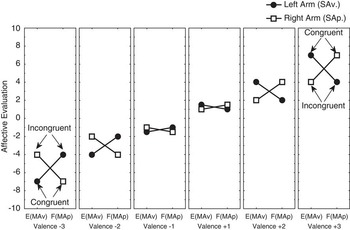
We recently reported that judgment of affective stimuli, such as photos from the International Affective Picture System (Lang, Bradley, & Cuthbert, Reference Lang, Bradley and Cuthbert2005), is influenced by the degree of congruence between the hemisphere involved in a volitional movement executed during judgment and the nature of the movement (approach vs. avoidance, Dru & Cretenet, Reference Dru and Cretenet2008; Figure 1). For right-handers, left hemispheric engagement for example by use of the contralateral extremity (Right Arm–Sided Approach, SAp) has been found to be associated with more positive valuations, whereas right hemispheric engagement (Left Arm–Sided Avoidance, SAv) is associated with more negative valuations (Davidson, Reference Davidson1984, Reference Davidson1992; Davidson, Ekman, Saron, Senulis, & Friesen, Reference Davidson, Ekman, Saron, Senulis and Friesen1990; Schiff & Lamon, Reference Schiff and Lamon1989, Reference Schiff and Lamon1994). Approach movements (Motor Approach, MAp; arm flexion, which brings objects closer) are associated with more positive valuations of neutral stimuli, whereas avoidance movements (motor avoidance, MAv; arm extension, which pushes objects away) are associated with more negative valuations (Cacioppo, Priester, & Berntson, Reference Cacioppo, Priester and Berntson1993). The congruence effect is manifested in the fact that either left hemisphere engagement by right arm flexion (positive-approach/positive-approach), or right hemisphere engagement by left arm extension (negative-avoidance/negative-avoidance) amplify judgments of affective stimuli, positive and negative, whereas other combinations of hemispheric engagement and contralateral arm movement (e.g., right arm extension, positive-approach-negative/avoidance) and left arm flexion (negative-avoidance/positive-approach) attenuate judgments of affective stimuli (Dru & Cretenet, Reference Dru and Cretenet2008; Figure 1).
Effect of laterality (sided avoidance vs. approach, SAv. vs. Sap.) and arm extension/flexion (motor avoidance vs. approach, MAv. vs. Map.) on judgment depending on valence.

In this study, we sought to understand more about the neuropsychological basis for this congruence effect. Specifically, we posited that congruence might mediate its effect by inspiring more confidence in judgment, hence less tendency to equivocate. Equivocation might be expected to reduce the magnitude of affective judgments; positive or negative (see Briñol & Petty, Reference Briñol and Petty2003). These authors have already shown that lateralized motor behaviors could also involve the usual-dominant or unusual–non-dominant hand used, providing different levels of confidence in judgment. We tested this hypothesis by replicating our earlier experiment, but concurrently assessing subjects’ confidence in their affective judgments. In the course of this experiment, we were also able to ask whether congruence effects on affective valuation and confidence were solely a product of stimulus valence, or whether they might be to some extent be influenced by the hemisphere engaged, for example greater with dominant hemisphere engagement. Finally, as an experimental control, we assessed the possible impact of subject confidence in relation to congruence effects on judgments in a completely different domain: whether or not segmented lines had been precisely bisected.
Study 1
Method
Participants
Fifty-two right-handed volunteers participated in the experiment (37 males, Mean age = 19.06 years, SD = 1.53). They were recruited in compliance with the Helsinki Declaration. Handedness was assessed through a six-item questionnaire (Porac & Cohen, Reference Porac and Cohen1981); participants giving at least five appropriate responses were selected for inclusion in the study.
Procedure
Participants were asked to press a table-top with either their right or left palm while facing a screen at a distance of 60 cm. They placed the selected palm either under the table exerting an upward pressure (flexion), or on the top of the table, exerting a downward pressure (extension). Recent work has shown that the effects of arm flexion (approach) and extension (avoidance) on affective judgments can be achieved by upward and downward forces, respectively, applied by the entire arm (Rotteveel & Phaf, Reference Rotteveel and Phaf2004). To ensure that under these experimental conditions, comparable weak pressure was exerted for the flexion and extension experiments, a 1-cm-thick rectangular piece of foam rubber was pasted to the underside and to the top of the table-top. With their upper arm perpendicular to the floor, participants were instructed to press on the foam rubber until they could feel the table and to maintain the exerted pressure for 8 s. In this way, no movement of the body itself was induced by the applied pressure. During the sustained application of pressure, an affective stimulus was projected onto the screen. Participants were asked to evaluate the stimulus with the help of a 17-point scale ranging from −8, very unpleasant, to +8, very pleasant. The experimenter, unaware of the aim of the study, stood behind the participants such that they could not see him.
Immediately following the 8-s flexion or extension, subjects documented their evaluation of the stimulus in a booklet with a different page for each stimulus. Participants also had to rate the confidence they had in their response (to what extent are you confident in the judgment you made? from “not at all confident,” rated as 1, to “very confident,” rated as 7). A rest period of 20 s was allowed between each stimulus. A familiarization phase helped to introduce the participants to the experimental task, to correct their posture, and to repeat the instructions.
The experimental design and stimuli
Nine valenced pictures (taken from the International Affective Picture System; Lang et al., Reference Lang, Bradley and Cuthbert2005) representing three different valences (extremely negative −3, neutral, and extremely positive +3, three pictures for each valence; see the Appendix) were projected. Responses to the stimuli were averaged for each of the three valence groups to provide the dependent variable for the study. A 2 (gender) × 2 (arm extension vs. flexion) × 2 (laterality) × 3 (valence, repeated measure) analysis of variance (ANOVA) was used to analyze the results.
Results and Discussion
Evaluation of the valenced stimuli
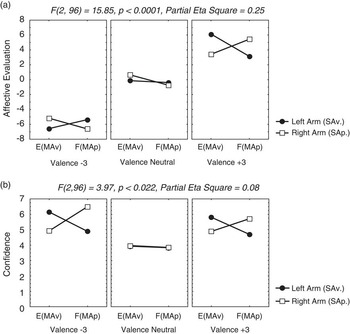
The ANOVA showed that valence had a significant main effect on affective evaluation (F(2,96) = 422.20; MSE = 1391.10; p = .00001; ηp 2 = .89). The mean rating of negative pictures was −5.93 (SD = 0.22); of neutral pictures −0.15 (SD = 0.30); and of positive pictures 4.53 (SD = 0.26) (Figure 2a).
Interaction effects between arm action, laterality and valenced stimuli on evaluation and confidence.

There was a single three-way interaction effect on affective evaluation involving arm action, laterality, and picture valence (F(2,96) = 15.85; MSE = 52.30; p < .00001; ηp 2 = .25; Figure 2a). There was a significant effect of congruence on affective evaluation of pictures with negative (Fnegative(1,48) = 8.98; MSE = 22.57; p < .004; ηp 2 = .15) and positive valence (Fpositive(1,48) = 23.04; MSE = 79.90; p < .00001; ηp 2 = .32), in which valuation of pictures of high valence, negative or positive, was attenuated by the presence of incongruence, but there was no congruence effect with neutral pictures (Fneutral(1,48) = 0.86; MSE = 4.09; p < .36; ηp 2 = .01), precisely as in our prior study (Dru & Cretenet, Reference Dru and Cretenet2008).
Confidence in the judgment made
There was a significant main effect of valence on confidence as well (F(2,96) = 24.93; MSE = 42.14; p = .0000; ηp 2 = .34; Figure 2b). The more extreme the valence of the pictures, the more confident participants were in their judgments, whether valence was negative or positive (M negative = 6.62; SD = 0.24; M neutral = 4.89; SD = 0.32; M positive = 6.28; SD = 0.25). Confidence was weakest for neutral pictures. There was a single three-way interaction effect on confidence involving arm action, laterality, and picture valence (F(2,96) = 3.97; MSE = 6.71; p < .022; ηp 2 = .08). There was a significant effect of congruence on confidence for pictures with negative valence (F(1,48) = 8.41; MSE = 25.26; p < .006; ηp 2 = .15) and a trend for pictures with positive valence (F(1,48) = 3.56; MSE = 12.11; p < .06; ηp 2 = .07), in which confidence was reduced by the presence of incongruence, but no congruence effect was observed with neutral pictures (F < 1). Thus, these results suggest that the effects of congruence on affective valuation might be mediated through confidence effects. When confidence is maximal, as with pictures with positive and negative valence and congruent arm action and laterality, the absolute value of affective valuation is maximal. When confidence is reduced, as with pictures with neutral valence or with pictures with positive or negative valence but incongruent arm action and laterality, the absolute value of affective valuation is reduced.
In the course of this experiment, we were also able to determine whether congruence effects on affective valuation and on confidence were solely a product of congruence and stimulus valence, or whether they might be to some extent be influenced by the hemisphere engaged, for example greater with dominant hemisphere engagement (right arm use). Figures 2a and 2b clearly show that whether or not the dominant hemisphere was engaged had no impact on congruence effects on either affective valuation or confidence ratings.
Study 2
Participants
Fifty-five right-handed student volunteers participated in the experiment (23 males; Mean age = 18.98 years; SD = 1.87). They were recruited in compliance with the Helsinki Declaration.
Procedure
The procedure was similar to that of Study 1 with one difference; different segmented lines were projected onto the screen during the 8-s flexion or extension.
The Experimental Design and Stimuli: The Bisection Line Test
Participants had to indicate the longer segment of 40 lines cut by a short perpendicular during a period of 8 s during which they pushed on the top or bottom of the table with the left or right arm. A rest period of 20 s occurred between presentations of each stimulus. The lines, which were projected onto a screen 60 cm distant, were 20 cm long and 1.5 mm thick. For 20 of the lines, the perpendicular exactly bisected the line. For 20 lines, the perpendicular was ±3 or ±5 mm from the exact middle (5 lines for each extent of deviation). The two types of lines were presented serially in random order. A judgment that the left segment was longer was coded −1, whereas a judgment that the right segment was longer was coded +1. Responses for each extent of deviation (−5 mm, −3 mm, 0, +3 mm, and +5 mm) were averaged to yield the principle dependent variable in this study. Following their judgments, subjects were asked to indicate their confidence in their judgments, using the same scale as in Study 1, yielding a confidence rating for each extent of deviation. Judgment of which was the longer segment, and confidence ratings were analyzed with 2 (gender) × 2 (arm flexion vs. extension) × 2 (laterality) × 5 (extent of deviation of the perpendicular) ANOVAs.
Results and Discussion
The bisected line test
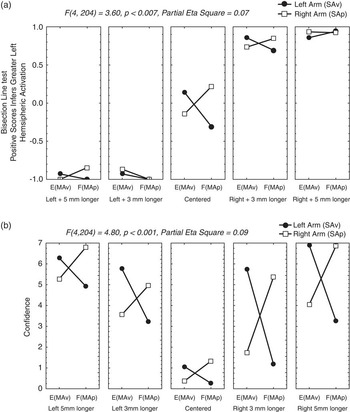
The first ANOVA revealed a significant main effect of extent of deviation (F(4,204) = 356.44; MSE = 44.11; p < .00001; ηp 2 = 0.87; M left 5mm = −0.94; SD = 0.04; M left 3mm = −0.94; SD = 0.03; M centered = −0.02; SD = 0.06; M right 3mm = 0.78; SD = 0.06; M right 5mm = 0.90; SD = 0.05). There was also a significant interaction between arm action, laterality, and extent of deviation (F(4,204) = 3.60; MSE = .44; p < .008; ηp 2 = .07; Figure 3a). Significant congruence effects were found only for lines that were bisected (Fleft 5mm(1,51) = 1.91; MSE = 0.17; p > .17; ηp 2 = .03; Fleft 3mm(1,51) = .25; MSE = 0.01; p > .61; ηp 2 = .004; Fcentered (1,51) = 11.54; MSE = 2.26; p < .001; ηp 2 = .18; Fright 3mm(1,51) = 1.21; MSE = 0.26; p > .27; ηp 2 = .02; Fright 5mm(1,51) = 1.56; MSE = 0.02; p > .69; ηp 2 = .003). In this condition, congruence was associated with a tendency to judge the right segment to be longer, whereas incongruence was associated with a tendency to judge the left segment to be longer.
Interaction effect between arm action and laterality and bisected lines on the bisection line test and confidence measure.

Judgment of confidence for the different bisected lines
The second ANOVA revealed a significant main effect of extent of deviation on confidence ratings (F(4,204) = 42.69; MSE = 219.01; p < .0001; ηp 2 = 0.45) showing that confidence in judgment was lower for the bisected lines (M left 5mm = 5.81; SD = 0.48; M left 3mm = 4.37; SD = 0.44; M centered = 0.76; SD = 0.38; M right 3mm = 3.50; SD = 0.45; and M right 5mm = 5.26; SD = 0.47). There was a significant interaction between the arm action, laterality, and extent of deviation on the confidence measure (F(4,204) = 4.80; MSE = 24.65; p < .001; ηp 2 = .09; Figure 3b). There was no congruence effect for bisected lines, whereas there was a statistically significant effect for the eccentrically cut lines (Fleft 5mm(1,51) = 2.33; MSE = 28.33; p < .13, ηp 2 = .04; Fleft 3mm(1,51) = 4.85; MSE = 53.37; p < .03; ηp 2 = .08; F −1(1,51); Fcentered (1,51) = 10.67; MSE = 1.34; p < .25; ηp 2 = .02; Fright 3mm(1,51) = 20.03; MSE = 230.140; p < .00004; ηp 2 = .28; Fright 5mm(1,51) = 12.58; MSE = 154.40; p < .0008; ηp 2 = .19). Looking at these effect sizes, congruence effects on confidence ratings were greater for lines cut to the left of midline than for lines cut to the right of midline.
Discussion
In our first experiment, we replicated the results of our prior study (Dru & Cretenet, Reference Dru and Cretenet2008), showing that affective valuation of pictures of high valence, negative or positive, was attenuated by the presence of incongruence between hemispheric disposition (left positive-approach; right negative-avoidance) and type of arm movement (flexion/approach or extension/avoidance). Incongruence was also associated with a small but significant reduction in degree of confidence in the valuations, suggesting that congruence might be mediating its effect on affective evaluation through its impact on confidence. However, in our second experiment, involving judgment of segmented lines, congruence effects were observed only for bisected lines, for which confidence ratings were the lowest, and not for off-center segmented lines, for which confidence ratings were higher. Thus, confidence in judgment does not provide a unifying explanation for the congruence effects on affective evaluation and line segmentation judgment. It may be that confidence is an important mediating mechanism in affective tasks but not in perceptual tasks. In our first experiment, the particular hemisphere engaged had no impact on congruence effects on either affective valuation or confidence ratings. On the other hand, in the second experiment, congruence was associated with a tendency to perceive the right segment of a bisected line as being longer, suggesting that congruence may have promoted a relatively greater degree of left hemispheric engagement. Then, this effect could not have been mediated by confidence because there was no significant effect of congruence on confidence for bisected lines.
However, these overall results would also lead to other theoretical considerations. Since confidence was also determined by motor congruence, albeit only with extreme stimuli (either in valence, Study 1 or with off-center segmented lines, Study 2), it could be proposed that hemispheric involvement through lateralized motor behaviors would also correspond with the use of a dominant (vs. non-dominant hand), providing certitude in judgment. Lateralized motor behaviors might simultaneously involve neuropsychological processes associated with the left Versus right side of the behavior performed when making evaluations, and the psychological processes linked with the dominant Versus non-dominant hand used, associated with judgments of thought confidence. The lack of evidence that confidence could play a possible mediating role between motor behaviors and judgment infers that motor congruence involves both a neuropsychological and another psychological explanation. It must be considered that unilateral motor cues represent a theoretical multilevel variable, depending on different mechanisms for judgment when motor congruence is experienced in different experimental conditions. The motor congruence effect, as an interaction between two pure bodily components, seemed to operate fully at different levels showing that embodiment theories of cognition and affect could explain complex mechanisms at the interface of psychological and neuropsychological variables (Cretenet & Dru, Reference Cretenet and Dru2009; Marshall, Reference Marshall2009). Finally, this embodied view could also have clinical implications for rehabilitation. Other investigators have demonstrated the role of the motor system and motion in reducing visual spatial bias with normal subjects (Choi et al., Reference Choi, Ku, Jeong, Lee, Ahn and Kang2005; Frassinetti, Rossi, & Làdavas, Reference Frassinetti, Rossi and Làdavas2001; Lin, Cermak, Kinsbourne, & Trombly, Reference Lin, Cermak, Kinsbourne and Trombly1996; MacLeod, & Turnbull, Reference MacLeod and Turnbull1999) and patients with cerebellar damage (Daini, Arduino, Di Menza, Vallar, & Silveri, Reference Daini, Arduino, Di Menza, Vallar and Silveri2008). If motor behaviors could help to improve cognitive and perceptual performance in clinical populations, then it is important to understand which mechanisms might be at work, without forgetting the motivational and affective processes involved.
Appendix
Valenced categorization of the different pictures taken from The International Affective Pictures System (IAPS, Lang et al., Reference Lang, Bradley and Cuthbert2005)

The first numbers corresponded to the references of the photos taken from the IAPS data. The values in brackets are valenced scores given by Ito, Cacioppo, and Lang (Reference Ito, Cacioppo and Lang1998) scored from 1 (very negative) to 9 (very positive). All these pictures were rated around the middle of the scale for the arousal dimension for controlling this factor.
Acknowledgments
There is no conflict of interest, and there are no sources of financial support for conducting the experiments and for preparing the manuscript. The authors contributed equally to this research. They are grateful to S. Duret, L. Grandjean, & L. Beaulieu, G. Dire, S. Freddi, M.P. Offredo, A. Palvair, P. Prudhomme, & R. Sanz for their technical assistance and T. Case for his comments on an earlier version of the manuscript.