






1 Introduction and preliminaries
If
 ${\cal F}$
is a family of subspaces of a finite-dimensional vector space V over a field
 $\mathbb {F}$
, Alg
 ${\cal F}$
is the set of linear transformations
 $T: V\rightarrow V$
which leave every element of
 ${\cal F}$
invariant. A family
 ${\cal F}$
of subspaces of V is called transitive if Alg
 ${\cal F}$
is the set
 $\mathbb {F} I$
of scalar transformations. If
 ${\cal F}\subseteq {\cal E}$
then Alg
 ${\cal E}\subseteq $
Alg
 ${\cal F}$
. Of course, the set of all subspaces of V is transitive. The study of transitive families of subspaces of complex Hilbert space was initiated by Halmos [Reference Longstaff2] and has been investigated in infinite as well as in finite dimensions (see [Reference Lambrou and Longstaff1, Reference Longstaff3–Reference Halmos5]). In this paper we work in
 ${{\mathbb {C}}}^n, n\ge 2$
. On such a space of dimension three or more every family with three or fewer nontrivial elements is not transitive, and there exist transitive families with four elements [Reference Longstaff3]. On such a space of dimension four or more a set of pairwise complementary nontrivial subspaces must have five or more elements to be transitive [Reference Longstaff2].
We identify linear transformations on
 ${{\mathbb {C}}}^n$
with their matrices relative to the standard basis
 $e_1,e_2,\ldots ,e_n$
. The set of
 $n\times n$
complex matrices is denoted by
 $M_{n}({{\mathbb {C}}})$
. If
 $e,f\in {{\mathbb {C}}}^n$
are nonzero vectors,
 $e\otimes f$
denotes the rank-one transformation on
 ${{\mathbb {C}}}^n$
defined by
 $(e\otimes f)x=(x\mid e)f, x\in {{\mathbb {C}}}^n$
, where ‘
 $(\cdot |\cdot )$
’ denotes the usual inner product. Thus
 $e_j\otimes e_i$
is identified with the elementary matrix
 $E_{i,j}$
. If T is a linear transformation on
 ${{\mathbb {C}}}^k$
, we denote its graph by
 ${\mathbb {G}}(T)$
; so
 ${\mathbb {G}}(T)=\{(x,Tx): x\in {{\mathbb {C}}}^k\}\subseteq {{\mathbb {C}}}^k\oplus {{\mathbb {C}}}^k$
. The commutant of a family
 ${\cal A}$
of
 $n\times n $
matrices is
 ${\cal A}'=\{X\in M_n({{\mathbb {C}}}): XA=AX$
for every
 $A\in {\cal A}\}$
. The set of eigenvalues of a matrix T, called the spectrum of T, is denoted by
 $\sigma (T)$
. The linear span of a set of vectors
 ${\cal V}$
is denoted by
 $\langle {\cal V}\rangle $
. The symbol ‘
 $\subset $
’ is used for strict set inclusion. The cardinality of a set
 $\Omega $
is denoted by
 $\lvert \Omega \rvert $
.
If
 ${\cal B}=\{f_1, f_2, \ldots , f_n\}$
is an (ordered) basis for
 ${{\mathbb {C}}}^n$
and
 $g\in {{\mathbb {C}}}^n$
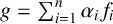
has basis representation
 $g=\sum _{i=1}^{n}\alpha _i f_i$
, the support of g with respect to
 ${\cal B}$
is the subset
 $\{1\le i\le n: \alpha _i\ne 0\}$
.
Definition 1.1. A family
 ${\cal F}$
of subspaces of a finite-dimensional vector space V over a field
 $\mathbb {F}$
is minimally transitive if it is transitive and has no transitive proper subfamily.
We will establish some basic facts about minimally transitive families of subspaces of
 ${{\mathbb {C}}}^n$
, investigate two classes of families (one-dimensional and ‘medial’, that is, pairwise complementary) and give some examples. From an earlier remark, any minimally transitive family of subspaces of
 ${{\mathbb {C}}}^n$
,
 $n\ge 3$
, has at least four elements and any transitive family with four elements is minimally transitive.
Proposition 1.2. Let V be a vector space of finite dimension
 $n\ge 2$
over a field
 ${\mathbb {F}}$
. Every transitive family
 ${\cal F}$
of subspaces of V has a transitive subfamily
 ${\cal E}$
with at most
 $n^2-n+1$
elements. As a consequence, every transitive family has a minimally transitive subfamily and every minimally transitive family of subspaces of V has at most
 ${n^2-n+1}$
elements.
Proof. If M is a nontrivial subspace of V of dimension k and
 $\mathscr{C}$
is a basis for M, and if this basis is augmented to be a basis
 ${\cal B}$
for V, then Alg
 $\{M\}$
is the set of linear transformations
 $T: V\rightarrow V$
whose matrix representation relative to
 ${\cal B}$
has the form
 $[\begin {smallmatrix}X&Y\\0&Z \end {smallmatrix}]$
, where the zero entry has size
 $(n-k)\times k$
, where k is the dimension of M, and where
 $X, Y, Z$
are arbitrary matrices with entries in
 $\mathbb {F}$
of sizes
 $k\times k$
,
 $k\times (n-k)$
,
 $(n-k)\times (n-k)$
, respectively. Thus Alg
 $\{M\}$
has dimension at most
 $n^2-n+1.$
Let
 $M_1$
be a nontrivial element of
 ${\cal F}$
. Since
 $\{M_1\}$
is not transitive, there exists
 $M_2\in {\cal F}$
with Alg
 $\{M_1,M_2\}\subset $
Alg
 $\{M_1\}$
. If
 $d_2=$
dim Alg
 $\{M_1, M_2\}$
and
 $d_1=$
dim Alg
 $\{M_1\}$
, then
 $d_2\le d_1-1$
so
 $d_2+1\le n^2-n+1$
. If
 $\{M_1,M_2\}$
is transitive, then
 $d_2=1$
and
 ${2\le n^2+n-1}$
, so we can take
 ${\cal E}=\{M_1, M_2\}$
. Otherwise, if
 $\{M_1, M_2\}$
is not transitive, there exists
 $M_3\in {\cal F}$
such that Alg
 $\{M_1,M_2, M_3\}\subset $
Alg
 $\{M_1,M_2\}$
. If
 $d_3= $
dim Alg
 $\{M_1, M_3, M_3\}$
, then
 $d_3\le d_2-1\le d_1-1$
so
 $d_3+2\le n^2-n+1$
. If
 $\{M_1, M_2, M_3\}$
is transitive,
 $d_3=1$
and
 $3\le n^2-n+1$
, so we can take
 ${\cal E}=\{M_1, M_2, M_3\}$
. Continuing in this way, after m steps we eventually obtain a transitive subfamily
 ${\cal E}= \{M_1, M_2,\ldots , M_m\}$
of
 ${\cal F}$
with Alg
 $\{M_1, M_2,\ldots , M_m\}\subset $
Alg
 $\{M_1, M_2,\ldots , M_{m-1}\}$
and with
 $d_m+(m-1)\le n^2+n-1$
, where
 $d_m=1$
, so that
 $m\le n^2+n-1$
.
If
 ${\cal F}$
is minimally transitive in the above construction, we must have
 ${\cal E}={\cal F}$
, and then
 $\lvert {\cal F}\rvert \le n^2-n+1$
.
Since
 ${\cal E}$
is finite and transitive, it has a minimally transitive subfamily. (If
 ${\cal E}$
is not minimally transitive,
 ${\cal E}\backslash \{M\}$
is transitive for some
 $M\in {\cal E}$
, and so on. After finitely many steps we obtain a minimally transitive subfamily of
 ${\cal E}$
.) This completes the proof.
In Section 2 we consider minimally transitive families of one-dimensional subspaces of
 $\mathbb {C}^n$
,
 $n\ge 3$
, showing that any such family has
 $\tau $
elements where
 $\tau $
satisfies
 $n+1\le \tau \le 2n-2,$
where both inequalities are sharp. We also show how they arise when they consist of the subspaces spanned by the standard basis vectors together with those spanned by
 $0$
–
 $1$
vectors. In the final section we consider families of nontrivial subspaces of
 ${{\mathbb {C}}}^k\oplus {{\mathbb {C}}}^k$
, all pairs of which are complementary. Such families arise as the set of nontrivial elements of medial subspace lattices, the study of which began in [Reference Longstaff2]. We give examples showing that the set of nontrivial elements of a medial subspace lattice on
 ${{\mathbb {C}}}^k\oplus {{\mathbb {C}}}^k$
,
 $k\ge 6$
, can have k elements. This provides the first example, when
 $k=6$
, of a medial subspace lattice whose set of nontrivial elements is minimally transitive but not of minimum cardinality.
2 Families of one-dimensional subspaces
A family of one-dimensional subspaces of
 ${{\mathbb {C}}}^2$
is transitive if and only if it has three or more elements, so it is minimally transitive if and only if it has three elements.
On
 ${{\mathbb {C}}}^n$
,
 $n\ge 2$
, it is easy to see that every transitive family
 ${\cal F}$
of one-dimensional subspaces spans
 ${{\mathbb {C}}}^n$
, and consequently it contains n or more elements. Clearly such a set of subspaces must contain at least
 $n+1$
elements, since a matrix which has every element of a basis as an eigenvector is diagonal with respect to that basis and not necessarily scalar. If it contains precisely
 $n+1$
elements, it has the form
 ${\cal F}=\{\langle f_1\rangle ,\langle f_2\rangle ,\ldots , \langle f_{n}\rangle ,\langle g\rangle \}$
where
 $\{f_1,f_2,\ldots , f_n\}$
is a basis for
 ${{\mathbb {C}}}^n$
and the support of g with respect to this basis is
 $\{1,2,\ldots ,n\}$
. (A diagonal matrix having a vector h as an eigenvector need not be scalar unless the support of h is maximum.) Of course, such a transitive family is minimally transitive, because it has minimum cardinality. This is generalised in Theorem 2.5 below.
Definition 2.1. Let
 $\Omega $
be a nonempty finite subset of
 ${{\mathbb {Z}}}^+$
. By a cover for
 $\Omega $
we mean a finite family of nonempty subsets of
 $\Omega $
whose union equals
 $\Omega $
. A subcover of a cover
 $\mathscr{C}$
for
 $\Omega $
is a subset of
 $\mathscr{C}$
which is also a cover for
 $\Omega $
. If
 $\mathscr{C}$
is a cover for
 $\Omega $
we say that the elements
 $i,j\in \Omega $
(possibly with
 $i=j$
) are connected by
 $\mathscr{C}$
if there exists a finite sequence
 $C_{p_1}, C_{p_2},\ldots , C_{p_{r-1}}, C_{p_{r}}$
of elements of
 $\mathscr{C}$
, such that
 $i\in C_{p_1},\, j\in C_{p_{r}}$
and
 $C_{p_{u}}\cap C_{p_{u+1}}\ne \varnothing $
for
 $1\le u\le r-1$
. A cover
 $\mathscr{C}$
for
 $\Omega $
is called a connecting cover for
 $\Omega $
if every pair of points of
 $\Omega $
are connected by
 $\mathscr{C}$
. A connecting subcover of a cover
 $\mathscr{C}$
for
 $\Omega $
is a subcover of
 $\mathscr{C}$
which is also a connecting cover for
 $\Omega $
.
Remark 2.2. (1) Let
 $\mathscr{C}$
be a cover for
 $\Omega \subseteq {{\mathbb {Z}}}^+$
.
If
 $C\in \mathscr{C}$
and
 $\mathscr{C}\backslash \{C\}$
is not a cover for
 $\Omega $
, that is, if
 $\Lambda =\bigcup \{B: B\in \mathscr{C}\backslash \{C\}\}\ne \Omega $
(take
 $\Lambda =\varnothing $
if
 $\mathscr{C}\backslash \{C\}=\varnothing $
), the elements of
 $\mathscr{C}\backslash \{C\}$
can be augmented with the singleton sets
 $\{\{i\}: i\in \Omega \backslash \Lambda \}$
to be a cover for
 $\Omega $
.
Define an equivalence relation on
 $\Omega $
by
 $i\equiv j$
if
 $i, j$
are connected by
 $\mathscr{C}$
and let
 $[i]$
denote the equivalence class containing i. Let
 $i_1,i_2,\ldots , i_k$
be a complete set of equivalence class representatives so that
 $\Omega =\bigcup \{[i_s]: 1\le s\le k\}$
and
 $[i_s]\cap [i_t]=\varnothing $
if
 $s\ne t$
. These equivalence classes are called the
 ${\textit {components}}$
of the cover
 $\mathscr{C}$
.
Let
 $\mathscr{C}_s=\{C\in \mathscr{C}: C\subseteq [i_s]\}$
for
 $1\le s\le k$
. Each
 $\mathscr{C}_s$
is nonempty. Indeed,
 $i_s\in C$
, for some
 $C\in \mathscr{C}$
. Then
 $C\subseteq [i_s]$
so
 $C\in \mathscr{C}_s$
.
We have
 $\bigcup \{C: C\in \mathscr{C}_s\}=[i_s]$
, that is,
 $\mathscr{C}_s$
is a cover for
 $[i_s]$
. To see this, let
 $j\in [i_s]$
. Then
 $j\in D\in \mathscr{C}$
, for some D. Then
 $D\subseteq [j]=[i_s]$
, so
 $D\in \mathscr{C}_s$
.
For
 $1\le s\le k$
, the cover
 $\mathscr{C}_s$
of
 $[i_s]$
is a connecting cover. Let
 $u,v\in [i_s]$
. Since
 $u\equiv v$
, by definition, there exists a finite sequence
 $C_{p_1}, C_{p_2},\ldots , C_{p_{r-1}}, C_{p_{r}}$
of elements of
 $\mathscr{C}$
such that
 $u\in C_{p_1},\, v\in C_{p_{r}}$
and
 $ C_{p_{t}}\cap C_{p_{t+1}}\ne \varnothing $
for
 $1\le t\le r-1$
. It follows from this that
 $\bigcup \{C_{p_t}: 1\le t\le r\} \subseteq [i_s]$
, so
 $C_{p_t}\subseteq [i_s]$
and
 $C_{p_t}\in \mathscr{C}_s$
for
 $1\le t\le r$
.
(2) If
 $D=$
diag
 $(d_1, d_2, \ldots , d_n)$
is a diagonal matrix and
 $g\in {{\mathbb {C}}}^n$
is an eigenvector of D, then
 $d_i=d_j$
for every
 $i,j$
belonging to the support of g. (For
 $Dg=\lambda g$
gives
 $(d_i-\lambda )g_i=0$
for
 $1\le i\le n$
.) It follows that if
 $D\in $
Alg
 $\{\langle g_1\rangle ,\langle g_2\rangle ,\ldots , \langle g_m\rangle \}$
then the diagonal of D will be constant on each connected component of
 $\Omega $
, the union of the supports of the
 $g_j$
,
 $1\le j\le m.$
So D is scalar if the set of supports of the
 $g_j$
,
 $1\le j\le m$
, is a connecting cover for
 $\{1,2,\ldots , n\}$
and need not be scalar otherwise.
Proposition 2.3. If
 $\mathscr{C}$
is a connecting cover for the nonempty finite subset
 $\Omega \subseteq {{\mathbb {Z}}}^+$
and
 $M= \max\{\lvert C\rvert :C\in \mathscr{C}\}$
, there is a connecting subcover
 ${\cal D}$
of
 $\mathscr{C}$
for
 $\Omega $
with cardinality at most
 $\lvert \Omega \rvert -M+1$
.
Proof. Let
 $C_1\in \mathscr{C}$
with
 $\lvert C_1\rvert =M$
. Let
 ${\cal D}_1=\{C_1\}$
. If
 $C_1=\Omega $
, we may take
 ${\cal D}={\cal D}_1$
. Otherwise, if
 $C_1 \ne \Omega$
, since
 $\mathscr{C}$
is connecting for
 $\Omega $
, there must exist a set
 $C_2\in \mathscr{C}$
such that
 $C_2\cap C_1\ne \varnothing $
and
 $C_2\cap C_1^ c\ne \varnothing $
(where ‘
 $(\cdot )^c$
’ denotes ‘complement in
 $\Omega $
’). Let
 ${\cal D}_2=\{C_1, C_2\}$
. Then
 $\lvert C_1\cup C_2\rvert \ge M+1$
and
 ${\cal D}_2$
is a connecting cover for
 $C_1\cup C_2$
. If
 ${C_1}\cup {C_2}=\Omega $
, we may take
 ${\cal D}={\cal D}_2$
. Otherwise, if
 ${C_1}\cup {C_2}\ne \Omega $
, there exists
 $C_3\in \mathscr{C}$
such that
 $C_3\cap (C_1\cup C_2)\ne \varnothing $
and
 $C_3\cap (C_1\cup C_2)^c\ne \varnothing $
. Let
 ${\cal D}_3=\{C_1, C_2, C_3\}$
. Then
 $\lvert C_1\cup C_2\cup C_3\rvert \ge M+2$
and
 ${\cal D}_3$
is a connecting cover for
 $C_1\cup C_2\cup C_3$
. Consequently, if
 $C_1\cup C_2\cup C_3=\Omega $
, we may take
 ${\cal D}={\cal D}_3$
.
Continuing in this way, after a finite number of steps, say r, we have a subset
 ${\cal D}_r=\{C_1, C_2, \ldots , C_r\}$
of
 $\mathscr{C}$
with
 $\lvert C_1\cup C_2 \cup \cdots \cup C_r\rvert \ge M+r-1$
and
 $C_1\cup C_2 \cup \cdots \cup C_r=\Omega $
. We may take
 ${\cal D}={\cal D}_r.$
Corollary 2.4. If
 $\lvert \Omega \rvert \ge 2$
and
 $\mathscr{C}$
is a connecting cover for
 $\Omega $
but
 $\mathscr{C}\backslash \{C\}$
is not, for every
 $C\in \mathscr{C}$
, then
 $\lvert \mathscr{C}\rvert \le n-M+1\le n-1$
, where
 $n=\lvert \Omega \rvert $
and
 $M= \max\{\lvert C\rvert : C\in \mathscr{C}\}$
.
Proof. This follows from the proposition and the observation that, since
 $\lvert \Omega \rvert \ge 2$
, no connecting cover for
 $\Omega $
can consist of singleton sets.
Theorem 2.5. Let
 $n\ge 3, m\ge 1$
and let
 ${\cal F}$
be a finite set of one-dimensional subspaces of
 ${{\mathbb {C}}}^n$
of the form
 ${\cal F}= \{\langle f_1\rangle ,\langle f_2\rangle ,\ldots , \langle f_n\rangle \}\cup \{\langle g_1\rangle ,\langle g_2\rangle ,\ldots , \langle g_m\rangle \}$
, where
 ${\cal B}=\{f_1, f_2,\ldots , f_n\}$
is a basis for
 ${{\mathbb {C}}}^n$
and where
 $g_j\in {{\mathbb {C}}}^n$
has support
 $G_j$
with respect to the basis
 ${\cal B}$
,
 $1\le j\le m$
.
(A) If the set
 ${\cal F}$
is minimally transitive then:
-
(i) the family
 ${\cal G}=\{G_j :1\le j\le m\}$
is a connecting cover for
$\{1,2,\ldots , n\}$
, and
${\cal G}\backslash \{G_j\}$
is not, for
$1\le j\le m$
;
-
(ii) for
$1\le i\le n$
, the set
$(\cap \{ G_j : i\in G_j\})\backslash \{i\}$
is nonempty and there is a component
$K_i$
of the cover
${\cal G}_i= \{G_j : i\not \in G_j\}$
of
$\{\kern1pt j: 1\le j\ne i\le n\}$
, augmented with singleton sets if necessary, with the property that
$k\in K_i$
implies either
$k\in \bigcap \{G_j : i\in G_j\}$
or
$ k\in \bigcap \{ G_j^{c} : i\in G_j\}$
, where
$G_j^{c}$
denotes the complement of
$G_j$
in
$\{1,2,\ldots ,n\}$
; -
(iii) for
$1\le i\le n$
, there exists
$\omega _i$
such that
$1\le \omega _i\le n$
,
$\omega _i\ne i$
and, for
$1\le j\le m$
,
$i\in G_j$
implies
$\omega _i\in G_j$
. Also,
$M=\max\{\lvert G_j\rvert :G_j\in {\cal G}\}\ge 3.$






(B) If each
 $g_j$
,
 $1\le j\le m$
, is a
 $0$
–
 $1$
vector with respect to the basis
 ${\cal B}$
, that is, if
 $g_j=\sum \{f_i: i\in G_j\}$
,
 $1\le j\le m$
, conditions (i), (ii) and (iii) together imply that
 ${\cal F}$
is minimally transitive.
Proof. Let U be the invertible
 $n\times n$
matrix satisfying
 $Uf_i=e_i$
,
 $1\le i\le n$
. Then, for any
 $x\in {{\mathbb {C}}}^n$
, the support of x with respect to
 ${\cal B}$
equals the support of
 $Ux$
with respect to the usual basis and, if y is a
 $0$
–
 $1$
vector with respect to the basis
 ${\cal B}$
, then
 $Uy$
is a
 $0$
–
 $1$
vector with respect to the usual basis. Hence we may assume at the outset that
 $f_i=e_i$
,
 $1\le i\le n.$
(A) Let
 ${\cal F}$
be minimally transitive. Since it is transitive,
 ${\cal G}=\{ G_j :1\le j\le m\}$
is a connecting cover for
 $\{1,2,\ldots , n\}$
. If
 $m\ge 2$
, for
 $1\le j\le m$
, since
 ${\cal F}\backslash \{\langle g_j\rangle \}$
is not transitive,
 ${\cal G}\backslash \{G_j\}$
is not a connecting cover for
 $\{1,2,\ldots , n\}$
. This proves (i).
To prove (ii) we will consider only the case where
 $i=1$
, the proof for other values of i being similar. Since
 ${\cal F}\backslash \{\langle e_1\rangle \}$
is not transitive, there exists a nonscalar matrix
 $T\in $
Alg
 $({\cal F}\backslash \{\langle e_1\rangle \})$
. We may suppose that
 $t_{1,1} =0$
, where
 $T=[t_{i,j}]$
, so that the first row vector of T is the zero vector, and
 $Tg_j=0$
, for every j with
 $1\le j\le m$
for which
 $1\in G_j$
. Let
 $g_j=(g_{j,1},g_{j,2}, \ldots ,g_{j,n})$
,
 $1\le j\le m$
. For any
 $i,j$
, we have
 $(Tg_j)_i=\sum _{k=1}^{n}t_{i,k}g_{j,k}=t_{i,1}g_{j,1}+t_{i,i} g_{j,i}$
. Hence, if
 $1\in G_j$
, then
 $Tg_j=0$
and
 $t_{i,1}g_{j,1}+t_{i,i} g_{j,i}=0$
, for
 $1\le i\le n$
. Thus
 $t_{i,1}=0$
, if
 $1\in G_j$
and
 $i\not \in G_j$
.
Let
 ${\cal E}=\{i\ge 2: t_{i,1}\ne 0\}$
. Since
 $Te_1\not \subseteq \langle e_1\rangle $
(otherwise T would be scalar),
 ${\cal E}$
is nonempty. Now
 ${\cal E}\subseteq (\bigcap \{ G_j : 1\in G_j\})\backslash \{1\}$
and
 $t_{i,i}\ne 0$
, for every
 $i\in {\cal E}$
. Also
 $t_{k,k}=0$
if
 $$\begin{align} k\ne 1 \mbox{ and } k\in G_p \mbox{ with }1\le p\le m,\quad \mbox{where } 1\in G_p \mbox{ and } k\not\in\cap\{G_j : 1\in G_j\}. \end{align} $$
If
 $1\not \in G_j$
,
 $1\le j\le n$
, since
 $(Tg_j)_i=t_{i,i}g_{j,i}$
and
 $g_j$
is an eigenvector of T, the diagonal entries
 $ \{t_{i,i}:i\in G_j\}$
are all equal. Hence the diagonal entries of T are equal on each component of the cover
 ${\cal G}_1$
of
 $\{2,3,\ldots , n\}$
provided by
 $\{G_j : 1\not \in G_j, 1\le j \le m\}$
, augmented with singleton sets if necessary. So no component of the cover
 ${\cal G}_1$
can contain an element of
 ${\cal E}$
and an element satisfying
 $(*)$
. Let
 $K_1$
be a component of this cover which contains an element of
 ${\cal E}$
. No element k of
 $K_1$
satisfies
 $(*)$
, so either
 $k\in \bigcap \{G_j : 1\in G_j\}$
or
 $k\in \bigcap \{ G_j^{c} : 1\in G_j\}$
.
(iii) From the proof for the case
 $i=1$
above,
 ${\cal E}\ne \varnothing $
and
 ${\cal E}\subseteq (\bigcap \{ G_j : 1\in G_j\})\backslash \{1\}$
. Thus there exists
 $\omega _1$
with
 $2\le \omega _1\le n,$
such that
 $1\in G_j$
implies
 $\omega _1\in G_j.$
A similar proof for the case
 $i\ne 1$
shows that, for every
 $i\ne 1$
, there exists
 $\omega _i$
with
 $1\le \omega _i\ne i\le n$
such that
 $i\in G_j$
implies
 $\omega _i\in G_j.$
It follows that every element of the cover
 ${\cal G}$
has at least two elements. If every element of
 ${\cal G}$
had precisely two elements then
 $m\ge 2 $
(since
 $n\ge 3$
) and there exist
 $G_p\ne G_q$
such that
 $G_p\cap G_q\ne \varnothing $
. Then
 $G_p\cap G_q=\{k\}$
for some k and
 $\omega _k\in G_p\cap G_q$
, so
 $G_p=G_q=\{k,\omega _k\}$
, a contradiction. Thus
 $M= \max\{\lvert G_j\rvert :G_j\in {\cal G}\}\ge 3.$
(B) Let each
 $g_j$
,
 $1\le j\le m$
, be a
 $0$
–
 $1$
vector with respect to the usual basis for
 ${{\mathbb {C}}}^n$
. That is,
 $g_j=\sum \{e_i: i\in G_j\}, \,1\le j\le m$
, and let conditions (i), (ii) and (iii) be satisfied. We show that
 ${\cal F}$
is minimally transitive.
Since
 $\{G_j: 1\le j\le m\}$
is a connecting cover for
 $\{1,2,\ldots ,n\}$
,
 ${\cal F}$
is transitive. Since
 ${\cal G}\backslash \{G_j\}$
is not a connecting cover for
 $\{1,2,\ldots ,n\}$
,
 ${\cal F}\backslash \{\langle g_j \rangle \}$
is not transitive, for
 $1\le j\le m$
. We will show that
 ${\cal F}\backslash \{\langle e_1\rangle \}$
is not transitive, the proof for the other cases, where we delete
 $\langle e_i\rangle $
from
 ${\cal F}$
, being similar.
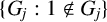
By hypothesis, there is a component
 $K_1$
of the cover
 $\{G_j : 1\not \in G_j\}$
of
 $\{2,3,\ldots ,n\}$
, augmented with singleton sets if necessary, with the property that
 $k\in K_1$
implies either
 $k\in \bigcap \{G_j : 1\in G_j\}$
or
 $ k\in \bigcap \{ G_j^{c} : 1\in G_j\}$
. Let
 $ K_{1h}=\{p\in K_1: p\in \bigcap \{ G_j : 1\in G_j\}\}$
and let
 $ K_{1c}=\{p\in K_1: p\in \bigcap \{ G_j^{c} : 1\in G_j\}\}$
. Let
 $$ \begin{align*}T=\textstyle \sum\{(e_1-e_s)\otimes e_s: s\in K_{1h} \}-\sum\{e_r\otimes e_r: r\in K_{1c}\}.\end{align*} $$
Let
 $2\le i\le n$
. Clearly
 $Te_i=-e_i$
if
 $i\in K_1$
and
 $Te_i=0$
otherwise. So T leaves each subspace
 $\langle e_i\rangle , 2\le i\le n$
, invariant.
If
 $1\in G_j$
, we have
 $\sum \{(e_1-e_s)\otimes e_s: s\in K_{1h}\} g_j=0=\sum \{e_r\otimes e_r: r\in K_{1c}\}g_j$
so
 $Tg_j=0$
. If
 $1\not \in G_j$
, since
 $ G_j$
is a subset of precisely one component of the cover
 ${\cal G}_1$
of
 $\{2,3,\ldots ,n\}$
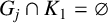
, either
 $ G_j\subseteq K_1$
or
 $ G_j\cap K_1=\varnothing $
. In the former case
 $Tg_j=-g_j$
and in the latter case
 $Tg_j=0$
. So T also leaves each subspace
 $\langle g_j\rangle $
,
 $1\le j\le m$
, invariant.
Since
 $K_1\ne \varnothing $
there exist
 $i_o$
such that
 $Te_{i_o}=-e_{i_o}$
, and since
 $1\in G_{j_o}$
for some
 $j_o$
,
 $Tg_{j_o}=0.$
It follows that T is nonscalar.
This completes the proof.
Corollary 2.6. A family of one-dimensional subspaces
 ${\cal F}$
of
 ${{\mathbb {C}}}^3$
is minimally transitive if and only if
 ${\cal F}= \{\langle f_1\rangle ,\langle f_2\rangle ,\langle f_3\rangle \}\cup \{\langle g\rangle \}$
, where
 ${\cal B}=\{f_1, f_2, f_3\}$
is a basis for
 ${{\mathbb {C}}}^3$
and where
 $g\in {{\mathbb {C}}}^3$
has support
 $\{1,2,3\}$
with respect to the basis
 ${\cal B}$
.
Proof. For the proof of necessity notice that if
 ${\cal F}$
is minimally transitive then
 ${\cal F}= \{\langle f_1\rangle ,\langle f_2\rangle , \langle f_3\rangle \}\cup \{\langle g_1\rangle ,\langle g_2\rangle ,\ldots , \langle g_m\rangle \}$
, where
 ${\cal B}=\{f_1, f_2, f_3\}$
is a basis for
 ${{\mathbb {C}}}^3$
and where
 $g_j\in {{\mathbb {C}}}^3,\,1\le j\le m$
. The support of each
 $g_j$
has at most three elements and, by Theorem 2.5, there is a
 $g_j$
with support
 $\{1,2,3\}$
. Having more than one
 $g_j$
with support
 $\{1,2,3\}$
contradicts minimal transitivity, so
 $m=1$
.
The sufficiency of the condition is easily proved.
Corollary 2.7. Let
 $n\ge 3$
. A minimally transitive family of one-dimensional subspaces of
 ${{\mathbb {C}}}^n$
has cardinality at most
 $2n-2.$
This inequality is sharp; indeed if
 $g_j=e_1+e_2+e_{j+2}$
, for
 $1\le j\le n-2$
, then
 ${\cal F}= \{\langle e_1\rangle , \langle e_2\rangle ,\ldots , \langle e_n\rangle \}\cup \{\langle g_1\rangle ,\langle g_2\rangle ,\ldots , \langle g_{n-2}\rangle \}$
is a minimally transitive family of subspaces.
Proof. If
 ${\cal F}$
is a minimally transitive family of one-dimensional subspaces of
 ${{\mathbb {C}}}^n$
and
 $n\ge 3$
, then
 ${\cal F}=\{\langle f_1\rangle ,\langle f_2\rangle ,\ldots , \langle f_n\rangle \}\cup \{\langle g_1\rangle ,\langle g_2\rangle ,\ldots , \langle g_{m}\rangle \}$
where
 $\{f_1, f_2,\ldots , f_n\}$
is a basis for
 ${{\mathbb {C}}}^n$
. If
 ${\cal G}$
is the connecting cover of
 $\{1,2,\ldots ,n\}$
provided by the supports of the
 $g_j$
,
 $1\le j\le m$
, then by Theorem 2.5 and Corollary 2.4,
 $m={\lvert \cal G}\rvert \le n-M+1$
where
 $M\ge 3$
. Thus
 $m\le n-2$
and
 $\lvert {\cal F}\rvert =n+m\le 2n-2$
. The remainder of the proof follows from the next example.
Example 2.8. This example shows that, for every
 $s\in {{\mathbb {Z}}}^+$
and
 $n\ge 3$
satisfying
 $n+1\le s\le 2n-2$
, there exists a minimally transitive family of one-dimensional subspaces of
 ${{\mathbb {C}}}^n$
with s elements.
Let
 $n\ge 3$
and let
 $k\in {{\mathbb {Z}}}^+$
satisfy
 $2\le k\le n-1$
. Let
 $g_j=\sum _{t=1}^{k}e_t+e_{k+j}$
, for
 $1\le j\le n-k$
. Then
 ${\cal F}= \{\langle e_1\rangle ,\langle e_2\rangle ,\ldots , \langle e_n\rangle \}\cup \{\langle g_1\rangle ,\langle g_2\rangle ,\ldots , \langle g_{n-k}\rangle \}$
is a minimally transitive family of subspaces. Let
 $ G_j=\{1,2,\ldots , k\}\cup \{k+j\}$
, for
 $1\le j\le n-k$
, be the support of
 $g_j$
. Condition (i) of the preceding theorem is clearly satisfied. For the verification of condition (ii), notice that
 $\bigcap \{ G_j : 1\in G_j\}=\{1,2,\ldots ,k\}$
and
 $\bigcap \{ G_j^{c} : 1\in G_j\}=\varnothing $
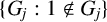
, and the components of the cover
 $\{ G_j : 1\not \in G_j\}$
of
 $\{j: 2\le j \le n\}$
, augmented with singleton sets if necessary, are the singleton sets
 $\{\{j\} : 2\le j\le n\}$
. The set
 $\{2\}$
is one of these components and
 $2\in \bigcap \{ G_j : 1\in G_j\}$
. The proofs for the cases where
 $2\le i\le k$
are similar.
Notice also that
 $\bigcap \{ G_j : k+1\in G_j\}=\{1,2,\ldots ,k+1\}$
and
 $\bigcap \{ G_j^{c} : k+1\in G_j\}=\{k+2, k+3,\ldots ,n\}$
, and the components of the cover
 $\{ G_j : 3\not \in {\cal G}_j\}$
of
 $\{j: 1\le j\ne 3\le n\}$
, augmented with singleton sets if necessary, is the single component
 $\{1,2,\ldots , n\}\backslash \{k+1\}$
. Every element of the latter belongs either to
 $\{1,2,\ldots ,k+1\}$
or
 $\{k+2, k+3,\ldots ,n\}$
. The proofs for the cases where
 $k+2\le i\le n$
are similar.
Taking
 $k=2$
in the above furnishes the remainder of the proof of Corollary 2.7. Extra verification of minimal transitivity in this case is supplied by the facts
 $$ \begin{align*}(e_1-e_2)\otimes e_2\in \mbox{Alg}({\cal F}\backslash \{\langle e_1\rangle\})\end{align*} $$
and
 $$ \begin{align*}(e_3-e_1)\otimes e_1\,\,+\,\,(e_3-e_2)\otimes e_2\,\, -\sum_{j=4}^{n}e_j\otimes e_j\in \mbox{Alg}({\cal F}\backslash \{\langle e_3\rangle\}).\end{align*} $$
Example 2.9. By Theorem 2.5, if
 $g_1,g_2,\ldots , g_m$
are nonzero vectors of
 ${{\mathbb {C}}}^n$
,
 $n\ge 3$
, then
 ${\cal F}=\{\langle e_1\rangle ,\langle e_2\rangle ,\ldots , \langle e_n\rangle \}\cup \{\langle g_1\rangle ,\langle g_2\rangle ,\ldots , \langle g_m\rangle \}$
is not minimally transitive if
 ${\cal F}^o=\{\langle e_1\rangle ,\langle e_2\rangle ,\ldots , \langle e_n\rangle \}\cup \{\langle g_1^o\rangle , \langle g_2^o\rangle ,\ldots ,\langle g_m^o\rangle \}$
is not, where
 $g_i^o$
is the
 $0$
–
 $1$
vector having the same support as
 $g_i$
,
 $1\le i\le m.$
The converse is false.
On
 ${{\mathbb {C}}}^5$
put
 ${\cal F}=\{\langle e_1\rangle ,\langle e_2\rangle ,\langle e_3\rangle ,\langle e_4\rangle ,\langle e_5\rangle \}\cup \{ \langle g_1\rangle ,\langle g_2\rangle ,\langle g_3\rangle \}$
with
 $g_1=(1,2,3,0,0)$
,
 $g_2=(2,1,0,1,0), g_3=(1,3,0,0,1)$
. Then
 $\cal F$
is not minimally transitive, since
 ${\cal F}\backslash \{\langle e_1\rangle \}$
is transitive. For if
 $T=[t_{i,j}]\in $
Alg(
 ${\cal F}\backslash \{\langle e_1\rangle \}$
), then
 $Tg_1=0$
gives
 $t_{2,1} +2t_{2,2}=t_{3,1}+3t_{3,3}= t_{4,1}= t_{5,1}=0$
, then
 $Tg_2=0$
gives
 $t_{2,1}=t_{2,2} = t_{3,1}=t_{3,3}=t_{4,4}=0$
and finally
 $Tg_3=0$
gives
 $t_{5,5}=0$
, so
 $T=0$
. However,
 ${\cal F}^o=\{\langle e_1\rangle ,\langle e_2\rangle ,\langle e_3\rangle ,\langle e_4\rangle ,\langle e_5\rangle \}\cup \{\langle g_1^o\rangle , \langle g_2^o\rangle , \langle g_3^o\rangle \}$
is minimally transitive, where
 $g_1^o = (1,1,1,0,0)$
,
 $g_2^o=(1,1,0,1,0)$
,
 $g_3^o =(1,1,0,0,1)$
(see Example 2.8, case
 $k=2$
).
Example 2.10. If
 $n\ge 3$
and
 $a_i, b_i$
are nonzero complex numbers for
 $1\le i\le n$
, and
 $g_i= a_i e_i+b_ie_{i+1}$
,
 $1\le i\le n-1$
, then
 $\{\langle e_1\rangle ,\langle e_2\rangle ,\ldots , \langle e_n\rangle \}\cup \{\langle g_1\rangle ,\langle g_2\rangle ,\ldots , \langle g_{n-1}\rangle \}$
is clearly transitive. However, it is not minimally transitive by Theorem 2.5(iii), since
 $M=$
max
 $\{\lvert G_j\rvert :G_j\in {\cal G}\}=2<3.$
(Also,
 $\omega _i$
does not exist for
 $1\le i\le n$
.)
3 Medial families
According to Halmos [Reference Longstaff2], a medial subspace lattice on
 ${{\mathbb {C}}}^n$
is a set of subspaces, containing the trivial subspaces
 $(0)$
and
 ${{\mathbb {C}}}^n$
, which has the property that every pair of its nontrivial elements is complementary, and which has at least two nontrivial elements.
Definition 3.1. A family
 ${\cal M}$
of subspaces of a finite-dimensional vector space V over a field
 ${\mathbb {F}}$
is medial if it contains at least two elements, if every element of
 ${\cal M}$
is nontrivial, and every pair
 $K,L$
of elements of
 ${\cal M}$
are complementary, that is,
 $K\cap L=(0)$
and
 $K+L=V$
.
With this definition, medial families of subspaces of
 $\mathbb {C}^n$
are precisely those arising as the set of nontrivial elements of medial subspace lattices.
On
 ${{\mathbb {C}}}^2$
, a medial family of subspaces is transitive if and only if it has three or more elements, and so is minimally transitive if and only if it has three elements. On
 ${{\mathbb {C}}}^3$
a medial family has two elements and is nontransitive.
It is observed in [Reference Longstaff2] that, on a space of dimension at least four, every transitive medial family has at least five elements. Transitive medial families of subspaces with minimum cardinality do exist on such spaces, of (necessarily even) dimension
 $2k$
with
 $k\ge 2$
. The easiest examples, on
 ${{\mathbb {C}}}^k\oplus {{\mathbb {C}}}^k$
, where
 $k\ge 2$
, of transitive medial families with five elements arise as the set of nontrivial elements
 ${{\mathbb {C}}}^k\oplus (0), (0)\oplus {{\mathbb {C}}}^k, {\mathbb {G}}(I), {\mathbb {G}}(A), {\mathbb {G}}(B),$
where
 $A, B, I-A, I-B, A-B$
are invertible and the commutant
 $(A,B)'={{\mathbb {C}}} I$
. To prove transitivity notice that if the matrix
 $[\begin {smallmatrix} W&X\\ Y&Z \end {smallmatrix}]$
leaves
 ${{\mathbb {C}}}^k\oplus (0)$
and
 $(0)\oplus {{\mathbb {C}}}^k$
invariant, then
 $X=Y=0$
. If it also leaves
 ${\mathbb {G}}(I)$
invariant then
 $W=Z$
. If it also leaves
 ${\mathbb {G}}(A)$
and
 ${\mathbb {G}}(B)$
invariant, then
 $W\in (A,B)'$
, so W is a scalar multiple of the identity.
All medial families of subspaces of
 ${{\mathbb {C}}}^{2k},\, k\ge 2$
, with at least three nontrivial elements arise as follows. Let
 ${\cal M}=\{M_i: 1\le i\le q\}$
be a set of pairwise complementary nontrivial subspaces of
 ${{\mathbb {C}}}^{2k}$
. By complementarity, each of the subspaces has dimension k. There is an invertible linear transformation
 $U: {{\mathbb {C}}}^{2k}\rightarrow {{\mathbb {C}}}^k\oplus {{\mathbb {C}}}^k$
such that
 $UM_1={{\mathbb {C}}}^k\oplus (0)$
and
 $UM_2= (0)\oplus {{\mathbb {C}}}^k$
. (Take
 $Ux=(y,z)$
, where
 $x=y+z$
and
 $x\in M_1, y\in M_2$
). If
 $3\le i\le q$
, since
 $M_i$
is a complement of both
 $M_1$
and
 $M_2$
, then
 $UM_i$
is a complement of both
 ${{\mathbb {C}}}^k\oplus (0)$
and
 $(0)\oplus {{\mathbb {C}}}^k$
, and so is
 ${\mathbb {G}}(T_i)$
for some invertible linear transformation
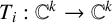 $T_i:{{\mathbb {C}}}^k\rightarrow {{\mathbb {C}}}^k$
. Then the matrix
 $[\begin {smallmatrix} I&0\\ 0&T_3^{-1} \end {smallmatrix}]$
maps
 ${{\mathbb {C}}}^k\oplus (0), (0)\oplus {{\mathbb {C}}}^k, {\mathbb {G}}(T_3), {\mathbb {G}}(T_4), {\mathbb {G}}(T_5),\ldots , {\mathbb {G}}(T_q)$
onto
 ${{\mathbb {C}}}^k\oplus (0)$
,
 $(0)\oplus {{\mathbb {C}}}^k$
,
 ${\mathbb {G}}(I), {\mathbb {G}}(T_3^{-1}T_4), {\mathbb {G}}(T_3^{-1}T_5), \ldots , {\mathbb {G}}(T_3^{-1}T_q)$
, respectively.
To summarise, there is an invertible linear transformation
 $V: {{\mathbb {C}}}^{2k}\rightarrow {{\mathbb {C}}}^k\oplus {{\mathbb {C}}}^k$
such that
 $V{\cal M}=\{{{\mathbb {C}}}^k\oplus (0), \, (0)\oplus {{\mathbb {C}}}^k,\, {\mathbb {G}}(I)\}\cup \{{\mathbb {G}}(S_i): 3\le i\le q\}$
, where
 $S_i$
,
 $3\le i\le q$
, are invertible
 $k\times k$
matrices. Because of complementarity each of
 $S_i, I-S_i$
,
 $3\le i\le q$
, and
 $S_i-S_j$
,
 $3\le i\ne j\le q$
, is an invertible matrix. Of course, the medial family
 ${\cal M}$
is transitive (respectively, minimally transitive) if and only if
 $V{\cal M}$
is.
The following result shows how any finite nonempty family
 ${\cal X}$
of
 $k\times k$
matrices,
 $k\ge 2$
, satisfying the commutant conditions (a)
 ${\cal X}'={{\mathbb {C}}} I$
, (b)
 ${\cal X}_{0}'\ne {{\mathbb {C}}} I,$
for every proper subset
 ${\cal X}_0$
of
 ${\cal X}$
, gives rise to a minimally transitive medial family of subspaces of
 ${{\mathbb {C}}}^k\oplus {{\mathbb {C}}}^k$
. Such an example, with two elements, is
 ${\cal X}= \{A_0, B_0\}$
where
 $A_0$
is a diagonal matrix with distinct diagonal entries and
 $B_0= g\otimes g$
, where g has support
 $\{1,2,\ldots , n\}$
. (Any matrix commuting with
 $A_0$
is diagonal, and any matrix commuting with
 $B_0$
leaves
 $\langle g\rangle $
invariant.)
Proposition 3.2. Let
 ${\cal X}=\{X_i:1\le i\le p\}, p\ge 2$
, be a family of
 $k\times k$
complex matrices,
 $k\ge 2$
, satisfying the commutant conditions (a)
 ${\cal X}'={{\mathbb {C}}} I$
, (b)
 ${\cal X}_{0}'\ne {{\mathbb {C}}} I,$
for every proper subset
 ${\cal X}_0$
of
 ${\cal X}$
. Let
 $\{\alpha _i :1\le i\le p\}$
be scalars such that the matrices
 $S_i=\alpha _i I-X_i$
,
 $1\le i\le p$
, satisfy:
-
(i)
$S_i$
is invertible, for
$1\le i\le p$
; -
(ii)
$S_i-S_j$
is invertible, for
$1\le i\ne j\le p$
; -
(iii)
$I-S_i$
is invertible, for
$1\le i\le p$
.


Then
 $ {\cal M}=\{{{\mathbb {C}}}^k\oplus (0), (0)\oplus {{\mathbb {C}}}^k,\, {\mathbb {G}}(I)\}\cup \{{\mathbb {G}}(S_i): 1\le i\le p\}$
is a transitive medial family of subspaces of
 ${{\mathbb {C}}}^k\oplus {{\mathbb {C}}}^k$
. There is a subset
 ${\cal T}$
of
 $\{{{\mathbb {C}}}^k\oplus (0), (0)\oplus {{\mathbb {C}}}^k, {\mathbb {G}}(I)\}$
, possibly empty, such that
 ${\cal T}\cup \{{\mathbb {G}}(S_i): 1\le i\le p\}$
is a minimally transitive medial family of subspaces of
 ${{\mathbb {C}}}^k\oplus {{\mathbb {C}}}^k$
.
Proof. Any two of
 $\{{{\mathbb {C}}}^k\oplus (0), (0)\oplus {{\mathbb {C}}}^k, {\mathbb {G}}(I)\}\cup \{{\mathbb {G}}(S_i): 1 \le i \le p\}$
intersect in
 $(0)$
and span
 ${{\mathbb {C}}}^k\oplus {{\mathbb {C}}}^k$
, as is easily verified. So
 ${\cal M}$
is a medial family of subspaces. If the matrix
 $[\begin {smallmatrix} W&X\\ Y&Z \end {smallmatrix}]$
leaves each of
 ${{\mathbb {C}}}^k\oplus (0), (0)\oplus {{\mathbb {C}}}^k, {\mathbb {G}}(I)$
invariant, then
 $X=Y= 0$
and
 $W=Z$
. If it also leaves each
 ${\mathbb {G}}(S_i)$
,
 $1\le i\le p$
, invariant then
 $W\in {\cal X}'$
, so W is scalar and
 ${\cal M}$
is transitive.
It is also the case that
 ${\cal M}\backslash \{{\mathbb {G}}(S_i)\}$
is nontransitive for
 $1\le i\le p$
. This follows from the fact that, for all such i, the commutant
 $({\cal X}\backslash \{X_i\})'$
contains a nonscalar matrix
 $W_i$
. Then the matrix
 $[\begin {smallmatrix} W_i&0\\ 0&W_i \end {smallmatrix}]$
leaves every element of
 ${\cal M}\backslash \{{\mathbb {G}}(S_i)\}$
invariant.
Finally, if
 ${\cal M}$
is not minimally transitive, there is an element, M say, of
 ${\cal M}$
such that
 ${\cal M}\backslash \{M\}$
is transitive. This M cannot be
 ${\mathbb {G}}(S_i)$
for
 $1\le i\le p$
. If
 ${\cal M}\backslash \{M\}$
is not minimally transitive then there is an element, L say, of
 ${\cal M}\backslash \{M\}$
such that
 ${\cal M}\backslash \{L, M\}$
is transitive. Again, this L cannot be
 ${\mathbb {G}}(S_i)$
for
 $1\le i\le p$
. If
 ${\cal M}\backslash \{L, M\}$
is not minimally transitive then there is an element, K say, of
 ${\cal M}\backslash \{L, M\}$
such that
 ${\cal M}\backslash \{K, L, M\}$
is transitive and
 $K\not \in \{{\mathbb {G}}(S_i): 1\le i\le p\}$
. Then
 $\{{\mathbb {G}}(S_i): 1\le i\le p\}$
is minimally transitive.
This completes the proof.
Remark 3.3. In the preceding proposition, scalars
 $\alpha _i$
,
 $1\le i\le p$
, always exist. They can be found, for example, by using the fact that
 $\lambda I-T$
is invertible if
 $\lvert \lambda \rvert>\Vert T\Vert .$
If C is a nonscalar
 $2\times 2$
matrix, consideration of its Jordan canonical form shows that
 $(C)'=\langle I, C\rangle $
. Thus if
 $A, B$
are nonscalar
 $2\times 2$
matrices satisfying
 $C\in (A,B)'$
then
 $A,B\in \langle I,C\rangle $
so
 $\langle I, A\rangle =\langle I,B\rangle =\langle I,C\rangle $
. To summarise, if
 $A,B$
are nonscalar
 $2\times 2$
matrices satisfying
 $(A,B)'\ne {{\mathbb {C}}} I$
, then
 $\langle I,A\rangle =\langle I,B\rangle $
.
Proposition 3.4. On
 ${{\mathbb {C}}}^4$
a minimally transitive medial family of subspaces has five elements.
Proof. Let
 ${\cal M}$
be a minimally transitive medial family of subspaces of
 ${{\mathbb {C}}}^4$
. By transitivity,
 ${\cal M}$
has at least five elements. Suppose it had more than five elements. We may suppose that
 ${\cal M}$
is
 $\{{{\mathbb {C}}}^2\oplus (0), (0)\oplus {{\mathbb {C}}}^2, {\mathbb {G}}(I)\}\cup \{{\mathbb {G}}(A_i): 1\le i\le p\}$
, where
 $A_i$
,
 $1\le i\le p$
, are
 $2\times 2$
matrices and
 $p\ge 3$
. Then
 $$ \begin{align*}\mbox{Alg}{\cal M}=\bigg\{\bigg[\begin{matrix} X&0\\ 0&X \end {matrix}\bigg]: X\in (\{A_i: 1\le i\le p\})'\bigg\}.\end{align*} $$
By minimal transitivity, no
 $A_i$
is a scalar multiple of the identity and since
 $p\ge 3$
,
 $(A_1,A_2)' \ne {{\mathbb {C}}} I$
. It follows that
 $\langle I,A_1\rangle =\langle I,A_2\rangle .$
In particular,
 $A_1\in \langle I,A_2\rangle $
, so that
 ${(\{A_i: 2 \le i\le p\})'=(\{A_i: 1\le i \le p \})'={{\mathbb {C}}} I}$
. Thus Alg(
 ${\cal M}\backslash \{{\mathbb {G}}(A_1)\})={{\mathbb {C}}} I$
. This contradicts the minimal transitivity of
 ${\cal M}$
.
Lemma 3.5. Let
 $F,G\in M_n({{\mathbb {C}}})$
,
 $n\ge 2$
, be rank-one idempotents with
 $FGF=\gamma F$
,
 $GFG=\gamma G$
. If
 $\alpha , \beta \in {{\mathbb {C}}}$
and
 $\xi =(1-\alpha )(1-\beta )-\alpha \beta \gamma \ne 0$
, then
 $I-\alpha F-\beta G$
is invertible and
 $(I-\alpha F-\beta G)^{-1} =I+aF+bG+c(FG+GF),$
where
 $a={\alpha (1-\beta )}/{\xi }$
,
 $b={\beta (1-\alpha )}/{\xi }, c={\alpha \beta }/{\xi }.$
Proof. This is a routine verification.
Corollary 3.6. Let
 $F,G\in M_n({{\mathbb {C}}})$
,
 $n\ge 2$
, be rank-one idempotents satisfying
 $FGF=\gamma F$
,
 $GFG= \gamma G$
. Then
 $I-\lambda (F-G)$
is invertible if
 $\lambda ^2 \gamma -\lambda ^2+1\ne 0$
, with inverse given by
 $(I-\lambda (F-G))^{-1}=I+aF+bG +c(FG+GF),$
where
 $a={\lambda (\lambda +1)}/{(\lambda ^2 \gamma -\lambda ^2+1)}$
,
 $b={\lambda (\lambda -1)}/{(\lambda ^2 \gamma -\lambda ^2+1)}$
and
 $c={-\lambda ^2}/{(\lambda ^2 \gamma -\lambda ^2+1)}.$
Proof. Take
 $\alpha =\lambda $
and
 $\beta =-\lambda $
in the lemma.
Remark 3.7. Lemma 3.5 can be extended to any finite number
 $\{E_i: 1\le i\le t\}$
of rank-one idempotents. The inverse of
 $I-\sum _{i=1}^{t} \alpha _iE_i$
can be expressed as a linear combination of words in
 $\{ E_i :1\le i\le t\}$
of length at most t since any word of length greater than t cannot contain distinct factors and
 $EXE\in \langle E\rangle $
if E is a rank-one idempotent and X is an arbitrary matrix. For example, if
 $E,F,G$
are rank-one idempotents, and
 $\alpha ,\beta ,\gamma \in {{\mathbb {C}}}$
, the inverse of
 $I-\alpha E-\beta F-\gamma G$
has the form
 $$ \begin{align*} I+a_1E &+a_2F+a_3G+b_1 EF+b_2EG+b_3FE+b_4FG+b_5GE+b_6GF \\ & +c_1(EFG+FEG)+c_2(EGF+GEF)+c_3(FGE+GFE) \end{align*} $$
where, provided certain quantities
 $\Gamma _1, \Gamma _2,\Gamma _3$
are nonzero,
 $$ \begin{align*} & a_1= \frac{\alpha(\kern1.2pt{\tilde{\beta}}{\tilde{\gamma}}-\zeta)}{\Gamma_1}, \quad a_2=\frac{\beta({\tilde{\alpha}}{\tilde{\gamma}}-\eta)}{\Gamma_2}, \quad a_3=\frac{\gamma({\tilde{\alpha}}{\tilde{\beta}}-\xi)}{\Gamma_3}, \\ & b_1=\frac{\beta{\tilde{\gamma}}}{\Gamma_2}, \quad b_2=\frac{{\tilde{\beta}}\gamma}{\Gamma_3}, \quad b_3=\frac{\alpha{\tilde{\gamma}}}{\Gamma_1}, \quad b_4=\frac{{\tilde{\alpha}}\gamma}{\Gamma_3}, \quad b_5=\frac{\alpha{\tilde{\beta}}}{\Gamma_1}, \quad b_6 =\frac{{\tilde{\alpha}}\beta}{\Gamma_2},\\ & c_1=\frac{\gamma}{\Gamma_3}, \quad c_2=\frac{\beta}{\Gamma_2}, \quad c_3=\frac{\alpha}{\Gamma_1}, \end{align*} $$
where
 ${\tilde {\alpha }}={(1-\alpha )}/{\alpha }$
,
 ${\tilde {\beta }}={(1-\beta )}/{\beta }$
,
 ${\tilde {\gamma }}={(1-\gamma )}/{\gamma }$
.
Let
 $f,g\in {{\mathbb {C}}}^n,\, n\ge 3$
be unit vectors. Let
 $F=f\otimes f$
and
 $G=g\otimes g$
. Then
 $F^2=F, G^2=G$
and
 $FGF=aF, GFG=aF$
, where
 $a=\lvert (f\mid g)\rvert ^2$
. By Corollary 3.6, we have
 $\sigma (F-G)\subseteq \{0\}\cup \{\pm \sqrt {1-a}\}. $
The reverse inclusion also holds. Since
 $F-G$
has rank at most two it is not invertible, so
 $0\in \sigma (F-G)$
. If
 $a=1$
, then
 $\langle f\rangle =\langle g\rangle $
and
 $F=G$
so
 $\sigma (F-G)=\{0\}$
. If
 $a=0$
then
 $f\perp g$
and
 $(F-G)f=f$
,
 $(F-G)g=-g$
. Finally, if
 $0<a<1$
, then
 $(F-G)h_{+}=(\sqrt {1-a})\,\,h_{+}$
and
 $(F-G)h_{-}=-(\sqrt {1-a})\,\,h_{-}$
where
 $h_{+}=(g\mid f)f +(\sqrt {1-a}\,\,-1)g, h_{-}=-(g\mid f)f+(\sqrt {1-a}\,\,+1)g$
.
Theorem 3.8. Let
 $k,m$
be integers with
 $k\ge 5$
and
 $m\ge 3$
. Let
 $\{E_i: 1\le i\le k\}$
be the rank-one orthogonal projections defined on
 ${{\mathbb {C}}}^k$
by
 $$ \begin{align*}E_i=\begin{cases} e_i\otimes e_i \quad& {\mbox{if }} 2 \le i\le k,\\ \displaystyle\frac{e\otimes e}{k}\quad & {\mbox{if }} i=1.\\ \end{cases}\end{align*} $$
where
 $e=(1,1,1\ldots ,1).$
Let
 $S_i =miI-E_i$
, for
 $1\le i\le k$
. Then
 $\{S_i: 1\le i\le k\}$
is a set of invertible matrices on
 ${{\mathbb {C}}}^k$
and
 ${\cal M}=\{{\mathbb {G}}(S_i): 1\le i\le k\}$
is a minimally transitive medial family of subspaces of
 ${{\mathbb {C}}}^k\oplus {{\mathbb {C}}}^k$
.
Proof. Since
 $\sigma (E_i)=\{0,1\}$
does not contain
 $mi$
,
 $S_i$
is invertible for
 $1\le i\le k$
. If
 $i\ne j$
, then
 $S_i-S_j= m(i-j)I-( E_i-E_j)$
. Then
 $\lvert m(i-j))\rvert \ge 3> \Vert E_i-E_j\Vert $
and it follows that
 $S_i-S_j$
is invertible. Consequently,
 ${\cal M}$
is a medial family of subspaces of
 ${{\mathbb {C}}}^k\oplus {{\mathbb {C}}}^k$
.
Step 1(a). We observe that
 $\{S_i : 2\le i\le k\}'=\{E_i : 2\le i\le k\}'\ne {{\mathbb {C}}} I.$
Indeed, each
 $S_i$
,
 $2\le i\le k$
, is a diagonal matrix so every diagonal matrix commutes with every
 $S_i$
,
 $2\le i\le k$
.
Step 1(b). We show that
 $\{S_i : 1\le i\le k, i\ne j\}'=\{E_i : 1\le i\le k, i\ne j\}'\ne {{\mathbb {C}}} I$
for
 $2\le j\le k$
. The matrix
 $(e_j-e_1)\otimes (e_j-e_1)$
belongs to
 $\{E_i : 1\le i\le k, i\ne j\}'.$
It follows that, for
 $1\le j\le k$
,
 ${\cal M}\backslash \{{\mathbb {G}}(S_j)\}$
is not transitive since
 $[\begin {smallmatrix}X_j&0\\0&X_j \end {smallmatrix}]$
leaves every element of
 ${\cal M}\backslash \{{\mathbb {G}}(S_j)\}$
invariant if
 $X_j\in \{E_i : 1\le i\le k, i\ne j\}'.$
We must show that
 ${\cal M}$
is transitive. The matrix
 $U=[\begin {smallmatrix}-S_3&I\\-DS_2&D \end {smallmatrix}]$
where we set
 ${D=(S_4-S_3)(S_4-S_2)^{-1}}$
is invertible, with inverse
 $$ \begin{align*}\left[\begin{array}{@{}ccc@{}}(S_2-S_3)^{-1}&-(S_2-S_3)^{-1}D^{-1}\\S_2(S_2-S_3)^{-1}&-S_3(S_2-S_3)^{-1}D^{-1}\\ \end{array}\!\right],\end{align*} $$
and U maps
 ${\mathbb {G}}(S_1), {\mathbb {G}}(S_2),{\mathbb {G}}(S_3), {\mathbb {G}}(S_4), \ldots ,{\mathbb {G}}(S_k)$
onto
 ${\mathbb {G}}(T_1), {{\mathbb {C}}}^k\oplus (0), (0)\oplus {{\mathbb {C}}}^k, {\mathbb {G}}(I)$
,
 ${\mathbb {G}}(T_5), \ldots , {\mathbb {G}}(T_k),$
respectively, where
 $T_1=D(S_1-S_2)(S_1-S_3)^{-1}$
and
 $$ \begin{align*}T_i= D(S_i-S_2)(S_i-S_3)^{-1}, \quad 5\le i\le k.\end{align*} $$
The proof is completed by proving that
 $$ \begin{align*}\{{\mathbb{G}}(T_1), {{\mathbb{C}}}^k\oplus (0), (0)\oplus{{\mathbb{C}}}^k, {\mathbb{G}}(I)\}\cup\{{\mathbb{G}}(T_i ): 5\le i\le k\}\end{align*} $$
is a transitive family of subspaces or, equivalently, that
 $(\{T_1\}\cup \{T_i : 5\le i\le k\})'={{\mathbb {C}}} I$
.
Step 2. We show that
 $\{T_i : 5\le i\le k\}'$
consists of diagonal matrices. Since
 $S_j$
is a diagonal matrix for
 $2\le j\le k$
,
 $T_i$
is a diagonal matrix for
 $5\le i\le k$
. For
 $5\le i\le k$
,
 $$ \begin{align*}T_i=(S_4-S_3)(S_4-S_2)^{-1}(S_i-S_2)(S_i-S_3)^{-1},\end{align*} $$
and if
 $p\not \in \{2,3,4,i\}$
,
 $(T_i)_{p,p}=(i-2)/2(i-3)$
, so
 $(T_i)_{p,p}=(T_i)_{1,1}$
if
 $p\not \in \{2,3,4,i\}$
.
On the other hand,
 $$ \begin{align*} (T_i)_{2,2} & = \frac{(i-2)m+1}{(i-3)(2m+1)}, \quad (T_i)_{3,3}=\frac{(i-2)(m+1)}{((i-3)m+1)2}, \\ (T_i)_{4,4} & = \frac{(i-2)(m-1)}{(i-3)(2m-1)}, \quad (T_i)_{i,i}=\frac{(i-2)m-1}{((i-3)m-1)2}. \end{align*} $$
It is easily verified that the values of
 $(T_i)_{1,1}, \,(T_i)_{2,2}, \,(T_i)_{3,3}, \,(T_i)_{4,4}$
are distinct. Let
 $X\in \{T_i: 5\le i\le k\}'$
. It now follows that X leaves each of the subspaces
 $\langle e_j\rangle $
,
 $2\le j\le k$
, invariant. (Use the fact that the eigenspaces of a matrix are invariant under all matrices commuting with it.) The matrix X will also leave
 $\langle e_1\rangle $
invariant since
 $\langle e_2, e_3, e_4, e_i\rangle ^{\perp }$
is also an eigenspace of
 $T_i$
for
 $5\le i\le k$
, so
 $$ \begin{align*}\bigcap\{ \langle e_2, e_3, e_4, e_i\rangle ^{\perp}: 5\le i\le k\}=\bigg(\bigvee\{ \langle e_j\rangle : j\ne 1\}\bigg)^{\perp}= \langle e_1\rangle .\end{align*} $$
Hence X is a diagonal matrix.
Step 3. We show that every diagonal matrix commuting with
 $T_1$
is a scalar multiple of the identity. Now
 $T_1=D(S_1-S_2)(S_1-S_3)^{-1}$
where D is a diagonal and invertible matrix. Let Y be a diagonal matrix satisfying
 $YT_1=T_1Y$
. Then
 $$ \begin{align*}YT_1=DY(S_1-S_2)(S_1-S_3)^{-1}=D(S_1-S_2)(S_1-S_3)^{-1},\end{align*} $$
so Y commutes with
 $(S_1-S_2)(S_1-S_3)^{-1}$
. We show that every element in the first column of
 $(S_1-S_2)(S_1-S_3)^{-1}$
is nonzero. It then follows that
 $X\in {{\mathbb {C}}} I$
. (If
 $Y=$
diag
 $(y_i)$
and
 $(S_1-S_2)(S_1-S_3)^{-1}=(s_{i,j})$
, then
 $(y_i-y_1)s_{i,1}=0$
.) Using Corollary 3.6,
 $$ \begin{align*} (S_1-S_3)^{-1} & =(-2mI-(E_1-E_3))^{-1}= -\frac{1}{2m}\bigg\{I+\displaystyle\frac{1}{2m}(E_1-E_3)^{-1}\bigg\} \\ & =-\frac{1}{2m} \bigg\{I+\frac{\alpha}{k}(e\otimes e)+\beta (e_3\otimes e_3)+\displaystyle\frac{\gamma}{k}(e_3\otimes e+e\otimes e_3)\bigg\}, \end{align*} $$
where
 $$ \begin{align*}\alpha=\displaystyle\frac{k(1-2m)}{1-k+4m^2k}, \quad \beta=\displaystyle\frac{k(1+2m)}{1-k+4m^2k}, \quad \gamma=\displaystyle\frac{-k}{1-k+4m^2k}.\end{align*} $$
Hence,
 $$ \begin{align*}(S_1-S_3)^{-1} e_1=-\frac{1}{2m}\bigg\{e_1+\bigg(\frac{\gamma}{k}\bigg)e_3+\bigg(\frac{\alpha}{k}\bigg)e\bigg\}\end{align*} $$
and
 $$ \begin{align*} (S_1-S_2)(S_1-S_3)^{-1}e_1 & =-\frac{1}{2m}\bigg\{-mI-\frac{1}{k}(e\otimes e)+e_2\otimes e_2\bigg\}\bigg\{e_1+\bigg(\frac{\gamma}{k}\bigg)e_3+\bigg(\frac{\alpha}{k}\bigg)e\bigg\} \\ & =-\frac{1}{2m} \bigg\{(-m)e_1+\bigg(\frac{\alpha}{k}\bigg)e_2-\bigg(\frac{\gamma m}{k}\bigg)e_3-\bigg(\frac{m\alpha+\alpha +1}{k}+\frac{\gamma}{k^2}\bigg)e\bigg\}. \end{align*} $$
Now
 $$ \begin{align*}\frac{\alpha}{k}=\frac{1-2m}{1-k+4m^2k}, \quad \frac{\gamma m}{k}=\frac{-m}{1-k+4m^2k}, \quad \frac{m\alpha+\alpha +1}{k}+\frac{\gamma}{k^2}=\frac{m(2m-1)}{1-k+4m^2k}.\end{align*} $$
This gives
 $$ \begin{align*} ((S_1-S_2)(S_1-S_3)^{-1}e_1\mid e_1) & = \frac{4m^2 k+2m-k}{2(1-k+4m^2 k)}, \\ ((S_1-S_2)(S_1-S_3)^{-1}e_1\mid e_2) & = \frac{(2m-1)(m+1)}{2m(1-k+4m^2 k)}, \\ ((S_1-S_2)(S_1-S_3)^{-1}e_1\mid e_3) & = \frac{m-1}{1-k+4m^2 k} \end{align*} $$
and
 $$ \begin{align*}((S_1-S_2)(S_1-S_3)^{-1}e_1\mid e_j)=\displaystyle\frac{2m-1}{2(1-k+4m^2 k)} \quad \mbox{for } 4\le j\le k.\end{align*} $$
It is now clear that every element in the first column of
 $(S_1-S_2)(S_1-S_3)^{-1}$
is nonzero so
 $Y\in {{\mathbb {C}}} I$
. This completes the proof.
Taking
 $k=6$
in the preceding theorem, we obtain the first example of a medial subspace lattice (on
 ${{\mathbb {C}}}^6\oplus {{\mathbb {C}}}^6$
) whose set of nontrivial elements is minimally transitive but not of minimum cardinality.
Acknowledgement
The author thanks the referee for helpful comments.


