INTRODUCTION
Accuracy and precision in radiocarbon (14C) dating depend on the combination of several factors affecting the main steps of the dating process, from the selection of the samples to their preparation and measurement. The best approach to obtaining good quality 14C dates involves systematically evaluating the various sources of anomalies potentially introduced during each stage of the process and trying to minimize uncertainties (Boaretto Reference Boaretto2009; Weiner Reference Weiner2010:245–60; Taylor and Bar-Yosef Reference Taylor and Bar-Yosef2014:130–71). Such a rigorous methodology clearly starts with an accurate sampling strategy designed to identify the most suitable materials for which a clear association between the 14C sample and the event to date can be established. In archaeological studies, this relationship (and its security) can be inferred through the correct interpretation of the processes that led to the deposition of the 14C sample and to the formation of the context from which it was retrieved. Once the chronological connection between the sample and its context of recovery is made clear, potential candidates for 14C dating should be chosen among those materials that can provide the necessary time resolution for the archaeological problem to be addressed, and that are enough well-preserved to produce a reliable date. Assessing this information is of crucial importance for the construction of robust prior models to be used as a priori information in Bayesian analysis of 14C data, a statistical approach routinely utilized in archaeology for the interpretation of 14C dates (Buck et al. Reference Buck, Cavanagh and Litton1996; Bayliss 2009, Reference Bayliss2015). Since the variety of environmental and depositional processes makes it impossible to define a rigid sampling procedure that could apply to each archaeological site, a dedicated sampling strategy should be routinely developed by archaeologists and 14C experts as an integrated part of the chronological analysis. With these concepts in mind, here we present the 14C investigation conducted at the Bronze Age site of Erimi Laonin tou Porakou (Limassol, Cyprus), with a focus on the sampling methodology we adopted in this specific archaeological context (for a comprehensive review of the Bronze Age in Cyprus, see for example Knapp Reference Knapp2013).
THE SITE OF ERIMI LAONIN TOU PORAKOU
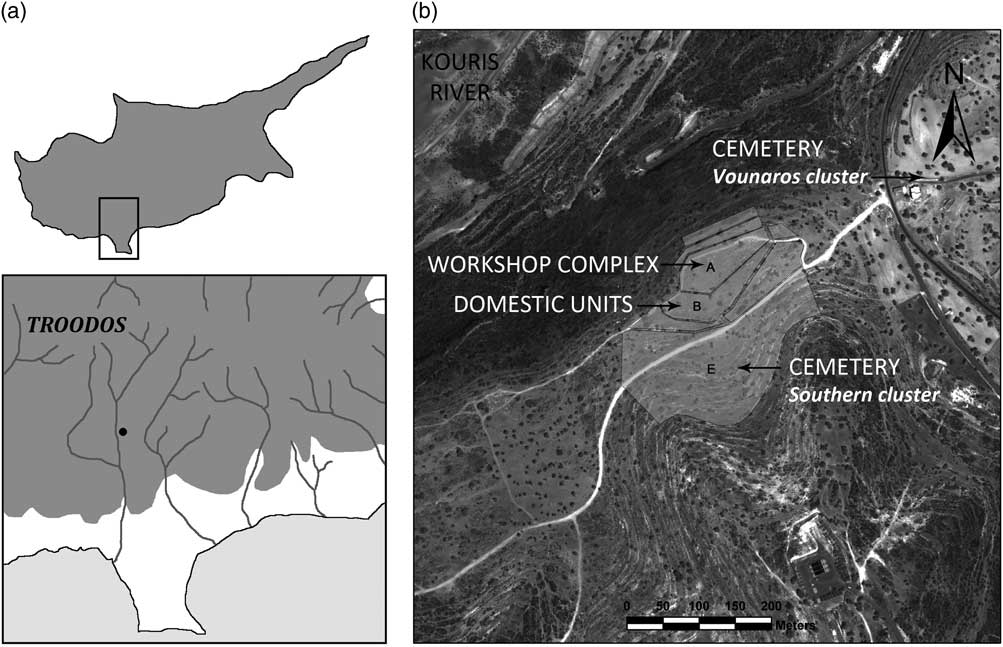
Erimi Laonin tou Porakou is located in the Kouris river valley, on the southern coast of Cyprus (see Figure 1a). The archaeological area lies on the highest hilltop of the eastern riverbank, facing south toward the modern Kouris dam, on the border between the modern villages of Ypsonas and Erimi (Cadastral Sheet LIII/ 46, Plots 331–336, 384; geo-coordinates 34°42′43.00′′N, 32°55′23.00′′E). Since 2009, the site has been systematically investigated by an Italian archaeological mission, as a joint project of the Universities of Turin and Florence in collaboration with the Department of Antiquities of Cyprus. Excavations at Erimi Laonin tou Porakou have revealed the presence of a Bronze Age settlement organized into three discrete areas with different uses and functions (see Figure 1b): Area A, located on the top of the hill, and Area B, on the first lower terrace, were occupied by a workshop complex and a domestic quarter, respectively; Area E, extending over two terraces sloping toward the south, corresponded to the southern cemetery (Bombardieri 2013, 2014, Reference Bombardieri2017). A further funerary cluster contemporary to the settlement and located eastward of it was identified in 2012 during rescue-excavations carried out by the Department of Antiquities of Cyprus in the area of Ypsonas Vounaros (Christofi et al. Reference Christofi, Stefani and Bombardieri2015).
(a) Erimi Laonin tou Porakou, location and topography; (b) location of the workshop complex (Area A), domestic units (Area B) and funerary clusters (Area E and Vounaros), shown on an Ikonos II satellite image.

Sampling for 14C dating began in 2010 with an exploratory study intended to verify occupation of the site area during the Bronze Age (Scirè Calabrisotto et al. Reference Scirè Calabrisotto, Fedi, Caforio and Bombardieri2012). These preliminary results paved the way for further investigation through 14C dating with the aim at supplementing the interpretation of the material culture and providing a reliable chronological framework for the study of this Bronze Age community. Samples were selected among the materials recovered in Area A (the workshop complex) and Area E (the southern cemetery), as they have been more extensively excavated. A brief description of these two areas is provided below.
The Workshop Complex
Located on the top of the hill, Area A corresponds to the productive complex of the settlement, organized with a distinctive layout made of open spaces and roofed units (Bombardieri 2013, Reference Bombardieri2017: 19–58). The workshop complex currently extends over an area of 25×25 m and it is functionally arranged into 12 discrete units/spaces: five open spaces (WA I–WAV), four roofed units (SA I–SA III, SA VI), and three additional units/spaces as yet not fully excavated, respectively to the northeast (SA IV–V) and southwest (SA VII) of the actual extension of the complex. The structural elements (installations and work places) and residual artifacts (tools, containers, special purpose vessels) connected with storage and working activities, and their spatial distribution within the complex, helped to characterize and understand the nature and development of this productive complex, presumably devoted to textile production (Bombardieri Reference Bombardieri2014).
Two main phases of activity have been evidenced within Area A. The earlier phase B corresponds to the beginning and progressively increasing workshop activity, which led to the first installation of a dedicated organized complex. The more recent phase A is marked by a new occupation of the settlement and a reorganization of workshop activity, during which some of the former installations were reused while others were built as new. Analysis of both the building structures and residual artifacts suggests changes in building materials and techniques, activities, and social and economic practices, from the earliest occupational phase (Phase B) to the most recent one (Phase A), during the Middle Cypriot (Middle Bronze Age).
The Southern Cemetery
As mentioned above, an extra moenia cemetery area extends toward the east and south of the Bronze Age settlement, including two distinct and contemporary tomb clusters (Bombardieri 2014, Reference Bombardieri2017: 73–128). The southern funerary cluster extends immediately outward from the settlement along two of the natural limestone terraces sloping toward the southeast, where a series of eleven rock-cut tombs (Tombs 228–232; 240–241, 248, 328, 427, and 428) were excavated during the 2008–2014 seasons. As to the funerary architecture, three major types of tombs were identified: pit tombs (T240, T328, T427), chamber tombs (T228–230, T232, T248, T428) and pit/chamber tombs (T231, T241). Pit tombs have elliptical or irregularly rounded plan and have been carved within the natural flat surface of the lowest identified terrace. Chamber tombs are more elaborated and have single or double irregularly rounded chambers with a cave-like section. A short dromos (narrow entranceway) leads to the grave chamber of Tombs 228–230, located on the upper terrace and unfortunately found looted; differently, deeper shaft dromoi were cut in the lower terrace where the entrances of Tombs 232, 248, and 428 were roughly outlined by regularizing the terrace façade. The ceramic assemblage of Area E generally points to a typical Middle Cypriot repertoire with prevalence in Red Polished (RP) ware and lower (and significant) percentage attestations in Drab Polished (DP) ware (Webb Reference Webb2017). Human remains were recovered in Tombs 228, 229, 230, 248, 328, 427, and 428, all containing multiple burials. Concerning mortuary practices, the skeletal remains were disarticulated and commingled, suggesting a degree of secondary treatment involving intentional bone manipulation and relocation within the grave (Albertini and Monaco Reference Albertini and Monaco2017).
SAMPLING STRATEGY
Two different sampling approaches were adopted for the workshop complex and the southern cemetery according to research questions and available materials. In Area A (workshop complex), potentially datable materials consisted of charcoal macro-remains retrieved manually during the excavations and archaeobotanical samples recovered from flotation procedures. The sampling strategy was conceived to chronologically define the range of utilization of the workshop complex and try to pinpoint the two consecutive phases evidenced within the sequence. Accordingly, we selected the samples most likely associated with either phase B or phase A, with a preference for short-lived remains collected from well-defined, undisturbed primary contexts. In order to do this, each deposit yielding datable materials was first evaluated according to three main parameters: stratigraphy and micro-stratigraphy, associated archaeological features, associated cultural material. Once a good definition of the depositional context had been assessed, careful examination of the physical characteristics of each potential sample was made, so as to establish whether it was likely to be residual in the context from which it derived. For instance, isolated samples like small fragments of charcoal or single seeds were judged likely to be intrusive or residual, and discarded. Similarly, uncharred or partially carbonized seeds that may have been secondarily introduced into a deposit by birds, rodents, or insects were also rejected.
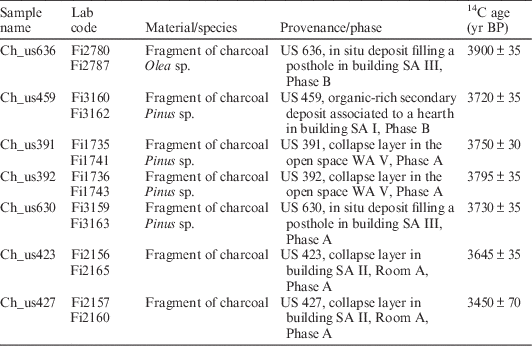
The selection process conducted on the organic materials from Area A eventually resulted in the rejection of all the archaeobotanical samples, and only a few deposits yielding charcoal macro-remains were considered as well-defined, reliable contexts. Regrettably, short-lived charcoals originating from contexts associated with primary in situ disposal, such as hearth or fire installations, were not retrieved in Area A. Consequently, samples were selected from primary deposits of wood charcoal associated with two types of features: postholes and collapsed structures. In both cases, the interpretation of the provenance of the charcoal and its depositional process is straightforward, and a functional relationship can be inferred between the material to be dated and the context from which it was recovered. However, wood charcoal originating from structural elements is usually susceptible to old wood issues and that would clearly affect the accuracy of the association between the date we obtain and the event we would like to date. In total, 7 charcoal samples were selected for 14C dating. As summarized in Table 1, samples Ch_us636 and Ch_us630 derive from in situ charcoal deposits filling two postholes and likely representing the remainder of the posts forming two different structures erected in building SA III during phase B and phase A, respectively. Differently, samples Ch_us391, Ch_us392, Ch_us423 and Ch_us427 were collected from collapse layers containing material of construction and interpreted as collapsed structures (most probably walls and roofing structures) erected during phase A in buildings SA I and SA II. In all cases, the dating of the charcoal samples can be related to the construction of the structures and thus to different building episodes occurring in the workshop complex during the two phases of occupation. A further charcoal sample, Ch_us459, was taken from an organic-rich secondary deposit of SA I on the basis of the interpretation of the depositional sequence evidenced from micromorphology analysis, according to which the charcoal deposit can be functionally related to the circular hearth found in the same building (see the Micromorphology section below for further details).
List of charcoal samples selected from Area A and measured 14C ages. When two separate pellets per sample were prepared, the best estimate of the 14C concentration was evaluated as the weighted average of the two measured fractions.

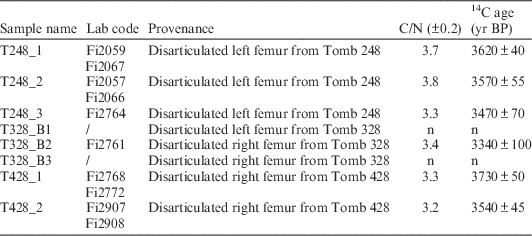
Concerning Area E (the cemetery), the skeletal remains recovered in the tombs represented a potential pool of datable materials to develop a chronology for the use of the southern cemetery that could be compared to the dates obtained from the workshop complex. Looted tombs (T228–230) were not considered for sampling, since they constitute an unsealed, and thus problematic, context of recovery. As for the unviolated tombs (T248, T328 and T428), the sampling strategy was designed to maximize both the number of sampled individuals within each tomb and the likelihood of recovering enough collagen for 14C measurements. Toward this purpose, after the completion of anthropological analysis, bone samples from each grave were collected according to two main parameters: minimum number of individuals (MNI) and preservation state. Since the recovered human remains were almost completely disarticulated and extensively commingled, the same element and side were preferably chosen within the skeletal assemblage of each tomb, so as to avoid dating the same individual more than once. Sampling was conducted within the shaft of long bones like femurs, as they are normally less depleted in collagen content. In addition, each element was visually inspected in order to avoid porous, brittle bones and to favour hard, dense ones. If the cross section was visible, as in the case of fragmented elements, then the bones showing a powdery or chalky matrix were rejected. In total, eight femoral fragments were sampled from the osteological collection of Tombs 248, 328, and 428 (see Table 2). Bone samples from Tombs 248 and 428 derive from left and right femurs, respectively. Concerning Tomb 328, two left and one right femur were selected for sampling since they were assigned to distinct individuals on the basis of considerations on morphology and size of the elements.
List of bone samples selected from Area E, C/N ratio calculated for the collagen residues and measured 14C ages. Abbreviation: n=not measured (collagen yield <0.8%). When two separate pellets per sample were prepared, the best estimate of the 14C concentration was evaluated as the weighted average of the two measured fractions.

Micromorphology
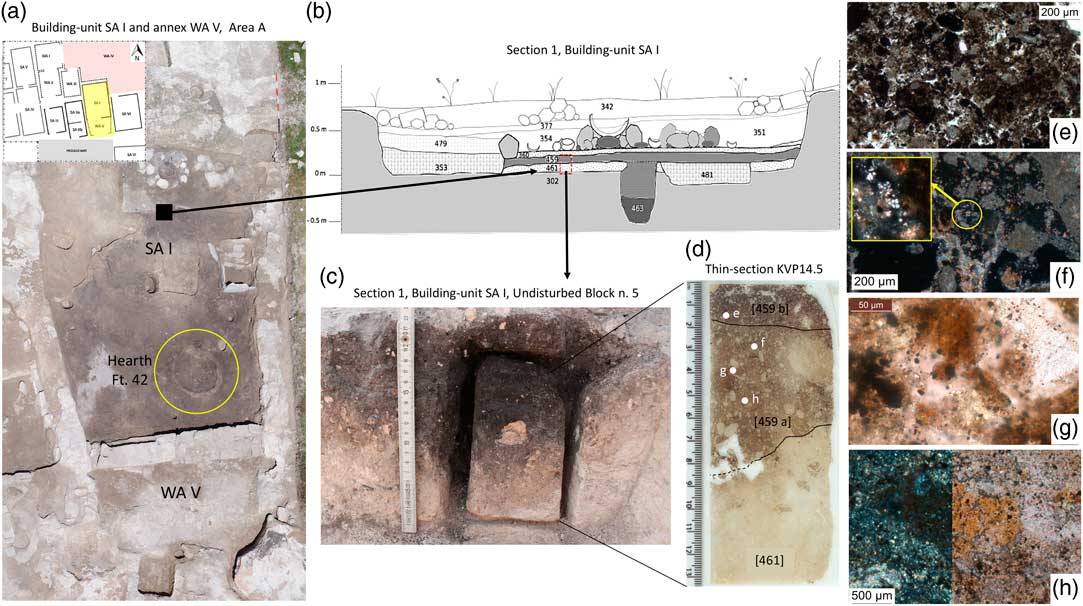
Micromorphology was applied as a high-resolution contextual analytical tool to support reconstruction of taphonomic processes and depositional pathways in the contexts analyzed, and assist sampling strategy by selecting samples from well-defined, depositional events (e.g. building construction and use, discard, maintenance or destruction). One undisturbed block for micromorphology was selected from the northern exposed section of building SA I. The related thin-section KVP14.5 was analyzed within this study since it included a depositional unit (US 459) rich in organic content from which sample Ch_us459 derived. The section selected for micromorphological study was cleaned with a palette knife and wet with water in order to bring out the sharpness of boundaries between deposits and the nature of inclusions. The practice of wetting the sections and documenting them under shadow condition is particularly important in Cyprus, due to the dryness of deposits, especially during summer seasons. Microstratigraphic sequences were photographed, drawn at 1:10 and described in detail, according to terminology used in soil science (Courty et al. Reference Courty, Goldberg and Macphail1989; Matthews 1995, Reference Matthews2005). The undisturbed soil block (13 cm high, 6–7 cm wide, and 10 cm deep) was cut out from stratigraphic sections, using a Swiss knife. Thin-section preparation was conducted at the laboratory facilities of the School of Archaeology, Geography and Environmental Science of the University of Reading. Microscopic examination was carried out using a Leica DMEP standard optical polarizing microscope in progressively high magnifications of ×40, ×100, ×200, ×400 in plane polarized light (PPL), cross polarized light (XPL) and oblique incident light (OIL). Description of composition and morphology followed standard methods of analysis and reference atlas (Bullock et al. Reference Bullock, Fedoroff, Jongerius, Stoops and Tursina1985; Courty et al. Reference Courty, Goldberg and Macphail1989; Matthews Reference Matthews1995; Stoops Reference Stoops2003; Stoops et al. Reference Stoops, Marcelino and Mees2010).
The analyzed soil block is characterized by a sequence of two 5–8-cm-thick layers of floor plasters, divided by a 9-cm layer of heterogeneous, organic-rich constructional packing. As shown in Figure 2, the heterogeneous, organic-rich secondary deposit (US 459) overlies the pale brown, fine sandy clay floor plaster of Phase B (US 461) and it marks the end of the earlier occupation of building SA I (phase B). The 9-cm-thick layer of dark, heterogeneous material was constructed as sub-floor packing before the introduction of a new layer of floor plaster (US 360), during the later Phase A. This heterogeneous deposit comprises burnt material including ash, disarticulated phytoliths and charred matter mixed with sediment aggregates. The presence of 5% spherulites, residues of dung pellets, scattered among ash (10%) and charred matter (>20%) may indicate discarded/raked-out material possibly originating from the nearby circular hearth (see Figure 2a), which were reused as ground-raising constructional material and perhaps import of material, given the thickness of 9 cm (Shahack-Gross et al. Reference Shahack-Gross, Albert, Gilboa, Nagar-Hillman, Sharon and Weiner2005; Macphail and Goldberg Reference Macphail and Goldberg2010:592–5).
(a) Aerial photo of building SA I, with the placement of section 1 (black square) on the northern side area; (b) Section 1 with the sequences of floors and deposits, as analyzed in the field; (c) picture of Section 1 with the undisturbed block n. 5; (d) thin section KVP14.5 represents the sequence of pale brown, sandy clay loam floor plaster of Phase B (US 461), overlain by the heterogeneous, organic rich packing (US 459); (e–h) photomicrographs of inclusions observed in units 459 a–b; (e) charred matter mixed with ashes and rare disarticulated phytoliths are distributed in the groundmass of unit 459a-b, XPL; (f) 5–15 μm spherulites are scattered in unit 459a as relicts of dung pellets, XPL; (g) disarticulated phytoliths scarcely recognizable in the groundmass of unit 459a, PPL; (h) phosphatic aggregate in unit 459a, as residue of organic waste (left in XPL, right in PPL).

14C-AMS SAMPLE PREPARATION AND MEASUREMENTS
All the samples selected for 14C dating were prepared and measured by accelerator mass spectrometry (AMS) at the LABEC Laboratory – Laboratorio di tecniche nucleari per l’Ambiente e i BEni Culturali – of INFN – Istituto Nazionale di Fisica Nucleare – in Florence (Italy). After mechanical cleaning, charcoal samples were pretreated following the conventional ABA method (see, for example, Cartocci et al. Reference Cartocci, Fedi, Taccetti, Benvenuti, Chiarantini and Guideri2007): the sample is treated with 1M HCl (about 80°C, 1 hr), 0.1M NaOH (room temperature, 30 min) and then 1M HCl (about 80°C, 1 hr). Typical processed charcoal masses were of the order of a few mg, with a yield after the pretreatment of about 50%. Bone samples were treated to extract collagen following a modified Longin method (Longin Reference Longin1971) as described in Scirè Calabrisotto et al. (Reference Scirè Calabrisotto, Fedi, Caforio, Bombardieri and Mandò2013). Typical processed bone masses were of the order of 500–600 mg. Collagen was successfully extracted in 6 out of 8 bone samples (see Table 2), with collagen yields ranging between 0.8 and 5 wt%. The quality of the extracted collagen was assessed via evaluation of the C/N atomic ratio measured on the collagen residues with a CHN elemental analyzer (Thermo Finnigan Flash EA1112), the same used for sample combustion. At INFN-LABEC, the cut-off points indicated by DeNiro (DeNiro Reference DeNiro1985) are taken as reference: C/N ratios should not fall outside the recommended range of 2.9–3.6, otherwise indicating probable contamination of the collagen. As shown in Table 2, within the experimental uncertainty of 0.2, all the collagen residues displayed acceptable C/N values and they were thus considered as well-preserved.
For all samples, the carbon dioxide originating from the combustion was finally reduced to graphite following our standard procedure (Fedi et al. Reference Fedi, Cartocci, Manetti, Taccetti and Mandò2007), by reaction with hydrogen at about 600°C, using iron as catalyst. Two graphite pellets were independently prepared and measured for all samples with the exception of T248_3 and T328_B2, whose collected collagen mass after the extraction was not sufficient. 14C concentrations in the unknown samples expressed as pMC (percent of modern carbon) were calculated correcting the measured 14C/12C isotopic ratios for isotopic fractionation (13C/12C isotopic ratio is simultaneously measured in the AMS beam line during each run) and background, and then normalizing the corrected values to the isotopic ratio measured for a set of NIST Oxalic Acid II standards. All the measured 14C ages were calibrated against the IntCal13 reference calibration curve (Reimer et al. Reference Reimer2013) and analyzed using OxCal v.4.2.4 (Bronk Ramsey Reference Bronk Ramsey2009).
RESULTS AND DISCUSSION
The measured 14C ages of the charcoal and the bone samples are displayed in Tables 1 and 2, respectively. When two separate pellets per sample were prepared, the best estimate of the 14C concentration was evaluated as the weighted average of the two measured fractions. In order to allow for an overall description of the chronological framework of Erimi Laonin tou Porakou, the 14C data from Area A and Area E were arranged into a Bayesian chronological model. The a priori chronological model was built considering the archaeological evidence. Since buildings SA I, SAII, and SA III are characterized by a distinct depositional history, features from these different buildings and related charcoal material cannot be sequenced. As a consequence, the charcoal samples were ordered in a chronological sequence relying on two contiguous phases: the earlier phase B and the more recent phase A. Due to the absence of any strong evidence linking the bone samples either to phase B or to phase A, they were arranged in a single phase. For the same reason, no assumption regarding the chronological relationship between samples from the workshop complex and from the cemetery was made. Because the ceramic chronology suggests that these two areas were utilized during the same cultural horizon, their respective sequences were simply described as overlapping. No reservoir effect was taken into account for the calibration of the bone 14C ages: measurements of δ13C and δ15N have been recently conducted on the collagen extracted from the same bone samples utilized for 14C dating and no significant consumption of freshwater or marine foods has been evidenced (Scirè Calabrisotto 2017).
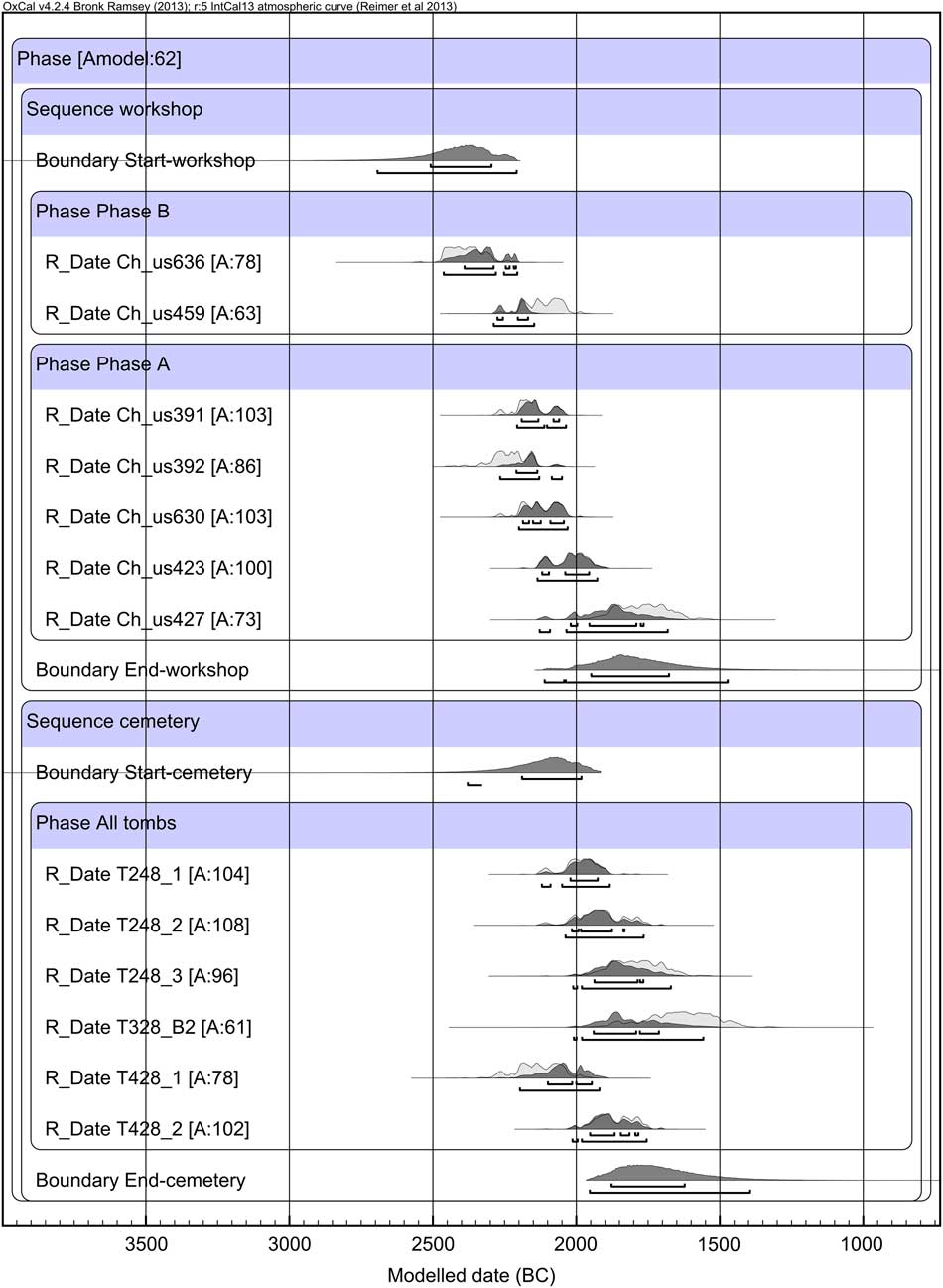
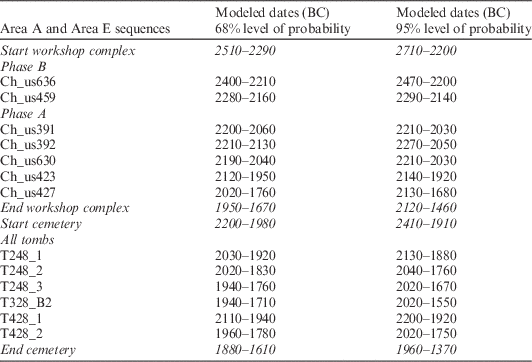
Results of the Bayesian modeling are shown in Figure 3 and Table 3. The agreement index Amodel is 62%, meaning that the agreement between the a priori archaeological information and the dating evidence can be considered satisfactory. As expected, the charcoal samples yielded dates which tend to be older than the estimates for the bone samples (see Table 3). The duration of the workshop complex was estimated from 2510–2290 BC to 1950–1670 BC (at 68% of probability) and from 2710–2200 BC to 2120–1460 BC (at 95% of probability). In terms of Cypriot chronology, taking Manning (Reference Manning2014) as a reference, the 68% probability range would correspond to the period from Late Chalcolithic/Philia phase (start) to the Middle Cypriot I–III (end), while the interpretation of the ceramic assemblages recovered in the workshop area points to occupation of the workshop complex during the Middle Cypriot. In particular, a very old date has been measured for sample Ch_us636, Olea species. This is reasonable considering the probable very long age range characterizing this tree, whose maximum lifespan has been estimated to be around 700 yr (Thomas Reference Thomas2003; Arnan et al. Reference Arnan, López, Martínez-Vilalta, Estorach and Poyatosc2012). On the other hand, samples Ch_us459, Ch_us391, Ch_us392 and Ch_us630, identified as Pinus species, produced calibrated ages only a century or so older than the bone samples. In this case, we can refer to the data obtained from Griggs et al. (Reference Griggs, Pearson, Manning and Lorentzen2014), who observed a maximum lifespan of 150–300 yr for Pinus brutia, the most common pine tree found at lower to middle elevations in Cyprus. In general, it seems that the calibrated ranges describing the Start and End boundaries of the workshop complex sequence are biased toward older ages: this can be due to the exclusive presence of long-lived charcoals within the sequence of Area A. This hypothesis is further supported by the too long span estimated for the utilization of the complex (400–800 yr at 68% level of probability as evaluated through the “Span” command in OxCal), which appears unrealistic for a two phases site like Erimi Laonin tou Porakou. A different chronological range has been estimated for Area E. Specifically, the Bayesian model suggests utilization of the southern cemetery from 2200–1980 BC to 1880–1610 BC (at 68% of probability) and from 2410–1910 BC to 1960–1370 BC (at 95% of probability), with the 68% probability range corresponding to the period from the Early Cypriot III/Middle Cypriot I to the Middle Cypriot II–III (as from Manning Reference Manning2014). In this case, the 14C evidence yielded by the bone samples is consistent with the analysis of the ceramic assemblage of Area E.
Probability distributions of the calibrated ages of the samples from Erimi Laonin tou Porakou as evaluated considering the Bayesian modeling explained in the text.

Modeled dates of each sample and ranges estimated for the Start and End boundaries of the workshop and the cemetery sequences.

CONCLUSIONS
A dedicated sampling strategy has been designed at Erimi Laonin tou Porakou to target the most suitable samples to be submitted for 14C dating, with the aim at providing a reliable chronological framework for the study of this Bronze Age community. In Area A, notwithstanding the selection of samples originating from well-defined contexts, the presence of long-lived charcoals has limited the accuracy of the estimation of the range of occupation of the workshop complex. Regrettably, current evidence does not allow for an accurate estimation of the inbuilt age probably associated to the charcoals and we must await future excavations and the recovery of reliable short-lived remains to be able to better define the chronology of Area A. On the other hand, the calibrated dates estimated for the bone samples are in good agreement with the ceramic chronology pointing to utilization of the southern cemetery during the Middle Cypriot.
In conclusion, the quality of 14C data can greatly benefit from a careful selection of the samples, even in cases when the only materials available for dating are those susceptible to inbuilt age. If the reliability of the context of recovery can be confidently assessed, this category of samples should not be discarded a priori. In fact, they potentially contain chronological information on the event we want to date and they can provide a preliminary chronological framework to be subsequently integrated with future evidence. Ultimately, a continuous dialog between archaeologists and radiocarbonists is fundamental for developing the sampling strategy that best suits to a specific archaeological context. The contributions of different specialists (geologists, anthropologists, palaeobotanists, etc.) are also proving more and more significant for improving our understanding of the sampled material and its context of provenance.
ACKNOWLEDGMENTS
We are grateful to the directors and acting directors of the Department of Antiquities of Cyprus who granted yearly official licenses and provided significant assistance and support: Pavlos Flourentzos, Maria Hadjicosti, Despina Pilides, and Marina Solomidou-Ieronymidou. Particular mention must be made of the kind cooperation of the archaeological officers and the whole staff of the District Archaeological Museums of Limassol and Episkopi. Thanks are also due to John Jack of the School of Archaeology, Geography and Environmental Science of the University of Reading, for his valid support in thin-section preparation. The authors are grateful to the two referees for careful reading of the paper and valuable suggestions which certainly improved the quality of the manuscript. Resources were mainly provided by the Italian Ministry of Foreign Affairs (MAE) and Università di Torino (Dipartimento di Studi Umanistici). Additional grants were provided by the Institute of Aegean Prehistory (Philadelphia) and the Mediterranean Archaeological Trust (Oxford). Micromorphology analysis was funded by the Arts and Humanities Research Council (AHRC).