1 Introduction
The notion of predicativity has been extensively studied in logic and the foundations of mathematics over the past century. A landmark in predicative mathematics is Hermann Weyl’s Das Kontinuum [Reference Weyl23, Reference Weyl24]. Weyl’s work was the first systematic attempt to develop substantial parts of mathematics—particularly analysis—on purely predicative grounds. After the publication of Das Kontinuum the study of predicativity experienced a fluctuating history, but regained prominence as a central theme from the 1950s onward, exerting a significant influence on different areas of logic.Footnote 1 Even today, predicative themes continue to inspire developments in various research fields.
In recent years, there has been renewed interest in the predicative system outlined by Weyl in Das Kontinuum and in his conception of predicativity. Avron has proposed a detailed reconstruction of Weyl’s ideas and a formalization of his system in [Reference Avron4]. This work also challenges some fundamental aspects of the interpretation of Das Kontinuum put forward by Feferman in several publications, e.g., [Reference Feferman, Cellucci and Sambin10–Reference Feferman, Hendricks, Pedersen and Jorgensen12], which had long been considered the standard interpretation. An approach similar to Avron’s was previously undertaken by Adams and Luo in a series of papers [Reference Adams and Luo2, Reference Adams and Luo3].
A key principle in predicative conceptions is that the universe of mathematical objects cannot be regarded as completed totality. Rather, it should be considered an open totality. At any stage, only some collections are given and the totality of these collections can be extended further. Accordingly, new collections can only be defined by quantifying over the collections that are already available, while definitions quantifying over the entire universe are not allowed. There are various ways in which this insight can be realized, ranging from stricter to more permissive interpretations. In the opening section of Das Kontinuum, Weyl offered his twist on this idea, providing a description of how mathematical objects are generated in a predicatively acceptable way starting from some basic data.
Weyl introduces two generative procedures: the logical process and the mathematical process. The logical process allows for the definition of new predicates and relations, starting from a stock of primitive predicates and relations over a given primitive domain and applying a series of purely logical and combinatorial operations. The mathematical process, instead, allows for the introduction of new entities—viz. sets—which are built from the corresponding conditions formed by the logical process. Further, it provides a criterion of identity for these new entities. The fundamental point is that these two processes can be iterated. The iteration of the processes expands the predicative mathematical universe, progressively generating new entities. The result is a ramified hierarchy of entities, where each entity at the level
$k+1$
 is obtained solely on the basis of data already available at the preceding level k.
Weyl describes these two processes in the first sections of Das Kontinuum along with the basic principles of his system. However, after introducing the Principle of Iteration in Chapter 1, §7, he partially revises his earlier exposition:
We see now, given that the principles of substitution and iteration are to be added, that we can no longer adhere to the notion of a production of relations and corresponding sets in separate levels. [Reference Weyl24, p. 40]
The main insight appears to be that the Principle of Iteration achieves the same results as iterating the logical and mathematical processes, but without imposing an artificial ramified structure. This aspect is largely discussed in [Reference Avron4, Reference Contente6]. Furthermore, none of the formalizations of Weyl’s system in the literature mentioned above is based on a ramified hierarchy.Footnote 2
The aim of this paper is not to propose another formalization of Weyl’s system, but rather to provide a conceptual and formal analysis of the iteration of the mathematical process from a modern perspective. We believe this can be interesting for a number of reasons:
-
– Weyl’s description of the iteration of the logical and mathematical processes provides a clearer articulation of the constructional metaphor [Reference Van Orman Quine18] underlying the ramified hierarchy. Therefore, a philosophical analysis of Weyl’s narrative combined with a faithful formalization allows for a more precise understanding of this notion of predicativity. It is tempting to consider Weyl’s iteration of the mathematical process as playing the same foundational role for the ramified hierarchy as the iterative conception of set does for the cumulative hierarchy.
-
– The interpretation within HoTT establishes a link with the more recent literature on type theory. In retrospect, this interpretation helps clarify certain cumbersome aspects of the ramified hierarchy and also provides hints on how to formalize mathematical notions in this setting. Similarly, the analysis and formalization of the restricted process allow us to establish a connection with subsystems of analysis and to confirm the claim that Weyl’s predicative analysis can be developed within the theory resulting from the restricted process [Reference Casari5, Reference Contente6]—thus relying only on the initial levels of the ramified hierarchy, without requiring the iteration of the mathematical process.
-
– We will consider both a classical and an intuitionistic version of the iteration of the mathematical process. To some extent, the resulting notion of predicativity is sensitive to the choice of the underlying logic—a point that is often neglected. In particular, principles that may be admissible when a constructive logic is adopted are not necessarily so in a classical setting. The study of Palmgren’s Functional Reducibility Axiom (FRA) [Reference Palmgren19] will allow us to substantiate this claim. Moreover, we believe that Palmgren’s work might provide reasons to reconsider the debate surrounding Russell’s original axiom of reducibility. Closely related to the choice of the logic of the process is Weyl’s notion of extensional determinateness, which has recently been analyzed in [Reference Crosilla and Linnebo8]. Analyzing this notion in relation to the iteration of the mathematical process appears to be a promising direction.
The paper is structured as follows. §2 provides a reconstruction of the iterated mathematical process. It also discusses the restricted version of the process, where the comprehension axiom is limited to arithmetical formulas. In addition, we explore potential variations in the underlying logic. While Weyl assumes classical logic, it is also interesting to consider intuitionistic logic, as it allows for a more liberal notion of predicativity. §3 presents the system
$\mathcal {LM}$
 and its intuitionistic counterpart, outlining some basic facts about these systems. The system
$\mathcal {LM}_0$
 —corresponding to the restricted process—is also introduced and its relationship with the subsystem of second-order arithmetic
$\mathbf {ACA}_0$
 is studied. The main result is the conservativity of
$\mathcal {LM}_0$
 over the latter. §4 defines an interpretation of the classical and intuitionistic systems within a version of Homotopy Type Theory. The validity of the interpretation is established. As a result, we gain proof-theoretic information on the strength of the system. Finally, the last section is devoted to the study of the FRA introduced by Palmgren in [Reference Palmgren19], which offers a new perspective about the status of the axiom of reducibility in the context of ramified type theory.
2 The logico-mathematical process
Let
$\mathbb {T}$
 be a mathematical theory. The sphere of operation (operationsbereich) of
$\mathbb {T}$
 consists of the following data:
-
– $\alpha _1, \ldots , \alpha _n$
 are the ground types (or categories in Weyl’s terminology);
-
– $R_1, \ldots , R_k$
are the primitive relations ranging over the ground types; -
– $=_{\alpha _1}, \ldots , =_{\alpha _n}$
are the equality relations associated with
$\alpha _1, \ldots , \alpha _n$
.


We assume that the mathematical universe is typed and the primitive relations always include the equality relations associated with the ground types.
For the Weylian predicativist, there is a ground type that must be included in any theory
$\mathbb {T}$
 , that is, the type
$\mathbb {N}$
 of natural numbers. Indeed, according to Weyl, any sphere of operation presupposes the absolute sphere of operation consisting of the type
$\mathbb {N}$
 , a constant symbol
$0$
 for zero, a function symbol
$s(-)$
 Footnote
3
for the successor and the equality
$=_{\mathbb {N}}$
 . Further, we assume that language of our predicative theory contains symbols for the logical constants
$\bot , \land , \lor , \rightarrow , \exists , \forall $
 . We can freely combine the primitive relations by means of these logical operators and in this way we obtain new relations which are the derived ones.
By reflecting on the language and the purely combinatorial operations performed on the primitive relations in the logical process, we can introduce new objects that correspond to the relations constructed thus far. This constitutes Weyl’s mathematical process. When introducing a new object X, we are obliged to specify an appropriate identity criterion for X. Such identity criterion is taken to be extensional.
First, we introduce the type
$\Omega _0$
 of all the propositions of level
$0$
 , which include the primitive propositions as well as the propositions obtained by applying the logical operations to the primitive ones. In this way, we can regard a proposition P as a term and if
$P, Q: \Omega _0$
 , then we have the following extensionality axiom:

which says that two propositions (of the same level) are equal if and only if they are materially equivalent. Of course, the correct formulation of the axiom holds for propositions of arbitrary level n and thus for an arbitrary type
$\Omega _n$
 .
Second we introduce the type of sets of
$\alpha $
 with level
$0$
 , where
$\alpha $
 is a ground type. This type is denoted by
$\mathsf {Set}_0(\alpha )$
 . A set inhabiting this type is obtained by abstraction from the corresponding proposition: if
$P: \Omega _0$
 and P contains
$x:\alpha $
 free, then we can form the following term:

Moreover, there is a membership relation
$\varepsilon $
 that connects elements of the ground type
$\alpha $
 to the newly introduced sets: if
$z: \alpha $
 and
$X : \mathsf {Set}_0 (\alpha )$
 , then
$z\ \varepsilon \ X$
 is a term of type
$\Omega _k$
 with
$k \geq 0$
 .
The axiom of extensionality for sets has the following form: if
$X, Y: \mathsf {Set}_0(\alpha )$
 , then

Also in this case, the correct formulation of the axiom is relative to an arbitrary level n. In fact, if
$\alpha $
 is a type, then we can always form the type
$\mathsf {Set}_n ( \alpha )$
 for any external natural number n.
The application of the mathematical process results in the introduction of new types. Therefore, it introduces new domains of quantification that are added to the ground types. Then, by applying the logical process again, we get new propositions of level 1 and from these we can build new sets. The procedure can be iterated for any finite n
Footnote
4
: this results in a sequence of types
$\Omega _n$
 and
$\mathsf {Set}_n(-)$
 . Such sequences are assumed to be cumulative: if
$P: \Omega _n$
 , then
$P: \Omega _{n+1}$
 and if
$X: \mathsf {Set}_n ( \alpha )$
 , then
$X: \mathsf {Set}_{n+1} ( \alpha )$
 .
The cumulativity of levels appears to be a quite natural condition for the Weylian predicativist. It simply asserts that if an object has been introduced at the level n, then such an object will be available at any level
$m \geq n$
 . The idealized predicativist mathematician records every construction that she has performed at the previous levels and is free to consider it at the actual level.
In summary, the iteration of the logical–mathematical process can be seen as an idealized temporal process of constructing entities starting from a primitive collection of data. These entities are generated step by step and are obtained by applying construction principles exclusively to entities already built at previous levels. In this sense, the process as conceived by Weyl aptly reflects the open-ended character of the predicative mathematical universe. The constraints on the construction process imposed by the ramification immediately block impredicative definitions.
In general, in accordance with the idea that the universe of mathematical objects does not form a completed or closed totality, we lack the ability to construct something like the powerset of
$\alpha $
 . However, we do have the possibility of considering all subsets of
$\alpha $
 up to a certain fixed level n.
Finally, it is worth noting that finite types can also be added as ground types to the theory. The reason for this is that, for the Weylian predicativist, they are an example of an extensionally determined concept [Reference Weyl24], and quantification over them is trivially meaningful and unproblematic. Therefore, we may include types like the unit type 1 and the type of booleans 2 in the theory. Furthermore, we will assume that types are closed under the product operation
$\times $
 , as it is technically convenient and appears to be a conceptually innocuous assumption.
2.1 The restricted process
It is also possible to outline a restricted version of the logico-mathematical process, which prevents the introduction of higher-level sets. This weaker procedure can be connected to the interpretation of Das Kontinuum advocated by Feferman and to certain subsystems of second-order arithmetic. We know from [Reference Simpson21] that non-trivial mathematical results can be established within these systems.
The restriction imposed on the logico-mathematical process takes the following form: the only formulas from which we can construct sets are those containing quantifiers ranging only over natural numbers (and not over sets of them). Such formulas are known as arithmetical formulasFootnote
5
in the literature. In practice, the restriction amounts to accepting the comprehension principle in the following form: given
$z : \mathbb {N}$


where P is arithmetical.
Therefore, the restricted process can be described as follows: we take the type of natural numbers as ground type and we apply the logical process building new propositions; then we introduce the type of arithmetical sets
$\mathsf {Set}_0(\mathbb {N})$
 . Arithmetical propositions are closed under quantification over natural numbers and a term of type
$\mathsf {Set}_0(\mathbb {N})$
 is well-formed whenever the proposition P is arithmetical.
The restricted process imposes a constraint on set-formation principles but not on the rules for forming propositions. We can still introduce propositions containing quantification over sets of natural numbers. However, the mathematical process cannot be applied to these and, as a result, they do not give rise to sets. Hence, all the conventions about levels are superfluous in the case of the restricted process, since only arithmetical sets are taken into account.
The core of Feferman’s reading of Das Kontinuum is that Weyl’s aim was to develop a kind of arithmetical mathematics. Weyl’s insight was that the definable sets of the first level of the ramified hierarchy are sufficient to develop significant parts of analysis. Such sets correspond to the arithmetical ones. Without entering into the debate about the interpretation of Das Kontinuum here,Footnote
6
it is worth mentioning that Avron has put forward a detailed criticism of Feferman’s interpretation in [Reference Avron4]. In particular, Avron challenges the idea that Weyl was committed to a form of arithmetical mathematics and argues that the extent of predicative mathematics as outlined in Das Kontinuum was significantly broader. Nevertheless, at least for the case of predicative analysis, it seems to be correct the claim that this can be developed in arithmetical systems in the sense of Feferman. The system proposed by Feferman in [Reference Feferman, Cellucci and Sambin10, Reference Feferman11] as a faithful formalization of Weyl’s theory is equivalent to the subsystem of second-order arithmetic known as ACA
$_0$
 ,Footnote
7
which is conservative over PA. In the following, we will show that the theory resulting from the restricted process is conservative over ACA
$_0$
 .
2.2 The logic of the process
A natural question is which logic the Weylian predicativist should adopt when iterating the Mathematical Process. Weyl in Das Kontinuum opted for classical logic. He believed that every quantified proposition expressible in the language of the system of Das Kontinuum has a determinate truth value. The motivations supporting this belief are articulated more clearly in a letter to Hölder (published as Appendix in [Reference Weyl24]). There, Weyl introduces the notion of extensionally determinate concept:
The sense of a clearly and unambiguously defined concept may indeed always assign the appropriate sphere of existence to the objects which share the essence expressed in the concept. But this certainly does not imply that this concept is extensionally determinate, i.e., that it is meaningful to speak of the existent objects falling under it as an ideally closed aggregate which is intrinsically determined and demarcated. Suppose P is a property pertinent to the objects falling under a concept C. And suppose P has a clear and unambiguous sense. Then the proposition “a has the property P” (where a is an arbitrary object which falls under C) affirms an entirely definite state of affairs which either does or does not obtain […] But if the concept C is extensionally determinate, then not only the question “Does a have the property P?” (where a is an arbitrary object falling under C), but also the existential question “Is there an object falling under C which has the property P?” possesses a sense which is intrinsically clear. [Reference Weyl24, p. 109]
An extensionally determinate concept C is one whose extension forms a ‘closed aggregate which is intrinsically determined and demarcated’. In a more down to earth language, we can say that a concept C is extensionally determinate just if the domain determined by C has a fixed extension. Therefore, we call a domain extensionally determinate if it is determined by an extensionally determinate concept. Such domains can be regarded as forming closed totalities. According to Weyl, the concept ‘natural number’ or any concept having a finite extension is certainly extensionally determinate. Whereas the concept ‘real number’ as conceived in classical analysis or the general concept of ‘property’ are not. It follows that the domains determined by these concepts cannot be taken to form closed totalities.
While this is sufficient to establish a distinction between open and closed totalities, it is still not an argument in support of classical logic. Classical reasoning is supported by the second half of the quotation above. If a is an object belonging to the extension of the concept C and P is a predicate that applies to objects in the extension of C, then not only the sentence
$P(a)\ \lor \neg P(a)$
 possesses a definite truth value, but also the existential sentence
$\exists (x: C) P(x)\ \lor \neg \exists (x:C) P(x)$
 does. According to Weyl, this is a defining property of extensionally determinate concepts.
Then, what characterizes domains given by extensionally determinate concepts is that bivalence continues to hold when quantified sentences are considered.Footnote 8
Classical logic is warranted because we are quantifying over domains having a fixed extension. The members of a finite domain can be exhaustively enumerated and for certain infinite domains like
$\mathbb {N}$
 , the extension is fixed because we have a procedure that allows us to generate all the members.
By contrast, we lack enumerations or procedures capable of exhaustively describing all the members of a domain that is not extensionally determinate. Therefore, bivalence ceases to hold for sentences quantifying over these domains. Weyl’s idea in Das Kontinuum seems to consider only those domains that are extensionally determinate.
It is interesting to assess the consequences of these views whenever the iteration of the Mathematical Process is considered. In particular, they should provide arguments in support of the classical system
$\mathcal {LM}$
 , that we will introduce in the next section.
If we want to adopt classical logic while iterating the mathematical process, we need to justify the claim that all entities generated through this iteration are extensionally determinate. In particular, the constructions that we apply to the types must preserve extensional determinateness at higher levels in the hierarchy.
For the type of propositions of a given level, we can argue as follows: we start from a primitive collection of propositions and we form new propositions by combining them by means of the logical operations. Since we can provide an exhaustive enumeration of all the propositions that are generated by this method, we can introduce a type that stands for the collection of all these propositions. Thanks to the level-restriction over quantification, it is not possible to introduce a proposition in
$\Omega _0$
 , which refers to higher levels. In this sense, the domain can be regarded as a closed collection. Then, we can extend the argument to levels greater than zero. At each step, a proposition is introduced only on the basis of entities that have been already constructed. Since we have a procedure to generate all the propositions of a given level and since the type of propositions of a given level cannot be ‘disordered’ by introducing propositions referring to later stages, it seems legitimate to conclude that
$\Omega _n$
 is extensionally determinate for each n.
To justify the claim that the type-forming operation
$\mathsf {Set}_n(-)$
 , which, given a type
$\alpha $
 , allows us to form the subsets of
$\alpha $
 of level n, preserves extensional determinateness, we can proceed as follows: first, we remark that the level of the type
$\mathsf {Set}_n$
 is always strictly greater than n; secondly, we observe that all such types should be enumerable. Set-like terms of type
$\mathsf {Set}_n (\alpha )$
 are introduced by abstraction: given
$x: \alpha $
 and a proposition
$P: \Omega _n$
 , we can form
$[ x: \alpha \ \vert \ P]$
 . The constraints on levels guarantee that each set of this form is introduced by quantifying only over objects that have been constructed at earlier levels and, in particular, the type of all these sets of level n is introduced at the level
$n + 1$
 . Therefore, the extension of all the subsets is always fixed locally—relatively to a level n—and we possess a procedure to generate exhaustively all these objects. In particular, for each level n and each type
$\alpha $
 , we can form the set
$V_{n, \alpha }$
 containing all the X’s in
$\mathsf {Set}_n (\alpha )$
 . This set is of type with level necessarily greater than n. Having access to this construction supports the claim that we have a completed collection of subsets with level n and hence that the operation
$\mathsf {Set}_n (-)$
 preserves extensional determinateness. In particular, all higher-level predicative sets can be taken to be extensionally determinate.
There are compelling reasons, however, to consider the iteration of the process with intuitionistic logic as well. The main motivation being that adopting intuitionistic logic allows for a more generous notion of predicativity. In the next section, we will also consider the constructive system
$\mathcal {LM}^i$
 .
In the realm of constructive foundations of mathematics, one can find many examples of predicative theories. Among the most well-known are Constructive Zermelo–Fraenkel set theory CZF [Reference Aczel, MacIntyre, Pacholski and Paris1] and various versions of Martin-Löf Type Theory [Reference Martin-Löf, Rose and Sheperdson16, Reference Martin-Löf17], including Homotopy Type Theory [22].
A first caveat is that predicativity here is understood in a generalized sense. These systems support constructions which make them stronger than predicative systems in the sense of Feferman–Schütte proof-theoretic analysis.Footnote 9
Working within a constructive setting permits some extensions of the predicative point of view that are hard to justify classically. Two such extensions are briefly discussed here: one by the inclusion of various forms of inductive definitions, and the other by function exponentiation.
The extension by generalized inductive definitions such as the type of well-founded trees makes Martin-Löf Type Theory stronger proof-theoretically. Furthermore, such extensions are also important for a smoother formalization of many notions appearing in the mathematical practice. The system
$\mathcal {LM}^i$
 is justified by an interpretation within (a fragment of) Homotopy Type Theory, as we will show later. It is worth noting that this system is very close to the theory introduced by Palmgren in [Reference Palmgren19], that is, a version of intuitionistic ramified type theory (IRTT). Palmgren also justifies his system by designing an interpretation within Martin-Löf Type Theory. Although the two interpretations are different, they suggest that it would be possible to extend the ramified systems with generalized inductive definitions, which are in fact validated by both models.
The other extension is by function exponentiation. One of CZF axioms is the axiom of exponentiation saying that, given two sets
$A,B$
 , the collection of all functions from A to B forms a set. It is easy to prove that this axiom is equivalent to the powerset axiom whenever classical logic is adopted [Reference Aczel, MacIntyre, Pacholski and Paris1]. However, exponentiation is strictly weaker than the powerset within a constructive setting.
Similarly, in Martin-Löf Type Theory we can form the type of functions from a type A to a type B,Footnote 10 where a primitive notion of function is considered.
These constructions are usually considered to be predicatively justified. In systems like
$\mathcal {LM}^i$
 as well as Palmgren’s IRTT, there is no primitive notion of function. However, functions can be introduced by adapting the usual set-theoretic definition. Prima facie, the introduction of an exponentiation axiom in ramified type theories like
$\mathcal {LM}^i$
 or Palmgren’s system does not seem to be justified. In fact, levels do not seem to be closed under functional exponentiation. Let us consider a simple example. Given the ground type
$\mathbb {N}$
 , we can define the following arithmetical set:

A function from
$\mathrm {Nat}$
 to
$\mathrm {Nat}$
 is a total functional relation, hence a term of type
$\mathsf {Set}_k (\mathbb {N} \times \mathbb {N})$
 . While it is clear that the level of
$\mathrm {Nat}$
 is 1, we cannot conclude that the same is true for the function. In general, we could have functions over
$\mathrm {Nat}$
 of many different levels. Moreover, the levels of such functions are not bounded from the levels of the domain and codomain. Furthermore, whenever we could form the set of functions
$\mathtt {Func}(A,B)$
 , where
$A, B: \mathsf {Set}_n (\alpha )$
 , this set will be necessarily of a level greater than n.
In general, it is not only true that levels are not closed under functional exponentiation, but also that we cannot show that functions with the same domain and codomain possess the same level. It would be tempting to say that whenever F is a function of arbitrary level k, there is an equivalent function
$F'$
 whose level is ‘minimal’. However, this sounds suspiciously similar to the Axiom of Reducibility and in fact the previous statement can be derived from Russell’s axiom. The most interesting aspect of Palmgren’s work [Reference Palmgren19] consists precisely in the introduction of a similar axiom without destroying the predicative character of the theory. This axiom of Functional Reducibility can also be formulated in our system. Roughly, the axiom is the following: given a function F from A to B with arbitrary level, there is a function G from A to B that is extensionally equal to F and whose level is bounded by the levels of A and B.
Palmgren defines a setoid model of his system within Martin-Löf Type Theory which validates Functional Reducibility, thereby showing that this axiom can be predicatively acceptable. We will see later that the axiom is also made valid under a different interpretation in type theory.
The crucial fact is that Palmgren’s FRA is predicatively acceptable just in case the underlying logic is intuitionistic as proved by Palmgren himself in [Reference Palmgren19]. Indeed, whenever we extend the logic with classical principles, then we can show that this is equivalent to the full Axiom of Reducibility. This fact seems to confirm that the extent of the notion of predicativity is sensitive to the underlying logic by providing further insight into the status of the Axiom of Reducibility.
Finally, there is a third option that we will not pursue here. Restricting classical logic to natural numbers, while employing intuitionistic logic for sets of natural numbers. This leads to semiconstructive systems [Reference Coquand and Palmgren7, Reference Feferman, Berger, Diener, Schuster and Seisenberger14]. Technically, such idea is implemented by including some version of bounded omniscience principles, that are weaker than the full law of excluded middle.
3 The systems
$\mathcal {LM}$
and
$\mathcal {LM}^i$


The aim of this section is to provide an axiomatization of the theory corresponding to the iteration of the Logico-Mathematical Process and to state some basic facts concerning it. In light of the considerations at the end of the previous section, we will present a classical and an intuitionistic version of the theory: they are called, respectively,
$\mathcal {LM}$
 and
$\mathcal {LM}^i$
 .
We will first present the theory
$\mathcal {LM}^i$
 . The types of
$\mathcal {LM}^i$
 are defined as follows.
Definition 3.1 (
$\mathcal {LM}^i$
-Types)

The ground types are:
-
– $\mathbb {N;}$
-
– for each external natural number n, $\Omega _n$
,


and types are closed under
$\times $
 and
$\mathsf {Set}_n(-):$

-
– if $\alpha $
and
$\beta $
are types, then
$\alpha \times \beta $
is a type; -
– if $\alpha $
is a type, then
$\mathsf {Set}_n (\alpha )$
is a type.


The following definition makes explicit the ramified structure of
$\mathcal {LM}^i$
 -types.
Definition 3.2 (Orders)
The map
$\ell $
 associating to each type symbol of
$\mathcal {LM}^i$
 a natural number, which represents the level or the order of the types, is defined as follows:
-
– $\ell (\mathbb {N}) = 0;$
-
– $\ell (\Omega _n) = n+1;$
-
– $\ell (\alpha \times \beta ) = \mathsf {max}(\ell (\alpha ), \ell (\beta ));$
-
– $\ell (\mathsf {Set}_n(\alpha ))= \mathsf {max}(\ell (\alpha ), n+1).$


For instance, the type
$\mathsf {Set}_0(\mathbb {N})$
 has order
$1$
 and the type
$\mathsf {Set}_2(\mathbb {N})\times \Omega _0$
 has order
$3$
 .
Definition 3.3 (
$\!\! \mathcal {LM}^i$
-Terms)

The terms are defined according to the following clauses:
-
– For any type symbol $\alpha $
, countably infinite variables
$x_1, x_2,x_3, \ldots $
of type
$\alpha $
. -
– $0 : \mathbb {N}$
and if
$t: \mathbb {N}$
, then
$\mathsf {succ}(t): \mathbb {N}$
. -
– If $s,t :\mathbb {N}$
, then
$s + t: \mathbb {N}$
and
$s \cdot t : \mathbb {N}$
. -
– If $a: \alpha , b: \beta $
, then
$(a,b): \alpha \times \beta $
and if
$c: \alpha \times \beta $
, then
$\mathsf {pr}_1(c): \alpha $
and
$\mathsf {pr}_2(c): \beta $
. -
– If $a,b: \alpha $
and
$\ell (\alpha ) \leq n$
, then
$a =_\alpha b: \Omega _n$
. -
– $\bot : \Omega _n$
. -
– If $P, Q: \Omega _n$
, then
$P \land Q: \Omega _n$
. -
– If $P, Q: \Omega _n$
, then
$P \lor Q: \Omega _n$
. -
– If $P,Q: \Omega _n$
, then
$P \rightarrow Q: \Omega _n$
. -
– If $P(x): \Omega _n$
for a variable
$x: \alpha $
and
$\ell (\alpha ) \leq n$
, then
$(\exists x: \alpha ) P: \Omega _n$
. -
– If $ P(x) : \Omega _n$
for a variable
$x : \alpha $
and
$\ell (\alpha ) \leq n$
, then
$(\forall x: \alpha ) P: \Omega _n$
. -
– If $P(x): \Omega _n$
for a variable
$x: \alpha $
, then
$[x:\alpha \ \vert \ P]: \mathsf {Set}_n (\alpha )$
. -
– If $a: \alpha $
and
$ A : \mathsf {Set}_n (\alpha )$
, then
$a\ \varepsilon \ A: \Omega _m$
(where
$n \leq m$
).


From this definition it is clear that set-like terms specified impredicatively are not well-formed. This is because if
$C {\ :\equiv \ } [ x: \alpha \ \vert \ P]: \mathsf {Set}_n (\alpha )$
 and P contains quantifiers ranging over
$\mathsf {Set}_n (\alpha )$
 itself or types of higher order than it, then C is not well-formed according to the clauses of Definition 3.3. Further, it should be noted that the variables occurring in the term-forming operator
$[ \ldots \ \vert \ \ldots ]$
 are bound. Finally, terms of type
$\Omega _n$
 represent propositions of order n for any natural number n.
The previous definition states which propositions are well-formed. We also need a definition expressing that a proposition P is true under certain assumptions. Assumptions are represented as contexts of finite length. In the present setting, we distinguish two kinds of assumptions: those of the form
$\Gamma := [x_1: \alpha _1, \ldots , x_n: \alpha _n]$
 , which concerns typed variables and those of the form
$\Delta := [P_1, \ldots , P_n]$
 , which concerns propositions. The judgment ‘P is true under the assumptions
$\Gamma; \Delta $
 ’ is represented as the sequent
$\Gamma \mid \Delta \vdash P$
 . One can read this as the proposition P follows from the propositions
$Q_1, \ldots , Q_n$
 in
$\Delta $
 under the assumption of the variable declarations in
$\Gamma $
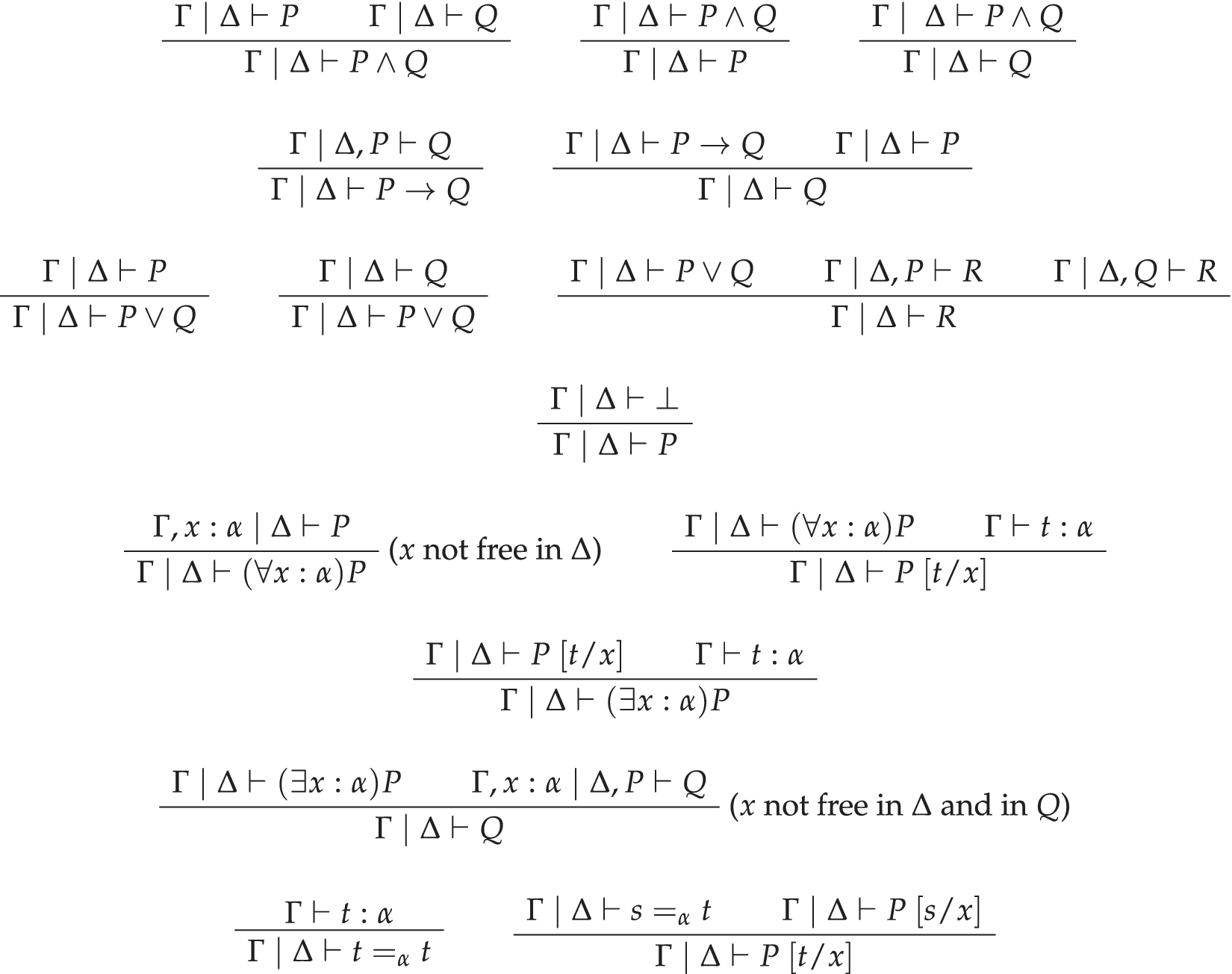
 . The definition of this notion is given by the rules in Figure 1 together with the usual structural rules that are implicitly assumed.Footnote
11
We will omit the type of propositions in giving the logical rules. We also need sequents of the form
$\Gamma \vdash t: \alpha $
 expressing that t is a well-formed term of type
$\alpha $
 under the assumptions in
$\Gamma $
 . Formally, sequents of this form are derived by treating the clauses in Definition 3.3 as term-forming rules, and will be used as premises in the logical rules of Figure 1.
Logical rules.

The axioms of the system are the following:
Axioms for
$\mathbb {N}$

-
– $x: \mathbb {N} \mid - \vdash \mathsf {succ}(x) =_{\mathbb {N}} 0 \rightarrow \bot $
. -
– $x: \mathbb {N}, y: \mathbb {N}\mid - \vdash \mathsf {succ}(x) =_{\mathbb {N}} \mathsf {succ}(y) \rightarrow x=_{\mathbb {N}} y$
. -
– $x: \mathbb {N}, y: \mathbb {N}\mid - \vdash x =_{\mathbb {N}} y \rightarrow \mathsf {succ}(x) =_{\mathbb {N}} \mathsf {succ}(y)$
. -
– $x : \mathbb {N} \mid - \vdash x + 0 =_{\mathbb {N}} x.$
-
– $x : \mathbb {N},\, y : \mathbb {N} \mid - \vdash x + \mathsf {succ}(y) =_{\mathbb {N}} \mathsf {succ}(x + y).$
-
– $x : \mathbb {N} \mid - \vdash x \cdot 0 =_{\mathbb {N}} 0.$
-
– $x : \mathbb {N},\, y : \mathbb {N} \mid - \vdash x \cdot \mathsf {succ}(y) =_{\mathbb {N}} (x \cdot y) + x.$
-
– $\Gamma \mid - \vdash P [0/x] \land (\forall n: \mathbb {N})(P [n/x] \rightarrow P[\mathsf {succ}(n)/x]) \rightarrow (\forall x: \mathbb {N}) P(x)$
,where $P(x): \Omega _n$
with
$x: \mathbb {N}$
and
$\Gamma $
contains the free variables of P other than x.


Axioms for
$\times $

-
– $x: \alpha , y: \beta \mid - \vdash \mathsf {pr}_1( (x,y)) =_\alpha x$
. -
– $x: \alpha , y: \beta \mid - \vdash \mathsf {pr}_2( (x,y)) =_\beta y$
. -
– $z: \alpha \times \beta \mid - \vdash (\mathsf {pr}_1(z), \mathsf {pr}_2(z)) =_{\alpha \times \beta } z$
.


Axioms of extensionality
-
– $X: \mathsf {Set}_n (\alpha ), Y: \mathsf {Set}_n (\alpha )\mid - \vdash X =_{\mathsf {Set}_n(\alpha )} Y \leftrightarrow (\forall z:\alpha ) (z\ \varepsilon \ X \leftrightarrow z\ \varepsilon \ Y).$
-
– $ P: \Omega _n, Q: \Omega _n\mid - \vdash (P =_{\Omega _n} Q) \leftrightarrow (P \leftrightarrow Q).$


Comprehension axiom
-
– $\Gamma , z:\alpha \mid - \vdash z\ \varepsilon \ [x:\alpha \ \vert \ P] \leftrightarrow P[z/x], $
where $P(x): \Omega _n$
with
$x: \alpha $
and
$\Gamma $
contains the free variables of P other than x.


Finally, the orders of propositions and sets are assumed to be cumulative:
-
– If $P : \Omega _n$
, then
$P: \Omega _{n + 1}$
. -
– If $A : \mathsf {Set}_n (\alpha )$
, then
$A : \mathsf {Set}_{n +1} (\alpha )$
.


Definition 3.4. The classical theory
$\mathcal {LM}$
 is obtained by adding to the logical rules the law of excluded middle
$\vdash P \lor \neg P$
 , for any
$P: \Omega _n$
 , to
$\mathcal {LM}^i$
 .
Lemma 3.5. For any type
$\alpha $
 and any order n, the equality relation
$=_\alpha $
 is an equivalence relation.
Lemma 3.6. The following statement is derivable:

Proof. By extensionality, we get
$x\ \varepsilon Y$
 . Then by equality rule, we can conclude
$y\ \varepsilon \ Y$
 .
Lemma 3.7. The following statement is derivable:

Lemma 3.8. The following principle is derivable in the system: whenever
$P: \Omega _n$
 ,

Proof. Let
$P(x)$
 be a proposition with order n and let us consider the term
$[ x: \alpha \ \vert \ P]: \mathsf {Set}_n (\alpha )$
 . It is clear that
$\forall x: \alpha \ ( x\ \varepsilon \ [x: \alpha \ \vert \ P] \leftrightarrow P(x))$
 holds. Therefore, the statement follows.
In [Reference Casari5] it is suggested that the axiom of extensionality for sets is given in the following form by Weyl: for propositions
$P, Q$
 of arbitrary level n

This principle is easily derivable in the present setting.
Lemma 3.9.
$\mathcal {LM}^i \vdash \mathsf {ext}$
 .
Proof. Given
$y : \alpha $
 such that
$P(y) \leftrightarrow Q(y)$
 , by comprehension we get
$y\ \varepsilon \ [x : \alpha \ \mid \ P(x)]\ \leftrightarrow y\ \varepsilon \ [x: \alpha \ \mid \ Q(x)]$
 . Then by extensionality the claim follows.
Notwithstanding, it is not possible to consider
$\mathsf {ext}$
 as a replacement for the axiom of extensionality, since it appears to be weaker. In particular, it seems that we can derive the axiom of extensionality from
$\mathsf {ext}$
 only under the assumption of this further principle:

First, we can prove that
$(\eta )$
 is derivable in
$\mathcal {LM}$
 .
Lemma 3.10.
$\mathcal {LM}^i \vdash \eta $
 .
Proof. By the comprehension axiom we know that for any
$x: \alpha $
 ,
$x\ \varepsilon \ [ x : \alpha \ \vert \ x\ \varepsilon \ X] \leftrightarrow x\ \varepsilon \ X$
 . Then by extensionality, we get the desired equality.
Secondly, we can prove that the full axiom of extensionality is derivable in the system
$\mathcal {LM}^{-}$
 —that is,
$\mathcal {LM}$
 minus extensionality—extended with the principles
$(\eta )$
 and
$(\mathsf {ext})$
 .
Lemma 3.11.
$\mathcal {LM}^{-} + \mathsf {ext} + \eta \vdash (\forall z:\alpha ) (z\ \varepsilon \ X \leftrightarrow z\ \varepsilon \ Y) \rightarrow X =_{\mathsf {Set}_n(\alpha )} Y $
 , for any
$X, Y: \mathsf {Set}_n(\alpha )$
 .
Proof. Let us assume
$\forall z:\alpha \ (z\ \varepsilon \ X \leftrightarrow z\ \varepsilon \ Y)$
 . Then by
$(\mathsf {ext})$
 ,
$[z: \alpha \ \vert \ z\ \varepsilon \ X] = [z: \alpha \ \vert \ z\ \varepsilon \ Y]$
 . Finally, by applying
$(\eta )$
 to both sides, we can conclude
$X = Y$
 .
As we have seen, finite domains are included by Weyl among the examples of extensionally determinate domains. Accordingly, it seems legitimate to extend the system with finite types. Finite types must be included among the ground types of
$\mathcal {LM}$
 . For instance, the unit type 1 contains a single canonical inhabitant

with the relevant axiom

stating that any other element in 1 is equal to the canonical element
$\ast $
 . The level of 1 is
$0$
 , that is,
$ \ell (\mathbf {1}) = 0$
 , since 1 is a ground type.
The inclusion of the unit type allows for a significant variation in the presentation of the system. We can dispense altogether with the types of propositions
$\Omega _n$
 : a proposition
$P: \Omega _n$
 can be encoded as a term
$[ x : \mathbf {1}\ \vert \ P]$
 belonging to the type
$\mathsf {Set}_n (\mathbf {1})$
 . In pursuing this approach, we need to present the syntax of the system as consisting of formulas that are a syntactic category distinct from terms and their types. In particular, the set of well-formed terms and the set of well-formed formulas will be defined simultaneously. However, in the following, we will stick to the presentation of the system with primitive types of propositions. Clearly, whenever the approach without the types
$\Omega _n$
 is adopted, the axioms of
$\mathcal {LM}$
 must be revised accordingly.
Palmgren followed a similar approach in [Reference Palmgren19]. He presents a system IRTT, which closely resembles
$\mathcal {LM}^i$
 , although with rather different motivations.Footnote
12
Moreover, he defines an interpretation of IRTT into a version of Martin-Löf Type Theory and introduces the FRA, which is validated by the interpretation and can be thought of as a more restrictive formulation of Russell’s reducibility axiom. It turns out that the axiom of functional reducibility is predicatively admissible only under the assumption of a constructive logic.
The types of IRTT are the unit type
$\mathbf {1}$
 , the natural numbers type
$\mathbb {N}$
 and they are closed under product
$\times $
 and restricted power set
$\mathcal {P}_n (\alpha )$
 . The logic is constructive and the axioms include congruence rules, Peano axioms, the induction scheme, extensionality and comprehension. Further, Palmgren assumes the axiom of relativized dependent choice and the axiom of functional reducibility. We will see that FRA can also be formulated within
$\mathcal {LM}$
 and is validated by the interpretation in HoTT. To formulate this axiom, we first need to introduce some elementary facts about the notion of function in
$\mathcal {LM}$
 .
The system
$\mathcal {LM}$
 does not include a primitive type of functions. However, in such a setting, functions can be represented as total functional relations by mimicking the usual set-theoretic definition.
Definition 3.12. The product
$A \otimes B : \mathsf {Set}_k (\alpha \times \beta )$
 of
$A: \mathsf {Set}_m (\alpha )$
 and
$B: \mathsf {Set}_n (\beta )$
 is defined as follows:

Definition 3.13. Given
$A: \mathsf {Set}_m (\alpha )$
 and
$B: \mathsf {Set}_n (\beta )$
 ,
$F_{A,B}: \mathsf {Set}_k ( \alpha \times \beta )$
 is said to be a function from A to B if it satisfies the following conditions:
-
(i) $F_{A,B}$
is a relation:
$(\forall x: \alpha ) (\forall y: \beta ) ( (x,y)\ \varepsilon \ F \rightarrow (x,y)\ \varepsilon \ A \otimes B)$
. -
(ii) $F_{A,B}$
is functional:
$(\forall x: \alpha ) (\forall y,y': \beta ) ((x,y)\ \varepsilon \ F \land (x,y')\ \varepsilon \ F \rightarrow y =_\beta y')$
. -
(iii) $F_{A,B}$
is total:
$(\forall x: \alpha ) (x\ \varepsilon \ A \rightarrow (\exists y: \beta ) (y\ \varepsilon \ B \land (x,y)\ \varepsilon \ F))$
.


We will denote a term
$F_{A,B}: \mathsf {Set}_k (\alpha \times \beta )$
 satisfying the conditions above with
$F: A \rightarrow _{k} B$
 .
Now we are ready to illustrate some basic facts and definitions regarding functions in
$\mathcal {LM}$
 . First, it is easy to observe that the axiom of extensionality for functions holds.
Lemma 3.14. If
$(\forall z : \alpha \times \beta ) ( z\ \varepsilon \ F \leftrightarrow z\ \varepsilon \ G)$
 , then
$F =_{\mathsf {Set}_k (\alpha \times \beta )} G$
 , for any
$F, G: A \rightarrow _{k} B$
 .
Proof. It immediately follows from the axiom of extensionality for sets.
We can define the notion of composition between functions and the identity function for any set-like term A.
Definition 3.15. For any
$A: \mathsf {Set}_n (\alpha )$
 , we define

Definition 3.16. Given
$F: A \rightarrow _{m} B$
 and
$G: B \rightarrow _{n} C$
 , where
$A: \mathsf {Set}_i(\alpha )$
 ,
$B : \mathsf {Set}_j (\beta )$
 and
$C: \mathsf {Set}_k (\gamma )$
 , we define

Note that the level of
$G \circ F$
 will depend on the levels of F and G as well as on that of
$\beta $
 .
The following proposition guarantees that these newly defined notions are well-behaved.
Proposition 3.17. For any
$1_A : A \rightarrow _{i} A$
 ,
$1_{B}: B \rightarrow _{j} B$
 ,
$F: A \rightarrow _{k} B$
 ,
$G: B \rightarrow _{m} C$
 ,
$H: C \rightarrow _{n} D$
 , the following equations hold:
-
i) $1_B \circ F_{A,B} = F_{A,B.}$
-
ii) $F_{A,B} \circ 1_A = F_{A,B.}$
-
iii) $H_{C,D} \circ (G_{B,C} \circ F_{A,B}) = (H_{C,D} \circ G_{B,C}) \circ F_{A,B.}$


Remark 1. It would be possible to extend the theory with a primitive notion of function types, where functions are expressed as
$\lambda $
 -terms. We can give the following clause to form the type
$\alpha \rightarrow \beta $
 (see also [Reference Leivant15]):
-
– If $\alpha $
and
$\beta $
are types and
$\ell (\alpha ) = m$
,
$\ell (\beta ) = n$
, then
$\alpha \rightarrow \beta $
is a type and
$\ell (\alpha \rightarrow \beta ) = \mathsf {max}(m,n)$
.


Then we could define the type
$\mathsf {Set}_{n}(\alpha )$
 as the type of propositional functions
$\alpha \rightarrow \Omega _n$
 and the definition preserves the level of the type. Furthermore, we could form the type of functions from natural numbers to natural numbers, which would have level
$0$
 . Hence, it would behave differently from the corresponding type of functional relations over natural numbers (viewed as a set). We leave the development of a version of the theory along these lines as a future task. We only remark that this development is essentially suggested by the interpretation in HoTT that we will consider later.
3.1 The arithmetical theory and ACA
$_0$

In this section, we turn our attention to the (classical) theory resulting from the restricted process. As we have seen in §2.1, the restricted process consists in limiting the comprehension axiom to arithmetical propositions. Thus, it prevents the introduction of higher-level sets, thereby blocking the iteration of the mathematical process. It follows that we need only the type of natural numbers and the type of arithmetical sets
$\mathsf {Set}_0 (\mathbb {N})$
 . Furthermore, there is no need to introduce a type of arithmetical propositions: they are defined simultaneously with the terms, but are not treated as terms themselves. We will only distinguish between arithmetical propositions and arbitrary propositions, which might contain quantifiers ranging over the type of arithmetical sets, but do not enter into the definition of set-like abstraction terms. Therefore, all the conventions about levels, set out in Definition 3.2, are superfluous in this context and the type structure is drastically simplified.
The main interest in studying the system resulting from the restricted process is that it can be compared to the system considered by Feferman in [Reference Feferman, Cellucci and Sambin10] as faithful formalization of Weyl’s ideas in Das Kontinuum. As we remarked above, Feferman’s proposal has been criticized for being a too restrictive formalization of Weyl’s conception of predicativity. However, there seems to be a general agreement on the fact that predicative analysis as conceived by Weyl can be formalized in systems of this strength.
Among the systems introduced in [Reference Feferman, Cellucci and Sambin10], the system
$K^{(\alpha )}$
 is of interest to us. As already observed by Feferman, such a system can be drastically simplified and turns out to be equivalent to the second-order system known as ACA
$\!\! _0$
 . This system is formulated in the two-sorted language
$L_2$
 .
Definition 3.18. The language
$L_2$
 is defined as follows:
-
– Number variables $k,m,n \ldots $
and set variables
$X, Y, Z \ldots $
-
– Terms: Each numerical variable is a term, the constants $0$
and
$1$
are terms and if
$s,t$
are terms, so are
$s + t$
and
$s \cdot t$
. -
– Formulas: Atomic formulas are those formulas of the form $s = t$
, where
$s,t$
are terms, and
$t \in X$
, where t is a term and X is a set variable. Formulas are built from atomic formulas by the usual connectives and quantifiers for both number and set variables.


The non-logical axioms of ACA
$_0$
 are the universal closures of the following formulas in
$L_2$
 :
-
– Basic axioms:
$$ \begin{align*} & n + 1 \neq 0 & m + 1 = n + 1 \rightarrow m = n \\ & m + 0 = m & m + (n +1) = (m + n) + 1 \\ & m \cdot 0 = 0 & m \cdot (n + 1) = (m \cdot n) + m. \end{align*} $$
-
– Induction axiom:
$$ \begin{align*} (0 \in X \land \forall n (n \in X \rightarrow n + 1 \in X)) \rightarrow \forall n (n \in X). \end{align*} $$
-
– Arithmetical comprehension axiom:
$$ \begin{align*} \exists X \forall n (n \in X \leftrightarrow \phi(n)), \end{align*} $$where $\phi (n)$
is arithmetical and X does not occur free in
$\phi $
.


This concludes the presentation of ACA
$_0$
 . Next, we introduce the system
$\mathcal {LM}_0$
 , that is meant to provide an axiomatization of the restricted process. The type structure of
$\mathcal {LM}_0$
 is defined as follows.
Definition 3.19. The types of
$\mathcal {LM}_0$
 are the following:

Definition 3.20. The terms and the arithmetical propositions of
$\mathcal {LM}_0$
 are simultaneously defined as follows:
-
– For each type $\alpha $
, countably many variables of types
$\alpha $
. -
– $0: \mathbb {N}$
and if
$a : \mathbb {N}$
, then
$\mathsf {succ}(a): \mathbb {N}$
. -
– If $a,b: \mathbb {N}$
, then
$a + b: \mathbb {N}$
and
$a \cdot b: \mathbb {N} $
. -
– If $P,Q $
are arithmetical propositions, then
$P\ \Box \ Q $
is an arithmetical proposition, where
$\Box \in \{ \land , \lor , \rightarrow \}$
. -
– If P is an arithmetical proposition, then $\neg P$
is an arithmetical proposition. -
– If $P(x)$
is an arithmetical proposition for a variable
$x: \mathbb {N}$
, then
$\mathcal {Q} x: \mathbb {N}.P$
is an arithmetical proposition, where
$\mathcal {Q} \in \{ \exists , \forall \}$
. -
– If $a, b : \mathbb {N}$
, then
$a =_{\mathbb {N}} b$
is an arithmetical proposition. -
– If $a : \mathbb {N}$
and
$X : \mathsf {Set}_0(\mathbb {N})$
, then
$a\ \varepsilon \ X $
is an arithmetical proposition. -
– If $P(x)$
is an arithmetical proposition for a variable
$x : \mathbb {N}$
, then
$[ x: \mathbb {N}\ \vert \ P ]: \mathsf {Set}_0(\mathbb {N})$
.


While we cannot introduce higher-level sets in
$\mathcal {LM}_0$
 , we can still form non-arithmetical propositions. Therefore, we are going to introduce a definition for such a class of propositions, which must also be considered for interpreting arbitrary formulas in the language of
$\mathbf {ACA}_0$
 . We call these simply propositions and they extend the arithmetical ones.
Definition 3.21. The propositions of
$\mathcal {LM}_0$
 are defined as follows:
-
– If P is an arithmetical proposition, then P is a proposition.
-
– If $P,Q$
are propositions, then
$P\ \Box \ Q $
, where
$\Box \in \{ \land , \lor , \rightarrow \}$
is a proposition. -
– If P is a proposition, then $\neg P$
is a proposition. -
– If $P(X)$
is a proposition for a variable
$X: \mathsf {Set}_0(\mathbb {N})$
, then
$\mathcal {Q} X: \mathsf {Set}_{0}(\mathbb {N}).P $
is a proposition, where
$\mathcal {Q} \in \{ \exists , \forall \}$
. -
– If $X,Y : \mathsf {Set}_0(\mathbb {N})$
, then
$X =_{\mathsf {Set}_0(\mathbb {N})} Y$
is a proposition.


Remark 2. It is possible to introduce a type of arithmetical propositions, thereby defining them as standard terms. However, this would make the translation into
$\mathbf {ACA}_0$
 slightly more complicated. Overall,
$\mathcal {LM}_0$
 can easily be seen as a subsystem of
$\mathcal {LM}$
 .
We assume any standard axiomatisation for many-sorted classical logic and Peano axioms for zero, successor, addition and multiplication. The other axioms of
$\mathcal {LM}_0$
 are the following:
-
– Induction axiom: For every $X: \mathsf {Set}_0(\mathbb {N})$
, $$ \begin{align*} (0\ \varepsilon\ X \land \forall n : \mathbb{N}\ (n\ \varepsilon\ X \rightarrow \mathsf{succ}(n)\ \varepsilon\ X)) \rightarrow \forall n: \mathbb{N}\ ( n\ \varepsilon\ X). \end{align*} $$
-
– Extensionality axiom: For every $X, Y: \mathsf {Set}_0 (\mathbb {N})$
, $$ \begin{align*} (\forall z: \alpha) ( z\ \varepsilon\ X \leftrightarrow z\ \varepsilon\ Y) \rightarrow (X =_{\mathsf{Set}_0 (\mathbb{N})} Y). \end{align*} $$
-
– Arithmetical comprehension axiom: For every $z: \mathbb {N}$
, $$ \begin{align*} z\ \varepsilon\ [x: \mathbb{N}\ \vert\ P] \leftrightarrow P [z/x], \end{align*} $$where P is arithmetical.


Remark 3. According to the restricted process, the extensionally determinate sets are identified with the arithmetical sets. Therefore, it follows that the collection of all extensionally determinate sets is not extensionally determinate, since the collection of arithmetical sets is not arithmetically definable. This provides a good example of the different strengths of the two processes. The iteration of the mathematical process allows us to consider the collection of arithmetical sets as an extensionally determinate set of higher level. In fact, we can form the set
$V_0 \ :=\ [ X: \mathsf {Set}_0 (\mathbb {N})\ \mid \ X =_{\mathsf {Set}_0 (\mathbb {N})} X ]$
 , which is perfectly well-defined whenever we iterate the mathematical process.
On the basis of the previous considerations about the formalization of predicative analysis in
$\mathbf {ACA}_0$
 , we want to show that
$\mathcal {LM}_0$
 and
$\mathbf {ACA}_0$
 are mutually interpretable. In this way, we can vindicate the claim that the restricted process is enough for developing predicative analysis in the style of Das Kontinuum.
The translation from
$\mathbf {ACA}_0$
 to
$\mathcal {LM}_0$
 is defined in a straightforward way: numerical terms are sent to terms of type
$\mathbb {N}$
 and set variables to variables of type
$\mathsf {Set}_0(\mathbb {N})$
 . The inductive clauses of the translation are given in the following definition.
Definition 3.22. The map
$(-)^\tau $
 from the language of
$\mathbf {ACA}_0$
 to the language of
$\mathcal {LM}_0$
 is defined as follows: in the case of terms we have

for arithmetical formulas we have

and the definition extends naturally to arbitrary formulas in the language of
$\mathbf {ACA}_0$
 , therefore only the clauses for quantifiers are given

Next, we show that the translation
$(-)^\tau $
 is sound.
Theorem 3.23. If
$\mathbf {ACA}_0 \vdash \phi $
 , then
$\mathcal {LM}_0 \vdash \phi ^\tau $
 .
Proof. The proof is a straightforward induction over the derivation of
$\phi $
 . The induction axiom is trivially validated by the corresponding axiom in
$\mathcal {LM}_0$
 . While, arithmetical comprehension is validated as follows: given a formula
$\phi (n)$
 with
$n: \mathbb {N}$
 , we can introduce the set
$[ n : \mathbb {N}\ \vert \ \phi (n)]: \mathsf {Set}_0 (\mathbb {N}) $
 . Then, the following trivially holds:

Hence, we conclude
$\exists X: \mathsf {Set}_0 (\mathbb {N})\ \forall n: \mathbb {N}\ ( n\ \varepsilon \ X\ \leftrightarrow \ \phi (n))$
 . This allows to interpret arithmetical comprehension.
In order to define a translation from
$\mathcal {LM}_0$
 to
$\mathbf {ACA}_0$
 , we follow a strategy similar to that employed in [Reference Adams and Luo3].
For each numerical term a of
$\mathcal {LM}_0$
 , we define an arithmetical formula of
$\mathbf {ACA}_0\, \eta _a(x)$
 , with x fresh, such that
$\mathbf {ACA}_0 \ \vdash \ \exists !x.\eta _a(x)$
 . To each set-term A of
$\mathcal {LM}_0$
 , we associate an arithmetical formula
$\theta _A(x)$
 , with x fresh, such that
$\mathbf {ACA}_0 \vdash \exists ! X. \forall x (x \in X \leftrightarrow \theta _A(x))$
 . An arithmetical proposition P is translated as an arithmetical formula
$ P^\star $
 and an arbitrary proposition is translated as an arbitrary formula in the language of
$\mathbf {ACA}_0$
 . Finally, it must be noted that in the language of
$\mathbf {ACA}_0$
 as defined in Definition 3.18 equality of sets is not included. However, the extension with the definition

is trivially a definitional extension of
$\mathbf {ACA}_0$
 , because we can derive within the theory that if for all
$x\, (x \in X\ \leftrightarrow \ x =x)$
 and for all x,
$ (x \in Y\ \leftrightarrow \ x =x)$
 hold, then
$X = Y$
 follows. This guarantees that the arithmetical sets interpreting set-terms of
$\mathcal {LM}_0$
 are unique and, moreover, that we can interpret the axiom of extensionality for sets.
Definition 3.24. The translation from
$\mathcal {LM}_0$
 terms and propositions to
$\mathbf {ACA}_0$
 is defined as follows:


The following lemmas are proved by induction.
Lemma 3.25. For any term a of
$\mathcal {LM}_0$
 , it holds in
$\mathbf {ACA}_0$
 that
$\eta _a(x) \land \eta _a(y)\ \rightarrow \ x = y$
 , where
$x,y$
 are fresh variables.
Proof. This is established by induction over the derivation of a.
Lemma 3.26. If a is a term of type
$\mathbb {N}$
 in
$\mathcal {LM}_0$
 , then
$\mathbf {ACA}_0 \vdash \exists !x\ \eta _a (x)$
 .
If
$ A$
 is a term of type
$\mathsf {Set}_0 (\mathbb {N})$
 in
$\mathcal {LM}_0$
 , then
$\mathbf {ACA}_0 \vdash \exists !\ X\ \forall x\ (x \in X\ \leftrightarrow \ \theta _A(x))$
 .
Proof. By induction over the structure of the term.
Lemma 3.27 (Substitution)
The following statements are derivable in
$\mathbf {ACA}_0$
 , where
$z, y$
 are fresh and
$\zeta _a$
 is equal to
$\eta _a$
 or
$\theta _a$
 whether
$a $
 stands for a numerical term or a set-like term, respectively:
-
– $\zeta _a (z)\ \rightarrow \ (\eta _{b[a/x]}(y)\ \leftrightarrow \ \eta _b (y)[z/x])$
. -
– $\zeta _a (z)\ \rightarrow \ (\theta _{A [a/x]}(y)\ \leftrightarrow \ \theta _A(y) [z/x])$
. -
– $\zeta _a(z)\ \rightarrow \ (( P[a/x])^\star \ \leftrightarrow \ P^\star \ [z/x])$
.


Proof. This is established by induction over the structure of terms and formulas.
Theorem 3.28. The translation of
$\mathcal {LM}_0$
 in
$\mathbf {ACA}_0$
 is valid. Therefore, the following statement holds:
-
– If $\mathcal {LM}_0 \vdash P$
, then
$\mathbf {ACA}_0 \vdash P^\star $
.


Proof. The proof is by induction over the derivations. In the case of comprehension, we get

which holds by the substitution lemma.
For the set extensionality axiom, let us assume that for all x,

Then, in particular, we have that
$z \in X \leftrightarrow z\in Y$
 by definition of the interpretation. This corresponds to
$X = Y$
 . The induction axiom is trivially validated by the corresponding axiom in
$\mathbf {ACA}_0$
 .
Furthermore, the following facts hold.
Theorem 3.29.
-
– For each term t of $\mathbf {ACA}_0$
,
$\mathbf {ACA}_0 \vdash \zeta _{t^\tau }(t)$
, where
$\zeta _t$
is defined as in Lemma 3.27. -
– For each formula P of $\mathbf {ACA}_0$
,
$\mathbf {ACA}_0 \vdash P\ \leftrightarrow ( P^{\tau })^\star $
.


Proof. The proof is by induction over the derivations. Both claims immediately follow from the definitions of the two interpretations.
This allows us to conclude that
$\mathcal {LM}_0$
 is conservative over
$\mathbf {ACA}_0$
 .
Corollary 3.30 (Conservativity)
For any formula P in the language of
$\mathbf {ACA}_0$
 , if
$\mathcal {LM}_0 \vdash P^{\tau }$
 , then
$\mathbf {ACA}_0 \vdash P$
 .
Proof. By the validity of the interpretation if
$P^{\tau }$
 is derivable in
$\mathcal {LM}_0$
 , then
$( P^\tau )^\star $
 is derivable in
$\mathbf {ACA}_0$
 . Further, by the previous theorem,
$( P^\tau )^\star \ \leftrightarrow \ P$
 is derivable in
$\mathbf {ACA}_0$
 and then so is P.
4 Interpretation in HoTT
In this section, we are going to define an interpretation of the system
$\mathcal {LM}^i$
 in HoTT. The interpretation can be easily extended to
$\mathcal {LM}$
 whenever HoTT is extended with LEM for h-propositions. First, we will review some preliminary facts about HoTT, following the standard reference [22]. Then, we will provide a definition of the interpretation and establish its validity.
4.1 Preliminaries
We will work with a version of type theory including the following type constructors:

In particular, for each external natural number i, the universe
$\mathcal {U}_i$
 is univalent. We assume a countable and cumulative hierarchy of univalent universes.
The Univalence Axiom is the following principle:

where the type
$A \simeq B$
 is the type of equivalences as defined in [22].
Definition 4.1. A universe
$\mathcal {U}$
 is said to be univalent if it satisfies UA.
We recall that the following two principles are derivable in the presence of UA:
-
– Function extensionality: Let us suppose $f, g: \Pi _{(x:A)} B$
. The map $$ \begin{align*} \mathsf{happ}(f,g): \mathrm{Id}_{(\Pi_{(x:A)}B}(f,g) \rightarrow \Pi_{(x:A)} \mathrm{Id}_B (f(x), g(x)) \end{align*} $$is an equivalence.
-
– Propositional extensionality: Let us suppose $P, Q: \mathcal {U}$
are h-propositions. The map $$ \begin{align*} \mathsf{idleqv}: (P =_{\mathcal{U}} Q) \rightarrow (P \leftrightarrow Q) \end{align*} $$is an equivalence.


The statement of propositional extensionality involves the notion of h-proposition that is defined as follows.
Definition 4.2. A type
$A: \mathcal {U}_i$
 is an h-proposition if the following type is inhabited:

In the same way, we can introduce the notion of h-set.
Definition 4.3. A type
$A: \mathcal {U}_i$
 is an h-set if the following type is inhabited:

Therefore, we can introduce a proof-term witnessing the fact that if A is an h-set, then its identity type is an h-proposition:

In general, it is possible to introduce a hierarchy of homotopy levels such that if A is of h-level
$n+1$
 , then
$\mathrm {Id_A}$
 is of h-level n (see [22, chap. 3]). Furthermore, such a hierarchy is cumulative [22, theorem 7.1.7].
Theorem 4.4. If a type
$A: \mathcal {U}_i$
 has h-level n, then it also has h-level
$n + 1$
 .
In particular, it holds that every h-proposition is an h-set and thus we can introduce the following proof-term:

H-propositions in HoTT satisfy the following closure properties.
Lemma 4.5. The types 0 and 1 are h-propositions and h-propositions are closed under the type constructors
$\times $
 and
$\Pi $
 (and hence also
$\rightarrow $
 ).
We can define the logic of h-propositions as follows:

The previous lemma allows us to introduce the following proof-terms, which we will need in the interpretation of
$\mathcal {LM}$
 :

As it stands, the logic of h-propositions suffers from severe limitations. In particular, it cannot express disjunction and existential quantification, since h-propositions are not closed under coproducts and dependent sums. The solution to these problems is provided by propositional truncation, which is an example of higher inductive type. This type constructor is given by the following rules:
-
– Formation: If $A: \mathcal {U}_i$
, then
$\lvert \lvert A\rvert \rvert : \mathcal {U}_i$
. -
– Introduction $_{1}$
: If
$a : A$
, then
$\lvert a\rvert : \lvert \lvert A \rvert \rvert $
. -
– Introduction $_{2}$
: If
$a,b: \lvert \lvert A \rvert \rvert $
, then
$\mathsf {sq}(a,b): \mathrm {Id_{\lvert \lvert A \rvert \rvert }}(a,b)$
. -
– Elimination: Let $C(z)$
be a family of types over
$z: \lvert \lvert A \rvert \rvert $
. If
$t: \lvert \lvert A \rvert \rvert $
,
$c_0 : C(\lvert a\rvert )$
and
$c_1: \mathsf {sq}(x,y)_{\ast }(d) =_{C(y)} e$
Footnote
13
under the assumptions
$x,y: \lvert \lvert A \rvert \rvert $
,
$d: C(x)$
and
$e: C(y)$
, then
$\mathsf {ind}_{\lvert \lvert \ \rvert \rvert }(t, c_0, c_1): C(t)$
.


Since the propositional truncation of a type is always an h-proposition, we can introduce the following proof-term:

Thanks to propositional truncation, disjunction and existential quantification can be defined as follows:

The following proof-terms are introduced to encode the fact that these are h-propositions:

In HoTT it is possible to show that h-sets satisfy the following closure properties.
Lemma 4.6. Finite types and natural number type are h-sets and h-sets are closed under the following type constructors:
$+, \Pi , \Sigma , \mathcal {W} $
 and set quotients. More generally, h-sets form a
$\Pi W$
 -pretopos.
We can introduce the following proof-terms witnessing that h-sets are closed under the corresponding type constructors:

H-sets are also closed under a classifier for h-propositions sitting within a universe
$\mathcal {U}_i$
 :

Such a type is an h-set:

The type of h-sets within a universe
$\mathcal {U}_i$
 is denoted by

Finally, we state the following lemma (see Lemma 2.3.1 in [22]) that we will use later.
Lemma 4.7. Given
$P: A \rightarrow \mathcal {U}_i$
 and
$x,y: A$
 , if
$p: \mathrm {Id}_A (x,y)$
 , then there is a map
$p_\ast : P(x) \rightarrow P(y)$
 .
4.2 The interpretation
We are going to show that
$\mathcal {LM}^i$
 can be interpreted in a fragment of the theory presented in [22] with propositional truncation as primitive type former and a cumulative hierarchy of univalent universes
$\mathcal {U}_i$
 . Furthermore, the interpretation extends to
$\mathcal {LM}$
 whenever HoTT is extended with the law of excluded middle.
The basic idea underlying the interpretation can be easily explained: a type
$\alpha $
 of
$\mathcal {LM}^i$
 is interpreted as an h-set in HoTT. More in detail, to each
$\mathcal {LM}^i$
 -type
$\alpha $
 , we associate a pair
$(\alpha ^{\circ }, \sigma _{\alpha ^{\circ }}): \mathsf {Set}_{\mathcal {U}_i}$
 , where the first element is a type in
$\mathcal {U}_i$
 and the second element is a proof that such a type is an h-set. Moreover, the universe level i is equal to
$\ell (\alpha )$
 . Therefore, in this interpretation ramification levels of
$\mathcal {LM}^i$
 -types are managed through universe levels in HoTT. In general, a term a with type
$\alpha $
 will be interpreted as
$a^\circ : \mathsf {pr}_1(\alpha ^\circ )$
 . In the case of propositions—that is, terms of type
$\Omega _n$
 —we have that a proposition
$P: \Omega _i$
 is interpreted as a pair
$(P^\circ , \pi _{P^\circ })$
 in
$\mathsf {Prop}_i$
 : the first element of the pair is a type in
$\mathcal {U}_i$
 and and the second element is a proof that
$P^\circ $
 is an h-proposition. Therefore, the derivation of a sequent with conclusion P is interpreted as the derivation of a judgement asserting that the type
$P^\circ $
 is inhabited.
Definition 4.8. We define an interpretation function
$(-)^\circ $
 from
$\mathcal {LM}^i$
 types and terms into HoTT types and terms as follows:

For the sake of brevity, proof-terms witnessing h-propositions have been written without spelling out their arguments: e.g.,
$\pi _\land $
 is an abbreviation for
$\pi _\land (\mathsf {pr}_1(P^\circ ), \mathsf {pr}_1(Q^\circ ), \mathsf {pr}_2(P^\circ ), \mathsf {pr}_2(Q^\circ ))$
 that is of type
$ \mathsf {isProp}(\mathsf {pr}_1(P^\circ ) \land \mathsf {pr}_1(Q^\circ ))$
 . On the other hand, proof-terms for h-sets have been written with their type arguments as subscripts.
Lemma 4.9.
-
– If P is a proposition of type $\Omega _n$
, then
$(P)^\circ $
is of type
$\mathsf {Prop}_{\mathcal {U}_n}$
. -
– If $\alpha $
is a type with level n, then
$(\alpha )^\circ : \mathsf {Set}_{\mathcal {U}_n}$
.


Proof. If
$P\ :=\ Q_1 \land Q_2 : \Omega _n$
 , then by induction hypothesis
$Q_1^\circ , Q_2^\circ : \mathsf {Prop}_{\mathcal {U}_n}$
 . This means that
$\mathsf {pr}_1(Q_1^\circ ), \mathsf {pr}_1 (Q_2^\circ ): \mathcal {U}_n$
 and
$\mathsf {pr}_2(Q_1^\circ ): \mathsf {isProp}(\mathsf {pr}_1(Q_1^\circ ))$
 and
$\mathsf {pr}_2(Q_2^\circ ): \mathsf {isProp}(\mathsf {pr}_1(Q_2^\circ ))$
 . Then, it follows that

and

that amounts to
$(Q_1 \land Q_2)^\circ : \mathsf {Prop}_{\mathcal {U}_n}$
 .
If
$P\ :=\ (\forall x: \alpha )\ Q: \Omega _n$
 , then by induction hypothesis
$\alpha ^\circ : \mathsf {Set}_{\mathcal {U}_n}$
 and
$Q^\circ : \mathsf {Prop}_{\mathcal {U}_n}$
 . Then, in particular
$\mathsf {pr}_1(Q^\circ ): \mathcal {U}_n$
 with
$\mathsf {pr}_2(Q^\circ ): \mathsf {isProp}(\mathsf {pr}_1(Q^\circ ))$
 . Therefore, we can form

with
$\pi _\forall (\mathsf {pr}_1(\alpha ^\circ ), x.\mathsf {pr}_1(Q^\circ (x)), x.\mathsf {pr}_2(Q^\circ (x))): \mathsf {isProp}( \forall _{(x: \mathsf {pr}_1(\alpha ^\circ ))} \mathsf {pr}_1(Q^\circ ))$
 .
But this means that
$(\forall (x : \alpha )\ Q)^\circ : \mathsf {Prop}_{\mathcal {U}_n}$
 .
If
$P\ :=\ a =_\alpha b: \Omega _n$
 , then by induction hypothesis we have
$\alpha : \mathsf {Set}_{\mathcal {U}_n}$
 and
$a^\circ , b^\circ : \mathsf {pr}_1(\alpha ^\circ )$
 . Then, we can form the type
$\mathrm {Id}_{\mathsf {pr}_1(\alpha ^\circ )} (a^\circ , b^\circ ): \mathcal {U}_n$
 .
By induction hypothesis we also have
$\mathsf {pr}_2(\alpha ^\circ ): \mathsf {isSet}(\mathsf {pr}_1(\alpha ^\circ ))$
 , hence we can derive the following proof-term:

Therefore,
$( a =_\alpha b :\Omega _n)^\circ : \mathsf {Prop}_{\mathcal {U}_n}$
 .
If
$P\ :=\ a\ \varepsilon \ B: \Omega _n $
 , then by induction hypothesis we have
$a^\circ : \mathsf {pr}_1(\alpha ^\circ )$
 , where
$\alpha ^\circ : \mathsf {Set}_{\mathcal {U}_n}$
 , and
$B^\circ : \mathsf {pr}_1(\alpha ^\circ ) \rightarrow \mathsf {Prop}_{\mathcal {U}_n}$
 . Therefore, it is immediate that
$B^\circ (a^\circ ): \mathsf {Prop}_{\mathcal {U}_n}$
 and so
$(a\ \varepsilon \ B)^\circ : \mathsf {Prop}_{\mathcal {U}_n}$
 .
When
$\alpha $
 is a ground type, the result is immediate by definition of the interpretation. When
$\alpha $
 is
$\beta _1 \times \beta _2$
 or
$\mathsf {Set}_n (\beta )$
 , then the result follows by the definition of the interpretation and the elementary closure properties of h-sets.
Lemma 4.10. The cumulativity conditions are validated by the interpretation
$(-)^\circ $
 : if
$P^\circ : \mathsf {Prop}_{\mathcal {U}_n}$
 , then
$P^\circ : \mathsf {Prop}_{\mathcal {U}_{n +1 }}$
 and
$A^\circ : \mathsf {Set}_{\mathcal {U}_{n}}$
 , then
$A^\circ : \mathsf {Set}_{\mathcal {U}_{n+1}}$
 .
Proof. This follows immediately from the cumulativity of universes in HoTT.
Theorem 4.11. If
$\Gamma \mid \Delta \vdash P$
 (where
$\Gamma , \Delta $
 might be empty) is derivable in
$\mathcal {LM}^i$
 , then
$(\Gamma \mid \Delta \vdash P)^\circ $
 is derivable in HoTT. Therefore, the interpretation
$(-)^\circ $
 is sound.
Proof. The proof proceeds by induction over the derivation. In general, a context
$\Gamma \mid \Delta $
 , where
$\Gamma := [ x_1: \alpha _1, \ldots , x_n :\alpha _n]$
 and
$\Delta := [Q_1, \ldots , Q_n]$
 , is interpreted as a context in HoTT with the following form:

For the logical rules, we consider the following examples, since it is straightforward to extend the proof to the other cases as well.
For the conjunction introduction rule, we reason as follows: by induction hypothesis, we have constructed proof-terms
$p: \mathsf {pr}_1(P^\circ )$
 and
$q : \mathsf {pr}_1(Q^\circ )$
 , where
$P^\circ , Q^\circ : \mathsf {Prop}_{\mathcal {U}_n}$
 . Then, it follows that

which is the interpretation of the conclusion. For the elimination rules, we reason as follows: by induction hypothesis, we have constructed a proof-term
$p: \mathsf {pr}_1(P^\circ ) \land \mathsf {pr}_2(Q^\circ )$
 , then it is immediate to conclude
$\mathsf {pr}_1(p): \mathsf {pr}_1(P^\circ )$
 . The other case is treated in the same way by applying the second projection.
For the disjunction introduction rules, we proceed as follows: by induction hypothesis, we have constructed a proof-term
$p: \mathsf {pr}_1(P^\circ )$
 , where
$P^\circ : \mathsf {Prop}_{\mathcal {U}_n}$
 . Then, it follows

where
$\mathsf {pr}_1(P^\circ ) \lor \mathsf {pr}_1(Q^\circ )$
 is an h-proposition in
$\mathcal {U}_n$
 and thus the conclusion is validated. The other rule is derived in the same way using
$\lvert \mathsf {inl}(q) \rvert $
 .
For the elimination rule, we reason as follows: by induction hypothesis we have constructed proof-terms
$c: \mathsf {pr}_1(P^\circ ) \lor \mathsf {pr}_1(Q^\circ ), d_0(x): \mathsf {pr}_1(R^\circ )$
 where
$x: \mathsf {pr}_1(P^\circ )$
 and
$d_1(y): \mathsf {pr}_1(R^\circ )$
 where
$y: \mathsf {pr}_1(Q^\circ )$
 .
Then by the elimination rule for propositional truncation, we get

which abbreviates as

and hence the conclusion is valid.
The introduction rule of the universal quantifier is interpreted as follows: by induction hypothesis, we have constructed a proof-term
$p: \mathsf {pr}_1(P^\circ (x))$
 with
$x: \mathsf {pr}_1(\alpha ^\circ )$
 . Then, we can derive the following term:
$\lambda x.p$
 with type
$\forall _{(x : \mathsf {pr}_1(\alpha ^\circ ))} \mathsf {pr}_1 (P^\circ )$
 and we know that such a type is an h-proposition.
For the elimination rule, we reason as follows: by induction hypothesis we have
$p: \forall _{(x : \mathsf {pr}_1(\alpha ^\circ ))} \mathsf {pr}_1 (P^\circ )$
 and
$a^\circ : \mathsf {pr}_1(\alpha ^\circ )$
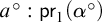 . Therefore, it is immediate to conclude by the elimination rule
$p(a^\circ ): \mathsf {pr}_1(P^\circ [a^\circ /x])$
 .
For the interpretation of the first equality rule, by induction hypothesis we have
$t^\circ : \mathsf {pr}_1(\alpha ^\circ )$
 . Therefore, it is immediate to conclude by the introduction rule for propositional equality

which amounts to the interpretation of the conclusion.
The second equality rule is validated as follows: by induction hypothesis, we have constructed
$p: \mathrm {Id}_{\mathsf {pr}_1(\alpha ^\circ )}(s^\circ , t^\circ )$
 and
$q: \mathsf {pr}_1(P^\circ )(s^\circ )$
 .
Therefore, by applying Lemma 4.7, we get
$p_\ast (q): \mathsf {pr}_1(P^\circ (t^\circ ))$
 .
For the other axioms of
$\mathcal {LM}^i$
 , let us first remark that the image of their interpretations in HoTT turns out to be an h-prop and so a pair. We show that the first component of the pair is inhabited to derive the validity of the axioms.
The first three axioms for natural numbers are easily derivable in HoTT and, moreover, since they have the form of implications between h-propositions, it follows that they are h-propositions. The derivation of the axioms for addition and multiplication is also entirely standard. In the case of the induction scheme, instead, it is easy to show that it can be derived by an application of a particular instance of the elimination rule for
$\mathbb {N}$
 in HoTT. Since
$\mathcal {LM}^i$
 -types are interpreted as h-sets, then it follows that the axioms for
$\times $
 are h-propositions. Furthermore, that the interpretations of these axioms are inhabited follow from the rules for
$\times $
 in HoTT.Footnote
14
The axiom of extensionality for sets is interpreted as follows: given
$X^\circ , Y^\circ : \mathsf {pr}_1(\alpha ^\circ ) \rightarrow \mathsf {Prop}_{\mathcal {U}_n}$
 , we want to prove that

Let
$z : \mathsf {pr}_1(\alpha ^\circ )$
 and
$t: X^\circ (z) \leftrightarrow Y^\circ (z) $
 , then by propositional extensionality we get a proof of
$\mathrm {Id}_{\mathsf {Prop}_{\mathcal {U}_n}}(X^\circ (z), Y^\circ (z))$
 .
By discharging the assumption, we get a proof of
$\Pi _{(z: \mathsf {pr}_1(\alpha ^\circ ))} \mathrm {Id}_{\mathsf {Prop}_{\mathcal {U}_n}}(X^\circ (z), Y^\circ (z))$
 . Finally by function extensionality, we conclude that
$\mathrm {Id}_{(\mathsf {pr}_1(\alpha ^\circ ) \rightarrow \mathsf {Prop}_{\mathcal {U}_n})}(X^\circ , Y^\circ )$
 is inhabited.
Extensionality for propositions is immediately validated by propositional extensionality in HoTT.
Finally, the Comprehension Axiom is interpreted as follows. Given
$z: \mathsf {pr}_1(\alpha ^\circ )$
 , we want to show that

This follows from the validity of the corresponding equality and an application of propositional extensionality.
It follows from the results in [Reference Rathjen, Jäger and Sieg20] that the proof-theoretic strength of the fragment of HoTT assumed to carry out the interpretation of
$\mathcal {LM}^i$
 is
$\Gamma _0$
 .
Corollary 4.12. Feferman–Schütte ordinal
$\Gamma _0$
 is an upper bound for
$\mathcal {LM}^i$
 .
It is important to observe that the interpretation can be carried out without assuming the type of well-founded trees
$\mathcal {W}$
 . This is crucial for the above corollary.
It is possible to extend HoTT with the law of excluded middle for h-propositions:

Theorem 4.13. The interpretation of
$\mathcal {LM}$
 in HoTT extended with LEM for h-propositions is valid.
However, in this case it is not possible to conclude that
$\Gamma _0$
 is an upper bound for the theory, because HoTT becomes fully impredicative when extended with classical logic. Therefore, the translation is not very informative proof-theoretically in the classical case. In any case, it is reasonable to expect that the strength of the classical system
$\mathcal {LM}$
 is below
$\Gamma _0$
 .
Remark 4. We could have adopted the interpretation proposed by Palmgren in [Reference Palmgren19] for his theory IRTT. Palmgren provides an interpretation within Martin-Löf Type Theory with an infinite sequence of universes. The construction relies on the notion of setoid, i.e., a type X endowed with an equivalence relation
$\sim _X$
 . Functions between setoids and predicates over setoids are assumed to respect this equivalence relation. In particular, set-like terms are interpreted as extensional propositional functions, ensuring that the extensionality axiom is immediately validated. Finally, propositions are interpreted via the traditional propositions-as-types approach.
In our interpretation, we avoid the use of setoids, working instead with h-sets, and the extensional principles are validated by their counterparts in HoTT. The main conceptual difference lies in the interpretation of the logic. Instead of adopting the propositions-as-types interpretation, we interpret
$\mathcal {LM}^i$
 -propositions as h-propositions in HoTT. We believe that this notion of proposition is more faithful to the conception of propositions underlying ramified type theory, where logical and set-theoretical notions are not identified. Finally, this interpretation also applies to Palmgren’s IRTT.
5 Functional reducibility axiom
The most interesting aspect of Palmgren’s IRTT is the Axiom of Functional Reducibility, which is validated by its interpretation and can be thought of as a restricted version of Russell’s Reducibility axiom. It turns out that FRA is predicatively admissible only under the assumption of a constructive logic. We devote this section to the study of FRA and show that it is also validated by our alternative interpretation in HoTT.
Before introducing FRA in
$\mathcal {LM}^i$
 , we need to introduce an additional measure. Following Palmgren [Reference Palmgren19], we can assign to each type
$\alpha $
 an equality level
-
– $\ell _{eq}(\mathbb {N}) = 0.$
-
– $\ell _{eq}(\alpha \times \beta ) = \mathtt {max}(\ell _{eq}(\alpha ), \ell _{eq}(\beta )). $
-
– $\ell _{eq}(\mathsf {Set}_n (\alpha )) = \mathtt {max}(\ell _{eq}(\alpha ), n).$
-
– $\ell _{eq}(\Omega _n) = n$
.


Then, it is possible to show by induction that for every type
$\alpha $
 ,
$\ell _{eq}(\alpha ) \leq \ell (\alpha )$
 .
The Axiom of Functional Reducibility is formulated as follows:
for any level n and for any
$X: \mathsf {Set}_j (\alpha )$
 ,
$Y: \mathsf {Set}_k (\beta )$
 ,
$F: \mathsf {Set}_n (\alpha \times \beta )$


where
$m = \mathtt {max}( \ell _{eq} (\beta ), j,k)$
 .
Given a function F of arbitrary level, FRA allows us to find a function that is extensionally equivalent to it but of lower level, as its level is bounded by the levels of the domain and the codomain and by the equality level of
$\beta $
 .
Remark 5. Let us take
$\alpha = \beta = \mathbb {N}$
 . We can define
$\textit {Nat}\ :=\ [x : \mathbb {N}\ \mid \ x =_{\mathbb {N}} x ] : \mathsf {Set}_0 (\mathbb {N})$
 . Then given
$F: Nat \rightarrow _n Nat$
 , by applying FRA we get a function G with level m, where
$m = 1$
 . Therefore, any function from natural numbers to natural numbers has a corresponding function of level
$1$
 .
In particular, FRA allows us to retain some benefits of the original Reducibility axiom without destroying the predicative character of the theory. An example is the definition of real numbers as Cauchy sequences. Indeed, the previous example can be extended to show that for any Cauchy sequence, we can always find an equivalent sequence of the first level. Therefore, the proliferation of levels affecting Russell’s original ramified type theory can be avoided in some cases thanks to FRA.
It is important to stress that the axiom FRA is predicatively admissible only under the assumption of constructive logic. In fact, Palmgren proves that if IRTT is extended with the law of excluded middle, then the following principle is derivable:

that corresponds to Russell’s original Reducibility axiom in this setting.
We show that Palmgren’s result implies that classical second-order arithmetic is interpretable in
$\mathcal {LM}$
 when the latter is extended with FRA.
Proposition 5.1. Full second-order comprehension is derivable in
$\mathcal {LM} + FRA$
 .
Proof. It is enough to show that
$\exists X: \mathsf {Set}_0(\mathbb {N})\ \forall x: \mathbb {N}\ ( x\ \varepsilon \ X\ \leftrightarrow \ \phi (x)$
 is derivable where
$\phi (x): \Omega _n$
 for an arbitrary
$n> 0$
 .
Indeed, given
$\phi (x): \Omega _n$
 , we can form the term
$A := [x : \mathbb {N}\ \mid \ \phi (x)]: \mathsf {Set}_n (\mathbb {N})$
 .
Then by full reducibility, we can find a set
$B: \mathsf {Set}_{0}(\mathbb {N})$
 such that for all
$z: \mathbb {N}$
 ,
$z\ \varepsilon \ A\ \leftrightarrow \ z\ \varepsilon \ B$
 . Hence,
$z\ \varepsilon \ B\ \leftrightarrow \ \phi (x)$
 and by introduction of the existential quantifier the claim follows.
The same reasoning applies to an arbitrary type
$\alpha $
 . Therefore, we could interpret full impredicative comprehension.
The interpretation of the classical system
$\mathcal {LM}$
 in HoTT extended with excluded middle trivially validates the full reducibility axiom.
Proposition 5.2. The following statement is derivable in classical HoTT:

Proof. The claim follows from the fact that propositional resizing is derivable in classical HoTT. Given
$z : A$
 , we get
$X(z): \mathsf {Prop}_{\mathcal {U}_n}$
 . Then, by resizing, there is
$Y(z): \mathsf {Prop}_{\mathcal {U}_0}$
 such that
$X(z)\ \leftrightarrow \ Y(z)$
 .
We conclude by showing that Palmgren’s FRA is also valid in our model. In the following, we write
$\alpha ^\circ $
 instead of
$\mathsf {pr}_1(\alpha ^\circ )$
 for simplicity.
Theorem 5.3.
$\mathcal {LM}^i$
 + FRA can be interpreted in HoTT according to the interpretation defined in §4.2.
Proof. By assumption, there are
$X: \alpha ^\circ \rightarrow \mathcal {U}_j$
 ,
$Y: \beta ^\circ \rightarrow \mathcal {U}_k$
 and
$F: \alpha ^\circ \times \beta ^\circ \rightarrow \mathcal {U}_n$
 where the latter satisfies the following conditions:

We want to show that there is
$G: \alpha ^\circ \times \beta ^\circ \rightarrow \mathcal {U}_m $
 such that for all
$z: \alpha ^\circ \times \beta ^\circ $
 ,
$F(z) \leftrightarrow G(z)$
 and, moreover,
$m = \mathsf {max}(\ell _{eq}(\beta ^\circ ), j,k)$
 .
A natural candidate for G would be a map that sends each
$z: \alpha ^\circ \times \beta ^\circ $
 to

together with a proof witnessing that the latter is an h-proposition and where
$x := \mathsf {pr}_1(z), y := \mathsf {pr}_2(z)$
 . To construct such an f, first we observe that f should be a map that, applied to elements of
$\alpha ^\circ $
 and
$X(x)$
 (where
$x: \alpha ^\circ )$
 , returns an element in
$\beta ^\circ $
 . So we can use the assumption about the totality of F encoded by
$\tau $
 . However, to get an element in
$\beta ^\circ $
 , we should apply projection to
$\tau (x,u)$
 . To do this, let us observe that the untruncated formulation of totality

is an h-proposition and so is equivalent to the truncated condition. First,
$Y(y)$
 and
$F(\langle x,y \rangle )$
 are h-propositions, so it is their product by Lemma 4.5. Then let us consider two elements
$(b_0, w_0)$
 and
$(b_1, w_1)$
 of type
$(\Sigma _{y: \beta ^\circ }) (Y(y) \times F(\langle x,y \rangle )\ ))$
 . Therefore, we obtain
$F(\langle x, b_0 \rangle )$
 and
$F(\langle x, b_1 \rangle )$
 . By applying
$\varphi $
 , it follows that
$q: b_0 =_{\beta ^\circ } b_1$
 . By transport along q, we get a proof of the equality of the second components. Hence,
$(b_0, w_0) = (b_1, w_1)$
 . This shows that
$(\Sigma _{y: \beta ^\circ }) (Y(y) \times F(\langle x,y \rangle )\ ))$
 is an h-prop.
Finally, by applying Lemma 4.5 again, we conclude that
$\Pi _{x: \alpha ^\circ }\ (X(x) \rightarrow (\Sigma _{y: \beta ^\circ }) (Y(y) \times F(\langle x,y \rangle )\ ))$
 is an h-proposition. Let us call e the equivalence between the truncated and untruncated formulations of totality and define
$\tau _e\ := e(\tau )$
 .
Our
$f(x,u)$
 is defined as
$\mathsf {pr}_1(\tau _e (x,u))$
 . Hence, the definition of G is now completed. By inspecting the definition, we can conclude that the level m is equal to
$ \mathsf {max}(\ell _{eq}(\beta ^\circ ), j,k)$
 .
It remains to show that for each
$z: \alpha ^\circ \times \beta ^\circ $
 ,
$F(z)$
 is equivalent to
$G(z)$
 .
From left to right: let us assume that
$c: F(\langle x,y \rangle )$
 . Then,
$\rho (x,y,c): X(x) \times Y(y)$
 .
Hence,
$\mathsf {pr}_1(\rho (x,y,c)): X(x)$
 . Therefore, we can form
$\tau _e (x, \mathsf {pr}_1(\rho (x,y,c))) $
 and we want to show that the first projection applied to this element is equal to y for any
$y: \beta ^\circ $
 . It is enough to apply
$\varphi $
 to get the desired equality. Therefore,
$G(\langle x,y \rangle )$
 holds.
From right to left: let us assume that
$G(\langle x,y \rangle )$
 holds.
Therefore, there are
$z: X(x)$
 and
$p: y =_{\beta ^\circ } \mathsf {pr}_1(\tau _e (x,z))$
 such that
$\langle x,y \rangle =_{\alpha ^\circ \times \beta ^\circ } \langle x, \mathsf {pr}_1(\tau _e(x,z))\rangle $
 holds and
$F(\langle x, \mathsf {pr}_1(\tau _e(x,z))\ ) $
 holds as well. Since F respects equality, we obtain that
$F(\langle x,y \rangle )$
 is equal to
$F(\langle x, \mathsf {pr}_1(\tau _e(x,z))\ ) $
 . This is a propositional equality between h-propositions, so it can be replaced by logical equivalence. Therefore,
$F(\langle x,y \rangle )$
 holds.
The results presented in this section provide a formal underpinning for the philosophical considerations in §2.2. Palmgren’s axiom provides a concrete example of a (useful) principle that is predicatively admissible when the underlying logic is intuitionistic, but ceases to be so in the classical setting. This substantiates the claim that a more liberal notion of predicativity is available in constructive contexts, as previously argued.
Remark 6. One of the referees raised the question of whether the FRA axiom is truly predicatively justified by its translation into a predicative system. This is a philosophically significant point that would merit a more extensive discussion. For now, it suffices to note that one of the motivations for introducing a translation different from Palmgren’s is precisely the idea that this new translation preserves the meaning of the logical and set-theoretic constructors of the ramified theory more faithfully, as highlighted in Remark 4. Furthermore, the idea that a principle may be considered predicatively justified by interpreting it in a theory whose predicativity is recognized is by no means new in the literature. As suggested by the referee, such a justification can be regarded as a form of instrumental justification rather than an intrinsic one. In any case, this issue deserves further reflection.
6 Conclusion
We have provided both a philosophical and formal analysis of Weyl’s iteration of the mathematical process. The iterated process offers a conceptually clear motivation for the ramified hierarchy. We believe that this explanation should be compared with other analyses of the ramified hierarchy (e.g., [Reference Feferman9]) to determine whether there is a convergence. More speculatively, this approach could be extended to Gödel’s constructible universe, which arised from predicative insights. There, the notion of definable powerset is iterated along transfinite sequences of ordinals, combining a predicative concept with an impredicative procedure.
Additionally, we have shown that the restricted version of the process naturally motivates a theory that is conservative over
$\mathbf {ACA}_0$
 , thereby establishing a robust link with Feferman’s interpretation of Weyl’s predicative analysis. Furthermore, the interpretation of the unrestricted system
$\mathcal {LM}^i$
 in HoTT helps clarify certain features of the ramified hierarchy from the perspective of modern type theory a là Martin-Löf and suggests potential ways to overcome difficulties that arise when attempting to formalize mathematical notions within ramified type theory. The use of universes to interpret the levels of the ramified hierarchy, as well as the possible introduction of principles that are validated by the interpretation and may have significant mathematical applications (one example being precisely the axiom of functional reducibility), illustrates this point. Finally, we have illustrated the relationship between the notion of predicativity, born out of Weyl’s mathematical process, and the choice of the underlying logic, also building on Palmgren’s work on the axiom of Functional Reducibility.
The present work opens up a range of possible developments. First, syntactical variations in the presentation of the systems can be explored, and it would be interesting to study extensions of the theory through principles validated by the interpretation in HoTT. Furthermore, other models of the systems should be examined—for instance, it should be possible to interpret the intuitionistic theory within a certain version of CZF, thereby providing a set-theoretic model. Proof-theoretically, it is promising to investigate the relationship with ramified analysis [Reference Feferman9]. Such an investigation could also be conceptually relevant, contributing to a better understanding of the ramified hierarchy.Footnote 15 On a more philosophical level, we plan to compare our analysis of the notion of extensional determinateness in this framework with other recent analyses in the literature.
Acknowledgments
I would like to thank Ansten Klev for his helpful comments on various drafts of this paper and the anonymous referees for their careful reading of the manuscript. I am also grateful to the audiences in Belgrade, Oslo, and Pisa for their feedback.
Funding
While writing this paper I was financially supported by a Lumina Fellowship, LQ300092101, from the Czech Academy of Sciences.