


Introduction
Bulimia nervosa (BN) and Binge Eating Disorder (BED) are common and disabling conditions with significant personal, social and relationship costs (Simon, Schmidt and Pilling, Reference Simon, Schmidt and Pilling2005). Early intervention improves outcome, but without early intervention, the risk of a chronic relapsing course is high (Reas, Williamson, Martin and Zucker, Reference Reas, Williamson, Martin and Zucker2000). Cognitive behaviour therapy (CBT) is considered the treatment of choice for bulimia nervosa (BN) and binge eating disorder (BED) (NICE, 2004).
The majority of people with eating disorders (EDs) do not access effective treatment (Hoek and van Hoeken, Reference Hoek and van Hoeken2003). The reasons for this are complex: in many areas the availability of specialist services and interventions is limited. A study published by the Royal College of Psychiatrists reported that many sufferers do not receive CBT due to the inequitable distribution of appropriate Eating Disorders Services (Royal College of Psychiatrists, 2001). Commissioned specialist eating disorders services can range from full multidisciplinary teams to none at all. Nationally, there has been a dramatic increase in the numbers of sufferers presenting for treatment (Turnbull, Ward, Treasure, Jick and Derby, Reference Turnbull, Ward, Treasure, Jick and Derby1996). An increase in local referral rates and capacity pressure reflects this trend. It has been suggested that having to wait for treatment leads to poor engagement and treatment retention (Schmidt et al., Reference Schmidt, Andiappan, Grover, Robinson, Perkins and Dugmore2008). Compensatory behaviours in eating disorders include bingeing and purging (vomiting, laxative abuse, diuretic abuse); these behaviours elicit high levels of shame and secrecy, and may act at barriers to help-seeking from GPs and Mental Health Services. To overcome these barriers and engage people in effective treatment without delay or disruption, new ways of service delivery need to be identified. Computer administered CBT (cCBT) may be able to bridge this gap.
Computer administered CBT approaches fit with national clinical priorities (Lewis et al., Reference Lewis, Anderson, Araya, Elgie, Harrison, Proudfoot, Schmidt, Sharp and Williams2003) and eating disorders treatment guidelines (NICE, 2004), which encourage the use of appropriate self-help approaches. In general, people also report a preference for self-help to conventional health care for mental health problems (Oliver, Pearson, Coe and Gunnell, Reference Oliver, Pearson, Coe and Gunnell2005). Computer administered CBT may have important advantages over more traditional manual based self-help intervention, which have been evaluated in this patient group (e.g. for review see Carter, Reference Carter, Fairburn and Brownell2002). First, computerized interventions using text and images, audio and video clips may be received as more interesting by patients and a mixture of teaching styles offered might facilitate the learning of the skills of self-management, which need to be mastered. Second, this kind of intervention is interactive and allows an individually tailored delivery of care. Third, computerized interventions can be designed to prevent unstructured browsing by reinforcing a sequential workflow. As bulimia nervosa affects mainly young women, the majority of whom are computer literate, it is an ideal target group for this type of treatment. Moreover, the shame and secrecy surrounding bulimic problems may make computer-based treatment particularly appealing to sufferers as a first line treatment (Burney and Irwin, Reference Burney and Irwin2000).
Different computerized CBT programmes have been used in the treatment of eating disorders in adults with BN, BED and partial syndromes and have had promising outcomes. (Carrard et al., Reference Carrard, Rouget, Fernandes-Aranda, Volkart, Damoiseau and Lam2006; Schmidt et al., Reference Schmidt, Andiappan, Grover, Robinson, Perkins and Dugmore2008).
A pilot study for Overcoming Bulimia CD-Rom CBT multi-media self-help intervention (Schmidt et al., Reference Schmidt, Treasure and Williams2001) examined the experience of new outpatients with bulimia nervosa referred to two eating disorders services (London and Leicester); 39 patients were offered CD-Rom CBT. Results showed that 67% of participants found the programme very easy or easy to use. There were significant improvements in terms of reduction of bingeing and laxative use. At the end of treatment 93% of participants said they would recommend the programme to a friend.
In a further investigation of the feasibility and efficacy of the Overcoming Bulimia CD-Rom CBT programme, 60 patients were offered the intervention (Bara-Carril et al., Reference Bara-Carril, Williams, Pombo-Carril, Reid, Murray, Aubin, Harkin, Treasure and Schmidt2004); it was offered as a self-help intervention, without any added therapist input. Results showed that the 47 who took up treatment, at follow-up, had significant reductions in bingeing and compensatory behaviours, most notably self-induced vomiting.
A later study examined whether therapist guidance improved uptake, adherence and outcome (Murray et al., Reference Murray, Schmidt, Pombo-Carril, Grover, Treasure and Williams2007). Two cohorts referred to a catchment-area based eating disorder service were offered CD-Rom CBT Overcoming Bulimia, one cohort with minimal guidance only, and the second with three brief focused support sessions with a therapist. There were no significant differences between the two groups in terms of treatment uptake, adherence or outcome. The findings from this study provided further support for the acceptability and efficacy of CD-Rom CBT for bulimia nervosa and highlighted more flexible approaches to offering cCBT across services.
However, Shapiro et al. (Reference Shapiro, Reba-Harrelson, Dymek-Valentine, Woolson, Hamer and Bulik2007) developed a version of cCBT for obese participants with a binge eating disorder and compared it to a CBT group condition and a waiting-list condition. They found that participants reduced bingeing following the two active interventions, but found no other differences between any of the conditions (Shapiro et al., Reference Shapiro, Reba-Harrelson, Dymek-Valentine, Woolson, Hamer and Bulik2007). A randomized controlled study of the internet version of cCBT, Overcoming Bulimia (iCBT) treatment for bulimia nervosa in student populations has been conducted (Munro et al., Reference Munro, Sanchez-Ortis, Stahl, House, Startup, Treasure, Williams and Schmidt2008). This internet version of cCBT, Overcoming Bulimia is supplemented with e-mail support. Seventy-six students with bulimia nervosa or eating disorder not otherwise specified (EDNOS) were recruited via e-mail. Participants were randomized to iCBT or a waiting list control. The majority (72%) had not had prior psychological treatment. Students who received immediate iCBT showed significantly greater improvement at 3 months and 6 months than those on the waiting list or delayed treatment control. Substantial and lasting improvements were reported in eating symptoms, affective symptoms and quality of life (Sanchez-Ortis et al., Reference Sanchez-Ortis, Munro, Stahl, House, Startup, Treasure, Williams and Schmidt2010). Patients with a diagnosis of binge eating disorder were excluded from the above study because of concerns in the literature that this group has a high placebo response (Jacobs-Pilipski et al., Reference Jacobs-Pilipski, Wilfley, Crow, Walsh, Lilenfeld, West, Berkowitz, Hudson and Fairburn2007).
A similar study utilizing iCBT found overall reductions in bulimic behaviours and cognitions following the intervention, but found that participants were still symptomatic at the 3 and 6 month follow-up. (Pretorious et al., Reference Pretorius, Arcelus, Beecham, Dawson, Doherty, Eisler, Gallagher and Schmidt2009).
As a small NHS outpatient specialist eating disorder service in the north of England, in 2005 we were interested in conducting a preliminary investigation in order to ascertain the utility of this method of intervention in a smaller outpatient eating disorders service setting. The research for computerized CBT was developing but had mostly focussed on the treatment of participants with bulimia nervosa. One of our study aims was to investigate the efficacy of this computerized intervention for participants with bingeing behaviours who have a diagnosis commensurate with binge eating disorder as well as participants with bulimia nervosa, and to investigate any differences in treatment outcome. We were also interested in our clients' experience of this type of intervention, as well as objective changes in eating behaviours pre- and post-intervention. Follow-up was conducted at one-year but data were not consistently returned. As Overcoming Bulimia was not directly endorsed in the eating disorders treatment guidelines (NICE, 2004) and only pilot study data were published, we chose to examine the utility of CD-Rom CBT as a waiting list initiative, rather than as part of a stepped-care approach.
At the beginning of this study in 2005, the literature for computerized CBT as an intervention was sparse and we were unsure of the efficacy of the intervention within our own service. As such, our main hypothesis was that there would be no significant differences on participant's symptoms post CD-Rom CBT, Overcoming Bulimia. Furthermore, we hypothesized that it would not be practical to implement in a small NHS outpatient eating disorders service and that participants would not be satisfied with this treatment option. These hypotheses reflected the brevity of literature in this field at that time and the general perceptions of most of the EDS team at the time the research began. These clinician perceptions of cCBT have been commonly reported in other publications (Waller and Gilbody, Reference Waller and Gilbody2009).
Method
Design
This was a preliminary investigation utilizing a repeated measures design to investigate the utility of using a CD-Rom CBT treatment package for the treatment of bulimia nervosa and binge eating disorder. This design was chosen as it replicated the design of the original investigations (Schmidt et al., Reference Schmidt, Treasure and Williams2001 and Bara-Carril et al., Reference Bara-Carril, Williams, Pombo-Carril, Reid, Murray, Aubin, Harkin, Treasure and Schmidt2004) and we wished to examine the feasibility and patient satisfaction within the context of a small locality-based NHS outpatient eating disorders service.
Participants and recruitment
Participants were recruited initially from the waiting list (27) and then from a consecutive series of new referrals (118) to the eating disorder service in Burnley, which provides a service to a catchment area population of over 500,000 people across East Lancashire. Ethical approval for the study was given by East Lancashire Research Ethics Committee (REC: 05/Q1305/67) and Lancashire Care NHS Trust Clinical Governance Network (Ref. 05/20).
Patients were routinely assessed by clinicians working within the Eating Disorder Service and each case was discussed during the weekly multidisciplinary team meeting. If the case presentation included binge eating and the individual had symptoms consistent with DSM-IV criteria for an eating disorder; bulimia nervosa, or binge eating disorder (Eating Disorder Not Otherwise Specified with a bingeing element), then clinicians would inform potential participants about the study and were offered the opportunity to participate in the study. Exclusion criteria reflected those used in earlier research (Bara-Carril et al., Reference Bara-Carril, Williams, Pombo-Carril, Reid, Murray, Aubin, Harkin, Treasure and Schmidt2004) and included insufficient level of English or literacy to enable patients to be assessed adequately and to understand the CD-Rom programme. Other exclusion criteria were anorexia nervosa, psychosis, acute suicidality, alcohol/substance dependence, severe learning disability and the inability to attend sessions on a regular basis.
Each participant was sent an opt-in/opt-out letter, study information sheet and a copy of Notes for Users, Overcoming Bulimia: Helping you get better. The participants who returned opt-in slips were offered an appointment to discuss the research and the Overcoming Bulimia treatment intervention. At this meeting questionnaires were completed and informed written consent obtained. Participants then booked their treatment sessions with the clinician.
Setting and treatment
The eating disorder service is a small specialist community outpatient NHS service located in Burnley taking referrals across east Lancashire. Working in the service was a consultant clinical psychologist (2 sessions), a cognitive behavioural therapist (8 sessions), three nurses (26 sessions) and a dietician (4 sessions). The service offered outpatient interventions to people who had an eating disorder (anorexia nervosa, bulimia nervosa, eating disorder not otherwise specified, including binge eating disorder). The eating disorder service liaised closely with the client's General Practitioner who was the designated responsible medical officer (RMO) in all cases.
The CD-Rom CBT treatment, Overcoming Bulimia, consists of eight interactive computerized modules, combining cognitive behavioural, motivational and educational strategies (Williams, Aubin, Cottrell and Harkin, Reference Williams, Aubin, Cottrell and Harkin1998). The CBT model and many elements of the intervention are based on the cognitive behavioural model of the maintenance of bulimia nervosa developed by Fairburn, Marcus and Wilson (Reference Fairburn, Marcus, Wilson, Fairburn and Wilson1993). However, there are some important differences in contents and emphasis. For example, the CD-Rom intervention uses specific strategies for improving motivation similar to the ones used by Schmidt and Treasure (Reference Schmidt and Treasure1993).
Module one covers the topic of BN and its physical, emotional and social consequences and introduces readers to the cognitive model of the maintenance of BN and how this might apply to them. Module two introduces the topic of why people develop eating disorders and how food, shape and weight are perceived in our society. In addition, self-monitoring of foods eaten and thoughts and feelings at the time are introduced. There is also a section on increasing motivation to change. Module three covers how to change, for example, how to fight food cravings and how to break the vicious cycle of BN. Module four covers the role of thoughts in bingeing, including unhelpful thinking styles and how to change extreme and unhelpful thinking. Module five covers the area of assertiveness and how to increase daytime activity. Module six covers problem solving, that is, the role of thinking and coping in the face of practical difficulties. Module seven is called “living life to the full” and covers the topics of how to face up to fears, how to build confidence and enjoy life more, how to start doing things the patient stopped doing, and how to use an activity diary to increase feelings of pleasure and achievement in life. Module eight addresses the topic of planning for the future and reviews what has been learnt. Participants work through the modules in order and can only proceed to the next module once the previous module has been completed. Each module requires about 45 minutes at the computer. Participant workbooks and putting into practice what you have learned (homework) tasks accompany each session. Self-assessment tools embedded in the programme provide participants with feedback of their progress. Participants accessed the treatment at the eating disorder service, usually within 4 to 6 weeks of opting into the study. They were introduced to the programme and booked in for computer appointments by clinical staff working at the eating disorder service. Participants were then encouraged to complete the programme over a period of 8 weeks, by working through one module per week. Participants had scheduled contact with a clinician during the introductory meeting, and again at the fourth session and then usually 2 weeks following session eight. Clinician contact was based upon guidance from a revised approach based on the most up to date developments in clinician guidance at the time (Bara-Carril et al., Reference Bara-Carril, Williams, Pombo-Carril, Reid, Murray, Aubin, Harkin, Treasure and Schmidt2004).
Assessments and measures
Assessments and post-intervention evaluation appointments were conducted face to face with all participants. Questionnaires were completed at assessment and evaluation appointments; one year follow-up data were posted to participants. The main outcome measure used in the original investigation of the feasibility and efficacy of the CD ROM based CBT self-help intervention (Bara-Carril et al., Reference Bara-Carril, Williams, Pombo-Carril, Reid, Murray, Aubin, Harkin, Treasure and Schmidt2004) was the Short Evaluation of Eating Disorder Symptoms (SEEDS) (Kordy et al., Reference Kordy, Richard, Herrmann, Murphy, Treasure and Charpentier1999). The SEEDS is a patient self-rating instrument developed in the context of a large naturalistic European multi-centre study of eating disorders. The scale provides separate ratings for frequency of binging, self-induced vomiting, laxatives/diuretic use, excessive exercise, and food restriction. Full validation of the SEEDS has yet to be published. Preliminary analysis of data obtained from 180 patients with a range of diagnoses, for whom ratings were made independently by both the patient and an experienced and trained clinician indicated inter-rater reliability. Eating disorder symptoms were assessed pre and post treatment.
Measures that were routinely used at the Eating Disorder Service before assessment and at the end of treatment were incorporated into the research. These were the Eating Disorder Inventory-3 (Garner, Reference Garner2004) and the CORE (CORE: Core System Group, 1998).
The Eating Disorder Inventory-3 (EDI-3; Garner, Reference Garner2004) is a widely used self-report measure of eating disorders. It is a self-report measure that provides standardized subscale scores on eight dimensions that are clinically relevant to eating disorders. In clinical settings the EDI-3 can provide information helpful in understanding the eating disorder psychopathology, planning treatment and assessing progress and response to treatment. Hundreds of research citations indicate the EDI-3 is a valuable research instrument, used as both outcome measure and prognostic indicator in treatment studies.
The Clinical Outcomes in Routine Evaluation System (CORE; Core System Group, 1998) is an outcome measure used widely across Psychological Services. It has subscales that evaluate changes in the domains of functioning, problems, well being and risk. It is a brief, self-report measure designed to have generic applicability across all levels of service delivery.
One objective of this study was to evaluate client's satisfaction of CD-Rom CBT intervention. A validated Client Satisfaction Questionnaire (Larsen, Attkinson, Hargreaves and Nguyen Reference Larsen, Attkinson, Hargreaves and Nguyen1979) was completed by participants at the end of the intervention.
Analysis
Questionnaire data were analyzed using SPSS-10 for Windows (SPSS: San Diego, CA), using analysis of variance and non-parametric tests. Effect sizes from pre treatment to post treatment reductions in eating disorder symptoms were calculated. Population means and standard deviations were obtained from the data set.
Results
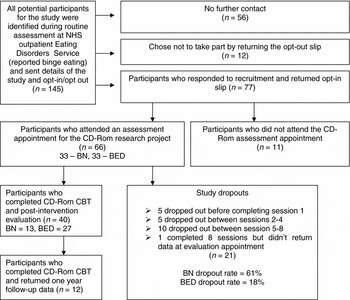
Of the 145 offered CD-Rom CBT, only 77 (52%) opted in to the study; of these 66 were assessed. Of these 66 participants who opted in and attended the initial assessment, 40 completed the CD-Rom Computerized CBT Programme, a 61% completion rate. Results were analyzed independently from the lead researcher and clinicians involved in conducting the study (see Figure 1).
Participant flow through study of CD-Rom CBT Overcoming Bulimia

Of the 66 individuals who completed assessment and offered written consent, 33 (50%) had bulimia nervosa, 33 (50%) had Binge Eating Disorder; 34 (51%) were on antidepressant medication, 27 (41%) were not taking medication; there was no information on 5 participants. Of the 66 who started treatment, 60 were female and 6 were male, the age range was 16 years to 62 years, mean age 33 years, notably only one participant (16 years old) was below the age of 18.
The duration of eating disorder was between one and 42 years with a mean score of 16 years. Those participants who had Binge Eating Disorder reported a significantly longer duration of eating disorder than those with bulimia nervosa.
Of those completing assessment for the study, 27 (41%) had received previous psychological treatment and 30 had experienced no previous treatment (45.5%). There was no information regarding previous treatment for 9 participants.
The number of sessions attended by the 66 participants who completed the assessment and signed consent to take up the intervention are as follows: 5 dropped out before completing session 1, 5 dropped out between sessions 2 and 4, and 10 dropped out between sessions 5 and 8. One participant completed all 8 sessions and attended the evaluation but failed to return questionnaires. The drop-out rate for those with bulimia nervosa was 61%; drop-out rates for binge eating disorder were 18%.
Given the relatively short duration of the CD-Rom intervention, measures of symptom reduction at post-group evaluation were viewed as the most optimal measure of efficacy. The primary hypothesis was that there would be no significant difference between pre and post group measures.
Data from the SEEDS were analyzed using Wilcoxen signed-ranks tests. Results show significant reductions in vomiting, W = −2.124, p < .05 and dieting, W = −2.634, p < .05 at post-intervention evaluations, together with near significant decreases on the binge scale, W = −1.750, p = .080 of the SEED Measure. These results mirror the promising results from the original studies (Schmidt et al., Reference Schmidt, Treasure and Williams2001; Bara-Carril et al., Reference Bara-Carril, Williams, Pombo-Carril, Reid, Murray, Aubin, Harkin, Treasure and Schmidt2004).
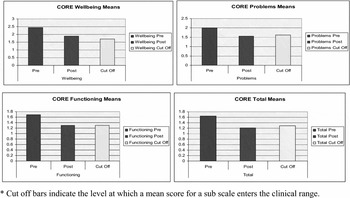
Data from the CORE and EDI-3 were analyzed using repeated measures analysis of variance (ANOVA). Results from the CORE showed a main effect of time on the functioning, well being and problems scales. Specifically, there were clinically significant and reliable improvements in Functioning Scale scores, F(1) = 9.836, p < .05, Well-being scores, F(1) = 13.411, p = .001 and Problems Scale score, F(1) = 14.642, p = .001 on the CORE (Clinical Outcomes, Research and Evaluation) (CORE: Core System Group, 1998) at post-intervention. There was not a main effect of time on the risk scale (see Figure 2).
Results from pre and post measures of the CORE *Cut off bars indicate the level at which a mean score for a sub scale enters the clinical range.

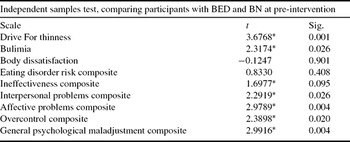
On the Eating Disorders Inventory-3 (EDI-3) (Garner, Reference Garner2004) there was only one significant change between pre and post scores; this was on the Bulimia Sub scale, F(1) = 5.155, p < .05. Overall, there was no main effect of diagnosis, indicating that the improvements made by participants with either BN or BED were not significantly different. At pre-intervention; on the CORE there were no differences between participants with BN and those with BED, indicating that general psychological symptoms are similar; however, at pre-intervention, participants with BN rated significantly higher than participants with BED on all scales of the EDI-3, apart from Body Dissatisfaction and Eating Disorder Risk Composite (see Table 1).
A comparison of participants with BED and BN at pre-intervention

This suggests that although participants with BED report a significantly longer ED duration than BN, t(51) = −3.867, p < .05; and have a similar level of general psychological difficulties as measured by the CORE, participants with BN experience more severe symptoms specific to an ED than participants with BED, as measured by the EDI-3. There is however a note of caution here, as the sample sizes were small, but the results are interesting and probably warrants further research.
Pearson correlations showed that participant age was positively, significantly associated with pre ratings of drive for thinness, p = −.461, p < .05 from the EDI, therefore younger participants were more likely to score higher for drive for thinness than older participants. Furthermore, there was a significant difference in participant's age between those with BN (M = 28.4 years SD 7.1) and BED (M = 38.9 years SD = 10.8), t(63) = −4.660, p < .001. It therefore seems that the younger BN participants have a higher drive for thinness than the older BED participants.
There were no significant differences between completers and dropouts on the scales of the CORE, EDI and SEED; however, there was a significant difference in their reported duration of having an eating disorder. Specifically, completers reported a significantly longer duration of an eating disorder (M = 19.3 years, SD = 6.6), than do dropouts (M = 7.7 years, SD 13.4), t(51) = −3.089, p < .05.
On the satisfaction questionnaire the mean satisfaction = 25.9, with a maximum possible score of 32; higher scores reflected greater satisfaction. An independent sample t-test showed that there were no significant differences between the ratings of satisfaction between diagnoses, indicating that both BN and BED participants experienced the course as acceptable. Also, participant satisfaction was not significantly associated with any of the CORE, EDI, or SEEDS scales, nor with any of the demographic information including age.
A thematic analysis was conducted on 40 satisfaction questionnaires that were filled out by participants that had completed the cCBT intervention. The satisfaction questionnaire has a space that prompts participants for “other comments please” and the analysis investigated these comments. The method was taken from a detailed description by Braun and Clarke (Reference Braun and Clarke2006) and so will not be described in detail here. Participants' comments were studied and given equal attention during the coding process. Themes were established via an inductive process and were not driven by a research question nor a particular interest. The aim of the approach was to explore these comments retrospectively.
Two themes were established from the participants' comments; gaining insight into their problems and feeling happier about themselves after the course. These themes represented the majority of participants' comments and only two participants made negative comments about cCBT.
Discussion
Treatment engagement and completion rate was somewhat higher (61%) than reported outpatient completion rates from other studies, most recently 44% (Waller et al., Reference Waller, Schmidt, Treasure, Murray, Aleyna, Emanuelli, Crockett and Yeomans2009). This rate may be related to the intervention being offered as a “waiting list initiative”, soon after initial assessment. Schmidt et al. (Reference Schmidt, Andiappan, Grover, Robinson, Perkins and Dugmore2008) has suggested that lengthy waiting times for treatment may lead to poor engagement and treatment retention.
To the contrary of our initial hypothesis participants reported significant improvements on the functioning, well-being and problem subscales of the CORE, the vomiting subscale of the SEEDS and the bulimia subscales of the EDI-3.
Furthermore, from our results cCBT is most efficacious in improving participants' general psychological symptoms for both BED and BN, as demonstrated by clinically, reliable improvements on the CORE subscales of functioning, well-being and problems. There were no differences between these two groups on the CORE measures at pre or post-intervention. This suggests that participants with BN and BED experience similar levels of general psychological distress at pre-intervention and make similar improvements at post-intervention.
For the specific ED symptoms however, as measured by the EDI, the efficacy of cCBT was more limited, with statistically significant changes only on the bulimia subscale, which is also reflected in the reduction in vomiting as measured by the SEEDS. These findings specific to ED symptoms are less impressive than results of previous studies (Pretorious et al., Reference Pretorius, Arcelus, Beecham, Dawson, Doherty, Eisler, Gallagher and Schmidt2009; Sanchez-Ortis et al., Reference Sanchez-Ortis, Munro, Stahl, House, Startup, Treasure, Williams and Schmidt2010).
The results from this study suggests cCBT may be less effective for participants with more severe eating disorder psychopathology as measured on the EDI-3; however, it may be a more useful and effective intervention for participants with less severe eating disorder symptoms. This premise would require further study.
In this sample, BN participants experienced more severe ED symptoms than participants with BED, were significantly younger and, interestingly, were more likely to dropout of the intervention. A possible hypothesis is that BN participants experienced higher levels of ED symptoms that cCBT is less effective in treating, which may be a contributing factor to the higher dropout rate in participants with BN. Possible factors may include the following: participants with more severe ED symptoms may dropout if they are disappointed with the limited change they make in their ED symptoms; or that their increased ED difficulties make it more difficult for them to engage; or that they are more ambivalent to change. Our results lead us to the latter; overall drop-outs had a significantly higher drive for thinness (EDI-3) than completers at pre-intervention and the majority of dropouts were BN participants. The aims of the intervention may have been perceived as conflicting with the egosyntonic nature of the participants' drive for thinness, thus resulting in dropout. These hypotheses require further study.
Patient take-up rates, reported acceptability, completion rates and significant improvements on post-intervention measures suggest that computerized CBT might be particularly helpful for those patients who have Binge Eating Disorder; a disorder within the subtype of EDNOS, often excluded from research trials. The inclusion of those who have BED into research trials for Overcoming Bulimia would likely support these study findings and illustrate wider applications of Overcoming Bulimia to all eating disorders that have a binge-eating component. This would be in line with recent transdiagnostic approaches to the treatment of eating disorders (Fairburn, Cooper and Shafran, Reference Fairburn, Cooper and Shafran2003; Fairburn et al., Reference Fairburn, Cooper, Doll, Hawker, Wales and Palmer2009).
In further contradiction to our initial hypotheses, we found that CD-Rom treatment is viewed by participants who complete the intervention as an acceptable form of treatment. Our satisfaction measure completed by participants at the post-intervention interview supports this. Also there were no significant differences between participants with BN and BED, their satisfaction ratings indicating that cCBT is acceptable to participants of either diagnosis. We did not have the capacity within this study to collect data on those who did not opt into the study or those who subsequently dropped out. This, in part, is due to the difficulties with low response rates from participants that have dropped out of the study.
Interestingly, the two themes that emerged from the satisfaction questionnaires - gaining insight into problems and feeling happier after the course - appear to highlight the efficacy of the cCBT intervention on a subjective level. It seems that participants felt that cCBT increased their sense of understanding and well-being, with the latter being consistent with the improvements demonstrated on the well-being subscale of the CORE.
Computerized CBT offers opportunities for early intervention and appears to enable and perhaps enhance engagement with the Eating Disorders Service. We noted that those who opted into and completed the CD-Rom self-help treatment were more likely to later engage and complete individual therapy. Those who dropped out of CD-Rom treatment were more likely to fail to opt in or dropout of individual therapy. A note of caution, however, as some patients who did not opt into the CD-Rom later completed individual therapy.
The CD-Rom treatment appears to offer an acceptable and effective treatment in a Stepped Care Approach for people with BN and BED. As an early intervention for patients ready to engage in treatment and begin to make changes it offers an acceptable and effective first step. The efficacy is reflected by the improvement in the participants' general psychological symptoms.
Limitations
The study does not show the effectiveness of cCBT against a control group and as such this study falls short of a randomized control trial. The efficacy of the cCBT can only be assumed and warrants further study before conclusions are generalized. The small sample size (n = 40) of this study is also a limitation and the sample was drawn from a single Eating Disorders Service. Furthermore, only 12 participants responded to the follow-up assessment and therefore the follow-up sample was not large enough to conduct analysis. This was unfortunate as participants were encouraged via letter to respond and complete these questionnaires, but response rates were very low.
Finally, we reflect on the practicality and efficacy of cCBT in the context of staff perceptions, which were initially negative. Over the course of the study, some staff received training and support in working with patients using the intervention. Over the 4-year duration of the study it became an integral part of the EDS' provision. The team felt they understood the approach and where it fitted in the stepped care model of interventions for eating disorders. When the study ended and recruitment ceased, a “gap” in provision was perceived by all EDS team members.
Acknowledgements
We would like to thank the members of the Eating Disorders Service, both past and present, for their hard work and support in enabling this work to be undertaken; to Keri Stephenson, our original service manager, for agreeing to and supporting the research; to Phil Horner our current manager for enabling the research to have an ending, and for iCBT to become part of the service intervention framework across the Eating Disorders Service Managed Clinical Network in Lancashire Care NHS Foundation Trust. Thank you also to Media Innovations Limited for their technical support.



Comments
No Comments have been published for this article.