The wheel, under which so many have worked, is not just a symbol. It has been our attitude for twenty-five years. … This wheel is a Robber Wheel [Räuberrad], and a wheel has to move. It is not a museum, it doesn't stay put, it moves onto the next place. … It may come back, but it is our Robber Wheel and that meant: “Beware, Volksbühne! Danger lurks here!” And that is what we did. We practiced solidarity with the homeless, with political lepers, with antisocials. A friend of mine from Hamburg said: “It's unbelievable how an antisocial—like you—lasted so long and actually brought people together through work, through artistic work.” … I thank my enemies for making it clear to me that art has to polarize. More, I thank my friends, and I thank you—whatever you think: it is important to have brought you together. I have a political hope for this city. As always, one will be disappointed. That's part of it. You win battles and lose wars. But you have to try again and again. That is the bottom line.Footnote 1
There is so much to say about the persistent critiques of and mobilizations against Chris Dercon's vision (or lack thereof) of the newly named Volksbühne Berlin. My task here, however, is a different one: to begin to understand why there has also been such persistent mobilization on behalf of the Volksbühne am Rosa-Luxemburg-Platz. In what follows, I provide some critical context for reflection upon the unique role the Volksbühne played in post-Wall Berlin. I suggest that in his twenty-five-year tenure at the Volksbühne, Frank Castorf worked to refunction the theatre apparatus itself, to transform the theatre as state institution, as interrelated set of supporting structures that extend beyond and behind the proscenium arch. Further, Castorf's work as both director and artistic director helps us to understand the complex relations between a theatre aesthetic, which exposes and critiques the structures of its (state) support, and a theatrical institution with similarly ambitious goals. As an aesthetic and as an infrastructural project, Castorf's Volksbühne enacted a new kind of public theatre in Berlin—and it is this project of institutional dis/avowal that we must remember (and dare to reenact) as so much more than reactionary or provincial nostalgia.Footnote 2
While the fervor with which an international debate has emerged around the Volksbühne “issue” is inconceivable in an American context (or any non-German context, for that matter), this kind of public debate has a long institutional history in Berlin's theatre scene. Indeed, in the wake of 1989, Berlin's rapidly changing arts landscape was mediated by an emerging neoliberal agenda, supported by the party politics of Berlin's Grand Coalition government, which catalyzed a slew of heated cultural policy controversies about the future of the state-subsidized arts.Footnote 3 The ensuing years of what many have since labeled the Berlin “theatre crisis”Footnote 4 saw a series of truly dramatic shifts: the dismantling of a number of long-standing theatre institutions, the advent of new institutions, and the remodeling of older institutions with new purposes and orientations. From a formerly East German perspective, the post-Wall theatre crisis was particularly grim. No other country in the world had supported the theatre on a per capita basis to the extent that the GDR had. And the processes of reunification decimated this vibrant performance panorama. Theatres in the former East closed in droves, and many ensembles scattered—or fled to the former West for higher salaried jobs (or any jobs at all). For Berlin's formerly eastern Staatstheater, or state-stages—Berliner Ensemble, Volksbühne, Maxim Gorki Theater, Deutsches Theater, Komische Oper, and Staatsoper—speculation ran deep in the early 1990s. Which stages would survive the crisis? Which would be forced to close their doors? Which would be forced to adopt entirely new artistic and/or infrastructural models? To the looming question, “Is there a cultural policy?” Frank Castorf proclaimed in one interview after the other: “It is like Russian Roulette.”Footnote 5
From the perspective of formerly eastern theatre makers, like Castorf, survival was also multivalanced, and much more than a question of funding. What would it mean to speak of a formerly East German state theatre in the context of the newly reunified German state? What would it mean to continue to speak of the formerly East German state theatre as public project, as collective project, as Volks- or People’s project, as Ensemble? In the early 1990s, the Volksbühne emerged as a paradigmatic site to pose, consider, and debate these questions.Footnote 6 This was a theatre that had helped to define the tradition of so-called political theatre in (East) Germany in the twentieth century and provided a theatrical home for the likes of Max Reinhardt, Erwin Piscator, Heiner Müller, and many others. In the early 1970s, the Volksbühne am Rosa-Luxemburg-Platz, under the leadership of Benno Besson, emerged as one of the most important theatres in Germany. After Besson's departure in 1974,Footnote 7 however, the theatre was plagued by one interim directorship after another, accompanied by plummeting audience numbers and harsh reviews of the “worst”Footnote 8 ensemble in the city. This “unsupportable situation”Footnote 9 made the Volksbühne a prime candidate for closure after reunification, alongside the (western) Freie Volksbühne and Schiller Theater Complex.Footnote 10 However, at the behest of scholar-critic Ivan Nagel, trusted advisor on all things theatre, Berlin's newly appointed Culture Senator, Ulrich Roloff-Momin, considered a different approach for the Volksbühne. In the spring of 1991, Roloff-Momin commissioned Nagel and three other colleagues to pen a series of “Considerations on the Future of the Berlin Theater” that would earnestly appraise the state of every performance institution in the city and offer proposals for their futures.Footnote 11 With regard to the Volksbühne, Nagel (in)famously recommended:
that the city of Berlin (with the same courage it displayed in 1970, when it took in Peter Stein and his ensemble) give the Volksbühne to a troupe of young artists, preferably with an ex-GDR core—a group dedicated to making its own theatre. The sociocultural shock and confusion of our times could translate themselves in Berlin—into a new, illuminating, and provocative theatrical gaze. The troupe of the Volksbühne East would need approximately the same amount of funding that the Volksbühne West has been receiving—perhaps less in the first two years. By the end of the third year it would be either famous or dead; in either case, further subsidies would not be a problem.Footnote 12
“Famous or dead”: an ultimatum sure to make headlines—and it did. For Nagel, there was only one director in town who could attempt to reenvision a distinctly eastern Volksbühne within the landscape of the “new” Berlin. There was only one “play-defiler,” “Altterrorist ,” “leftist Ayatollah”; only one “manic, pathological Schmuddelfink, gaunt eclectic, hooligan, a[nd] primal-scream-therapist”;Footnote 13 only one “theatre-terminator and drama-detonator”; only one “wrecker and destroyer,” “enfant terrible and clown-king”;Footnote 14 only one “charlatan of the demise or prophet of the beginning”; a “poseur, a bully, a moralist.”Footnote 15 In other words, for Nagel, there was only one suitable candidate to lead this young, ex-GDR troop: Frank Castorf—the “cowboy from Prenzlauer Berg.”Footnote 16 And the Culture Senator heeded his advice.Footnote 17
“It is not a museum, it doesn't stay put, it moves onto the next place.”
Castorf inaugurated the new Volksbühne on 8 October 1992 with a motto that would dictate (or at least color) the thematics and methodological bent of this first season and many seasons to come: “From the Seventh of October to the Ninth of November.” The date 7 October was the inaugural day of the German Democratic Republic in 1949, and 9 November was the day the Wall came down in 1989. But Castorf's invocation was much more than an uncritical commemoration of the GDR, and much more than an attempt simply to revive some bygone brand of “Ost-Theater,” of theatre as it “had been” in the former East. Sometimes referred to as Schicksalstag, or that “Fateful Day,” 9 November also bore witness to some of the other most significant events in twentieth-century German history: the demise of the German monarchy and the declaration of Karl Liebknecht's (failed) “Free Socialist Republic” in 1918; the Beer Hall Putsch, which marked the emergence of the Nazi Party in 1923; and Kristallnacht in 1938. Castorf's invocation was also much more than a call for simple, unmediated comparisons among revolutionary socialism, national socialism, “real existing” socialism, and socialism's subsumption by global capital. Instead, he was interested in and committed to an immanent analysis that mandated a deep and thorough engagement with the very complex relations (and contradictions) among these movements, their ideas, their historical figures, and their artistic outputs. For Castorf, there is no “right” message, no hard distinctions between past and present, between good and evil. Rather, as Siegfried Wilzopolski understands Castorf's approach: “[He] does not recognize theater as a means of solving problems. On the contrary, theater amplifies problems and destroys every alternative. … Theater doesn't resolve contradictions, it intensifies them beyond acceptable limits.”Footnote 18
The Volksbühne programmed eight premieres that first season, four directed by Castorf himself: Shakespeare's King Lear, Arnolt Bronnen's Rhineland Rebels (Rheinische Rebellen), an adaptation of Burgess's A Clockwork Orange, and Euripides’ Alcestis. Each play, claimed Castorf, could be reread from the perspective of (t)his immanent “left critique of a left Utopia.”Footnote 19 And the results were most certainly fiery: “Beer spills, potato salad flies. … Joy through strength!”Footnote 20 “On the stage, without regard for the plays, excrement is openly and diligently secreted and genitals are presented with dedication.”Footnote 21 “Irritations, amalgamations, role-play, small fights in over-the-top costumes.”Footnote 22 “Castorf's obsessions are not ideas, but what is left over: crap, junk, garbage.”Footnote 23 “Mannerist, hyperrealistic , decadent, nihilistic, exactly the opposite of everything else.”Footnote 24 A “theatre hostage crisis.”Footnote 25 In concert with chief designer Bert Neumann and chief dramaturg Matthias Lilienthal, Castorf also programmed a very diverse “auxiliary” program to accompany and augment the productions in repertoire on the main stage. “Where the dramaturgy departments of other theatres usually strive for a so-called coherence of content,” Thomas Irmer remembers citing Lilienthal, “in which supplementary programs are brought in connection with (the theatre's) productions, the mise-en-scène of the Volksbühne … consciously aimed at openness and at the offer to leave it to the ‘recipient’ to construct potential connections.”Footnote 26 Concerts, symposia, films, lectures, political meetings, and “café hangs” filled all rooms of the massive building until the wee hours of the morning. There was a youth theatre—without pedagogical guidelines. There were performances administrated by the homeless. There were brawls between skinheads and Autonomen. There was a left-wing hunger strike. There was football, rock ’n’ roll, and lots and lots of beer. As Lilienthal explained: “In place of intelligibility, the Volksbühne proposed fragmentation, dictatorship in the place of democracy, irony and trash in place of political correctness, in the place of acquiescence came provocation, in the place of understanding came strangeness.”Footnote 27
Castorf's explicitly “Ost-Theater,” then, was no mere (n)Ostalgic derivative.Footnote 28 When asked if he mourned the loss of the GDR, his response was quick and to the point: “No, for God's sake”; “the GDR perished very logically in its own decadence.”Footnote 29 The East German state was a “colossus of nonmovement,”Footnote 30 he argued, a “still and stinking body of water”Footnote 31 paralyzed by doctrine. “Finally, it could not go on any longer, because there was no more fresh blood, no more wind, no oxygen left in that stinking swamp.”Footnote 32 And “when I look to Bonn now,” Castorf exclaimed glibly in reference to the temporary capital, “I see this again”—this same penchant for doctrine, for inflexibility, for stasis, for homogenization, and for totalizing “appropriation”Footnote 33—only now sanctioned by a new Republic. For Castorf, then, the project of the Volksbühne was not to embody or restage the “typical” GDR state-stage, but rather to “release the potentialities of this state.”Footnote 34 And though those potentialities were most certainly varied along the so-called political spectrum, for Castorf they also stood in critical tension with the (re)unifying agendas of Berlin's Grand Coalition government—itself another instance, he explained, of entrenched institutional thinking. As Castorf liked to say, there was something quite profound about the artist's capacity as political actor, a capacity for shock, within a totalitarian system; this is something he desperately missed in the reunified Germany.Footnote 35 For this very reason, as soon as he moved into his new office on Rosa-Luxemburg-Platz, Castorf (infamously) hung a large, framed portrait of Stalin on the wall. Next, he erected three massive letters—”OST”—at the building's highest point, perched prominently for the whole town to see, and to encourage—or demand—that a new (re)public engage the many associations that word might evoke. “The Volksbühne is important because it is a GDR institution that survived,” Castorf explained. “But we do something that the GDR, as a state, did not do.”Footnote 36 Namely: “I want to open up a window through which a clear, cold wind blows, which brings with it a bit of disorder to stuffy Berlin.”Footnote 37
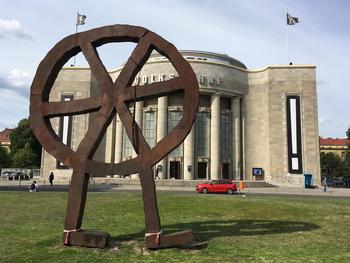
Castorf has never been shy about making clear that he stands in open opposition to the totalizing collective agendas of both the former GDR leadership and of contemporary party politics. “I am marred by the GDR,” he claims. “All that [i]s interesting for me [i]s movement.”Footnote 38 This “movement,” always frenetic, always energetic, spectacular even, is one in which individual and collective, capitalist and socialist, past and present collide, always also externalizing this collision in “hysterical eruption.”Footnote 39 As Lilienthal explains: “The Volksbühne 1992 was above all an adventure playground. The uninstitutionalized moment after the fall of the Wall made everything possible. … It was a utopian moment, in which hierarchy seemed to be abrogated. … What came to pass was a trashlike reenactment of a recently destroyed history.”Footnote 40 This reenactment was inextricably bound with a trashlike imagining of a future that was not-yet-determined. But in the present moment, the results were in—and well within the bounds of the Nagel's three-year asymptote: Frank's “postsocialist gambling joint,” his “ruffians’ playground,” his “blood-and-testicle-temple,”Footnote 41 had arrived, indeed exploded, on the scene as the “most controversial and exciting stage in Germany.”Footnote 42 Before long, the Volksbühne team installed a massive iron Robber Wheel on the front lawn, thus calling upon—and challenging—all Berliners to engage the new social function of the theatre standing before them in all its delinquent knavery (Fig. 1).Footnote 43
The Räuberrad (Robber Wheel) on 20 June 2017, ten days before it was removed in protest against the new Dercon administration. Photo: The author.

“I thank my enemies for making it clear to me that art has to polarize.”
As I suggest above, the structural conversation about the shifting status of the state-stage amidst the shifting realities of postreunification Berlin was representative of the intersecting processes of (nascently) neoliberal urban development into which Berlin was thrust—and thrust itself—after the fall of the Wall. In the immediate context of reunification, cultural political authorities working on behalf of the Grand Coalition launched a sustained critique of the state-stage's infrastructural stagnation. They argued that state-support and enduring security facilitated: intransigent inflexibility and an abuse of privilege through rapidly expanding administrative and technical apparatuses; overly firm union regulations and strict divisions of labor; rigid allocations of internal funds due to outdated federal and municipal budgetary laws; an increasingly static repertoire of classics and light comedies; hierarchal thinking and bureaucratic malaise. In the interest of creativity, then, austerity was deemed necessary to relieve the city of its high cultural expenditures by transitioning toward more private initiatives attuned to the benefits of a consumer-oriented theatre model and a commercially driven box office. In the context of present-day Berlin, although the rhetoric has become more nuanced, the state-stage continues to encounter demands for “flexibility,” “innovation,” “experimentation,” and “creativity”—demands that state-subsidized institutions justify their activities economically and compete in a demand- and innovation-based “global” network of private- and third-sector-driven creative industries. Although he strongly objects to being labeled a “neoliberal,”Footnote 44 Chris Dercon's new Volksbühne Berlin makes productive use of just this kind of language: he jettisoned the politically charged “am Rosa-Luxemburg-Platz” and inaugurated in its place a “theatre without borders” that “reflect[s] on the contemporary,” into which “artists from Berlin, Europe and the world are invited to contribute to an ever-evolving urban society” in order to promote a “vision of an open, cosmopolitan community.”Footnote 45 Less generously stated, Dercon has inaugurated a set of event spaces that do away with both ensemble and repertoire, exchanged longtime employees for expanded round-the-clock security personnel, and countered political and artistic opposition with police force.
In Berlin, this particular brand of institutional disavowal, so eager to rethink “big” government and its long-standing swath of accompanying infrastructures of support in the arts sector for something more flexible is still most controversial in many camps, and has been for a long time. “I believe … that we can refunction the flaw that we all have in the areas of administration and organization into a virtue,” Castorf claimed.Footnote 46 And for Castorf, the apparatuses and administrations in question were, of course, those of the state-stage. While he admits that the state-stage system is laden, if not burdened with, what he calls, “feudalistic structures,”Footnote 47 he also understands these structures, at least as a starting point, to be the theatre's strength. But how? “The (state) subsidy system has the great advantage that we are economically independent,” he explains. “This is a crazy privilege. We do not need to beg for grants from Mercedes or Hoechst.”Footnote 48 Political independence via financial dependence? At first, one suspects a most twisted logic. But, for Castorf, the subsidy system—as feudal system—secures the theatre as an “elite island of resistance”Footnote 49 against a kind of “capitalist efficiency”Footnote 50 and the kinds of political “straightforwardness” and tactical “systematic thought”Footnote 51 that accompany it. “Especially if you are funded through tax money,” Castorf claims, “you have the duty to be subversive. You have to be ungrateful.”Footnote 52 He continues: “All theatre lives on subsidies. When these cease to exist, then the differentiated cultural offerings that were previously on offer will no longer be feasible. If we abandon the [state] theatre, we incur a new Americanism, which makes me anxious.”Footnote 53
Castorf is not interested in an avant-garde resistance that steps outside the “ponderous apparatus.”Footnote 54 He is not interested in a scene “free” of state involvement.Footnote 55 He is not interested in a political or artistic “underground.” He is not interested in abandoning the ensemble or the repertoire. Rather, he is interested in an art of institutional dis/avowal that leans on and into systems of state support as the very means by which he seeks to imagine and enact their undoing: “I want to come into the trained, state-theatre apparatus with my performances and, together with the performers, change that apparatus from the inside.”Footnote 56 “I could have never pulled off taking over a smaller theatre. But the Volksbühne was so big, so empty, so kaputt—it was worth seizing.”Footnote 57 From deep inside the state apparatus, and crafting productions that made use of every corner of the theatre building, Castorf (believed he) was well positioned to “inspect meticulously” the “German national body,”Footnote 58 and to “meddle”Footnote 59 in form, in content, in the spaces between and beyond: “I can really work with taboos and must not think about ratings or customers.”Footnote 60 “Our aim is financial and personal latitude in order to remain mutable.”Footnote 61 Castorf's argument, however, was not a naïve appeal for a more “critical” stage reality free from the posturing of politicians. No: he insisted sharply that “[t]he structure must be broken apart, new operational units must be created, which … are both organizationally and artistically diverse.”Footnote 62 Castorf understood—and still understands—himself as artist and/as producer, and the state-stage, oddly enough, is the aesthetic/infrastructural space in which he feels best poised to launch this project, to launch this critique of a “false [state] obsession with order.”Footnote 63 “It's not about hindrance,” he claims, “but rather about the polarization of chaos in order to be productive.”Footnote 64 For Castorf, then, it is about battling for the institution by battling both with and within it.
“Beware, Volksbühne! Danger lurks here!”
Although Castorf was the dominant figure of the German (and perhaps broader European) theatre in the 1990s and early 2000s, critics widely acknowledge that this stardom has “distinctly faded” in recent years. None of his productions were invited to the German Theatertreffen festival between 2004 and 2013, after almost a decade of consistent invitations. And though he did receive invitations in 2014, 2015, and 2018, many agree that his work has “increasingly run out of control … becoming ever less coherent.”Footnote 65 Critics and audiences alike often greet his premieres with annoyance, or worse yet, with ambivalence, claiming that the work has become “repetiti[ve]” and “thoroughly predictable.”Footnote 66 Even his most recent piece, a highly anticipated production of Hugo's Les Misérables at the Berliner Ensemble, received a number of tepid responses: “As always with Castorf, by the end you are only waiting for it to be over.”Footnote 67 While one would be hard-pressed to disagree fully with all critical claims of stagnation, I want to read against the grain of this widespread critique of redundancy and repetition as “artistic crisis.” Instead, I question whether some of this critical negativity is not a reaction to the criticism that Castorf himself has consistently waged against the routine practices of present-day (bourgeois) theatregoers in reunified Berlin. Indeed, the unenthusiastic, even hostile, critical response underlines the act of “provocation”—or, as Castorf likes to call it, the act of “war”—he hopes to wage on the (traditional) theatre audience. As he explains:
I could also say it's like an attack, a war against the archenemy and the archenemy is the audience. But the general rule still says that a boring evening means good theater. Not with us! We polarize the audience. I often wish a performer would scream to them and say, “You're a bunch of bums!” And the audience would yell back, “You're an arrogant, stuttering asshole!” Our society needs this kind of confrontation.Footnote 68
Castorf is committed to the “offensive.”Footnote 69 He was always committed, very much in line with the young Bertolt Brecht, to the Volksbühne as “boxing ring.”Footnote 70 With these principles in mind, from the very start of his tenure as artistic director, he set out to build, and to enable, a different kind of audience. He immediately slashed ticket prices to 5 DM for the unemployed, for students, and for retirees; and standard tickets cost only between 12 and 20 DM, dramatically less than other stages in town. He opened the space to radical political groups, on the Right and the Left. He invited the homeless, the disabled, and other often-marginalized groups inside. He made it a point to reach out to the (then) working-class neighborhoods in Berlin and beyond, especially Prenzlauer Berg, where the theatre is located. “The only mandate I feel at the Volksbühne,” Castorf explained, “is to bring together people who do not normally meet in the theatre.”Footnote 71 Once they were inside, beer in hand, anything and everything was possible—or so the thinking went. And the interesting irony is that the more provocative, offbeat, or even flat-out offensive the work became, the more people continued to flock: “[W]e have an audience that does not like what we do at all, but they come because of the other climate, as a revolt against total appropriation.”Footnote 72 Elsewhere: “[W]e at the Volksbühne are fortunate because our standing public does not read reviews. … They come to us because they have the feeling that our theatre has something to do with their lives.”Footnote 73 And as Lilienthal elaborated, again, most polemically: “We have something against West Berlin dentists. Here, other values apply.”Footnote 74
But what were the goals for and potentials of this new audience? More than a mere democratization of the theatre, Castorf was—and remains—interested in exploring the types of tenuous, if not explosive or violent, dynamics (artistic, political, institutional) that emerge in the name of democratization. He is interested in exploring and forging dynamics that engage in an immanent critique of that “discredited notion of community.”Footnote 75 For Castorf, then, the Volksbühne was at its best when right-wing skinheads came to a performance and threw rocks at the windows, or even came to blows with other audience members.Footnote 76 He was doing his job when the arguments in the canteen were just as—or even more—interesting than the works on the stage.Footnote 77 The state-stage was most successful when it featured a mix—or jumble—of forms: “dance, rock music, philosophy, film.”Footnote 78 And as a work of state infrastructure, it was most resonant—dare one say useful—when it both facilitated and embodied surprise, adventure, chaos, violence, and even its very own undoing. Because, as Castorf explains:
In Berlin, the violence is already there. We're not producing it; we're pointing it out and pointing at it when we show Stalinist trials on the left side and Nazi Theresienstadt films on the right. It's always running on a scale between left-wing autonomous pirate broadcasting on the rooftop and baroque music below. Sometimes we find heroin needles because we don't close at midnight. We let people sit longer and talk. But there's always an excitement. Nowhere do you see more diverse groups of people than here. People speak together. I see that as an opportunity for this society.Footnote 79
“It's unbelievable how an antisocial—like you—lasted so long and actually brought people together through work, through artistic work.”
Castorf is most interested in spontaneity, immediacy, nonidentity, even irrationality. He assumes a world that is “not intact,” and insists, at every moment, on a rebellion against “expected schemes” as a form of “spiritual hygiene.”Footnote 80 At the same time, he is always willing and ready to put his own modes of (theatrical) production on the dissection table. And he is willing to reexamine (and to perform) the ways in which these modes themselves function by engaging with—though not trying to tame or to incorporate—the uncertainties, even the violence, inherent in those modes themselves. “Theatre for me,” he explains, “is the attempt at the synthesis of—strictly stated—the impossible. I begin from the individual, whose life has very strange combinations. … In doing so, what matters most for me is the sphere of production, and I try to organize it so that it is a model of free labor.”Footnote 81 Castorf returns to one principle again and again and again: fun.
Because the basic mystery, as I said, is a very simple one: happy work. … The fun that me and a few other people have when we make theatre—this was always completely independent of the expectations of this society-apparatus; it was equally anticapitalist and anticommunist; we practiced a freedom that was directed against usurpation and ideological assertions. … The conditions of production should be such that the producers do their work willingly, and the product will look accordingly—that was always my impulse to make theatre. … One should really preserve the carnival spirit and defend it ruthlessly. I'm not afraid of the country fair when it has something to do with the life of the time.Footnote 82
Castorf aspires to a mode of making that is both collaborative and antagonistic. Dependent, vulnerable, generous, but also aggressive and caustic, he does not exempt himself (or his collaborators) from the same challenges they wish to impose on their audience. In the rehearsal room and on the stage, then, he suspends (while also most certainly embracing) a certain kind of hierarchy—committed to allow the process and its hiccups to inform the work. He hardly plans. He begins each rehearsal—wine spritzer in hand—unsure what will come next … until it comes. He screams plenty. And if conflicts with actors or others arise, he works to integrate that into the process and the product. He—notoriously—works with an ensemble of actors whom others think are “wrong” for a particular role, or better yet, whom others think should not be actors in the first place.Footnote 83 He also works with many “non”-actors. As he elaborates elsewhere:
I try to create successful productions as a model for free working conditions. Conditions that are generated internally and not controlled by the outside. This is an old Marxist and also anarchic thought. The images that spring from such work are colored slightly with anarchism and nihilism. They crisscross each other, there are no clear thoughts. Maybe the necessary analytical powers are missing too. These may be accurate criticisms, and people do have problems with productions like these. But they remain indestructible because the secret basic recipe is so simple. It's fun work. And that, in principle, is political.Footnote 84
It is clear, however, that Castorf's is no mere anarchic thought. So-called fun is not just about some antianalytical and abstract negation of those limiting structural conditions—of the state-stage, or of capital more broadly. It is not just about denying the bore, or the oppressive expectations, of that dreadful “outside,” and replacing it with some more amusing, unpredictable “inside.” Rather, it seems that fun—in all its inherent and unpredictable perversities—is itself a kind of infrastructural counterpart to Castorf's method of blurring, or even exploding, those bounds between “outside” and “in,” between “you” and “us.” It seems, in other words, that fun is an essential element of Castorf's unique art of institutional dis/avowal. To have a good time is, for him, a deeply politicized and dutiful practice of determinate negation, a way of both engaging and undoing—or simultaneously undoing by engaging—the means and relations of production in which he has chosen to inevitably enmesh himself. “I am also the leader of a production institution,” Castorf explains:
I have the opportunity to provide work for two or three hundred people. … In times when it is no longer taken for granted in Germany and Europe that everyone can work, it is a privilege to provide work. And it is very strange that this work is not mere wage labor for these people, but that this artistic work joins them together in another way, also politically: joins people together who previously were Left, Right, old, young, ugly, and beautiful.Footnote 85
One must construct and facilitate “conditions of production” that make you “unimpeachable”;Footnote 86 in doing so, he claims, you “frame a utopia, practicing the future within the existing conditions of the present.”Footnote 87 And yet, Castorf had no utopian illusions of purely antiauthoritarian and nonhierarchical conditions of production at the Volksbühne. Just as he worried about a ubiquitous, new American mentality of capitalist efficiency, his experiences in the former East make him equally wary of the ideological affirmation and harmonizing consciousness that can emerge in the attempt to install so-called horizontal structures—even at the theatre. No, Castorf also likes to say most polemically: “Theatre is always a dictatorship.”Footnote 88 We must always acknowledge what can be gained from “dictatorial thinking,” he asserts, “though it must always [also] be called into question by those who practice it.”Footnote 89
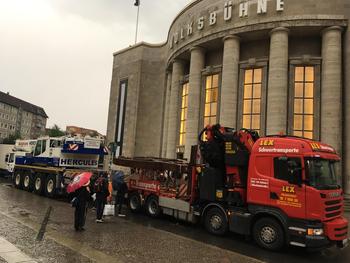
Castorf's art of dis/avowal, of avowal and disavowal, then, is precisely one that engages deeply with the varied institutions (and ruling logics) within which he is enmeshed as the means by which he seeks to rethink them. In every moment of tenuous, multigenred mash-up, of (mis)communication, of formal and organizational experiment, of “movement,” Castorf & Co. deny us the possibility of any grand resolution of conflict between supposed poles in constant tension. Indeed, for twenty-five years, the Volksbühne—am Rosa-Luxemburg-Platz—worked critically to refunction the state-stage as an essential and ever-evolving public institution, openly embracing its mutable and irreconcilable opposites. Robbers: they demanded and performed collective political and ethical labor, while also basking in the possibilities of contradiction, antagonism, and moral ambiguity. Robbers: they challenged our widely accepted relations between theatre maker and theatre audience, between producers and their means of (cultural) production, between aesthetics and its supporting apparatuses. Robbers: they ran off with their own Robber Wheel, touting always the danger and the promise—both aesthetic and political—of nonreconciliation (Fig. 2).
The Räuberrad (Robber Wheel) was carted away in rainy protest on 30 June 2017. The large “OST” had already been removed from the roof on 24 June. Photo: The author.