





1. Introduction
Pulsating stars are key probes of stellar structure and evolution. Among A/F-type stars,
 $\delta$
Scuti (
 $\delta$
Sct) and
 $\gamma$
Doradus (
 $\gamma$
Dor) variables are particularly relevant because they exhibit distinct types of oscillations driven by different physical mechanisms.
 $\delta$
Sct stars, located at the intersection of the Cepheid instability strip and the main sequence, pulsate in radial and non-radial pressure (p) modes with short periods excited by the
 $\kappa$
-mechanism associated with helium ionization (Aerts et al. Reference Aerts, Christensen-Dalsgaard and Kurtz2010). In contrast,
 $\gamma$
Dor stars pulsate in high-order gravity (g) modes, with longer periods likely driven by convective blocking at the base of their envelopes (Dupret et al. Reference Dupret, Grigahcène and Garrido2005).
High-precision photometry from space missions such as Kepler has led to the discovery of hundreds of hybrid pulsators that simultaneously exhibit both p- and g-modes (Grigahcène et al. Reference Grigahcène, Antoci and Balona2010; Uytterhoeven et al. Reference Uytterhoeven, Moya and Grigahcène2011; Balona Reference Balona2014). These hybrid
 $\delta$
Sct /
 $\gamma$
Dor stars are particularly valuable for asteroseismology because the coexistence of both mode types provides tighter constraints on internal stellar structure and helps reduce degeneracies in seismic modeling (Reference Sánchez Arias, Córsico and AlthausSánchez Arias, Córsico & Althaus 2016). However, many hybrids are found outside the predicted instability strips, suggesting that additional physical processes–such as rotation, diffusion, or mixing–may influence their excitation (Tkachenko et al. Reference Tkachenko2013; Antoci et al. Reference Antoci, Cunha and Bowman2019).
As accurate stellar parameters are essential for asteroseismology, extensive ground-based spectroscopic and photometric follow-up has been conducted over the past decade to refine the parameters listed in the Kepler Input Catalog (e.g. Casagrande et al. Reference Casagrande2014; Niemczura et al. Reference Niemczura2015; Zong et al. Reference Zong2018; Pinsonneault et al. Reference Pinsonneault2025). In this context, Strömgren–Crawford photometry was obtained for about 2,500 stars in the Kepler field at the Observatorio Astronómico Nacional in San Pedro Mártir (OAN–SPM), providing homogeneous estimates of their physical properties following the methodology described by Fox-Machado et al. (Reference Fox-Machado2025). A preliminary analysis of their space-based light curves is presented in this contribution.
2. Star Sample and Variability Classification
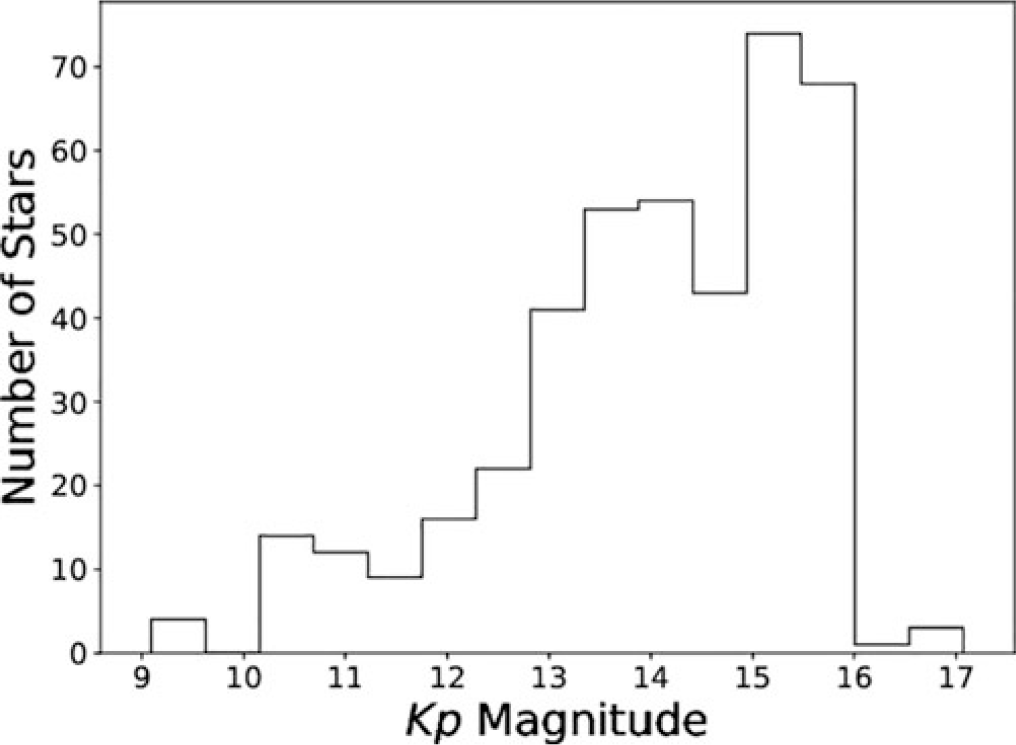
Figure 1 shows the Kp-magnitude distribution of the analyzed stars. The sample is dominated by targets in the range
 $Kp = 13-16$
, with a clear maximum near
 $Kp \simeq 15$
.
Distribution of Kepler magnitudes (Kp) of the analyzed stars. Most targets lie in
 $Kp=13-16$
.

To investigate their variability, we implemented an automatic classification pipeline to analyze the time-series data from the Kepler and TESS missions. The process begins by retrieving all available light curves from the Mikulski Archive for Space Telescopes (MAST). For each target, we extract the PDCSAP fluxes produced by the Presearch Data Conditioning pipeline, along with their corresponding Barycentric Julian Dates (BJDs) from the FITS files. The light curves are corrected for long-term instrumental trends before computing Lomb-Scargle periodograms using the Lightkurve Python package (Lightkurve Collaboration 2018). From each power spectrum, we extract key frequency-domain features, including the most significant peak frequencies and their amplitudes, the total power in predefined low-, mid-, and high-frequency bands, and frequency-to-power ratios that help distinguish between different pulsation regimes.
A supervised machine-learning model was then trained on a labeled dataset of stars with well-established classifications. The extracted features were standardized and used to train a Gradient Boosting Classifier (Friedman Reference Friedman2001). The trained model was subsequently applied to the unlabeled sample to predict the variability type based on their periodogram characteristics.
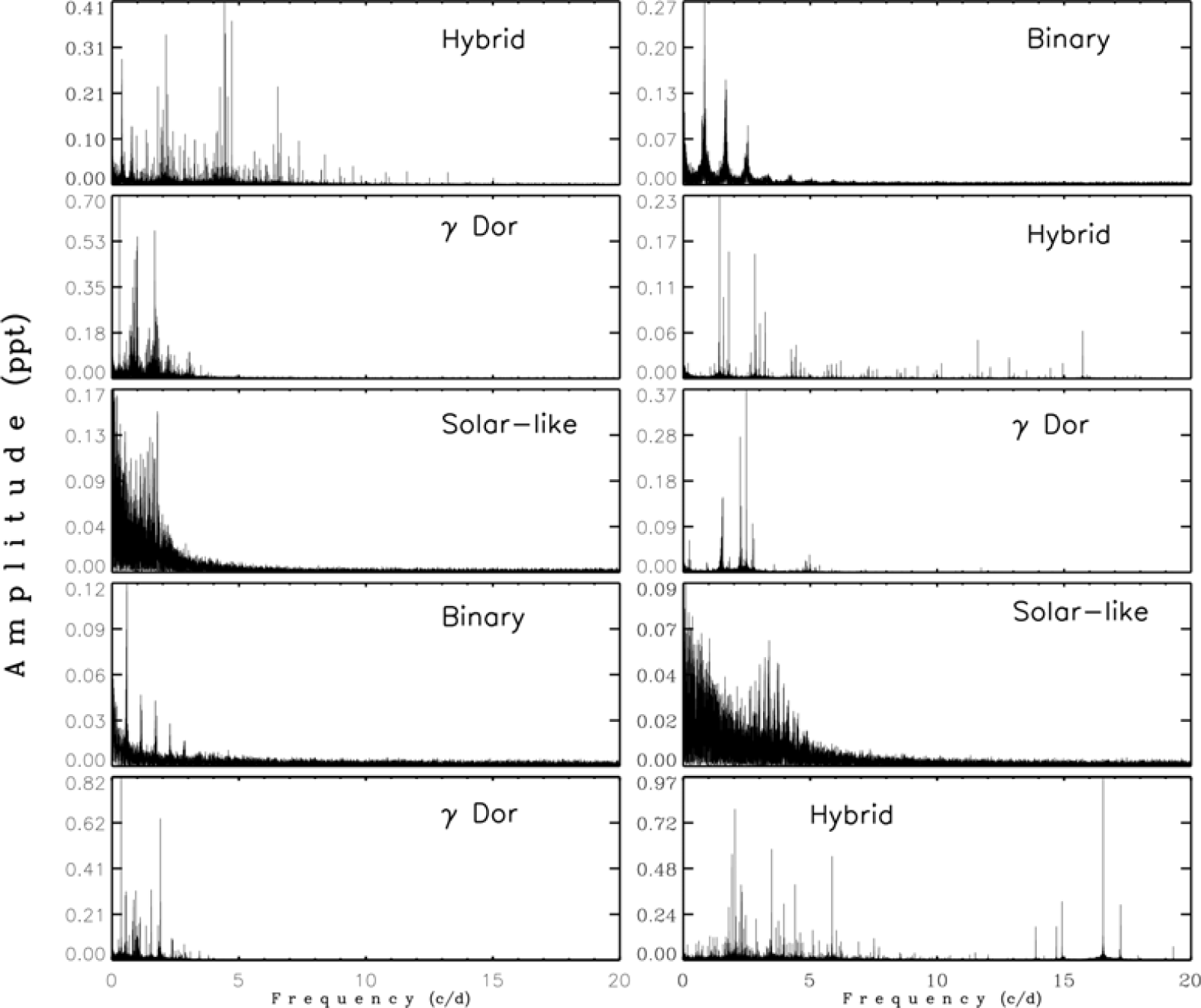
Figure 2 displays examples of amplitude spectra for variability classes that were automatically assigned by the pipeline. The
 $\gamma$
Dor stars show dominant low-frequency peaks below
 $\sim5$
d
 $^{-1}$
, consistent with high-order g-mode pulsations. Hybrid pulsators exhibit both low-frequency g-modes and high-frequency p-modes, while solar-like oscillators display a broad excess of power typical of stochastically excited modes produced by turbulent convection. Additionally, all light curves and their corresponding periodograms were manually inspected to confirm or correct the variability types that were automatically assigned.
Representative amplitude spectra for binaries,
 $\gamma$
Dor, hybrid, and solar-like oscillators.

3. Conclusions
We analyzed space photometry of 2,500 candidate pulsating stars, for which accurate physical parameters derived from Strömgren–Crawford observations are available. An automatic classification pipeline was developed to identify and characterize the main types of stellar variability based on frequency-domain features extracted from Lomb-Scargle periodograms.
The pipeline successfully distinguished
 $\delta$
Scuti,
 $\gamma$
Doradus, hybrid, solar-like, rotational, binary, and non-variable stars. Approximately 10% of the analyzed stars were identified as
 $\delta$
Scuti /
 $\gamma$
Doradus hybrid candidates, which will be the subject of detailed ensemble asteroseismic modeling.
 Kp=13−16
 γ

 Open access

