

1 The pending pension reform agenda
During the 1980s and 1990s, Latin America and the Caribbean (LAC) implemented an ambitious agenda of social security reforms largely aimed at restoring financial sustainability to pension systems (i.e., fighting intergenerational inequality), fostering domestic capital and financial markets, and simultaneously building a clear link between contributions and benefits. Focusing on the latter, it was expected that these reforms would contribute to a gradual increase in the percentage of workers who contribute, and eventually, in the percentage of elderly with a pension (see World Bank, 1994; Lindbeck and Persson, Reference Lindbeck and Persson2003 for an analysis of these and other economic benefits, and Barr and Diamond, Reference Barr and Diamond2006 for an opposing view).
With approximately 20 years of experience in the region, the effects of these reforms have been many and varied. A large amount of research has addressed the merits and problems of the type of systems, for example of introducing defined contribution and individually funded systems (usually known as ‘private systems’) compared with public pay-as-you-go systems (see Gill et al., Reference Gill, Packard and Yermo2005 for a survey for the region, and). The most significant and positive impacts seem to be related to the development of domestic capital markets, financial deepening and productivity (see Acuña et al., Reference Acuña, Fuentes, Secada, Villagómez and Villar2013 for an analysis on Chile, Colombia, Mexico and Peru). Also, some progresses are evident on fiscal sustainability and intergenerational equity, although long-lasting transition rules advice more caution when interpreting the results (see Melguizo et al., Reference Melguizo, Muñoz, Tuesta, Vial and Franco2009 for a deep analysis on Chile and a reference to Colombia, Mexico and Peru).
However, much less analyzed and discussed has been the fact that, irrespective of the pension systems involved, pension coverage depends on the capacity of labor markets to create jobs in which workers and firms contribute to the pension system; in other words, formal jobs. Despite the reforms in the region, pension coverage is still considered generally low. This is the focus of our paper.
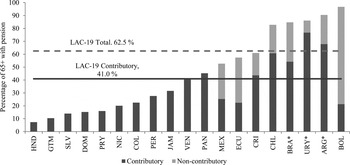
In the region today, according to national household surveysFootnote 1 , only four out of ten citizens aged 65 and older are receiving a contributory pension. Recently, many countries have substantially increased pension coverage through programs focused on expansion of non-contributory pensions. This expansion has helped raise the proportion of older adults who receive a pension to more than six out of ten. Yet, the majority of pensions (either contributory or non-contributory) pay less than 10 dollars a day. This means that two of the key objectives of pension systems – elimination of poverty in old age and maintenance of an adequate standard of living for workers once they stop working (Barr and Diamond, Reference Barr and Diamond2006) are still only achieved for a small number of the region's elderly. In the absence of further reforms, the percentage of workers who contribute to the pension system is not expected to increase significantly. This implies that many will have either a limited or non-existent access to an adequate future pension in the region (Figure 1).
Pension Coverage in LAC, 2010. Notes: Based on household surveys (circa 2010). The share of non-contributory pensions in Argentina, Brazil and Uruguay has been obtained by dividing the number of beneficiaries of these programs, calculated as the population 65 and over in the census's administrative records, by the number of people age 65 and over. This could be an imperfect measure of coverage since eligibility for a non-contributory pension could be obtained earlier than 65. Household surveys in Colombia, El Salvador and Paraguay do not record whether individuals received a non-contributory pension, but administrative evidence suggests that the number of beneficiaries was low in the year of the analysis. LAC-19 corresponds to the regional weighted average. Source: Authors’ calculations.

However, very different pension realities coexist in LAC. The purpose of this paper is not to prescribe recipes or formulas, but rather to help understand the causes of the poor performance of most of the pension systems in LAC, and find possible avenues for improvement, taking as a starting point the evidence accumulated from policies already implemented in the region.
2 Why is low pension coverage in LAC a problem?
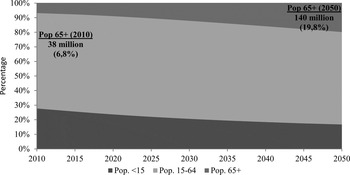
The population in LAC is young but aging rapidly. While in 2010 the percentage of adults who were 65 and older represented only 6.8% of the population, projections by Celade (2011) suggest that by 2050 this age group will grow to 19.8% of the region's total population. Thus, in 2050 there will be more than 140 million people aged 65 and older, nearly four times more than the 38 million elderly living in the region today (Figure 2).
Population projection for LAC, 2010–50. Source: Celade (2011).

LAC region is confronted with the challenge of providing an adequate income for millions of individuals who will retire in the coming decades. Yet, the mechanisms to address these challenges are built on weak foundations. First, there will be fewer potential workers to support each elderly citizen. The number of working-age individuals (age 15–64) for each citizen aged 65 and older will decrease from 9.6 today to 3.2 in 2050, according to the same population projections. Second, contributory pension systems, whose purpose is to transfer present consumption (when a person is able to work) to future consumption (when a person can no longer work), are not currently capable of generating enough savings for old age since most jobs in the region are informal. In other words, the lack of savings stems for the existence of informal jobs in which firms and workers are not contributing to social security.Footnote 2 We will explore this point further later in the paper. Third, according to our projections and using standard formality-growth elasticities, economic growth, even if it continues at the rate of the last decade, will not be sufficient to fix this problem of providing adequate pensions, as shown in the next sub-section.
2.1 Projecting pension coverage in LAC
In order to project the percentage of old-age population that will have a pension in the coming years we perform an stylized simulation using the share of workers contributing to social security by decile and by country in 2010 as the baseline (see Appendix 1 for more details). We project coverage assuming that when gross domestic product (GDP) per capita doubles, the share of workers contributing increases by 10 percentage points, i.e., an elasticity growth-formality of 0.1, following Packard (Reference Packard2001), Djankov et al. (Reference Djankov, La Porta, López-de-Silanes and Shleifer2002), Loayza et al. (Reference Loayza, Oviedo and Servén2004) and Loayza and Rigolini (Reference Loayza and Rigolini2011). This estimate is also in line with our own calculations using panel estimates with fixed effects (although lower than results obtained with cross-section analysis, which were found to be around 0.1). We assume the elasticity growth-formality to be the same across countries and income deciles. Given that there is no contribution density data available for most of the countries it is difficult to map contribution into coverage. We proxy such density and calculate the coverage share of the population over 65 years assuming three alternative scenarios: in the first, we assume that present contributors have contribution densities of 100%, and those who do not contribute have contribution densities of 0%. In the second, we assume that adequate coverage demands at least a contribution density of 50% and assume that the share of contributors by decile is a good proxy for the density contributions of that particular decile. In the third scenario, we make the same assumption than in the second scenario regarding contribution densities but consider to be covered all those who, given their contributions, qualify for a replacement ratio of 30% or above according to their own national pension system.Footnote 3
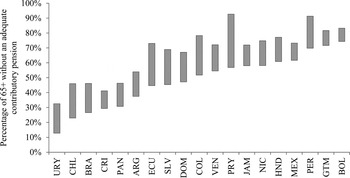
Figure 3 provides the results, presented as an interval resulting from the maximum and minimum coverage obtained from each of these three methods, combined with annual GDP per capita growth between 1% and 5% (see Appendix 1 for details). Using this stylized projections, we estimate that in the absence of reforms, between 47% and 60% of the 140 million elderly adults in 2050 (66–83 million people) will reach retirement without having generated the savings needed to fund an adequate pension in their old age.
Share of elderly population (65+) without an adequate contributory pension 2050. Source: Authors’ calculations. See Appendix 1 for details.

Given the present state of the labor market, the coverage deficit will be higher among women than men, and will be heavily concentrated among workers who currently have low-and middle-income jobs, work for small businesses, or are non-wage earners (for example, self-employed).
This low coverage will have significant social, political, fiscal and economic consequences.
-
• Social: longer life expectancy and smaller family size means that families will need to devote greater effort and resources to the care of the elderly, which will compete with the investments families must make in health, education or even housing for future generations.
-
• Political: in the coming decades, adults aged 65 and older will make up between 20% and 30% of the potential electorate of the region, so their needs will be decisive in electing governments. In this context, achieving adequate pension coverage will be a key demand from future governments.
-
• Fiscal: lack of coverage is a latent fiscal cost in the region. Because democratic governments in LAC are not going to ignore the demands of a growing percentage of the population, countries will have to allocate more resources to compensate for this inadequate pension coverage. Some simple simulations show that the estimated cost to cover citizens over the age of 65 without a social anti-poverty pension in 2050, depending on the indexation mechanisms and the country, may range between with 2 and 5 percentage points of GDP per year (i.e., three times more than the present cost).
-
• Economic: how coverage gaps are closed can have an impact on the functioning of labor and investment markets and long-term productivity growth.
As a result, pensions are set to become one of the cornerstones of economic and social policy in LAC in the coming decades.
3 The labor market as the epicenter of low coverage
Social protection systems in the region were first established in the 1930s and 1940s under the influence of the social insurance system implemented in Germany by Otto von Bismarck during the late nineteenth century. This system was created with the understanding that social benefits are for wage earners who acquire them by means of contributions paid jointly with employers. As a result, by design only citizens who were wage earners during their working lives, and their families, had access to pensions, leaving others out.
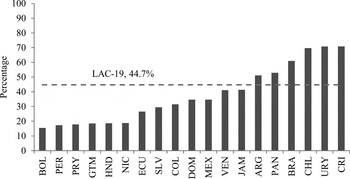
Although some countries in LAC have been including groups of non-wage earners in the pension systems, much of the low coverage observed today is due to this original design. On average, only four out of ten LAC workers are contributing to a social security system at any given time, according to data taken from the aforementioned national household surveys (Figure 4).
Percentage of contributors over total employment in LAC, 2010. Source: Authors’ calculations.

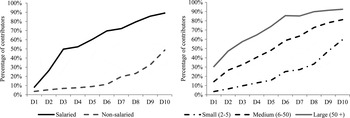
What is even more challenging is that only two out of ten non-wage earners (such as self-employed and employers), who make up about 30% of workers in the region, contribute to the pension systems; a percentage similar to that observed among wage earners in small businesses. These contributions remain low not only for low-income workers but also among middle-class workers.Footnote 4 (Figure 5)
Pension savings: contributors to the pension system in LAC by income decile, occupation and firm size, 2010. Source: Authors’ calculations.

It is noteworthy that using cross-section data on contribution rates from Pallares-Miralles et al. (Reference Pallares-Miralles, Romero and Whitehouse2012), we find that adjusted by GDP per capita, contribution rates in the LAC region tend to be well below the international trend. The share of workers contributing to social security in countries like Mexico, Colombia or Peru is between 20 and 30 percentage points lower than their respective GDP per capita would predict.
Our view is that a combination of stringent labor regulations, high non-wage labor costs, low levels of labor productivity, low valuation of the benefits of formality and poor enforcement by part of the state has led the state, workers, and firms to make a series of decisions, which have created a bad equilibrium in labor markets in LAC. In this equilibrium, only a small percentage of medium- and low-wage earners regularly contribute to the pension systems.
In order to move toward universal coverage, it is crucial to alter this situation by increasing the benefits and/or reducing the costs of complying with formality for workers and employers. In the latter case, this means evaluating not only the contributions to the pension system and other social security programs, but also the costs associated with labor legislation (cost of dismissal, minimum wages, and registration costs). Equally important, the benefits of being informal need to be reduced (Levy, Reference Levy2008).
4 Experiences toward universal pension coverage
Essentially, there are two ways to increase pension coverage, each with its own advantages and disadvantages: granting pensions to those reaching retirement age who do not have social insurance coverage, or making workers currently in the labor market save for their future (i.e., contribute to a pension scheme).Footnote 5 Finding the balance between the two – providing coverage for current older adults and guaranteeing coverage for future retirees – is the challenge that economic policymakers in the region need to solve.
Experiences in the region among countries with different income and formality situations, such as Bolivia and Chile, reveal that non-contributory pensions are effective in increasing the number of people with access to income in old age. In fact, it is the only tool able to provide coverage to the elderly who are currently without social insurance, as well as for the long-term informal workers who will retire in the coming decades. However, depending on their design, non-contributory pensions could significantly affect the decision to participate in the labor market and in the contributory systems (Carvalho Filho, Reference Carvalho Filho2008; Galiani and Gertler, Reference Galiani and Gertler2009; Bosch and Guajarro, Reference Bosch and Guajardo2012; Juárez and Pfutze, Reference Juárez and Pfutze2012; Rodrigues de Oliveira and Kassouf, Reference Rodrigues de Oliveira and Kassouf2012). Advances in coverage achieved through non-contributory pensions are very important (see Rofman et al., Reference Rofman, Apella and Vezza2013, for a detailed description of these programs in LAC), but the design of these tools must include not only proposals for financial sustainability, but also the possible effect of these non-contributory pensions on the labor market and, in particular, on the incentives for participating in the contributory systems.
However, non-contributory pensions are only part of the solution to low coverage. Although they can alleviate or even completely eliminate poverty in old age, they are not effective in ensuring that individuals, particularly those in the middle class, maintain their standard of living in old age. To generate adequate levels of future pensions, pension savings for today's workers need to be increased by expanding both the number of contributors and the frequency of their contributions. To do this, the region has followed different paths. Implementing a reduction of social security costs seem to be effective in generating formal employment, especially in the groups that tend not to be associated with the pension system, such as young people, non-wage earners and wage earners in small businesses. For example in Chile, a social security subsidy for employees and firms hiring young disadvantaged workers increased the share of these workers in between 2.5 and 4.1 percentage points (Universidad de Chile, 2012). Indeed, several countries are moving in this direction. Colombia's recent tax reform cut formal labor costs by 13 percentage points (from 37.5% to 24% of wages) for all workers, and Brazil has eliminated social security contributions for strategic sectors with the aim of increasing formal employment. Although the question remains to what extent subsidies targeted to particular groups, such as the self-employed or small business employees, could result in discouraging firms from growing or encouraging self-employment. Such outcomes could, in turn, have adverse consequences for the productivity of the economy.
The empirical literature also suggests that the increase in formality (especially among small firms) requires greater enforcement of social security laws; it also requires that firms and workers see more value in formality. For example, in a controlled experiment, Andrade et al. (Reference Andrade, Bruhn and McKenzie2013) show that none of the information or financial incentives had an impact on formalization of small firms in Brazil; only a visit by a labor inspector prompted an increase in the registration of these small firms. However, although it seems clear that stricter monitoring in the labor market expands the number of formal jobs, it can also destroy jobs that cannot survive regularization due to low productivity or because firms and workers see little value in contributing to social security. Therefore, increased enforcement needs to be accompanied by an improvement in the benefits offered by formality and/or reduction in their cost.
Innovations in how the State and social security agencies, in particular, relate to citizens can constitute a low-cost policy for expanding pension coverage. These innovations include financial education campaigns and improvement in information and channels that facilitate contributions. For example, pilot programs in Peru and Bolivia suggest that sending reminders via a text message or a letter can be an effective and low-cost way of stimulating savings (Karlan et al., Reference Karlan, McConnell, Mullainathan and Zinman2012).
Overall, it is difficult to suggest or establish a single policy capable of correcting all the problems related to coverage given the diverse realities of the region. In order to achieve long-term solutions, governments will need to explore and make progress on several dimensions. Since the LAC countries are at very different starting points, emphasis on a particular dimension will depend on the specific challenges faced by each country.
5 Eliminating poverty in old age and supporting formal employment
In our view, it is possible to move toward universal pension coverage in LAC. Under certain conditions, the system is affordable now and in the future. Achieving this goal requires not only establishing sustainable and efficient anti-poverty pensions, but also making a firm commitment to create more formal jobs for the people that are in the labor market today. This is the only sustainable strategy for providing adequate pensions in the long term. Informality is the outcome of the original designs of social welfare systems, the incentives provided by the state in labor markets, and the value placed by workers and firms on the benefits of formality, all of which can be changed.
For this matter, it is not feasible or desirable to propose a single reform for all LAC countries. However, it is possible to set out a series of key principles for any of the options chosen. The most important are:
-
• Universality: understand the interaction of the pension system with the labor market and the tax system.
-
• Integrality: acknowledge the interactions and attempt to connect all the provisions of the social insurance system (contributory and non-contributory) such as retirement, disability, survivors’ pensions and health and unemployment insurance.
-
• Efficiency: create good incentives for pension savings, capital markets development and participation in formal employment.
-
• Transparency: simplify the rules so they are understood by citizens and firms.
-
• Innovation: experiment with subsidy mechanisms for contributions and in channels that facilitate contributions.
Based on these principles, a set of financial and non-financial instruments designed to expand coverage could be evaluated. The financial instruments, consistent with the two objectives of pension systems (poverty reduction and maintenance of the standard of living of workers after retirement), could include:
-
• An anti-poverty non-contributory pension for all citizens. These pensions should be established with strict eligibility criteria in terms of age (adjusted to life expectancy dynamics) and at a level sufficient to reduce poverty in old age. This type of pension should have stable financing, supported by strong fiscal institutions (e.g., a Fiscal Council). To strengthen its sustainability, it would be advisable that their cost is budgeted in a medium-term fiscal framework, even presenting alternative funding sources. Finally, non-contributory pensions should be designed such that they do not compete with contributory systems. This occurs when everyone, regardless of whether they qualify for a contributory pension or not receive it. If that is too costly, efforts should be made to integrate contributive and non-contributive pillars and reduce disincentives to contribute as much as possible.
-
• Mechanisms to promote formal employment. Among other options, subsidies can be offered to reduce contributions for wage and non-wage earners, supporting the incorporation of low- and middle-income workers into the formal system. Given the distribution of coverage gaps and the low level of savings, these measures will favor not only financial development but also equity.Footnote 6
These financial instruments would be supplemented by changes in the design and implementation of pension policies, including:
-
• Phasing non-wage earners into social security. Establishing the obligation to contribute for all workers, irrespective of their occupational category (wage earner or not), on financial conditions equal to those of wage earners. Today, affiliation for independent workers is voluntary for all or a subset of non-wage earners in four countries in the region (Bolivia, Ecuador, Mexico and Venezuela). Recognition of the special characteristics of this group should be considered when designing new ways for contributing. This can be done by facilitating the channels to contribute (automatic retention of income, simplification of procedures, reminders). Instead, targeted subsidies or lower contributions for this group are not advisable as they may distort economic activity in favor of smaller, less productive activities (Pages, Reference Pages2010).
-
• Progress in enforcement, information, and financial education. Based on links to information sources, improved inspection, and a better pension culture.Footnote 7
Reforms that respect these principles and use the range of financial instruments mentioned could completely eliminate poverty in old age and lead to a significant and sustainable increase in formal employment and pension savings in LAC.
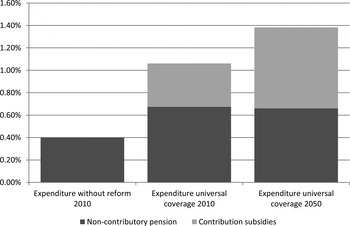
To illustrate this proposal and its budgetary implications, a pension that provides an income of 10% of per capita GDP for all those aged 65 and older in 2010 costs annually an average of 0.7% of GDP (ranging from 0.4% in Guatemala and Jamaica to 1.4% in Uruguay).Footnote 8 This level of spending would remain stable over time in terms of GDP if the pensions are adjusted for inflation. Measures to stimulate formal employment require additional resources. For instance, if the government subsidizes workers’ (wage earners or not) pension contributions with an amount equivalent to 50% of what a worker earning a minimum wage should contribute, the total cost (universal pension and subsidies) rises to 1.1% of GDP in 2010 and 1.4% in 2050.Footnote 9 (Figure 6)
Cost of pension reform, compared with current spending on non-contributory pensions in LAC-19. Note: LAC-19 refers to the simple average. Source: Authors’ calculations.

This implies that the reform would require an additional budgetary effort of around one percentage point of GDP per year more than the amount that the region is already allocating to non-contributory pensions. It would eradicate poverty among citizens aged 65 and older and significantly increase formal employment. These gains would be even greater if, parallel to the introduction of financial instruments, the contribution channels and enforcement were improved.
The expansion of non-contributory programs could substantially reduce poverty in old age, consolidating the advances that the region has made over the last decade (Lustig et al., Reference Lustig, Lopez-Calva and Ortiz-Juarez2013). But perhaps more importantly, if the measures proposed here are able to shift labor from informal to formal jobs there would be an expansion in coverage in other social insurance elements that are packaged together with pensions, such as health, disability, and life insurance. Furthermore, improvements in productivity and growth will be expected to follow in the medium run as firms become more formal (Busso et al., Reference Busso, Fazio and Levy2012).
5.1 Heterogeneity across countries
The heterogeneous nature of LAC countries – specifically regarding the characteristics of their pension systems and the state of those systems – is extremely important. And yet, the proposed pension principles described herein can be seen as valid for all of the region's countries. It is the implementation of each of these families of instruments that must be designed according to the specific challenges of each country, institutional capacity, and social preferences. Any single country may have to deal with one or more of these issues and, therefore, use one or more of the families of instruments. Although any classification system of policy instrument is, by definition, debatable, LAC countries face a series of situations that stand out in the area of pension reform-related challenges and which call for focusing on different parts of the described proposal.
5.1.1 Countries without non-contributory pillars
This paper makes three basic recommendations for developing non-contributory pillars.
First, create universal access for all citizens, integrating this pillar into existing formal contributory pillars in order to avoid disincentives to contributing. Second, establish a pension level that eliminates poverty in old age. And third create an effective institutional framework, within existing institutional arrangements, to ensure that future adjustments to this pillar are sustainable in the long term.
These recommendations are important, to a greater or lesser extent, when considering how developed the non-contributory pillars are in the various countries. In some countries with no non-contributory pillar, based on this chapter's guidelines, it would be advisable to begin by implementing one, especially if contributory coverage is low or very low, and if old-age poverty rates are high.
5.1.2 Countries with non-contributory pillars
For countries that already have some sort of anti-poverty tool in place, but the tool is not universal or not integrated with contributory systems, their challenge is to expand this tool by gradually integrating it with contributory pillars. The ultimate goal is to create a single social insurance and protection system. When a country has no clear institutional framework that governs the levels and future adjustments to these pillars, the challenge is to develop the necessary mechanisms or institutions to guarantee adequate pension levels and clear adjustment rules to ensure future sustainability and independence from the political cycle. The creation of independent (or almost independent) pension and fiscal institutions will be an essential step toward this objective.
5.1.3 The challenge to include non-salaried workers
The region faces a big challenge covering non-salaried workers. In countries where non-salaried workers are not required to contribute to social security, the first step for would be to fully integrate these workers into the social pension system by mandating contributions. Such mandates make sense given that said workers constitute a significant portion of the region's workforce and this is where the main pension coverage gaps exist. Making contributions mandatory should be done gradually and be tailored to the contributing capacity of the groups targeted for inclusion. Even though this is a necessary step, the region's experience indicates that mandating contributions will not radically change the inclusion of non-salaried workers into pension systems. Therefore, additional measures are needed. For countries in which non-salaried workers are already required to contribute, but through separate systems, efforts should be made to align these systems to prevent large disparities in the costs of being part of the system to salaried and non-salaried workers through subsidies. Countries must innovate: ideal reforms should provide greater payment flexibility and will use the various mechanisms deemed effective by behavioral economics to increase savings, such as instituting options by default, automatic deposits, and reminders.
5.1.4 Countries with a low percentage of workers contributing and high non-salary related costs
For countries whose contributory systems have not been successful at attracting a high percentage of workers into their pension systems, and for which non-wage labor costs are high, they should implement subsidies on pension contributions paid by the government, particularly for middle- and low-wage earners. This implementation should be carried out in conjunction with a series of additional measures to tighten oversight of the labor market, as well as initiatives to improve the population's financial literacy. All these economic policy initiatives should fit into an overarching medium-term strategy that includes evaluations of both the tax and labor systems with the goal of transferring part of the non-wage labor costs to other types of taxes that create fewer distortions – such as indirect taxes or taxes on natural resources. Special attention should be paid to restrictions that minimum wages and firing costs both place on generating pension savings at the lower end of income distribution.
5.1.5 Countries with a low percentage of workers contributing and low non-salary related costs
This situation points to systemic flaws in a country's labor markets that are incapable of creating formal jobs, even when the cost of being formal is relatively low. This condition demands an evaluation of the large bottlenecks that impede the generation of formal employment. Although the nominal costs of formal employment are not excessive, one possibility could be that the de facto costs are very high. Other possibilities relate to a lack of confidence that the government can provide its population with adequate social protection systems, as well as a lack of institutional capacity to implement effective social pension policies. Typically, non-salaried workers carry out the lion's share of work in these countries. As such, these challenges and the measures previously described would also be applicable in these cases.
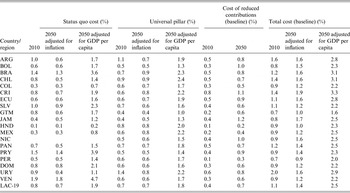
The cost of non-contributory systems and subsidies would greatly depend on demography, fiscal, social protection and insurance systems in place. Table A1 in the Appendix 1 provides a country by country cost of the status quo and the reforms here proposed. The heterogeneity among countries is clear. For instance, providing universal non-contributory pillars today would be more costly for Argentina or Uruguay with already aged populations, whereas it would be less costly for Guatemala or Bolivia. On the other hand, the cost of providing subsidies for formal workers would greatly depend on the wage distribution of workers and the potential impact of these subsidies to increase contributions. In the short run, this could be relatively cheap for countries with small formal sectors like Honduras, Peru or Dominican Republic. If generous and effective enough, they could be around 1 point of GDP in some countries.
Even so, it is worth emphasizing that there is no single formula for universal coverage of pensions. Furthermore, the set of reforms proposed here is not a substitute for parametric reforms (increasing retirement age, reducing benefits or increasing contributions) that are necessary in some defined benefit systems, which are projected to be impacted from the rapid demographic change that the region will experience over the next few decades. In fact, increasing coverage can put additional pressures on these systems. Therefore, in countries with sustainability issues, shoring up the pension system should be a pre-requisite for coverage expansion.
6 On the political economy of pension and tax reform
After more than a decade of moderately high growth, a decline in commodity prices brings a new normal of lower growth and lower fiscal revenues to the LAC region. If the situation worsens, the strong expansion seen in social programs may come to a halt and some of the gains in non-contributive pensions could even be undone. This situation brings some important trade-offs regarding pension reform.
On one hand, from a demographic standpoint, now is the time to invest in expanding coverage of pension systems while the region is still young. This would help prepare the bulging generations of future old-age people for retirement and future fiscal liabilities would be contained. Only Argentina, Brazil, Chile, Costa Rica, Cuba, and Uruguay show an advanced stage of demographic transition. However, this window of opportunity will gradually close as the population ages and reforms will become more urgent and costlier. On the other hand, if the region enters a protracted period of lower growth and tightening fiscal budgets, it will reduce the appetite for financing subsidies or other measures to increase the share of the working age population contributing to a pension. This will postpone the solution of the problem and will make it harder and costlier to solve in the future.
Funding challenges are compounded by the fact that, perhaps because of the young population, pensions are not social or economic priorities for the majority of citizens of LAC. Pensions do not appear in the top 20 main priorities/concerns of the Latin American population. The Social Protection Survey in Chile and similar surveys conducted by the IDB (2008) show that a great majority of citizens have never thought how they will finance their old age, even those close to the retirement age. This lack of concern about future pensions reduces governments’ priority for moving forward in this area. Political returns are higher if limited resources are allocated to finance non-contributive pensions of the currently old who already feel the pain of old-age poverty, than if allocated to improve the coverage of the larger future old-age generation.
Given this situation, the region needs to undergo substantive structural reforms that can increase productivity and with it, long-term economic growth (Pagés, Reference Pages2010; Powell, Reference Powell2013). In economic terms, reforming pension systems, especially in relation to improved functioning of the labor market, are a key element in a strategy to boost productivity and potential growth (Pages, Reference Pages2010). Some simulations show that if all countries in the region implemented appropriate reforms, including labor and pensions, the region's potential growth could increase by up to two percentage points per year, overcoming the so-called ‘middle-income trap’ (Powell, Reference Powell2013). Pension reforms aimed at expanding coverage during the working life of citizens could also improve the fiscal situation in the medium and long term. The International Monetary Fund predicts public spending on pensions in traditional defined-benefit public schemes could reach 12% of GDP in Argentina by 2050 (compared to 7% in 2010) and 17% in Brazil (compared to the current 9%) (Clements et al., Reference Clements, Coady, Eich, Gupta, Kangur, Shang and Soto2012). These figures would be much larger if they would account for the size of the population unprotected during old age and the fact that social pressure on governments to establish and/or expand non-contributory pension programs will intensify. This underscores the need of improving intergenerational accounting, so fiscal projections can account for present and future tradeoffs.
A central recommendation would be to concentrate efforts in limiting the heavy charges on formal employment, or at least not add additional burdens, because of their negative effects on formal employment and in increasing other sources of revenue. It is important to note that it is plausible to have low fiscal pressure (over GDP) but high non-wage costs on formal workers. In fact, countries with large informal sectors tend to have higher non-wage costs and less taxation revenues (e.g., Colombia, Mexico and Peru) (Figure 7).
Non-wage costs in LAC. Note: The 2012 tax reform in Colombia may have reduced non-labor cost 13.5% points, down to 40% of wages.

Regarding some initiatives that aim to allocate, in a formal way, part of the collection of value-added tax (VAT) or natural-resource taxes to fund the non-contributory pillar, the option with the most support as a funding source for social protection systems is probably the consumption tax. Although in LAC, VAT already make up a large portion of tax revenue, with levels barely lower than those in OECD countries (6.3% vs. 6.6% of GDP) OECD-ECLAC-CIAT-IDB (2015), there are significant differences among countries: Panama with 3%, Mexico with 4%, Colombia with 5%, as well as in most Central American economies. Within this line of reform, the so-called ‘personalized VAT’ option would eliminate the numerous deductions and other tax expenditures included in this tax throughout the region and would compensate the poorest deciles of the population through direct cash transfers (Barreix et al., Reference Barreix, Bes and Roca2010, Reference Barreix, Bes, Roca, Bárcena and Serra2012). According to analyses on Chile, Colombia, Costa Rica, Ecuador, El Salvador, the Dominican Republic, and Uruguay, this measure, combined with limited modifications to rates in some cases, would raise between one and two points of GDP to fund the pension reform. Furthermore, this approach would do away with a regressive element and increase transparency within the public budget.
It has been also argued that a potential source of funding stems from the fact that many big countries in the region (e.g., Argentina, Bolivia, Brazil, Chile, Ecuador, Mexico, Peru, and Venezuela) are net commodity exporters of food, minerals, and fuels. Therefore, a portion of these revenues (corporate income taxes, royalties, profits from public enterprises) could be set as an additional resource to fund pension reforms. LAC currently draws almost 2% of GDP from taxes on natural resources, double the figure in the 1990s. However, both in the case of the VAT (Hemming, Reference Hemming2013) and, particularly, commodity-related revenues, cyclical considerations must be built in since consumption and commodity prices tend to be very volatile, as the recent sharp decline in oil and other commodity prices shows. In addition, for non-renewable natural resources, the resource depletion timeline must also be taken into account.
Demands for job creation could be also capitalized in favor of reforms. Citizens expressed two aspirations that are intrinsically related to pension reform as proposed in this paper: reduction of poverty and unemployment. They are even willing to pay more taxes to fund quality public services in health, education, and security (Daude and Melguizo, Reference Daude and Melguizo2010). Access to formal job facilitates access to the middle class. The reality in LAC is that the region's new middle classes are still largely informal and exposed to great vulnerability, particularly if economic conditions are no longer favorable (OECD, 2010 names them middle sectors; Ferreira et al., Reference Ferreira, Messina, Rigolini, Lopez-Calva, Lugo and Vakis2013 the strugglers). In this context, if framed correctly in terms of jobs, the emerging middle classes of LAC could act as triggers for a series of ambitious pension changes, in line with the contents of the proposed reform, leading to an expansion of formal employment for people with low and medium incomes.
Appendix 1
Forecast coverage of contributory systems: the status quo
We estimate the share of covered adults percentage of elderly adults who will have accumulated sufficient resources to fund a pension,
 $C_{t,d,g}^M $
, for cohort retiring in t, belonging to income decile d and gender g according to the following equation
 $$C_{t,d,g}^M = P_{t,g}^M \times D_{t,d,g}^M \times S_{t,d,g}^M \times I(D_{t,d,g}^M \gt x),$$
Where,
 $P_{t,g}^M $
,
 $D_{t,d,g}^M $
and
 $S_{t,d,g}^M $
are the average participation rate in the labor market, the contribution density and the share of workers contributing to the system for cohort retiring in t, belonging to income decile d and gender g, respectively. Furthermore, the function
 $I\left( {D_{t,d,g}^M \gt x} \right)$
takes value 1 if the density is higher the threshold x, and hence that particular decile qualifies for a contributory pension, 0 otherwise. The base year is 2010 and the lifetime averages for each variable are taken from retrospective projections of the four decades prior to retirement.
The densities and the share of active workers and participation rates evolve according to the following laws of motion,
 $$\eqalign{{D_{t + 1,d,g}} = & {D_{t,d,g}} \times (1 + \gamma ) \times \omega \;{\rm if}\;{D_{t,d,g}} \lt 100\%, \cr {S_{t + 1,d,g}} = & {S_{t,d,g}} \times (1 + \gamma ) \times \omega \;{\rm if}\;{S_{t,d,g}} \lt 100\%,} $$
Where that the percentage of contributors and contribution densities evolve based on an elasticity/GDP per capita ratio of γ = 0.1. Therefore, when GDP per capita doubles, the percentage of contributors and contribution densities for each decile will increase 10 percentage points.
Fiscal cost of the status quo and the reform scenario, 2010 and 2050 (percentage of GDP)

We set the participation rate for men at P t,g=Men = 100%, but we let the partition of women evolve according to the following low of motion
 $${P_{t,g = {\rm Women}}} = {P_{t,g = {\rm Women}}} \times (1 + \theta )\;{\rm if}\;{P_{d,g = {\rm Women}}} \lt 100\%, $$
Where θ matches for each country the percentage of women that will participate in the labor market in 2050.
This data use in this paper is restricted to household surveys, which very rarely identify the contribution density of the pension system for workers. The only pertinent information contained therein is whether they are working or not and what percentage of workers contribute (or are affiliated) to the pension system at a given time. We use the household surveys for 19 countries in the region to obtain C
t=2010,d,g
,
 $P_{t = 2010,g}^M, D_{t = 2010,d,g}^M $
, and
 $S_{t = 2010,d,g}^M $
according to three different set of assumptions and project them according to the laws of motion in equations A.2.
Method 1 assumes that, for each decile, those that are contributing today will do so for 100% of their working life. If this were the case, all current contributors would be covered in the future. Given the high rotation between formal and informal employment, this estimate is imperfect but it gives us a first glimpse of how today's labor market situation will influence future pension coverage. In this case the necessary that is,
 $${D_{t = 2010,d,g}} = 100\% ;{S_{t = 2010,d,g}} = \displaystyle{{{F_{t = 2010,d,g}}} \over {{W_{t = 2010,d,g}}}},x = 50\%, $$
Where F t=2010,d,g is the number of workers contributing to the system in 2010 for decile d and gender g and W t=2010,d,g the correspondent number of workers for that decile and gender.
Method 2 attempts to extract workers’ contribution densities from household surveys. This entails making some assumptions the share of current contributors map into contribution densities. In order to do this we calculate the percentage of contributors per decile, and then using this percentage as the contribution density for the decile. We assume that all workers in that decile are contributing with the same density, that is,
 $${D_{t = 2010,d,g}} = \displaystyle{{{F_{t,d,g}}} \over {{W_{t,d,g}}}};{S_{t,d,g}} = 100\%, x = 50\%. $$
Neither of these two methods accounts for the differences in the region's systems. Using the densities-per-decile predictions from Method 2 and the IDB World Bank-OECD pension simulator (2014), we obtain the replacement rates for each system. We deem a decile ‘covered’ if it has a replacement rate of at least 30%.
 $${D_{t = 2010,d,g}} = \displaystyle{{{F_{t = 2010,d,g}}} \over {{W_{t = 2010,d,g}}}};{S_{t = 2010,d,g}} = 100\%, x = f(r = 30\% ).$$
Finally, regardless of the method each cohort retiring at time t is added to the stock of pensioners according to the gender share.
To provide a range of the evolution of coverage over the next 35 years we use three different annual per capita growth for the 2010–50 period: 1%, 2.5%, and 5%.
Although this approach does not replace a detailed actuarial per-country analysis, they are a good approximation of the levels of pension coverage that the countries will see in the coming decades. They are also consistent with the independent estimates from other institutions, such as the International Labor Organization (ILO), World Bank, and the Spanish Banco Bilbao Vizcaya Argentaria (BBVA).
Estimating the cost of reforms
Non-contributory systems
The cost of a non-contributory pension as a function of GDP is determined by:
 $$\displaystyle{{{C_t}} \over {PI{B_t}}} = \displaystyle{{P_t^E \times F_t^E \times V{P_t}} \over {PI{B_t}}},$$
Where C
t
is the level of total spending on non-contributory pensions in monetary units,
 $P_t^E $
is the number of persons of a specific minimum age (i.e., persons over the age of 65),
 $P_t^E $
is the percentage of persons of this age that would be the target population to receive a non-contributory pension, and VP
t
represents the value of the non-contributory pension, with all of the above determined as a function of t time.
A more intuitive way to see the change of costs is by introducing the factor of total population, P t . This allows us to rewrite the cost as a function of GDP as follows:
 $$\displaystyle{{{C_t}} \over {PI{B_t}}} = \displaystyle{{P_t^E} \over {{P_t}}} \times F_t^E \times \displaystyle{{V{P_t}} \over {PIBp{c_t}}}.$$
This rewritten identity underscores the three driving forces that will determine the evolution of non-contributory pension costs as a percentage of GDP per capita: (i) the demographic evolution factor, (ii) pension targeting, and (iii) the generosity of the pensions vis-à-vis GDP per capita.
For the purposes of this paper, we use projections from the Latin American Demographic Center (CELADE) for the Economic Commission for Latin America and the Caribbean (ECLAC).
The two main assumptions are the non-contributory pension level, set at 10% of GDP per capita in each country, and the inflation indexation. However, we provide a link where additional calculation can be made with different assumptions about the generosity of the pension, its indexation as well as the target group at http://coberturauniversal.net/calculadorapensiones/
Subsidies to contributory systems
The contributory part assumes that social contributions of all workers are subject to a fixed reduction, equal to 50% of the contributions due from a minimum wage earner. We simulate this subsidies in an stylized system where the contribution rate is 10%, a real interest rate of 3%, the number of years of contribution equal to 40 years of uninterrupted contributions, and a discount rate on the annuity equal to 15 (this is the usual factor used to transform accumulated savings into a pension received every year until the death of the beneficiary) and the GDP per capita growth is 2.5%. These assumptions and their fiscal implications can be recalculated country by country at http://coberturauniversal.net/calculadorasubsidios/
Three scenarios are used, in addition to the status quo scenario with no reform.
Status quo: The elasticity of the percentage of contributors in relation to economic growth is set to γ = 0.1 for all income deciles. This means that when a country doubles its GDP per capita, the ratio of contributors out of total workers jumps 10 percentage points.
The key parameter for simulating the reform is how much additional contributions will be generated through monetary incentives. Literature on matching contributions summarized in Hinz et al. (Reference Hinz, Holzmann, Takayama and Tuesta2012) suggests that a 25% subsidy increases savings by around five percentage points, i.e., an elasticity of 0.2. Kugler and Kugler (Reference Kugler and Kugler2009) and Heckman and Pagés (Reference Heckman and Pagés2008) found higher elasticities of approximately 0.5. The three scenarios are simulated based on the elasticity used in the following settings.
Scenario for a conservative reform: elasticity of formal employment to GDP per capita growth rate set to γ = 0.2.
Scenario for baseline reform: elasticity between the percentage of formal employment and GDP per capita growth rate set to γ = 0.4.
Scenario for optimistic reform: elasticity between the percentage of formal employment and GDP per capita growth rate set to γ = 0.8.