The epidemiology of methicillin-resistant Staphylococcus aureus (MRSA) infections has evolved during the past 15 years as MRSA has emerged as a significant pathogen in the community.Reference Fridkin, Hageman and Morrison 1 , Reference Herold, Immergluck and Maranan 2 Although the most common clinical manifestations of community-associated MRSA (CA-MRSA) are skin and soft-tissue infections (SSTIs),Reference Fridkin, Hageman and Morrison 1 , Reference Liu, Graber and Karr 3 invasive infections, such as bloodstream infections (BSIs),Reference Popovich, Weinstein and Hota 4 have major morbidities.Reference Klevens, Morrison and Nadle 5 CA-MRSA infections initially were reported in several distinct populations—children in day care,Reference Fridkin, Hageman and Morrison 1 amateur and professional athletes,Reference Begier, Frenette and Barrett 6 , Reference Kazakova, Hageman and Matava 7 military personnel,Reference Campbell, Vaughn and Russell 8 and individuals in correctional facilities. 9 More recently, factors that have been associated with CA-MRSA colonization and infection have included residence in public housing,Reference Hota, Ellenbogen, Hayden, Aroutcheva, Rice and Weinstein 10 illicit drug use,Reference Popovich, Hota and Aroutcheva 11 human immunodeficiency virus (HIV) infection,Reference Crum-Cianflone, Burgi and Hale 12 , Reference Popovich, Weinstein, Aroutcheva, Rice and Hota 13 incarceration exposure,Reference Hota, Ellenbogen, Hayden, Aroutcheva, Rice and Weinstein 10 and high-risk sexual behaviors.Reference Diep, Chambers and Graber 14 , Reference Lee, Taylor and Bancroft 15 Although national estimates have shown a decrease in the incidence of invasive hospital-associated MRSA infections during the past 10 years, the incidence of CA-MRSA infections has remained relatively stable.Reference David, Daum and Bayer 16 , Reference Dantes, Mu and Belflower 17
In the United States, USA300 is the most common CA-MRSA strain type when assessed by pulsed-field gel electrophoresis (PFGE).Reference Tenover, McDougal and Goering 18 In a study of emergency rooms in 11 US cities, MRSA was found to be the most common cause of SSTIs, with most infections due to USA300.Reference Moran, Krishnadasan and Gorwitz 19 In addition, USA300 MRSA strains are an important cause of nosocomial BSIs in many medical centers.Reference Popovich, Weinstein and Hota 4 , Reference Seybold, Kourbatova and Johnson 20 , Reference Diekema, Richter and Heilmann 21 Given how widespread USA300 strains are in community and healthcare settings, it is unclear whether there remain significant risk factors that distinguish USA300 from non-USA300 strain types.Reference Popovich and Weinstein 22
The objective of our study was to examine the epidemiology of S. aureus bacteremia during a several-year period at a large safety-net hospital in Chicago. For BSIs due to MRSA, we determined the proportion due to the USA300 strain type during this time and the strain-specific risk factors.
METHODS
Surveillance of S. aureus BSIs
We used electronic surveillance dataReference Wisniewski, Kieszkowski, Zagorski, Trick, Sommers and Weinstein 23 to identify cases of S. aureus BSIs from patients receiving care at Stroger (formerly Cook County) Hospital (CCH), a 464-bed safety-net hospital in Chicago, Illinois, from January 1, 2007, through December 31, 2013. Community-onset (CO) BSIs were defined as occurring in dialysis centers, in emergency rooms, or within the first 3 days of hospitalization, irrespective of prior healthcare exposures; hospital-onset (HO) BSIs were defined as occurring 4 or more days into hospitalization. Incidence density rates for both CO– and HO– methicillin-susceptible S. aureus (MSSA) and MRSA BSIs were calculated. The CCH catchment population, calculated as described previously,Reference Hota, Ellenbogen, Hayden, Aroutcheva, Rice and Weinstein 10 was used as the denominator for CO-BSIs, whereas hospital-wide patient-days served as the denominator for HO-BSIs. Nonbloodstream clinical cultures positive for MRSA within 2 weeks of index bacteremia were recorded for each patient to infer bacteremia origin before BSI and complications after BSI. Repeat positive blood cultures within 30 days after the index bacteremia were excluded.
Genotypic Analysis and Antibiotic Susceptibility
Available MRSA isolates in 2007–2013 underwent PFGE for genotypic analysis; strain types were interpreted per McDougal et al.Reference McDougal, Steward, Killgore, Chaitram, McAllister and Tenover 24 The antibiotic susceptibility profiles of USA300 MRSA isolates were recorded. Multidrug resistance was defined as resistance to 4 or more non-β-lactam antibiotic classes.
Risk Factors for MRSA BSIs
Primary medical chart review was conducted for patients with MRSA BSIs whose isolates underwent PFGE analysis. Data elements included demographic characteristics, comorbidities (eg, HIV infection, active malignancy, diabetes mellitus, dermatologic conditions, hepatitis C infection), prior healthcare exposures (ie, hospitalization in the prior 3 months), presence of central venous catheter at time of BSI, and whether the patient was dialysis dependent (ie, hemodialysis or peritoneal dialysis).
Other information collected on community exposures included current temporary housing (defined as homeless or residing in a shelter, substance abuse center, subsidized or supportive housing, or other unstable residence), current or former incarceration, and current or former illicit drug use. Outcomes data that were collected included duration of hospital stay, intensive care unit admission 48 hours before or 72 hours after first positive blood culture, and all-cause in-hospital mortality.
Statistical Methods
Statistical analysis was conducted using SAS software, version 9.2 (SAS Institute). Poisson regression was used to determine changes in BSI incidence rates. Categorical variables were analyzed by χ2 test or Fisher exact test for small samples; continuous variables were analyzed by the independent-samples t test. Logistic regression was used for multivariate analysis. Factors on univariate analysis with P<.2 were included in multivariate analysis and covariates were removed by backward elimination. In the model, effect modification was assessed by determining the significance of interaction with the introduced product term, and confounding was identified by 10% or greater difference between crude and adjusted estimates.
Approval for the study was obtained by the CCH and Rush University Medical Center institutional review boards. The CCH institutional review board oversees approval for inclusion of records from detainees at Cook County Jail who are hospitalized at CCH; approval was also obtained from the Office of Human Research Protections.
RESULTS
PFGE Results for MRSA BSIs
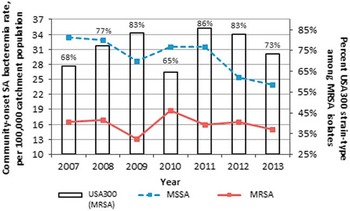
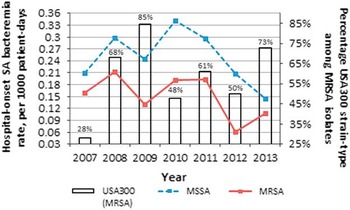
PFGE analysis was performed for 88% of MRSA BSI isolates. The proportion of genotyped isolates per year ranged from 79% in 2011 to 96% in 2007. USA300 was the predominant strain type of MRSA BSI isolates, comprising 70% of all genotyped isolates. Seventy-six percent of CO-MRSA BSIs were due to USA300 MRSA strains, with the proportion of CO-MRSA BSIs due to USA300 largely stable during the study period (Figure 1). For 4 years of the study period, the proportion of HO-MRSA BSIs due to USA300 exceeded 60% (Figure 2).
Incidence of community-onset Staphylococcus aureus (SA) bacteremia and proportion of methicillin-resistant S. aureus (MRSA) isolates due to USA300 from Stroger Hospital of Cook County in Chicago, Illinois, in 2007–2013. MSSA, methicillin-susceptible S. aureus.

Incidence of hospital-onset Staphylococcus aureus (SA) bacteremia and proportion of methicillin-resistant S. aureus (MRSA) isolates due to USA300 from Stroger Hospital of Cook County in Chicago, Illinois, in 2007–2013. MSSA, methicillin-susceptible S. aureus.

USA100 was the second most prevalent strain type and accounted for 18% of genotyped MRSA BSIs. USA100 strains were observed among both CO (15%) and HO (23%) BSIs. Remaining strain types constituted a small proportion of genotyped isolates. There were only 6 multidrug-resistant USA300 isolates (2.7%) identified and resistance to tetracyclines (3%) or to trimethoprim-sulfamethoxazole (1 isolate) was rare.
Baseline Demographic Characteristics of Study Population
A total of 1,015 cases of S. aureus bacteremia were identified from January 1, 2007, through December 31, 2013. There were 366 BSIs due to MRSA (36%) and 649 BSIs due to MSSA (64%). The mean (SD) age of individuals with an S. aureus BSI was 50 (14) years; 73% were male, 53% were African-American, and 25% were of Hispanic ethnicity. African-Americans were significantly more likely to have a BSI due to MRSA than MSSA (odds ratio [OR], 2.1 [95% CI, 1.6–2.8]; P<.001), in comparison with other races. Hispanic ethnicity was negatively associated with a BSI due to MRSA (OR, 0.5 [95% CI, 0.4–0.8]; P<.001).
Surveillance of S. aureus BSIs
The overall incidences of CO-MSSA and MRSA BSIs were 29.6 and 16.1 BSIs per 100,000 catchment population, respectively. The incidence of CO-MSSA BSIs significantly decreased over time (P=.04) (Figure 1). In contrast, the incidence of CO-MRSA BSIs remained stable during the study period (P=.87).
The overall incidences of HO-MSSA and MRSA BSIs were 0.25 and 0.15 BSIs per 1,000 patient-days, respectively. During the study period, the incidence of HO-MRSA BSIs significantly decreased (P=.045) (Figure 2). For HO-MSSA BSIs, the incidence was initially stable and then decreased following 2010.
Predictors of MRSA Strain Type
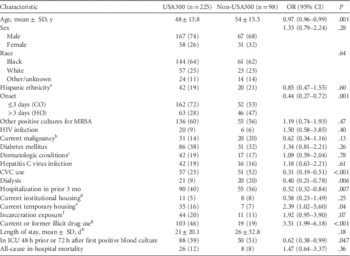
We sought epidemiologic factors that distinguished MRSA BSIs due to USA300 from those due to non-USA300 strains. On univariate analysis, significant risk factors associated with the USA300 strain type included younger age (OR, 0.97 [95% CI, 0.96–0.99]; P=.001), current temporary housing (2.39 [1.02–5.60]; P=.04), and current or former illicit drug use (3.51 [1.99–6.18]; P<.001) (Table 1). Incarceration exposure was associated with risk of BSI due to the USA300 strain type, although this trend did not reach statistical significance (P=.07).
Univariate Analysis of Risk Factors and Outcomes for Patients With Methicillin-Resistant Staphylococcus aureus Bacteremia, 2007–2013

NOTE. Data are no. (%) of patients, unless otherwise indicated. CO, community-onset; CVC, central venous catheter; HIV, human immunodeficiency virus; HO, hospital-onset; ICU, intensive care unit; OR, odds ratio.
a For determination of ethnicity, data were missing for 5 cases.
b Current malignant tumor includes both hematologic and solid-organ malignant tumors.
c Dermatologic conditions include psoriasis, eczema, decubitus or other skin ulcers, sequelae of skin popping, excoriating skin cancers, burns, boils, or other nonspecific conditions such as desquamation, xerotic eruption, or drug rash.
d Institutional housing is defined as residing in a skilled nursing facility, senior assisted living, or inpatient rehabilitation.
e Temporary housing is defined as homeless or residing in a shelter, substance abuse center, subsidized or supportive housing, or other unstable residence (hotel room, friends’ homes).
f Incarceration exposure is defined as individuals who are currently incarcerated and/or have ever been incarcerated throughout their lifetime.
g Illicit drug use includes intravenous and non-intravenous drug use, including methadone as a surrogate for former drug use if specified in the chart.
h Length of stay refers to total duration of hospitalization. Data were missing and/or not applicable (ie, not hospitalized) for 7 cases.
Requirement for dialysis (OR, 0.40 [95% CI, 0.21–0.78]; P=.006), having an indwelling central venous catheter (0.31 [0.19–0.51]; P<.001), and hospitalization in the prior 3 months (0.52 [0.32–0.84]; P=.007) were each negatively associated with BSIs due to the USA300 strain type. Hospital length of stay and all-cause in-hospital mortality were not different on the basis of strain type. However, individuals with USA300 MRSA BSI were less likely to have an intensive care unit admission around the time of bacteremia (OR, 0.62 [95% CI, 0.38–0.99]; P=.047).
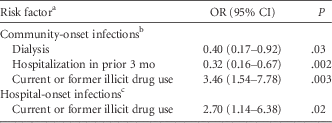
We found that there was differential risk for strain type on the basis of onset of bacteremia and hospitalization in the prior 3 months (P=.02) in the multivariable model, and therefore we performed stratified analysis by onset of bacteremia. The predictors for USA300 strain type differed on multivariate analysis for CO and HO infections (Table 2). For CO-MRSA BSIs, illicit drug use remained a significant risk factor for BSIs due to the USA300 strain type (OR, 3.46; 95% CI, 1.54–7.78; P=.003), whereas dialysis and hospitalization in the prior 3 months were negatively associated with BSIs due to the USA300 strain type. For HO-MRSA BSIs, only illicit drug use predicted strain type, with a significant association with USA300 (OR, 2.70 [95% CI, 1.14–6.38]; P=.02).
Multivariate Analysis of Risk Factors for Patients With USA300 Methicillin-Resistant Staphylococcus aureus Bacteremia, 2007-2013

NOTE. OR, odds ratio.
a Initial variables included in the model were onset, age, current malignancy, dialysis, hospitalization in prior 3 months, current temporary housing, incarceration exposure, current or former illicit drug use, and intensive care unit admission 48 hours prior or 72 hours after first positive blood culture. Central venous catheter use was not included owing to collinearity with current malignancy and dialysis.
b Community-onset bacteremia occurs within 3 days of admission, in emergency rooms, or in dialysis centers. Hospital-onset bacteremia occurs >3 days into hospitalization.
c In an unstratified model, hospital-onset bacteremia was negatively associated with USA300 (OR, 0.20 [95% CI, 0.09–0.43]; P<.001) when there was no prior hospitalization or when there was prior hospitalization (0.22 [0.06–0.83]; P=.02), suggesting little impact of prior hospitalization in nosocomial bacteremias.
DISCUSSION
In 2007–2013, the incidences of HO-MSSA, HO-MRSA, and CO-MSSA BSIs decreased, while the incidence of CO-MRSA BSIs was largely unchanged. Seventy percent of all MRSA BSIs were due to the USA300 strain type. More than half of HO-MRSA isolates during the study period were due to USA300, surpassing USA100 as the predominant nosocomial strain type in our study. Illicit drug use was a significant predictor for the presence of MRSA USA300 strain type among both CO- and HO-MRSA BSIs.
The decrease in the rate of HO-MRSA BSIs is consistent with recently published national surveillance studies of invasive MRSA infections.Reference David, Daum and Bayer 16 , Reference Dantes, Mu and Belflower 17 We also noted a decrease in HO-MSSA BSIs following 2010; decreases in both HO S. aureus BSIs may be due to substantial efforts aimed to reduce healthcare-associated infections.Reference Huang, Septimus and Kleinman 25 , Reference Muto, Jernigan and Ostrowsky 26 Significant geographic variability in CO S. aureus BSI rates has been reported,Reference David, Daum and Bayer 16 and our study provides further regional characterization of S. aureus bacteremia rates. It is unclear why CO-MRSA rates remained stable while CO-MSSA rates decreased in our catchment population. Prior studies on S. aureus SSTIs in Chicago observed large increases in CA-MRSA SSTIs without a decline in CA-MSSA SSTIs, suggesting that CA-MRSA infections were occurring in addition to, and not as a replacement of, CA-MSSA infections.Reference Hota, Ellenbogen, Hayden, Aroutcheva, Rice and Weinstein 10 , Reference Popovich, Weinstein, Aroutcheva, Rice and Hota 13 One might speculate that different patient populations in the community may be colonized with MSSA versus MRSA, and thus epidemiologic changes for CO infections due to these pathogens may not occur in parallelReference Hota, Ellenbogen, Hayden, Aroutcheva, Rice and Weinstein 10 , Reference Popovich, Weinstein, Aroutcheva, Rice and Hota 13 ; nevertheless, there may be other explanations, such as confounding by healthcare-associated CO-MSSA infections.
As an extension of prior work demonstrating the increasing proportion of inferred community genotypes within HO-MRSA BSIs during the years 2000–2006,Reference Popovich, Weinstein and Hota 4 we were able to confirm the continued high prevalence of the USA300 strain type among HO-MRSA BSIs during 2007–2013 at our large safety-net hospital. This high proportion of nosocomial MRSA BSIs due to USA300 has been reported in other tertiary medical centers in the United States,Reference Diekema, Richter and Heilmann 21 supporting the idea that the USA300 strain type is now endemic in healthcare settings across the country.
Our work also extends national surveillance studies by determining whether epidemiologic risk factors can still distinguish USA300 and non-USA300 MRSA strains. We found that illicit drug use was a significant predictor of the USA300 strain type, irrespective of CO or HO. Prior work has documented an association with drug use and CA-MRSA colonization or infection.Reference Popovich, Hota and Aroutcheva 11 , Reference Lee, Taylor and Bancroft 15 We previously observed that illicit drug use was associated with a higher CA-MRSA colonization burden (ie, more body sites of colonization) and with colonization by USA300 strain type among newly hospitalized HIV-infected and HIV-negative individuals at CCH.Reference Popovich, Hota and Aroutcheva 11 In HIV-infected outpatients who were men who have sex with men residing in Los Angeles, Lee et alReference Lee, Taylor and Bancroft 15 found that illicit drug use and high-risk sexual behaviors were both associated with an increased risk of CA-MRSA SSTIs; methamphetamine use was associated with an 8-fold increased risk of MRSA SSTI, whereas condom use was protective. These studies suggest that illicit drug use may be a surrogate for overall high-risk social networks that foster spread of USA300 MRSA strains in the community. We speculate that individuals who use illicit drugs may be admitted to the hospital already colonized with USA300 strains and thus are more likely to develop both community and nosocomial BSIs due to the USA300 strain type.
We found that dialysis dependence and recent hospitalization were negatively associated with the USA300 strain type for CO-MRSA BSIs, suggesting that more traditional hospital strains may still have a foothold in certain healthcare settings. Dialysis dependence is a well-known risk factor for MRSA colonizationReference Patel, Jenkins and Mediavilla 27 and invasive infections, with greater than 100-fold higher incidence of infection compared with the general population. 28 In the past 10 years, there has been an overall decrease in invasive MRSA infections in patients who require chronic dialysis.Reference Nguyen, Lessa and Belflower 29 A national study of invasive MRSA infections in US dialysis centers in 2005–2011 found that 59% of genotyped MRSA isolates were due to USA100 and 27% were due to USA300; however, the proportion of USA300 MRSA isolates increased yearly during the study period.Reference Nguyen, Lessa and Belflower 29 These findings suggest that USA300 MRSA may be an increasingly important pathogen in patients who are dialysis dependent and that the epidemiology of MRSA infections in this population is evolving.
A few limitations to our study should be noted. First, the study is retrospective; however, manual medical chart review was used in conjunction with data elements that were prospectively collected electronically, which improves completeness of the data set. Second, the study setting was a highly diverse inner-city population seeking care at the major safety-net hospital in Chicago, which may limit the generalizability of the results. However, given the high burden of colonization and infection due to USA300 MRSA in inner-city populations across the United States,Reference Fridkin, Hageman and Morrison 1 , Reference Liu, Graber and Karr 3 the evolving epidemiology of USA300 that we demonstrated may be found in other areas. Finally, since an assessment of nasal and extranasal MRSA colonization was not performed on individuals at hospital admission, we do not know whether individuals who developed HO-MRSA BSIs entered the hospital colonized with USA300 or non-USA300 strains or whether they were acquired during hospitalization. Potentially, USA300 strains are now prevalent enough in healthcare settings to be considered a hospital pathogen, similar to traditional hospital MRSA strains (eg, USA100).
In conclusion, our findings suggest that USA300 MRSA is now endemic within both community and hospital settings. Despite overall decreases in HO-MRSA infections, for 4 years of the study period the proportion of HO-MRSA BSIs due to USA300 was greater than 60%. Illicit drug use remained a significant risk factor for both CO- and HO-MRSA BSIs. Enhanced prevention efforts in the community for certain populations, such as those engaging in illicit drug use, may be necessary to further curb the spread of invasive MRSA infections.
ACKNOWLEDGMENTS
We thank the Collaborative Research Unit at CCH for their assistance with data collection.
Financial support. Centers for Disease Control and Prevention (Epicenter Grant Cooperative Agreement 1U54CK000161).
Potential conflicts of interest. All authors report no conflicts of interest relevant to this article.