1. Introduction and geological setting
1.a. Shropshire and the Welsh Borders
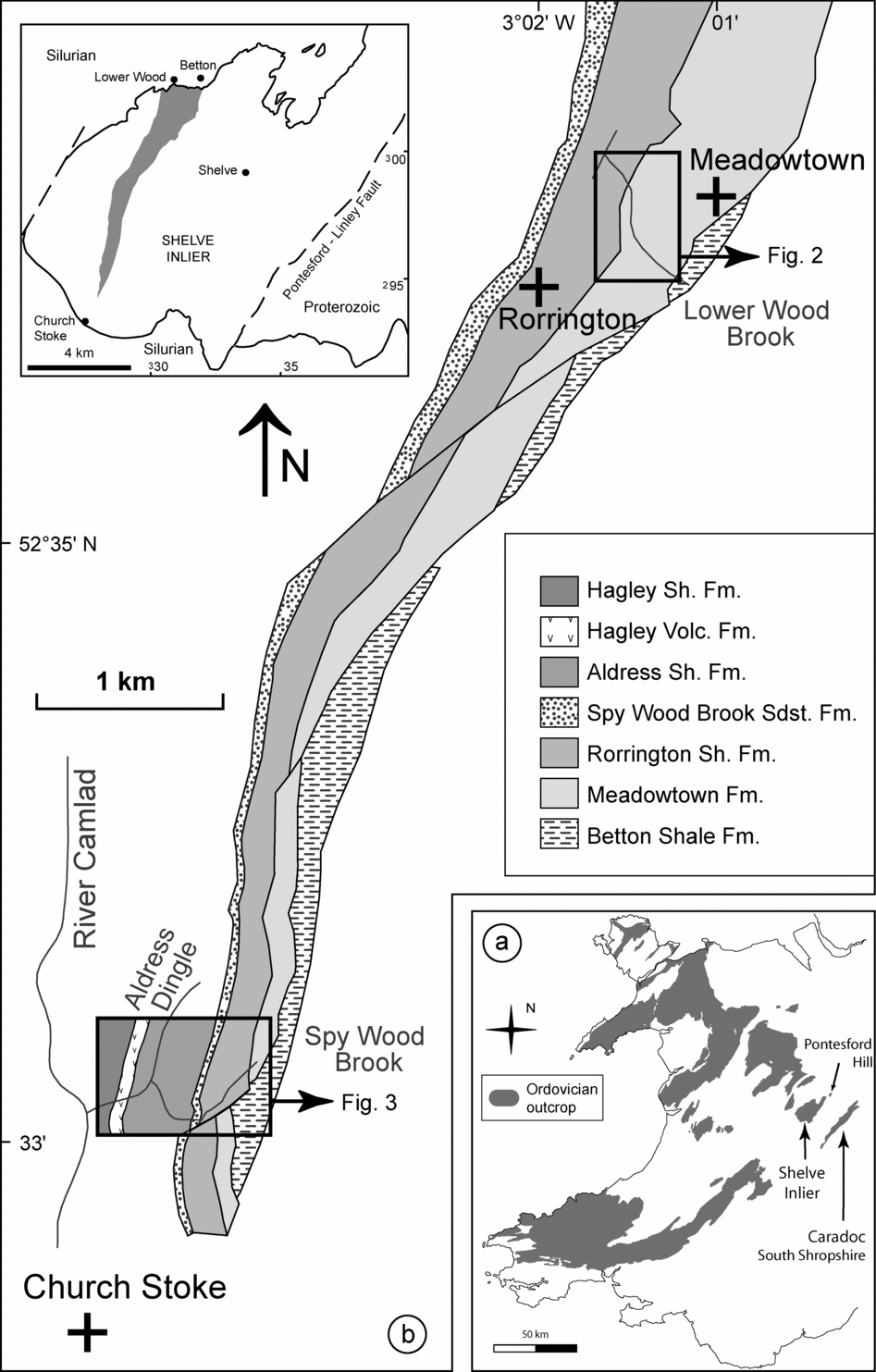
Ordovician successions on either side of the Pontesford-Linley Fault are significantly different. West of this structure, the main, thick Shelve area sequence (Fig. 1a) displays a more or less complete record of Tremadoc, Arenig, Llanvirn and Caradoc rocks. In contrast, east of the Pontesford-Linley Fault, the thin, shallow marine Caradoc successions at Pontesford Hill and in the Caradoc type area (Fig. 1a) rest unconformably on rocks of Precambrian to Tremadocian age (Whittard, Reference Whittard1979; Fortey et al. Reference Fortey, Harper, Ingham, Owen, Parkes, Rushton and Woodcock2000). An interpretation explaining the discrepancies states that the Pontesford-Linley Fault was active during pre-Caradoc times, forming the southeastern margin of the Welsh basin. The basin in which the deposition of the Shelve sediments took place lay west of the shoreline, while the area east of it was emergent as part of the Midland Platform. The early Caradoc sea-level rise, the gracilis transgression, initiated deposition also in the area east of the lineament, giving rise to the deposits of the type Caradoc area (Whittard, Reference Whittard1979; Woodcock, Reference Woodcock1984). Alternatively, substantial displacement along the Pontesford-Linley Fault system, during Caradoc times or later, might have caused/enhanced the shelf-basin contrast, juxtaposing terranes that were widely separated during most of the Ordovician (Woodcock, Reference Woodcock1984; Woodcock & Gibbons, Reference Woodcock and Gibbons1988, p. 917).
(a) Ordovician outcrops in Wales and the Welsh Borderland. (b) Location of the sections and summary geological map of the most relevant units in the Shelve Inlier (modified after Bettley, unpub. Ph.D. thesis, Univ. Oxford, 1998 and Cave & Hains, Reference Cave and Hains2001). The inset map has UK national grid coordinates: grid SJ in the north, grid SO in the south.

1.b. The Shelve Inlier
The outcrop area of the Ordovician rocks of the Shelve Inlier covers a surface of some 111 km2 in Shropshire and the Welsh county of Powys (Fig. 1b). The area is more or less centred around the village of Shelve, and geologically bounded by the Pontesford-Linley Fault in the east, and by overstepping lower Silurian rocks at the southern and northern edges (Whittard, Reference Whittard1979). The westerly dipping succession consists of marine shelf sediments, intercalated with volcanic deposits. The continuously fossiliferous successions have drawn the attention of geologists ever since Murchison's time, and an overview of previous research on the area has been given in several papers by Whittard (Reference Whittard1931, Reference Whittard1952, Reference Whittard1979). The 1979 paper provides a detailed geological map of the area, as well as a full description of the Ordovician rocks, with the exception of the Tremadoc Shineton Shale Formation and the Habberley Formation.
Following Whittard (Reference Whittard1979), three important taxonomic studies have been carried out on material from the Shelve area. The studies by Strachan (Reference Strachan1986) and by Hughes (Reference Hughes1989) deal exclusively with graptolites. A third major contribution by R. M. Bettley (unpub. Ph.D. thesis, Univ. Oxford, 1998) reviewed the former faunas and focused on carefully measured sections containing mixed trilobite–graptolite faunas, among others in the Shelve area, and on their high-resolution correlation. Following the latter study, Bettley, Fortey & Siveter (Reference Bettley, Fortey and Siveter2001) proposed the Lower Wood Brook Section (Fig. 2) of the northern part of the Shelve Inlier as a possible type section for the base of the Nemagraptus gracilis Biozone. This is one of the reasons why we studied this section for chitinozoans, together with the additional Spy Wood Brook section (Fig. 3), although the section has never been officially brought to a vote before the International Subcommission on Ordovician Stratigraphy (ISOS) or the International Union of Geological Sciences (IUGS). The work by Bettley (unpub. Ph.D. thesis, Univ. Oxford, 1998) and Bettley, Fortey & Siveter (Reference Bettley, Fortey and Siveter2001) provides a calibration of our data with the other fossil groups present.
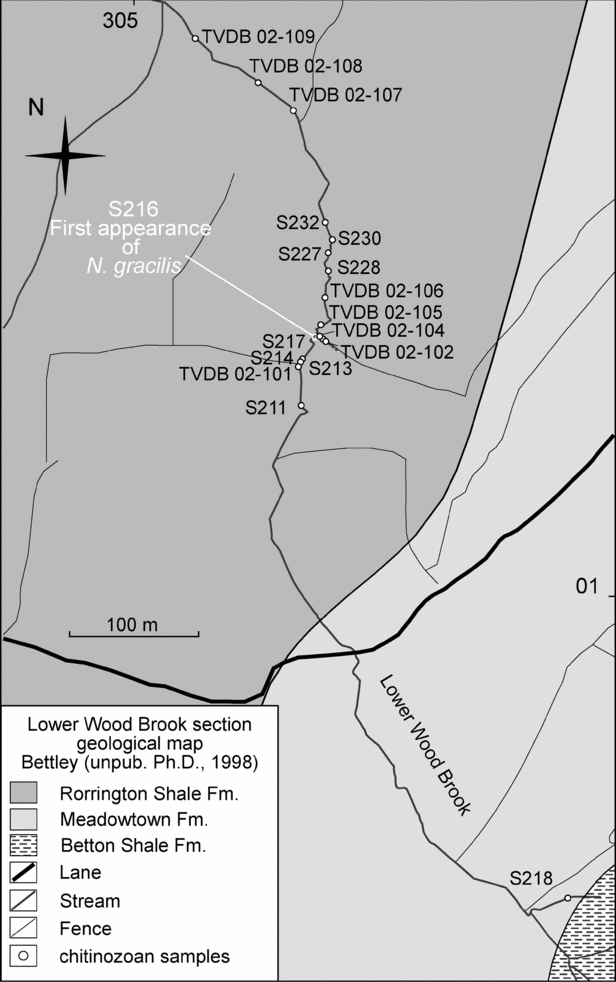
Geological map of the Lower Wood Brook section with the sample localities (after R. M. Bettley, unpub. Ph.D. thesis, Univ. Oxford, 1998). The map has UK national grid coordinates (see Fig. 1).

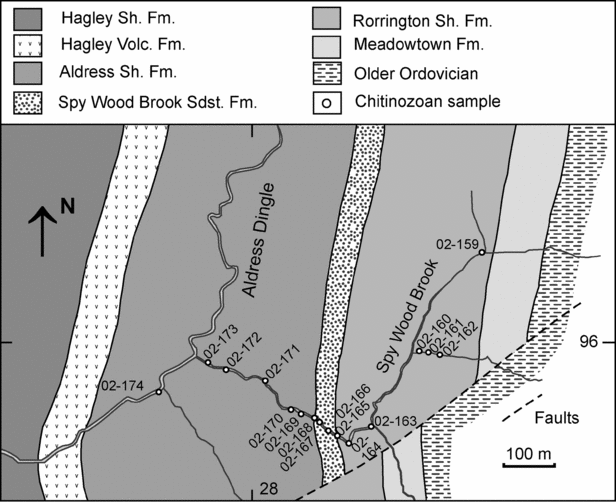
Geological map of the Spy Wood Brook section with the sample localities (after Hughes, Reference Hughes1989). The map has UK national grid coordinates (see Fig. 1).

As far as previous chitinozoan research is concerned, the work of Jenkins (Reference Jenkins1967) has become a standard, and focused on Llanvirn and Caradoc chitinozoans, respectively, from the Shelve Inlier and the type Caradoc area (see below). The BGS (British Geological Survey) memoir for the Montgomery area (sheets 165/151) by Cave & Hains (Reference Cave and Hains2001) is used here as the lithostratigraphical reference, upgrading most of Whittard's (Reference Whittard1979) members to formations (as originally suggested by Lynas, Reference Lynas1985).
1.c. The type Caradoc area
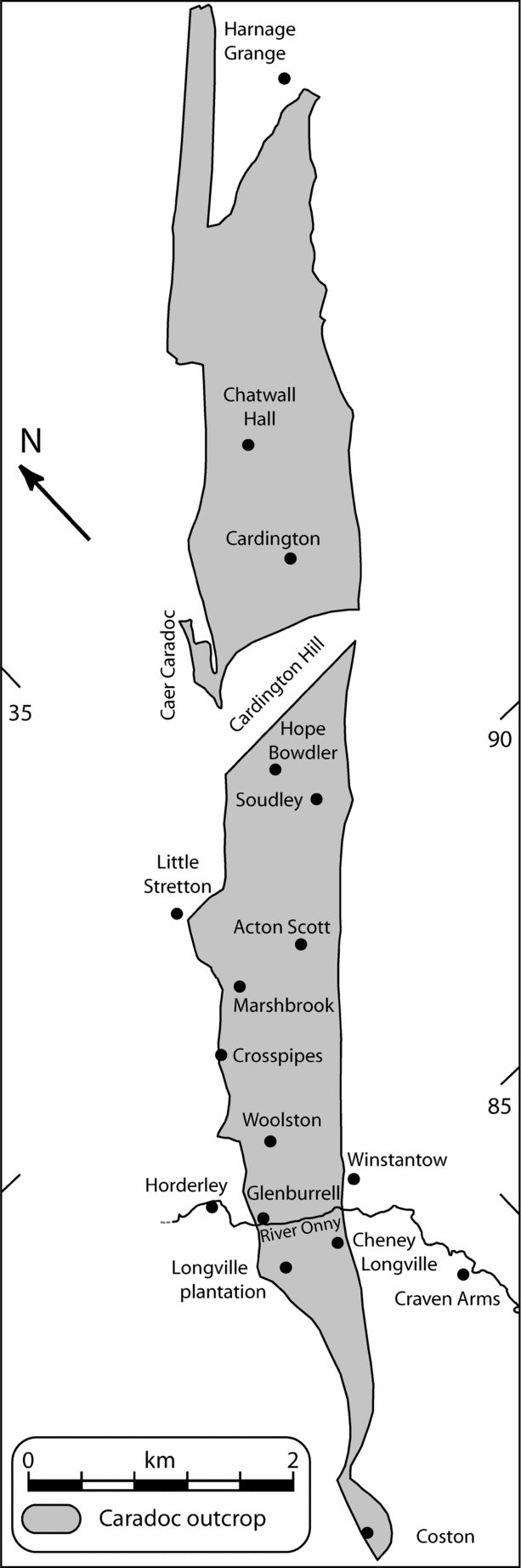
The Caradoc succession in south Shropshire crops out south of the Church Stretton Fault, from Harnage in the north to Coston in the south, in two tracts that are separated by upfaulted Cambrian and Proterozoic rocks near Hope Bowdler and Cardington (Fig. 4). The sequence in the northern part is thicker, but the sequence in the south is more complete (Fortey et al. Reference Fortey, Harper, Ingham, Owen, Parkes, Rushton and Woodcock2000; Rushton et al. Reference Rushton, Owen, Owens and Prigmore2000). As already mentioned, and in contrast to the Shelve area deposits at the far side of the Pontesford-Linley Fault, only the Caradoc Series is exposed in south Shropshire, where its basal beds rest diachronously and unconformably on rocks of Precambrian to Tremadoc age. The rocks are shallow-water deposits and mainly comprise sandstones, siltstones, mudstones and shales (Williams et al. Reference Williams, Strachan, Bassett, Dean, Ingham, Wright and Whittington1972).
The Caradoc Inlier: sketch map of the northern and southern tracts of the type Caradoc area, showing the main localities and the Onny Valley section (modified after Dean, Reference Dean1958). The national grid coordinates are from grid SO.

Dean (Reference Dean1958) reviewed the scientific contributions on the area, starting from Murchison's definition of the ‘Caradoc Sandstone’ (Reference Murchison1839), which already postulated its best section along the Onny River as the ‘type area’. The area was where Bancroft (Reference Bancroft1933) originally defined the subdivision of the Caradoc into seven stages, largely based on brachiopod biostratigraphy. Dean (Reference Dean1958, Reference Dean1960, Reference Dean1964) reviewed the stages and lithostratigraphical units, and added the trilobite biostratigraphy to the schemes. For the lower units of the successions, he applied a separate lithostratigraphical terminology for the areas south and north of the Cardington area. The succession in the southern (Coston) part comprises the following formations, from bottom to top: the Coston, Smeathen Wood, Glenburrell, Horderley Sandstone, Alternata Limestone, Cheney Longville, Acton Scott and Onny formations (Dean, Reference Dean1958; Fig. 5). In the northern (Chatwall) part, the succession consists of the Hoar Edge Grits, Harnage Shales, Chatwall Flags, Alternata Limestone, Cheney Longville and Acton Scott formations (Dean, Reference Dean1960). This double terminology persists in more recent contributions (e.g. Williams et al. Reference Williams, Strachan, Bassett, Dean, Ingham, Wright and Whittington1972; Savage & Bassett, Reference Savage and Bassett1985; Rushton et al. Reference Rushton, Owen, Owens and Prigmore2000; Fortey et al. Reference Fortey, Harper, Ingham, Owen, Parkes, Rushton and Woodcock2000). Some authors, though, seem to prefer using certain of the northern formation names in the southern part (e.g. Turner, Reference Turner1982; A. Ancilletta, unpub. DEA thesis, Univ. Liège, 1997). We will follow Fortey et al. (Reference Fortey, Harper, Ingham, Owen, Parkes, Rushton and Woodcock2000). The areas with separate lithostratigraphical divisions coincide with the Cressage-Cardington and Onny sub-basins suggested by Smith & Rushton (Reference Smith and Rushton1993) (Rushton et al. Reference Rushton, Owen, Owens and Prigmore2000; Fortey et al. Reference Fortey, Harper, Ingham, Owen, Parkes, Rushton and Woodcock2000).
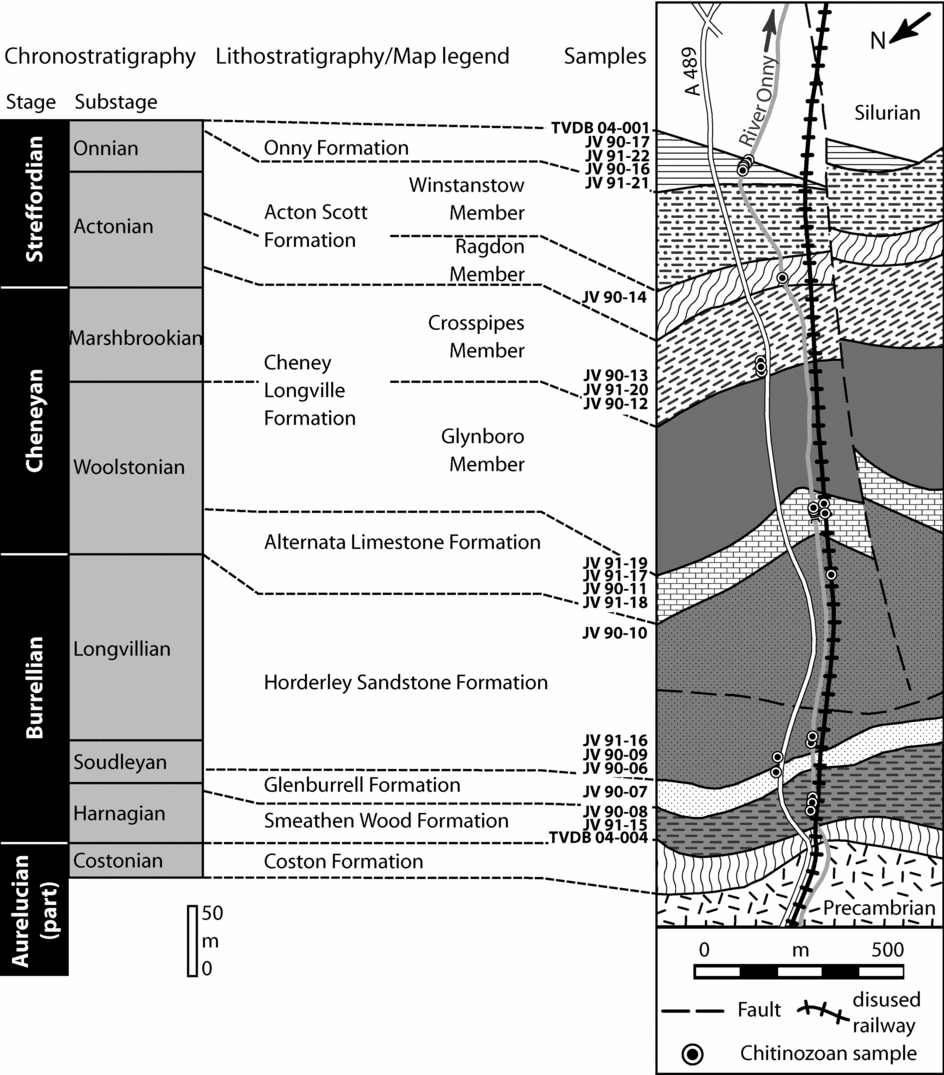
Geological map of the Onny Valley section with the sample localities and the chrono- and lithostratigraphy of the southern Caradoc area (after Rushton et al. Reference Rushton, Owen, Owens and Prigmore2000). For location of the section, see Figure 4.

It should be stressed that the Caradoc succession is incomplete in its type area. Apart from the already cited unconformity at the base of the beds, the Llandovery lies unconformably on the locally youngest Caradoc. This can be seen clearly in the famous cliff section in the Onny Valley, where the Onnian rocks at the top of the Caradoc succession are overlain by the upper Llandovery Hughley Shale Formation with a very slight angular unconformity.
Fortey et al. (Reference Fortey, Harper, Ingham, Owen and Rushton1995) downgraded the stages erected by Bancroft (Reference Bancroft1933; see also Dean, Reference Dean1958 and Hurst, Reference Hurst1979) to substage level and contracted them into four stages ‘of greater utility in both Anglo-Welsh and international correlation’ (Fortey et al. Reference Fortey, Harper, Ingham, Owen and Rushton1995, p. 20). Further detailed information on chronostratigraphy, shelly faunas and lithostratigraphy can be found in most of the above-cited publications.
Nemagraptus gracilis has been recognized from the Hoar Edge Grits, in the Costonian substage (Pocock et al. Reference Pocock, Whitehead, Wedd and Robertson1938; Dean, Reference Dean1958; Fortey et al. Reference Fortey, Harper, Ingham, Owen, Parkes, Rushton and Woodcock2000; Rushton et al. Reference Rushton, Owen, Owens and Prigmore2000). Although graptolites from the higher stratigraphical levels, deposited in shallow water, are sparse, Dean (Reference Dean1958 and in Williams et al. Reference Williams, Strachan, Bassett, Dean, Ingham, Wright and Whittington1972) drew the base of the Diplograptus multidens Biozone in the top part of the Costonian Stage (as in the Spy Wood Sandstone Formation: Williams et al. Reference Williams, Strachan, Bassett, Dean, Ingham, Wright and Whittington1972, p. 40). He postulated that the Actonian Stage and most of the Onnian Stage belong to the Dicranograptus clingani Biozone. Rushton et al. (Reference Rushton, Owen, Owens and Prigmore2000) suggested that the base of the D. multidens Biozone lies very close to the Costonian–Harnagian boundary, again based on correlations with Spy Wood Brook. Both Rushton et al. (Reference Rushton, Owen, Owens and Prigmore2000) and Fortey et al. (Reference Fortey, Harper, Ingham, Owen, Parkes, Rushton and Woodcock2000) did not use the stratigraphically higher graptolite occurrences in their correlation schemes.
Savage & Bassett (Reference Savage and Bassett1985) reported conodonts from most of their samples taken from the south Shropshire Caradoc. They are rarely abundant and comprise no species diagnostic for biozones.
Turner (Reference Turner1982) reported Caradoc acritarchs from the type Caradoc area, mixed with reworked species of Tremadoc and Arenig/Llanvirn age, in an essentially inverted succession, illustrating successive erosion of progressively older source material. The peak of reworking seems to be located from halfway up the Horderley Sandstone Formation to midway in the Cheney Longville Formation (Turner, Reference Turner1982, text-fig. 5, p. 136), coinciding with energetically higher depositional conditions.
Jenkins (Reference Jenkins1967) studied the Caradoc chitinozoans from the southern Caradoc area, mainly from the Onny Valley section and its immediate vicinity. He recognized four separate chitinozoan assemblages, numbered 1 to 4. This four-fold subdivision was conveniently used by Fortey et al. (Reference Fortey, Harper, Ingham, Owen and Rushton1995), together with other fossil groups displaying a comparable pattern, to corroborate their division into four stages of the Caradoc. However, the stage boundaries do not precisely correspond to those of the chitinozoan assemblages. Thirty years later, Ancilletta (unpub. DEA thesis, Univ. Liège, 1997) restudied the systematics of the rich chitinozoan assemblages from the Onny Valley section using the scanning electron microscope (SEM), a technique unavailable toJenkins.
2. The sections studied, chitinozoan sampling and methodology
2.a. Shelve Inlier
The Shelve Inlier section most important to our project is the Lower Wood Brook Section. It can be found between Rorrington and Meadowtown, from grid reference SJ 3091 0064 at the head of the stream to SJ 3055 0153, before the stream changes direction and continues along strike (R. M. Bettley, unpub. Ph.D. thesis, Univ. Oxford, 1998; Fig. 2). The section exposed consists of three formations, from bottom to top: the Betton Shale Formation, the Meadowtown Formation and the Rorrington Shale Formation and is unfaulted except for a normal fault at the base of the section (R. M. Bettley, unpub. Ph.D. thesis, Univ. Oxford, 1998).
The lithological appearance of the Betton Shale Formation is discussed by Whittard (Reference Whittard1979) and by Cave & Hains (Reference Cave and Hains2001, pp. 27–8); only the uppermost strata are exposed in the section.
The fauna and detailed lithology of the sand-, silt- and (dominating) mudstones of the Meadowtown Formation were described by Whittard (Reference Whittard1979), Bettley (unpub. Ph.D. thesis, Univ. Oxford, 1998) and by Cave & Hains (Reference Cave and Hains2001, pp. 28–30). Bettley attributed the entire formation to the Hustedograptus teretiusculus Biozone and to two successive trilobite biozones, namely, the Whittardolithus inopinatus and the Lloydolithus lloydii biozones (see Bettley, Fortey & Siveter, Reference Bettley, Fortey and Siveter2001).
The Rorrington Shale Formation consists of blue-black shales with abundant graptolites (Whittard, Reference Whittard1979; Cave & Hains, Reference Cave and Hains2001). Complete faunal lists and logs were given by R. M. Bettley in an unpublished Ph.D. thesis (Univ. Oxford, 1998). The FAD (First Appearance Datum) of Nemagraptus gracilis is determined at a level 262.28 m above the base of the section, or 76 m above the base of the Rorrington Shale Formation, at locality S216 [SJ 3059 0128]. The section has subsequently been proposed as type section for the base of the N. gracilis Biozone and D. irregularis Sub-biozone (Bettley, Fortey & Siveter, Reference Bettley, Fortey and Siveter2001, pp. 945–6). The level represents the zonal boundary between the Hustedograptus teretiusculus and N. gracilis biozones, the Llanvirn–Caradoc boundary in the UK, or the global Middle–Upper Ordovician boundary. The base of the N. gracilis Biozone is drawn at about the same level as Hughes (Reference Hughes1989) suggested, but higher than supposed earlier, by Williams et al. (Reference Williams, Strachan, Bassett, Dean, Ingham, Wright and Whittington1972), among others. Near the top of the section, the base of the Marrolithoides anomalis trilobite Biozone can be recognized. The upper part of the formation is unexposed.
A second section studied in the Shelve Inlier is found along Spy Wood Brook, a tributary to the Aldress Dingle, which in turn runs into the River Camlad (Figs 1, 3). Spy Wood Brook and the Aldress Dingle are Sites of Special Scientific Interest (SSSIs). In ascending order, the succession exposed consists of the Meadowtown, Rorrington Shale, Spy Wood Sandstone, Aldress Shale, Hagley Volcanic and Hagley Shale formations, all of which were studied in detail by Cave & Hains (Reference Cave and Hains2001) and Whittard (Reference Whittard1979). Bettley's research (unpub. Ph.D. thesis, Univ. Oxford, 1998) on this particular section was, like our own, restricted to the upper Rorrington Shale, Spy Wood Sandstone and Aldress Shale formations. He positioned the base of the Diplograptus foliaceus Biozone at the FAD of Orthograptus apiculatus in the Rorrington Shale Formation at 7.04 m below the base of the Spy Wood Sandstone Formation, and proposed the Spy Wood Brook section as the type section for this level.
Chitinozoan samples from the Shelve Inlier have been obtained on two occasions. A first batch of samples consists of graptolite slabs collected by Richard Bettley, nicely positioned vis-à-vis his measured sections and graptolite zonal boundaries. The samples are numbered S2**/slab number. The slab number is irrelevant to our (destructive) approach and has been omitted in most cases below. Additional samples from Lower Wood Brook were collected in the field during the summer of 2002, using the maps provided by Richard Bettley (Figs 1, 2). The samples are numbered TVDB 02-1** and are especially closely spaced across the base of the Nemagraptus gracilis graptolite Biozone. The samples from the Spy Wood Brook (and its tributary Dead Man's Dingle), in the southern part of the area, were collected from the Rorrington Shale, Spy Wood Sandstone and Aldress Shale formations, during the same field season, using the maps of Bettley (unpub. Ph.D. thesis, Univ. Oxford, 1998) and Hughes (Reference Hughes1989; Fig. 3). The same TVDB 02-1** label type is used.
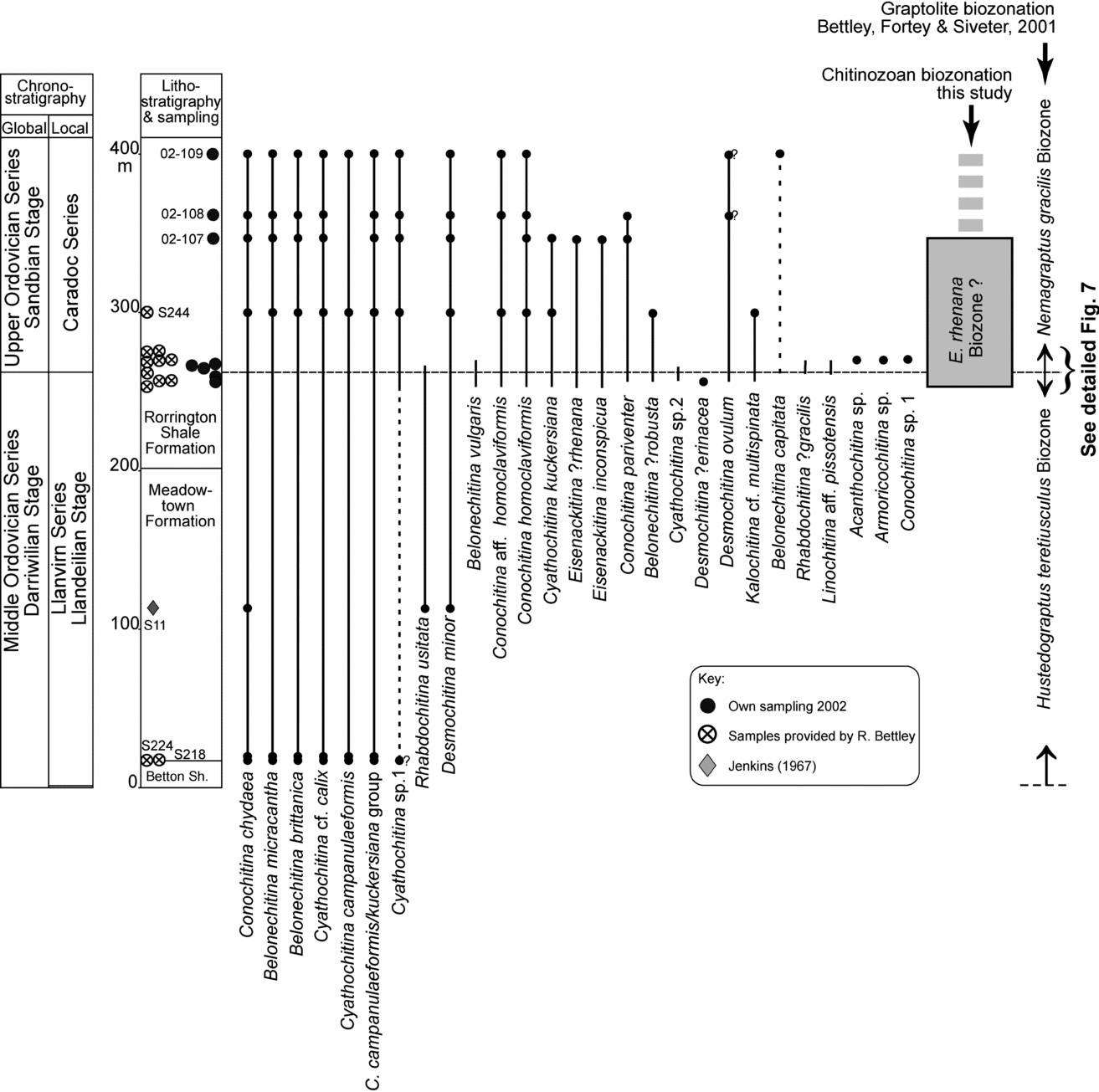
For his chitinozoan analysis, Jenkins (Reference Jenkins1967) collected most of his Llanvirn material from the Shelve area and his Caradoc material from the type Caradoc area. We were mainly interested in the Llanvirn–Caradoc transition and Caradoc successions in the Shelve area. Hence, there is little overlap in sampling between Jenkins' work and our study, with the exception of Jenkins' highest sample from the Shelve area (S11), which has been included in our range chart (Fig. 6).
Range chart of chitinozoan species in the Lower Wood Brook section (Shelve Inlier).

2.b. Sampling and methodology at Onny Valley
The samples available to this study were the same as those of Ancilletta (unpub. DEA thesis, Univ. Liège, 1997). They were collected from the Onny Valley exclusively, which is the type locality for the Actonian and Onnian substages, and a SSSI. The collection covers the exposed levels of the succession described above and illustrated in Figure 5 (Coston to Onny formations). All sampled localities are as far as possible related to the localities and levels used by Jenkins (Reference Jenkins1967) and Turner (Reference Turner1982). Additional samples were collected in the summer of 2004, especially in the topmost Onnian exposed. All localities are described in the Appendix. Figure 5 illustrates their geographical and stratigraphical positions.
The memoir of A. Ancilletta (unpub. DEA thesis, Univ. Liège, 1997) was never published formally, and hence is virtually unavailable to the scientific community. His data have therefore been (partially) incorporated herein, with his approval. However, several of his species identifications and systematics remarks have been revised by the first author. Furthermore, numerical tables illustrating the concentrations of chitinozoans in Ancilletta's memoir showed inconsistencies. Therefore we considered only the absolute number of specimens recorded for each species (A. Ancilletta, unpub. DEA thesis, Univ. Liège, 1997, p. 44, table 2), as being accurate. As for Jenkins (Reference Jenkins1967), he did not record absolute frequencies. Keeping these difficulties in mind, our biostratigraphical study mainly focused on the re-evaluation of presence or absence of chitinozoan species, rather than their absolute concentration or the number of specimens per gram of rock.
Four of Ancilletta's samples (unpub. DEA thesis, Univ. Liège, 1997) were completely reinvestigated, including dissolution of new rock material according to standard palynological techniques. This allowed us to check the composition of the fauna and the absolute frequency of species. The samples treated as such include JV 90-07, 90-09, 91-16 and 90-13 and these were added to the samples collected in 2004, TVDB 04-001 and 04-004 (see Section 4). Topmost sample 04-001 was specifically taken in a futile attempt to recognize faunas from the Caradoc–Ashgill transition as reported from northern England (see Vandenbroucke, Rickards & Verniers, Reference Vandenbroucke, Rickards and Verniers2005). Additional specimens, to check identifications, were obtained from several of Ancilletta's stored residues (samples JV 90-12, 90-14, 90-16, 91-22 and 90-17), but it is not known how much of the residue originally obtained they represent (see Section 4).
3. Chitinozoan results from the Shelve Inlier
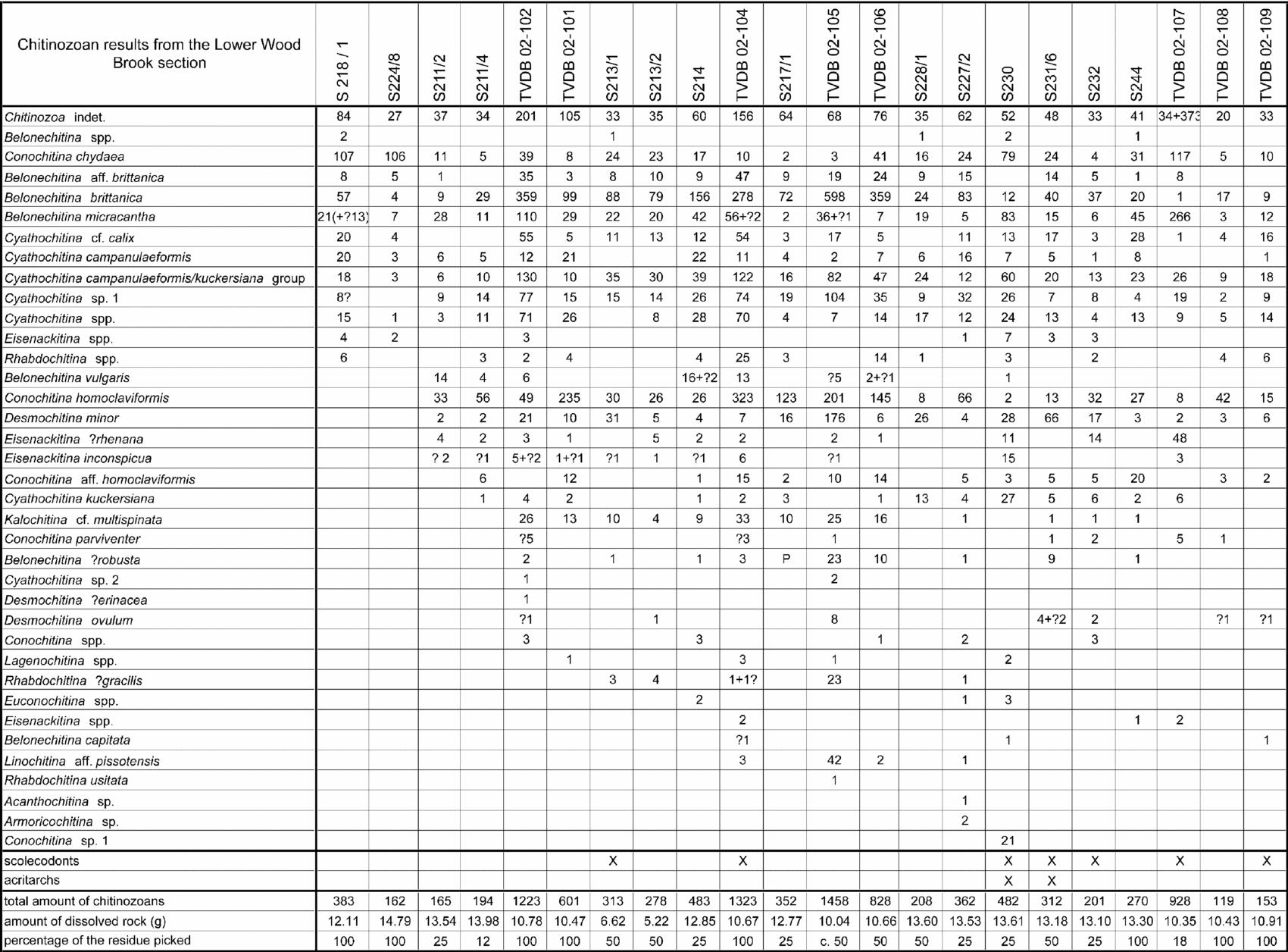
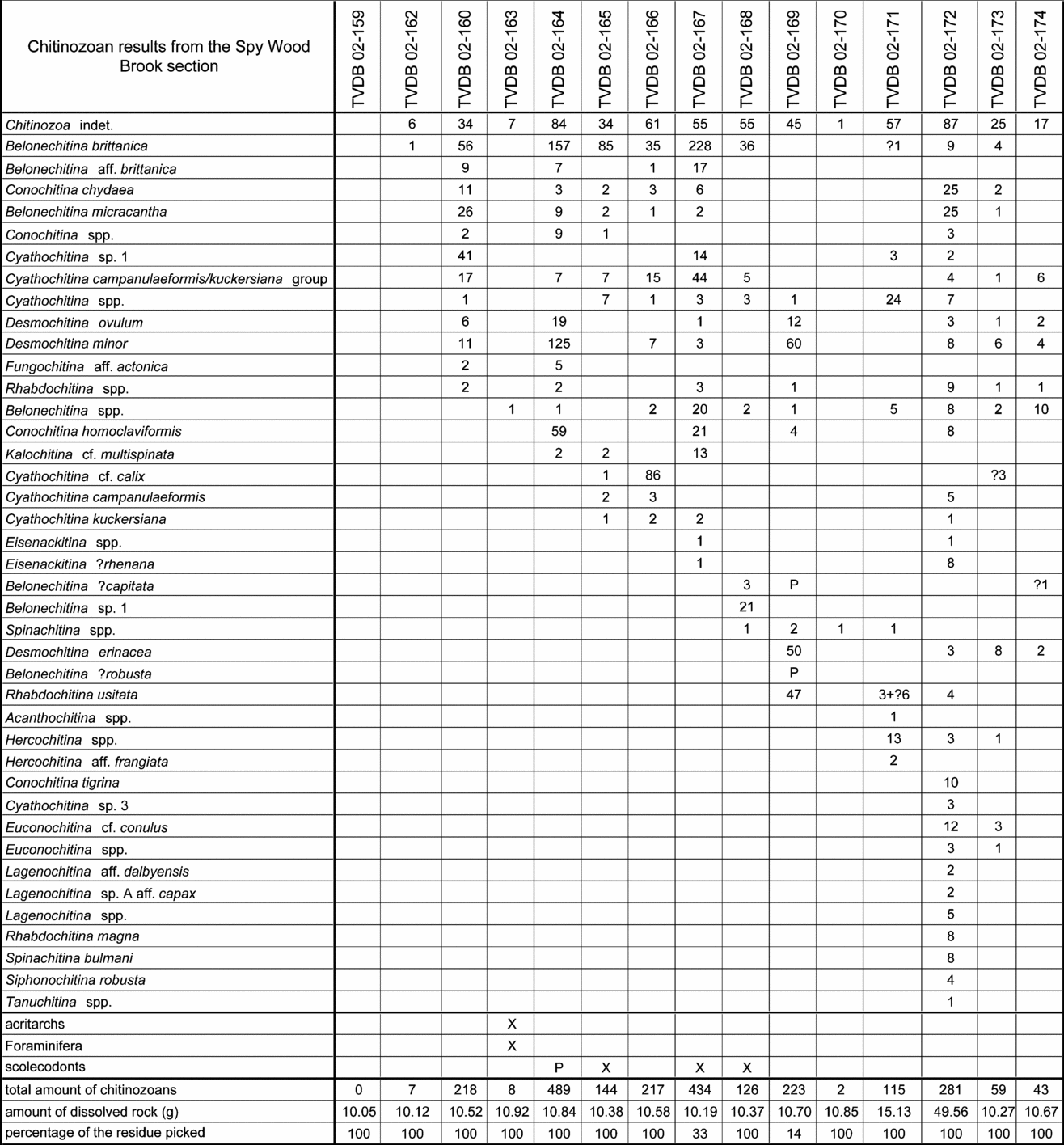
Twenty-one samples from the Lower Wood Brook section and fifteen samples from the Spy Wood Brook section have been processed for chitinozoans. Most samples yielded a high number of moderately to well-preserved chitinozoans. The results of the chitinozoan study in the Shelve area are shown qualitatively on Figures 6, 7 and 8, quantitatively on Figures 9 and 10, and briefly discussed below, by section and in ascending stratigraphical order, with emphasis on the FADs of the particular species. A systematic review of the chitinozoans from the study areas is undertaken in a Palaeontographical Society Monograph by Vandenbroucke (Reference Vandenbroucke2008b).
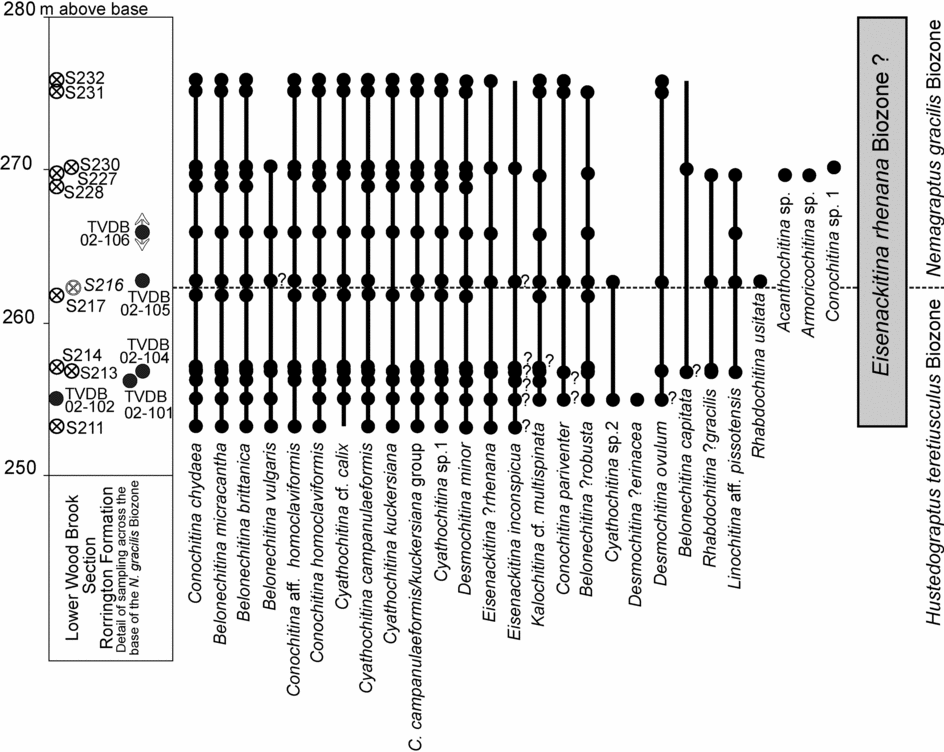
Detailed range chart of chitinozoan species across the base of the Nemagraptus gracilis Biozone, or the base of the global Upper Ordovician Series or of the British Caradoc Series in the Lower Wood Brook section (Shelve Inlier). For legend see Figure 6.

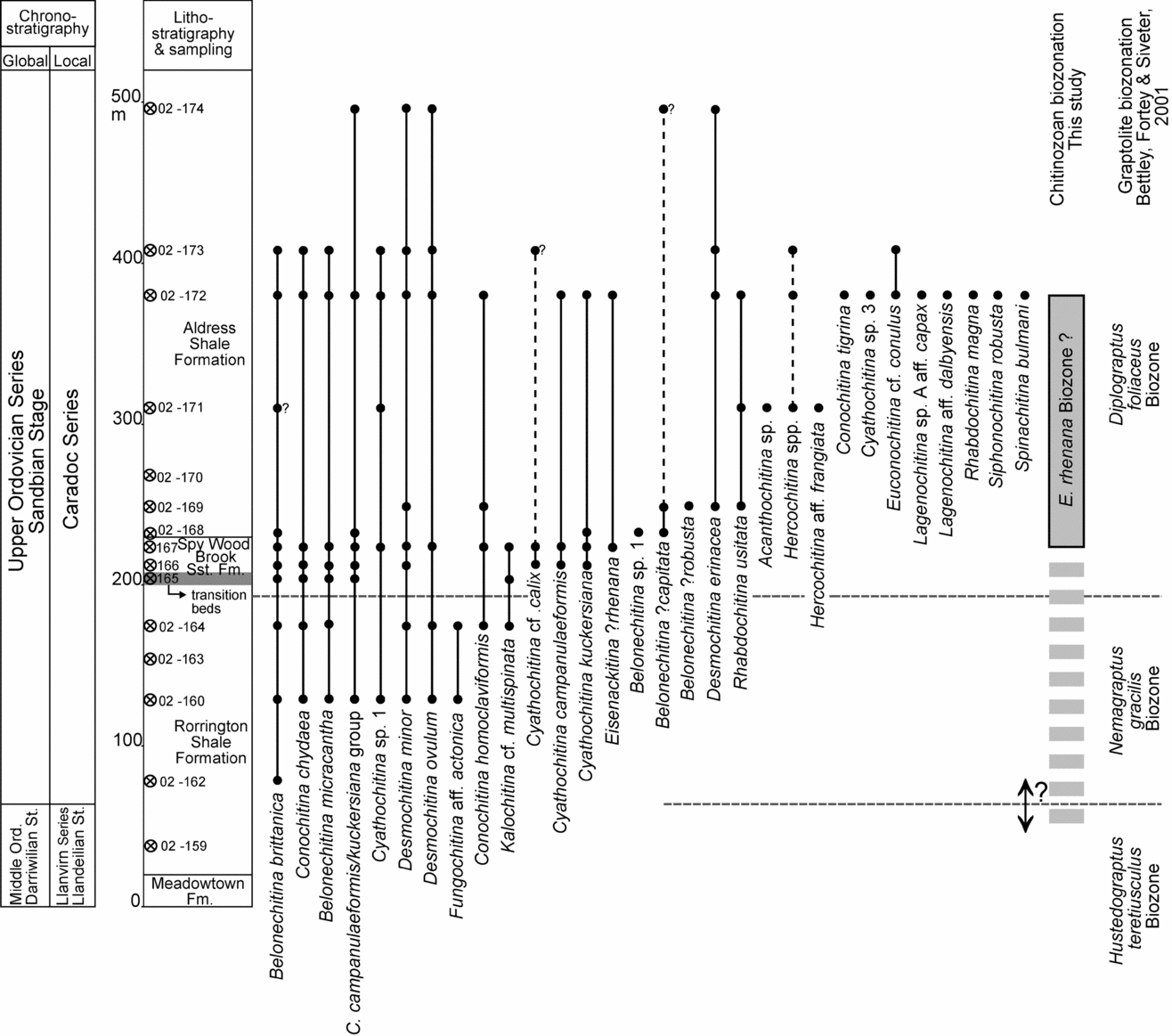
Range chart of chitinozoan species in the Spy Wood Brook section (Shelve Inlier). ‘St.’ – ‘Stage’.

Numerical results of the chitinozoan study in the Lower Wood Brook section of the Shelve Inlier.

Numerical results of the chitinozoan study in the Spy Wood Brook section of the Shelve Inlier.

3.a. Lower Wood Brook
The two lowermost samples, stratigraphically more than 200 m below the base of the Nemagraptus gracilis Biozone, yielded long-ranging species Conochitina chydaea, Belonechitina micracantha, Belonechitina brittanica, Cyathochitina cf. calix, Cyathochitina campanulaeformis, Cyathochitina campanulaeformis–kuckersiana group, in addition to some poorly identified Cyathochitina sp. 1. These forms occur in almost every sample (see Fig. 6). Preservation in these two samples is rather poor.
All hitherto cited species continue to occur in great numbers higher up, throughout the samples taken around the lower boundary of the Nemagraptus gracilis graptolite Biozone as shown on the detailed range chart in Figure 7. They are joined by the common species Conochitina homoclaviformis and Conochitina aff. homoclaviformis. Desmochitina minor and Belonechitina vulgaris appear at the same level. Eisenackitina?rhenana and Eisenackitina inconspicua range from sample S211 upwards, usually in lower numbers and in fewer samples than most of the other species.
Conochitina parviventer, Belonechitina ?robusta, Cyathochitina sp. 2, Desmochitina ovulum, Desmochitina ?erinacea and Kalochitina cf. multispinata can be found from sample TVDB 02-102 upwards, except for D. ?erinacea, which is restricted to sample 02-102.
Linochitina aff. pissotensis and doubtful observations of Belonechitina capitata and Rhabdochitina ?gracilis are reported from slightly higher up-section onwards (sample TVDB 02-104). From more or less the same level, Laufeldochitina fragments have been reported on previous accounts by Vandenbroucke et al. (Reference Vandenbroucke, Fortey, Siveter and Rickards2003), but further observations discovered that this identification could not be sustained due to poor preservation.
Single sample observations of one specimen of the genus Acanthochitina, two belonging to Armoricochitina, one Rhabdochitina usitata, and of several specimens of Conochitina sp. 1 are listed in Figure 9.
3.b. Spy Wood Brook
Samples from the Rorrington Shale Formation in Spy Wood Brook yield no new species in comparison to the results obtained from Lower Wood Brook, with exception of a few observations of Fungochitina aff. actonica in samples TVDB 02-160 and 02-164. The same is true for samples taken from the finer-grained horizons within the Spy Wood Sandstone Formation; worthwhile mentioning might be the first occurrence in this section of Eisenackitina ?rhenana in sample TVDB 02-167 (ranging up to TVDB 02-172). Apart from the quite peculiar Belonechitina sp. 1 in sample TVDB 02-168, the lower samples from the Aldress Shale Formation continue to yield species already reported lower in the section or from Lower Wood Brook. Somewhat higher up-section, new species appear, represented by many specimens in open nomenclature, in sample TVDB 02-171 (Hercochitina spp., Hercochitina aff. frangiata and a single Acanthochitina specimen). In sample TVDB 02-172, there is quite an influx of species previously not seen, such as Conochitina tigrina, Cyathochitina sp. 3, Euconochitina cf. conulus, Lagenochitina aff. dalbyensis, Lagenochitina sp. A aff. capax, Rhabdochitina magna, Spinachitina bulmani and Siphonochitina robusta, together with a rather complete set of species from the long-ranging assemblage cited above.
4. Chitinozoan results from the Onny Valley
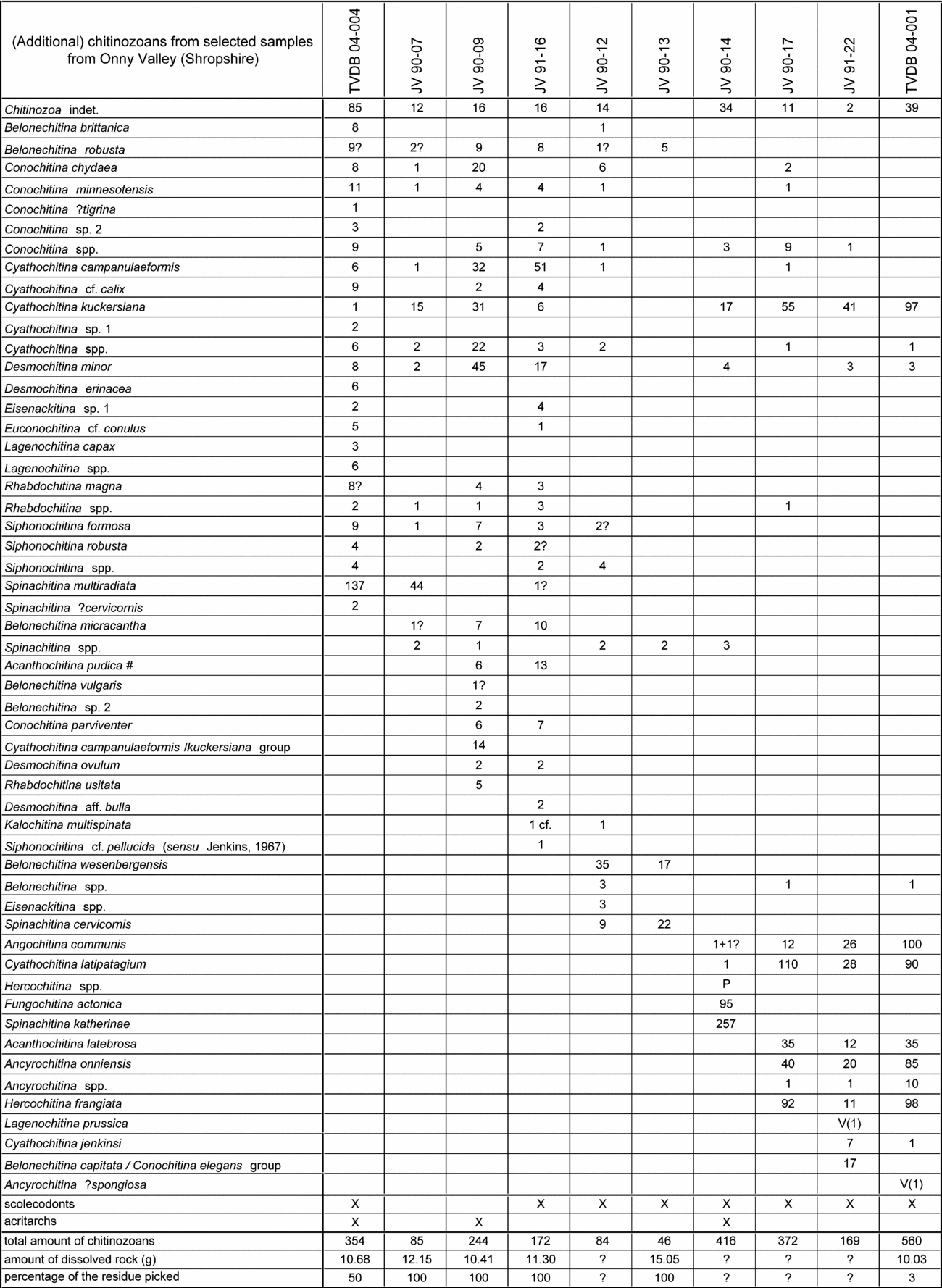
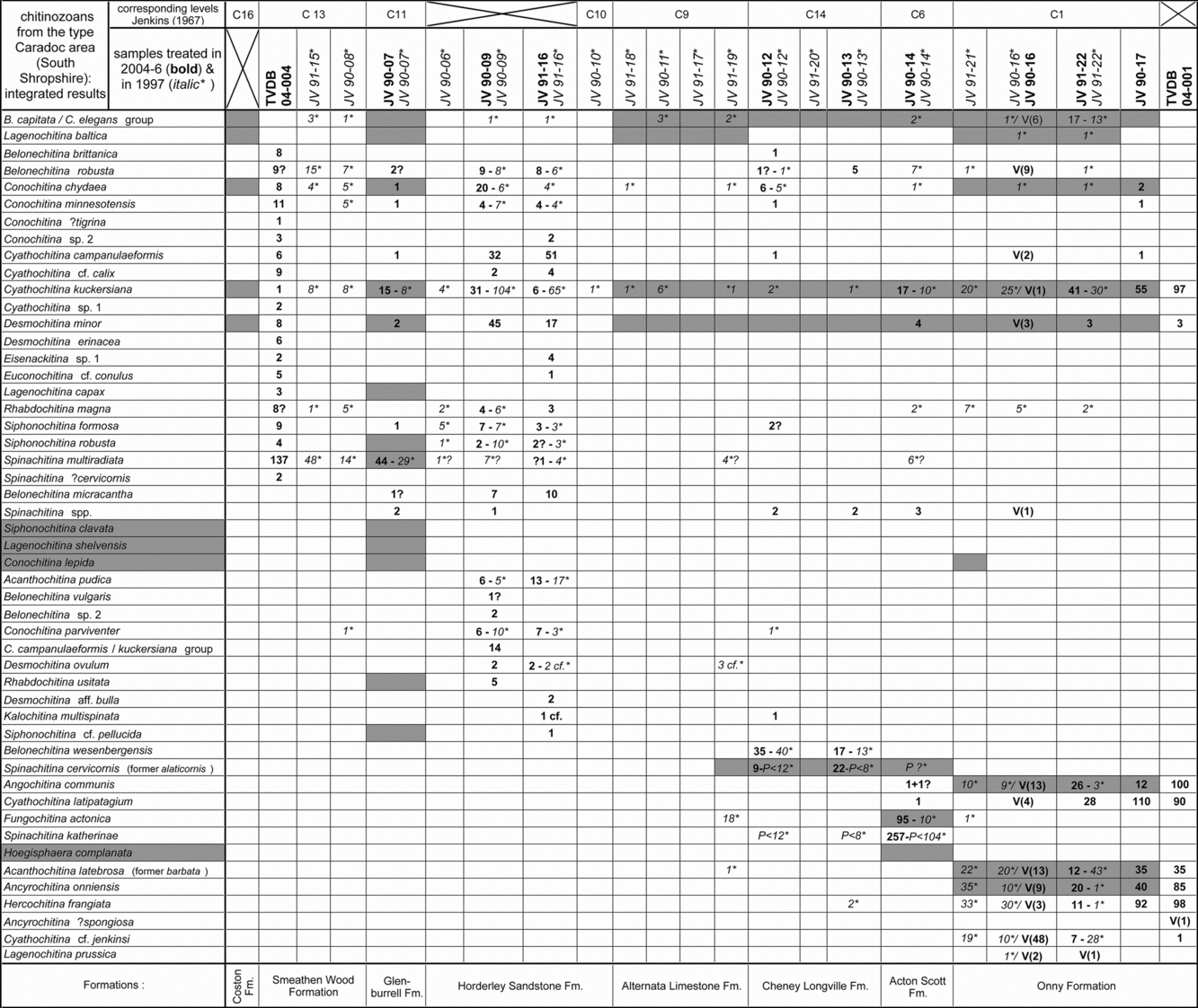
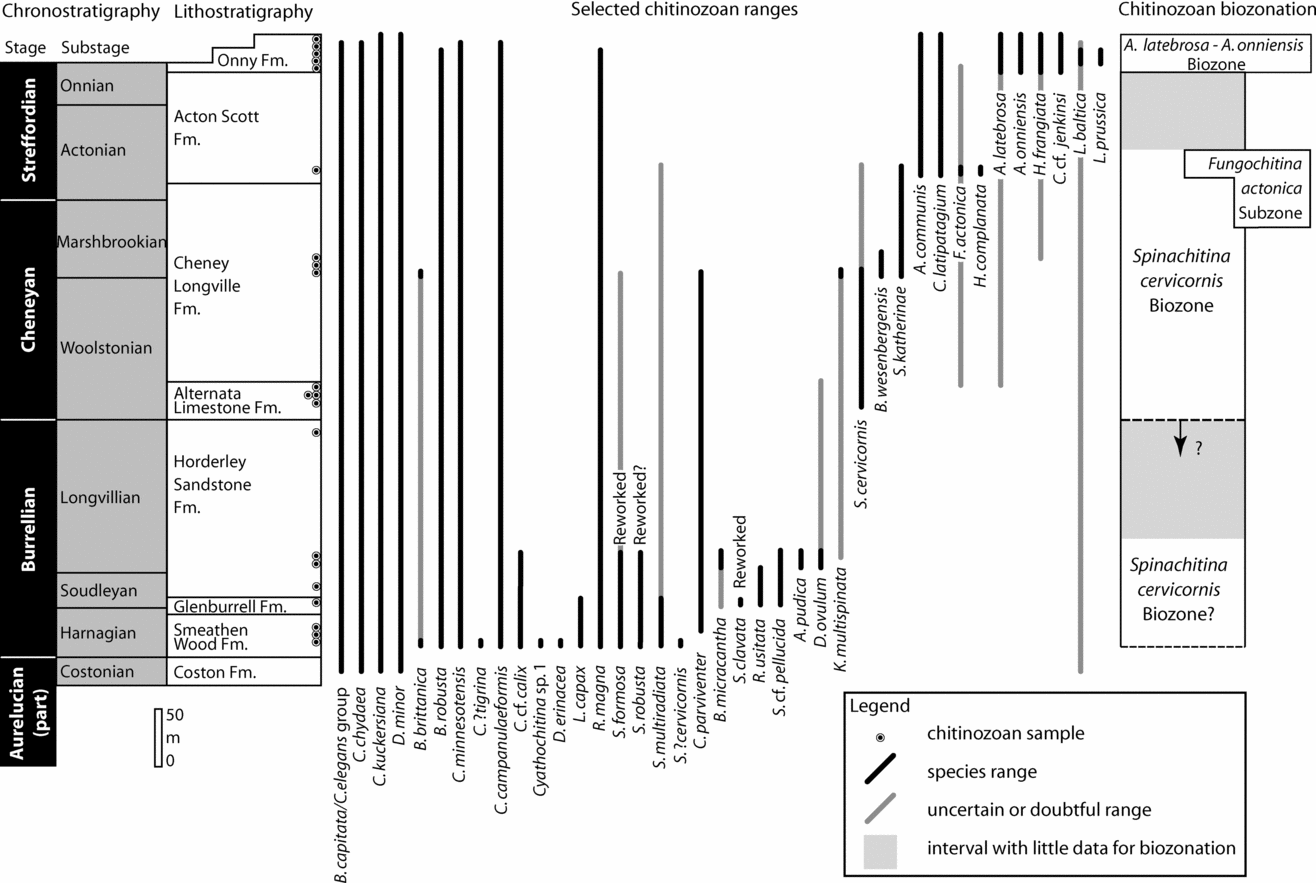
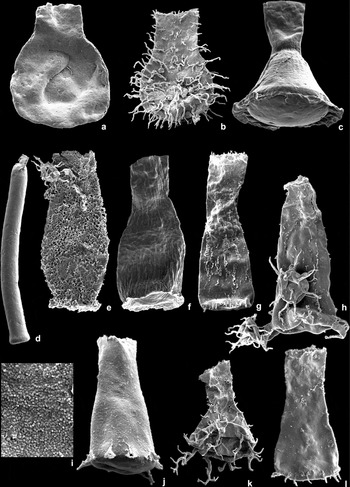
Figure 11 lists the results of the samples we studied. Figure 12 gives an overview of the data obtained from the three chitinozoan studies in the area. Selected samples from Jenkins (Reference Jenkins1967, table I, p. 482) are also included, which are not from the Onny Valley section itself. Rather than discussing the results bed by bed or level by level, the most important points of discrepancy with the studies of Jenkins (Reference Jenkins1967) and Ancilletta (unpub. DEA thesis, Univ. Liège, 1997) are listed below; many of those are discussed in detail by Vandenbroucke (Reference Vandenbroucke2008b). The latter publication also gives the formal description of all the species from this section. Selected ranges are shown in Figure 13; a selection of species is shown in Figure 14.
Numerical results of this chitinozoan study in the Onny Valley (excluding data from A. Ancilletta, unpub. DEA thesis, Univ. Liège, 1997, and from Jenkins, Reference Jenkins1967). ‘?’ in the lower rows refers to the lack of accurate data on the concentration of chitinozoans in the stored residues of Ancilletta. ‘V’ stands for a species observed in the part of the residue that was not used for counting or statistical analysis (that is, the part not included in ‘percentage of residue picked’).

Overview of the combined data obtained from the three chitinozoan studies on the southern Caradoc area by Jenkins (Reference Jenkins1967: shaded), Ancilletta (unpub. DEA thesis, Univ. Liège, 1997: number of specimens in italic, with ‘*’) and ourselves (number of specimens in bold typeface). Selected samples from Jenkins (Reference Jenkins1967, table I, p. 482) are also included, which are not from the Onny Valley section itself; for example, C16 is from as far away as the northern (Chatwall) tract of the Caradoc Inlier. ‘P’ stands for species present but lacking absolute abundance data in the work of Ancilletta (unpub. DEA thesis, Univ. Liège, 1997); ‘V’ stands for a species observed in a sample of residue studied in 2005, but in the part of the residue that was not used for counting or statistical analysis (‘percentage of residue picked’ in Fig. 11).

Range chart and a biozonation in the Onny Valley section (southern Caradoc area), integrating the three chitinozoans studies in the area (Jenkins, Reference Jenkins1967; A. Ancilletta, unpub. DEA thesis, Univ. Liège, 1997; this study). The grey lines represent uncertain species ranges (e.g. for end-range specimens only found in one of the three studies, in low numbers, such as the doubtful occurrences of L. baltica low in the stratigraphy, see text Section 4 and Fig. 12). The base of the Spinachitina cervicornis Biozone is ill-constrained because of minor systematic problems. The left-hand side columns are after Rushton et al. (Reference Rushton, Owen, Owens and Prigmore2000).

Chitinozoans from the Onny Valley section. All measurements in micrometres (L × Dp, or L × Dp × Dc, or L × Dp × Dc × Lc). For abbreviations, see Paris (Reference Paris1981): L – total length, Dp – chamber diameter, Dc – diameter of oral tube, Lc – length of oral tube. (a) Lagenochitina prussica, sample 90–16 (190 × 160 × 70); (b) Angochitina communis, sample 91–22 (100 × 65 × 38); (c) Cyathochitina latipatagium, sample 90–16 (210 × 150 × 55); (d) Belonechitina capitata–Conochitina elegans group, sample 91–22 (630 × 65 × 50); (e) Acanthochitina latebrosa (with attached acritarch), sample 90–16 (350 × 140 × 100); (f) Cyathochitina cf. jenkinsi, sample 04–001 (260 × 115 × 65); (g) Hercochitina frangiata, sample 90–16 (220 × 80 × 45); (h) Spinachitina katherinae (with attached acritarchs), sample 90–14 (200 × 90 × 35); (i) detail of the granular ornamentation of L. prussica; see (a); (j) Spinachitina cervicornis, sample 90–13 (130 × 60 × 35); (k) Ancyrochitina onniensis, sample 91–22 (100 × 65 × 25); (l) Spinachitina multiradiata, sample TVDB 04–004 (140 × 60 × 40).

(1) Jenkins (Reference Jenkins1967) reported Lagenochitina baltica with rare occurrences low in the section, and more frequent ones in the Onny Formation. Ancilletta (unpub. DEA thesis, Univ. Liège, 1997) also found the species in the Onny Formation. In the samples and residues (re)studied in 2005, however, we did not find any L. baltica. Moreover, neither Jenkins' nor Ancilletta's photographs allowed recognition of the typical granular ornamentation of the species, although the latter author mentioned the granules in his description. Examining the specimens from the Jenkins collections, deposited at Sheffield University, we were unable to provide a decisive answer to the uncertainty concerning the species' presence in the Onny Valley section; the specimens of the Onny Formation (Jenkins' C1 levels) might indeed be attributed to L. baltica, although we remain cautious without SEM observation of the ornamentation. However, we have serious doubts about the identification of the (fragmentary) ones from the Glenburrell Formation (Jenkins' C11, Burrellian), which most probably are another species. In addition to this morphological uncertainty, the species occurs aberrantly low in the Onny Valley stratigraphy (in Jenkins, Reference Jenkins1967), while in other sections it does not range below the base of the Fungochitina spinifera Biozone (Onnian to Cautleyan in northern England).
However, the samples (re)studied in 2005 confirm the presence of Lagenochitina prussica (see Figs 11, 12) in the Onny Formation, as suggested by Ancilletta (unpub. DEA thesis, Univ. Liège, 1997). L. prussica and L. baltica are morphologically similar; L. prussica differs from L. baltica only by its more spherical chamber shape, and is the only contemporaneous Lagenochitina species that bears the same characteristic ornamentation. Both are known to co-occur, the FAD of L. prussica only slightly later than that of L. baltica (Nõlvak & Grahn, Reference Nõlvak and Grahn1993). In short, we are quite sceptical about the rare, lower occurrences of L. baltica mentioned by Jenkins (Reference Jenkins1967), but the records of the species and of L. prussica from the Onny Formation seem to be valid.
(2) Spinachitina multiradiata from the Onny Valley has large basal spines and is systematically close to the smooth Spinachitina cervicornis specimens, figured by Nõlvak & Grahn (Reference Nõlvak and Grahn1993) to illustrate the index species of their eponymous biozone (see discussion in Section 5.b). Previous chitinozoan studies in the section (Jenkins, Reference Jenkins1967; A. Ancilletta, unpub. DEA thesis, Univ. Liège, 1997) respectively identified the species as Ancyrochitina bulmani and Spinachitina bulmani. The species has a more extended range in our and Ancilletta's studies, compared to the range reported for A. bulmani by Jenkins.
(3) Acanthochitina pudica has been found on the same levels as by Ancilletta (unpub. DEA thesis, Univ. Liège, 1997), but apparently was not observed by Jenkins.
(4) Ancyrochitina alaticornis as reported by both Jenkins (Reference Jenkins1967) and Ancilletta (unpub. DEA thesis, Univ. Liège, 1997) has herein been attributed to a different genus and split into Spinachitina cervicornis and Spinachitina katherinae. The difference between the two species is that the latter undoubtedly bears ornamental crests on the vesicle wall. The original, smooth to lightly ornamented, A. alaticornis of Jenkins (Reference Jenkins1967) is considered synonymous to S. cervicornis, following practice in Baltoscandia (J. Nõlvak, pers. comm. 2007; Y. Grahn, pers. comm. 2006). Ancilletta's emendation of A. alaticornis to include heavily ornamented forms (S. katherinae) is rejected.
(5) One of the authors (TVDB) was able to examine the vast Canadian chitinozoan collections of A. Achab and E. Asselin at the INRS-ETE in Quebec. Following re-study of the Onny Valley material as well as material from Pointe Laframboise (Anticosti Island, Quebec: Achab, Reference Achab and Lespérance1981), we reject Ancilletta's synonymy (unpub. DEA thesis, Univ. Liège, 1997) of the Hirnantian Spinachitina taugourdeaui and his ornamented Spinachitina alaticornis. The latter species is called Spinachitina katherinae in the presentaccount.
(6) Likewise, the recognition of Hercochitina gamachiana in the Onny Valley section by Ancilletta (unpub. DEA thesis, Univ. Liège, 1997) proved incorrect after comparison with the original Quebec material.
(7) After study of Acanthochitina barbata from Anticosti Island (Achab, Reference Achab1977; our own observations in Quebec, 2004) and from Estonia (our own SEM observations on material kindly provided by Jaak Nõlvak), we concluded that the specimens from Onny Valley, originally attributed to A. barbata by both Jenkins (Reference Jenkins1967) and Ancilletta (unpub. DEA thesis, Univ. Liège, 1997), are in fact a different species, Acanthochitina latebrosa (Vandenbroucke, Reference Vandenbroucke2008b).
(8) The systematic problems with Angochitina communis, its suggested synonymy with Belonechitina hirsuta, and the resulting stratigraphical implications are commented on by Vandenbroucke (Reference Vandenbroucke2008b). We followed the Jenkins holotype definition, adding forms with shorter and aligned spines to the species, which were called Belonechitina sp. B by Ancilletta (unpub. DEA thesis, Univ. Liège, 1997).
5. Interpretation, stratigraphical value and biozonation
5.a. Shelve Inlier
Although the samples yielded a high number of moderately to well-preserved chitinozoans, the assemblage displayed a rather low diversity and was virtually devoid of stratigraphically important species.
Superficially looking at the Lower Wood Brook range chart (Fig. 6), one might have the impression that a large number of new species appear immediately below the base of the Nemagraptus gracilis Biozone. This is, however, not the case, the visual effect being caused by the unusually small scale of the figure, necessary to include the two lowermost samples. The effect is enhanced by the large unsampled interval of more than 200 m between S224 and S211 and the rather poor preservation in the lowermost two samples. The detailed range chart (Fig. 7) is still at a fairly small scale, representing a little less than 30 m of shales, but it shows that no chitinozoan species has its first or last occurrence around the base of the N. gracilis Biozone.
Most of the chitinozoans identified at species level have an extensive range through the thick section, and, based on the literature, through a large part of the Ordovician. Well-known examples are Conochitina chydaea, Belonechitina micracantha, Cyathochitina cf. calix, Cyathochitina campanulaeformis, Cyathochitina campanulaeformis–kuckersiana group, Desmochitina ovulum, Desmochitina minor, etc.
Species having more stratigraphical potential are: Eisenackitina ?rhenana, Eisenackitina inconspicua and Linochitina aff. pissotensis in the Lower Wood Brook section; Conochitina tigrina, Spinachitina bulmani and Siphonochitina robusta in the Spy Wood Brook section (although the latter species may be reworked). These species, however, occur in much lower numbers than the first group.
5.a.1. Eisenackitina rhenana Subzone?
Eisenackitina ?rhenana has also been reported from the Swedish Fågelsång section, GSSP (Global Stratotype Section and Point) for the base of the Upper Ordovician; the chitinozoans from this section have been studied by Bergström et al. (Reference Bergström, Finney, Xu, Pålsson, Zhi-hao and Grahn2000) and Vandenbroucke (Reference Vandenbroucke2004). E. ?rhenana is slightly larger than Eisenackitina rhenana and lacks a clearly developed flexure (Vandenbroucke, Reference Vandenbroucke2004). It has a longer range than E. rhenana, the subzonal index fossil used as a proxy for the base of the Upper Ordovician and it extended both below and above the lowest and highest records of E. rhenana (Vandenbroucke, Reference Vandenbroucke2004). However, the difference between the ranges of both species in Fågelsång is only in the order of magnitude of a couple of metres. In addition, a species listed by Nõlvak & Grahn (Reference Nõlvak and Grahn1993) as being characteristic for the upper part of the Laufeldochitina stentor Biozone and its E. rhenana Subzone, namely Conochitina tigrina, has been discovered in the Spy Wood Brook section in the same sample as the topmost find of E. ?rhenana. According to Nõlvak (Reference Nõlvak and Poldvere2005), C. tigrina has been found in the upper part of the E. rhenana Subzone in the Mehikoorma core. Nõlvak (Reference Nõlvak and Poldvere2001) also shows the presence of C. tigrina in the topmost part of the L. stentor Biozone of the Valga (10) core, immediately above the E. rhenana Subzone. In short, we consider their coexistence to be quite stable. The absence of the index fossil from the Shelve area, or its imperfect preservation hampering positive identification, does not allow us to recognize the E. rhenana Subzone of the L. stentor Biozone as such, but we will provisionally use the E. rhenana Subzone? to indicate proximity to the level at Fågelsång. We have not found E. ?rhenana or any other species indicative of the E. rhenana Subzone? in the upper half of the Rorrington Shale Formation in the sections studied, which explains the apparent gap between finds of the subzone in its different localities on Figures 6 and 8.
Eisenackitina inconspicua has been defined in the Fågelsång section (Vandenbroucke, Reference Vandenbroucke2004), where unfortunately it is one of the longer-ranging species, and it is difficult to evaluate its stratigraphical range. The stratigraphical value of the species has yet to be confirmed, although its presence in the same graptolite biozones in both Fågelsång and the Shelve areas is an important indication of its stratigraphical potential.
Linochitina pissotensis is the index fossil of the eponymous northern Gondwana biozone defined as the total range zone of L. pissotensis (Paris, Reference Paris1990). In contrast to our own previous findings (Vandenbroucke et al. Reference Vandenbroucke, Fortey, Siveter and Rickards2003), the specimens are not identical to the ones recovered from Gondwana (Paris, pers. comm. 2003, 2005) and are kept in open nomenclature. The biozone could therefore not be identified in Lower Wood Brook.
Al-Hajri (Reference Al-Hajri1995) also reported a remarkable similarity between the Saudi Arabian faunas and the Shropshire fauna in Jenkins (Reference Jenkins1967). However, he recorded Laufeldochitina robusta (a synonym for Siphonochitina robusta) from much lower levels than recorded in our study from the Shelve area: lower Llanvirn in Saudi Arabia, in contrast to Caradoc–Burrellian in the Onny Valley (see next Section).
Conochitina tigrina, Siphonochitina robusta and (?) Spinachitina bulmani allow us to link the Spy Wood Brook section with the type Caradoc area, as discussed in the next two paragraphs.
5.b. Onny Valley
Typical Llanvirn forms have been noticed in the section, such as Siphonochitina formosa and Siphonochitina clavata, and they are thought to have been reworked (Fig. 13), not least because of earlier reports of reworking of acritarchs in the section (Turner, Reference Turner1982), and because of their much shorter range on other palaeocontinents, where they are used for biostratigraphical purposes. The presence of other species that are known from Llanvirn times onwards, such as Siphonochitina robusta and Conochitina parviventer, is less easily explained by reworking, as they have also been observed in the contemporaneous Caradoc Shelve Inlier deposits. The latter were formed in deeper water settings, where reworking is less probable, at least by the mechanism described by Turner (Reference Turner1982). Unlike the case with acritarchs, no Tremadocian chitinozoans were found, easily enough explained considering the early stage of chitinozoan dispersal during the Tremadocian.
The lowermost levels from the section yield a fauna described by Jenkins (Reference Jenkins1967) as ‘Assemblage one’ and comparable to the rather uniform chitinozoan assemblage recovered from the Shelve area. Accurate correlations are difficult, however, due to the rather long stratigraphical range of most species. Conochitina tigrina might prove interesting to link both sections, although only one, doubtfully identified, specimen has been reported from the Onny Valley. In addition, Spinachitina bulmani, found in levels higher in the Aldress Shale Formation in Spy Wood Brook, is morphologically very close to Spinachitina multiradiata from the Smeathen Wood Formation, although no certainty exists about the true FAD of the species in both sections.
Spinachitina multiradiata is an interesting species. As already mentioned, the basal spines remind us of the slightly more complex appendices of Spinachitina cervicornis. The latter species bears ornamentation on the chamber wall, while S. multiradiata is smooth. However, Nõlvak & Grahn (Reference Nõlvak and Grahn1993, plate III, a, p. 256), in the paper in which they erect the S. cervicornis Biozone, figure a smooth S. cervicornis specimen; it is morphologically very close to S. multiradiata found in the Onny Valley.
Based on the succession in the Onny Valley, we propose an evolutionary lineage of progressively more complex ornamentation within the genus Spinachitina. It starts with Spinachitina multiradiata, a form with large basal spines already a bit further developed than in the shorter-spined Spinachitina bulmani (Jansonius, Reference Jansonius1964). Higher up, Spinachitina cervicornis bears more complex, comb-like appendices, but is otherwise smooth to lightly ornamented; Spinachitina katherinae has similar appendices, but bears ornamentation on the chamber wall, consisting of crests of membranes or arches formed by spines with connected tops, aligned parallel with the vesicle's longitudinal axis and continuing on the appendices (see Vandenbroucke, Reference Vandenbroucke2008b, text-fig. 8).
It is at present unclear where the base of the Spinachitina cervicornis Biozone ought to be drawn exactly. In Baltica, Spinachitina multiradiata straddles the base of the Spinachitina cervicornis Biozone and at the base of the Onny Valley section, a few specimens of Spinachitina ?cervicornis have been observed (Fig. 13). In the Onny Valley, the lowest unambiguous Spinachitina cervicornis are from the Alternata Limestone Formation (following our colleagues in Baltica, where S. alaticornis is considered a junior synonym of S. cervicornis: Yngve Grahn, pers. comm. 2006; Jaak Nõlvak, pers. comm. 2007). For the time being, we attribute the interval below the Alternata Limestone Formation only tentatively to the S. cervicornis Biozone. If eventually it becomes clear that our S. multiradiata or S. ?cervicornis specimens are indeed identical to the Baltoscandic S. cervicornis zonal index fossils, then the base of the S. cervicornis Biozone can be lowered to the Costonian. It is worthwhile to note that in Laurentian sections, the evolutionary lineage is not seen; there, the only suggested evolution within S. bulmani is the increasing slenderness of its vesicle (Vandenbroucke, Verniers & Clarkson, Reference Vandenbroucke, Verniers and Clarkson2003).
5.c. Onny Valley biozonation
In summary, the following biozones can be observed in the Onny Valley section, from bottom to top (Fig. 13).
5.c.1. Spinachitina cervicornis Biozone
The biozone was defined by Nõlvak & Grahn (Reference Nõlvak and Grahn1993) in Baltoscandia as corresponding to the total range of the index fossil, a definition that is emended here so the zone ranges up to the lowest occurrence of the index species of the overlying biozone; we also take into account that these authors consider S. cervicornis and S. alaticornis to be synonymous (Grahn, pers. comm.; Nõlvak, pers. comm.). In the Onny Valley section, the biozone can thus easily be recognized in the Alternata Limestone, Cheney Longville and Acton Scott formations, corresponding to Cheneyan to mid-Streffordian age. Lower down in the stratigraphy, in the Smeathen Wood, Glenburrell and Horderley Sandstone formations (Burrellian), the biozone has only been tentatively recognized, by the presence of Spinachitina multiradiata and Spinachitina ?cervicornis. Desmochitina juglandiformis, known from this zone in Baltoscandia and present in other sections in the UK, is absent in south Shropshire. Spinachitina katherinae (remarkably similar to the index fossil), Belonechitina wesenbergensis and Acanthochitina pudica are easily recognizable, accessory species within this biozone, although the latter ranges within the lower part of the biozone that is only doubtfully attributed to it.
5.c.2. Fungochitina actonica Subzone
The subzone is defined by the first occurrence of Fungochitina actonica up to the lowest occurrence of the index species of the overlying biozone. In the Onny Valley the species is typically recovered from the Acton Scott Formation (Actonian). The records of the index species from the Alternata Limestone (A. Ancilletta, unpub. DEA thesis, Univ. Liège, 1997; see Fig. 13) are unconfirmed.
5.c.3. Acanthochitina latebrosa–Ancyrochitina onniensis Biozone
The biozone is defined by the first occurrence of Acanthochitina latebrosa up to the lowest occurrence of the index species of the overlying biozone, excluding the single specimen from the Alternata Limestone Formation reported by Ancilletta (unpub. DEA thesis, Univ. Liège, 1997). In the Onny Valley, the biozone is restricted to the Onny Formation (Onnian). The accessory index fossil Ancyrochitina onniensis has the same range as the zonal index fossil. Both are joined by Hercochitina frangiata, Cyathochitina cf. jenkinsi, Angochitina communis, rare Lagenochitina prussica and, probably, Lagenochitina baltica. Angochitina communis has been excluded from the zonal definition, because of taxonomic problems (Vandenbroucke, Reference Vandenbroucke2008b).
The three biozones correspond well with ‘Assemblages two, three and four’ as reported by Jenkins (Reference Jenkins1967).
Inter-section correlations are discussed at length in a paper by Vandenbroucke (Reference Vandenbroucke2008a), but the most important stratigraphical links are listed below. Despite the problems concerning the systematics of Angochitina communis, the species does allow correlation with the Cross Fell Inlier (northern England). There, at lower stratigraphical levels, the species has been used for definition of a local biozone, as no other usable chitinozoans were available (Vandenbroucke, Rickards & Verniers, Reference Vandenbroucke, Rickards and Verniers2005), this in contrast with the practice in Onny Valley, where species with fewer systematic problems were preferentially used for biozone definition. Specimens of A. communis from both sections, illustrated in plates 12 and 22.2 of Vandenbroucke (Reference Vandenbroucke2008b), show their identical appearance. Acanthochitina latebrosa has also been reported from the Fungochitina spinifera Zone in Whitland in south central Wales (Vandenbroucke et al. Reference Vandenbroucke, Williams, Zalasiewicz, Davies and Waters2008); likewise, Lagenochitina prussica and Lagenochitina baltica, normally typical of the F. spinifera Zone and younger, have been reported from the Onny Valley. These records represent very low yields of specimens (especially when compared to the remainder of the assemblages), which obscures their potential to correlate these two biozones.
Apart from the minor taxonomic problems, the recognition of the Spinachitina cervicornis Biozone allows straightforward correlation with the upper Haljala, Keila and lower Oandu stages in Baltoscandia (Nõlvak & Grahn, Reference Nõlvak and Grahn1993; Webby et al. Reference Webby, Cooper, Bergström, Paris, Webby, Droser, Paris and Percival2004; Nõlvak, Hints & Männik, Reference Nõlvak, Hints and Männik2006). Additionally, the Scottish Hartfell Score section, formerly proposed as a GSSP for the base of the Katian stage of the international Upper Ordovician Series, contains chitinozoans from the S. cervicornis Biozone (Zalasiewicz and others, unpub. data, 2004: http://www.ordovician.cn). Interestingly, a section supplemental to the selected Black Knob Ridge GSSP for the base of the Katian stage, known as ‘section D’, yields well-preserved chitinozoans in two levels, one below and one above the base of the Katian. The lowest of these levels was attributed to the S. cervicornis Biozone; the higher one remained unzoned but was dated to the Baltoscandian Keila stage (Goldman and others, unpub. data, 2005: http://www.ordovician.cn). Possible ties with the upper part of the sections studied from the Shelve area have already been mentioned, although the assemblage used consists of rather long-ranging species, with the exception of Conochitina tigrina, but the stratigraphical value of this species has to be treated with caution, as only a single, questionably identified, specimen was found in the Onny Valley.
This paper is a contribution to an ongoing construction of an Upper Ordovician chitinozoan biozonation in the UK, tied to British chronostratigraphy in its original type areas (Vandenbroucke, Reference Vandenbroucke2008a).
6. Conclusions
With a few exceptions, the assemblage recovered in the Shelve Inlier consists mainly of long-ranging species. Although a large number of chitinozoans were studied, little specific variation occurs throughout the 400 m thick succession, and no particular faunal change in the chitinozoan assemblage was observed at or near the base of the Nemagraptus gracilis Biozone. The chitinozoans allow us to conclude only that this level is stratigraphically close to the base of the Upper Ordovician, although a good, unambiguous proxy for this boundary has not been recognized, as has been in the GSSP for that level, at Fågelsång. A provisional, local Eisenackitina rhenana Subzone? is proposed, using the range of the species retained under open nomenclature, and the presence of Conochitina tigrina in the topmost part of the biozone. The presence of the formerly recognized upper part of the northern Gondwana Linochitina pissotensis Biozone across the Llanvirn–Caradoc boundary (Vandenbroucke et al. Reference Vandenbroucke, Fortey, Siveter and Rickards2003) is here rejected.
The rich and well-preserved chitinozoan fauna of Caradoc type area, along the Onny River in the south Shropshire region, has been re-evaluated to attribute the assemblages to more generally applicable biozones. Interestingly, almost the entire section can be interpreted as belonging to the originally Baltoscandian Spinachitina cervicornis Biozone; in the Cheneyan and lower to middle Streffordian parts of the section this biozone is certainly present, but in the lower (Burrellian) part, the attribution is rather doubtful due to a systematic problem concerning Spinachitina ?cervicornis and Spinachitina multiradiata. The top part of the section, namely the Onny Formation, has been attributed to a (local) Acanthochitina latebrosa–Ancyrochitina onniensis Biozone. An accessory species of this zone is also present in the uppermost Caradoc beds in the Cross Fell Inlier and the biozone has some poorly represented species in common with the F. spinifera Zone in Whitland. The previously established presence of Acanthochitina barbata in the Onnian is rejected. On the whole, the chitinozoan fauna from the Onny Valley is rather different from the faunas from other sections in the Anglo-Welsh Basin, a separation not easily explained, unless perhaps by different palaeo-environmental settings.
Acknowledgements
Florentin Paris and one anonymous reviewer provided helpful and constructive comments. We thank Richard Bettley (Oxford University) for providing samples, Derek Siveter (Oxford University), Brian Chatterton (University of Alberta) and Geert Van Grootel (Ghent University) for assistance in the field, Jaak Nõlvak (Tallinn University of Technology) for providing specimens, Jan Vanmeirhaeghe (Ghent University), Florentin Paris (University of Rennes I, CNRS), Aicha Achab and Ester Asselin (INRS-ETE, University of Quebec), Yngve Grahn (Petrobras, Brazil) and Jaak Nõlvak for help with identifications, Charles Wellman, Ken Dorning and Duncan Mclean for arranging access to the Jenkins collection at Sheffield University, Sabine Vancauwenberghe for the laboratory preparations, and Stephen Louwye, Achilles Gautier (Ghent University), and Aicha Achab (INRS-ETE, University of Quebec) for commenting on an earlier version of this paper (as part of TVDB's Ph.D. jury). Although included in the authorship of this paper, in acknowledgement of his effort, we were unable to locate or re-contact Antonio Ancilletta in person. This paper is a contribution to the IGCP 503 project (Ordovician Palaeogeography and Palaeoclimate) and the FWO research project 3G027105. FWO-Flanders is sincerely acknowledged for funding our projects.
Appendix. Sample localities
Shelve Inlier
Shropshire, Welsh Borderland
The GPS measurements below are in the standard WGS84 reference system and the bedding is given as dip direction/dip readings.
Samples from Lower Wood Brook, provided by Richard Bettley (see Bettley, unpub. Ph.D. thesis, Univ. Oxford, 1998)
The geographical position of the samples along Lower Wood Brook is indicated on the map in Figure 2.
S 218/1: 17.39 m above the base of the section
S 224/8: 17.71 m above the base of the section
S 211/2 and S 211/4: 253.23 m above the base of the section
S 213/1 and S213/2: in between S211 and S214 (no accurate position provided)
S 214: 257.11 m above the base of the section
S 217/1: 261.79 m above the base of the section
S 228/1: 268.69 m above the base of the section
S 227/2: 269.76 m above the base of the section
S 230: 270.15 m above the base of the section
S 231/6: 275.11 m above the base of the section
S 232: 275.86 m above the base of the section
S 244: c. 300 m above the base of the section
Sample localities, Lower Wood Brook, 2002
TVDB 02-102: Bettley's (unpub. Ph.D. thesis, Univ. Oxford, 1998) Locality S217 (Fig. 2), in a tributary to Lower Wood Brook, immediately south of the fence, 8.0 m upstream from the confluence with Lower Wood Brook; Rorrington Shale Formation
TVDB 02-101: Bettley's (unpub. Ph.D. thesis, Univ. Oxford, 1998) Locality S212 (Fig. 2), on the left bank of Lower Wood Brook, a little downstream of the fence on the left bank, in the middle part of the outcrop; Rorrington Shale Formation
TVDB 02-104: Bettley's (unpub. Ph.D. thesis, Univ. Oxford, 1998) Locality S217 (Fig. 2), in a tributary to Lower Wood Brook, immediately south of the fence, 2.7 m upstream from the confluence with Lower Wood Brook; Rorrington Shale Formation
TVDB 02-105: 9.5 paces downstream along Lower Wood Brook from the place where the fence described in TVDB 02-104 crosses Lower Wood Brook; Rorrington Shale Formation
TVDB 02-106: 9 paces downstream along Lower Wood Brook from the locality of TVDB 02-105, in the middle of the river; Rorrington Shale Formation
TVDB 02-107: 9 paces downstream along Lower Wood Brook from Bettley's (unpub. Ph.D. thesis, Univ. Oxford, 1998) Locality S234 (Fig. 2) or 9 paces downstream along Lower Wood Brook from the place where the field boundary crosses Lower Wood Brook; Rorrington Shale Formation
TVDB 02-108: 35 paces downstream along Lower Wood Brook from the locality of TVDB 02-107; N 52° 36.331' W 003° 01.537'; Rorrington Shale Formation
TVDB 02-109: 59 paces downstream along Lower Wood Brook from the locality of TVDB 02-108; Rorrington Shale Formation
Sample localities, Spy Wood Brook, 2002
TVDB 02-159: Spy Wood Brook, right bank, 8 paces downstream of the confluence with the most northerly tributary shown in Figure 3; N 52° 33.541′ W 003° 03.371′; Rorrington Shale Formation
TVDB 02-162: 42 paces upstream in Dead Man's Dingle from TVDB 02-160; N 52° 33.411′ W 003° 03.471′; Rorrington Shale Formation
TVDB 02-160: Dead Man's Dingle, a tributary to Spy Wood Brook, 15 paces upstream from the confluence of the two aforementioned streams; N 52° 33.412′; W 003° 03.510′; middle Rorrington Shale Formation; bedding 270/50
TVDB 02-163: in the middle of Spy Wood Brook, 3 m downstream of a tributary, which is the first tributary south of Dead Man's Dingle; Rorrington Shale Formation; bedding 315/66; N 52° 33.329′; W 003° 03.603′
TVDB 02-164: Spy Wood Brook, right bank, in the centre of the curve, where the stream takes a c. 90° swing, top Rorrington Shale Formation
TVDB 02-165: Spy Wood Brook, 5 paces upstream from a 46 cm thick sandstone layer outcrop, in the transitional facies to the Spy Wood Sandstone Formation, stratigraphically 11 cm above the lowest clear 20 cm thick sandstone layer
TVDB 02-166: Spy Wood Brook, 14 paces downstream from the 46 cm thick sandstone layer outcrop described in TVDB 02-165; stratigraphically 11.40 m above the top of the same sandstone layer; Spy Wood Brook Sandstone Formation; N 52° 33.348′ W 003° 03.648′
TVDB 02-167: Spy Wood Brook; top Spy Wood Brook Sandstone Formation, Bedding 160/40; N 52° 33.358′ W 003° 03.675′
TVDB 02-168: Spy Wood Brook; 10 to 20 m downstream from the TVDB 02-166 locality; transitional beds to the Aldress Shale Formation with obvious calcite veins; Bedding 278/85; N 52° 33.348′ W 003° 03.684′
TVDB 02-169: Spy Wood Brook, left bank, downstream from the TVDB 02-168 locality; N 52° 33.350′ W 003° 03.700′; Aldress Shale Formation
TVDB 02-170: Spy Wood Brook, left bank, downstream from the TVDB 02-169 locality; N 52° 33.360′ W 003° 03.716′; Aldress Shale Formation; Bedding 265/55
TVDB 02-171: Spy Wood Brook, left bank, downstream from the TVDB 02-170 locality; N 52° 33.381′ W 003° 03.784′; Aldress Shale Formation
TVDB 02-172: Spy Wood Brook, left bank, downstream from the TVDB 02-171 locality; N 52° 33.387′ W 003° 03.812′; Aldress Shale Formation
TVDB 02-173: Spy Wood Brook, left bank, downstream from the TVDB 02-172 locality; 22 paces upstream from the place where the brook disappears in concrete pipes below a forest track, or 29 paces upstream from the confluence with the Aldress Dingle; N 52° 33.403′ W 003° 03.894′; Aldress Shale Formation; Bedding 278/60
TVDB 02-174: Aldress Dingle, left bank, 8 paces downstream from a tributary to the Aldress Dingle (which is c. 100 m south of the Aldress Dingle-Spy wood Brook confluence); Aldress Shale Formation
Onny Valley
Shropshire, Welsh Borderland
List with all the labels used for the samples during the separate phases of the study, linked to the sample localities described in the literature by Jenkins (Reference Jenkins1967) and Turner (Reference Turner1982).

TVDB 04-001: Onny River cliff section, easternmost side of the outcrop, 2 m west of the eastern edge of the cliff, 70 cm above the water level; stratigraphically 20 to 25 cm below the unconformity with the Silurian (sample with the trilobite Onnia ?superba); top Onny Formation
TVDB 04-004: Onny River; 27 paces east of the pedestrian bridge, which is immediately east of the former railway bridge across the Onny River; left bank; 4 paces east of the western edge of the outcrop; Harnage Shale Formation