Introduction
Despite the frequent deployment of ‘age’ as a principle for social organisation, maintaining a coherent basis for the stable categorisation of age has in recent years become somewhat problematic. What has most undermined age's social categorisation is the notable change in the material circumstances of later life. These have improved significantly over recent decades. Paradoxically, concern over the social exclusion and cultural marginalisation of older people in contemporary society seems to have grown (Levy, Reference Levy2017). This shift in the circumstances of later life is remarkable. This apparent ‘disjunction’ between the material and symbolic positioning of later life, made more salient by recent suggestions that age has become ‘the new class’ (Erk, Reference Erk2017; Pickard, Reference Pickard2019), is the focus of the present paper. It is the argument of the paper that rather than continuing to consider age as a status, or a class or a category, it is more appropriate and more useful to consider later life as a social space or location whose objective and symbolic boundaries are subject to active contestation.
Even in the 1970s and 1980s, a number of writers in the United Kingdom (UK) still considered ‘the elderly’ to be ‘an economically dependent’ status group (Turner, Reference Turner1989: 602), ‘trapped in poverty’ (Walker, Reference Walker1980: 54), with old age ‘synonymous with poverty’ (Shragge, Reference Shragge1984: 196). Within this framework, first evident in the 19th century's categorisation of ‘those impotent through age’ as a category within the destitute classes, ‘the elderly’ had been treated as a group apart (Rowntree, Reference Rowntree1901). In the last decade or so, a number of writers have begun to claim the precise opposite, with the older generation, often rebadged and renamed as the ‘baby-boomers’, considered a singularly advantaged status group (Bristow, Reference Bristow2019: 5). Replacing earlier concerns over the economic marginality and structured dependency of old age has been a resurgence in the idea of age/generational conflict. Signalled by a series of ‘boomer-blaming’ books appearing in the last decade or so (Beckett, Reference Beckett2010; Howker and Malik, Reference Howker and Malik2010, Reference Howker and Malik2013; Willetts, Reference Willetts2010, Reference Willetts2019), this changing viewpoint reflects and elaborates themes that were first articulated in the United States of America (USA) back in the 1980s (Williamson and Watts-Roy, Reference Williamson, Watts-Roy, Williamson, Watts-Roy and Kingson1999: 14). It is within this context of contestation that age is being proposed as ‘the new class’.
Such arguments are not new. Writers both in the USA and UK proposed a similar shift away from ‘traditional’ class politics to a ‘new’ generational politics (Thurow, Reference Thurow1996; Turner, Reference Turner1998; Hamil-Luker, Reference Hamil-Luker2001). The current confusion over the social representation of old age seems more evident than ever, even if the basis for its representation has become less distinct. This paper aims to examine the grounds for continuing to attribute a social categorical status to old age as relationally distinct from people ‘of working age’, whether the material basis for such categorisation is still feasible, and whether or not its ‘new’ positioning as a class or group in direct conflict with those of working age makes any better sense.
In approaching this question, I begin by considering what in general constitute the grounds for realising a social class or category and whether, in the light of such considerations, old age still fits such a designation. Seeking a framework with which to pose these questions (what constitutes a class or category and whether age fits those criteria), I draw heavily upon Bourdieu's writings, particularly those defining and distinguishing between the objective and symbolic nature of social categorisation (Bourdieu, Reference Bourdieu1987, Reference Bourdieu2018). Employing this framework, I suggest that age – or rather later life – can better be represented as a social location rather than a distinct social category, class or status (cf. Barken, Reference Barken2019). Such a location (or perhaps more accurately such a network of locations), I hope to show, exists as a complex and contested symbolic space rather than an objectively determined position or status (whether of advantage or disadvantage).
Such a space, I suggest, can be mapped, on one hand, by the collective representation of age in terms of its human capital (some quantum of acquired agedness) and, on the other, by its ‘generational’ identity (e.g. those carrying the legacy of the 1960s). These contrasting representations reflect what some social psychologists have termed the ‘dual identity’ of age (Weiss and Lang, Reference Weiss and Lang2012), its agedness contrasted with its generational identity. This shift can be seen to reflect the more general cultural turn that Nancy Fraser described some time ago, from groups striving for greater redistribution to those striving for greater recognition (Fraser, Reference Fraser1995).
Social categories, classes and locations
In 1987, Bourdieu presented a keynote address at the University of Chicago, entitled ‘What Makes a Social Class?’ It formed part of a series of lectures concerning the formulation of social categories within the social sciences (Bourdieu, Reference Bourdieu2018), providing a conceptual framework for approaching the issue of social categorisation, and hence grounding the question addressed by this paper of whether age, generation or later life might function as social categories, classes or locations (Eyerman and Turner, Reference Eyerman and Turner1998; Barken, Reference Barken2019; Pickard, Reference Pickard2019). Bourdieu was concerned with indicators for classifying, coding and differentiating individuals into social categories or classes (Bourdieu, Reference Bourdieu2018: 23–25). Although such indicators constitute ‘objective’ data, they beg the question of their social meaning. Purely subjective considerations of classes, codes and differences are constrained by objective principles of codification. At the same time, while ‘the objective positions define the limits within which the representations may vary … within those limits there is room for manoeuvre’ (Bourdieu, Reference Bourdieu2018: 71). This room to manoeuvre is, for Bourdieu, a critical issue in social representation.
It raises the question of any group's representational power either to define itself or be defined (Bourdieu, Reference Bourdieu1987: 14). A class ‘exists when there are agents capable of imposing themselves as authorised to speak and to act officially in its place and in its name’ (Bourdieu, Reference Bourdieu1987: 15). Without such representational power, no class or category can be realised, whatever objective indicators (as positions in social space) exist to constitute the indices for such a classification. If age is to be a class, what apart from age and those acts of nomination conferred by registration can provide the symbolic power to represent those coded as ‘aged’ and what group or structure would seek so to do? Individuals located in systems of codification like age and agedness may or may not have representational power, and further they may or may not have an interest in drawing upon those systems of codification to assert their identity as aged. The objective similarity of their positions, qua ‘aged persons’ occupying the shared social space of later life, might provide the circumstances for their constituting themselves as a class, but only insofar as those in such circumstances see this as advancing their interests to do so, within this symbolic space.
As regards age, those in a position to represent themselves as ‘aged’ or ‘old’ may choose not to make age a source of their symbolic power; in which case, it falls to those who are not old – not necessarily those who are young, but simply those self-defined as not old – who might see symbolic power invested in their not being old. This assertion of identity through the denial of identity might seem to confirm the inherent ‘relationality’ of age categories, in that one category or code only makes sense when set against others (Barken, Reference Barken2019: 2). But such relationality must still be based upon objective conditions. For Bourdieu, objective differences must exist between age groups for there to be any ground for contestations of age as a social category, whether or not that ‘space of differences’ is deemed ‘relational’ rather than ‘substantial’ (Bourdieu, Reference Bourdieu1987: 3).
While these considerations implicitly focus upon the more traditional concept of class, they are formulated to apply to all forms of social categorisation, including those of ‘age, gender and the like’ (Bourdieu, Reference Bourdieu2018: 24). Two issues seem unresolved in Bourdieu's writings, however. The first concerns the grounds for constituting ‘objectivity’, the second for determining ‘representational power’ and the exact nature of the ‘social guarantee’ Bourdieu claims should be attached to any classification for it to have sociological validity. These issues of categorical validation provide the context for addressing the particular case of old age and its consensual status as a social class or category.
Old age: its objective location as income and wealth
Up until the 20th century, most older people were unaware of their exact chronological age. Nevertheless, terms like old and young, like rich and poor, were widely employed as descriptors of individuals and groups. The need to more ‘objectively’ define the status of ‘old’ emerged only gradually (and relatively recently) as part of the wider processes of modernisation and the developing administrative machinery of the state (Roebuck, Reference Roebuck1979; Prévost and Beaud, Reference Prévost and Beaud2015).Footnote 1 Chronological age acquired much of its codificational power during the course of the late 19th and early 20th century, with the introduction of legalised systems of education, health and welfare presaged upon chronological delineation of eligibility and obligation (Cain, Reference Cain1974; Roebuck, Reference Roebuck1979). These developments were in turn established on the back of rising levels of literacy and numeracy within newly industrialising societies and the state's mandatory registration of births and deaths (Emigh, Reference Emigh2002). A more educated population enabled a wider range of requirements to be applied by the state demanding proof of age, thereby expanding the salience of, and ‘social guarantee’ attached to, age and age classification (Crayen and Baten, Reference Crayen and Baten2008: 16). While there was an initial tendency to exaggerate age later in life (leading to more upward ‘age heaping’), the continuing modernisation of society witnessed a decline in the benefits attached to old age, with a concomitant decline in the practice of late-life age heaping in public records (A'Hearn et al., Reference A'Hearn, Baten and Crayen2009). Although age was, at times, promoted as a signifier of leisure and security, most notably through the Townsendite movement in the USA, throughout the 19th and into much of the 20th century, later life remained a status or position associated with a lack of resources and a consequent loss of societal regard (Cowgill and Holmes, Reference Cowgill and Holmes1972; Cowgill, Reference Cowgill1974).
The industrial era gave a premium for strength and youth; age paid the penalty, even after the replacement of poor law relief with old-age pensions (Rowntree and Lavers, Reference Rowntree and Lavers1951; Cole, Reference Cole1962). The objective position of younger and older adults set them apart in terms of average income and relative poverty, and in an era of low wages and limited home-ownership, there were scant prospects for the accumulation of wealth with age. Estimates of the relative socio-economic position of pensioner households compared with households of working-age adults can be gleaned from the observation that, when indices of consumer price inflation were being developed, the UK government effectively ignored the expenditures of pensioners as such households were considered to have so little to spend (Ministry of Labour and National Service, 1957).
In terms of economic indices, the mid-century position of old people (represented as pensioner households) seemed to fit clearly as that of a social category or class set apart, largely confined to hearth and home, and financially much poorer than the working-age population whose own improving cultural and financial position was rapidly drawing away from that inherited by their parents and grandparents (Gilleard and Higgs, Reference Gilleard and Higgs2005). In 1961, for example, the top 10 per cent of earners earned just over three times that of the bottom 10 per cent (Institute of Fiscal Studies, 2019) and the median income of the top 25 per cent of the population was only twice that of the bottom 25 per cent. The rate of poverty in the general population was just over 13 per cent.Footnote 2 Among working-age families with children, it was under 10 per cent; among households without children, it was 6 per cent. By contrast, 38 per cent of pensioner households were poor, four times the rate of working-age households. Estimates of median income suggest that working-age households had more than double the income of pensioner households (Institute of Fiscal Studies, 2019). This corresponds to figures collected at the time indicating that older householders working full time had a total average income more than two times that of retired householders (Cole, Reference Cole1962: tables 32, 58).
It seems reasonable to conclude that, at least on the basis of household income, the objective financial circumstances of older retired people were every bit as distinct from those of people of working age as those separating the top and the bottom sectors of the general population. If one were to calculate from the Institute of Fiscal Studies’ (2019) database the mean income of the bottom 75 per cent of the population and compare it with the top 25 per cent (as rough proxies for the ‘working classes’ and the ‘upper classes’ of the time), in the same year (1961) the former's income (£135) was well over half that of the latter's (£246). The relative financial gap between ‘old’ and ‘young’ households in the early 1960s was effectively greater than that between working and upper classes, objective grounds sufficient for considering retired householders as much, if not more of, a ‘class’ or ‘category’ as the working and bourgeois classes.Footnote 3
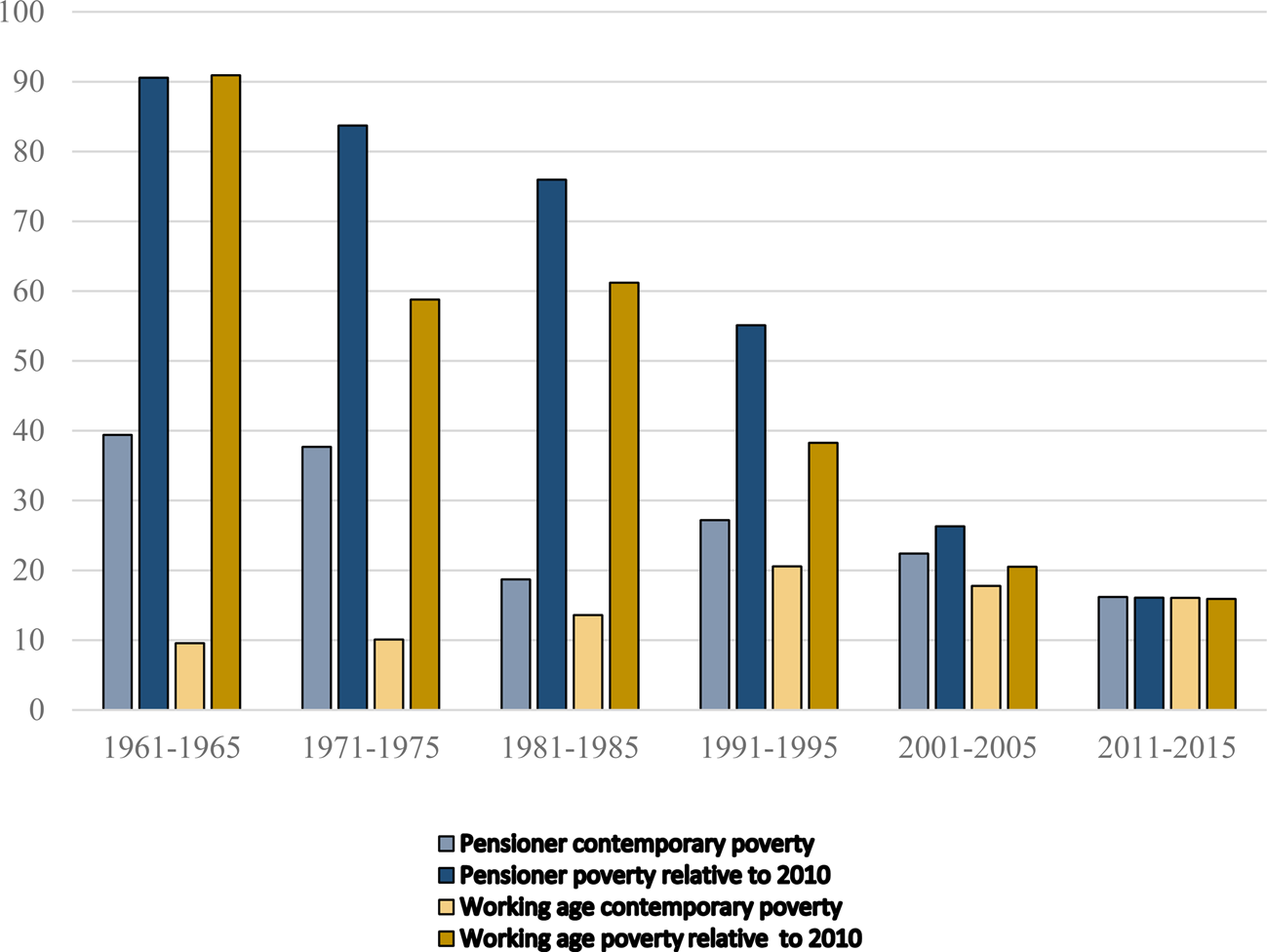
If similar principles are applied to contemporary data, what evidence is there that similar objective distinctions continue to separate pensioners from working-age households as much as they separate the ‘working’ and ‘upper’ classes? In 2017/2018, relative poverty rates among the general population were similar to the figures for 1961 (14%); among retired households, the rate was 16 per cent; among working-age households with children, 25 per cent; and among working-age households without children, 18 per cent. Whereas in 1961, four times as many retired households were in relative poverty compared with the rates among working-age households, in 2017/2018 proportionately more working-age households (20%) were in relative poverty than were retired households. This is illustrated in Figure 1, showing two distinct rates of poverty averaged over five years for working-age and retired households. The rates shown represent (a) the relative rate of poverty set at 60 per cent or less than the median income at the time compared with (b) the relative rate of poverty set at 60 per cent or less than the median income towards the end of the series (2010/2011). The second set reflects more starkly the long-term trend towards improving economic standards over the period, and the retrospective level of living from past to present.
Changing rates of poverty in the United Kingdom, 1961–1965 to 2011–2015: pensioner versus working-age households.
Source: Author's calculations from the Institute of Fiscal Studies’ (2019) spreadsheet.

Turning to data on income, in 2017/2018 the median annual equivalised final income after tax and benefits for working-age households was £36,500 (equivalised disposable income £36,332) while for retired households, their median annual equivalised final income after tax and benefits was £31,280 (disposable income £27,702). In 1961, working-age households earned 60 per cent more than pensioner households; in 2017/2018, they earned just 14 per cent more. While the gap between the economic circumstances of retired/old householders and working-age/young householders has diminished markedly, that within the working-age population has grown. Where once retiree (retired) households were set apart from working-age households by their relative poverty and low incomes, this is no longer the case. Income inequality within both the working-age and retired populations has by contrast grown (Gilleard, Reference Gilleardin press). In a little over half a century, age has ceased to delineate a class apart, if judged by such objective criteria as income and relative poverty rates.
While income and income poverty may no longer distinguish the position of aged/retired households from those of working age, other material hardships it might be argued continue to set retired householders apart and foster their social exclusion. Measures of material hardship have only been recorded systematically in the present century. Still it is possible to draw some albeit tentative conclusions about relative levels of hardship in retired and working-age households from a variety of sources, including national surveys commissioned or conducted by the British government's Office for National Statistics (ONS). Drawing upon these surveys, the Institute of Fiscal Studies has observed that, in comparison with households with children, pensioner households report less hardship, whether in terms of access to cash, running short of food, taking holidays or visiting family (Bourquin et al., Reference Bourquin, Cribb, Waters and Xu2019: 35–36, figures 3.4, 3.5; see also Rahman, Reference Rahman2019: 21).
Early results from the latest Wave 6 ONS Wealth and Assets Survey provide further demonstration of the position of pensioner households in Britain. In response to questions asking ‘how often they ran out of money at the end of the week or month, or needed a credit card or overdraft to get by’, the survey found that less than 5 per cent of pensioners reported running out of money, compared with 12 per cent of the general population. When asked if they could cover sudden unexpected major expenses, only 5 per cent of pensioners reported being unable to do so. By comparison, 9 per cent reported being unable to cover any unexpected major expense (ONS, 2019: 5, 9, figures 2, 4). Figures on household debt show a similar pattern. The latest available figures from the ONS 2016 Wealth and Assets Survey indicate that 38 per cent of British households had some financial liabilities, excluding mortgage debt, while only 13 per cent of retired households had debts (ONS, 2016: 16).
Turning to the wealth owned by working-age and retirement households, households headed by people of retirement age (age 65 or more) own just under half (45%) of Britain's total net wealth, even though they represent just over one-third of the population (ONS, 2018a). More retired households own formal financial assets (80%) than do householders aged 25–64 years (72%) (ONS, 2018b). These differences are not large, but taken together they illustrate how far the social category of ‘the old’ (represented by chronological age) has lost its former distinctly disadvantaged socio-economic status vis-à-vis ‘the non-old’. Since the kind of detailed large-scale surveys of household assets, debt, poverty and wealth now undertaken by the British government were not carried out during the ‘glorious decades’ of the 1950s, 1960s and 1970s, reliance has to be placed primarily on income data when making direct comparisons between past and present economic circumstances of retired and non-retired households.
The Resolution Foundation, however, has published some long-term UK data that show how retired households have experienced increasing wealth along with rising incomes over the course of the last half century. Home-ownership, for example, has shifted notably in favour of the retired population (Resolution Foundation, 2019). In 1960s Britain, most people, young or old, did not own their own home. In 1964, less than 30 per cent of household heads were home-owners and at that time, people aged 45–54 years were most likely to own their own home. Thirty per cent of those of retirement age (age 65 or more) were home-owners, a figure close to the population average. By 2017, a majority of the population in the UK owned their own home (52%), with some three-quarters of retirement-age householders doing so. By contrast, home-ownership among those aged 25–34 years old remained more or less unchanged, at a mere 28 per cent (Resolution Foundation, 2019). From being one of the least likely age groups to own their home, in this second decade of the 21st century those aged 65 years and over have become the age group most likely to do so.
Symbolic struggles and the social representations of age
While there is much less difference between the material circumstances of working-age and retired households in the second decade of the 21st century, there is nevertheless widespread and growing concern over ageism in contemporary society (Levy, Reference Levy2017). While Bourdieu recognises that the objective and subjective bases for social categorisation may differ, he assumed that some objective base had to be observed to establish the potential for any subsequent symbolic categorisation, granted a degree of ‘indeterminacy and fuzziness’ between the two (Bourdieu, Reference Bourdieu1987: 11; Reference Bourdieu2018: 70). Much of the current narrative supporting the notion of a specially advantaged group of older people – greedy geezers, lucky boomers, etc. – hinges upon their delineation as a particularly fortunate and privileged generation (Street and Cossman, Reference Street and Cossman2006; Bristow, Reference Bristow2016, Reference Bristow2019; Pickard, Reference Pickard2019). Such discourse draws attention away from age and agedness, promoting instead the idea that time and period (i.e. cohort or generation) rather than agedness determines their advantaged location. This in turn also resonates with the preferences of older people themselves who, when given the choice, self-identify much more with a generational rather than an aged identity (Williams, Reference Williams, Bryman, Bytheway, Allatt and Keil1987: 100; Weiss and Lang, Reference Weiss and Lang2012). Arguably now, given older people's improved material resources, such representational power also carries more weight.
If chronological age no longer exercises quite the determining influence it once did on income and material resources, the point of reference in representing agedness has shifted to other, rather older ‘objective’ considerations, namely those of morbidity and mortality. Despite greater longevity, and improvements in the general health and vitality of older people (Costa, Reference Costa2000; Fogel, Reference Fogel2004), many remain sceptical about the extent to which the objective gains in longevity have yielded equivalent gains in healthy life (Gruenberg, Reference Gruenberg2005; Case and Deaton, Reference Case and Deaton2015). Considered outside the nexus of the economy, agedness as sheer chronology remains a constant reminder of bodily limitations. Unsurprising then that those who ‘feel’ their age and those who view darkly the prospect of their future ageing are less likely to stay healthy in later life and more likely to die than those whose subjective age remains younger (Westerhof et al., Reference Westerhof, Miche, Brothers, Barrett, Diehl, Montepare, Wahl and Wurm2014).
The subjective categorisation of age in terms of sheer ‘agedness’ is generally avoided by older people. Most seem to favour denial and the assertion of other identities, or choose to identify with a collective place in time (i.e. as members of a generational location like the ‘boomers’). The extent to which other aspects of social location (e.g. in terms of ethnicity, gender, home-ownership or occupational history) influence which of the ‘two faces’ of ageing individuals or groups select as their subjective categorisation requires further research. The extent to which markets, the media and the state make salient one or the other aspect is likely clearly to influence those choices and their adoption within the broader society. Unlike the potential of relatively easily accessible statistical data to map the objective parameters of a potential social class, category or group, the means of mapping its symbolic space are more indeterminate. The furore created by imposing age criteria in instituting lockdown procedures during the COVID-19 pandemic provides perhaps the most recent illustration of the new ‘symbolic’ struggle over the oppression of chronological categorisation (Taylor, Reference Taylor2020; Ayalon, Reference Ayalonin press).
Studies of media representations of later life, or of its representations in government policies or simply in the narrative discourses evident in everyday conversations, offer opportunities to do so. The work of Coupland (Reference Coupland2009) illustrates the scope for identifying representations of age, time and later life through media discourse, and the particular centrality of the body as the arena upon which so much of the discursive construction of age is built. As Coupland and others have pointed out, such discourses offer both the prospect of plasticity in how age is performed and presented, as well as implying the message that without such practices, age as both objective chronology and corporeality will operate otherwise as burden and disadvantage (Low and Dupuis-Blanchard, Reference Low and Dupuis-Blanchard2013: 61).
The objective socio-economic conditions that once clearly separated working-age and retirement-age households have all but disappeared. Still a collective memory seems to hover over contemporary representations of old age. It is almost as if successive cohorts of people reaching retirement age and facing much fairer futures retain, as it were in the rear-view mirror, elements of a symbolic framework constructed around the objective hardships of the past. Even as later life is promoted to the new generations of older people as increasingly ‘plastic’ and ‘performative’, this seems somehow only to darken, not erase those shadows. Whatever the objective circumstances that shape the symbolic representations of a social class or category, the symbolic remains subjective; open to collective reconstructions by new generations, but foreshadowed by the past.
Age – later life – is an example of a social space, an arena for what Bourdieu calls ‘symbolic struggles’ (Bourdieu, Reference Bourdieu1992: 242–243) over classification and representation. A generation of social actors with undoubtedly more capital and more forms of capital than before are seeking to shape new meanings out of later life. The contestation between a ‘new’ class of ‘greedy geezers’ and a new ‘age-irrelevant’ later lifestyle has become more salient precisely because the objective conditions setting old age apart from working life have lost all definition. But while those meanings seem generally to privilege the performative, locating advantage and representational power in the subjective choices of individual citizen consumers, making the wrong choices risks calling down the old disadvantages of age. The greater the emphasis upon choice, the greater the risk of failure. It is almost as if, as a result of failing to invest in the appropriate technologies of self-care or investing unwisely, the old agedness might quickly return. At the same time, there are counter-concerns that if later life is increasingly allowed so free a rein, it may ride roughshod over the opportunities of future generations. In short, the struggle is over later life's symbolic space more than it is about rich and poor age groups. Bourdieu's concept of multiple and exchangeable forms of capital seems relevant here, as the struggle over the social space of later life seems no longer one of acquiring equality in material (financial) capital between adult age groups, but is now about seeking equivalence in the more symbolic resources of social and cultural capital (Bourdieu, Reference Bourdieu and Richardson1986).
Conclusions
I have drawn heavily on Bourdieu's distinction between objective and symbolic constructions of social categories, classes and locations to examine the debate over representations of age as the ‘new class’ set in contrast to its ‘old’ categorisation as part of the ‘destitute’ classes. In doing so, I have sought to confront the ‘two faces of age identity’ and the ‘age-stereotype paradox’ to which other researchers have drawn attention (Weiss and Lang, Reference Weiss and Lang2012; Levy, Reference Levy2017). Both phenomena, I have argued, illustrate Bourdieu's distinction between the symbolic construction of classes (or groups) and the objective conditions that make such classifications possible. Much of the objective conditions of the 1960s that surrounded later life and set it a good distance apart from those of working age – making old age a class apart, as Townsend (Reference Townsend1981) once suggested – no longer apply. This purported new class, by contrast, is framed less by its ‘agedness’ than by its perceived generational advantage. Paradoxically, when old age was objectively very much a class apart, the symbolic distance between working-age and retirement-age households was less, and certainly less often mapped by its symbolic space. Retirement, if not old age, may have been seen as a tragedy, but members of this age group did not represent themselves nor were they represented as an ‘invisible’, ‘oppressed’ or ‘unrecognised’ group. Retirement was a loss defined less by age than by withdrawal from the labour market (Townsend, Reference Townsend1963). Identity politics were only just getting off the ground. Besides, they were largely the concerns of the young. Class and poverty mattered more than identity, and class and poverty seemed shared.
A half century later, the objective distance, measured by economic, material circumstances, between retired and working-age households has shrunk. A much wider gap now exists among the working-age population between those at the top and the bottom of the income distribution, and to a parallel if lesser extent among retired householders (Gilleard, Reference Gilleardin press). Despite these changes in material circumstances, the symbolic construction of later life is more contested than ever, whether represented as opportunity or oppression. In objective terms, age is definitely not the ‘new’ class. Old age defined by need and lack, by its ‘structural dependency’ is, to that extent, an outdated social category. Framed not as a class or a category, but as a network of social locations, however, age's social representation qua ‘old’ is still capable of being a distinct and devalued identity, whether as a result of wrong choices or oppressive forces. The term ‘ageism’ is increasingly applied to describe the invisibility, marginality and oppression said to be faced by those in later life (Bytheway, Reference Bytheway2005; Gullette, Reference Gullette2012, Reference Gullette2017). Such contestations are enacted less over material resources than through the symbolic conflicts over the meaning and symbolic value attached to agedness and later life (McHugh, Reference McHugh2003). The contemporary challenge of later life is, as Nancy Fraser noted in relation to the ‘post-socialist’ politics of identity, more one of recognition than redistribution (Fraser, Reference Fraser1995).
If there is little to justify the current objectification of older people as a class, let alone their representation as a category defined by disadvantage, what constitutes the case for re-positioning them as a ‘new’ class, where the balance of advantage and disadvantage is reversed? Now efforts are being made to represent older people symbolically as ‘a lucky generation’, whose interests are thought to be winning out over the interests of the younger generations, typically the millennials (Sinn and Uebelmesser, Reference Sinn and Uebelmesser2002; Emery, Reference Emery2012; Bristow, Reference Bristow2016, Reference Bristow2019). Such attempts to represent older people as a new ‘class’ defined by their generational advantage similarly lack any objective distinctions located in the material, economic circumstances surrounding later life, in contrast to working life. These arguably have become representational struggles, contested as much in terms of anticipated futures as they are in the everyday present.Footnote 4 Proponents of generational conflict, for example, argue that members of the present older generation are ‘using up’ or ‘exhausting’ the communal resources that they should be enriching and transferring to subsequent generations. In effect, they are represented as depleting the capital of future generations of older people (cf. Kotlikoff and Burns, Reference Kotlikoff and Burns2005). Such future scenarios are in turn linked, explicitly or implicitly, with concerns over present and future climate change and the very future of the planet (Heller, Reference Heller2003; White, Reference White2017).
Whether framed as activists opposed to society's ageism combating advocates for a rebalanced generational justice, these contestations are struggles over representations rather than resources. Age's place in society is being fought over between those representing older people as members of a greedy generation and those representing it as a socially invisible group, constituting what Levy has termed the ‘age-stereotype paradox’ of our times (Levy, Reference Levy2017). The fact that age and agedness remain infrequently selected sources of self-attributed identity suggests that age's symbolic contestations remain matters of differing social and cultural attributions (and personal dilemmas) rather than strongly dominant, or highly politicised social identities, a class or group ‘for itself’ as it were, such as are associated with ethnicity, gender and sexuality (Hyde and Jones, Reference Hyde, Jones, Formosa and Higgs2015). No ‘grey’ politics has achieved a comparable space in the new counter-cultures, even as the domains of social life linked with identity politics have undoubtedly grown (Goerres, Reference Goerres2008; Gilleard and Higgs, Reference Gilleard and Higgs2009).
The growing equivalence between the objective circumstances of retired and working-age households and their common engagement with consumption renders the symbolic struggle over age's location within society increasingly detached from any objective divisions in adults’ current material circumstances.Footnote 5 Arguably, much of the struggle focuses upon resisting the social categorisation of age, including a disinclination to accept the determinacy of chronology, by enhancing instead the salience of generational identities and generational legacies (Weiss and Lang, Reference Weiss and Lang2012). The social division between a dependent non-working and an independent working life has been replaced by largely symbolic struggles over distinctions operating within as much as between age groups (e.g. in terms of ethnicity, gender and sexuality). What Bourdieu defined as the symbolic struggle over representation I suggest is now evident in the social space making up later life. This struggle seems about becoming as free from the constraints of age-as-identity as from age-as-class. It reflects the concerns and connections, the aspirations and ambivalences of a common, if divided, citizenship applicable to adults of all ages. Neither a ‘new’ class nor an ‘old’ category, later life in the 21st century may be better understood as a social space where past and present social divisions are enacted and various forms of ‘symbolic capital’ are sought.