

Mental health and wellbeing of young Australians has become a growing concern in recent years due to an increase in the incidence of suicide and mental health issues such as depression, anxiety (15.4%), and substance abuse (12.7%), and a decrease in the average age of onset, with 50% of all mental health disorders commencing by 14 years of age (Allen & McKenzie, Reference Allen and McKenzie2015; Australian Bureau of Statistics [ABS], 2008; Wilson, Bushnell, & Caputi, Reference Wilson, Bushnell and Caputi2011). According to Mission Australia’s 2016 Youth Survey findings, a staggering 22.8% of adolescents aged 15–19 years met criteria for a serious mental health issue in 2016 compared to 18.7% in 2012. Females were more than twice as likely as males to be in severe psychological distress, with stressors related to coping, school and study problems, and depression (Bullot, Cave, Fildes, Hall, & Plummer, Reference Bullot, Cave, Fildes, Hall and Plummer2017; Mission Australia & Black Dog Institute, 2017).
Adding to the alarming trend in youth mental health statistics is emergent research indicating that this population have low mental health literacy (MHL) levels and are often more likely to not seek help or delay help-seeking for mental health concerns, which can have a detrimental impact on their wellbeing. The 2007 National Survey of Mental Health and Wellbeing (NSMHW) showed that in young people aged 16–24 years, only 32% sought professional help for anxiety, 49% for affective disorders, and 11% for substance abuse in the previous 12 months (Reavley, Cvetkovski, & Jorm, Reference Reavley, Cvetkovski and Jorm2011). As indicated in the most recent Youth Mental Health Report (2012–2016), young people with a probable serious mental illness have consistently reported that they would go to friends, parents or the internet for help, as opposed to professional services (Mission Australia & Black Dog Institute, 2017). Counselling services at school were accessed by only 16% of students identified with a mental health issue (Rickwood, Deane, & Wilson, Reference Rickwood, Deane and Wilson2007). Embarrassment, fear of judgment, preference for self-reliance, stigma, and poor emotional competence and MHL are some of the factors that have been identified as barriers to help-seeking (Reavley, Yap, Wright, & Jorm, Reference Reavley, Yap, Wright and Jorm2011; Rickwood et al., Reference Rickwood, Deane and Wilson2007). A lack of understanding of what mental health problems can lead to if left untreated is also very likely.
Lack of understanding of mental health and wellbeing in this population has been documented in a number of studies. Singletary et al. (Reference Singletary, Bartle, Svirydzenka, Suter-Giorgini, Cashmore and Dogra2015) reported that only 8% of the participants (aged 13–14 years) considered mental health to be part of general health and wellbeing, while 97% of participants perceived being healthy to mean being physically healthy, including eating well and exercising. Mental health literacy, defined as knowledge and beliefs about mental disorders that aid their recognition, management or prevention (Jorm et al., Reference Jorm, Korten, Jacomb, Christensen, Rodgers and Pollitt1997), encompasses six attributes that include the ability to recognise mental health disorders, identify risk factors, know how to seek and obtain mental health information, knowledge of prevention, identify the best treatments and resources available, as well as how to access this support (Jorm, Reference Jorm2015). Such definitions have traditionally been developed based on research with adult populations; however, recent research has identified the importance of advancing developmentally appropriate frameworks of MHL in children and young people (Bale, Grové, & Costello, Reference Bale, Grové and Costello2018). Emerging research in the development of child-specific MHL scales has identified five key themes in understanding children’s mental health knowledge: having an overview of mental illness, reducing stigma, building resilience, increasing help-seeking, and understanding risk factors (Riebschleger, Grove, Cavanaugh, & Costello (Reference Riebschleger, Grove, Cavanaugh and Costello2017).
Recognising a mental health issue is the first step to seeking help from a professional. Failure to recognise the signs and symptoms of a mental health issue is likely to delay help-seeking, resulting in poor outcomes. Low levels of MHL have been linked to high rates of suicides and poor health outcomes in both males and females (McNamara, Reference McNamara2013), and poor help-giving responses to peers suffering from mental illnesses (Kelly, Jorm, & Wright, Reference Kelly, Jorm and Wright2007). Low MHL also resulted in premature termination of intervention programs in adolescents (Salerno, Reference Salerno2016).
The Relationship Between Mental Health Literacy and Help-Seeking
Individuals make reasoned decisions to engage in behaviours by evaluating the information available to them (Jung, von Sternberg, & Davies, Reference Jung, von Sternberg and Davis2017). Therefore, it can be assumed that by improving MHL, by addressing beliefs and attitudes, and providing accurate information about mental health issues and appropriate resources available, we may be able to influence young people’s attitudes and willingness to engage in help-seeking behaviour for mental health concerns.
Wright et al. (Reference Wright, Harris, Wiggers, Jorm, Cotton, Harrigan and McGorry2005) assessed young people’s recognition rates of depression and psychosis, reporting that almost half of the participants identified depression correctly, while only a quarter identified psychosis correctly. Younger participants aged 12–17 years were also significantly less likely to identify both depression and psychosis compared to the older group, aged 18–24 years. Younger participants’ lack of life experience and exposure was suggested as a possible reason for the findings. In the same study, psychologists and psychiatrists were most often recommended by participants for those with psychosis, while GPs were nominated for the depression vignettes. The researchers highlight the need to further evaluate young people’s knowledge with regard to other mental health problems, such as social phobia, posttraumatic stress disorder and sources of help. Correspondingly, Morgan and Jorm (Reference Morgan and Jorm2007) showed that only 40% of adolescents recognised Beyondblue as an organisation providing mental health services to youth.
More specifically, differences in MHL levels and help-seeking behaviour have been observed between males and females in that males have been shown to have lower MHL levels, less favourable attitudes towards mental health, high stigma concerns, and low intention to seek help, which makes them ‘hard-to-reach’ and a more vulnerable subgroup (Best, Manktelow, & Taylor, Reference Best, Manktelow and Taylor2016; Lynch, Long, & Moorhead, Reference Lynch, Long and Moorhead2018; Mackenzie, Gekoski, & Knox, Reference Mackenzie, Gekoski and Knox2006; Rafal, Gatto, & DeBate, Reference Rafal, Gatto and DeBate2018). Males were also more likely to engage in maladaptive ways to deal with mental health issues, including using medication and alcohol (Cotton, Wright, Harris, Jorm, & McGorry, Reference Cotton, Wright, Harris, Jorm and McGorry2006). Cotton et al. (Reference Cotton, Wright, Harris, Jorm and McGorry2006) found that females (60.7%) were significantly more likely to correctly identify depression in the presented vignettes compared to males (34.5%). Females also showed higher literacy levels for anxiety disorders compared to males, suggesting that they may be more aware of anxiety disorders, given their higher prevalence in females (Hadjimina & Furnham, Reference Hadjimina and Furnham2017). Gender role socialisation and conformity to traditional male norms play a role in understanding these gender differences. It is suggested that seeking help, which requires relying on others, and disclosing emotional distress and concerns may be in opposition to the stereotypical messages males receive about the importance of physical toughness, self-reliance and emotional control (Addis & Mahalik, Reference Addis and Mahalik2003). Research has shown that females, on the other hand, are generally more open to share emotions, seek professional help and offer emotional support to others (Rickwood, Deane, Wilson, & Ciarrochi, Reference Rickwood, Deane, Wilson and Ciarrochi2005).
Existing research is indicating a promising relationship between MHL and help-seeking behaviour. Following a school-based MHL intervention on knowledge and stigma, researchers found a positive relationship between mental health knowledge and attitudes towards mental illness, with an increase in knowledge significantly predicting an increase in positive attitudes towards mental illness (Milin et al., Reference Milin, Kutcher, Lewis, Walker, Wei, Ferrill and Armstrong2016). Kutcher, Wei, and Morgan (Reference Kutcher, Wei and Morgan2016), reported improved knowledge, decreased stigma towards mental health disorders, and increased help-seeking efficacy in participants after reading Transitions, a comprehensive life-skills resource provided to post-secondary students. Moreover, 85% of the participants reported that they would encourage a peer to seek help for mental health issues, while 15% reported that they would seek it for themselves after reading this relatively simple and easily accessible resource.
Australian studies have yielded mixed results with respect to MHL and help-seeking. According to Lubman et al. (Reference Lubman, Berridge, Blee, Jorm, Wilson, Allen and Wolfe2016), participants reported increased intentions to seek help from formal sources and increased confidence in helping a peer at 6-week follow-up after completing the MAKINGtheLINK program, which focused on teaching adolescents how to help their peers overcome barriers to engage with professional help for substance-use problems. Similarly, teen Mental Health First Aid (tMHFA), implemented in public schools for Year 10 students, found that students reported greater improvements in confidence supporting a peer and the number of adults/professionals rated as being helpful, as well as reductions in stigmatising beliefs (Hart et al., Reference Hart, Morgan, Rossetto, Kelly, MacKinnon and Jorm2018). In contrast, some studies found that higher MHL levels did not necessarily improve intentions and attitudes towards help-seeking (Rickwood, Cavanagh, Curtis, & Sakrouge, Reference Rickwood, Cavanagh, Curtis and Sakrouge2004). A systematic review conducted on the effectiveness of school MHL programs in reducing stigma and improving help-seeking among youth (12–25 years of age) concluded that only a handful of studies measured actual help-seeking behaviour, with the majority investigating attitudes towards help-seeking with mixed results (Wei, Hayden, Kutcher, Zygmunt, & McGrath, Reference Wei, Hayden, Kutcher, Zygmunt and McGrath2013). Another limitation with these studies was that most developed their own questionnaires and vignettes to evaluate the outcomes rather than using validated measures.
Although findings are somewhat mixed, prior research does indicate a relationship between MHL levels and intentions to seek help. Lesser known is the connection between MHL, help-seeking and wellbeing. Such research can be used to inform interventions implemented to address mental health concerns and ideally increase help-seeking behaviour in young people.
The Current Study
The current study aimed to contribute to knowledge of the role of MHL in relation to intentions to seek help and wellbeing levels, using standardised and validated measures. As prior research has indicated gender differences in mental health literacy levels and intentions to seek help, this was also explored. The following key research questions were developed from the literature:
1. What is the relationship between MHL, help-seeking intentions and wellbeing in senior students?
2. Do students with higher MHL levels report greater intentions to seek help?
3. Do students with higher MHL levels report greater wellbeing?
4. Do females report higher MHL levels and greater intentions to seek help for mental health issues compared to males?
5. Do students who display greater intentions to seek help report greater wellbeing?
Based on previous research, it was hypothesised that:
1. Students who possess high levels of MHL would be more likely to report greater intentions to seek help and higher levels of wellbeing.
2. Females would report higher MHL levels and greater intentions to seek help compared to males.
Method
Participants
The sample consisted of 32 participants, 22 females (68.8%) and 10 males (31.3%), ranging from 16 to 18 years of age. All participants were recruited from a co-educational independent school in south-east Melbourne; 19 (59.4%) of the participants recruited were from Year 11 and 13 (40.6%) from Year 12. There were 28 local students (87.5%) and 4 international students (12.5%). The school provides a P–12 universal, evidence-based resilience program and employs a wellbeing team comprised of registered psychologists.
Procedure
Ethical approval from the University Human Research Ethics Committee (HREC) was obtained prior to the commencement of the study. Information about the research project was provided to students at year-level assemblies and informed consent was obtained from both students and parents/guardians. There were no exclusion/inclusion criteria for participation. All participants were required to complete three hard-copy questionnaires on MHL, wellbeing, and attitudes towards help-seeking. This information was collected directly by the researcher.
Measures
Mental Health Literacy Scale (MHLS). Mental health literacy was assessed using the MHLS (O’Connor & Casey, Reference O’Connor and Casey2015). The MHLS is aligned with the Diagnostic and Statistical Manual of Mental Disorders (5th ed.; DSM-5; American Psychiatric Association, 2013) and has good internal test–retest reliability (r = .797). Scores range from 35–160. A cut-off score of 130 was used to differentiate two groups, with the high MHL group scoring above 130 and the low MHL group scoring below 130. This cut-off score was chosen based on the known groups assessment values indicated in the original article by the authors of the MHLS (O’Connor & Casey, Reference O’Connor and Casey2015).
General Help-Seeking Questionnaire (GHSQ). The GHSQ (Wilson, Deane, Ciarrochi, & Rickwood, Reference Wilson, Deane, Ciarrochi and Rickwood2005) was used to assess intentions to seek help from different sources. The self-reported questionnaire includes two questions that assess help-seeking intentions for personal or emotional problems and for suicidal ideation from different sources. The questionnaire has been adapted for use with high school students and has shown positive associations with aspects of emotional competence, retrospective and prospective help-seeking behaviour. The GHSQ also shows good test–retest reliability (r = .92; Wilson et al., Reference Wilson, Deane, Ciarrochi and Rickwood2005). The total help-seeking scores range from 37–102.
EPOCH Measure of Adolescent Wellbeing. The EPOCH measure of Adolescent Wellbeing (Kern, Benson, Steinberg, & Steinberg, Reference Kern, Benson, Steinberg and Steinberg2016) was used to evaluate wellbeing of the participants. This measure includes 20 items that assesses five positive psychological characteristics, including engagement, perseverance, optimism, connectedness, and happiness. The EPOCH measure has shown good reliability and validity and has been validated using 4,480 American and Australian adolescents aged between 10 and 18 years. The scores range from 1 to 5.
Results
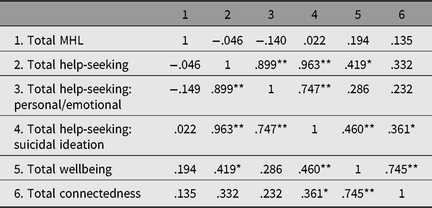
There was a significant, moderate positive correlation between total wellbeing and help-seeking in general, r(30) = .419, p < .05 with high levels of total wellbeing associated with greater intentions toward help-seeking in general (see Table 1). A significant, moderate positive correlation was also found between total wellbeing and help-seeking for suicidal ideation r(30) = .460, p < .001, with high levels of total wellbeing associated with greater intentions toward help-seeking for suicidal ideation. Of the five wellbeing factors, connectedness was found to have a significant, moderate positive correlation with help-seeking for suicidal ideation r(30) = .361, p < .05. Mental health literacy level was not significantly correlated with help-seeking for personal/emotional problems, suicidal ideation or overall wellbeing of participants.
The correlations between mental health literacy, help seeking and wellbeing

Note: ** The correlation is significant at the .01 level (two-tailed);
* The correlation is significant at the .05 level (two-tailed).
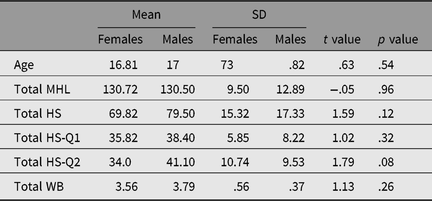
Independent samples t test did not indicate any significant differences between males and females in overall MHL levels or overall intentions to seek help for personal/emotional problems or suicidal ideation (see Table 2).
Mental health literacy, help-seeking and wellbeing: Descriptive statistics and gender differences

Note: MHL = Mental health literacy; HS = help-seeking; HS-Q1 = help-seeking (personal); HS-Q2 = help-seeking (suicidal); WB = wellbeing.
However, analysis of individual items on the MHLS indicated that females (M = 3.36, SD = .58) were significantly more likely than males (M = 2.90, SD = .56; t(32) = -2.1, p = .04, two-tailed) to accurately identify generalised anxiety disorder (GAD) in an individual. The magnitude of the differences in the means (mean difference = -.46, 95% CI [-.91, -.01]) was moderate (eta squared = .80).
Males (M = 4.80, SD = 1.39) were significantly more likely to indicate they would seek help from GPs for personal or emotional problems compared to females (M = 3.27, SD = 1.24; t(30) = 3.10, p = .004, two tailed). The magnitude of the differences in the means (mean difference = 1.53, 95% CI [0.52, 2.53]) was large (eta squared = 1.16). Males (M = 5.20, SD = 1.62) were also significantly more likely than females (M = 3.50, SD = 1.74;t(30) = 2.62, p = .014, two-tailed) to indicate they would seek help from GPs for suicidal ideation. The magnitude of the differences in the means (mean difference = 1.70, 95% CI [0.37, 3.02]) was large (eta squared = 1.01).
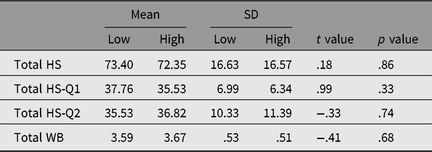
No significant differences were found between males and females in overall wellbeing. The high MHL and low MHL groups also did not differ significantly in overall wellbeing levels (see Table 3).
Help-seeking and wellbeing: Descriptive statistics and MHL group differences

Note: HS = help-seeking; HS-Q1 = help-seeking (personal); HS-Q2 = help-seeking (suicidal); WB = wellbeing.
Discussion
The present study aimed to investigate the relationship between MHL, intentions to seek help, and wellbeing in senior secondary school students. Specifically, the study investigated whether high levels of MHL were associated with greater intentions to seek help and greater wellbeing, as well as whether females reported higher MHL and greater intentions to seek help for mental health issues compared to males. The first hypothesis was not supported, as MHL levels were not found to be associated with intentions to seek help or wellbeing in participants. The second hypothesis was partially supported, with gender differences found in MHL levels for GAD and also for intentions to seek help from different sources; however, this was isolated to seeking help from GPs and not help-seeking overall.
Results did not indicate a relationship between MHL levels and intentions to seek help. This is in contrast to other studies that have demonstrated increased MHL levels, resulting in improved attitudes and intentions toward help-seeking (Hart et al., Reference Hart, Morgan, Rossetto, Kelly, MacKinnon and Jorm2018; Lubman et al., Reference Lubman, Berridge, Blee, Jorm, Wilson, Allen and Wolfe2016). This is likely contributable to the small sample size of this study and also the homogeneity of the participants or inclusion bias; it is possible that students with more favourable attitudes toward discussing mental health knowledge were more motivated to participate.
A positive association was found between total wellbeing of participants and intentions to engage in general help-seeking and help-seeking for suicidal ideation. This is partly explained by the connectedness factor of the EPOCH measure and the positive association found between connectedness and help-seeking for suicidal ideation. It could therefore be inferred that those with increased wellbeing, and increased levels of connectedness in particular, likely had more favourable attitudes toward help-seeking due to feeling more supported and valued by others — for example, feeling they have friends that care about them. The link between connectedness to school, community, peers, and wellbeing has been demonstrated in a number of prior studies (Govender et al., Reference Govender, Naicker, Meyer-Weitz, Fanner, Naidoo and Penfold2013; Rickwood et al., Reference Rickwood, Deane and Wilson2007; Rickwood et al., Reference Rickwood, Deane, Wilson and Ciarrochi2005; Townsend et al., Reference Townsend, Musci, Stuart, Ruble, Beaudry, Schweizer and Wilcox2017) and has been identified as being a facilitator of help-seeking. Young people often seek help from established and trusted people such as parents and peers; thus, it is argued that building such relationships with people before the need arises can help to ensure their wellbeing in the long run (Rickwood et al., Reference Rickwood, Deane, Wilson and Ciarrochi2005).
Analyses indicated that females were more likely to correctly identify GAD than males. This confirms findings of previous studies, which indicate that females are more likely to have higher MHL levels for anxiety disorders than males due to higher prevalence in women and therefore greater awareness of the symptoms (Furnham, Abajian, & McClelland, Reference Furnham, Abajian and McClelland2011; Hadjimina & Furnham, Reference Hadjimina and Furnham2017). Clark, Hudson, Dunstan, and Clark (Reference Clark, Hudson, Dunstan and Clark2018) investigated barriers and facilitators to help-seeking for clinical anxiety in men; they argued men are more likely to hold a negative stigma toward anxiety and may not consider anxiety to be a ‘real problem’. This, along with masculinity norms and threats to personal or public image, can prevent men from seeking help for symptoms of anxiety (Lynch et al., Reference Lynch, Long and Moorhead2018). Greater efforts to challenge these gendered perceptions of anxiety are needed and could ideally be targeted and addressed in the school environment.
The study did not identify gender differences in help-seeking overall but did find that males were more likely to seek help from a doctor or a GP for personal and/or emotional problems and for suicidal ideation than females. These results are consistent with the Mission Australia and Black Dog Institute (2017) report, which identified that males were more likely to seek help from community agencies. Such identified gender differences have implications for the school practitioner, highlighting the importance of looking at preferred help-seeking supports of young people and considering this when determining referral pathways for students presenting with mental health concerns.
Limitations
There were a number of limitations in this study. The primary limitation is the small sample size, which impacts the generalisability of the results and the statistical power of the study. The sample was also quite homogenous, with low variability in terms of MHL levels. This may be impacted by recruitment from an independent school where a greater emphasis on mental health promotion could be assumed, thereby influencing participants’ views towards mental health knowledge and awareness. Future research with use of a larger and a more heterogeneous sample, including both private and public schools, is recommended. Also, the GHSQ measure used assessed help-seeking intentions and not actual help-seeking behaviour, therefore longitudinal follow-up is also recommended to determine whether intentions to seek help results in actual help-seeking behaviour for mental health concerns. The current study would also have benefitted from inclusion of qualitative interviews to complement the small sample and to help contextualise the findings. This would be a worthwhile addition to future research.
Conclusions
Despite limited statistical power, the results of the study have important and practical implications for future research and practice. The association between wellbeing and help-seeking identified in the current study highlights the importance of establishing and increasing initiatives focused on student connectedness to promote positive help-seeking attitudes and behaviour in young people. With further empirical support, the implications of this research could influence future mental health policy and programming in schools such that gender differences in relation to help-seeking attitudes and mental health knowledge are directly addressed.
Author ORCIDs
Chelsea Hyde 0000-0002-6805-7092
Financial support
This research received no specific grant from any funding agency, commercial, or not-for-profit sectors.
Conflicts of interest
One of the authors is a paid employee in the school where data was collected. To manage any potential conflict of interest this author was not involved in data collection or input.
Ethical standards
The authors assert that all procedures contributing to this work comply with the ethical standards of the relevant national and institutional committees on human experimentation and with the Helsinki Declaration of 1975, as revised in 2008.