Introduction
The pelagornithids, commonly known as pseudo-toothed birds, are a peculiar group of volant seabirds characterized by numerous osseous tooth-like processes of the beak, and extremely light and thin bones with a highly specialized structure adapted for pelagic soaring (Olson, Reference Olson1985; Bourdon, Reference Bourdon2011). They were cosmopolitan birds whose fossil record dates back to the late Paleocene and extends up to the latest Pliocene (e.g., Olson, Reference Olson1985; Mourer-Chauviré and Geraards, 2008; Mayr, Reference Mayr2009; Bourdon et al., Reference Bourdon, Amaghzaz and Bouya2010; Boessenecker and Smith, Reference Boessenecker and Smith2011). Although this group was included in a distinct taxon, the Odontopterygiformes, earlier authors noted their affinities with other seabirds such as Procellariiformes and polyphyletic traditional “Pelecaniformes” (Wetmore, Reference Wetmore1928; Howard, Reference Howard1957, Reference Howard1978; Harrison and Walker, Reference Harrison and Walker1976; Brodkorb, Reference Brodkorb1963; Olson, Reference Olson1985; Goedert, Reference Goedert1989). Nevertheless, these similarities were recently considered as the result of convergence (Mayr, Reference Mayr2011). Recent phylogenetic analyses suggest a sister group relationship of pseudo-toothed birds and Anseriformes (both included in the new clade Odontoanserae; Bourdon, Reference Bourdon2005, Reference Bourdon2011). However, a phylogenetic analysis (including characters used by Bourdon, Reference Bourdon2005) resulted in a more basal position of Pelagornithidae outside the crown-group Galloanseres (Mayr, Reference Mayr2011).
Bourdon et al. (Reference Bourdon, Amaghzaz and Bouya2010, see also Bourdon, Reference Bourdon2011) noted that within the family Pelagornithidae two morphological types or clades (Mayr et al., Reference Mayr, Goedert and McLeod2013) can be distinguished. Defined by plesiomorphic characters, the first clade includes Dasornis Owen, Reference Owen1870 species (including Odontopteryx Owen, Reference Owen1873; and Macrodontopteryx Harrison and Walker, Reference Harrison and Walker1976) and is restricted to the late Paleocene/early Eocene of Morocco (Bourdon, Reference Bourdon2005; Bourdon et al., Reference Bourdon, Amaghzaz and Bouya2010), and early Eocene of England (Harrison and Walker, Reference Harrison and Walker1976; Mayr, Reference Mayr2008). The second and younger clade, corresponds to the derived Pelagornis species (here referred as Pelagornis sensu lato Mayr et al., Reference Mayr, Goedert and McLeod2013; containing Pelagornis Lartet, Reference Lartet1857; Osteodontornis Howard, Reference Howard1957; Pseudodontornis Lambrecht, Reference Lambrecht1930; Palaeochenoides Shufeldt, Reference Shufeldt1916; and Tympanonesiotes Hopson, Reference Hopson1964) found on all continents from late Oligocene to late Pliocene strata (e.g., Olson, Reference Olson1985; Mayr et al., Reference Mayr, Hazevoet, Dantas and Cachao2008, Reference Mayr, Goedert and McLeod2013; Mourer-Chauviré and Geraads, Reference Mourer-Chauviré and Geraads2008; Mayr and Rubilar-Rogers, Reference Mayr and Rubilar-Rogers2010; Boessenecker and Smith, Reference Boessenecker and Smith2011; Ksepka, Reference Ksepka2014).
The systematic status of all middle Eocene to early Oligocene pelagornithids is very poorly known. These specimens exhibit some of the apomorphies of Pelagornis, and correspond to taxa with intermediate morphology between Dasornis and Pelagornis types. This is the case of Lutetodontopteryx tethyensis Mayr and Zvonok, Reference Mayr and Zvonok2012, a relatively well-represented taxon from the middle Eocene of Ukraine; some fragmentary specimens from the middle Eocene of Togo (Bourdon and Cappetta, Reference Bourdon and Cappetta2012), Belgium (Mayr and Smith, Reference Mayr and Smith2010; Mayr and Zvonok, Reference Mayr and Zvonok2012), and Nigeria (Andrews, Reference Andrews1916; Mayr et al., Reference Mayr, Hazevoet, Dantas and Cachao2008); and other remains from the late Eocene of Antarctica (Cenizo, Reference Cenizo2012), and the latest Eocene/?early Oligocene of North America (Goedert, Reference Goedert1989).
Particularly, the Antarctic pelagornithid record is restricted to few and isolated remains from the Eocene of Seymour Island in the Antarctic Peninsula (Fig. 1). The first pseudo-toothed birds known from this continent were represented by a very large rostral fragment (Tonni and Cione, Reference Tonni and Cione1978; Tonni, Reference Tonni1980), and two poorly preserved mandibular portions (Tonni and Tambussi, Reference Tonni and Tambussi1985). Stilwell et al. (Reference Stilwell, Jones, Levy and Harwood1998) reported the first fossil bird from lower-middle Eocene outcrops of East Antarctica, which consists on an eroded humeral diaphysis described in detail by Jones (Reference Jones2000). A well preserved distal end of tarsometatarsus previously referred to the “terror birds” Phorusrhacidae (Case et al., Reference Case, Reguero, Martin and Cordes-Person2006) was reallocated within Pelagornithidae (Cenizo, Reference Cenizo2012). Furthermore, a complete humerus, still under study, was mentioned by Rubilar-Rogers et al. (Reference Rubilar-Rogers, Yury-Yáñez, Mayr, Gutstein and Otero2011), and a tip of beak was recently figured by Tambussi and Degrange (Reference Tambussi and Degrange2013) without comments about its affinities.
Location map of the La Meseta Formation and the new Submeseta Formation outcrops in Seymour Island, Antarctic Peninsula, West Antarctica. Other stratigraphic units are also indicated: CVF=Cross Valley Formation; LBF=López de Bertodano Formation; SF=Sobral Formation; WF=Weddel Formation; sd=surficial deposits.

The finding of the oldest Antarctic pelagornithid (a distal end of humerus, MLP 12-I-20-4) in middle Ypresian levels (early Eocene), and the recent description of new and more complete Paleogene specimens (e.g., Bourdon et al., Reference Bourdon, Amaghzaz and Bouya2010; Mayr and Zvonok, Reference Mayr and Zvonok2011, Reference Mayr and Zvonok2012; Bourdon and Cappetta, Reference Bourdon and Cappetta2012; Mayr et al., Reference Mayr, Goedert and McLeod2013) invites to review of the Antarctic record of the group, which represents the only pseudo-toothed birds known for the Paleogene of the Southern Hemisphere.
Geological setting
The sedimentary sequence exposed on Seymour (Marambio) Island is more than 2 km thick and represents the uppermost part of the infill of the James Ross Basin (del Valle et al., Reference Del Valle, Elliot and MacDonald1992). The youngest strata constitute the Seymour Island Group that includes the Paleocene Cross Valley Formation at the bottom, and the early Eocene/?earliest Oligocene La Meseta Formation at the top. A geological map of the Seymour Island with new stratigraphic sequence and datings of the Eocene marine horizons was recently published (Montes et al., Reference Montes, Nozal, Santillana, Marenssi and Olivero2013). The La Meseta Formation was splitted into two geologic units, La Meseta and Submeseta formations which are separated and bounded by a prominent erosional surface covered by 20- to 40-m thick inclined heterolithic facies composed of estuarine, very fine sandstones, and mudstones (Marenssi, Reference Marenssi2006).
The La Meseta Formation (La Meseta Alloformation in Marenssi et al., Reference Marenssi, Santillana and Rinaldi1998a) is exposed along the slopes of the plateau of Seymour (Marambio) Island (Fig. 1). It is an unconformity-bounded unit (Elliot and Trautman, Reference Elliot and Trautman1982; Ivany et al., Reference Ivany, Lohmann, Hasiuk, Blake, Glass, Aronson and Moody2008) deposited between the Thanetian and the Lutetian (i.e., between 58.7–40.4 Ma; Montes et al., Reference Montes, Nozal, Santillana, Marenssi and Olivero2013). This unit is approximately 560-m thick and fills a 7-km wide valley cut down into older sedimentary rocks constituting the island; its current location is the result of regional uplift and tilting of the Marambio Group beds (Reguero et al., Reference Reguero, Goin, Acosta Hospitaleche, Dutra and Marenssi2013).
The La Meseta Formation includes mudstones and sandstones with interbedded conglomerates and is organized into six erosionally based units (Marenssi et al., Reference Marenssi, Santillana and Rinaldi1998a). These are named, from base to top: Valle de Las Focas, Acantilados I, Acantilados II, Campamento, Cucullaea I, and Cucullaea II (Fig. 2). These lens-shaped units represent different sedimentation stages related to sea level fluctuations (Marenssi et al., Reference Marenssi, Net and Santillana2002) deposited in deltaic, estuarine and shallow marine environments as part of a tectonically controlled incised valley system (Porębski, 1995; Marenssi et al., Reference Marenssi, Santillana and Rinaldi1998b). An open marine, protected, and estuarine environment provided suitable habitat and good preservation potential, evidenced by a high diversity and abundance of fossil remains (Marenssi, Reference Marenssi2006). Provenance studies on sandstones of the La Meseta Formation demonstrated that the source rock was located west-northwest along the present day Antarctic Peninsula.
Stratigraphic section of the La Meseta Formation and the new Submeseta Formation unit proposed by Montes et al. (Reference Montes, Nozal, Santillana, Marenssi and Olivero2013), Seymour Island, Antarctic Peninsula. Characteristic invertebrates are indicated as: t=Turritella; cu=Cuccullaea; v=veneroids.
The new unit, Submeseta Formation (Montes et al., Reference Montes, Nozal, Santillana, Marenssi and Olivero2013), is the uppermost part of the former early/middle Eocene to ?earliest Oligocene La Meseta Formation (Elliot and Trautman, Reference Elliot and Trautman1982; Ivany et al., Reference Ivany, Lohmann, Hasiuk, Blake, Glass, Aronson and Moody2008). This unit corresponds to the Facies Association III of Marenssi et al. (Reference Marenssi, Santillana and Rinaldi1998b), characterized by a uniform sandy lithology that represents a tidal shelf influenced by storms. The Submeseta Formation is organized into three allomembers (Fig. 2) named from base to top: Submeseta I, Submeseta II, and Submeseta III (Montes et al., Reference Montes, Nozal, Santillana, Marenssi and Olivero2013). Montes et al. (Reference Montes, Nozal, Santillana, Marenssi and Olivero2013) placed the base of the Submeseta Formation at 43.4 Ma (upper Lutetian), and the top of this unit at 33.9 Ma (Priabonian/Rupelian).
Material and methods
Anatomical terminology follows Baumel and Witmer (Reference Baumel and Witmer1993). The pseudo-teeth were ranked following Mourer-Chauviré and Geraards (2008) and Louchart et al. (Reference Louchart, Sire, Mourer-Chauviré, Geraads, Viriot and de Buffrénil2013).
Institutional abbreviations
LACM, The Natural History Museum of Los Angeles County, Los Angeles, USA; MCZ, Museum of Comparative Zoology, Harvard University, Cambridge, USA; MLP, Museo de La Plata, La Plata, Argentina; MNHN, Museo Nacional de Historia Natural, Santiago, Chile; NHMUK, Natural History Museum, London, United Kingdom; OCP.DEK/GE, Office Chérifien des Phosphates, Direction des Exploitations de Khouribga, Service de Géologie, Morocco; SMF, Senckenberg Research Institute Frankfurt, Frankfurt am Main, Germany; UCR, University of California, Riverside, USA; USNM, National Museum of Natural History, Washington, USA.
Systematic paleontology
Order Odontopterygiformes Howard, Reference Howard1957
Family Pelagornithidae Fürbringer, Reference Fürbringer1888
Pelagornithidae indet. morphotype 1
Distal end of right humerus (MLP 12-I-20-4) assigned to Pelagornithidae indet. morphotype 1 from the early Eocene of Seymour Island (West Antarctica). (1–4) Cranial, caudal, dorsal, and distal views, respectively. Abbreviations: cd=condylus dorsalis; cv=condylus ventralis; ed=epicondylus dorsalis; fmb=fossa musculi brachialis; fo=fossa olecrani; icu=insertion of the musculus extensor carpi ulnaris; sh=sulcus humerotricipitalis; tsv=tuberculum supracondylare ventrale. Scale bar=20 mm.
Description
The distal end of humerus MLP 12-I-20-4 is nearly complete but both condyli have lost their cranial surface, also the epicondyli dorsalis et ventralis and the sulcus scapulotricipitalis are partially eroded (Fig. 3.1–3.4). The assignment of MLP 12-I-20-4 to the pseudo-toothed birds is based on the following characters (Mourer-Chauviré and Geraads, Reference Mourer-Chauviré and Geraads2008; Mayr and Smith, Reference Mayr and Smith2010; Bourdon et al., Reference Bourdon, Amaghzaz and Bouya2010; Bourdon and Cappetta, Reference Bourdon and Cappetta2012): (1) craniocaudally compressed shaft, (2) distal condyli located at the same level and distally prominent, (3) roughly rounded condylus ventralis, (4) prominent epicondylus dorsalis, (5) shallow fossa olecrani and sulcus humerotricipitalis, and (6) dorsal margin of the shaft narrow and ridge-like just proximal to the distal end.
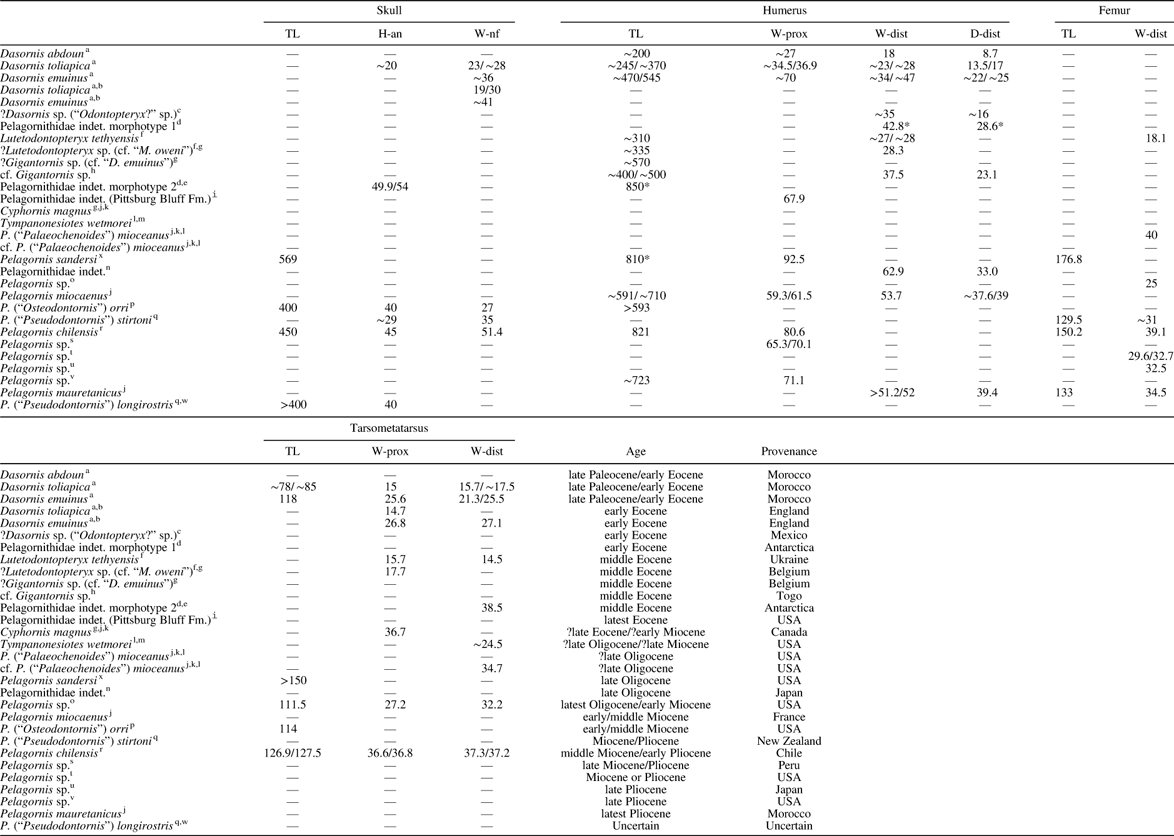
Although its size is somewhat larger, the Antarctic material has strong similarities with a humerus coming from the middle Eocene of Togo and tentatively referred to Gigantornis Andrews, Reference Andrews1916 by Bourdon and Capetta (2012, fig. 2L–N and P). However, both specimens are included in the size range observed for Dasornis emuinus (Bowerbank, Reference Bowerbank1854) from the late Paleocene/early Eocene of Morocco (Bourdon et al., Reference Bourdon, Amaghzaz and Bouya2010; Table 1). The wide intraspecific size variability reported for some pelagornithids (i.e., D. emuinus; D. toliapica [Owen, Reference Owen1873]; Bourdon et al., Reference Bourdon, Amaghzaz and Bouya2010; and Pelagornis miocaenus Lartet, Reference Lartet1857; Mourer-Chauviré and Geraards, 2008) suggests that the Antarctic and Togo specimens may belong to the same species.
Skull and limb dimensions of pseudo-toothed birds of Seymour Island compared with those of other Pelagornithidae
All measurements are in millimeters.
Data taken from: aBourdon et al. (Reference Bourdon, Amaghzaz and Bouya2010), bHarrison and Walker (1976), cGonzález-Barba et al. (Reference González-Barba, Scwennicke, Goedert and Barnes2002), dthis work, eRubilar-Rogers et al. (Reference Rubilar-Rogers, Yury-Yáñez, Mayr, Gutstein and Otero2011), fMayr and Zvonok (2012), gMayr and Smith (Reference Mayr and Smith2010), hBourdon and Cappetta (2013), iGoedert (Reference Goedert1989), jMourer-Chauviré and Geraads (2008), kHopson (Reference Hopson1964), lOlson (1985), mWetmore (1928), nOkazaki (Reference Okazaki1989), oMayr et al. (Reference Mayr, Goedert and McLeod2013), pHoward (1957), qHoward and Warter (Reference Howard and Warter1969), rMayr and Rubilar-Rogers (2010), sChávez et al. (2007), tOlson and Rasmussen (Reference Olson and Rasmussen2001), uOno (Reference Ono1980), vBoessenecker and Smith (2011), wLambrecht (1930), xKsepka (2014).
* Preserved.
D-dist=depth of distal end; H-an=height at aperturae nasi ossea; TL=total length; W-dist=width of distal end; W-nf=width of naso-frontal hinge; W-prox=width of proximal end.
Although the epicondylus dorsalis of MLP 12-I-20-4 is only partially preserved, its morphology is similar to that of cf. Gigantornis sp. from Togo. It is more robust than that of Dasornis and less projected and rounded than the corresponding structure in Pelagornis (Bourdon et al., Reference Bourdon, Amaghzaz and Bouya2010; Bourdon and Cappetta, Reference Bourdon and Cappetta2012). According to the preserved outline, the condylus ventralis of MLP 12-I-20-4 was smaller than that of Pelagornis and similar to those of Dasornis and cf. Gigantornis sp. In dorsal view (like in Dasornis and cf. Gigantornis sp.), MLP 12-I-20-4 exhibits two deep concavities for the insertion of the musculus extensor carpi ulnaris surrounded by a thick and smooth ridge (Fig. 3.3). In Pelagornis these concavities are shallower and the ridge is missing or poorly developed (Bourdon et al., Reference Bourdon, Amaghzaz and Bouya2010; Bourdon and Cappetta, Reference Bourdon and Cappetta2012). A well-defined tuberculum supracondylare ventrale is present in MLP 12-I-20-4, which is more vertically oriented (subparallel to the main axis of the diaphysis), and more proximally extended than in Dasornis.
The fragmentary distal shaft of the humerus USNM 494035 from East Antarctica has been figured by Stilwell et al. (Reference Stilwell, Jones, Levy and Harwood1998, fig. 2) and Jones (Reference Jones2000, fig. 1). Although the surface of the diaphysis is highly crushed and broken at the proximal level of the condyli, the fossa musculi brachialis is preserved as a cranial depression recognizable in distal view. The size of the diaphysis, its cranio-caudal compression, and the extremely thin wall of cortical bone (evidencing a high pneumaticity not present in others large sized coetaneous Antarctic birds; i.e., Ratites, Sphenisciformes) allow the inclusion of USNM 494035 in the Pelagornithidae (see similarities with specimens described by Boessenecker and Smith, Reference Boessenecker and Smith2011; and Fitzgerald et al., Reference Fitzgerald, Park and Worthy2012). Moreover, the wide fossa musculi brachialis, the narrow ridge-like margo dorsalis, the shallow sulcus humerotricipitalis, and the shape and extension of the tuberculum supracondylare ventrale (Jones, Reference Jones2000) are also similar to that of pelagornithids. Size and morphological characters of USNM 494035 are similar to those observed in the humerus MLP 12-I-20-4 here described.
Material
MLP 12-I-20-4, distal end of right humerus (Fig. 3.1–3.4); USNM 494035, fragmentary distal portion of shaft of right humerus (Stilwell et al., Reference Stilwell, Jones, Levy and Harwood1998, fig. 2; and Jones, Reference Jones2000, fig. 1).
Occurrence
MLP12-I-20-4 comes from the Cucullaea I Allomember (level 35 in Montes et al., Reference Montes, Nozal, Santillana, Marenssi and Olivero2013, fig 2) of the La Meseta Formation (Marenssi et al., Reference Marenssi, Santillana and Rinaldi1998a), IAA 1/95 locality, Seymour Island, Antarctic Peninsula, West Antarctica. Strontium dating yielded ages of 52.8–49 Ma for this locality (middle Ypresian, early Eocene; Montes et al., Reference Montes, Nozal, Santillana, Marenssi and Olivero2013).
The specimen USNM 494035 was found in an erratic glacial (A303) collected from moraine deposits on the NW side of Mount Discovery, McMurdo Sound, East Antarctica. The associated micro and macro invertebrate fauna indicates an early/middle Eocene age (Jones, Reference Jones2000; and references therein).
Measurements
MLP 12-I-20-4: see Table 1. USNM 494035 (Jones, Reference Jones2000): preserved length, 85 mm; maximum dorso-ventral width, 32 mm; maximum cranio-caudal depth, 22 mm; thickness of bone wall, 1.5 mm.
Pelagornithidae indet. morphotype 2
Pelagornithid specimens assigned to morphotype 2 from the middle Eocene of Seymour Island (West Antarctica). (1) Comparative proportions of the cranial remains from Antarctica (MLP 08-XI-30-42, MLP 78-X-26-1) and the holotype of the giant species Pelagornis chilensis (after Mayr and Rubilar-Rogers, Reference Mayr and Rubilar-Rogers2010). (2, 3) rostral end of rostrum maxillare (MLP 08-XI-30-42) in lateral and dorsal views; (4–8) most rostral narial region of rostrum maxillare (MLP 78-X-26-1) in dorsal, lateral, ventral, and cranial (7, 8) views, respectively; (9–11) distal end of right tarsometatarsus (UCR 22176, cast MLP) in dorsal, plantar, and distal views, respectively. Abbreviations: cid=canalis interosseus distalis; cr=culmen ridge; ct=cristae tomiales; ftp=fossa for mandibular tooth-like processes; fvd=foramen vasculare distale; dc=dorsolateral constriction; pmp=processus medioplantaris; mvs=medioventral sulcus; ls=longitudinal sulcus; pr=palatal ridge; tp=toothlike processes (2–4=rank); tII, tIII, and tIV=trochleae metatarsorum II, III, and IV. Scale bars=20 mm; except in 1=50 mm.
Description
The rostral end of the rostrum maxillare MLP 08-XI-30-42 is congruent with those of other pseudo-toothed birds (Rincón and Stucchi, Reference Rincón and Stucchi2003; Stidham, Reference Stidham2004; Bourdon et al., Reference Bourdon, Amaghzaz and Bouya2010; Mayr and Rubilar-Rogers, Reference Mayr and Rubilar-Rogers2010; Mayr and Zvonok, Reference Mayr and Zvonok2012; Ksepka, Reference Ksepka2014). Its size exceeds the medium-sized D. toliapica and L. tethyensis, and even the larger D. emuinus, corresponding in dimensions with the giant Neogene Pelagornis species (Fig. 4.1). The cristae tomiales preserve the base of the first rostral-most large tooth-like process (Fig. 4.2). The rostral end is slightly ventrally curved, and the transverse sulcus before the tip of the beak is absent in MLP 08-XI-30-42, as well as in D. toliapica and L. tethyensis, whereas is typically present and well developed in Pelagornis (Olson, Reference Olson1984; Stidham, Reference Stidham2004; Bourdon et al., Reference Bourdon, Amaghzaz and Bouya2010; Mayr and Rubilar-Rogers, Reference Mayr and Rubilar-Rogers2010; Mayr and Zvonok, Reference Mayr and Zvonok2012; Ksepka, Reference Ksepka2014). The longitudinal sulcus of MLP 08-XI-30-42 is less defined than in Pelagornis.
The rostrum maxillare MLP 78-X-26-1 (Fig. 4.4–4.8) has a deep longitudinal sulcus running upward along the dorsal third of the beak. In pelagornithids, these lateral sulci are longitudinally extended along the dorsal margin of the beak from apex rostri to aperturae nasi, whereas posteriorly, these sulci are more ventrally located (Bourdon et al., Reference Bourdon, Amaghzaz and Bouya2010; Mayr and Rubilar-Rogers, Reference Mayr and Rubilar-Rogers2010). Because of that, MLP 78-X-26-1 is referred to the sector immediately developed cranially to the aperturae nasi ossea. A dorsolateral constriction on the caudal section of the preserved culmen (Fig. 4.4) corresponds to that one developed cranially to the aperturae nasi ossea reported for other pelagornithids (Mayr and Rubilar-Rogers, Reference Mayr and Rubilar-Rogers2010; see also Ksepka, Reference Ksepka2014, fig.1.a). A dorsally located ridge (Tonni, Reference Tonni1980, fig. 4.4, 4.5) is very well defined as in Dasornis, whereas it is weaker or absent in Pelagornis. The maxilla from Antarctica is less compressed than in Dasornis, but narrower than in Pelagornis. On the contrary, the longitudinal sulcus is more dorsally located than in Dasornis and similar to the condition of Pelagornis (Harrison and Walker, Reference Harrison and Walker1976; Bourdon et al., Reference Bourdon, Amaghzaz and Bouya2010). As is typical of Pelagornithidae, the ventral surface of MLP 78-X-26-1 shows two longitudinal sulci for the location of the cristae tomiales and deep fossae for the tooth-like projections of the mandible (Lambrecht, Reference Lambrecht1930; Harrison and Walker, Reference Harrison and Walker1976; Tonni, Reference Tonni1980; Stidham, Reference Stidham2004; Mayr and Rubilar-Rogers, Reference Mayr and Rubilar-Rogers2010). Between both, there is a palatal ridge (central palatal region sensu Harrison and Walker, Reference Harrison and Walker1976, fig. 4.7) extended ventrally almost half of the rostrum in cross section. This condition is similar to that of Dasornis, which shows a well-defined medioventral sulcus (interpalatal groove sensu Harrison and Walker, Reference Harrison and Walker1976). In contrast, Pelagornis has a palatal ridge that is strongly convex and prominent (Harrison and Walker, Reference Harrison and Walker1976; Bourdon et al., Reference Bourdon, Amaghzaz and Bouya2010), and the sulcus is missing (Harrison and Walker, Reference Harrison and Walker1976; see Mayr and Rubilar-Rogers, Reference Mayr and Rubilar-Rogers2010, fig. 1D). On both cristae tomiales, MLP 78-X-26-1 shows three poorly preserved tooth-like processes. The largest one is on the middle, separated from the other two by an equidistance of 9.7 mm (Tonni, Reference Tonni1980), corresponding to pseudo-teeth of rank 2 and 3, respectively. Between them, small protuberances probably represent the basis of very thin “needles” of rank 4. The largest tooth-like processes of rank 1 are not preserved. A striking feature is the dorsoventral height of the beak measured at the level of the apertura nasi ossea, which is highest than in any other pelagornithid species known (Table 1). A polishing of the cross section (Fig. 4.8) permits the first detailed observation of its inner structure, which evidences an extreme bone pneumaticity.
The tarsometatarsus UCR 22176 (Fig. 4.9–4.11, 5) has the largest distal transverse width known for pseudo-toothed birds (Table 1, Cenizo, Reference Cenizo2012). The general morphology is similar to Dasornis, although it shares some features with Pelagornis (Cenizo, Reference Cenizo2012). The corpus of UCR 22176 is mediolaterally narrower than Pelagornis, and wider than Dasornis (Bourdon et al., Reference Bourdon, Amaghzaz and Bouya2010, fig.5) whereas is similar to the preserved proximal shaft of L. tethyensis (Mayr and Zvonok, Reference Mayr and Zvonok2012). The shaft of UCR 22176 is nearly square in cross-section, like in Dasornis; in Pelagornis the section is rectangular and dorsoplantarly depressed. Like in Dasornis, the trochlea metatarsi II of UCR 22176 is less distally displaced (Fig. 5) than in Pelagornis chilensis Mayr and Rubilar-Rogers, Reference Mayr and Rubilar-Rogers2010; whereas L. tethyensis and ?late Oligocene/early Miocene Pelagornis specimens exhibit an intermediate condition. However, this trochlea is less plantarly projected (Fig. 5) than in Dasornis but more than in P. chilensis (Bourdon et al., Reference Bourdon, Amaghzaz and Bouya2010; Mayr and Rubilar-Rogers, Reference Mayr and Rubilar-Rogers2010; Mayr, Reference Mayr2011; Mayr and Zvonok, Reference Mayr and Zvonok2012); the plantar extension in UCR 22176 is similar to that of L. tethyensis and the specimen tentatively assigned to Pelagornis (‘Palaeochenoides’) mioceanus by Hopson (Reference Hopson1964; see also Mayr et al., Reference Mayr, Goedert and McLeod2013). The processus medioplantaris (Fig. 4.11, 5) of the trochlea metatarsi II is more medially extended than in Dasornis and L. tethyensis (it is absent in P. chilensis). As in Dasornis and L. tethyensis, the trochleae metatarsorum II and IV are narrower and less excavated than those of Pelagornis. Likewise, as in Dasornis (although in a lesser degree), the plantar surface of trochlea metatarsi III is narrow, elongate, and with proximally convergent margins (a condition also observed in Lutetodontopteryx); whereas in Pelagornis this trochlea is plantarly wider, shorter and its margins are more parallel each other (the only exception is the late Oligocene/early Miocene Pelagornis sp. from Oregon, Mayr et al., Reference Mayr, Goedert and McLeod2013, fig. 5). UCR 22176 shares with Dasornis the lateral tilting of the trochlea metatarsi III (Bourdon, Reference Bourdon2005; Bourdon et al., Reference Bourdon, Amaghzaz and Bouya2010). The dorsal opening of the foramen vasculare distale in UCR 22176 is proximodistally elongated, like that of Dasornis (Bourdon et al., Reference Bourdon, Amaghzaz and Bouya2010; a similar condition would be present in L. tethyensis); whereas it is subcircular in Pelagornis. On the other hand, the foramen vasculare distale in UCR 22176, is recessed plantarly and opens close to the canalis interosseus distalis like in Pelagornis (Bourdon, Reference Bourdon2005; Mayr and Rubilar-Rogers, Reference Mayr and Rubilar-Rogers2010; Mayr, Reference Mayr2011).
Comparative morphology of the tarsometatarsus in Pelagornithidae. Selected specimens are listed from left to right: Dasornis toliapica OCP.DEK/GE 1146 and Dasornis emuinus OCP.DEK/GE 1106 (after Bourdon et al., Reference Bourdon, Amaghzaz and Bouya2010, reversed for comparison), D. emuinus NHMUK 894 (after Harrison and Walker, 1977), Lutetodontopteryx tethyensis SMF Av 553a+b (holotype, after Mayr and Zvonok, Reference Mayr and Zvonok2012), Pelagornithidae indet. morphotype 2 UCR 22176 (MLP cast), cf. Pelagornis (‘Palaeochenoides’) mioceanus MCZ 2514 (after Hopson, Reference Hopson1964, reversed for comparison), Pelagornis sp. LACM 128424 (after Mayr et al., Reference Mayr, Goedert and McLeod2013), Pelagornis chilensis MNHN SGO.PV 1061 (holotype, after Mayr and Rubilar-Rogers, Reference Mayr and Rubilar-Rogers2010). (1–3) Dorsal, plantar, and distal views, respectively. Abbreviations: DP=distal projection of the trochleae metatarsorum II and IV; mp=processus medioplantaris; PP=plantar projection of the trochleae metatarsorum II and IV; tII, tIII, and tIV=trochleae metatarsorum II, III, and IV. Unscaled images for comparison.
Material
MLP 08-XI-30-42, rostral end of rostrum maxillare (Fig. 4.2, 2.3); MLP 78-X-26-1, most rostral narial region of rostrum maxillare (Fig. 4.4–4.8); UCR 22176, distal end of right tarsometatarsus (Fig. 4.9–4.11).
Occurrence
All the specimens come from the Submeseta II Allomember (level 38 in Montes et al., Reference Montes, Nozal, Santillana, Marenssi and Olivero2013, fig. 2) of the Submeseta Formation (Montes et al., Reference Montes, Nozal, Santillana, Marenssi and Olivero2013), DPV 13/84 (MLP 08-XI-30-42 and MLP 78-X-26-1) and RV 8702 (UCR 22176) localities, Seymour Island, Antarctic Peninsula, West Antarctica. Strontium dating yielded an age between 41.1–37.8 Ma for both localities (Bartonian, middle Eocene; Montes et al., Reference Montes, Nozal, Santillana, Marenssi and Olivero2013).
Measurements
See Table 1.
Remarks
An almost complete humerus (SGO.PV 22001) assigned to a pelagornithid was recently found in Bartonian/?Priabonian levels (middle/late Eocene, Submeseta Formation) of Seymour Island (Rubilar-Rogers et al., Reference Rubilar-Rogers, Yury-Yáñez, Mayr, Gutstein and Otero2011). Its morphology resembles more the Neogene Pelagornis than the Paleogene Dasornis. It belongs to a bird similar-sized to the largest know pelagornithid Pelagornis sandersi Ksepka, Reference Ksepka2014 (Table 1), but unfortunately, it is still under study and cannot be directly compared. Giant size, morphological affinities (Pelagornis-like features) and the stratigraphical provenance of the specimen (Rubilar-Rogers et al., Reference Rubilar-Rogers, Yury-Yáñez, Mayr, Gutstein and Otero2011) are consistent with assignment to morphotype 2.
Reassignment of other alleged Antarctic Pelagornithids
An incomplete articular portion of a mandible (MLP 83-V-30-1, Fig. 6.1, 6.2) found in the middle levels of the Submeseta Formation (DPV 13/84 locality, level 38, Submeseta II Allomember, middle Eocene; Fig. 2) has previously been assigned to Pelagornithidae (Tonni and Tambussi, Reference Tonni and Tambussi1985). However, such a taxonomic assignment was based on characters that are present in other birds, such as (1) a straight ventral margin of the mandible (shared with penguins), (2) the caudal edge forming an angle of almost 90° with the ventral margin (shared with Eocene penguins; Acosta Hospitaleche and Haidr, Reference Acosta Hospitaleche and Haidr2011), and (3) an elongated articular surface, oblique with respect to the ramus mandibulae (shared with many other birds, including penguins).
Specimens previously referred to Pelagornithidae and here reassigned to other taxa. (1, 2) Fragmentary mandible (MLP 83-V-30-1) reassigned to Sphenisciformes indet. coming from the middle Eocene of Seymour Island (locality DPV 13/84, level 38) in lateral and medial views; (3–5) fragmentary dentary of fish (MLP 83-V-30-2) coming from the late Eocene of Seymour Island (DPV 16/84 locality, level 39) in lateral, cranial and medial views, respectively. Abbreviations: cl=cotyla lateralis; p=prominence. Scale bar=20 mm.
This mandible is strong and robust, but unfortunately, it shows a badly weathered external surface. Neither the processus retroarticularis nor the fossa caudalis are preserved. The cotyla lateralis is larger than the cotyla medialis; they are both merged with a small prominence at the medial side (Fig. 6.2). MLP 83-V-30-1 exhibits the morphology that is congruent with that expected for a penguin mandible (Ksepka and Bertelli, Reference Ksepka and Bertelli2006, fig 3; Acosta Hospitaleche and Haidr, Reference Acosta Hospitaleche and Haidr2011, fig. 2A–C, and E). Regrettably, the incomplete nature of the material does not allow an accurate assignment. However, the external cortex of MLP 83-V-30-1 is relatively thick, unlike in pelagornithids. Based on that and the features commented on above, MLP 83-V-30-1 should be considered as Sphenisciformes indet., belonging to a robust and giant species, within the size range of Palaeeudyptes or Anthropornis (Jadwiszczak and Acosta Hospitaleche, Reference Jadwiszczak and Acosta Hospitaleche2013, Reference Acosta Hospitaleche2015; Acosta Hospitaleche and Reguero, Reference Acosta Hospitaleche and Reguero2015).
A second specimen (MLP 83-V-30-2, Fig. 6.3–6.5) was previously described by Tonni and Tambussi (Reference Tonni and Tambussi1985) as a pelagornithid. This fossil comes from the upper levels of the Submeseta Formation (DPV 16/84 locality, level 39, Submeseta III Allomember, late Eocene; Fig. 2). This specimen consists of a fragmentary fish dentary bone with a strong and conical tooth and a piece of a second tooth. The tooth is slightly bent backwards and has its internal cavity exposed at the tip. The tooth surface is weathered, but a pedicle is developed at its base, and the tooth is inserted in a shallow longitudinal groove. Based on its gross morphology, the specimen may probably be assigned to the cod-icefish Mesetaichthys jerzmanskae Bieñkowska-Wasiluk, Bonde, Moller and Gazdzicki, Reference Bieñkowska-Wasiluk, Bonde, Moller and Gazdzicki2013, a Notothenioidei (Perciformes) recently described (Bieñkowska-Wasiluk et al., Reference Bieñkowska-Wasiluk, Bonde, Moller and Gazdzicki2013) for the Submeseta Formation (middle/late Eocene). The specimen in question (MLP 83-V-30-2) is not referable to Aves, much less Pelagornithidae.
Discussion and conclusions
Regarding their affinities, both morphotypes recognized for Antarctic pelagornithids share with the late Paleocene/early Eocene Dasornis the presence of several possible plesiomorphic characters (i.e., humerus: deep concavities for the musculus extensor carpi ulnaris surrounded by a thick and smooth ridge; rostral end of the beak: slightly down-curved, absence of transverse sulcus; narial region of the rostrum: well-defined dorsolateral constriction and dorsal ridge, palatal ridge slightly prominent, and with a marked medial sulcus; tarsometatarsus: corpus mediolaterally narrower with square cross section, narrow and poorly excavated trochlea II, proximally positioned trochlea II with a processus medioplantaris, narrow dorsal opening of foramen vasculare distale). However, a number of characters also remind the more derived condition typical of the Neogene Pelagornis (i.e., humerus: flattened diaphysis, well-developed epicondylus dorsalis, vertically positioned and proximally extended tuberculum supracondylare ventrale; narial region of the rostrum: longitudinal sulcus more dorsally positioned; tarsometatarsus: recessed and more distally located plantar opening of the foramen vasculare distale, slight plantar projection of trochlea II, wider and lower dorsal surface of trochlea III). A combination of plesiomorphic and derived character states, showing an ‘intermediate’ condition between Dasornis and Pelagornis was already reported in post-early Eocene and pre-late Oligocene specimens. Taxa showing such combination include the middle Eocene L. tethyensis from Ukraine (Mayr and Zvonok, Reference Mayr and Zvonok2011, Reference Mayr and Zvonok2012), Gigantornis eaglesomei Andrews, Reference Andrews1916 from Nigeria (Harrison and Walker, Reference Harrison and Walker1976; Mayr et al., Reference Mayr, Hazevoet, Dantas and Cachao2008), Togo specimens referred to Gigantornis (Bourdon and Cappetta, Reference Bourdon and Cappetta2012), and some other remains from Belgium tentatively assigned by Mayr and Smith (Reference Mayr and Smith2010) to D. emuinus and Macrodontopteryx oweni Harrison and Walker Reference Harrison and Walker1976 (although they probably correspond to Gigantornis and Lutetodontopteryx, respectively; Mayr and Zvonok, Reference Mayr and Zvonok2012; see also Bourdon et al., Reference Bourdon, Amaghzaz and Bouya2010). The late Eocene and ?early Oligocene materials from Oregon described by Goedert (Reference Goedert1989) also seems to fit in this intermediate morphology (Mayr et al., Reference Mayr, Goedert and McLeod2013).
A valuable element in order to recognize plesiomorphic-derived conditions is probably represented by the tarsometatarsus. The progressive increase in the distal projection of the trochlea metatarsi II, and the reduction of its plantar extension are consistent with the rise of the more modern taxa studied (Fig. 5). The distal end of tarsometatarsus UCR 22176 from the middle Eocene of Seymour Island is morphologically more similar to the middle Eocene L. tethyensis and the probably late Oligocene P. “Palaeochenoides” mioceanus than to any other pseudo-toothed birds. UCR 22176 belonged to a huge bird similar to P. “Palaeochenoides” mioceanus (Table 1) and markedly larger than L. tethyensis (similar in size to D. toliapica).
Pelagornithid size-types
Otherwise, considering the worldwide pelagornithid record and according to the estimated wingspan, four approximate size-ranges were identified (Fig. 7). The small gannet-sized Dasornis abdoun Bourdon et al., Reference Bourdon, Amaghzaz and Bouya2010 (1.5–1.7 m wingspan; Bourdon et al., Reference Bourdon, Amaghzaz and Bouya2010), the medium albatross-sized D. toliapica and L. tethyensis (2–3 m wingspan; Bourdon et al., Reference Bourdon, Amaghzaz and Bouya2010), the large D. emuinus (3.5–4.5 m wingspan; Mayr, Reference Mayr2009; Bourdon et al., Reference Bourdon, Amaghzaz and Bouya2010), and finally, the giant middle/late Eocene and Neogene Pelagornis-related taxa (5–6 m wingspan; Olson, Reference Olson1985; Mayr, Reference Mayr2009; Mayr and Rubilar Rogers, 2010; Boessenecker and Smith, Reference Boessenecker and Smith2011; Ksepka, Reference Ksepka2014).
Temporal distribution, phylogenetic affinities, and size-types in selected pelagornithid species (modified from Mayr et al., Reference Mayr, Goedert and McLeod2013). The internal nodes are supported by the following presumable derived features (Mayr et al., Reference Mayr, Goedert and McLeod2013, and present work): Clade 1 (humerus with ventral portion of proximal end narrow and tuberculum dorsale strongly projected, ulna with very short olecranon, trochlea metatarsi II at the same level or slightly more plantarly projected than the trochlea IV); Clade 3 (femur with trochlea fibularis lacking sulcus). The Clade 2 is still uncertain, but according to general similarities it considered by Mayr et al. (Reference Mayr, Goedert and McLeod2013) as Pelagornis s.l. (a presumable derived character noted here is the presence of the transverse furrow near the tip of the rostrum). The size-types represent the wingspan inferred by extrapolated dimensions of the known elements in incomplete specimens compared with the homologous elements in the P. chilensis holotype, the most completely known pelagornithid specimen. The gray areas indicate possible cladogenetic event. (Af) Africa, (E) Europe, (NA) North America, (Ant) Antarctica, (NZ) New Zealand, (SA) South America, (Au) Australia.
The Antarctic material assigned to morphotype 1 (middle Ypresian), including the humerus MLP 12-I-20-4 and the humeral shaft USNM 494035 (Jones et al., 2000) correspond to the large size-type (i.e., equivalent in size to D. emuinus, Table 1). The material assigned to morphotype 2 (Bartonian/?Priabonian, including the humerus recently described by Rubilar-Rogers et al., Reference Rubilar-Rogers, Yury-Yáñez, Mayr, Gutstein and Otero2011) correspond to the giant size-type. As stated previously (see also Tonni, Reference Tonni1980; Cenizo, Reference Cenizo2012), they may belong to birds larger than the huge Neogene taxa (i.e., P. chilensis; similar-sized to P. sandersi; Table 1), constituting one of the largest pelagornithid known so far.
In this sense, two Antarctic morphotypes were recognized by previous authors. However, it was thought that both morphs coexisted during the middle/late Eocene of Seymour Island (Tonni and Tambussi, Reference Tonni and Tambussi1985; Cenizo, Reference Cenizo2012). This idea was conceived from the finding of the mandible MLP 83-V-30-1 assigned—at that time—to a pelagornithid. Its removal from pelagornithids implies that only giant pseudo-tooth birds (i.e., morphotype 2) are known for the Bartonian/?Priabonian strata of the Submeseta Formation.
Across the world, a large diversity of body sizes of pelagornithids has been recorded between the late Paleocene and middle Eocene (Mayr, Reference Mayr2009). Since the middle/late Eocene, only giant pelagornithids are known. These forms (more than 5 m wingspan) show a trend toward acquiring huge sizes, reaching a maximum specialization during the late Neogene (Fig. 7). Even taking into account the incompleteness of the fossil record, it seems that large, medium, and small taxa (Fig. 7) become extinct after middle Eocene times. An ecological competition for food or breeding sites could be the main cause (Mayr, Reference Mayr2009). A large list of candidates for such a competition may include the oldest Procellariformes (Noriega and Tambussi, Reference Noriega and Tambussi1996; Tambussi and Acosta Hospitaleche, Reference Tambussi and Acosta Hospitaleche2007; Tambussi and Degrange, Reference Tambussi and Degrange2013; Reguero et al., Reference Reguero, Goin, Acosta Hospitaleche, Dutra and Marenssi2013) described for the Cucullaea II Allomember (Ypresian/Lutetian), and the extremely diversified and widely extended early penguin fauna (Acosta Hospitaleche and Reguero, Reference Acosta Hospitaleche and Reguero2010; and references therein). The onset and diversification of giant forms occurred at the same time both in penguins (Clarke et al., Reference Clarke, Ksepka, Stucchi, Urbina, Giannini, Bertelli, Narváez and Boyd2007; Ksepka and Clarke, Reference Ksepka and Clarke2010), and pseudo-toothed birds. Giant penguins are recorded until the latest Eocene/earliest Oligocene in Antarctica (Acosta Hospitaleche, 2013, Reference Acosta Hospitaleche2015; Acosta Hospitaleche and Reguero, Reference Acosta Hospitaleche and Reguero2015), and the late Oligocene in New Zealand (Ksepka and Ando, Reference Ksepka and Ando2011). After that, giant penguins disappear from the fossil record, suggesting an important ecological segregation favoring medium and small penguins, in contrast with pseudo-toothed birds, in which giant size was maintained until their extinction in the late Neogene.
Highlights in pelagornithid evolution
The phylogenetic affinities within Pelagornithidae are not well understood, and thus, reliable conclusions are difficult to assess. The following inferences about the evolutionary history of the group should be considered as preliminary, and must be confirmed with new and more complete findings. On this basis, and having in mind that the pelagornithid record is patchy, three main evolutionary events can be recognized.
MLP 12-I-20-4, assigned to morphotype 1, is the oldest pseudo-toothed birds from Antarctica, and is more derived than Dasornis in several features. It indicates in the middle Ypresian, the presence of a more specialized ‘clade’ than that of Dasornis. This first event probably includes the disappearance of Dasornis and would be the starting point of the dominance of more advanced forms (“Clade” 1, Fig. 7) with a trend toward the extreme specialization of soaring capacity.
The second event would be linked to the origin of the Pelagornis s.l. species (hypothetical Clade 2, Fig. 7; see Mayr et al., Reference Mayr, Goedert and McLeod2013). It would have occurred during the early Oligocene, although unfortunately, the fossil record of pseudo-toothed birds is very scarce for that time. Finally, Mayr et al. (Reference Mayr, Goedert and McLeod2013) recognized some presumable synapomorphies that allow to join the younger Mio/Pliocene taxa in a highly specialized group of forms (Clade 3, Fig. 7), that probably constituted the third and more recent evolutionary event in pelagornithids.
Acknowledgments
We thank the logistic support of the Dirección Nacional del Antártico and Fuerza Aérea Argentina during field work in Antarctica. Especially to Cecilia Deschamps and Federico Agnolin for their assistance with English version. The suggestions and comments provided by the associate editor Daniel Ksepka, Estelle Bourdon and an anonymous reviewer improved the quality of the manuscript and are appreciated. The Instituto Antártico Argentino supported this project along with grants from the Consejo Nacional de Investigaciones Científicas y Técnicas, Agencia Nacional de Promoción Científica y Tecnológica, and Universidad Nacional de La Plata.