1. Introduction
One arrives at what I shall call the Complex-First Paradox when one conjoins relatively well-supported views on language acquisition and typology with widely held views on the neural realization of meaning and some general principles of evolution and development. At the core of the paradox is the question why concepts of substances, typically expressed by concrete nouns, seem to lexicalize early, in both ontogeny and phylogeny. This seems to conflict with the view that they are semantically far more complex than concepts that lexicalize later. The paradox consists of five propositions. Each seems plausible in its own right, and empirical or theoretical evidence will be brought forward in the course of the paper. The set of propositions is apparently inconsistent, though. It thus points to an explanatory deficit in linguistic theory:
(P1) The meanings of concrete nouns, in ontogeny and (probably) phylogeny, are acquired earlier than those of many—eventually even all—other word classes.
(P2) The meanings of concrete nouns are substance concepts.
(P3) Substance concepts are semantically more complex and their neural realizations more widely distributed in cortex than those expressed by the other word classes in question.
(P4) For a cortically implemented syntax-semantics interface, the more widely distributed a concept's neural realization is, the more effort it takes to establish a link between the concept and some lexical expression thereof.
(P5) In ontogeny and phylogeny, capabilities demanding more effort, all other things being equal, develop and, respectively, evolve later than those demanding less effort.
In a specific sense the meanings of concrete nouns such as mama, milk, and mouse can be regarded as semantically more complex or, to use another word, thicker than the meanings of other word classes, for example, simple adjectives such as blue and big. Presupposing that meanings are mental concepts, the sort of semantic complexity referred to in our context relates to concept decomposition: The substance concept [milk] decomposes into not only perceptual components of various modalities such as [white], [fluid], and [sweet] but also components that relate to affordances such as [to drink]. The attributive concept [blue], in contrast, seems to be relatively thin: it does not decompose into distinct conceptual parts and seems to pertain to the visual domain only.
As I will argue in more detail below, semantic complexity correlates with a wider distribution of the conceptual parts, respectively, their neural realizations in the cortex. Accordingly, one expects the neural correlate of [milk] to pertain to visual, tactile, gustatory, and action-related regions. In contrast, the correlate of [blue] seems to be bound to the visual cortex.
Following another of the assumptions, a word-to-meaning assignment ought to be more easily tractable for a cortically realized syntax-semantics interface if the neural correlate of the meaning is relatively local rather than widely distributed. In this respect, the link between the adjective blue and the attributive concept [blue] should require less effort than the link between milk and [milk].
It is a quite general principle of evolution now that with regard to one and the same domain, incrementally more complex capabilities, ceteris paribus, evolve later than simpler ones. Certain reptile species had to have feathers and winglike forelimbs first; only then could they have evolved the ability to fly. Vision could succeed in evolution only after light detection had evolved. Natura non facit saltus. Nature does not make leaps. The principle also has analogies in ontogenetic development: Before children are able to jump with both feet off the ground, they have to be able to stand with their feet on the ground. Children can pronounce simple closed syllables (consonant vowel consonant, e.g., come) before they are able to pronounce syllables with complex codas (consonant vowel consonant consonant, e.g., cast; Vihman Reference Werning, Werning, Machery and Schurz1996).
Given those assumptions, how can it be that the meaning of a noun such as milk ontogenetically and phylogenetically still is acquired earlier than that of an adjective such as blue?Footnote 1 Since the concept [milk] is semantically more complex than [blue], its neural correlate should be more widely distributed, the link between the concept and its expression should imply more effort, and thus it ought to be established later in ontogeny and phylogeny. Rather than the empirical claim made by the first proposition, on the basis of the other four assumptions we should expect that the meanings of concrete nouns, in ontogeny and phylogeny, be acquired later than those of other word classes. Noticeably, many philosophers have indeed regarded attributive concepts as systematically prior to substance concepts. For Carnap (Reference Carnap1928), for example, color qualities were among the first categories to be attained from ur-experiences in his Aufbau. A similar assignment of priorities can probably be attested to nearly the entire empiricist tradition.
2. The Role of Concepts
Concepts are not exclusively possessed by humans, and concept possession does not essentially depend on language capabilities. It has been argued that, at least, all higher primates have concepts. Mammals and even other vertebrates such as birds can also arguably be ascribed concepts (see Stephan [Reference Vihman1999] for a review). With regard to humans, concepts are involved (i) in language comprehension, where they are providers of linguistic meaning; (ii) in perception, where they provide perceptual categories; and (iii) in other cognitive tasks such as the interrelation of beliefs and desires in the production of actions. Here the conceptual constituents determine intentional content.
Primitive concepts can be combined to form complex concepts. In all three domains a principle of compositionality applies, according to which the semantic value (meaning, perceptual, or, respectively, intentional content) of a complex representation (a linguistic expression, a perception, or a thought) is in a structure-dependent way determined by the semantic values of its parts (Werning Reference Werning2005a). Provided that compositionality holds, a theory of conceptual decomposition is to explain how the concept [milk] contributes to the meaning of the sentence The milk is empty, to the content of the perception that it is milk that is in the glass, and to my belief that some milk is in the fridge, which explains why I open the fridge when I am thirsty. These examples indicate that the widely assumed requirement of compositionality forces us to assume certain constraints on the structure of single concepts. To account for compositionality in the examples, we have to assume that the concept [milk] comprises the information that milk is usually filled in bottles or other containers, which can be empty; that it has a number of perceptual features such as being white and liquid, which allow visual recognition; and that it has the affordance of being drinkable, which leads to milk-specific action.
In our context, the most important distinction in the domain of concepts is that between attributive concepts and substance concepts. Attributive concepts represent features of objects that are volatile in the sense that one and the same object can fall under different attributive concepts at different times: an object may, for example, change its color, size, or speed but still continue to exist. The concept [blue] thus is a paradigmatic attributive concept.
Substance concepts, in contrast, are governed by the identity conditions of objects: they serve to reidentify things over time in spite of their contingent changes of attributes and so allow us to gather, store, and update information in a systematic and enduring way (Millikan Reference Mithun, Vogel and Comrie1998). They are typically expressed by concrete nouns, whereas attributive concepts are typically expressed by adjectives or abstract nouns.
3. Typological Aspects in Language Acquisition and Evolution
The paradox arises from the fact that substance concepts are ontogenetically and probably phylogenetically earlier lexicalized than attributive concepts. The great mass of children's earliest words are concrete nouns. During the so-called naming explosion, when children around 18 months of age first systematically organize their concepts by means of a lexicon, they preponderantly pair substance concepts with concrete nouns, whereas the assignment of adjectives and abstract nouns to the attributive concepts they express comes much later (Ingram Reference Martin1989). Some languages do not even have adjectives or have just a closed set of them (Dixon Reference Dixon, Brown, Miller and Asher1999), while the class of concrete nouns is arguably universal and always open. One may thus also argue that nouns in phylogeny are prior to adjectives. With respect to the typology of the words earliest in development, Barrett (Reference Barrett, Fletcher and MacWhinney1995, 367) in a handbook article provides the following overview:
0th–100th word: high proportion of common nouns.
200th–…: proportion of common nouns decreases.
50th–100th word: proportion of verbs begins to increase.
400th–500th word: verb proportion continues to increase and finally begins to level out.
50th–100th word: proportion of adjectives begins to increase.
100th–500th word: proportion of adjectives continues to increase.
Even authors like Bloom (Reference Bloom2000), who are more critical of the notion of a naming explosion, concede that in the earliest phase of language development there is an “object bias”: a new word by default is interpreted as a name of an object (i.e., as a concrete noun). It needs some counterevidence for the child to realize that a word (an adjective or verb) expresses a property or an action instead.
If the data are interpreted correctly, we can make the following inference: since concrete nouns express substance concepts and prototypical adjectives express attributive concepts, and since concrete nouns are acquired by the child earlier than adjectives, it follows that substance concepts are ontogenetically lexicalized earlier than attributive concepts.
With respect to the claim on phylogeny, the evidence is more indirect and less compelling—hence the qualification “probably.” It is an undenied fact that in all languages in which the types of nouns and adjectives exist, there are more concrete nouns than adjectives (Dixon Reference Dixon, Brown, Miller and Asher1999). Even in English (Givon Reference Ingram1970) most adjectives are derived from either nouns or verbs, while there are only very few original adjectives. The noun type is arguably universal (Mithun Reference Petersen, Werning, Priss, Polovina and Hill2000), whereas the adjective type clearly is not. If adjectives were phylogenetically earlier than concrete nouns, we should expect the situation with regard to universality to be the other way round. In light of the available evidence, proposition P1 is hence relatively well supported, at least, if one identifies the contrasting word class with the class of adjectives.
4. Semantics: Informationally Encapsulated or Grounded in Sensorimotor Schemata?
One of the main controversies regarding the functional characteristics and the neuro-cognitive implementation of the semantics of language is whether it is modular or not. According to modularist approaches, the meanings of words and sentences are processed in a locally confined module that processes information in an encapsulated, autonomous, and amodal way (Clifton and Ferreira Reference Clifton, Ferreira and Garfield1987). Candidates for cortical correlates of semantic processes are often supposed to be localized in left temporal and partially in frontal regions (Friederici Reference Friederici2002). Regions typically associated with either perceptual or motor processes in this paradigm are typically not regarded as contributing any functional constituents to semantics.
Semantic modularism might be a way to avoid proposition P3 and thus escape the paradox, for it denies the presupposition that the concepts expressed by concrete nouns are cortically realized in a widely distributed way. The meanings of all linguistic expressions, be they complex or simple, should be confined to a localizable module if semantic modularism is true.
Notwithstanding the empirical evidence, there are a number of theoretical problems with modularist approaches toward semantics. First, there is the duplication problem: if it is true that a concept such as [banana], hosted by a semantics module, decomposes into a number of feature concepts [yellow], [sweet], and so forth and a number of affordance concepts [edible], [to be peeled], and so forth, the modularist assumption of informational encapsulation entails that these constituent concepts are also hosted by the module. However, since concepts also provide perceptual categories, the feature concepts [yellow] and [sweet] should also occur in sensory subsystems. Since concepts also play a role in action control, something analogous is true for many constituent concepts of affordances such as [edible] or [to be peeled], which should occur in motor subsystems. The latter is supported by rich evidence on the so-called mirror-neuron system in the premotor cortex or its animal homologues, which plays a role not only in action control but also in action representation (Rizzolatti and Craighero Reference Ruhlen2004). The fact that modularism urges us to postulate a duplication of conceptual resources—[yellow]-in-semantics/[yellow]-in-perception and [eat]-in-semantics/[eat]-in-action—is not per se fatal for modularist approaches toward semantics. Evolution often doubles functions (e.g., cooling the body by perspiration plus cooling it by respiration). The duplication problem, however, imposes an extra burden on modularist explanations of semantics.Footnote 2
A second problem is the content problem: What makes an internal neurobiological state a representation with a certain content? Why is a certain constellation of neurobiological activity somewhere in the brain a representation of yellow rather than blue, of eating rather than drinking, or of a banana rather than an apple? The most prominent answer—at least in naturalist philosophical approaches—is that an internal state A is a representation of an external state B partly because there is some causal-informational covariation relation, of sorts, between A and B: B-instances typically cause A-instances and A-instances indicate B-instances. Informational theories of content have been developed in the literature with some rigor (e.g., Dretske Reference Dretske1981). Those theories can naturally be applied to explain how states hosted by sensorimotor systems with either afferent or efferent information channels can have representational contents. It is far more difficult to see how such theories might be used to explain the representational contents of states if the latter are located in an informationally encapsulated, amodal semantics module. Conceptual role theories of content (Block Reference Block, Stich and Warfield1994) have been developed as an alternative to informational theories but still suffer from severe explanatory deficits. For example, they fail to accord with compositionality requirements (Fodor and Lepore Reference Fodor and Lepore1991).
Both the duplication and the content problems are avoided by the antimodularist view of situated conceptualization (Barsalou Reference Barsalou, Cohen and Lefebvre2005). Here concepts are regarded as grounded in sensorimotor schemata. In this approach, semantic processes are not regarded as informationally encapsulated, amodal, and confined to a specific region of the brain, but as involving a network of sensorimotor and possibly also nonsensorimotor subsystems.
5. Situated Conceptualization and Neuro-frames
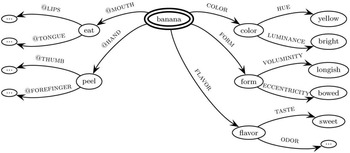
In psychology, philosophy, and linguistics, various theories have been proposed to account for the decomposition of concepts. For the present purpose the choice of frame theory as a starting point seems most fruitful (Barsalou Reference Barsalou, Lehrer and Kittay1992). Frames are recursive attribute-value structures. A frame is defined for a large domain of things and contains a fixed set of attributes (e.g., color, form) each of which allows for a number of different values (red, green, …; round, square, …). The attributes in question are not constrained to perceptual modalities but may as well involve attributes of motor affordances. Frames can be nested hierarchically, and mutual constraints between attributes (e.g., between states of an object and actions directed to it) and between larger frames can be incorporated (see fig. 1).
Hypothetical fragment of the frame for the concept [banana]. The substance concept to be decomposed is marked by a double circle as the referring node of the frame. The labeled arrows denote attributes, the nodes their values. Nodes are themselves regarded as concepts and thus as conceptual parts of the central concept. Whereas, in English, feature attributes (shown on the right) are frequently lexicalized—their arguments typically enter possessive constructions such as The color of the banana is yellow or The banana has the color yellow—affordance attributes (on the left) are rarely overtly expressed. On the basis of linguistic and neurobiological evidence, I assume that affordances often relate to body parts and hence use the convention “@ + body part.” Formally, attributes are mappings from domains of some type into domains of some other type. Petersen and Werning (Reference Piccinini and Scott2007) provide an explicit account of frames, using a calculus of typed feature hierarchies and incorporating typicality effects.

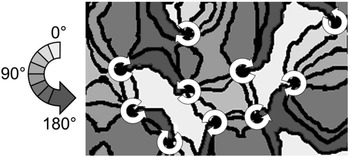
For many attributes involved in perceptual processing one can anatomically identify cortical correlates. Those areas often exhibit a twofold topological structure and justify the notion of a feature map: (i) a receptor topology (e.g., retinotopy in vision, somatotopy in touch), in which neighboring regions of neurons code for neighboring regions of the receptive field; and (ii) a feature topology, in which neighboring regions of neurons code for similar features (see fig. 2). With regard to the monkey, more than 30 cortical areas forming feature maps are experimentally known for vision alone (Felleman and van Essen Reference Felleman and van Essen1991). Also, affordance attributes seem to have cortical correlates, predominantly in the premotor cortex. The discovery of the so-called mirror neuron system (see Rizzolatti and Craighero [Reference Ruhlen2004] for a review) may provide a basis to integrate affordances into frames.
Cortical realization of the attribute orientation by a neural feature map. A fragment (about 4 square millimeters) of cat primary visual cortex is shown (adapted from Crair et al. [Reference Crair, Ruthazer, Gillespie and Stryker1997]). For each so-called hypercolumn, the arrows indicate the polar topology of the orientation values represented by the columns (monochromatic fields surrounded by black lines). The various hypercolumns are arranged in a retinotopic topology.

The fact that values of different attributes may be instantiated by the same object but are processed in distinct regions of cortex poses the problem of how this information is integrated in an object-specific way: the binding problem. A prominent and experimentally well-supported solution postulates oscillatory neural synchronization as a mechanism of binding: Clusters of neurons that are indicative for different properties sometimes show synchronous oscillatory activity, but only when the properties indicated are instantiated by the same object in the perceptual field; otherwise they are firing asynchronously. Synchronous oscillation, thus, might be regarded to fulfill the task of binding together various property representations to form the representation of an object as having these properties (Singer Reference Stephan1999). Using oscillatory networks as biologically motivated models, one could demonstrate how the topological organization of information in the cortex, by mechanisms of synchronization, may yield a logically structured semantics of concepts (Werning Reference Werning2005b). Oscillation functions play the role of object concepts. Clusters of feature-sensitive neurons play the role of attributive concepts. Schnitzler, Timmermann, and Gross (Reference Singer2006) could experimentally demonstrate the essential role of neural synchronization for action control. This may justify the extension of the synchrony-based neuro-frame approach from features to affordances. Provided that a concept is completely decomposable into a fully specified frame and provided that neural maps for each attribute can be identified in the cortex, a specific pattern of synchronizing neural activity distributed over neural clusters may amount to the cortical fingerprint of the concept.
Support for the theory of neuro-frames also comes from a number of neuro-linguistic studies. On the basis of a review of neurobiological data, Pulvermüller (Reference Pulvermüller1999) suggests that neural assemblies that pertain to the sensorimotor cortices and are bound by neural synchronization play an important role in understanding the meanings of words. Studies on functional magnetic resonance imaging regarding the understanding of verbs, for example, hint to a differential top-down activation of motor and premotors areas (Pulvermüller Reference Rappelsberger, Weiss, Schack and Miller2005). We know that the understanding of concrete nouns such as hammer, for which not only features but also affordances are salient, results in an activity distributed over the premotor and the visual cortex (Martin et al. Reference Millikan1996). The hypothesis that words for substance concepts arouse more widely distributed activity than words for attributive concepts is, furthermore, supported by electroencephalographic studies (Rappelsberger, Weiss, and Schack Reference Rizzolatti and Craighero2000).
From this and further evidence (reviewed by Martin [Reference Martin, Wiggs, Ungerleider and Haxby2007]) we may conclude that the correlates of substance concepts are highly distributed neural states. Substance concepts are thus not expected to be realized by locally circumscribed regions of the cortex but by cell assemblies that may pertain to highly distinct parts of the cortex and involve perception as well as motor areas. In contrast, the neural correlates of attributive concepts would be constrained to local cortical regions.
6. Is Complex Really First?
Another strategy to avoid the paradox is to limit the scope of the assumption P2 that the meanings of concrete nouns are substance concepts. One might advocate a meaning shift of a certain kind in nouns during development or evolution: Whereas for modern adults concrete nouns express substance concepts with a complex semantics, it might be that the child's usage of the noun mama only labels a salient person in his or her daily life or that, for an early human, the noun for water just expressed the affordance of being drinkable. It is indeed very likely that the concepts expressed by nouns change in development and evolution. The concept [birth-giving] is not a conceptual part of [mama] for the 2-year-old as it is for us. Early humans did not represent water as molecularly complex. However, is it plausible that nouns of young children and early humans do not at all express substance concepts with some decent, if only different, semantic complexity? How could the word mama in the child's language be a label for a particular person if the child were not able to recognize and treat that person as mama (in his or her sense)? If we do not want to fall back onto an iconic theory of representation, we have to postulate that the child mentally represents a bundle of salient features and affordances.
In the case of phylogeny, the challenge could also be phrased as follows: Was there a time when [water] was an attributive concept—for a simple affordance or feature? That a substance concept finally reduces to just one attributive concept is the tenet of essentialism. The problem is that for most everyday substances one can hardly find any cognitively plausible candidates for essences. Being H2O is essential for water, but is this how humans cognitively represent water? The alternative is to decompose a substance concept into a structure of feature and affordance concepts, none of which specifies an essential property, but only a typical one. Even though water prototypically is tasteless, there is salty water. Water can change its color, taste, aggregate state, and so forth, even though some values for each of those attributes are more typical than others. Water is also used in typical ways—for drinking, washing, and swimming—but it can also be burned by magnesium torches.
There are, of course, lots of nouns in English that express single attributive concepts: abstract nouns. The large majority of them are morphologically derived or, at least, syntactically marked (compare water to beverage, fluidity, etc.). This indicates that nouns expressing single attributive concepts are evolutionarily rather late. There is thus little evidence that [water] in the early stages of language evolution ever was a semantically simple attributive concept rather than a semantically complex substance concept as it is today. Proposition P2 holds also for the early stages of development and evolution.
A further option to attack the paradox seems to be the principle P5 that capabilities demanding more effort, ceteris paribus, develop and, respectively, evolve later than those demanding less effort. One might argue that the demand for effort is not the only, maybe not even the most, important factor that determines evolutionary priority. One may point out that there is stronger evolutionary pressure to lexicalize concepts as complex as substance concepts than to lexicalize attributive concepts. It arguably is rather economic to lexicalize concepts for often-recurring, highly specific entities of great survival value. Telling someone that there are bananas somewhere is not only shorter but also more exact than telling someone that there are sweet, longish, bowed, bright yellow things around that one may peel and eat. However, an appeal to greater selection pressure does not suffice to explain evolutionary priority: To explain why protobirds evolved the ability to fly, one has to appeal to some sort of evolutionary pressure to fly. If flying did not have a selective advantage for protobirds, the ability would not have evolved. Maybe protobirds had to reach or leave trees quickly to escape predators. However, if protobirds had not had feathers and very winglike forelimbs in the first place, the ability to fly would not have evolved either. Even if selection pressure was maximal and flying was the only way a certain reptile species could have survived, if the species did not have feathers and winglike forelimbs, it would have died out rather than evolve wings. In addition to evolutionary pressure, any explanation of capabilities must appeal to some step-by-step evolution of mechanisms: from the more primitive to the more complex.
Similar considerations apply to development. In the language acquisition literature it is often argued that learning concrete nouns is informationally more valuable for the child than having available adjectives because objects denoted by concrete nouns are more salient, less variable, practically more relevant, and so forth than the properties denoted by adjectives. There might indeed be more incentives for the child to learn concrete nouns. However, this does not overrule the fact that linguistic and cognitive abilities have to be acquired step by step. Simpler neural processes ought to develop earlier than more complex ones.
We still have no answer for the following questions: (i) How could a mechanism evolve that enables certain regions of cortex that are involved in representing a word (phonologically, syntactically, etc.) to address those regions of the sensorimotor cortices that represent the word's meaning? (ii) How does such a mechanism develop in the young child? Given that semantically complex words are evolutionary and developmentally prior, such an interface must have strong distributive capacities from the beginning.
A conclusion could be that proposition P4 is the culprit. Maybe distributive neural states are actually more easily addressable than local ones. There is some evidence in the connectionist literature that something like this might be true: As a result of learning and the strong correlation of features, coalitions are formed among feature representations such that it is often harder to excite single-feature representations than whole bundles. However, those observations do not directly translate into biologically more realistic models of feature binding. Plausible solutions to the Complex-First Paradox are still to be awaited.