Introduction
Nesidiocoris tenuis (Reuter) (Hemiptera: Miridae) is a cosmopolitan species whose status as a pest and/or as beneficial has been controversial for a long time. While considered a pest of tobacco by Indian researchers (Prasad et al., Reference Prasad, Halappa, Vajranabhaian and Prasad1979; Patel, Reference Patel1980), it was considered as beneficial to tobacco in the Philippines due to its high predation efficiency on Spodoptera litura (F.) and the lack of damage to the crop (Torreno, Reference Torreno1994; Torreno & Magallona, Reference Torreno and Magallona1994). In the Mediterranean region, it was first mentioned as a pest for tomatoes by El-Dessouki et al. (Reference El-Dessouki, El-Kifl and Helal1976) in Egypt, who described the damage produced on stems and shoots by the repeated feeding punctures of the stylet in these tissues. Although in Sicily it was initially described as a pest due to the brown rings produced on tomato shoots, as well as flower abortion, its role as an efficient predator was also considered and discussed (Vacante & Tropea-Garcia, Reference Vacante and Tropea-Garcia1994). In the south of France, it has always been considered as a pest of tomatoes (Trottin-Caudal & Millot, Reference Trottin-Caudal and Millot1997; Trottin-Caudal et al., Reference Trottin-Caudal, Fournier, Leyre and Chabrière2006); but, in the Canary Islands (Carnero et al., Reference Carnero, Díaz, Amador, Hernández and Hernández2000) and more recently in southeast Spain (Calvo et al., Reference Calvo, Bolckmans, Stansly and Urbaneja2008; Sanchez, Reference Sanchez2008), its predation efficiency on whiteflies has been considered its main virtue. Moreover, it is now commercially produced and released in tomatoes in the south of Spain to control Bemisia tabaci (Gennadius) (Hemiptera: Aleyrodidae) populations (Albajes et al., Reference Albajes, Castañé, Gabarra, Alomar, Bigler, Babendreier and Kuhlmann2006). Since it occurs spontaneously in most Mediterranean regions and its populations colonise tomato crops when they are not heavily treated with insecticides, it is a species to take into account when biological control programs are applied to tomatoes in these regions.
Damage described by this bug on tomato plants includes brown halos around the stem, shoots and the pedicels of leaves and flowers. These rings are caused by the repeated feeding punctures at the same point, which produce a wound response in the plant leading to an increase in the protein content of these areas (El-Dessouki et al., Reference El-Dessouki, El-Kifl and Helal1976; Raman & Sanjayan, Reference Raman and Sanjayan1984a; Raman et al., Reference Raman, Sanjayan and Suresh1984). Although whitish halos on tomato fruit had previously been described by Calvo & Urbaneja (Reference Calvo and Urbaneja2003), Sanchez & Lacasa (Reference Sanchez and Lacasa2008) found no evidence of damage to tomato fruits due to N. tenuis, as opposed to other mirid species, such as Dicyphus tamaninii Wagner and D. hesperus Knight (Hemiptera: Miridae), which do cause feeding injuries to fruits (Alomar & Albajes, Reference Alomar, Albajes, Alomar and Wiedenmann1996; Shipp & Wang, Reference Shipp and Wang2006).
In previous experiments, we have shown that the brown rings produced on tomato plants by the bug during a limited feeding period can be healed by the plant itself and disappear after a few days. In the same experiments, we have also shown that the number of rings produced is inversely correlated with the density of prey available for the predator, which is a key element in the management of crop damage (Arnó et al., Reference Arnó, Castañé, Riudavets, Roig and Gabarra2006). Calvo et al. (Reference Calvo, Bolckmans, Stansly and Urbaneja2008) and Sanchez (Reference Sanchez2008) also related plant damage to prey scarcity. However, information is not available about the long-term effects of this zoophytophagous predator on plant growth and the yield of tomato crops. Therefore, the aim of this study was to evaluate the risk of damage to tomatoes posed by this predator in extreme conditions of prey scarcity, as well as high predator populations. For this purpose, growth parameters of the tomato plants, such as plant height and fruit production, were measured after temporary or prolonged infestations by high densities of N. tenuis.
Materials and methods
Temporary infestation of tomato plants with N. tenuis
The aim of this experiment was to check whether the injury caused to tomato plants by a short infestation of N. tenuis nymphs or adults was irreversible or whether it disappeared after a few weeks. The study was conducted during September 2005 in an experimental glasshouse (30 m2) in which eight rows of eight tomato plants per row (var. Bodar F1, Seminis Vegetables Seeds) were grown in standard coconut fibre growing bags (120×40 cm). Plants had seven to ten leaves when the study started and were tied to strings. Fertigation was used to fertilize and irrigate the plants. The apical growing shoot and the youngest expanded leaf of the plant (smaller than 20 cm in length) were enclosed with a 45×18 cm muslin bag, and 20 adults or 20 late instar nymphs of N. tenuis were introduced inside the bag. All the N. tenuis individuals were derived from permanent colonies maintained on tobacco plants with eggs of Ephestia kuehniella (Zeller) (Lepidoptera: Pyralidae) as prey, at 25±1°C, 70±10% RH and 16:8 h (L:D) photoperiod. In the control treatment, plants were covered with the muslin bag but no predators were introduced. No arthropod prey was present inside the bags in any case. Each treatment was replicated ten times considering the plant as the experimental unit. Plants inside the greenhouse were randomly assigned to each treatment. After one week, the predators were removed with the aid of a manual aspirator, and the number of live individuals was counted. Five days after predator removal, the number of brown rings and scars on the stem, petioles of the leaves, leaflets and flower inflorescences were counted. Three weeks later, the length of the leaf in the bag, the length of the whole growing shoot, the total surface area of leaves included in the bag, the number of healthy and aborted flowers and the number of set fruits were measured.
Prolonged infestation of tomato plants with N. tenuis
The aim of this trial was to evaluate the type and severity of the damage caused by different densities of N. tenuis on tomato plants with an almost absence of prey during a summer season. An experimental plastic house (430 m2) was divided into twelve large exclusion cages (6.40×4.50 m) with a fine plastic net of 10×20 gauge mesh (anti-Bemisia), in order to avoid whitefly entrance and prevent predator escape. Each cage had six standard coconut fibre growing bags. There were two bags in each row, and two tomato plants (var. Boro, a long life cultivar, Semillas Fitó, Barcelona, Spain) per bag, with a total of 12 plants per cage that were transplanted on the 14 June 2006. Plants were tied to strings, pruned as needed and maintained on a fertigation system. On 30 August all plants were topped by removing the apical growing shoot. Temperature and RH were recorded using a digital data logger (Hobo, Onset Computer Corporation, Massachusetts) placed at 2.15 m above ground level in the middle of the greenhouse.
Three predator release rates (6, 12 and 24 predators per plant) and a control (no predators) were tested using a randomized complete block design with these four treatments replicated three times. Predators were released in the exclusion cages as late nymphal instar in two introductions (half of the rate at each date), approximately two (29 June) and three (3 July) weeks after transplanting. The N. tenuis individuals were collected from our permanent colonies, as described in the previous section. No arthropod prey were introduced except for 100, 200 and 400 E. kuehniella irradiated eggs per plant that were supplied in the cages containing 6, 12 and 24 predators per plant, respectively, twice during the season (21 July and 3 August) to allow predator survival and reproduction. The eggs were located in the upper part of the plant where most of the predators were present.
Establishment of the predator in the crop and within-plant distribution
For two months, mirid population density was measured weekly by inspecting the three upper leaves and the growing shoot of six randomly selected plants per cage, starting four weeks after transplant. From each plant, the number of live nymphs and adults of N. tenuis was recorded. Cumulative insect-days were calculated according to Ruppel (Reference Ruppel1983). On the 24th of August, during the morning, the distribution of predators along the plant was also evaluated in the six predators per plant treatment by counting the number of nymphs and adults present on each leaf and on the shoots of all the plants.
Injuries to the plant caused by N. tenuis and the effect on plant growth
To assess whether plant feeding by the predator resulted in a limitation of plant growth, on the same six plants where predator population was monitored, the number of brown rings around the stems, leaf and flower cluster petioles on the three youngest leaves and on the growing shoot were recorded two weeks after releasing the predators. The number of trusses and set fruits per plant were also recorded on a weekly basis. In addition, the total height of all plants was recorded on four sampling dates.
As the experiment developed, visual differences in plant growth among the treatments were apparent from the eighth truss onwards. Therefore, to characterize the part of the plant potentially affected by the action of the predator at the end of the crop (6 October), two heights (fourth truss and eighth truss, with the fourth being older than the eighth) were used as representative of the growing periods. The following parameters were measured on six plants per cage: the number of leaves below the fourth truss, the number of leaves above and below the eighth truss, the height of the plant above the eighth truss, the length of the rachis and the area of the leaf below the fourth and eighth truss, as well as the length of the upper and lower internodes of these leaves.
To compare light assimilation in the photosynthetic capacity of the leaves, two 20 mm diameter disks were cut from the terminal leaflet of the second leaf below the eighth truss. They were then desiccated in an oven at 60°C for 48 h and weighed again to calculate the rate of dry matter production per unit area. The remaining part of the leaflet was also weighed, introduced in water for 24 h for rehydratation, weighed again, desiccated in an oven at 60°C for 48 h and weighed in order to calculate the relative water content: (wet weight–dry weight)/(wet hydrated weight–dry weight).
Fruit damage caused by N. tenuis
To determine whether plant feeding by the predator resulted in loss of fruits and weight reduction, the trusses were harvested once a week from 24 August until 25 September. On the last sampling date, all remaining trusses were harvested. From each truss, the number and weight of developed fruits, injured fruits and missing fruits were recorded. Missing fruits included undeveloped fruits that never grew larger than 1 cm in diameter, and those with only the petiole remaining in the truss.
All the cages were sprayed on 8 August with an acaricide (bromopropylate, Neoron 50, Syngenta Crop Protection AG, Basel, Switzerland) to control Aculops lycopersici (Tryon) and on 22 September with a fungicide (kresoxim methil, Stroby, Basf SE, Rhein, Germany) to control powdery mildew. On 29 August imidacloprid (Confidor, Bayer Cropscience AG, Monheim and Rhein, Germany) was applied through the irrigation system to eliminate N. tenuis only in the cages of the control treatment.
Statistical analysis
In the first trial, the number of brown rings and scars, length of leaf number one, shoot length, total leaf area, number of healthy flowers, aborted flowers and set fruits were compared among treatments with a one-way ANOVA. In the second trial, all insect and plant parameters evaluated were compared among treatments with a two-way ANOVA. The parameters analyzed were: cumulative insect-days, number of brown rings on the stem or petioles, total plant height, number of leaves, length of internodes, length of the rachis, leaf area, plant height above truss eight, dry weight, relative water content, number of trusses per plant, number of sets, missing and collected fruits and yield weight. Significant differences between means were identified with Duncan's multiple range test (P<0.05). To homogenize variances, data were log transformed when needed.
Results
Temporary infestation of tomato plants with N. tenuis
The mean percentage of live insects found inside the muslin bags after one week was 44.7% and 57.7% for adults and nymphs, respectively. Therefore, almost half of the individuals died during the experiment.
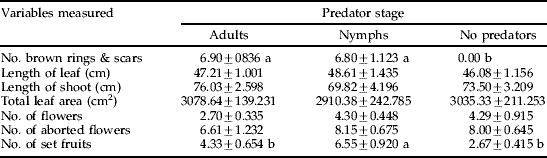
The number of brown rings and scars on the stem and on the petioles of leaves, leaflets and inflorescences five days after removing the predators was significantly higher in the bags containing predators than in the control (F=23.93, df=2, 27, P<0.0001), but there were no significant differences between the number of injuries caused by nymphs or adults (table 1). After three weeks, neither the length of the leaf included in the bag nor the length of the whole shoot or the total leaf area were affected by the presence of predators (F=1.07, df=2, 26, P=0.357; F=0.84, df=2, 26, P=0.443 and F=0.19, df=2, 26, P=0.826, respectively). In addition, the number of flowers present or aborted was also not significantly affected by the treatments (F=1.72, df=2, 27, P=0.197; F=0.91, df=2, 27, P=0.415, respectively). However, more set fruits were found on the plants that had nymphs than on the plants that had adults or on the control plants (F=7.87, df=2, 27, P=0.002).
Mean values of variables measured (±SE). Number of brown rings and scars on the stem, petioles of leaves, leaflets and flower inflorescences were evaluated five days after removing predators. The leaf length, shoot length and total leaf area, as well as the number of healthy flowers, aborted flowers and set fruits were measured three weeks after eliminating the predators.
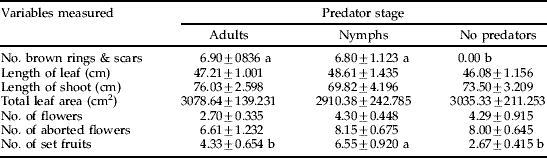
Means in a row followed by the same or no letter are not significantly different (P=0.05).
Therefore, although visible injuries were recorded on the stem and petioles, no effect was recorded on plant growth after three weeks due to the action of predator nymphs or adults confined on the shoot for one week.
Prolonged infestation of tomato plants with N. tenuis
Establishment of the predator in the crop and within-plant distribution
Nesidiocoris tenuis successfully established and reproduced on tomato when released as late instar nymphs. Adults of N. tenuis were already found on the 12th of July, 13 days after first predator release (FPR). On the 26th of July, 28 days after FPR, there were an average of 8.05, 11.94 and 12.00 individuals per plant in the 6, 12 and 24 treatments, respectively. These populations were growing and on the 14th of August, these populations increased to an average of 12.28, 23.17 and 18.89 individuals per plant in each treatment, respectively. No predators were found in the control treatment, except for some individuals in the last week of the trial.
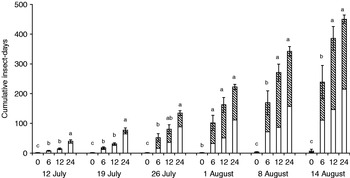
When considering the population dynamics of the predator in terms of cumulative insect-days (fig. 1), there were statistical differences between treatments for all sampling dates (12 July: F=50.89, df=3, 11, P<0.0001; 19 July: F=53.88, df=3, 11, P<0.0001; 26 July: F=65.63, df=3, 11, P<0.0001; 1 August: F=56.29, df=3, 11, P<0.0001; 8 August: F=38.53, df=3, 11, P=0.0003; 14 August: F=34.76, df=3, 11, P=0.0003). However, differences between treatments were not consistent on all sampling dates. For example, significant differences were found between treatment levels 12 and 24 nymphs per plant only on the first two sampling dates. Predator density at the lower release rate, six nymphs per plant, was significantly lower than that at the intermediate density, 12 nymphs per plant, only on the last two sampling dates. The number of cumulative nymph days on the 14th of August, 46 days after FPR, was not substantially higher than that of accumulated adults (fig. 1). At the six predators per plant density, the ratio of nymphs to adults was 1.16, whereas at a density of 12 it was 1.65 and at a density of 24 it was 1.09. There was an appreciable increase of the predator population only at a density of 12, while at the other densities the number of nymphs was almost the same as that of adults.
Cumulative number of insect-days (mean±SE) for N. tenuis nymphs (striped bars) and adults (white bars) on the terminal shoot and the first three developed leaves for the six sampling dates. Numbers released were 0, 6, 12 and 24 nymphs per plant on the 29th of June and 3rd of July. Within a sampling date, bars with the same letter are not significantly different (P=0.05).

Mean greenhouse temperature until plants were topped ranged between 30 and 40°C, with maximum temperatures between 45 and 50°C. The thermal constant for N. tenuis eggs and nymphs is 330.9°d (Sanchez et al., Reference Sanchez, Lacasa, Arnó, Castañé and Alomar2009) and, by 24 August, three generations of the predator could have occurred.
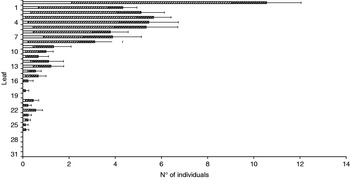
The within-plant distribution of nymphs and adults was not homogeneous but tended to aggregate in the youngest region of the plant (fig. 2). The upper third of the plant contained 88.5% of the predator population and was composed primarily of nymphs. On the 24th of August, 56 days after FPR (fig. 2), the ratio of nymphs to adults increased substantially, with a value of 6.52, compared to that of 14 August (fig. 1). The weekly sampling unit used to monitor the mirid population (growing shoot and three upper leaves) comprised 45.5% of the predators on the plant.
Within-plant distribution. Number of N. tenuis (mean±SE) nymphs (striped bars) and adults (white bars) on 24 August. Leaf 1 is the youngest one and the bar above it corresponds to the growing shoot.

Injuries to the plant caused by N. tenuis and effect on plant growth
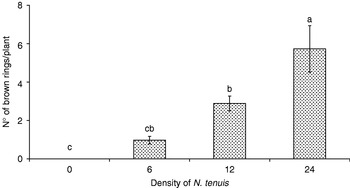
The three densities of the predator tested caused a variable number of injuries. Thirteen days after FPR, injuries of the vascular tissues were observed in the stem of the plant, as well as in the petioles of the leaves and leaflets, and also on the petioles of the flower clusters. The number of brown rings was significantly higher for a density of 24 N. tenuis nymphs per plant than the other densities considered (F=16.19, df=3, 11, P=0.0018), and no brown rings were observed in the control treatment with no predators (fig. 3).
Number of brown rings (mean±SE) present on the stems, petioles of leaves and the flower cluster of the three upper leaves and the growing shoot of the plants for the three (6, 12 and 24) densities of N. tenuis considered, as well as for the control treatment. Scouting was performed on the 12th of July, 13 days after FPR. Bars with the same letter are not significantly different (P=0.05).

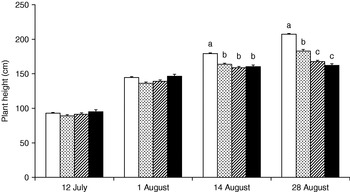
The action of the predator decreased the vegetative growth of the plant with a reduction of its height and the number of leaves. An increase of dry matter per unit of leaf area was also observed. The total height of the plants was significantly lower in the treatments with the predator than in the control treatment on the last two sampling dates (12 July: F=2.36, df=3, 11, P=0.1702; 1 August: F=2.01, df=3, 11, P=0.2139; 14 August: F=8.95, df=3, 11, P=0.0124; 28 August: F=18.79, df=3, 11, P=0.0019) (fig. 4). Therefore, the effect on the height was detected 46 days after FPR. On the last sampling date, the plants that had the lower predator density were significantly taller than those with the two higher densities.
Total plant height (mean±SE) according to the three (6, 12 and 24) densities of N. tenuis considered and the control treatment on four sampling dates. Within a sampling date, bars with the same letter or no letter are not significantly different (P=0.05) (□, 0;  , 6;
 , 12; ▪, 24).

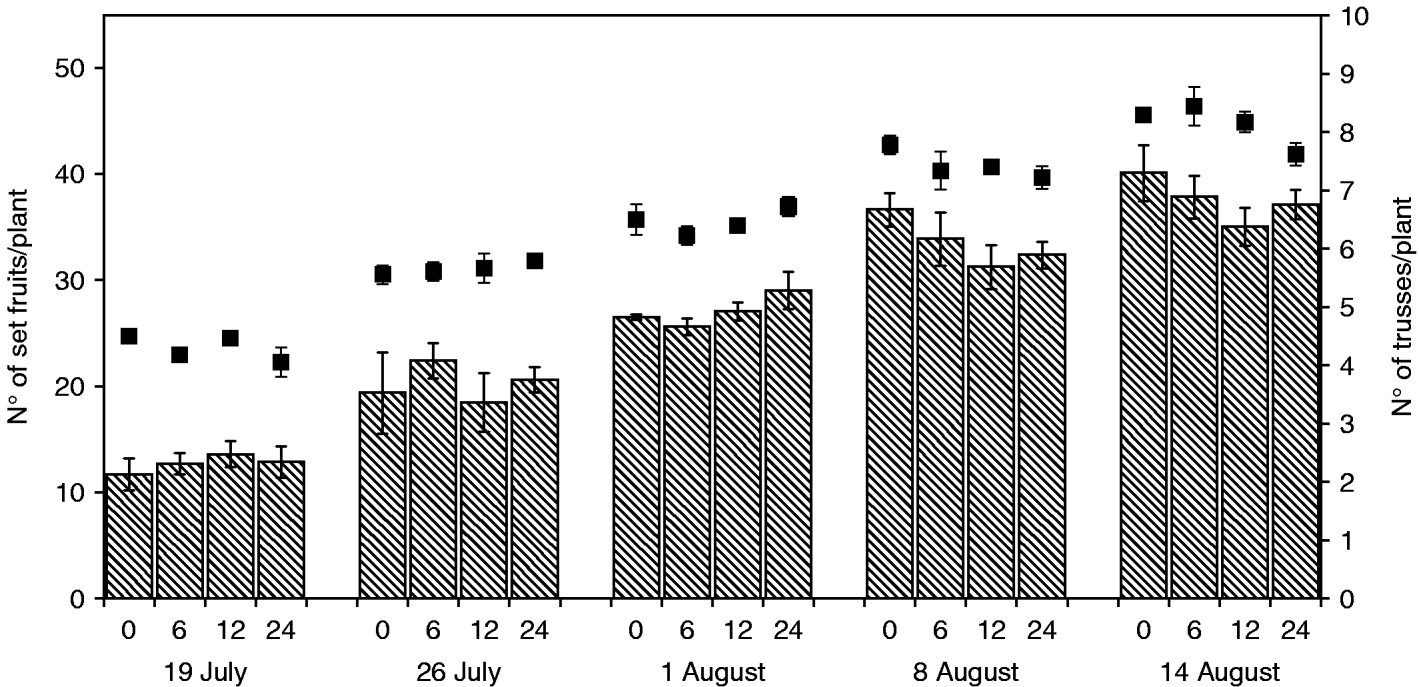
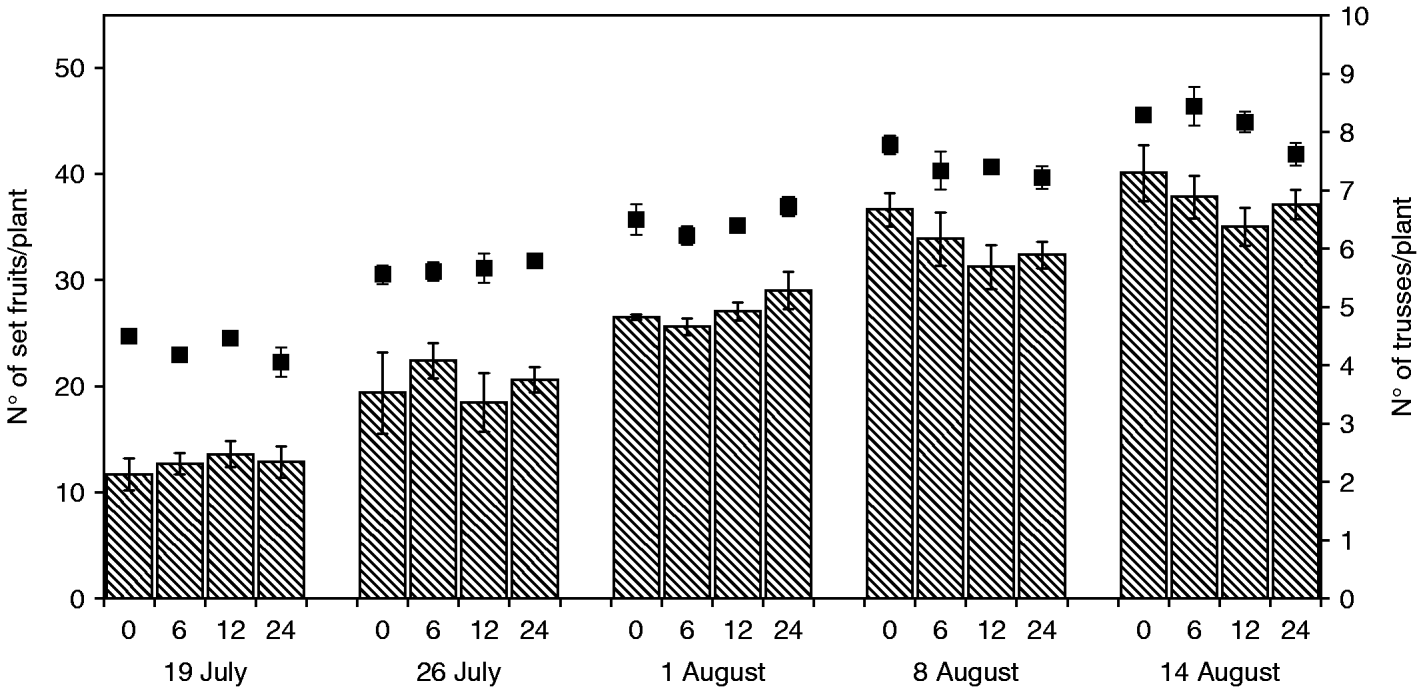
Until 14 August, the number of trusses per plant at each sampling date (including those with flowers) was not significantly different (fig. 5). The number of set fruits at each sampling date was also not significantly different for the treatments with different densities of the predator in comparison with the control treatment.
Number of trusses (squares) and set fruits (bars) per plant (mean±SE) at each sampling date for the three densities of the predator considered and for the control treatment.
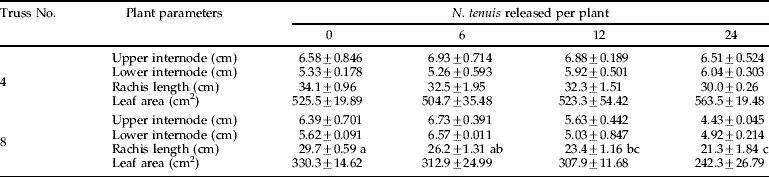
At the end of the crop (6 October, 99 days after FPR and 37 days after plants were topped), different plant growth parameters were evaluated in order to characterize which part of the plant was more affected by predator action (tables 2 and 3). The length of the leaf internodes just below truss four, rachis length and its leaf area were similar in all treatments (upper internode: F=0.39, df=3, 11, P=0.7653; lower internode: F=3.60; df=3, 11, P=0.0851; length of rachis: F=1.49, df=3, 11, P=0.3102; leaf area: F=0.54, df=3, 11, P=0.6716). Also, the size of the internodes of the leaf just below truss eight were similar in all treatments (F=4.59, df=3, 11, P=0.0537 and F=3.49, df=3, 11, P=0.0901 for upper and lower internodes, respectively). However, the leaf was significantly shorter at the 24 predator density than the six predator density and in the controls (F=10.39, df=3, 11, P=0.0086), although its surface area was similar for all treatments (F=3.49, df=3, 11, P=0.0898).
Values (mean±SE) of the length of upper and lower internodes, rachis length and area of the leaves below truss four and truss eight, for the three N. tenuis densities (6, 12 and 24) considered, as well as the control treatment.
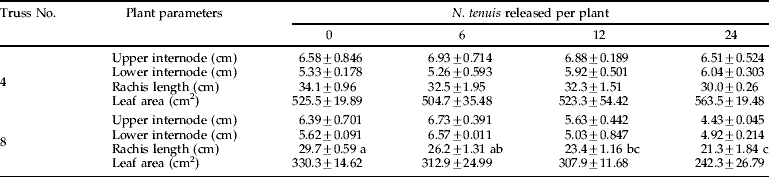
Data recorded on 6 October 2006. Means in a row followed by the same or no letter are not significantly different (P=0.05).
Values (mean±SE) of the number of leaves per plant below truss four, number of leaves below and above truss eight, and length of the shoot above truss eight for the three N. tenuis densities (6, 12 and 24) considered, as well as the control treatment.

Data recorded on 6 October 2006. Means in a row followed by the same or no letter are not significantly different (P=0.05).
The number of leaves was affected by the densities of N. tenuis supported by the plants, and this effect was located in the upper part of the plant. As can be seen in table 3, 37 days after plants were topped, the number of leaves below truss four was similar in all treatments (F=1.36, df=3, 11, P=0.3407), while below truss eight it was influenced by the predator densities (F=6.03, df=3, 11, P=0.0305), with a lower number of leaves for density 24 than density six and the control. Above truss eight, there were marked differences among treatments in the number of leaves per plant (F=8.20, df=3, 11, P=0.0152) and also in the height of the plant above truss eight (F=37.09, df=3, 11, P=0.0003).
There were significant differences between treatments in the rate of dry matter production per unit of leaf area (F=11.34, df=3, 11, P=0.0069) with a higher rate for the 24 nymphs per plant treatment than the six nymphs per plant and the control treatment (table 4). However, no significant differences were observed between treatments for the relative water content or relative turgidity (F=1.47, df=3, 11, P=0.3132), indicating that high predator densities did not cause water stress to the plants, and the significant differences in dry weight may be related to other plant physiological mechanisms.
Mean (±SE) dry weight per unit area and relative water content of leaves on the second leaf below truss eight at the end of the crop (6 October 2006).

Means in a row followed by the same or no letter are not significantly different (P=0.05).
Fruit damage caused by N. tenuis
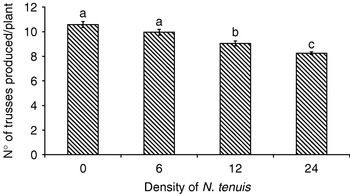
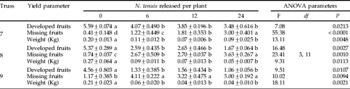
The total number of trusses per plant harvested at the end of the crop was significantly higher for the control and the six N. tenuis nymphs per plant than the 12 and 24 nymphs per plant treatments, and these latter treatments were also different between themselves (F=21.19, df=3, 11, P=0.0014) (fig. 6). Significant differences in the number of developed and missing fruits and truss weight among predator treatments and the control treatment were present only in the last trusses examined, that is trusses seven, eight and nine (table 5). The percentage of missing fruits for the seventh truss increased from 7% in the control treatment to 47% in the 24 N. tenuis treatment, and this difference increased in the next trusses, since the ninth truss had 21% missing fruits in the control treatment and 74% in the 24 N. tenuis treatment. The size of tomato fruits was also affected by the treatments, since the seventh truss had a mean fruit weight of 36 g for the control and 26 g for the 24 predator treatment, whereas the ninth truss gave 46 g for the control and 28 g for the 24 predator treatment. Therefore, the different predator densities tested had an important effect on the fruit production of each plant, both on the number and weight of harvested fruits. Surprisingly, there were no significant differences for these parameters between the three predator densities tested. The 24 N. tenuis treatment (seventh and eighth trusses) had 40% of mature fruits with small punctures and a green halo on the skin. We considered that these injuries were not important and these fruits were included in the harvested fruits column.
Mean number (±SE) of collected trusses per plant for the three densities of predator considered. Bars with the same letter are not significantly different (P=0.05).

Mean (±SE) number of developed fruits and missing fruits (undeveloped and fallen fruits), and the weight of the yield per plant per truss, according to each density of N. tenuis (6, 12 and 24) released.

Means in a row followed by the same letter are not significantly different (P=0.05).
Discussion
The damage risk that a high population of N. tenuis poses to tomato crops when arthropod prey are scarce was related to the duration of the interaction between the predator and the plant. Only after six weeks, the damage caused by the continuous feeding of the predator on the growing shoots and stems was shown by a significant stunting of the plants and a reduction in the yield, both in the number and size of fruits. Before this time period, the injuries produced by the feeding punctures of the predator did not cause any reduction of vegetative growth or fruit production of the plant.
In the temporary infestation, despite the considerable level of injuries observed five days after removing the N. tenuis, no effect was detected on plant length, number of flowers produced or the number of set fruits three weeks after removing the predators. In this experiment, 20 individuals per plant were released (with a survival of approximately 50% at the end of the trial). This density was higher than the densities found in commercial fields sampled by Arnó et al. (Reference Arnó, Castañé, Riudavets, Roig and Gabarra2006) in which densities of adults and nymphs together ranged between 0.13 and 5.23 per plant. This indicates that the tomato plant had a good capability for healing the wounds produced by the bug, and the injuries eventually disappear, as already shown by Arnó et al. (Reference Arnó, Castañé, Riudavets, Roig and Gabarra2006). Similar results were obtained by Grafius & Morrow (Reference Grafius and Morrow1982) with Lygus lineolaris (Palisot de Beauvois) and Adelphocoris lineolatus (Goeze) (Hemiptera: Miridae) on asparagus. After 7–8 days of infestation with these mirids, the plants compensated for the injuries produced and no damage was detected.
In the prolonged infestation experiment, the predators were able to establish well on the crop despite the scarcity of available prey. Tomato is a preferred host plant for N. tenuis (El-Dessouki et al., Reference El-Dessouki, El-Kifl and Helal1976; Raman & Sanjayan, Reference Raman and Sanjayan1984b); and, in the absence of prey, it can sustain the immature development of the predator better than in other plants, such as eggplant and sweet pepper (Urbaneja et al., Reference Urbaneja, Tapia and Stansly2005). Three weeks after FRP, the first generation occurred and densities per plant were similar or higher than those found in the first experiment. The third generation of predators occurred seven weeks after FRP, due to the high temperatures registered in the greenhouse compartments, and the densities ranged between 12 and 23 individuals per plant (corresponding to three and five per leaf), according to the treatment. Therefore, the predator densities suffered by the crop in our experiment were similar to, or slightly higher than, those evaluated by other authors, such as Calvo et al. (Reference Calvo, Bolckmans, Stansly and Urbaneja2008) and Sanchez (Reference Sanchez2008), and higher than those found in commercial crops by Arnó et al. (Reference Arnó, Castañé, Riudavets, Roig and Gabarra2006). From one month after FPR onwards, no differences in cumulative insect-days were detected between 12 and 24 N. tenuis per plant treatments. This was probably due to the shortage of prey to feed on, despite the fact that E. kuehniella eggs were supplied twice during the crop period. The low availability of prey may also explain the low reproduction rate because we did not find a high proportion of nymphs in the population up to two months after FPR (fig. 1).
The number of brown rings produced by N. tenuis was related to its density (fig. 3), as has been previously reported. In greenhouse experiments, Calvo et al. (Reference Calvo, Bolckmans, Stansly and Urbaneja2008) tested different N. tenuis densities per plant and showed also a proportional relationship between the number of brown rings and predator density. Similar results were obtained by Sanchez (Reference Sanchez2008) by assessing natural populations of N. tenuis in commercial tomato greenhouses.
Damage caused to the crop by the predator was important and affected both the growth of the plant and the yield, but it was only observable six to seven weeks after FPR. The tomato crop supported the effect of predators well during the first six weeks of interaction, independently of the density introduced. After that time, the effect was dramatic both in terms of the vegetative growth of the plant and on the fruits.
The total height of plants with predators was significantly lower than those of the control treatment at the third and fourth sampling dates (fig. 4), six and eight weeks after FPR, respectively, for the three predator densities tested. The reduction of height was not uniform along the plant but was located around and above truss eight, and it was expressed mainly by a lower number of leaves and a shorter height of the shoot above this truss (tables 2 and 3), in comparison to the control treatment. This reduction was related to the density of predators released. Truss eight was growing on 8 August (fig. 5), and at that time the lower density predator treatment had a mean of 175 cumulative insect-days (fig. 1). The remarkable effect of the predator on the number of trusses (fig. 6), the number of developed fruits and their weight was not observable until truss seven (table 5). The number of set fruits per plant when trusses seven, eight and nine were in formation (1, 8 and 14 August) was not significantly different between treatments (fig. 5), indicating that there was no flower abortion due to the action of the predator or, if it did occur, the plant produced more flowers in order to compensate for flower loss. We have observed that not all set fruits grew to full size tomatoes in the predator treatments, some remained as undeveloped fruits (<1 cm dia.) until harvest and were added to aborted flowers and considered ‘missing fruits’ (table 5). At fruiting, the truss is mainly supplied by the two subtended leaves, as well as the leaf above (Atherton & Rudich, Reference Atherton and Rudich1986), and the size of these leaves for trusses seven, eight and nine was particularly affected by the predator.
Sanchez & Lacasa (Reference Sanchez and Lacasa2008) find no yield reduction after three weeks of interaction between N. tenuis and the crop, and their results agree with those of the present work since we did not notice yield loss during the first weeks of crop-predator interaction. Although they observe a decrease in the number of developed fruits, which is overcompensated by an increase in the individual fruit weight, this did not occur in our experiment. We did not find any significant differences in truss weight or number of developed fruits among the N. tenuis treatments tested in trusses 1–6. However, in subsequent trusses, our results showed a dramatic loss of yield. The same authors propose a mathematical model that predicts no yield loss when fruit abortion values are lower than 28%. But the results of the present work did not match the predictions of their model; in the prolonged infestation trial, we had recorded values of missing fruits of 23% (in table 5, for truss seven and for the treatment six N. tenuis released per plant: (missing fruits/missing+developed fruits)×100) that corresponded with a truss weight reduction of 45%. There were differences among both trials. We had almost no prey and a long time of interaction between the predator and the crop; whereas, in the Sanchez & Lacasa (Reference Sanchez and Lacasa2008) trial, they have whiteflies on the crop and a short predator-crop interaction time. Still, the model they propose does not take into account the density of prey when predicting yield loss, and the availability of prey is a key factor in the phytophagy of this bug (Arnó et al., Reference Arnó, Castañé, Riudavets, Roig and Gabarra2006; Calvo et al., Reference Calvo, Bolckmans, Stansly and Urbaneja2008; Sanchez, Reference Sanchez2008).
Predator distribution was aggregated in the top part of the plant (fig. 2), and this is the area were most of the damage occurred. This preference has already been reported by El-Dessouki et al. (Reference El-Dessouki, El-Kifl and Helal1976) who found that this region has a protein content of 18% in contrast with the lower part of the plant that only has a 10% content. The growing regions of the plant receive nutrients from other parts of the plant in order to be able to develop until they are capable of synthesising their own assimilates (Atherton & Rudich, Reference Atherton and Rudich1986). Other predatory mirids that are present in tomato crops, such as D. tamaninii and Macrolophus caliginosus Wagner (Hemiptera: Miridae), have a more even distribution along the tomato plant with maximum densities located in the middle part of the plant (Alomar, Reference Alomar1994). In the case of D. hesperus, their distribution along the tomato plant is biased to the lower part of the plant, where 46% of the population is located (Shipp & Wang, Reference Shipp and Wang2006). All these other mirid species produce a different type of damage causing mainly spots and scars on the tomato fruit, and no damage to the vegetative part of the plant has been reported.
It seems that feeding on the plant by this mirid bug acts as a sink for plant assimilates and competes with the vegetative growing and fruiting processes of the plant, as occurs with many pests. In greenhouse cucumbers, Shipp et al. (Reference Shipp, Wang and Binns2000) and Hao et al. (Reference Hao, Shipp, Wang, Papadopulos and Binns2002) reported that the impact of western flower thrips on marketable yield was cumulative and could only be detected after plants had been exposed to a considerable accumulated thrips pressure. Similar results were shown by Welter et al. (Reference Welter, Rosenheim, Johnson, Mau and Gusukuma-Minuto1990), for outdoor cucumbers attacked by western flower thrips and Thrips palmi Karny (Thysanoptera: Thripidae), and by Shipp et al. (Reference Shipp, Binns, Hao and Wang1998a,Reference Shipp, Hao, Papadopulos and Binnsb), for greenhouse sweet peppers also attacked by western flower thrips. Xu & Zhang (Reference Xu and Zhang1991), examining the relationship between Trialeurodes vaporariorum (Westwood) abundance and cucumber production, determined that obvious differences in photosynthetic rate could be seen between the infested and the control treatment only after 21 days of pest infestation, and the largest differences were detected after 48 days of interaction.
In summary, N. tenuis is a predator that has a high capacity for controlling insect pests, and it is currently used to control B. tabaci. However, when there is a shortage of prey, it increases its feeding on the plants; and, as we had shown in this trial, if this occurs for a prolonged time period, plant growth as well as the quantity and quality of yield were reduced. As it is native and very abundant in the Mediterranean region, this predator usually colonizes tomato crops which are not heavily sprayed with insecticides. Additionally, in some areas, augmentative inoculations are carried out for B. tabaci control. Consequently, in order to take advantage of their high predation capacity, it is necessary to monitor their populations continuously to avoid the risk of economic damage to the tomato crop. It is noteworthy that complete absence of prey is unlikely to occur under real crop conditions, especially for a polyphagous predator that can feed on several arthropods, and their presence can reduce the risk of damage produced by N. tenuis to the crop.
The netting of greenhouse vents has become a common practice in areas with heavy attacks of B. tabaci, as in the southeast of Spain. This netting not only protects the crop from immigration of insects, but it also impedes the exit of internal insect populations. In the case of mirid bugs, such as D. tamaninii and M. caliginosus, it has been shown that they constantly migrate from tomato greenhouses to outdoor crops and vice versa (Gabarra et al., Reference Gabarra, Alomar, Castañé, Goula and Albajes2004). In the case of N. tenuis, the netting could be especially important because predators are not able to migrate outside the crop when the prey becomes scarce, and the resultant damage to the crop could be important.
Acknowledgements
We would like to acknowledge Job Roig, Pilar Hernández, Francisca Oliver and Víctor Muñoz for their dedication and patience in performing an important part of the field work for this study. We are most grateful to Ramon Albajes and Oscar Alomar for reviewing an early version of this manuscript, and to two anonymous reviewers for their valuable suggestions. This work was funded by the Spanish Ministry of Education and Science (projects AGL2004-07690/AGR and AGL2007-60371/AGR).