Introduction
The Neolithic of Island Southeast Asia was a transitional period between the c. 4000 BP (and earlier) forager societies associated with flaked-stone tools, and the c. 2000–1000 BP societies of the ‘Early Metal Age’, whose economies generally included food production. Neolithic assemblages are defined by the presence of pottery and absence of metal, independent of signs of food production, which evidently was a minor component of any Neolithic economy in Island Southeast Asia. Accordingly, pre-pottery archaeological deposits can be associated with pre-Neolithic foragers—even at places where the initial appearance of pottery might not have preceded 2500–2000 cal BP, as at Walandawe on Sulawesi (O'Connor Reference O'Connor2015; O'Connor et al. Reference O'Connor, Bulbeck, Piper, Aziz, Marwick, Campos, Fenner, Aplin, Fakhri, Suryatman, Maloney, Hakim, Wood, O'Connor, Bulbeck and Meyer2018; Bulbeck Reference Bulbeck and Smith2019).
This article describes baked-clay assemblages from two Walandawe sites. To our knowledge, these constitute the largest-documented assemblages of such material from pre-pottery contexts in the world. We also document the application of patterning to nearly half of the baked clay (by weight). This use of patterning is unparalleled in other assemblages of pre-pottery baked clay, including both older assemblages in Eurasia and broadly contemporaneous assemblages in Island Southeast Asia. Its documentation is a major addition to our knowledge of the technical skills of Island Southeast Asian forager societies working with stone (microliths and denticulate stone points in South Sulawesi—Bulbeck Reference Bulbeck, Keates and Pasveer2004), bone (points made from mammalian bone and anterior teeth—Aplin et al. Reference Aplin, O'Connor, Bulbeck, Piper, Marwick, Pierre, Aziz and Langley2016) and shell (adzes and fishhooks in the eastern islands—O'Connor Reference O'Connor2015). Its documentation is also a major addition to our knowledge of the interest in aesthetics shown by localised Island Southeast Asian forager societies in the creation of shell ornaments (O'Connor Reference O'Connor2015) and ochre-based rock art (Oktaviana et al. Reference Oktaviana, Bulbeck, O'Connor, Hakim, Suryatman, Wibowo, St Pierre and Fakhri.2016).
‘Baked clay’ refers to clay set hard through heat, including structures such as clay hearths and simple kilns (and their remnants), whose purpose was the firing of other materials (Vandiver et al. Reference Vandiver, Soffer, Kliva and Svoboda1989). This contrasts with ‘ceramic’ products, which are fashioned and then dried before being heated to a deliberately high temperature to make them durable (Hommel Reference Hommel, Cummings, Jordan and Zvelebil2013). Our 2012–2013 excavations at Walandawe recovered 3.8kg of baked-clay fragments from the Early to Late Holocene levels of the Gua Talimbue Cave, and 293g from the Mid-Holocene levels of the Gua Sambagowala rockshelter.
The deep antiquity of fireplaces (including those with baked clay) is best documented in Western Eurasia. Middle Palaeolithic examples include slabs of hardened clay placed around a fireplace at the Grotte du Prince in Italy and the superimposed ash layers from a repeatedly used fireplace at Qesem Cave in Israel, dated to approximately 300 000 years ago (Hommel Reference Hommel, Cummings, Jordan and Zvelebil2013; Shahack-Gross et al. Reference Shahack-Gross, Berna, Karkanas, Lemorini, Gopher and Barkai2014). The earliest-documented examples of intact clay hearths are the basin-shaped structures from the Aurignacian layers at Klisoura Cave 1 in Greece, which date to around 35 000 years ago (Karkanas et al. Reference Karkanas, Koumouzelis, Kozlowski, Sitlivy, Swobczyk, Berna and Weiner2004). These precede the construction of domed and horseshoe-shaped clay kilns for the firing of ceramics at Dolni Vsĕstonice in the Czech Republic, which date to around 26 000 years ago (Vandiver et al. Reference Vandiver, Soffer, Kliva and Svoboda1989).
The diverse ceramic objects reported from European Upper Palaeolithic sites from 26 000 years ago onwards include, in Moravia, figurines, personal ornaments, pellets and ‘structural ceramics’; over 400 fragments of clay fired at low temperatures from Gravettian sites on the Russian plains; and figurines and possible figurine fragments from Pavlovian Culture sites in Central Europe (Budja Reference Budja, Jordan and Zvelebil2010). A small ceramic vessel dated to approximately 18 000 years ago from Shulgan-Tash in the Southern Urals prefigures the Mesolithic (sedentary forager) pottery assemblages documented at numerous sites, from the Far East to Europe and North Africa (Hommel Reference Hommel, Cummings, Jordan and Zvelebil2013; Lucquin et al. Reference Lucquin, Robson, Eley, Shoda, Veltcheva, Gibbs, Heron, Isakkson, Nishida, Taniguchi, Nakajima, Kobayashi, Jordan, Kaner and Craig2018). A proposed method of forming early pots in eastern Siberia—the smearing of clay onto the walls of a net-lined pit (McKenzie Reference McKenzie, Jordan and Zvelebil2010: 171)—may reflect the transition to early pottery from baked-clay products, the latter of which form the focus of the present article.
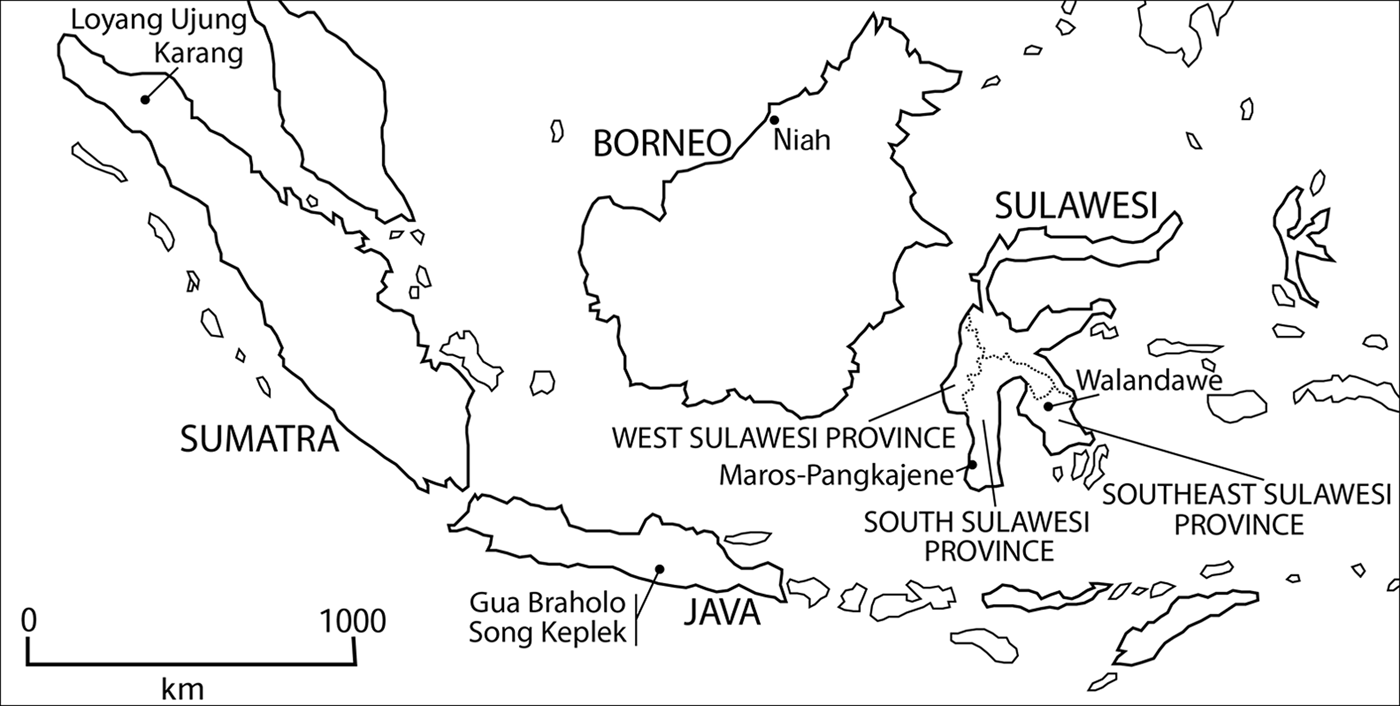
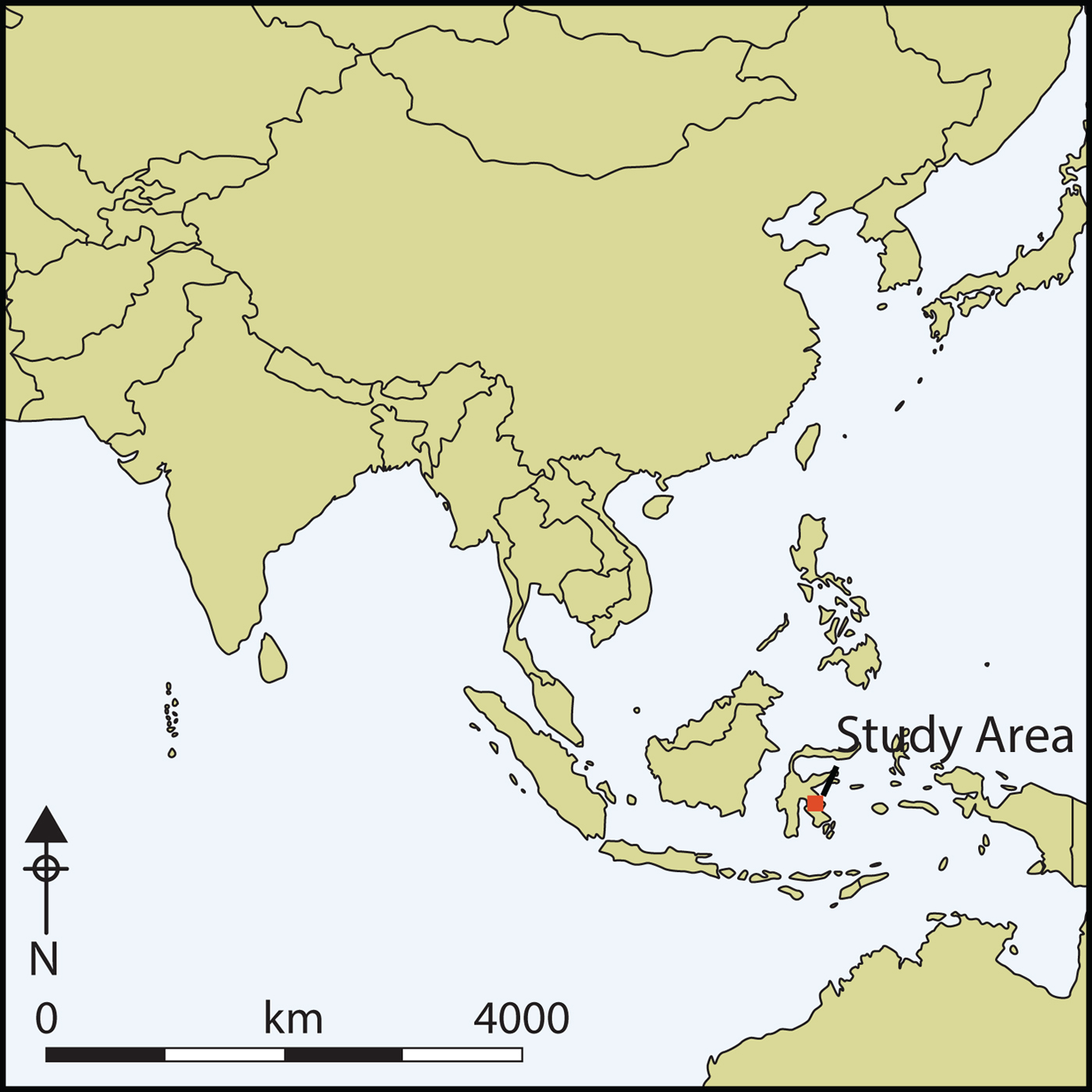
Reports of baked clay from cave deposits in Island Southeast Asia are few and far between. Simanjuntak (Reference Simanjuntak and Simanjuntak2002: 127) notes burnt soil marking the traces of pre-Neolithic fireplaces at Gua Braholo and Song Keplek in Java. Rabett et al. (Reference Rabett, Barker, Barton, Hunt, Lloyd-Smith, Paz, Piper, Premathilake, Rushworth, Stephens, Szabó and Barker2013: 226) mention an Early Holocene ritual deposition of a fragment of baked clay associated with two cylindrical stones and a limestone ornament at the West Mouth of the Great Cave of the Niah Caves in Borneo. Setiawan (Reference Setiawan2014) describes 39 lumps of clay with leaf and rattan impressions associated with fragmentary human bones—directly dated by the Bandung Geology Laboratory to 4400±120 BP (uncalibrated, laboratory code unpublished)—at the Loyang Ujung Karang cave in Sumatra; here, the author interprets the impressions as remnants of a leaf-and-rattan wrapping for the fragmentary burial. The only potentially relevant account from Sulawesi, the large orchid-shaped island at the centre of the Indonesian archipelago (Figure 1), is a vague reference to Holocene hearth features (Glover Reference Glover1976: 120). This dearth of evidence persists despite numerous excavations in the Maros-Pangkajene karsts, which have provided sequences dating back to more than 30 000 cal BP, and Holocene cave deposits elsewhere in South (south-west) Sulawesi dated by lithic typologies (Bulbeck Reference Bulbeck, Keates and Pasveer2004, Reference Bulbeck, Bacus, Glover and Piggot2006; Hakim et al. Reference Hakim, Nur and Rustam2009; Hakim & Suryatman Reference Hakim and Suryatman2013; O'Connor & Bulbeck Reference O'Connor, Bulbeck, Cummings, Jordan and Zvelebil2013; Hasanuddin Reference Hasanuddin.2017, Reference Hasanuddin., O’ Connor, Bulbeck and Meyer2018; Suryatman et al. Reference Suryatman and Harriss2017; Brumm et al. Reference Brumm2018; Suryatman et al. Reference Suryatman, Mahmud, Fakhri, Burhan, Oktaviana, Saiful and Syahdar.2019). Our recovery of nearly 4kg of baked-clay fragments from Gua Talimbue and Gua Sambagowala in Southeast Sulawesi was therefore unexpected in the context of Sulawesi and wider Island Southeast Asian prehistory.
Locations in Island Southeast Asia mentioned in the text (figure by D. Bulbeck).

The Walandawe study area, Southeast Sulawesi
Gua Talimbue and Gua Sambagowala are located in the Walandawe area of Southeast Sulawesi, close to the Wiwirano River, which drains rolling terrain interspersed with rugged outcrops of ultramafic ophiolites (oceanic crust that has been uplifted above sea level) and limestone karsts. Both sites produced flaked stone, bone, shell and other finds, including pot sherds in their upper spits (Suryatman et al. Reference Suryatman, Bulbeck, Marwick, Oktaviana and Wibowo2016; Fakhri Reference Fakhri, O'Connor, Bulbeck and Meyer2018).
Gua Talimbue is a south-west-facing cliff-foot cave that was probably formed through ground-water processes in both the vadose (ground surface to the water table) and phreatic (saturation zone beneath the water table) zones. It includes winding chambers that extend into the limestone hill and that are accessible via at least three entrances. The main entrance is around 8m high (at the drip line), 23m wide and 13m deep. The slope of the floor is approximately 2–5°. The cave-floor deposit is 4m thick, the upper 3m predominantly resulting from wet-season fluviatile sedimentation, and includes pebbles, sand and clay. The lower metre of deposits consists of yellow-brown clay, which may indicate the presence of standing or slow-moving water at the site (O'Connor et al. Reference O'Connor2014).
Gua Sambagowala is a dolomite rockshelter located on the edge of the Wiwirano River flats. The rockshelter extends around 19m east–west, the drip line extending between 3–7m from the back of the shelter. The slope of the floor is approximately 5°. Silty material dominates the 2.40m of deposits excavated within a 1m2 test pit (O'Connor et al. Reference O'Connor2014). Excavation of a 1m2 test pit at Gua Mo'o hono—another cliff-face rockshelter at Walandawe—produced a larger archaeological assemblage than Gua Sambagowala, including hearth features in the pottery layers, but no clay pieces (O'Connor et al. Reference O'Connor, Bulbeck, Piper, Aziz, Marwick, Campos, Fenner, Aplin, Fakhri, Suryatman, Maloney, Hakim, Wood, O'Connor, Bulbeck and Meyer2018).
The baked-clay fragments from Gua Talimbue and Gua Sambagowala can be differentiated from the pottery excavated at the Walandawe sites (Bulbeck et al. Reference Bulbeck, Aziz, O'Connor, Calo, Fenner, Marwick, Feathers, Wood and Prastiningtyas2016; O'Connor et al. Reference O'Connor, Bulbeck, Piper, Aziz, Marwick, Campos, Fenner, Aplin, Fakhri, Suryatman, Maloney, Hakim, Wood, O'Connor, Bulbeck and Meyer2018) in their lack of identifiable rim, body or base sherds. The baked-clay surface colours generally correspond to red to reddish-brown Munsell soil colours (including light and dark shades), which contrast with the typically brown and grey hues of the Walandawe potsherds. Furthermore, although the baked clay and Walandawe pottery are similar in the presence of white grain inclusions, these grains are typically larger and more granular in the baked clay, whereas the potsherds are usually white-speckled and sometimes even free of macroscopically visible inclusions.
The pottery sherds typically also have two smoothed surfaces (interior and exterior), either or both of which may have surface patterns (decoration) and adhering residues. In contrast, the baked-clay fragments from Gua Talimbue and Gua Sambagowala show smoothing on, at most, one side, with patterns and adhering residues found only on these prepared surfaces. The Gua Talimbue and Gua Sambagowala fragments appear to have derived from clay structures, which were heated to high temperatures, effectively firing the structures’ interior clay surfaces. This process is similar to that reported for Iron Age European bloomery furnaces, where the inner 40–60mm of the clay walls is fired, but the wall core and exterior surfaces remain as unfired clay and hence are usually poorly preserved (Blair Reference Blair and Mathieu2002). This phenomenon is also similar to that recorded on intact Aurignacian hearths at Klisoura Cave 1, where there is also a contrast between a smooth interior surface and more granular exterior surface (Karkanas et al. Reference Karkanas, Koumouzelis, Kozlowski, Sitlivy, Swobczyk, Berna and Weiner2004: figs 4a & 5a), with the interior surfaces fired during the heating of the hearths’ contents to temperatures between 400 and 600°C.
Gua Talimbue: excavation, sequence and baked-clay distribution
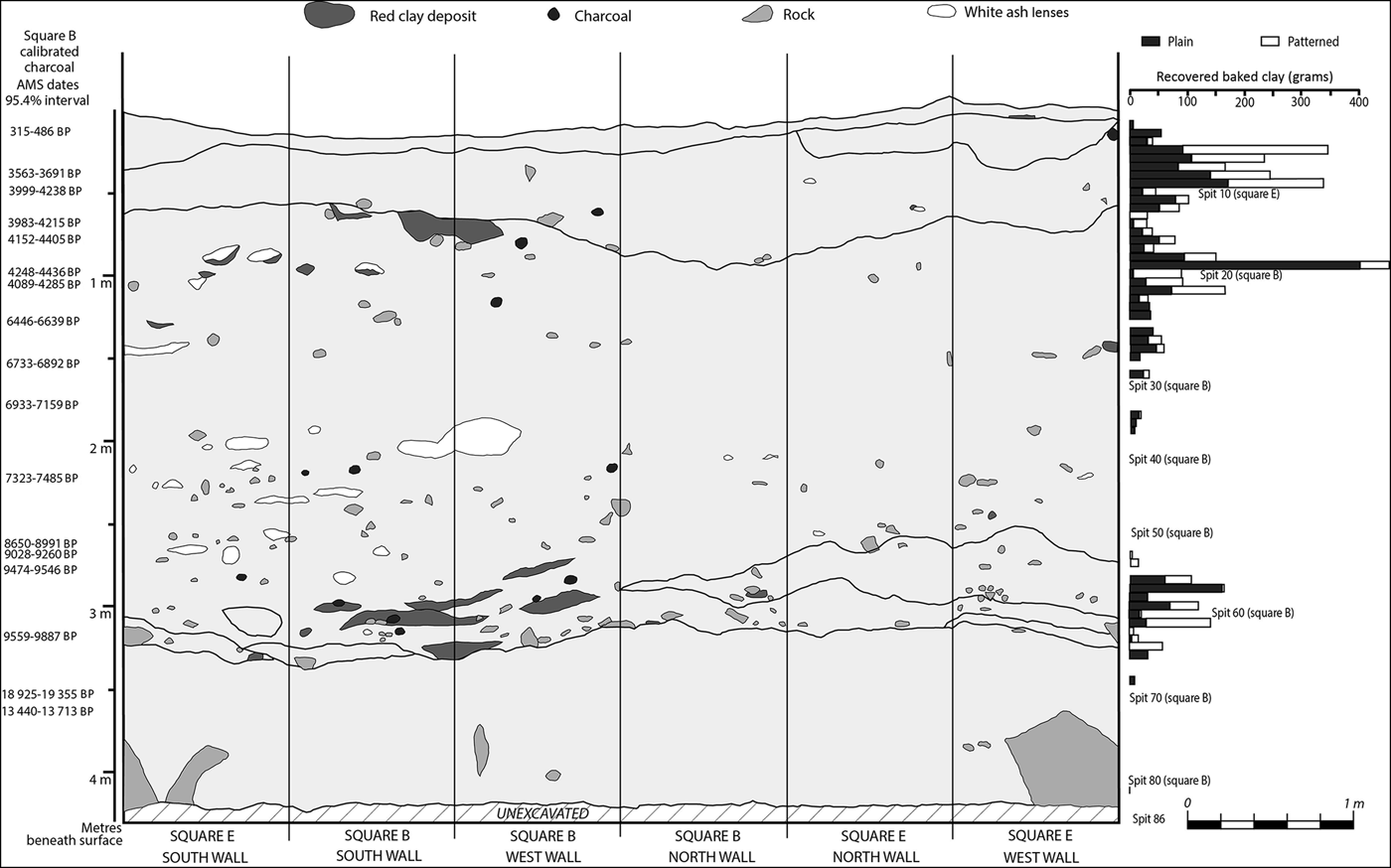
The Gua Talimbue excavation focused on two areas of the cave. The adjoining A, C and D squares to the west were excavated to a depth of approximately 0.55m, allowing the recovery of an extended human skeleton buried with glass beads and an iron ornament (see Bulbeck et al. Reference Bulbeck, Aziz, O'Connor, Calo, Fenner, Marwick, Feathers, Wood and Prastiningtyas2016). The small quantity of baked clay recovered from these squares was not recorded in detail and so is not reported here. Near the centre of the cave, the adjoining squares B and E were excavated in 50mm spits to a depth of just over 4m (Figure 2). Larger finds were recorded in situ, while smaller finds were recovered by wet sieving through 5mm and 1.5mm mesh sieves. We separated the baked clay into plain and patterned fragments, recorded the weight of the fragments to the nearest 0.5g (Table S1 in the online supplementary material (OSM)), and assigned each fragment to the relevant 50mm spit recorded during the excavation (Table S2).
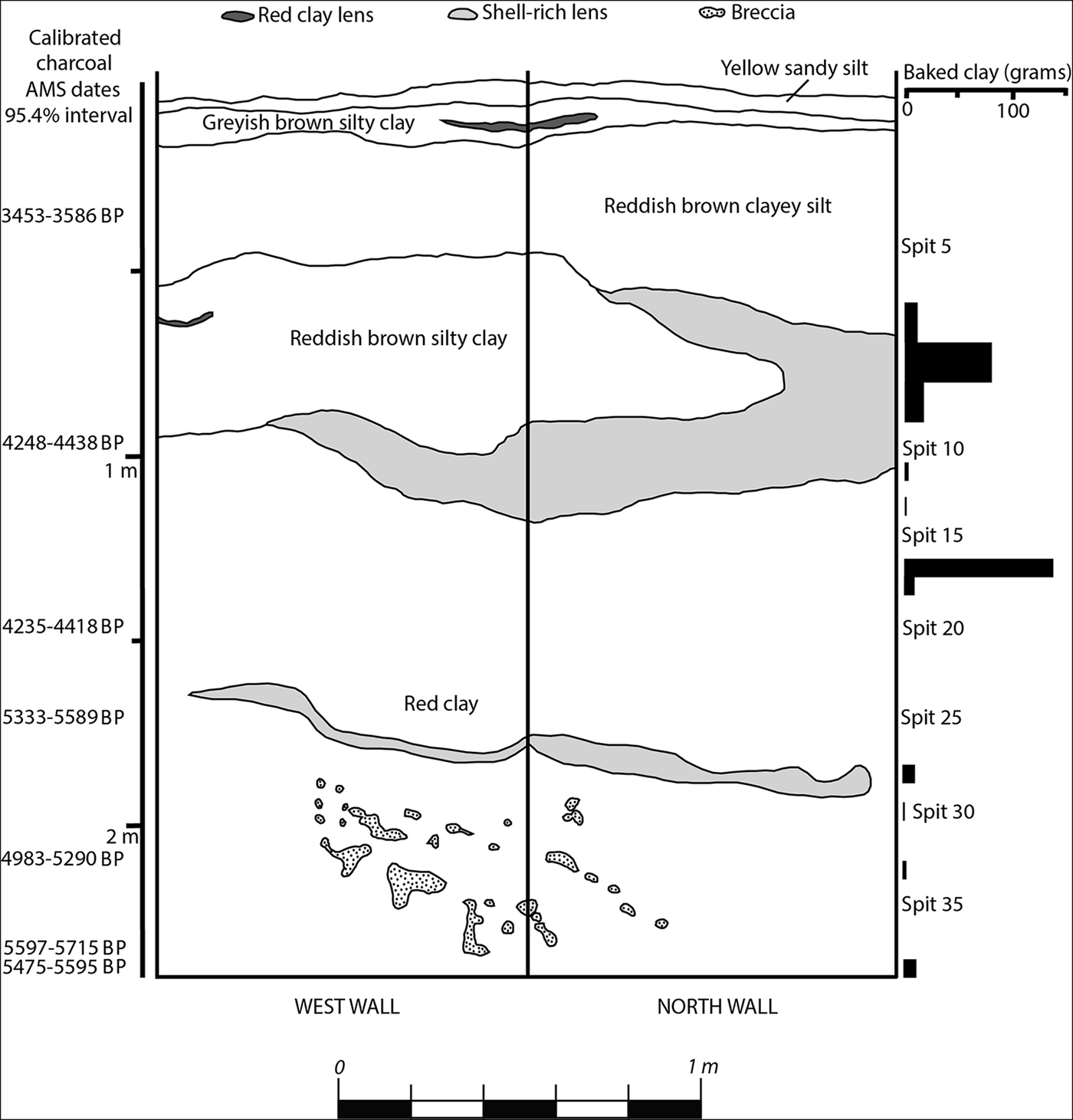
Stratigraphic section of Gua Talimbue squares B and E, with calibrated dates and baked-clay distribution (sources: Table S1; Suryatman et al. (Reference Suryatman, Bulbeck, Marwick, Oktaviana and Wibowo2016) incorporated under a CC BY-NC-ND 4.0 licence) (figure by D. Bulbeck).

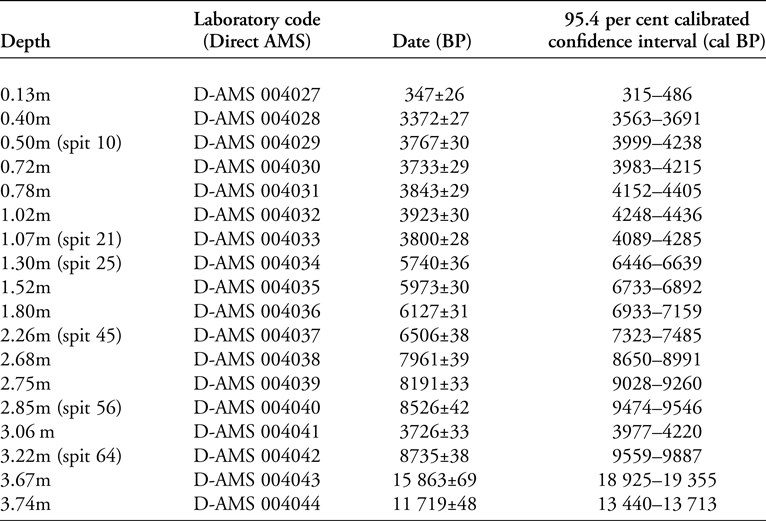
Eighteen AMS determinations on unidentified plant charcoal samples collected in situ during the excavation and from the sections of square B are presented in Table 1. The calibrated dates are presented in Figure 2, with the exception of one out-of-sequence date of 3726±33 BP (D-AMS 004041). A Holocene midden deposit containing discrete features of red clay, charcoal concentrations and lenses of white ash extended down to a layer of imbricated freshwater shellfish at approximately 3.20m beneath the surface (around spit 65). The underlying deposit beneath the shellfish layers consists of yellow-brown clay with sparse evidence for habitation, and is featureless in section, apart from rock inclusions. Although stratigraphically inverted, the two available radiocarbon dates, c. 19 000 cal BP (spit 71, 3.67m) and 13 500 cal BP (spit 73, 3.74m), confirm a Pleistocene date. Excavation was discontinued at a depth of 4.20m, without reaching bedrock, due to the difficulty of working within the 2 × 1m pit.
AMS determinations from Gua Talimbue square B, calibrated with IntCal13 (Bronk Ramsey Reference Bronk Ramsey2013)

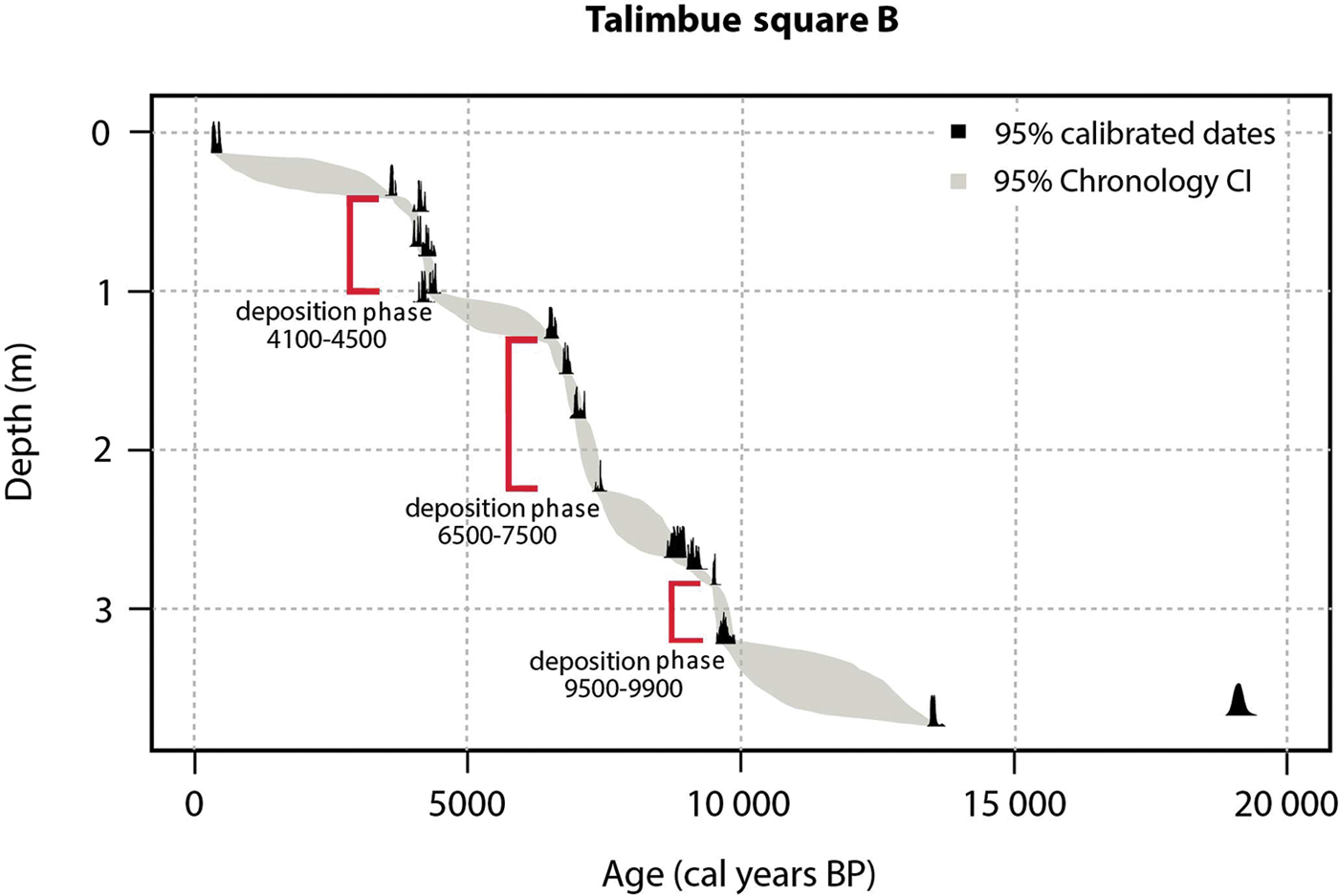
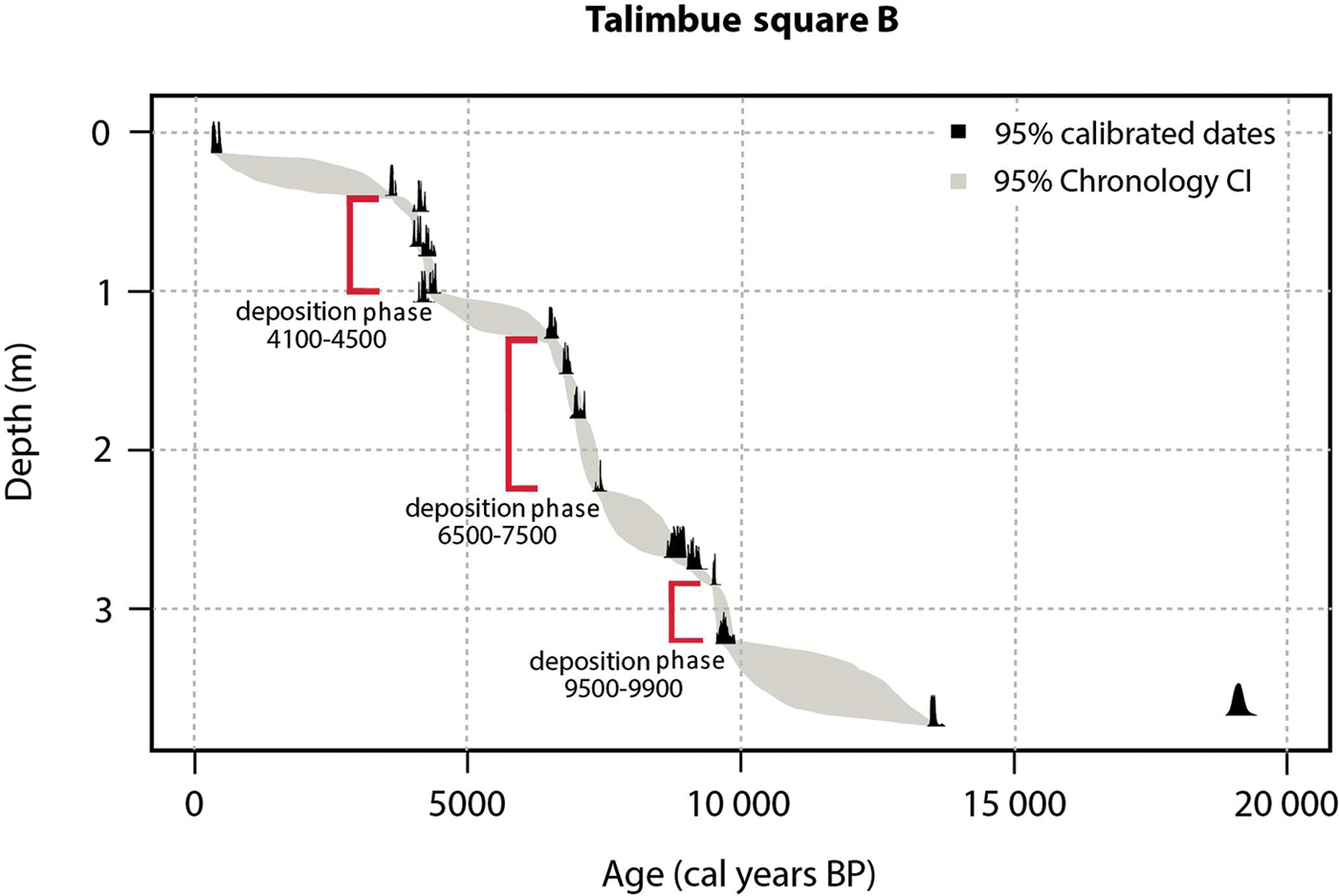
The charcoal samples immediately overlying the imbricated shellfish layer are spatially associated with red-clay features, while the charcoal samples from higher in the stratigraphy are not (Figure 2). Potential bioturbation of the upper deposit is indicated by the presence of insect casts and roots recorded during the excavation from spits 1–10 (0.50m depth) and sparse rootlets from spits 11–22 (1.16m depth). Based on the stratigraphic position of the dated samples, the Holocene midden deposit appears to have mostly accumulated in three pulses, rather than evenly over time. These three pulses of deposition, c. 4100–4500 cal BP (spits 10–21, 0.50–1m depth), 6500–7500 cal BP (spits 25–45, 1.30–2.30m depth) and 9500–9900 cal BP (spits 56–64, 2.90–3.20m), are associated with 95.4 per cent calibrated confidence intervals that nestle together (Table 1), and a steep gradient of accumulated deposit over a short period of time (Figure 3).
Median calibrated Holocene dates from Gua Talimbue square B (95 per cent confidence—see the OSM), plotted against the stratigraphic depth of the dated samples (source: OSM computer code output) (redrawn by D. Bulbeck).
Two concentrations of red-clay features appear in the stratigraphic section (Figure 2). The upper concentration, positioned between approximately 0.60m and 1m below the surface (4100–4500 cal BP), includes a large discrete feature of red clay (not collected) on the south-west wall of square B at around 0.70m depth, as well as other red-clay features associated with lenses of white ash; nodules of red clay were observed during excavation in spits 6–19 (0.30–0.95m). The deeper concentration, between 2.70–3.20m below the surface (9100–9900 cal BP), comprises lenses of red clay, along with red-clay clasts. Both the upper and lower concentrations of red-clay features correspond to peaks in the quantities of baked clay recovered during excavation, even though the uppermost peak of recovered baked clay (spits 5–9, 0.25–0.45m) stratigraphically overlies the upper concentration of red-clay features in the stratigraphic section (Figure 2). Between spits 30 and 54 (1.60–2.70m), there were no patches of red-clay deposit in the sections, very little baked clay was recovered and red-clay mottling was observed only rarely. In summary, it is possible to identify a general association between the presence of red-clay features in the section and the recovery of baked clay from the deposit.
The excavated cultural remains are presented in Table S3 and Figures S1–2. Freshwater shellfish was usually the dominant find by weight in the midden deposit in spits 1–51 (0–2.60m), dating back to c. 7500 cal BP. Pottery was recovered down to spit 3 in square B and spit 6 in square E. In both cases, the pottery overlies the stratigraphically uppermost concentration of baked clay. The interpolated date for the initial appearance of pottery lies between 2000 cal BP (with reference to square B) and 3000 cal BP (with reference to square E). Between spits 52 and 64 (2.70–3.20m)—dating back to around 9900 cal BP—lithics are generally the dominant find by weight, accompanied by moderate quantities of vertebrate and freshwater shellfish remains. The underlying Pleistocene deposit produced few finds, apart from modest quantities of lithics.
The baked clay is assigned to plain and patterned categories. Square B yielded 634.5g of plain baked clay between spits 2 and 80 (0.07–3.98m) and 1188g of patterned baked clay between spits 5 and 64 (0.23–3.19m). Square E yielded 1542.5g of plain clay between spits 1 and 66 (0.07–3.24m), and 463g of patterned baked clay between spits 1 and 63 (0.07–3.10m) (Table S2). Both the plain and patterned categories were discontinuous in their vertical distribution (Figure 2), and tailed off in the Late Pleistocene layers, which yielded only plain, not patterned, baked clay.
Gua Talimbue: analysis of the baked-clay patterns
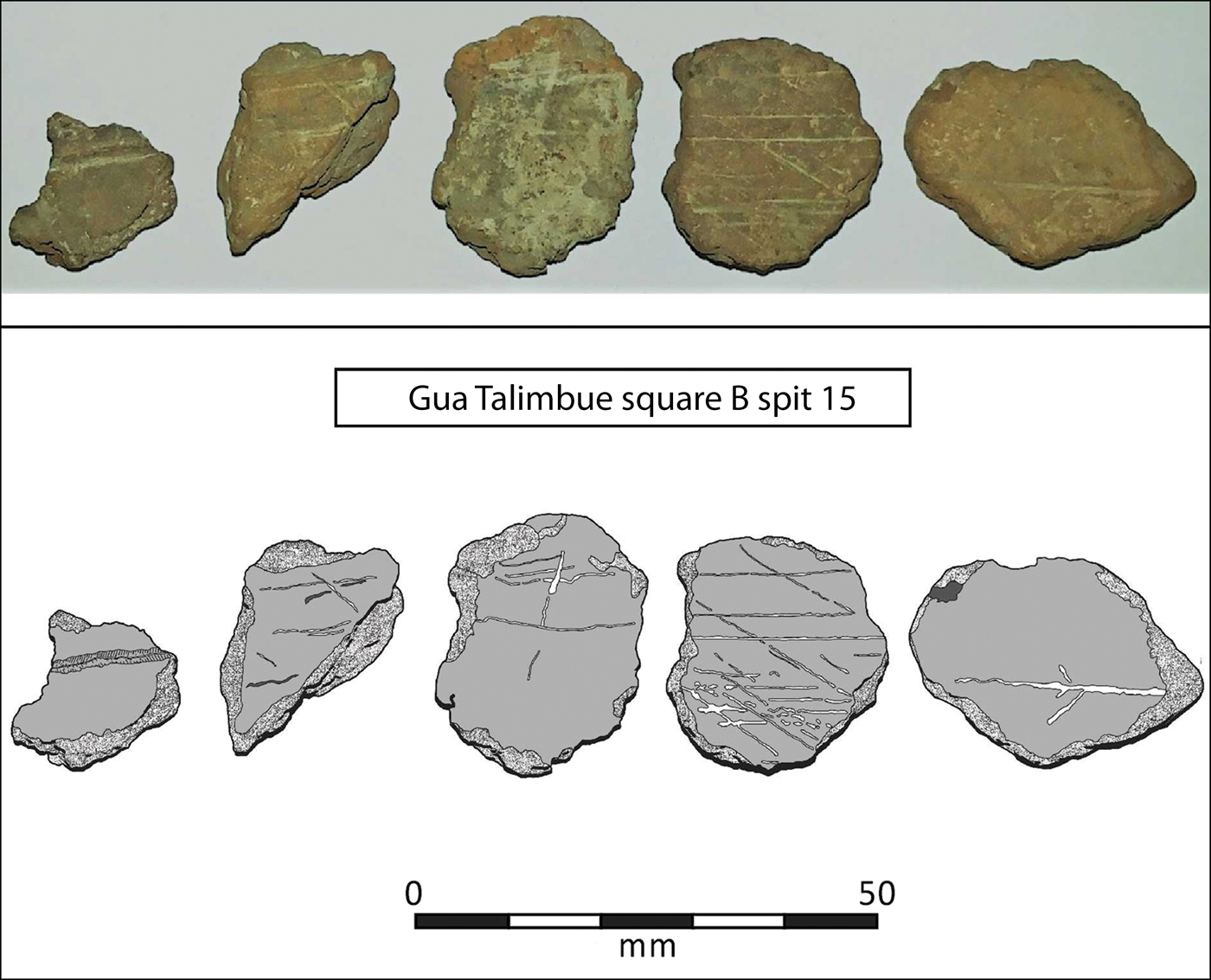
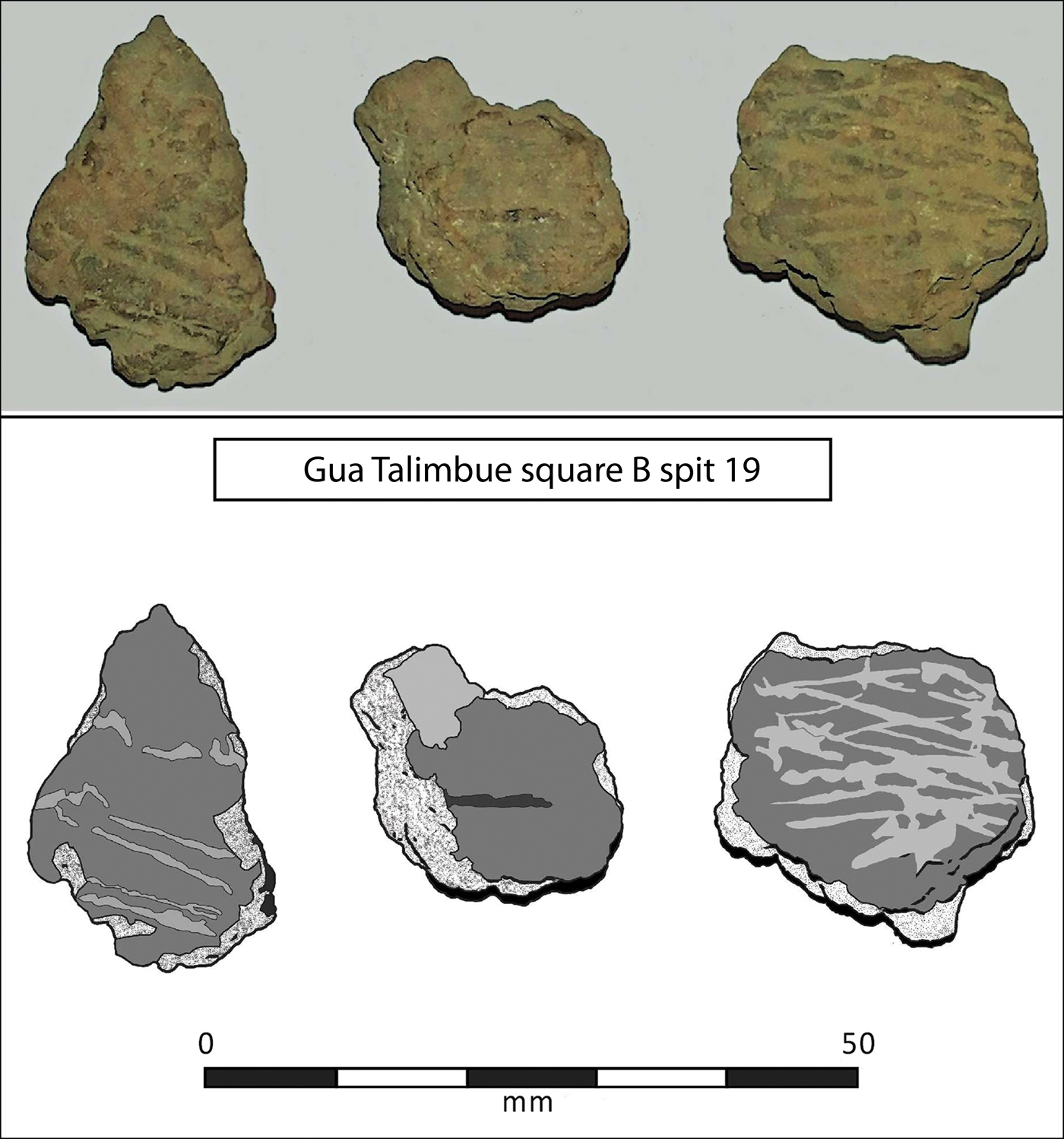
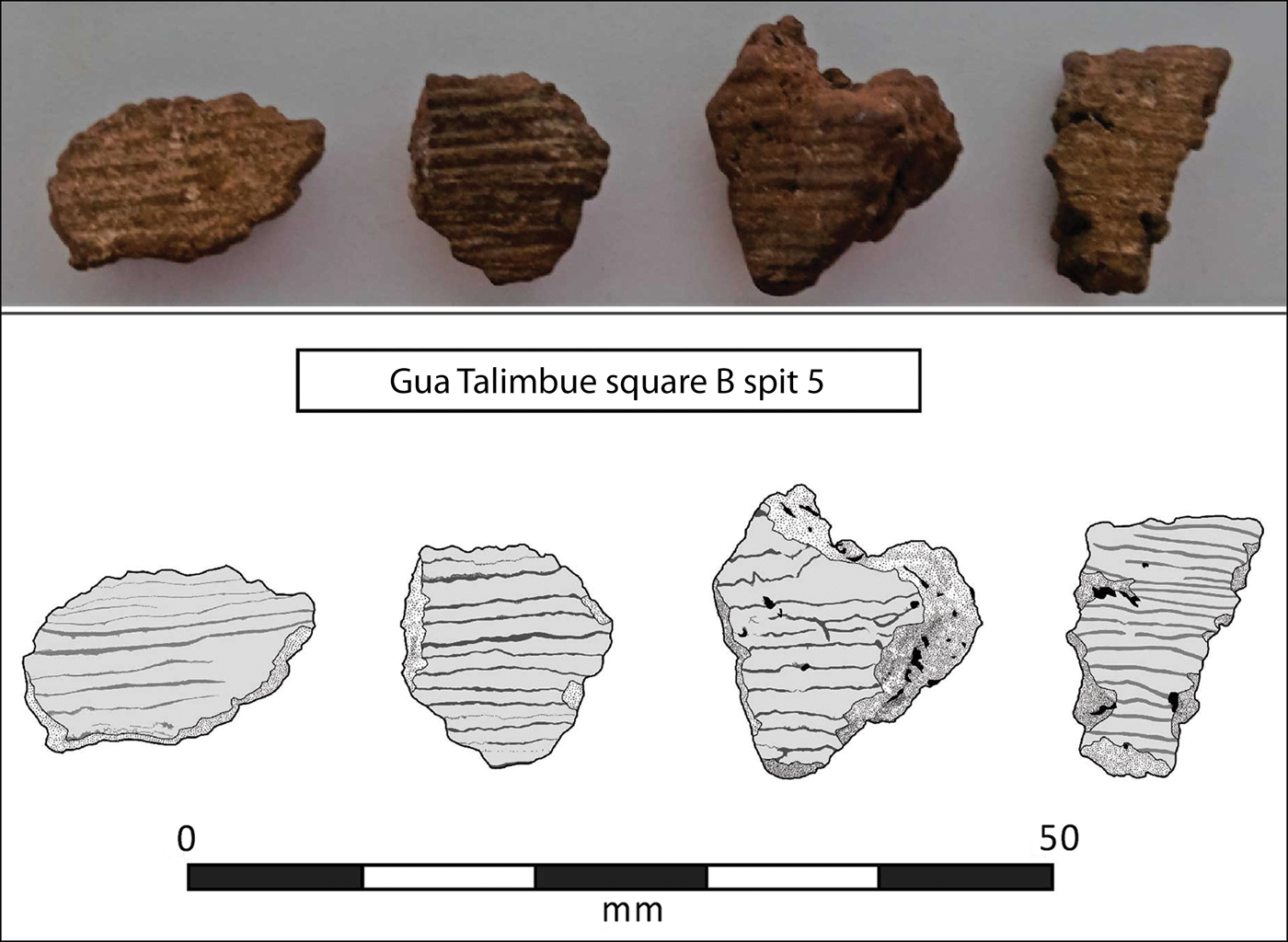
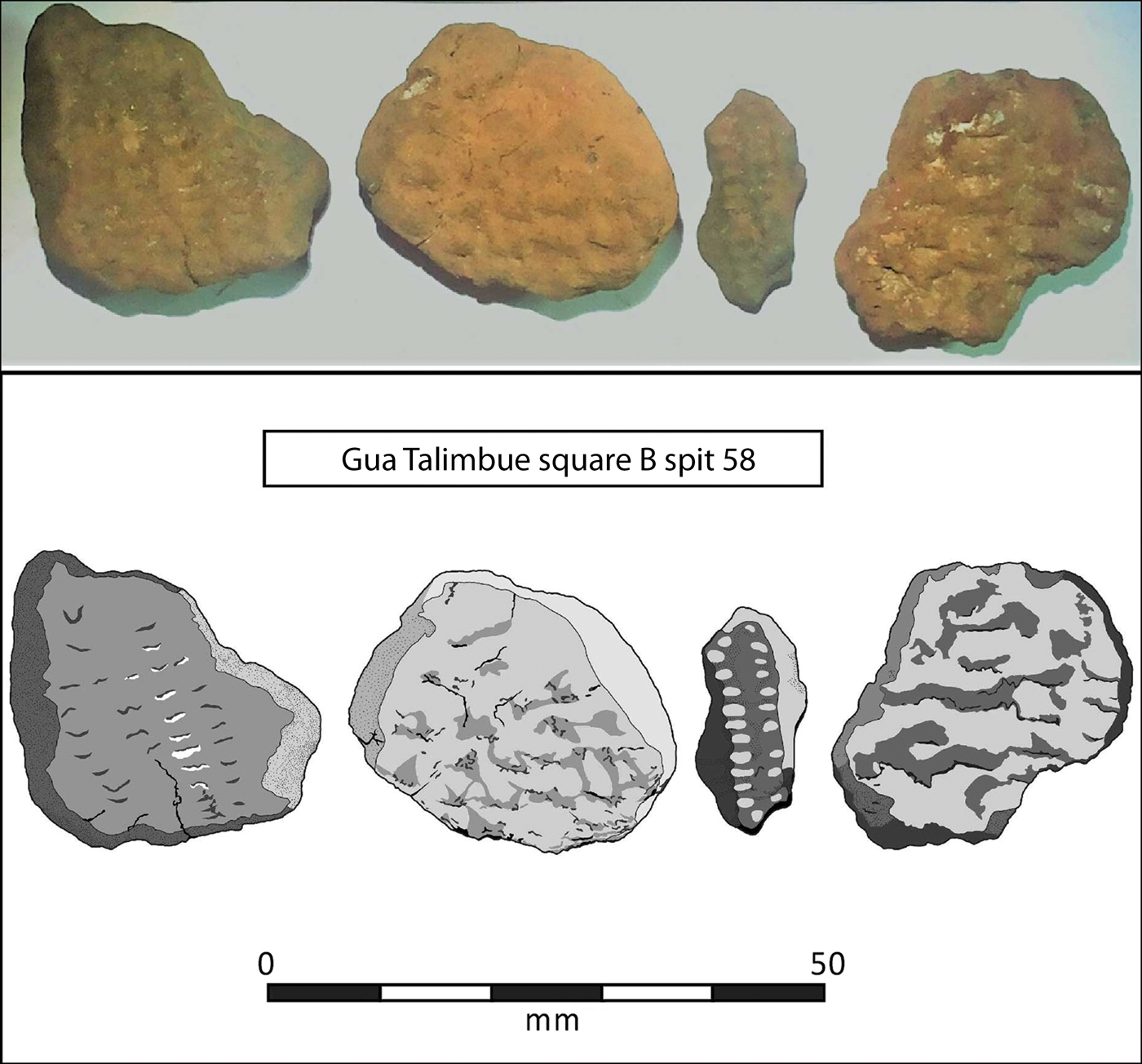
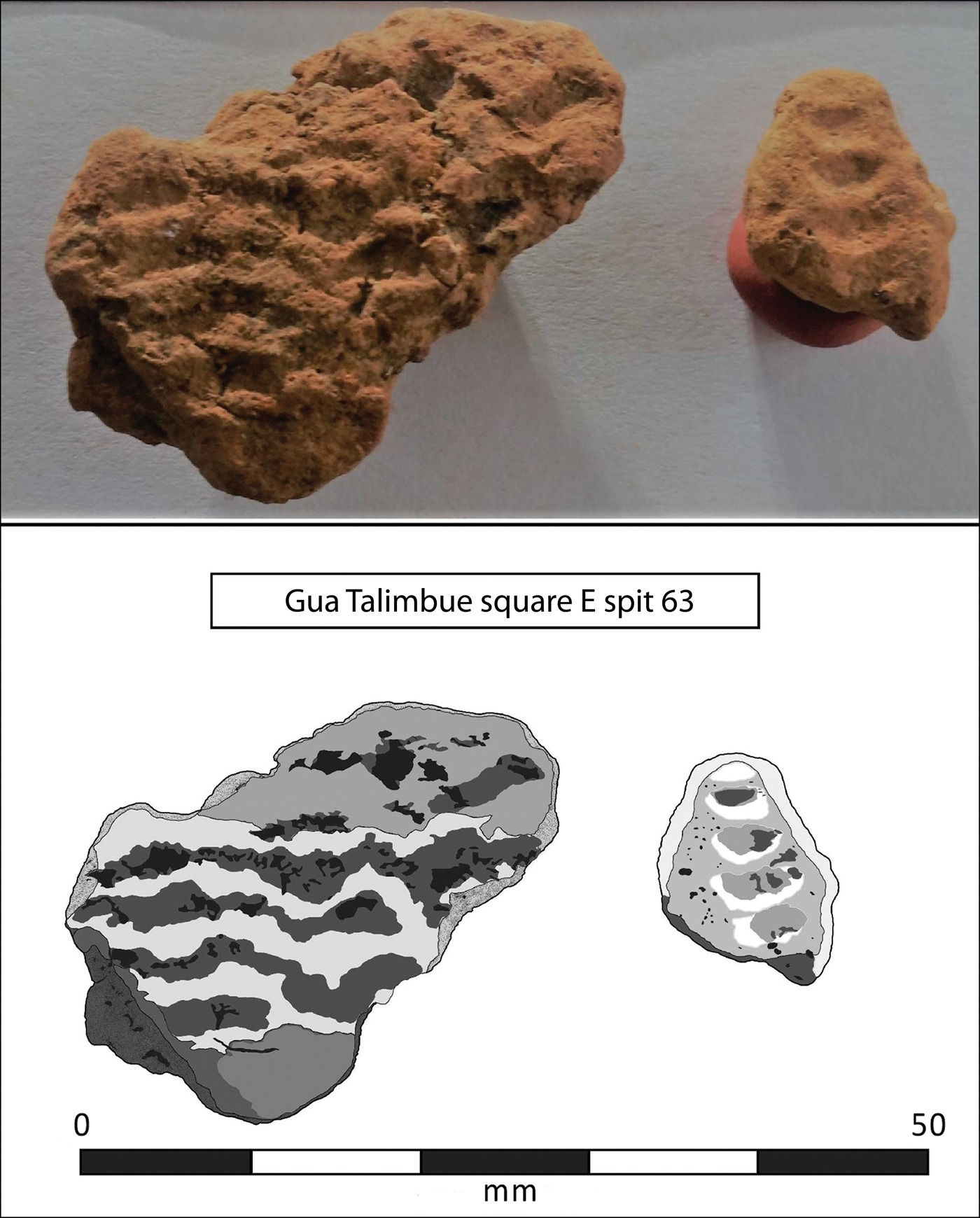
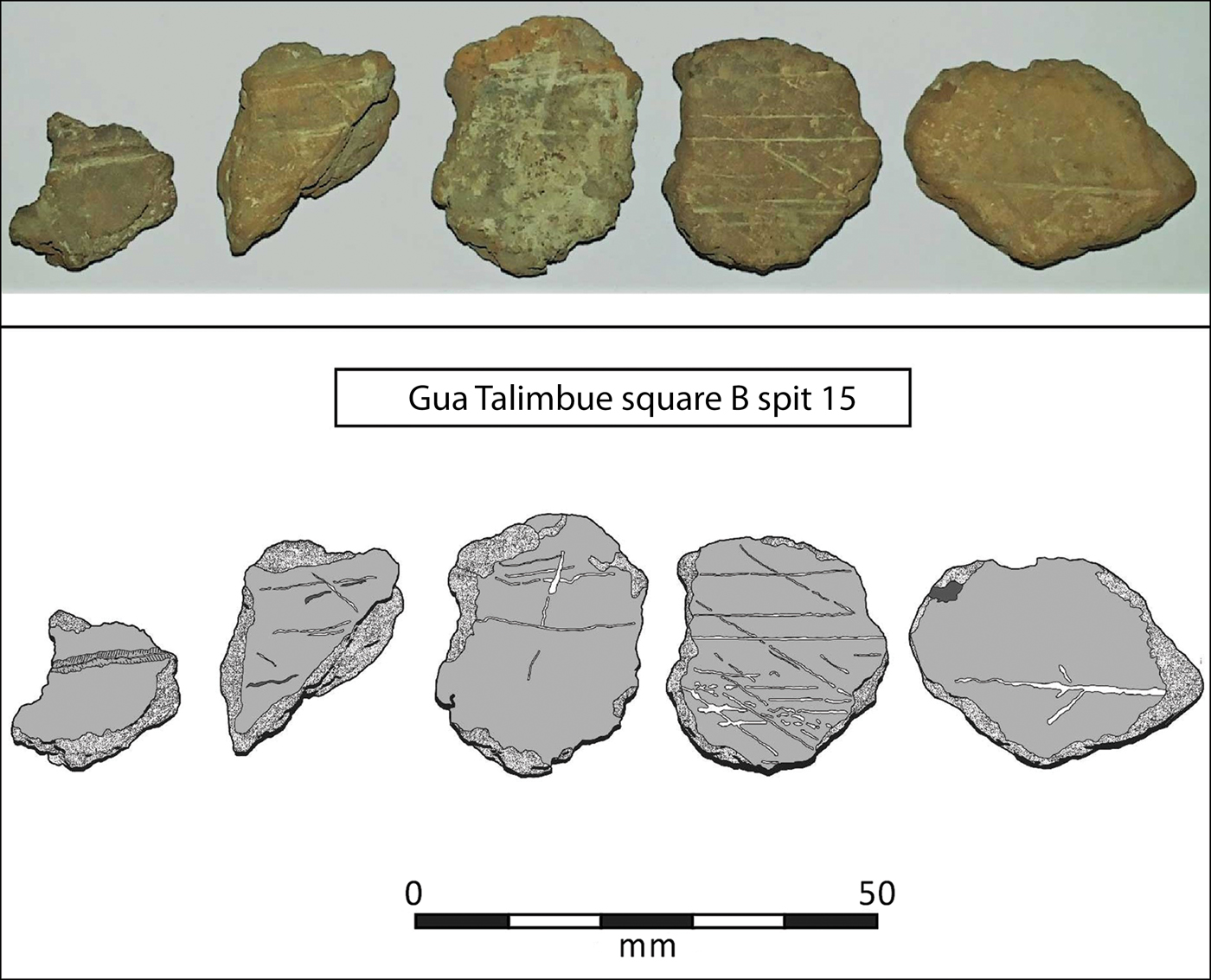
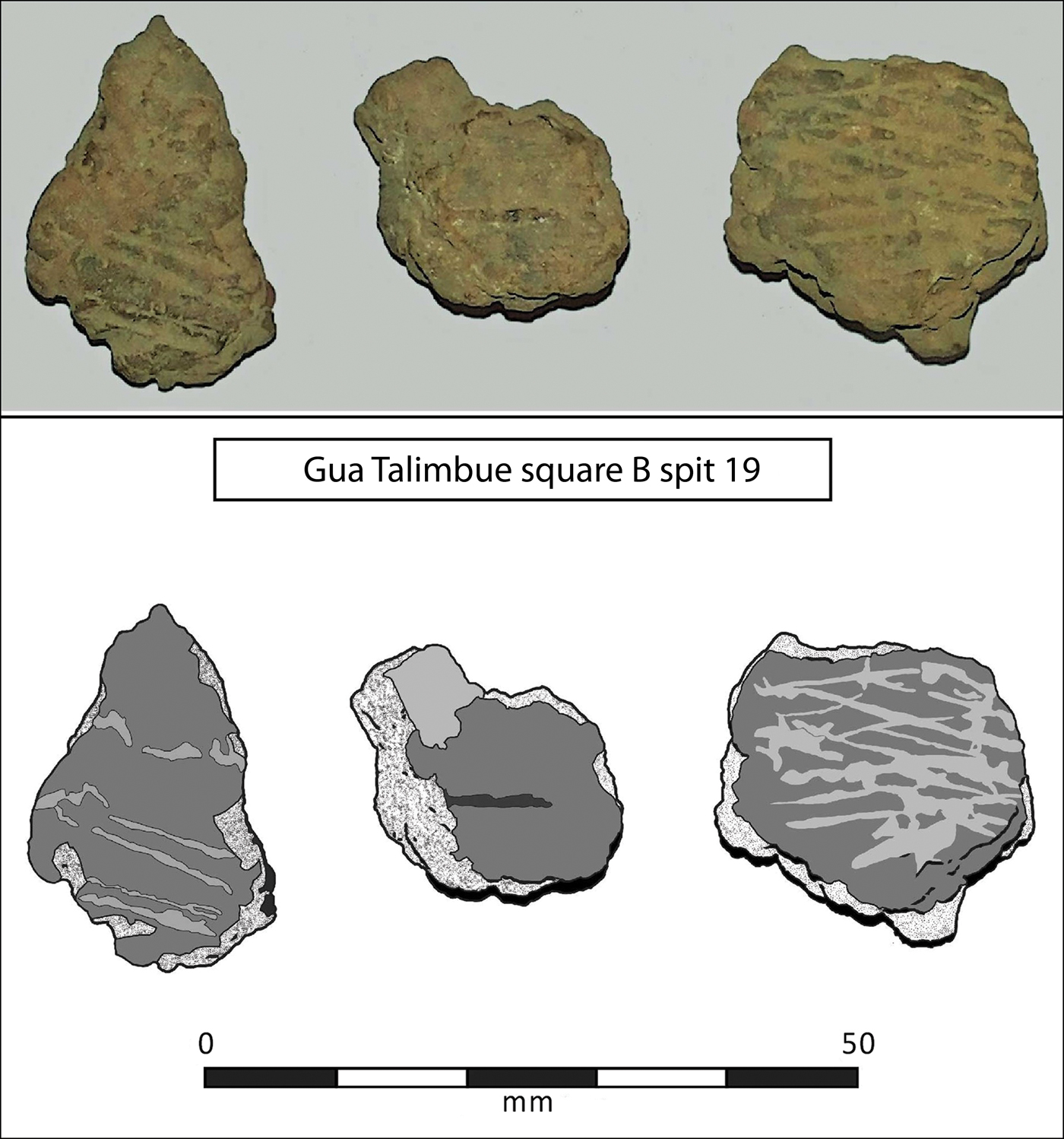
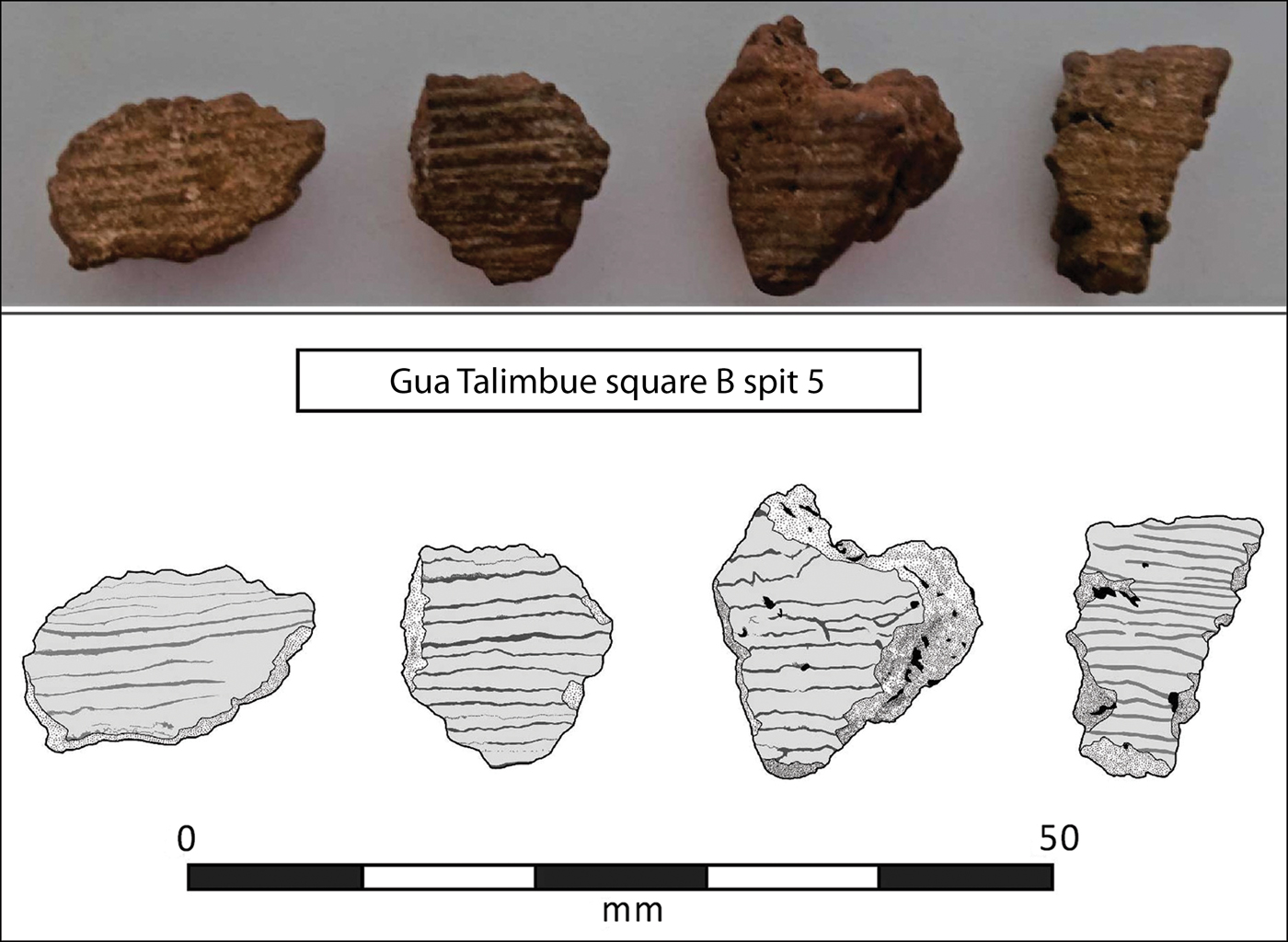
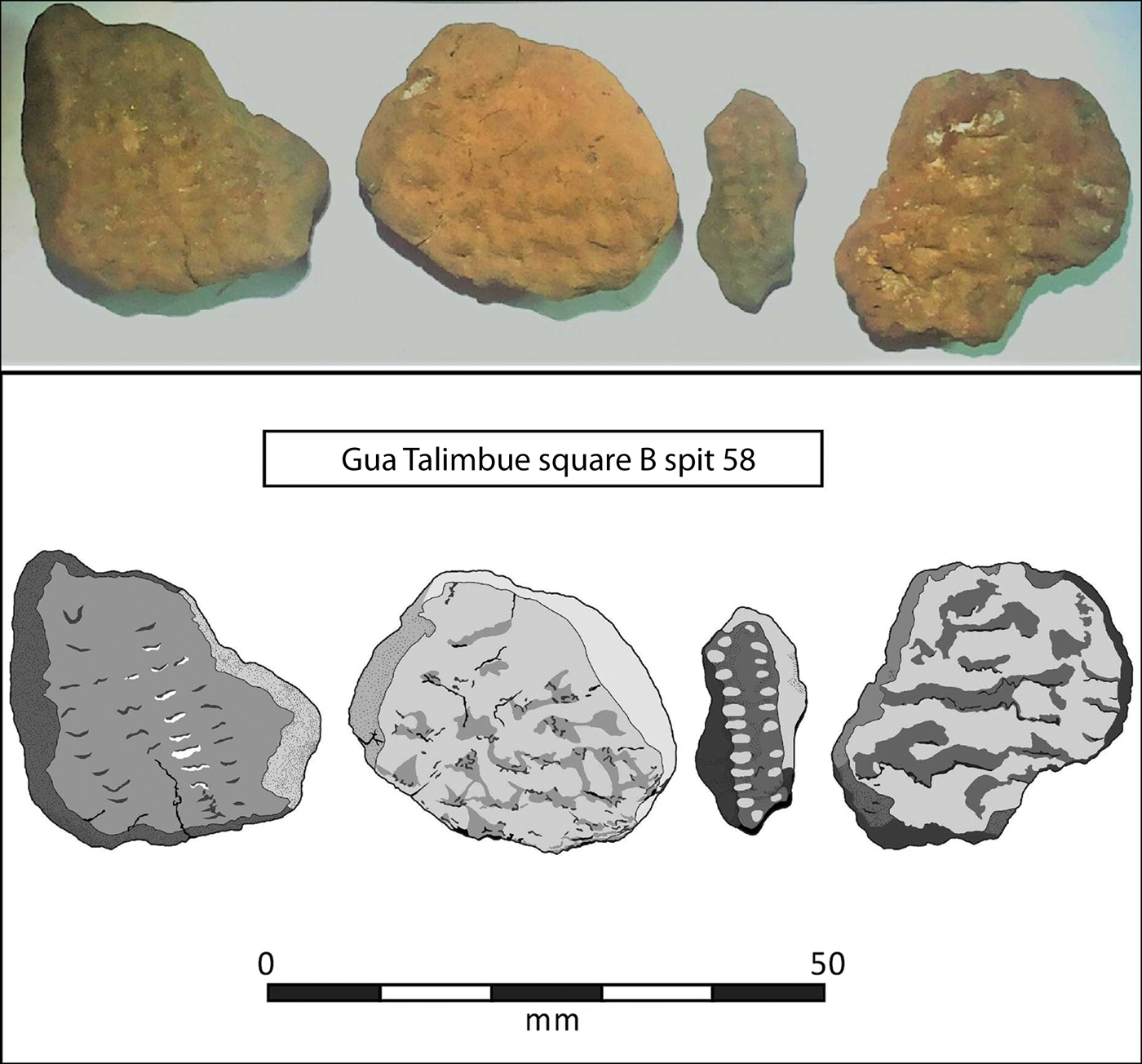
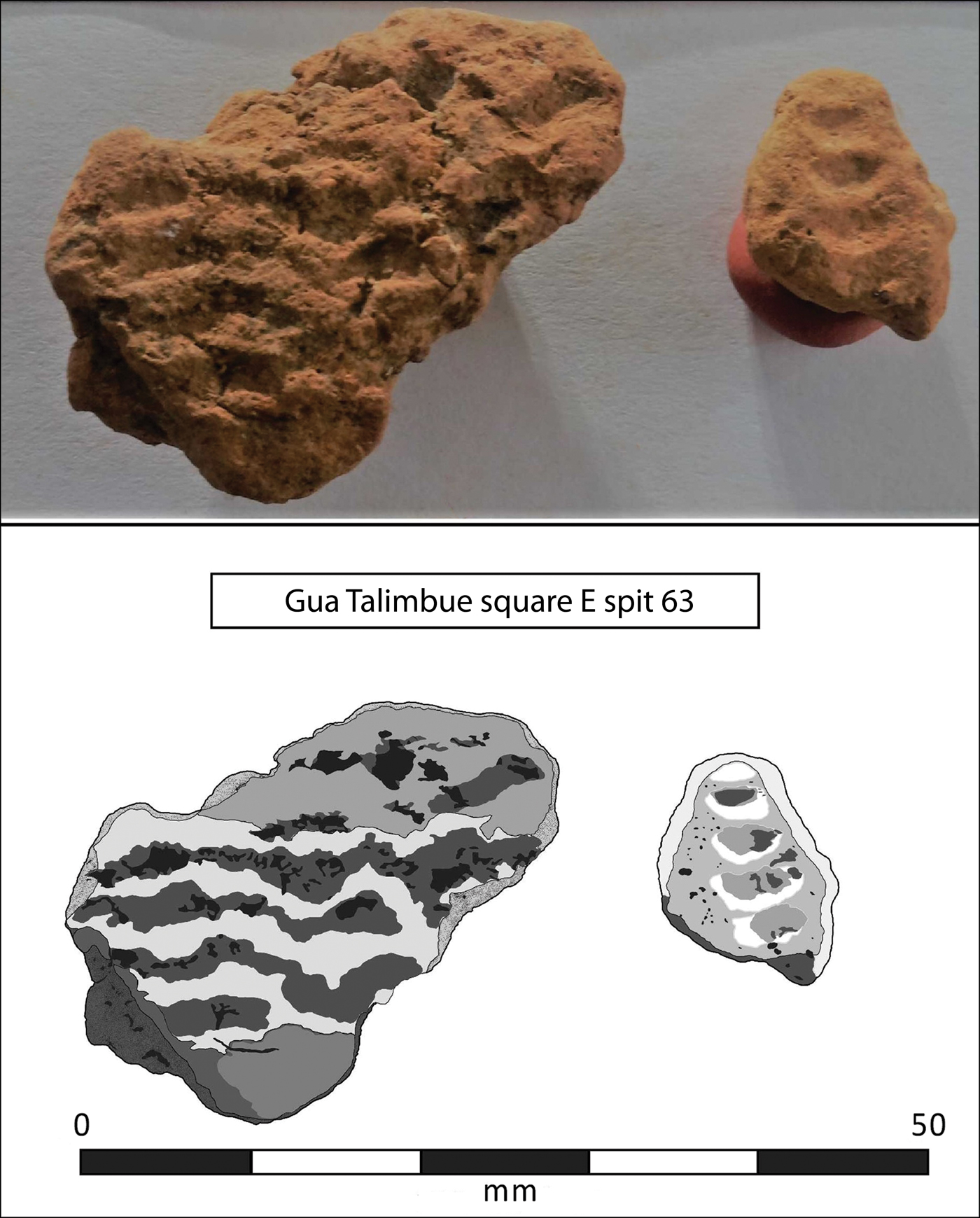
A classification of the 299 patterns found on the interior surfaces of the 249 patterned fragments from Gua Talimbue is presented in Table S4. The most frequent class comprises shallow linear furrows labelled ‘striations’ (n = 156, 52.2 per cent), which includes white-infilled, irregular parallel (Figure 4), regular parallel and cross-hatched (Figure 5) striations. Striations sometimes occur in parallel sets (n = 22), including cross-hatching, but are also found in more loosely configured sets (Figure 4). Deeper linear depressions are labelled ‘corrugations’ (n = 73, 24.4 per cent) when in parallel formation (Figure 6), and ‘incisions’ (n = 13, 4.3 per cent) when appearing in isolation (Figure 4). Two fragments with surface ridges complete the total number of 244 linear patterns. The remaining 55 patterns include 27 irregular impressions (Figure 6) and 28 curvilinear patterns, including 11 with semi-circles, nine with dashes (Figure 7), six with lunate patterns (Figure 8) and two with quadrangular stamps. The curvilinear patterns in particular are reminiscent of motifs found on decorated pottery, even though they do not resemble the particular motifs on the decorated Walandawe pottery (Bulbeck et al. Reference Bulbeck, Aziz, O'Connor, Calo, Fenner, Marwick, Feathers, Wood and Prastiningtyas2016; O'Connor et al. Reference O'Connor, Bulbeck, Piper, Aziz, Marwick, Campos, Fenner, Aplin, Fakhri, Suryatman, Maloney, Hakim, Wood, O'Connor, Bulbeck and Meyer2018).
Photograph (above) and illustrations (below) of baked-clay fragments from Gua Talimbue square B spit 15, showing incisions (far left and far right), sets of parallel white-infilled striations (second and fourth from left) and irregularly parallel striations (centre) (photograph by Fakhri; illustration by D. Bulbeck).
Photograph (above) and illustrations (below) of baked-clay fragments from Gua Talimbue square B spit 19, showing regularly parallel striations (far left), irregular impression (centre) and cross-hatched striations (far right) (photograph by Fakhri; illustration by D. Bulbeck).
Photograph (above) and illustrations (below) of baked-clay fragments with corrugations from Gua Talimbue square B spit 5, showing regularly parallel striations (first, second and fourth from left) and irregular parallel striations (third from left) (photograph by Fakhri; illustration by D. Bulbeck).
Photograph (above) and illustrations (below) of baked-clay fragments from Gua Talimbue square B spit 58, showing dashes arranged perpendicularly (first and third from left), fields of semi-circular impressions (second from left) and semi-circular incisions (far right) (photograph by Fakhri; illustration by D. Bulbeck).
Photograph (above) and illustrations (below) of baked-clay fragments from Gua Talimbue square E spit 63 with lunates—lengthwise repetition producing rounded zigzags (left) and repetition perpendicular to length (right) (photograph by Fakhri; illustration by D. Bulbeck).
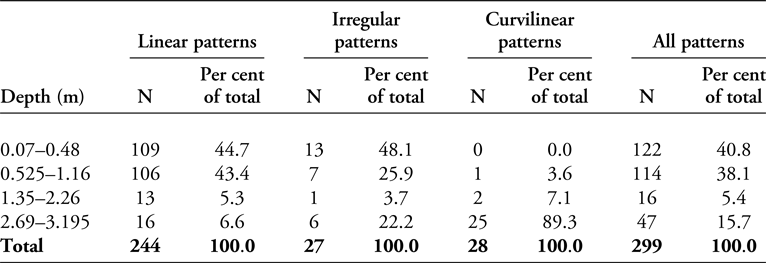
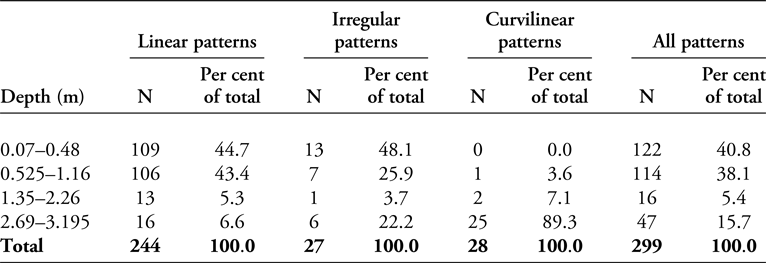
Both the quantity and character of the patterns vary with stratigraphic depth (Table 2 & Figure S3). Together, the patterns encountered between 0.03–0.48m and between 0.53–1.16m—which cover the Mid/Late Holocene—account for 236 (79 per cent) of the total patterns, with approximately equal numbers of patterns in the spits that correspond to the 4100–4500 cal BP pulse of deposition (0.53–1.16m) and in the overlying spits. Linear patterns dominate (91 per cent), followed by irregular impressions (8.5 per cent). The patterns encountered between 1.35 and 2.26m, which includes the 6500–7500 pulse of deposition, account for a mere 5 per cent of the total, and comprise mostly linear but also some curvilinear patterns. The most notable contrast with the Mid/Late Holocene patterns is provided by the Early Holocene patterns encountered between 2.69–3.20m, which covers the 9500–9900 cal BP pulse of deposition. Although comprising only 16 per cent of the total patterns, they account for 89 per cent of the curvilinear patterns, including semi-circles, dashes, quadrangles and lunates.
Vertical distribution of Gua Talimbue patterned baked-clay fragments (summarised from Table S6 in the OSM). Linear patterns include striations, corrugations, incisions and ridges. Irregular patterns are impressions not elsewhere included. Curvilinear patterns include semi-circular, dash, lunate and quadrangular patterns. Percentages may not sum exactly to 100.0% due to rounding.
Based on the similarity of patterns, surface colour and relief, and excavated depth, we grouped the patterned fragments into 46 sets that potentially correspond to distinct baked-clay structures (Tables S5–6). This analysis shows that convex surfaces were frequent on the patterned fragments encountered between spits 26 and 64 (1.25–3.19m depth), but not on those from the spits above spit 26, which mainly have a concave or unevenly smoothed surface. To explain this difference, we can use the basin-shaped, baked-clay structures from Klisoura Cave 1, Greece, as a comparative model, which are significant both for their completeness and their construction by pre-pottery foragers. These structures exhibit a thickened ‘rim’ with a coarse, convex surface along the top of the basin-shaped structure, and a concave surface on the inside of the structure beneath the rim (Karkanas et al. Reference Karkanas, Koumouzelis, Kozlowski, Sitlivy, Swobczyk, Berna and Weiner2004). The combined information on dating, patterns and surface shape suggests the following chronology and interpretation for the decorated baked clay at Gua Talimbue:
1. C. 9900–8800 cal BP: frequently, convex surfaces derived from the ‘rim’ of clay structures, with predominantly curvilinear patterns, consistent with the production of motifs designed to enhance the visual appearance of the structures.
2. C. 7000–6500 cal BP: based on a small sample of patterned baked clay, mainly linear patterns on a variety of convex, concave and undulating surfaces.
3. C. 4500–2500 cal BP: predominantly linear patterns on mostly concave and unevenly smoothed surfaces. The range of linear patterns may reflect the application of surface-finish techniques, impressions left by plant materials lining the interior surfaces, and designs to enhance visual appearance prior to use and any re-use.
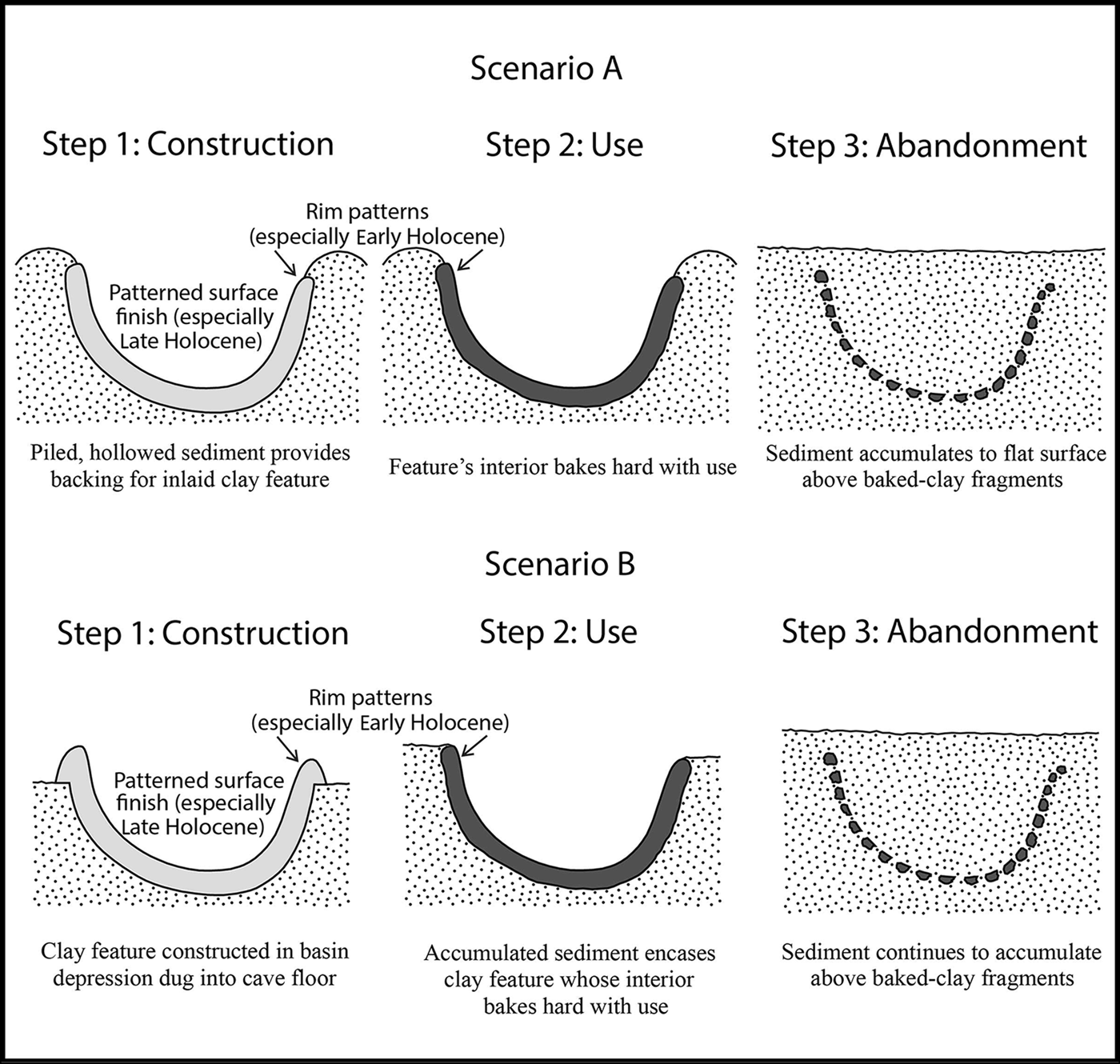
Two different scenarios may explain the concentrations of baked-clay fragments associated with phases of rapid sediment accumulation between 4100–4500 cal BP and 9500–9900 cal BP (Figure 9). In scenario A, which best fits the Mid/Late Holocene evidence, the cave occupants produced an inset hearth by scooping surface sediment into a ring around a shallow pit, which was then lined with clay. Patterns were applied to the internal surface of the structure, which was hardened during heating. In scenario B, which best fits the Early Holocene evidence, the structure may have comprised a brazier-like hearth constructed partly above the ground surface of the cave, as also described for the Aurignacian clay hearths at Klisoura Cave 1 (Karkanas et al. Reference Karkanas, Koumouzelis, Kozlowski, Sitlivy, Swobczyk, Berna and Weiner2004). Rapid sedimentation helped to keep the structure intact, while heating during use hardened its interior.
Two scenarios to explain the association between baked clay and intervals of rapid sediment accumulation at Gua Talimbue (illustration by D. Bulbeck).

Hearth construction and use in the vicinity of the excavated squares may have been discontinuous between the Early and Late Holocene. This would explain the absence of Mid-Holocene baked-clay fragments, apart from the small quantity associated with the pulse of sedimentation between spits 26 and 45 (1.38–2.36m, 6500–7500 cal BP). As for the upper stratigraphy, spits 1–9 (0.07–0.48m) produced approximately the same quantity of baked clay as spits 10–22 (0.53–1.17m), which implies that hearth construction continued in the vicinity of the excavated squares after 4000 cal BP. Furthermore, due to a slower rate of deposition, spits 1–9 correspond to a notably longer time interval than spits 10–22, resulting in numerous baked-clay fragments, despite lacking the favourable preservation conditions provided by the rapid accumulation of deposit in spits 10–22.
Gua Sambagowala
A single test pit, pit A, was excavated at Gua Sambagowala (Figure 10). The finds comprised a shell midden associated with potsherds in spits 1–2, and a pre-pottery shell midden in the 36 lower spits (Tables S7–8). Spits 7–38 yielded 293g of baked clay, including two small fragments of baked clay with roughly parallel striations from spit 11 (c. 4400 cal BP) and spit 30 (c. 5500 cal BP). Freshwater shellfish was the dominant cultural material between spits 3 and 38 (0.31–2.40m depth), at a density between 24.5 and 74.2g/kg of excavated sediment.
Stratigraphic section of Gua Sambagowala test pit A with calibrated dates and baked-clay distribution (sources: Table S7; Fakhri (Reference Fakhri, O'Connor, Bulbeck and Meyer2018) incorporated under a CC BY-NC-ND 4.0 licence) (illustration by D. Bulbeck).

Traces of hearths, such as burnt stone and white ash, were recorded in 12 spits between spits 4 and 32 (Table S8). Although these traces were recorded in only two of the 11 spits with baked clay, the latter should also be interpreted as representing the remains of hearths, particularly as burnt animal bone was found embedded in one fragment. While burnt nut remains and wood charcoal were consistently present from spits 4–21 (0.38–1.53m depth), only wood charcoal was present between spits 22 and 38 (1.60–2.40m depth). This disparity, due either to dietary change or preservation conditions, suggests that spits 21 and 22 mark a chronological divide between c. 3500–4500 cal BP (spits 4–21) and c. 5500–6000 cal BP (spits 22–38).
In summary, the Gua Sambagowala excavation produced a small assemblage of baked clay dating to c. 5500–6000 cal BP, and a larger assemblage dating to c. 4000–4500 cal BP. The smaller, earlier assemblage falls within a gap in the chronology of the Gua Talimbue baked clay, whereas the larger, later assemblage corresponds to a peak in the presence of baked clay at Gua Talimbue.
Discussion
Together, Gua Talimbue and Gua Sambagowala demonstrate the production of clay hearths in the Walandawe area of Southeast Sulawesi between c. 9900 and 2500 cal BP, and in contexts that are mainly, if not entirely pre-pottery. The late appearance of pottery at Walandawe—no earlier than c. 2500 cal BP, compared with 3500 cal BP in South and West Sulawesi (Bulbeck Reference Bulbeck and Simanjuntak2008)—may reflect the efficacy of the local clay hearths for the cooking function that was one of the major uses of prehistoric earthenware in Indonesia (Soegondho Reference Soegondho1995). That said, the prominence of baked clay at these two sites—unprecedented for Island Southeast Asia—may also be, at least partly, due to the associated rapid rates of sediment accumulation: three pulses at Gua Talimbue and two at Gua Sambagowala. Indeed, the breaks in the distribution of baked clay at Gua Talimbue between c. 4500–6500 and 7500–9000 cal BP correspond to intervals of slower sediment accumulation, even if the rapidly accumulated sediment at Gua Talimbue may have been partly a result of the deliberate piling of sediment to encase the clay hearths (scenario A), rather than a purely natural process that fortuitously preserved clay-brazier-like structures (scenario B).
Gua Talimbue particularly stands out for the quantity of baked clay (3.8kg), 1.7kg of which exhibits patterning. These patterns changed over time, from the Early Holocene when distinctive, mainly curvilinear, designs were applied to the most visible part of the hearth (the rims), to the Mid/Late Holocene when predominantly linear patterns were applied across the interior surface of the hearths as part of a general surface finishing. In both cases, the additional work involved in enhancing the hearths' appearance agrees with stratigraphic evidence that they were intended for long-term use, and are suggestive of local craft specialisation. These hearths may have served as focal points for communal feasting, as suggested by substantial associated faunal assemblages of approximately 4.6kg from Gua Sambagowala (Fakhri Reference Fakhri, O'Connor, Bulbeck and Meyer2018) and 49.5kg from Gua Talimbue (Table S1), and which would have been facilitated by the large floor area of Gua Talimbue. Karkanas et al. (Reference Karkanas, Koumouzelis, Kozlowski, Sitlivy, Swobczyk, Berna and Weiner2004) highlight the importance of hearths as a focus of performance and social life, although they interpret the intact clay structures at Klisoura Cave 1 as small satellite hearths that surrounded a central, more permanent hearth that has been preserved only as concentrations of charcoal. At Gua Talimbue, however, the quantity of baked clay suggests that it derived from central hearths, even if the structures do not survive.
To our knowledge, the use of patterned clay in the visual enhancement of hearth structures is unparalleled in any other pre-Neolithic contexts—and certainly in the quantity documented at Gua Talimbue. A connection between patterning and quantity appears probable, specifically in that the occupants of Gua Talimbue adopted techniques to enhance visually the clay structures that they produced in large quantities. Generally, baked clay preserves poorly in cave sites and there may be as yet undiscovered parallels for Gua Talimbue. Regardless, the Gua Talimbue baked clay provides an insight into the clay craftwork skills of pre-Neolithic foragers, which arguably approaches that of the Eastern European Upper Palaeolithic repertoire of baked ceramics.
Conclusions
The discovery of a total of nearly 4kg of baked clay at Gua Sambagowala and especially at Gua Talimbue reflects the skilled use of local clay in the production of hearths during the Holocene. These clay hearths may have been constructed either partly above the surface as braziers (in the Early Holocene) or as clay-inlaid hearths created within built-up piles of sediment (in the Mid/Late Holocene). During the Early Holocene, the exterior appearance of the Gua Talimbue hearths was enhanced with curvilinear rim motifs, while in the Mid/Late Holocene, internal surface finishing was used. The Gua Talimbue baked clay reflects a level of technical skill in the construction and decoration of clay hearths hitherto undocumented in pre-Neolithic Island Southeast Asia. It presents a major additional insight into the technical and aesthetic sophistication of Island Southeast Asian foragers, as previously documented for materials such as stone, bone, shell and ochre. It also includes Southeast Sulawesi as an exemplar of the potential of foragers for the sophisticated use of clay, as reflected elsewhere in the Late Pleistocene ceramics of Eastern Europe and the Terminal Pleistocene to Early Holocene pottery of the Far East.
Acknowledgements
Both Gua Talimbue and Gua Sambagowala were excavated as part of the project ‘The Archaeology of Sulawesi: A Strategic Island for Understanding Modern Human Colonization and Interactions Across our Region’, and funded by the Australian Research Council (DP110101357).
Supplementary material
To view supplementary material for this article, please visit https://doi.org/10.15184/aqy.2019.134