INTRODUCTION
Incorporation of rice straw into paddy soil returns most of the nutrients and organic matter, improving soil physical, chemical and biological properties (Abdulla Reference Abdulla2007). In recent years, with the ban on straw burning in the USA and some Asian countries, incorporating rice straw into paddy soil has become one of the most important disposal options for rice growers (Blank et al. Reference Blank, Jetter, Wick and Williams1993; Mandal et al. Reference Mandal, Misra, Hati, Bandyopadhyay, Ghosh and Mohanty2004).
However, with the popularization of straw incorporation, some new concerns have arisen, such as temporary immobilization of N (Silgram & Chambers Reference Silgram and Chambers2002), enhanced emission of methane (CH4) (Chidthaisong & Watanabe Reference Chidthaisong and Watanabe1997) and increased disease risk (Abdulla Reference Abdulla2007). Inocula of pathogens causing soil-borne diseases such as stem rot and sheath blight can survive in soil or on infected rice straw. During the process of straw incorporation, plant pathogens present on the straw biomass are also incorporated into the paddy soil. Therefore large-scale rice straw incorporation might contribute to the build-up of soil-borne plant pathogens and an increase in disease severity.
Rice sheath blight, caused by the soil-borne pathogen Rhizoctonia solani Kühn AG-1-IA, has been the most economically significant disease of rice in South-East Asian rice-growing regions (Singh et al. Reference Singh, Shukla, Singh and Sinha2004). In recent years, some investigations into incorporating rice straw into the soil and disease severity have been reported. In an experiment carried out by Mithrasena et al. (Reference Mithrasena, Adhikari and Wickramasinghe1989), there was no significant increase in sheath blight disease severity due to incorporation of straw, whether infected or uninfected. In another study, stem rot disease severity was also not significantly affected by the residue treatments of removal from the field, burning in situ or incorporation into the soil (Cintas & Webster Reference Cintas and Webster2001). These results indicated that rice straw incorporation had no effect on disease severity.
However, the effects of rice straw incorporation on disease severity are extensive since disease severity is the comprehensive result of three factors: the growth status of the plant, the environment and the pathogen. To explain the effects of straw incorporation on disease severity the plant resistance, environmental temperature and humidity, and the inoculum potential of the pathogen should be considered.
During the process of rice straw incorporation, although it is apparent that the incorporated straw added pathogens to the soil, the pathogen needs to persist in soil at least 7–8 months before rice seedlings are transplanted in May of the next year.
During these 7–8 months, the soil environment is changed greatly by the organic matter incorporated. It is difficult to speculate about the relationship between the initial and the final amount of pathogen inoculum that survive. In general, under the same conditions, the more inoculum that is present, the more severe the disease (Sweetingham Reference Sweetingham1991). Therefore, to explore the effects of straw incorporation on disease severity, a greater understanding of pathogen dynamics in paddy soil after straw incorporation is required. However, at present this information is limited.
The aims of the present study were to determine the effects of diseased rice straw incorporation on dynamics of R. solani AG-1-IA in paddy soil and to determine the relationship between pathogen quantity and disease severity after straw incorporation.
MATERIALS AND METHODS
Microbial strains
Rhizoctonia solani AG-1-IA strain RS05 was isolated from rice, Oryza sativa L., sheaths with rice sheath blight symptoms. The samples were collected on 1 September 2007 by the Plant Protection Department of AnHui Agriculture University, China. Prior to use, this strain was identified by internal transcribed spacer (ITS) sequences of rDNA. For plasmid transformation and amplification, Escherichia coli strain DH5α was used.
Real-time polymerase chain reaction detection
Published real-time polymerase chain reaction (PCR) primers and probes were used in the present study (Budge et al. Reference Budge, Shaw, Colyer, Pietravalle and Boonham2009), which include AG-1-IA_F:5′-TTGTTGCTGGCCTTTTCTACCT-3′; AG-1-IA_R: 5′-ATGGAATTAAATCCACCAACTATTGCT-3′; AG-1-IA_P:5′(FAM)-CATCACACCCCCTGTGCACTTGTGAGA-(TAMRA)3′. All real-time PCR assays were set up as 25 μl reactions using Premix ExTaq™ (Takara Biotechnology, Dalian, China. Cat. No. DRR390S) following the manufacturer's protocols. The final concentration of primers was used at 600 nm and probe at 250 nm. Real-time PCR reactions were carried out within the Applied Biosystems’ 7500 real-time PCR System beginning with 95 °C for 30 s and 40 cycles of 95 °C for 5 s and 60 °C for 34 s. For absolute standard curves, purified plasmids pMD18-T containing known 711 bp ITS sequence from R. solani AG-1-IA strain RS05 with dilutions ranging from 2·81×108, 2·81×107, 2·81×106, 2·81×105, 2·81×104, 2·81×103 to 2·81×102 copies/μl were used. Amplification efficiency (AE) was calculated using the equation AE=−1+10(−1/slope). For soil sample standard curves, mycelium of R. solani AG-1-IA was added to paddy soils in increments of 1, 5, 10, 50, 100, 500, 1000, 5000 and 10 000 μg/g; DNA extraction was performed using UltraClean™ Soil DNA Isolation Kit (MoBio Laboratories, Inc., Carlsbad, CA, USA. Cat. No. 12800-50) according to the manufacturer's protocols. Extractions were repeated five times for each inoculation.
Field design and soil sampling method
A field study was carried out to investigate the effects of straw incorporation on the persistence of R. solani AG-1-IA inoculum in soil and severity of disease. Three separate experimental locations, at SuPu town (31°37′N, 116°24′E, 59 m asl), SuSong county (30°07′N, 116°19′E, 23 m asl) and FengYang county (32°53′N, 117°35′E, 31 m asl), Anhui province, China were established in August 2009. At each location, three replicated 1000 m2 field trial districts were established (3000 m2 in total). Each trial plot per treatment was 30 m2 (3×10 m). During the period of 10–14 September 2010, five treatments were applied at each trial location: (i) no straw incorporation, (ii) incorporation of healthy rice straw only, (iii) incorporation of 0·9 healthy rice straw and 0·1 diseased straw, (iv) incorporation of 0·7 healthy and 0·3 diseased straw and (v) incorporation of 0·5 healthy and 0·5 diseased straw. The diseased straw used had a disease severity index of 25·8 as determined according to the method for rice sheath blight investigation (described in detail below). In September 2011, after rice harvesting, all of the diseased rice straw was removed from the paddy field and only healthy rice straw from other fields was incorporated. All the plots were separated by a gap of 2 m and a 2 m-high plastic membrane to prevent cross-infection, and separate irrigation systems were used to prevent movement of inoculum between plots. The cropping system used was a rotation of rice and oilseed rape (Brassica napus L.). In an individual experimental year, rice was harvested and rice straw was chopped to c. 20 cm long and incorporated into soil by ploughing from 10 to 14 September each year, at a rate of 3000 kg/ha. The oilseed rape seedlings were transplanted 15 days later. After harvesting the oilseed rape in May of the following year, the soil was ploughed and rice seedlings were transplanted. No fungicide was used during the course of the experiments. The total fertilizer used for rice was 100 kg N/ha, 30 kg P2O5/ha and 30 kg K2O/ha, and all other cultural practices were kept the same between the treatments. Five representative soil samples were collected from the top 1 cm of soil in each plot along a W-shaped path and the amount of pathogen inoculum in the five soil samples were determined separately by real-time PCR for two continuous years from 15 April 2010–15 April 2012. Samples were stored at −20 °C before being used and DNA extraction was performed using UltraClean™ Soil DNA Isolation Kit (MoBio Laboratories, Inc., Cat. No. 12800-50) according to the manufacturer's protocols.
Rice sheath blight investigation
Rice sheath blight severity was investigated on 15 August each year, near rice maturity, when the field was being drained for harvest. Tillers were cut below the water line. In all plots, 50 tillers were collected along a W-shaped path within each plot section. Over 500 individual plants were rated for disease severity by the method developed by Krause & Webster (Reference Krause and Webster1973). Plants were divided into six categories based on disease symptoms: 0=healthy, no symptoms; 1=slightly infected with symptoms and sclerotia on the outer leaf only; 2=mildly infected only for the leaves under the third leaf from the top; 3=infected only for the leaves under the second leaf from the top; and 4=the top leaves were infected; 5=the whole plant was infected and withered. The disease severity index (A) was calculated as follows: A=[Σ(B i×B d)/(M×M d)]×100, where B i=number of infected plants, B d=disease severity rating from 0 to 5, M=total number of plants examined, M d=5. An index of 0 indicates all plants are healthy, and an index of 100 indicates all plants are severely infected.
Statistical analysis
All calculations were performed using SPSS 11.5 software (SPSS Inc., Chicago, USA). The distribution of each data set was determined by the one-sample Kolmogorov–Smirnov test (Leigh et al. Reference Leigh, Prouzová, Macková, Macek, Nagle and Fletcher2006), which indicates whether data sets are distributed normally (P>0·05) or non-parametrically (P<0·05). Normally distributed data sets were compared with one-way analysis of variance and multiple comparisons of treatments were conducted by Fisher's Least Significant Difference (LSD) method. Linear regression was used to calculate the absolute standard curves, and soil sample standard curve. The Pearson correlation coefficient was used to find the correlation between rice sheath blight severity and pathogen quantity in soil at different stages after straw incorporation.
RESULTS
Absolute standard curves
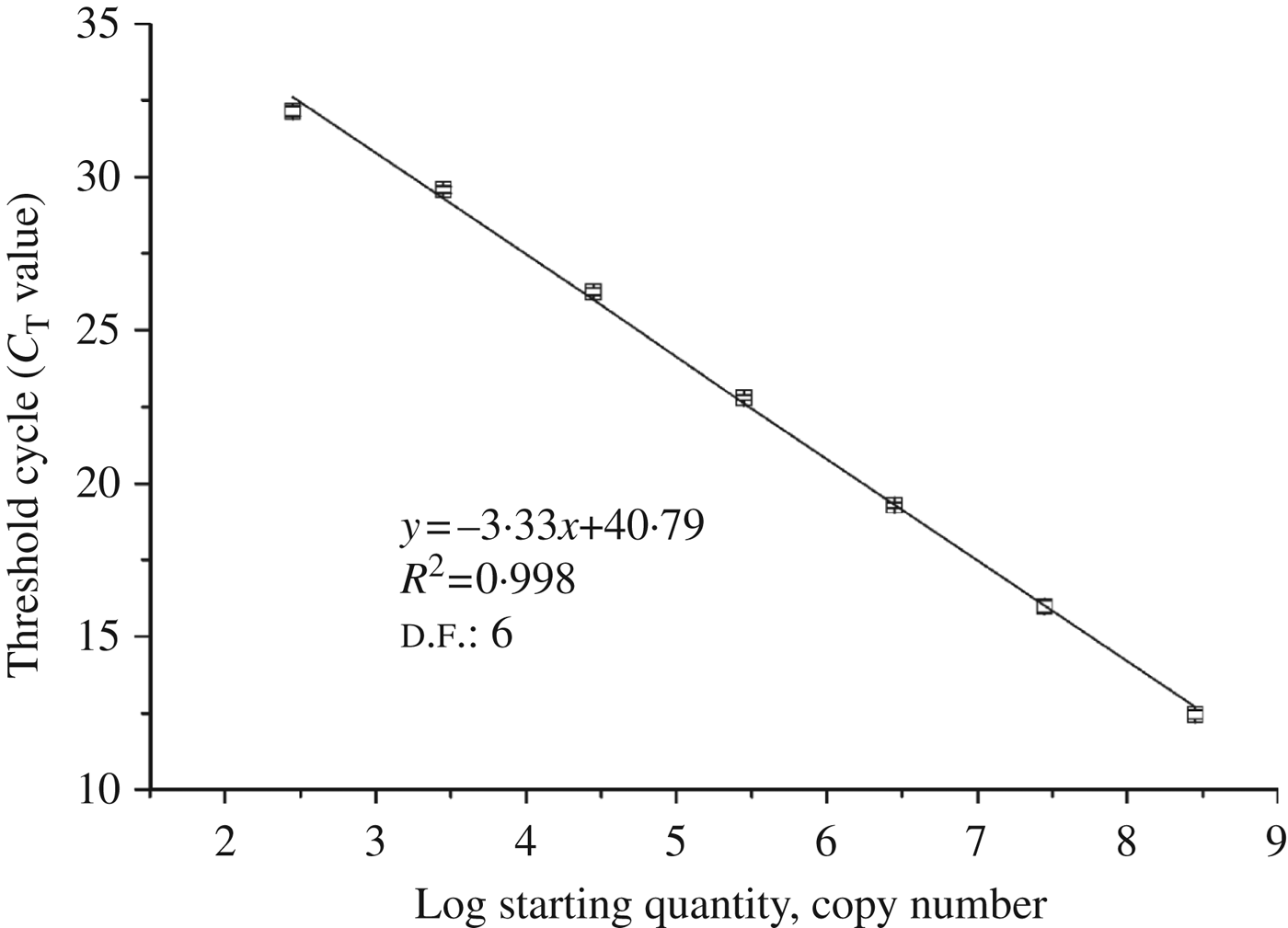
The absolute standard curve was established using serial dilutions of the cloned plasmid pMD18-T containing target DNA from R. solani AG-1-IA strain RS05. Real-time PCR showed good sensitivity in detecting R. solani AG-1-IA and a high linear dynamic range of quantification from 2·81×102 to 2·81×108 copies/μl with a good correlation factor of R 2=0·998 (Fig. 1). The regression equation was Y=−3·33X+40·79 and AE was 99·71%, indicating the primer, probe and the reaction conditions were suitable for quantification of R. solani AG-1-IA.
Real-time PCR absolute standard curve for R. solani AG-1-IA. Pure plasmid DNA containing target DNA serially diluted from 2·81×108 to 2·81×102 copies/μl was used as sample. Least-squares linear regression was used.

Soil sample standard curves
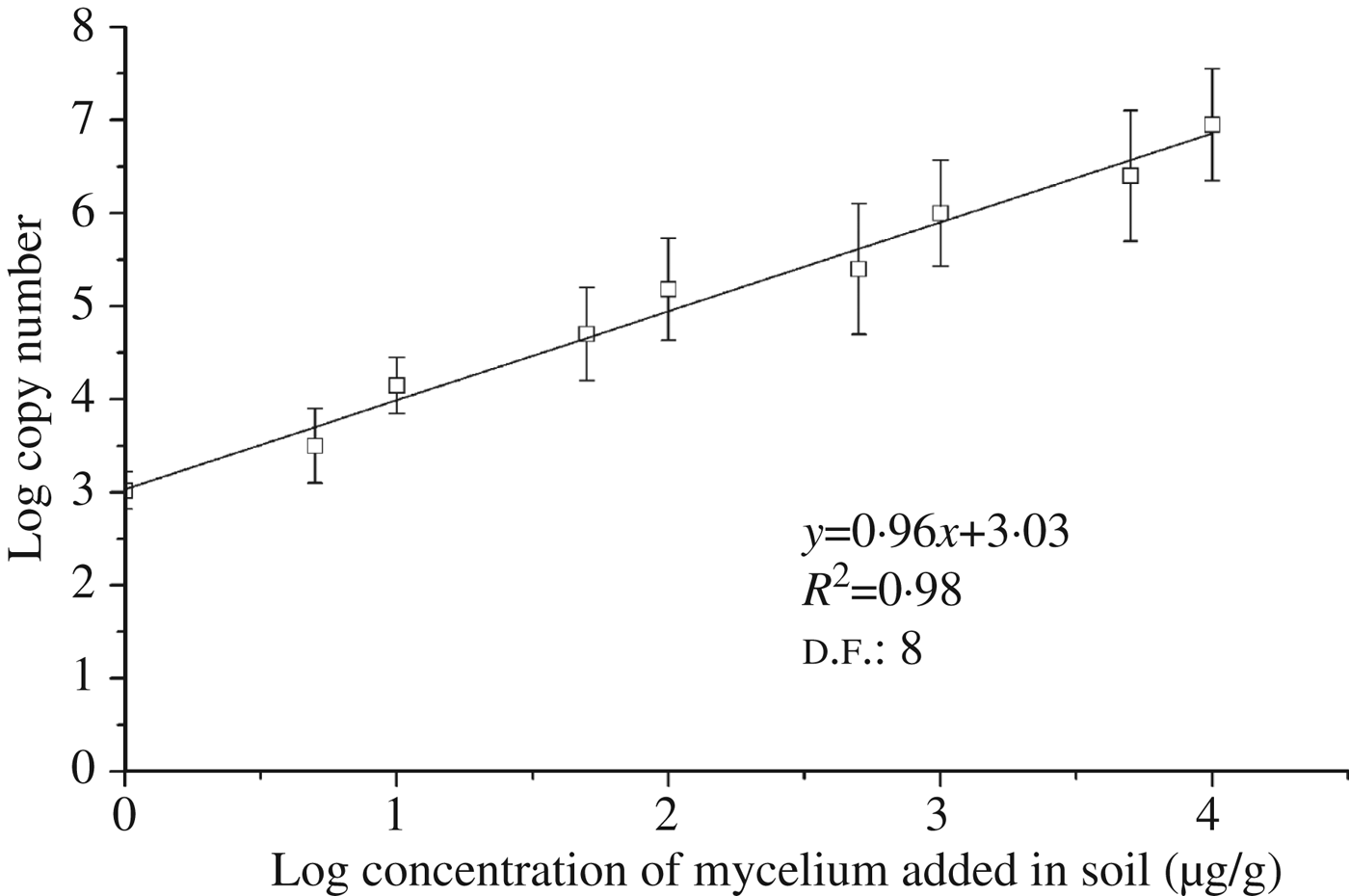
After the rice sheath blight pathogen was artificially added to paddy soils in the ladder, the number of copies detected increased with increasing pathogen concentration. The control treatment in which no pathogen was added resulted in a detection of 469 copies/g soil. Therefore, this value was subtracted from all the other data points in the soil sample standard curve before plotting. At the lowest concentration of 1 μg/g soil, the average detected copy number was 1052 (Fig. 2). The fitting equation was Y=0·96X+3·03 (X:Log concentration of mycelium added in soil; Y:Log copy number detected). The goodness of fit was 0·98, indicating that the method is feasible for the quantification of R. solani AG-1-IA in soil.
Real-time PCR standard curve for quantification of R. solani AG-1-IA in soil samples. Mycelium of R. solani was added to paddy soil in ladder concentration from 1 to 10 000 μg/g soil.
Dynamics of soil pathogens
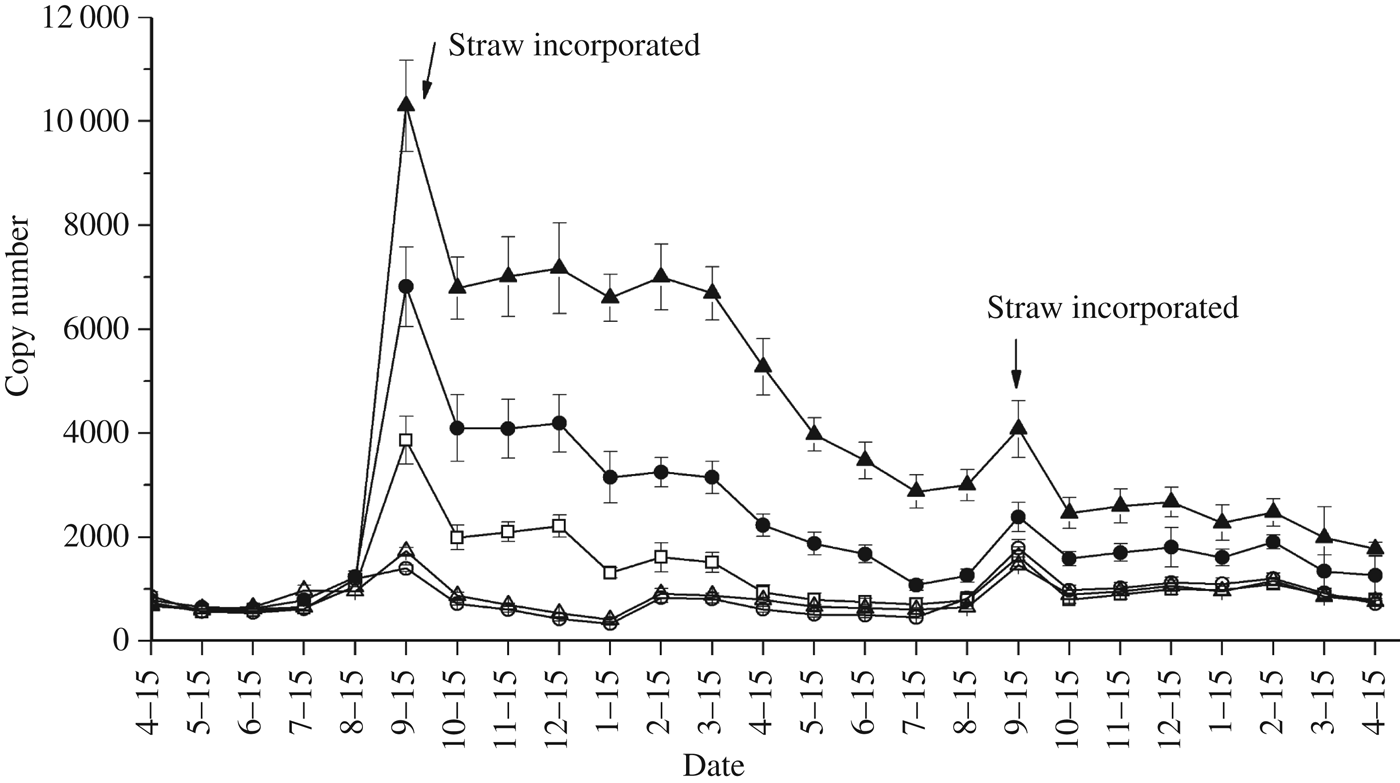
The pathogen quantities were detected in all treatments throughout the trial period (Fig. 3) and increased with increasing proportion of diseased straw. Incorporation of 0·5 and 0·3 diseased straw increased pathogen inoculum in the soil significantly (P<0·05) during the experimental period of 25 continuous months. Incorporation of 0·1 diseased straw enhanced the amount of pathogen inoculum significantly (P<0·05) during the first 7 months from 15 September 2010 to 15 March 2011, but no significant increase was found from 15 April 2011 to 15 April 2012. For the 0 treatment with no diseased straw, the pathogen numbers in September 2010 were significantly (P<0·05) higher than no straw treatment, whereas in September 2011 they were significantly lower (P<0·05) than that of the treatments with no diseased straw.
Population dynamics of R. solani inoculum in soil during rice straw incorporation from April 2010 to April 2012 at three separate locations in Anhui province. Treatments consisted of: ▲ incorporation with 0·5 diseased straw; ● incorporation with 0·3 diseased straw; □ incorporation with 0·1 diseased straw; △ incorporation with healthy straw; ○ no straw incorporated. (d.f.=8).
In September 2010, during the first season, inoculum numbers increased by 8·9, 4·5, 2·7, 0·8 and 0·2 times as a result of 0·5, 0·3, 0·1 and 0 diseased straw and no straw incorporation, respectively. In the second season in September 2011, inoculum numbers increased by 0·4, 0·9, 1·1, 1·2 and 1·2 times as a result of healthy straw incorporation. Pathogen quantities were significantly lower (P<0·05) directly after the second season straw incorporation, compared with the first season straw incorporation.
Effects of straw incorporation on disease severity
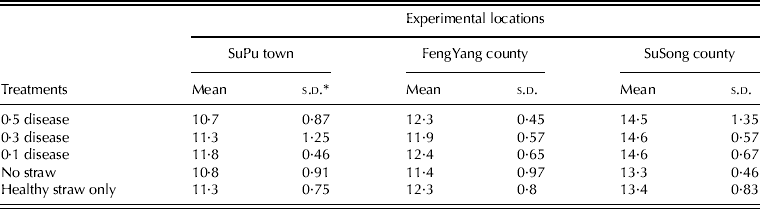
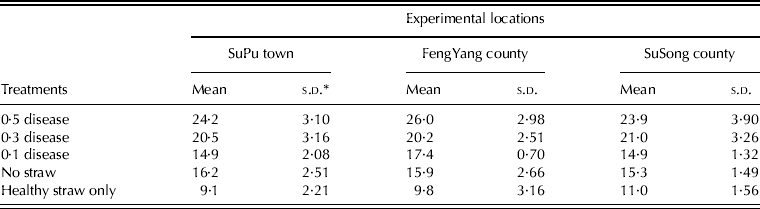
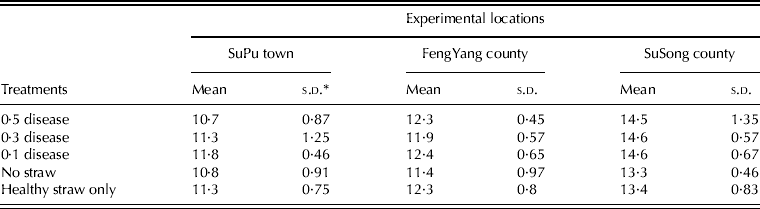
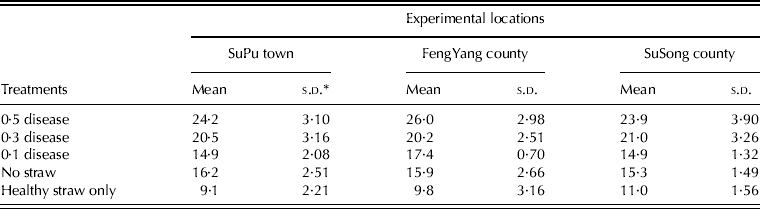
The disease severity indexes of rice sheath blight were determined on 15 August 2010, prior to straw incorporation (Table 1). No significant differences were found between the experimental plots at the three locations. After straw incorporation on 14 September 2010, the disease severity index of rice sheath blight was investigated on 15 August 2011. At two of the locations the disease severity index was significantly lower (P<0·05) for the treatment without diseased straw compared with all the other treatments (including no straw incorporation) (Table 2). No significant differences were found between no straw incorporation and incorporation with 0·1 diseased straw, indicating that incorporation of a small amount of diseased straw into soil did not increase disease severity. However, when a large amount of diseased rice straw (>0·3) was incorporated, the disease severity was significantly higher (P<0·05) than the control treatments of no straw or healthy straw only.
Disease severity index of rice sheath blight prior to the year of straw incorporation
* At each location, three replicated trial districts were investigated, d.f.=2.
Disease severity index of rice sheath blight after diseased rice straw incorporation
* At each location, three replicated trial districts were investigated, d.f.=2.
Correlation analysis
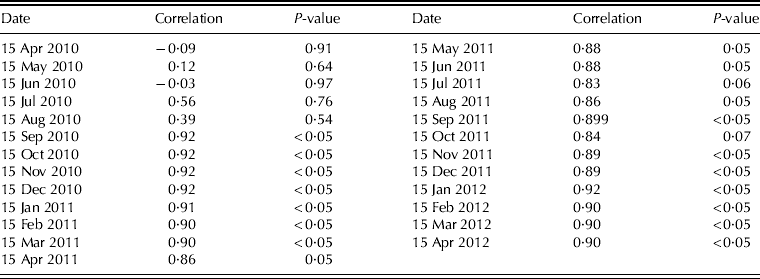
To determine the relationship between soil pathogen amount and disease severity, Pearson correlation coefficients at different stages after straw incorporation were calculated (Table 3). The disease severity did not correlate to the pathogen numbers in the soil before straw incorporation, but it was directly proportional to soil pathogen numbers during the whole period after straw incorporation from September 2010 to April 2012. Correlation coefficients varied from 0·83 to 0·92, and were significant (P<0·05) in 14 of the 25 months.
Correlation analysis of rice sheath blight severity and pathogen inoculum in soil during rice straw incorporation
DISCUSSION
Knowledge of the dynamics of a plant pathogen in soil is crucial for understanding the effects of straw incorporation on disease severity. The results of the present study revealed that incorporation of diseased rice straw had significant effects on the amount of soil-borne inoculum of R. solani AG-1-IA in soil. The inocula in soil during the experimental period were enhanced significantly by increases in the proportion of diseased rice straw incorporated. Rice sheath blight severity was significantly correlated (P<0·05) to pathogen numbers in 14 of the 19 months investigated after straw incorporation. These results proved that rice straw incorporation influences disease severity through changing the amount of inoculum in soil.
Pathogen numbers in soil increased with higher proportions of diseased straw incorporated, indicating that diseased rice straw increased the pathogen numbers in soil significantly. For the no straw treatment and only healthy straw treatments, as well as the treatments during the second straw incorporation (only healthy straw), the increase in September could be attributed to the sclerotia that fell during rice harvest and the small amount of inoculum from incorporated and scattered straw, and rice stubble after rice harvest.
A major result generated by the present study was that the pathogen numbers in September were significantly lower directly after the second season straw incorporation (only healthy straw), compared with the first season straw incorporation for the four treatments of 0, 0·1, 0·3 and 0·5 diseased straw incorporation. However, for the no straw treatment, the pathogen numbers in September of the second season were significantly higher than that of the first season. Moreover, for the no straw treatments, the pathogen numbers in September of the first season were significantly lower compared with incorporation of healthy straw only, whereas the pathogen numbers in September of the second season were significantly higher than that of incorporation of healthy straw only. These results suggested that the decomposition environment after straw incorporation was not suitable for the survival of the pathogens and that healthy rice straw incorporation could control pathogen density in soil.
From September to October the pathogen inoculum decreased sharply for all the treatments. There could be two possible reasons for this: firstly, the rice stubble and rice straw on the surface of the paddy soil were turned over to the bottom. Most of the organic matter was therefore buried under the soil by ploughing and these organic materials helped to reduce the pathogen densities. In addition, several studies have shown that organic matter in soil can be very effective in controlling plant diseases caused by pathogens such as R. solani (Papavizas & Davey Reference Papavizas and Davey1960; Diab et al. Reference Diab, Hu and Benson2003), Fusarium spp. (Lewis & Papavizas Reference Lewis and Papavizas1977), Pythium spp. (McKellar & Nelson Reference McKellar and Nelson2003) and Sclerotium spp. (Coventry et al. Reference Coventry, Noble, Mead and Whipps2005). Mechanisms have been proposed for this, including enhanced activities of antagonistic microbes (Hoitink & Boehm Reference Hoitink and Boehm1999), increased competition against pathogens and release of chemicals toxic to fungi during decomposition of the organic matter (Smolinska Reference Smolinska2000; Tenuta & Lazarovits Reference Tenuta and Lazarovits2002). The second reason could be that the temperature in October started to decrease, which also caused reduced growth rate of pathogen in the soil. Ritchie et al. (Reference Ritchie, Bain and McQuilken2009) studied the effects of nutrient status, temperature and pH on mycelial growth, sclerotia production and germination of R. solani from potato and found that temperature had a significant effect on the mycelial growth rate through soil of R. solani strains, and the optimum temperature for mycelial growth of R. solani was between 20 and 25 °C.
In suppression of soil-borne plant pathogens, crop rotation has been shown to be effective for most diseases. For example, root rot of beans can be reduced by rotating with non-host crops (Strange & Scott Reference Strange and Scott2005). However, at present the effects of oilseed rape on the rice sheath blight pathogen in rice–oilseed rape rotation systems are still unknown. In the current study, oilseed rape was grown in two continuous growing seasons from October 2010 to April 2011, and from October 2011 to April 2012. For the five treatments of 0·5 diseased straw, 0·3 diseased straw, 0·1 diseased straw, healthy straw only and no straw incorporation, The amount of rice sheath blight inoculum in soil was reduced by 22·3, 45·6, 52·9, 9·1 and 14·6%, respectively in the first season, and 28, 20, 1·0, 14·6 and 26·5%, respectively in the second season. These reductions could be partly due to the controlling function of oilseed rape in the rotation. However, further studies will be needed to demonstrate conclusively the effects of oilseed rape in rotation systems on rice disease.
The disease severity for incorporation of healthy straw only was significantly lower than that of the no straw treatment, indicating that incorporation of healthy rice straw could reduce disease severity. The 0·1 diseased straw incorporation had no significant effect on disease severity, indicating that incorporation of a low proportion of diseased rice straw had no effect on disease severity. These results were in accordance with the previous results of Mithrasena et al. (Reference Mithrasena, Adhikari and Wickramasinghe1989) and Cintas & Webster (Reference Cintas and Webster2001), both of whom used rice straw with low disease levels (disease severity index varied from 2·58 to 4·14) for incorporation and found that straw incorporation had no effect on disease severity. However, the present results showed that a high proportion of diseased straw incorporation can increase the pathogen inoculum in paddy soil significantly and also increase disease severity. Therefore, incorporation of diseased rice straw into paddy soil should be regarded as a risk to rice production and severely diseased straw should be removed from the field or pre-treated, e.g. by anaerobic composting or sterilization.
In the present study, the dynamics of the pathogen in soil after rice straw incorporation were investigated in detail. To the authors’ knowledge, it was the first report of the effects of different proportions of diseased straw incorporation on the amount of pathogen inoculum in soil and disease severity. Mithrasena et al. (Reference Mithrasena, Adhikari and Wickramasinghe1989) investigated sheath blight disease severity affected by different methods of rice straw incorporation, but they did not investigate the amount of pathogen inoculum in soil during rice straw decomposition. Some related experimental results were reported on rice stem rot caused by Sclerotium oryzae by Cintas & Webster (Reference Cintas and Webster2001), who investigated the over-wintered sclerotia recovered from soil in spring each year after straw incorporation in autumn of the previous year and found that significantly fewer viable sclerotia were recovered from the burned sub-plots compared with all other sub-plots including straw incorporation, straw rolling and straw removal. The results of Cintas & Webster (Reference Cintas and Webster2001) mentioned that straw incorporation might result in an increase in this disease, but did not report detailed data on the dynamics of pathogen inoculum.
To study the dynamics of plant pathogens in soil, selection of a rapid and accurate method is vital. The main techniques used in the past include host material baiting (Papavizas & Davey Reference Papavizas and Davey1959), wet sieving and direct microscopic examination (Boosalis & Scharen Reference Boosalis and Scharen1959) and plate profiling (Anderson & Huber Reference Anderson and Huber1965). These methods were not accurate and usually labour-intensive and therefore not suitable for large-scale quantification studies. Currently, the development of the real-time PCR technique has greatly facilitated the detection of micro-organisms including fungi, bacteria and virus in plant and soil samples (Lievens et al. Reference Lievens, Brouwer, Vanachter, Cammue and Thomma2006; Li et al. Reference Li, Li, Twieg, Hartung and Levy2008). Budge et al. (Reference Budge, Shaw, Colyer, Pietravalle and Boonham2009) developed a suite of real-time PCR techniques to detect and discriminate 11 anastomosis groups (AGs) of R. solani, and the methods developed were then used to investigate the spatial distribution of R. solani AG-2-1 in field soils. The present results demonstrated that real-time PCR can be used to detect R. solani AG-1-IA in natural soil samples. These results should be helpful for recommendations on rice straw incorporation and for improved disease control.
This study was financially supported by the National Science Foundation of China (grant no. 31000872).