Introduction
Intraguild predation (IGP) is the killing and consuming of a heterospecific competitor that uses similar resources as the prey, and also benefit from preying on each other. IGP has been shown in a number of invertebrate and vertebrate species pairs (Polis et al., Reference Polis, Myers and Holt1989; Rosenheim et al., Reference Rosenheim, Kaya, Ehler, Marois and Jaffee1995; Rosenheim, Reference Rosenheim1998; Raymond et al., Reference Raymond, Darby and Douglas2000; Snyder and Ives, Reference Snyder and Ives2001; Rieger et al., Reference Rieger, Binckley and Resetarits2004; Sergio et al., Reference Sergio, Marchesi, Pedrini and Penteriani2007; Martinou et al., Reference Martinou, Raymond, Milonas and Wright2010; Ferreira et al., Reference Ferreira, Cunha, Pallini, Sabelis and Janssen2011; Perdikis et al., Reference Perdikis, Lucas, Garantonakis, Giatropoulos, Kitsis, Maselou, Panagakis, Lampropoulos, Paraskevopoulos, Lykouressis and Fantinou2014). The aggressor is referred to as the intraguild predator (IG predator), the victim is the intraguild prey (IG prey), and the common resource is an extraguild prey (Lucas et al., Reference Lucas, Coderre and Brodeur1998). IGP not only provides an additional food resource for IG predators, but may also reduce inter- or intraspecific competition, so that it is sometimes considered to be an extreme form of competition. As IG prey populations may suffer substantial mortality due to IGP (Lucas et al., Reference Lucas, Coderre and Brodeur1998; Dixon, Reference Dixon and Dixon2000; Sato et al., Reference Sato, Yasuda and Evans2005), there is evidence that in many cases the IG prey tends to avoid habitats where the IG predators are already or potentially present (Nakashima et al., Reference Nakashima, Birkett, Pye, Pickett and Powell2004; Sarmento et al., Reference Sarmento, Venzon, Pallini, Oliveira and Janssen2007; Frago and Godfray, Reference Frago and Godfray2014). Such habitat selection has been shown both for IG prey females in their choice of suitable oviposition sites, and for IG prey offspring in their choice of feeding sites. Examples are aphid-feeding ladybirds and lacewings (Ruzicka, Reference Ruzicka1998, Reference Ruzicka2001a, Reference Ruzicka2001b; Agarwala et al., Reference Agarwala, Bardhanroy, Yasuda and Takizawa2003; Sato et al., Reference Sato, Yasuda and Evans2005), aphid hymenopteran parasitoids (Nakashima et al., Reference Nakashima, Birkett, Pye, Pickett and Powell2004), dragonflies and damselflies (Ferris and Rudolf, Reference Ferris and Rudolf2007; Mortensen and Richardson, Reference Mortensen and Richardson2008), several species of tree frogs (Hyla) (Rieger et al., Reference Rieger, Binckley and Resetarits2004) and various bird species (e.g. Sergio et al. Reference Sergio, Marchesi, Pedrini and Penteriani2007).
While visual detection of IG predators may be common in vertebrates, the invertebrate IG prey may also use chemical cues associated with the presence of IG predators for habitat selection (Dicke and Grostal, Reference Dicke and Grostal2001). For example, oviposition-deterring compounds in the tracks of larvae of ladybird species (Coleoptera: Coccinellidae) deter females of conspecific or heterospecific ladybirds from laying eggs (Hemptinne et al., Reference Hemptinne, Lognay, Doumbia and Dixon2001; Ruzicka, Reference Ruzicka2003, Reference Ruzicka2006). Hydrocarbons left on the plant by foraging adult ladybirds Coccinella septempunctata and Adalia bipunctata also lead to patch-leaving behaviour of a number of aphid parasitoid species (Nakashima et al., Reference Nakashima, Birkett, Pye and Powell2006). In addition to these non-volatile ladybird tracks, volatile cues have been implicated in the IGP avoidance behaviour of the ladybird Cycloneda sanguine, but the compounds involved have not yet been identified (Sarmento et al., Reference Sarmento, Venzon, Pallini, Oliveira and Janssen2007). We still know little about how IG prey decides to avoid or to leave a patch where the risk of an IGP is high. For habitat choice by IG prey, any chemical cue emitted by an IG predator is a candidate cue to avoid contact with a particular IG predator species. In addition, chemical compounds emitted by the (extraguild) prey, when preyed upon, would also indicate the presence of a predator, but would not be specific to a predator species. The use of such unspecific signals has not been described for IGP systems.
Aphids (Hemiptera: Aphididae) are attacked by a large number of predators and parasitoids, and hence IGP within the guild of aphid natural enemies is frequent (Lucas, Reference Lucas2005). One effective aphid predator that is used frequently in aphid biocontrol is the predatory gallmidge larvae, Aphidoletes aphidimyza (A. aphidimyza) (Rondani) (Diptera: Cecidomyiidae) (Markkula et al., Reference Markkula, Tiittanen, Hämäläinen and Forsberg1979; Boulanger et al., Reference Boulanger, Jandricic, Bolckmans, Wäckers and Pekas2019). The rather small and defenceless larvae of A. aphidimyza suffer from IGP by many other aphid predators, in particular ladybird larvae and predatory anthocorid bugs (Lucas et al., Reference Lucas, Coderre and Brodeur1998; Christensen et al., Reference Christensen, Enkegaard and Brodsgaard2002). Larvae of A. aphidimyza are furtive predators and extract the aphids' body contents on the site without stimulating any significant increase in quick predator avoidance behaviour (e.g. aphid dropping); however, attacks may result in an increase in aphid walking (slow predator avoidance behaviour). There is evidence that A. aphidimyza larvae leave patches where it could become prey to other predators (Lucas et al., Reference Lucas, Coderre and Brodeur1998; Lucas and Brodeur, Reference Lucas and Brodeur2001). Lucas et al. (Reference Lucas, Coderre and Brodeur1998) studied IGP among three common aphid predator species, A. aphidimyza, Chrysoperla rufilabris and Coleomegilla maculata lengi, in the presence and absence of extraguild prey Macrosiphum euphorbiae to characterise the levels and symmetry of IGP among the various stages of the predators. They found that A. aphidimyza is more vulnerable to IGP than the other two predators. In addition, they realised that the sessile and low mobility stages, such as larval or pupal stages of all predator species are more vulnerable to IGP.
One important compound that mediates aphid–predator interactions is the aphid alarm pheromone (E)-β-farnesene (EBF) that is emitted by an aphid when attacked by a predator (Bowers et al., Reference Bowers, Webb, Nault and Dutky1972; Kislow and Edwards, Reference Kislow and Edwards1972). EBF triggers various behavioural reactions: an aphid may become more alert, withdraw the stylet or drop off the host plant (Montgomery and Nault, Reference Montgomery and Nault1977; Humphreys and Ruxton, Reference Humphreys and Ruxton2019). As EBF is only emitted after an attack, it is an indication of predatory activity in the aphid colony (Hatano et al., Reference Hatano, Kunert, Bartram, Boland, Gershenzon and Weisser2008).
In this paper, we use synthetic EBF to investigate if aphid alarm pheromone affects the searching behaviour of the gallmidge A. aphidimyza. Such use of EBF to indicate the presence of an IG predator would be interesting as this would be the first example of the use of an unspecific (extraguild) prey alarm signalling for the avoidance of IGP. In particular, we test if (1) A. aphidimyza larvae change their behaviour in aphid colonies when exposed to EBF, (2) non-predatory adult females of A. aphidimyza change movement or oviposition behaviour in aphid colonies when exposed to EBF, or at two different densities of aphids in the presence of EBF and lastly, (3) EBF mediates changes in IGP of Orius laevigatus (O. laevigatus) (Hemiptera: Anthocoridae) on A. aphidimyza.
Materials and methods
Experimental conditions
Black bean aphid, Aphis fabae, was reared on, and experiments were conducted, on the four-week-old broad bean, Vicia faba, in 10 cm diameter pots covered with air-permeable cellophane bags (L × W = 39 × 18.5 cm, Armin Zeller, Nachf. Schütz & Co, Langenthal, Switzerland) to prevent the scape of experimental insects. These bags have to be air-permeable because it was needed to remove the extra moisture from the bags. Aphids were originally collected near Jena (Thuringia, Germany) on Vicia faba.
For the experiments, aphid replicate (isofemale) lines were initiated by placing single aphid females on new plants. Descendants of a single foundress were used among treatments in each experiment to account for maternal effects (Kunert and Weisser, Reference Kunert and Weisser2003) and were always tested on the same day (i.e. one aphid replicate line was used only once for each treatment). The experiments were conducted at 20°C, with a photoperiod of 16:8 L:D and about 75% relative humidity.
Rearing of experimental predators
The predatory midge, A. aphidimyza, was obtained as pupa from a commercial supplier (Katz Biotech Services, Germany). Adults were hatched by placing the pupae into a dark growth chamber for 48 h at 20°C. To obtain gallmidge larvae, adult A. aphidimyza was released on aphid-infested plants for laying eggs. Nine days after eclosion, the larvae reached the third instar (maintained on plants with A. fabae as a food source) and were then used in the experiment. To obtain gravid females, couples of newly-hatched female and male flies from the pupae stage were kept separately in test tubes (diameter 50 mm, height 100 mm) for 24 h to encourage mating and gravid females were subsequently used in the experiment.
The predatory minute bug, O. laevigatus, was obtained as adults from the same commercial supplier. Adults were kept in a dark growth chamber at 10°C (according to the Katz Biotech AG company's instruction for short-term storage of adult O. laevigatus, those should be stored in a cool (8–10°C) and dark place) and fed with A. fabae until they were used in the experiments.
Experiment I – Larval behaviour
This experiment tested the effect of EBF on the behaviour of A. aphidimyza larvae, in the absence or the presence of aphids. Thus, the experiment had two treatments with two-factor levels, each in a 2 × 2 factorial design. One predatory A. aphidimyza gallmidge larva was released either on an aphid-free plant or a plant infested with 10 third/fourth nymphal instars of the aphid A. fabae, and these were exposed to either EBF (Bedoukian Research Inc., Danbury, CT, USA) or to n-hexane as a control.
To obtain experimental aphids, eight adult aphids from a replicate line were placed on four new broad bean plants (two adult aphids on each plant) to produce 10–12 offspring within 24 h after which time the adults were removed from the plant. The four plants were randomly allocated to one of the four treatments. After 6 days, ten offspring were left on the plant and used in the experiment.
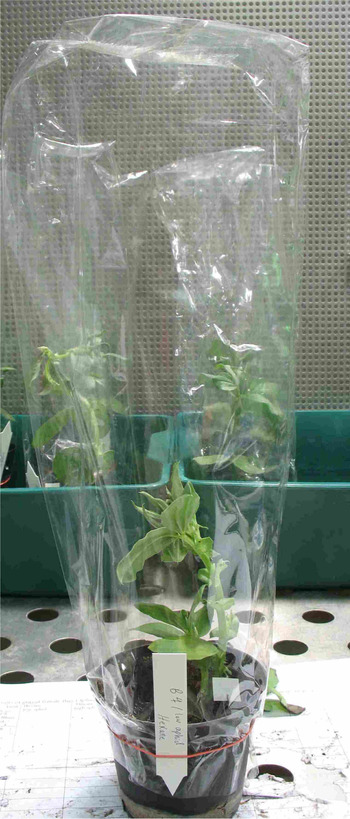
A single larva of A. aphidimyza was starved for 5 h before being placed on a second fully expanded leaf of each plant. The plant was then covered by a cellophane bag (fig. 1). The cellophane bag had no connection with the plant, and there was a space between the plant and the bag, so, the cellophane bag had no effect on larval foraging behaviour. Immediately after placing the bag on the plant, EBF solution (500 ng in 3 μl n-hexane) or only 3 μl n-hexane was applied, using a glass syringe (10 μl, Hamilton), through a small hole in the cellophane bag with a piece of filter paper (1 × 1 cm) held by a wire that was inserted into the soil (Kunert et al., Reference Kunert, Otto, Rose, Gershenzon and Weisser2005). The distance between the filter paper and the plant was ~5 cm (fig. 1). For the next 15 min, the behaviour of A. aphidimyza larva was observed at every 1 min such that a snapshot of behaviour was taken once every minute (in total 15 observations) without removing the cellophane bag using a desk table magnifier with 20 × magnification. Larvae displayed one of the following behaviours when being on the plant: larval movement (crawling) on the leaf, larval movement on the stem, no movement (resting), head circulation (alert behaviour while not moving on the plant), also used as defence behaviour (cf. Messelink et al., Reference Messelink, Bloemhard, Cortes, Sabelis and Janssen2011) and feeding (predatory behaviour). We also noted when a larva was off the plant. Aphid behaviour was also observed for 1 min after the application of EBF or n-hexane, and noted when they moved off the plant. We calculated the proportion of time points (N = 15) doing a particular behaviour for using in the analyses. Finally, we calculated the time up to the first attack as the number of observations before the first attack of a larva on an aphid was observed. In total 15 replicates were used in the experiment (15 × 4 treatments = 60 experimental units).
The experimental unit, which shows a setup for the experiments. A broad bean, Vicia faba, in 10 cm diameter pots covered with air-permeable cellophane bags (L × W = 39 × 18.5 cm, Armin Zeller, Nachf. Schütz & Co, Langenthal, Switzerland) to prevent the scape of experimental insects.

Experiment II – Female behaviour
This experiment tested the effect of EBF on the behaviour of gravid A. aphidimyza females, at two different densities of aphids. As preliminary experiments had shown that female A. aphidimyza only lays eggs on aphid-infested plants, females were released on plants infested by either 50 (high density) or 5 (low density) aphids. The different densities were chosen to test the effect of EBF on females over a broader range of aphid densities. Thus, the experiment had also two treatments with two-factor levels each, in a 2 × 2 factorial design. Female A. aphidimyza and aphids were exposed to either EBF (500 ng in 3 μl n-hexane) or 3 μl n-hexane as a control three times in the experiment: at the beginning and after 8 and 16 h.
To obtain low-density aphid colonies a single adult of A. fabae was introduced on a new bean plant and allowed to produce offspring for 24 h. Five offspring were left on the plant. To obtain high-density colonies, ten adult aphids from the same line were at the same time introduced to another plant for 1 day after which all aphids except about 50 (48–52) offspring were removed from the plant. The plants were used in the experiment when the offspring were 6 days old. Plants were again covered with cellophane bags.
To start the experiment, a single mated female of A. aphidimyza (17 days old) was released into the cellophane bag using a glass tube (diameter 15 mm, height 120 mm). Immediately afterwards, EBF or n-hexane was applied using a glass syringe (10 μl, Hamilton) onto a piece of filter paper (1 × 1 cm) fixed with a wire that was inserted into the soil. The behaviour of the female was observed at every 1 min for 10 min (in total ten observations): Movement on the plant, immobile on the plant, immobile off the plant (on the cellophane bag) or flying off the plant. After 24 h, the total number of eggs laid on the plant was counted. In addition, aphid walking behaviour was recorded for 1 min after the application of solutions. In total 27 replicates were used in the experiment (27 × 4 treatments = 108 experimental units).
Experiment III – Effect of EBF on IGP
To assess the effect of EBF on IGP of A. aphidimyza by O. laevigatus, four third-instar larvae of A. aphidimyza were starved for 5 h before being placed on a leaf of an experimental plant with a group of eight black bean aphids covered with a cellophane bag. Immediately after placing the larvae on the plant, EBF solution (500 ng in 3 μl n-hexane) or only 3 μl n-hexane was applied (for details see experiment I).
After 5 min, the behaviour of the four A. aphidimyza larvae was classified: feeding on aphids, moved off the plants, or still on the plant but not feeding. Aphid behaviour was also observed for 1 min after the application of EBF, to assess if aphids were walking away from the feeding site or dropped from the plant. After these five min, an O. laevigatus female was introduced, using a fine paintbrush, near the aphid colony where most A. aphidimyza larvae were also present. The behaviour of the O. laevigatus was then observed once a minute for 15 min. We noted if the O. laevigatus was walking on the plants, whether it was immobile or whether it was attacking an A. aphidimyza larvae or an aphid. In total 13 replicates were used in the experiment (13 × 2 treatments = 26 experimental units).
Statistical analysis
Results are presented as means ± standard error in all cases. All data were analysed in R v3.2.0 using RStudio v 0.98.977. Data for the first (larval behaviour) and second (female behaviour) experiment was analysed using GLMs with quasi-binomial error distribution for the response variables with proportion data. Here, we used the number of instances of a particular behaviour bound as one variable to the total number of instances, using the cbind function in R. In these experiments, we also analysed the movement of aphids (number of aphids moving within 1 min of EBF application) and the number of eggs laid by the female A. aphidimyza and here, we used a GLM with quasi-Poisson error distribution of count data. For experiment III, we also ran models using aphid movement and O. laevigatus attack rate on aphids to test the relative importance of each variable in the model. The time to first attack by A. aphidimyza larvae was analysed using a standard linear model with normal error distribution. Full models were first run, including block as a factor, and then a backwards stepwise model was used to obtain the minimum adequate model.
Results
Experiment I – Larval behaviour
The A. aphidimyza larvae exhibited more instances of alert behaviour (head circulation, an alert and orientation behaviour of the gallmidge larvae) and the movement on the stem when EBF was present, but this was dependent on the presence of aphids (table 1). For example, head circulation was most frequent when there were no aphids and EBF was present (17.8 ± 2.7% of instances in this treatment), and least when there were no aphids and no EBF (5.8 ± 2.2% of instances; fig. 2). Larval movement on the stem and off the plant was more frequent on plants with aphids and EBF alarm pheromone (fig. 2); in this treatment, aphids were also more likely to move off the plant (18.7 ± 2.1% move when EBF was present compared to only 3.1 ± 0.9% when EBF was absent). In the other treatments, there was little movement on the stem or off the plant and therefore on these, we observed more instances of movement on the leaf and feeding on aphids (fig. 2). There was no significant difference in the time to first aphid feeding instance between the EBF (11 ± 1.78 min, n = 4) and control treatments (8.78 ± 1.16 min, n = 9) (F 1,11 = 1.11, P = 0.314), although only 13 replicates, in which larvae were feeding, could be evaluated.
The behaviour of aphids and A. aphidimyza larvae. Data are given as the mean number for the aphids and as the proportion of time spent (15 min) among experimental treatments for Aphidoletes: with aphids (hashed bars) and without aphids (soild bars), and with exposure to EBF alarm pheromone (grey bars) and without exposure to EBF alarm pheromone (white bars). Aphidoletes behaviour was split into different movement behaviours (off plant, on leaf, on stem and no movement) plus alert behaviour (head circulation) and predatory behaviour (feeding). Different letters denote significant difference between treatments (P < 0.05). Error bars show ± 1SE.

Summary of results from A. aphidimyza larval behaviour experiment, using plants with/without aphids and with/without exposure to EBF.

Arrows show the direction of effect, ↑ means more instances of this behaviour in either the presence of aphids or with EBF alarm pheromone, ↓ means fewer instances of this behaviour. N = 60. Values in bold are significant at P < 0.05.
Experiment II – Female behaviour
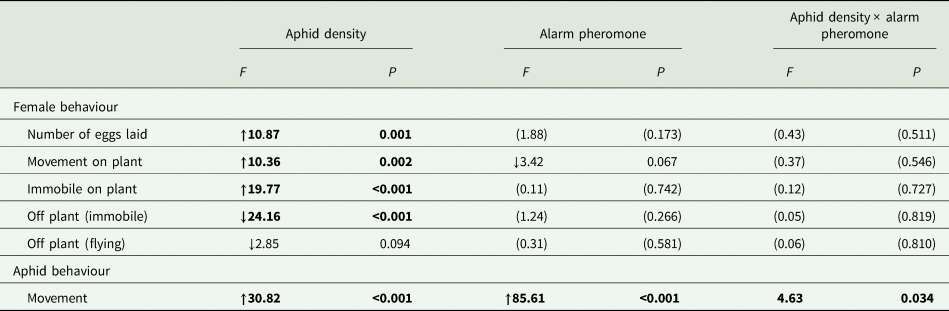
The behaviour of the adult female A. aphidimyza was strongly affected by aphid density (table 2). Females spent more time on the plant when the aphid density was high and this did not vary with the EBF treatment, which had very little effect on female behaviour (table 2; fig. 3). In total 57 out of 108 females lay eggs in the experiment. Females laid significantly more eggs in the high aphid density treatments, with no effect of EBF (table 2, fig. 3).
The behaviour of aphids and A. aphidimyza females. Data given as the mean number for the aphids and eggs laid, and the proportion of time spent (10 min) among experimental treatments for other Aphidoletes female behaviour: with a high density of aphids (hashed bars) and low density of aphids (solid bars), and with exposure to EBF alarm pheromone (grey bars) and without exposure to EBF alarm pheromone (white bars). Aphidoletes female behaviour was split into different movement behaviours (movement on plant, immobile on plant, off plant (immobile) and off plant (flying)) plus oviposition behaviour (number of eggs laid). Different letters denote significant difference between treatments (P < 0.05). Error bars show ± 1SE.

Summary of results from A. aphidimyza female behaviour experiment, using plants with high/low aphid density and with/without exposure to EBF.

Arrows show the direction of effect, ↑ means more instances of this behaviour in either the high aphid density or with EBF alarm pheromone, ↓ means fewer instances of this behaviour. N = 108. Values in brackets were removed from the minimum adequate model. Values in bold are significant at P < 0.05.
The addition of EBF increased aphid movement and the response was dependent on aphid density with more instances of aphid walking in the high-density treatment with EBF (table 2, fig. 3). The number of instances of aphid movement was the same for the high and low aphid densities with no EBF with 5 instances across all replicates compared to 74 instances across all replicates when EBF was present (fig. 3). Thus, while there were more aphids in the high-density treatment potentially leading to a higher chance of aphid movement, without EBF the aphids moved very little in either density treatment.
Experiment III – Effect of EBF on IGP
Consistent with the previous experiments, aphids were observed to walk away and drop off the plant more often in the presence of EBF (F 1,24 = 227.6, P < 0.001). The behaviour of A. aphidimyza larvae was consistent with the results from experiment I, with larvae only leaving the plant when EBF was present (F 1,24 = 26.67, P < 0.001) and also feeding on aphids for less time with EBF present (F 1,24 = 28.27, P < 0.001) (fig. 4). By including aphid movement into the model as a covariate for movement of A. aphidimyza larvae off the plant, we see that EBF treatment still significantly explains more of the variation (F 1,23 = 49.70, P < 0.001) than does aphid movement (F 1,23 = 13.23, P < 0.001).
The behaviour of A. aphidimyza larvae and O. laevigatus adults, with and without EBF alarm pheromone addition. Data are given as the mean number of Aphidoletes (total of four individuals) and the proportion of time spent (15 min) for Orius behaviour. Different letters denote significant difference between treatments (P < 0.05). Error bars show ± 1SE.

There was no effect of EBF on the time that O. laevigatus spent either immobile (F 1,24 = 0.98, P = 0.333) or walking on the plant (F 1,24 = 0.02, P = 0.883) (fig. 4). Attacks of O. laevigatus on A. aphidimyza, were, however, more frequent when EBF was not present (F 1,24 = 9.21, P = 0.006), and when EBF was present O. laevigatus attacked more aphids (F 1,24 = 3.45, P = 0.076) (fig. 4). By including aphid movement and O. laevigatus attack rate on aphids into the model as a covariate for the attack rate of O. laevigatus on A. aphidimyza we found that EBF again explains a significant amount of variation (F 1,22 = 6.54, P = 0.018) above that explained by aphid movement (F 1,22 = 6.39, P = 0.019) or O. laevigatus attack rate on aphids (F 1,22 = 13.85, P = 0.001).
Discussion
We found that the larvae of the predatory gallmidge A. aphidimyza responded to the presence of EBF with non-predatory adults not responding. The aphids themselves responded strongly to EBF by moving off the plant, which may have also led the larvae to also move off the plant since they only did this in response to EBF when aphids were present. In accordance, the larvae showed less movement on the leaves as they moved onto the stem and consequently off the plant when both aphids and EBF were present. Therefore, EBF presence plus aphid movement off the plant together had a stronger (non-additive) effect on the probability of a larva leaving a plant. Larval feeding was also disrupted by EBF, with more feeding occurring when there was no EBF and less when there was, again likely influenced by the aphid movement off the plant. The increased probability of moving off a plant in the presence of both aphids and EBF was also found to be related to a reduced probability of being preyed upon by intraguild predators, such as O. laevigatus. This suggests that the plant-leaving behaviour also serves to reduce the risk of intraguild predation.
Gallmidge head circulation movements were also increased after EBF application, particularly when there were no aphids. This indicates the behaviour may be linked to IG predator recognition. Head circulation is an alert behaviour response to the search for additional cues on the presence of an IG predator (Messelink et al., Reference Messelink, Bloemhard, Cortes, Sabelis and Janssen2011). Predatory A. aphidimyza gallmidges are stealthy predators, and the larvae approach their victims by inconspicuous creeping movements and subdue them by injecting a paralyzing toxin, thereby deactivating behavioural defences of the prey. Gallmidge feeding itself does not stimulate any significant increase in dropping behaviour or movements of the remaining aphids in the colony (Klingauf, Reference Klingauf1967; Lucas and Brodeur, Reference Lucas and Brodeur2001). Thus, for gallmidge larvae, any increase in aphid plant-leaving behaviour on the plant is evidence for the action of a different aphid predator on the plant (Lucas et al., Reference Lucas, Coderre and Brodeur1998). By leaving plants when aphids start to move around, gallmidge larvae not only decrease the risk of becoming a victim of IGP, but this could also be a cue to leave due to diminishing resources. While we did not inherently test this in our experiments, the slow and stealthy attack method by A. aphidimyza larvae means they cannot feed on moving aphids and thus would be negatively affected by increased aphid movement.
The behaviour of adult females of A. aphidimyza was not affected by the application of EBF. Instead, females responded to increased aphid density on the plant by increasing residence time and oviposition rate. Thus, females respond positively to the likelihood of increasing their reproductive success (reviewed by Boulanger et al., Reference Boulanger, Jandricic, Bolckmans, Wäckers and Pekas2019), but they do not react towards possible risks for their offspring. A possible explanation for the lack of response, apart from a possible inability to perceive EBF, is that EBF emission is not a good indicator for the future risk of IGP for the gallmidge offspring. In another study, adult A. aphidimyza females also did not respond to the presence of adult or larvae of the coccinellid IG predator Coleomegilla maculata (Lucas and Brodeur, Reference Lucas and Brodeur1999). On the other hand, female gallmidges are able to recognise the presence of conspecific gallmidge larvae. When aphid colonies were exposed to A. aphidimyza larvae or to water extracts of larvae, female gallmidges laid significantly fewer eggs in such colonies (Ruzicka and Havelka, Reference Ruzicka and Havelka1998). These conflicting results need further attention. It is possible that the time-delay between egg-laying and the hatching of the larvae makes an avoidance of currently predator-occupied patches non-adaptive, as many aphid predators stay only for a short time in aphid colonies (Minoretti and Weisser, Reference Minoretti and Weisser2000). However, this may be unlikely since eggs are vulnerable to intraguild predation because of their small size and immobility (Lucas, Reference Lucas2005). With respect to their ability of perceiving EBF, a number of studies have suggested that female midges use honeydew as a cue in the process of prey location and do not use plant volatiles or odours from the aphids themselves (reviewed by Boulanger et al., Reference Boulanger, Jandricic, Bolckmans, Wäckers and Pekas2019).
IGP is widespread in aphidophagous guilds and represents an important mortality factor for aphid predators (Rosenheim et al., Reference Rosenheim, Wilhoit and Armer1993; Müller et al., Reference Müller, Adriaanse, Belshaw and Godfray1999; Arim and Marquet, Reference Arim and Marquet2004; Lucas, Reference Lucas2005; Nedved et al., Reference Nedved, Fois, Ungerova and Kalushkov2013; Yu et al., Reference Yu, Feng, Fu, Sun and Liu2019). We have shown that the presence of EBF not only alerts aphids but also results in a change in the behaviour of predatory gallmidge larvae. To our knowledge, this provides the first example for a role of an unspecific (extraguild) prey alarm signal in the avoidance of IGP by the intraguild prey. Interestingly, in the interaction between aphids and gallmidges, EBF may be classified as a synomone (Vet and Dicke, Reference Vet and Dicke1992) as it provides benefits to both the producer and the receiver of the signal: for gallmidge larvae, the risk of an IGP is reduced while the leaving of gallmidges also provides benefits for the aphids because their predation pressure is reduced. However, while the aphid benefits from short-term reduced predation, it also suffers from reduced feeding that will reduce its own reproductive efforts. Moreover, if the gallmidge is successful in avoiding IG predation then this can benefit its population growth, therefore longer-term dynamics may reveal a negative effect on aphids. It needs to have in mind that in this study the synthetic EBF has been tested, not a compound that is released by an organism.
The most important applied aspects of the findings of IGP are their use in biological control and conservation management (Müller and Brodeur, Reference Müller and Brodeur2002; Boulanger et al., Reference Boulanger, Jandricic, Bolckmans, Wäckers and Pekas2019). We note that in this study synthetic EBF was used rather than aphid-derived EBF, and thus these interactions require further study to understand how the levels produced by aphids in the field may impact biological control and IGP effects. We showed that at higher aphid density adult gallmidges were more likely to be on the plant and lay eggs, while the larvae were more likely to respond to the alarm pheromone and follow aphids off the plant. In an agricultural field, this would increase the number of larvae on plants with high aphid density, but also the larvae will potentially follow the aphids as they move onto other plants after being disturbed by other predators further increasing overall biocontrol. Field experiments and longer-term studies on the community-level consequences will lead to a greater understanding of how IGP can be managed in the field to maximise biological control success.
Acknowledgements
Support from the Deutsche Forschungsgemeinschaft (DFG, WE 3081/2-3) and the Ministry of Science, Research and Technology of Iran (for MH) was acknowledged. MM was supported by the Institute of Science and High Technology and Environmental Sciences, Graduate University of Advanced Technology, Kerman, Iran. We thank Katz Biotech Services for the provision of predators.
Author contributions
Conceived and designed the experiments: MH, WWW. Performed the experiments: MH, EH. Analysed the data: MH, MM, SZ. Contributed to the writing of the manuscript: MH, MM, SZ, WWW.
Conflict of interest
The authors declare that they have no conflict of interest.