Introduction
The lichen genus Lecanora Ach. s. lat. is a widespread and very diverse genus consisting of c. 600 species worldwide, and broadly circumscribed as including species with lecanorine apothecia, simple, hyaline ascospores, green-algal photobionts and Lecanora-type asci (Zahlbruckner Reference Zahlbruckner, Engler and Prantl1926; Ryan et al. Reference Ryan, Lumbsch, Messuti, Printzen, Śliwa, Nash, Nash, Gries and Bungartz2004; Bungartz et al. Reference Bungartz, Elix and Printzen2020). Species of Lecanora in its broadest sense are currently assigned to several different genera or species groups, based on phenotypic characters and/or phylogenetic analyses (Eigler Reference Eigler1969; Zhao et al. Reference Zhao, Leavitt, Zhao, Zhang, Arup, Grube, Pérez-Ortega, Printzen, Śliwa and Kraichak2016), for example Bryonora Poelt (Poelt Reference Poelt1983); Palicella Rodr. Flakus & Printzen (Rodriguez Flakus & Printzen Reference Rodriguez and Printzen2014); Lecanora s. str. (Brodo Reference Brodo1984; Lumbsch Reference Lumbsch1994; Guderley Reference Guderley1999; Papong & Lumbsch Reference Papong and Lumbsch2011); Lecanoropsis M. Choisy (=L. saligna group) (Ivanovich et al. Reference Ivanovich, Dolnik, Otte, Palice, Sohrabi and Printzen2021); Polyozosia A. Massal. (=Myriolecis Clem., L. dispersa group) (Clements Reference Clements1909; Zhao et al. Reference Zhao, Leavitt, Zhao, Zhang, Arup, Grube, Pérez-Ortega, Printzen, Śliwa and Kraichak2016); Protoparmelia M. Choisy (Choisy Reference Choisy1929); Protoparmeliopsis M. Choisy (=L. muralis group) (Zhao et al. Reference Zhao, Leavitt, Zhao, Zhang, Arup, Grube, Pérez-Ortega, Printzen, Śliwa and Kraichak2016); Pulvinora Davydov et al. (Davydov et al. Reference Davydov, Yakovchenko, Hollinger, Bungartz, Parrinello and Printzen2021); Tephromela M. Choisy (Choisy Reference Choisy1929); Vainionora Kalb (Kalb Reference Kalb1991). Even so, there are still some species that do not fit into existing genera or species groups, partly because no conclusive systematic framework currently exists on how to separate the remainder of Lecanora species into more natural units.
The core of Lecanora s. str. (i.e. the Lecanora subfusca group) is the species related to the type species L. allophana Nyl. (Brodo & Vitikainen Reference Brodo and Vitikainen1984), which is characterized by a crustose thallus, the production of atranorin, the presence of calcium oxalate crystals in the amphithecium, ellipsoid to broadly ellipsoid spores, and filiform conidia (Brodo Reference Brodo1984; Lumbsch Reference Lumbsch1994). The presence and size of crystals in the epihymenium and amphithecium (when checked in polarized light, crystals shine brightly), their solubility, pigmentation of the epihymenium, and the structure and development of the amphithecial cortex, are important diagnostic characters in this group (Kofler Reference Kofler1956; Brodo Reference Brodo1984; Miyawaki Reference Miyawaki1988; Lumbsch Reference Lumbsch1994; Guderley Reference Guderley1999). Brodo (Reference Brodo1984) summarized and revised these different diagnostic characters based on previous studies, and published a valuable monograph of North American species that has been used as an important reference for the study of Lecanora s. str.
In addition, detailed regional revisions of Lecanora s. str. exist for Australasia (Lumbsch Reference Lumbsch1994), South and Central America (Guderley Reference Guderley1999), the Czech Republic (Malíček Reference Malíček2014), India (Upreti Reference Upreti1998), Thailand (Papong & Lumbsch Reference Papong and Lumbsch2011) and Japan (Miyawaki Reference Miyawaki1988). From China, 119 species of Lecanora s. lat. have so far been reported (Zahlbruckner Reference Zahlbruckner and Handel-Mazzetti1930; Wei Reference Wei1991; Mamut et al. Reference Mamut, Li, Abbas and Fu2019; Lü et al. Reference Lü, Yang and He2020), including several newly described species and new country records published in recent decades (Lü et al. Reference Lü, Wang, Ren, Shi and Zhao2008, Reference Lü, Ren, Sun, Yang and Zhao2009a, Reference Lü, Wang and Zhaob, Reference Lü, Zhang, Liu, Zhao and Wang2012, Reference Lü, Ren, Jiang, Wang and Zhao2013; Wang et al. Reference Wang, Wang and Lumbsch2013; Lü & Zhao Reference Lü and Zhao2017a, Reference Lü and Zhaob). Among them, c. 25 species belong to Lecanora s. str. (Han et al. Reference Han, Zhao and Guo2009; Lü et al. Reference Lü, Ren, Jiang, Wang and Zhao2013). However, molecular data are largely lacking and no comprehensive systematic revision of the group has so far been published.
This study is part of the ongoing project ‘Lecanomics’ (https://lecanomics.org), which aims to develop new ways to identify and delimit species of the genus Lecanora. Among the collections from south-west China, there were two distinctive, closely related taxa. Lecanora zeorina Li J. Li & Printzen constitutes a new species, which we describe below. Another species was identified as Protoparmeliopsis crystalliniformis B. G. Lee & Hur., for which we suggest the new combination Lecanora crystalliniformis (B. G. Lee & Hur) Li J. Li & Printzen. Phenotypic characters, geographical distribution and phylogenetic relationships of the two species are presented and discussed below.
Materials and Methods
The specimens in this study are deposited in the Lichen Herbarium, Kunming Institute of Botany, Chinese Academy of Sciences (KUN), and the Herbarium Senckenbergianum Frankfurt/M. (FR) (duplicates).
External morphological characters were studied on air-dried material under a stereomicroscope (Zeiss Stemi SV11). Anatomical features were studied using a light microscope (Zeiss Axioskop 2 plus) on transverse sections of apothecia and thalli prepared with a freezing microtome (Zeiss HYRAX KS 34) and mounted in water or lactophenol cotton blue. Measurements are presented in the following way: (minimum–)(x̄ - SD)–(x̄ + SD)(–maximum), where x̄ is the arithmetic mean and SD is the standard deviation. Crystals in apothecia were observed in polarized light (POL); their solubility was studied in 20% HNO3 (N) and 10% KOH (K).
Spot tests were conducted with K and a saturated aqueous solution of NaClO (C). Thin-layer chromatography (TLC) was performed in solvents A, B′ and C to identify lichen chemical compounds, generally following standardized methods (Culberson Reference Culberson1972; Arup et al. Reference Arup, Ekman, Lindblom and Mattson1993).
Total DNA was extracted from dried samples using the GeneOn Plant DNA Extraction Kit (GeneOn BioTech, Changchun, China) with the magnetic bead method. The fungal internal transcribed spacer (ITS) regions of the rDNA were amplified via polymerase chain reaction (PCR) using the primers ITS1F (Gardes & Bruns Reference Gardes and Bruns1993) and ITS4 (White et al. Reference White, Bruns, Lee, Taylor, Innis, Gelfand, Sninsky and White1990), and the mitochondrial small subunit (mtSSU) of ribosomal RNA using the newly designed primers 16F (5ʹ–3ʹ: CAGCAACTTGGAGGAATG) and 972R (5ʹ–3ʹ: ATGATGACTTGTCTTAGTCC). Polymerase chain reactions (PCR) were performed in 25 μl volumes using Illustra PuReTaq Ready-To-Go PCR Beads (GE Healthcare Life Sciences, Little Chalfont, Buckinghamshire, UK) containing 5 μl of DNA extract and 1 μl (10 pmol μl-1) of each primer. Cycling conditions included initial denaturation at 94 °C for 5 min, followed by four cycles of 94 °C for 30 s, 54 °C (53 °C for mtSSU) for 30 s, and 72 °C for 60 s; 30 cycles of 94 °C for 30 s, 48 °C for 30 s, and 72 °C for 60 s; with a final extension at 72 °C for 10 min. The PCR products were sequenced by Macrogen Europe (Amsterdam, The Netherlands).
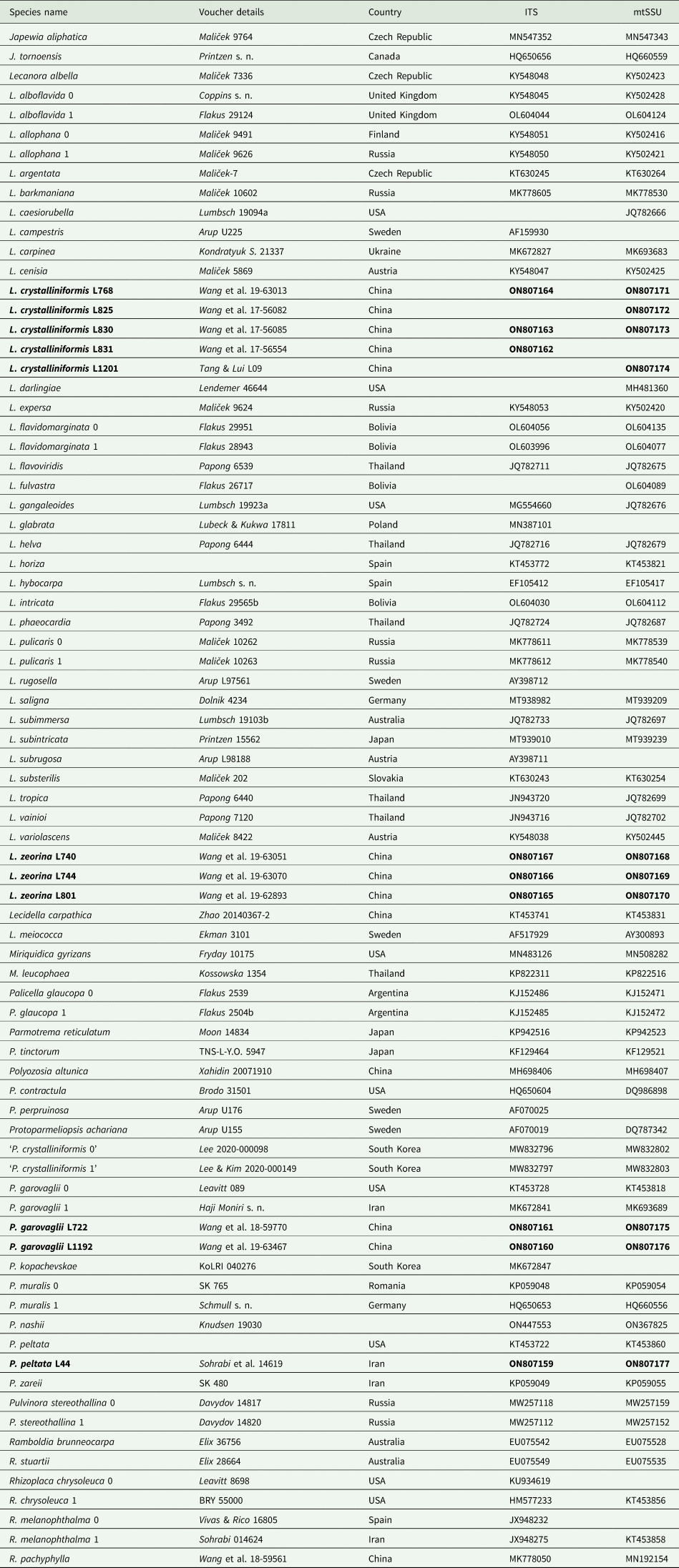
We used the newly generated nrITS and mtSSU sequences and additional sequences downloaded from GenBank (Table 1) to reconstruct a phylogenetic tree. Sequences were assembled and edited with Geneious Prime v. 2021.0.3. Each gene dataset was aligned using the MAFFT algorithm on the GUIDANCE2 web server (http://guidance.tau.ac.il/; Sela et al. Reference Sela, Ashkenazy, Katoh and Pupko2015), simultaneously removing poorly or ambiguously aligned regions with the default parameter settings. Congruence between different gene datasets was checked before concatenating. The final concatenated alignment included 972 bp and 80 taxa, and had the following dimensions: 77 sequences, 296 bp for ITS; 72 sequences, 676 bp for mtSSU.
Specimens used for the phylogenetic analyses including collection information and GenBank Accession numbers for nrITS and mtSSU sequences. Newly obtained sequences are in bold; species names are followed by a Lecanomics ID, which refers to the ‘Lecanomics’ project (https://lecanomics.org).

A maximum likelihood (ML) phylogenetic tree with simultaneous inference of the optimal partitioning scheme and substitution models for each data partition was inferred using the online version of IQ-TREE (Trifinopoulos et al. Reference Trifinopoulos, Nguyen, von Haeseler and Minh2016) with automated substitution model selection, suggesting four initial partitions (ITS1, 5.8S, ITS2, mtSSU). The best-fit model for each partition was selected according to the Bayesian information criterion (BIC) as follows: K2P + G4 for ITS1 and ITS2, K3P + R2 for 5.8S, and TPM2u + F + I + G4 for mtSSU. Branch support was estimated with 1000 ultrafast bootstrap (UFBoot) replicates; UFBoot ≥ 95% indicates well-supported clades (Minh et al. Reference Minh, Nguyen and von Haeseler2013). Bayesian reconstructions of phylogenies were performed with MrBayes v. 3.2.6 (Ronquist et al. Reference Ronquist, Teslenko, van der Mark, Ayres, Darling, Höhna, Larget, Liu, Suchard and Huelsenbeck2012) to infer phylogenetic trees applying the models inferred by PartitionFinder v. 2.1.1(Lanfear et al. Reference Lanfear, Frandsen, Wright, Senfeld and Calcott2017), because most of the models inferred by IQ-TREE are not implemented in MrBayes. The substitution models for MrBayes were: K80 + G for ITS1 and ITS2, K80 + I for 5.8S, and HKY + I + G for mtSSU. All model parameters were unlinked among partitions and we used the default distributions for priors. Two parallel runs with four chains each were run for 10 million generations, in which the initial 50% of sampled data was discarded as burn-in. Bayesian posterior probabilities (PP) ≥ 0.95 were visualized on the ML tree.
Results and Discussion
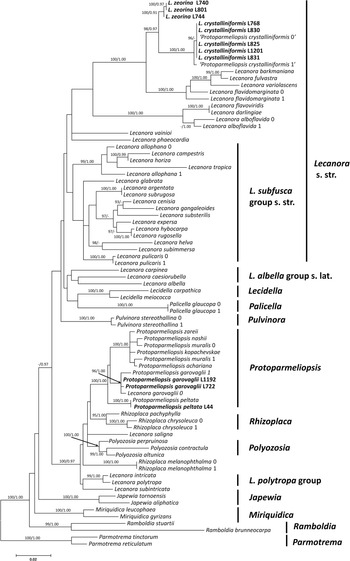
The taxon sampling comprised 76 taxa of the Lecanoraceae, with two taxa of Ramboldiaceae (Ramboldia brunneocarpa Kantvilas & Elix and R. stuartii (Hampe) Kantvilas & Elix) and two taxa of Parmeliaceae (Parmotrema reticulatum (Taylor) M. Choisy and P. tinctorum (Despr. ex Nyl.) Hale) used as the outgroup (Fig. 1). Newly generated sequences were deposited in GenBank.
Maximum likelihood (ML) phylogeny of representative genera and species groups of the family Lecanoraceae based on concatenated nrITS and mtSSU sequences. Ultrafast bootstrap values (UFBoot) ≥ 95% and posterior probabilities (PP) ≥ 0.95 are shown above internal branches. Newly generated sequences are in bold; species names are followed by a Lecanomics ID, which refers to the ‘Lecanomics’ project (https://lecanomics.org). All other sequences were downloaded from GenBank (Table 1).
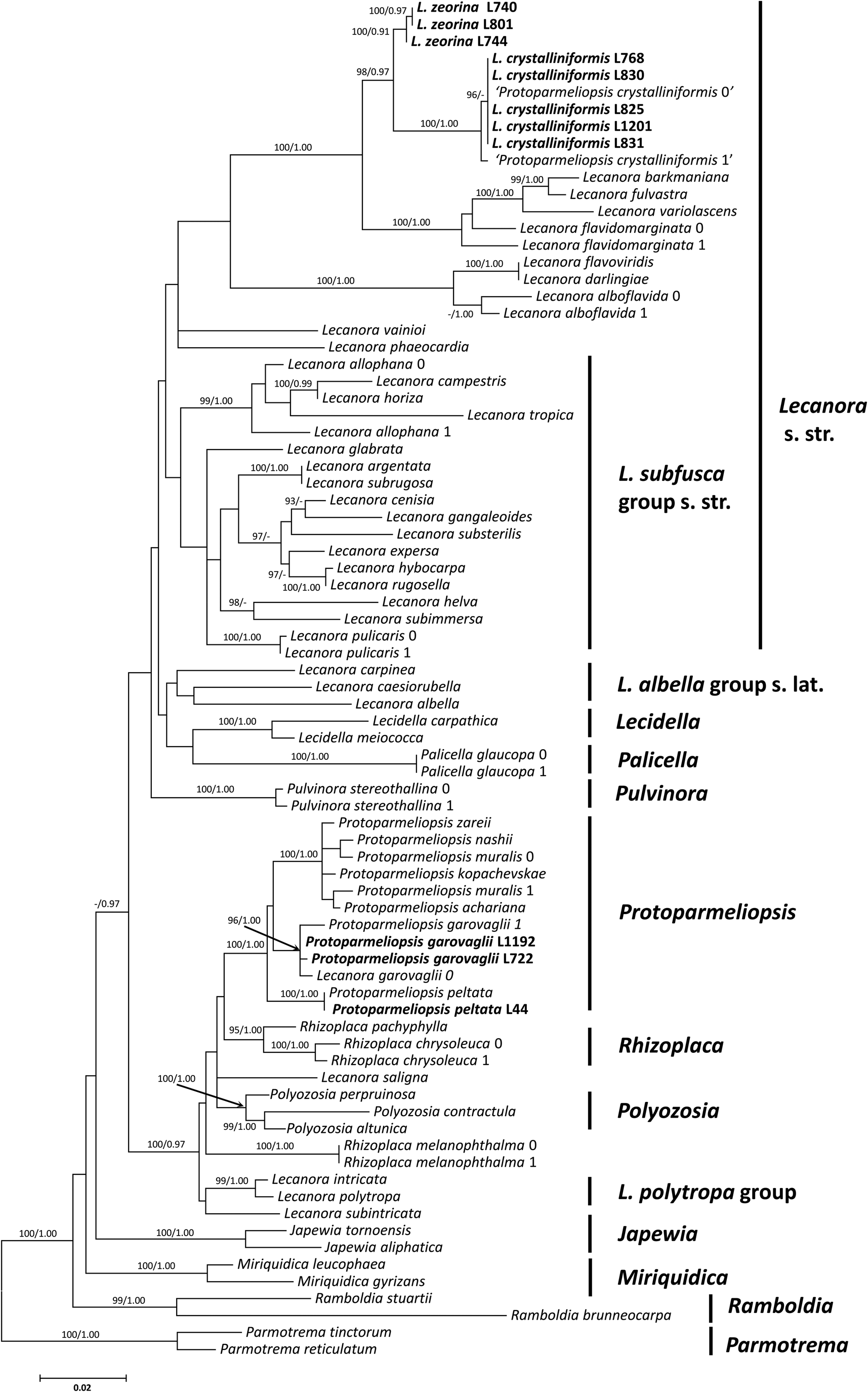
The phylogenetic tree shows most major genera and species groups within Lecanoraceae. Among them, Protoparmeliopsis (=Lecanora muralis group), Rhizoplaca Zopf, Polyozosia (=Lecanora dispersa group), the Lecanora polytropa group and the Lecanora saligna group fall into one strongly supported clade (UFBoot = 100%, PP = 0.97). Selected sequences of the species of Lecanora s. str. cluster together, but the clade is poorly supported.
Sequences of ‘Protoparmeliopsis’ crystalliniformis, proposed as a new species by Lee & Hur (Reference Lee and Hur2021) from South Korea, are nested among sequences of an unidentified taxon collected from China with strong support (UFBoot = 100%, PP = 1.00). Its systematic position is distant from the genus Protoparmeliopsis, instead falling within Lecanora s. str. in our phylogenetic tree. This, together with its phenotypic characteristics being similar to Lecanora s. str., leads us to suggest the new combination Lecanora crystalliniformis (B. G. Lee & Hur) Li J. Li & Printzen, with a detailed discussion following below. The new species Lecanora zeorina Li J. Li & Printzen is closely related to L. crystalliniformis and the sister group relationship is strongly supported (UFBoot = 98%, PP = 0.97). Both species share the characteristics of an areolate to squamulose thallus, large POL+ crystals in the amphithecium, the production of atranorin, and filiform conidia, characters in agreement with typical members of Lecanora s. str.
These two species form a strongly supported (UFBoot = 100%, PP = 1.00) sister group to a group consisting of two sorediate species (L. barkmaniana Aptroot & Herk and L. variolascens Nyl.) and two species with pruinose apothecia (L. fulvastra Kremp. and L. flavidomarginata B. de Lesd.). Further sorediate species (L. darlingiae Lendemer & E. Tripp and L. alboflavida Taylor) and a species with a dark hypothecium (L. flavoviridis Kremp.) cluster into one clade with strong support (UFBoot = 100%, PP = 1.00); this seems related to the above clades but the relationship is poorly supported in this analysis. Malíček et al. (Reference Malíček, Berger, Palice and Vondrák2017) mentioned that L. barkmaniana and L. variolascens do not belong to the L. subfusca group in the narrow sense but form an isolated clade. Our results show that these species sit on relatively long divergent branches and display some phenotypic characters (soredia, pigmented hypothecium, more or less squamulose thallus and zeorine apothecia) not usually found in species of the L. subfusca group s. str. (with a mostly non-sorediate thallus, hyaline hypothecium and lecanorine apothecia). However, the majority of characters are in accordance with the circumscription of Lecanora s. str. Additional studies are necessary to fully understand the circumscription of these species and we prefer to retain them in Lecanora s. str. here.
Taxonomy
Lecanora crystalliniformis (B. G. Lee & Hur) Li J. Li & Printzen comb. nov.
MycoBank No.: MB 847550
Protoparmeliopsis crystalliniformis B. G. Lee & Hur, MycoKeys 84, 163–183 (2021); type: South Korea, 2020, BDNA-L-0000349 (KBA—holotype), MB 839183.
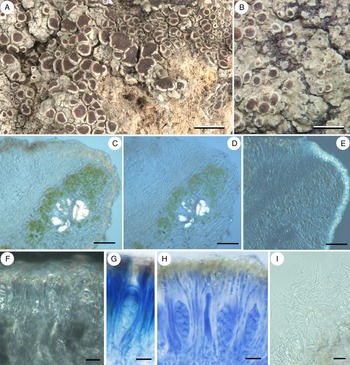
Lecanora crystalliniformis (FR-0183007). A & B, lichen thallus habit and lecanorine apothecia. C–E, vertical sections of apothecia in polarized light. C, in water, small crystals in epihymenium and amphithecial cortex, and large crystals in amphithecial medulla POL+, epihymenium with brown pigment. D, in K, cortical and epihymenial small crystals dissolved, amphithecial large crystals persistent, epihymenial pigment dissolved or paler. E, in N, cortical and epihymenial small crystals persistent, amphithecial large crystals dissolved, epihymenial pigment turned orangish. F, details of epihymenial small crystals in polarized light. G, Lecanora-type asci, in Lugol's iodine. H, 8-spored, clavate asci in lactophenol cotton blue, paraphyses weakly anastomosing. I, filiform conidia. Scales: A & B = 1 mm; C–E = 50 μm; F–I = 10 μm. In colour online.

Thallus crustose, areolate to squamulose, reduced to scattered granules or areolae, or almost squamulose, sometimes forming a continuous areolate crust, margin indeterminate, areoles irregular in outline, smooth to irregularly wrinkled; upper surface pale greyish or pale grey-green to whitish, dull or slightly glossy; cortex within small crystals, POL+, soluble in K.
Apothecia lecanorine, numerous, rounded, dispersed or densely aggregated, arising singly on areoles when young, then becoming sessile, (0.3–)0.5–1.0(–1.3) mm diam.; disc plane to slightly convex, reddish to deep reddish brown, somewhat shiny, epruinose; margin persistent or rarely excluded, level with disc or prominent, entire or slightly crenate, concolorous with the thallus, smooth, with a parathecial ring; amphithecium with numerous algal cells and large crystals (POL+) insoluble in K, soluble in N; cortex distinct, gelatinous or interspersed, filled with minute crystals soluble in K but remaining in N, 15–20(–25) μm thick; parathecium hyaline, 15–20 μm thick, consisting of thick-walled anastomosing hyphae, with fine crystals mostly in the uppermost layer, dissolving in K but remaining in N; epihymenium orangish brown, 10–20 μm high, pigment soluble in K (or fading to paler brown), changing to orangish in N, with fine crystals dispersed mostly between paraphyses in upper part of the hymenium, soluble in K but remaining in N; hymenium colourless, 80–100 μm high; paraphyses slightly anastomosing, septate, simple, c. 1.5–2.0 μm thick, not or slightly expanded at tips; hypothecium colourless, composed of anastomosing hyphae; asci clavate, Lecanora-type, 40–60 × 11–13 μm, 8-spored; ascospores simple, hyaline, ellipsoid to broadly ellipsoid, (8.0–)9.0–13.0(–14.0) × (5.0–)5.5–7.0(–7.5) μm.
Pycnidia immersed in thallus, wall brown to olive-brown; conidia filiform, straight to curved, 15–26 × 1 μm.
Chemistry
Thallus K+ yellow, KC−, C−; atranorin and an unidentified compound at R f class 4–5 (A), 5–6 (B′), 5–6 (C), after charring yellow to orange-brown with orange halo in daylight and yellow to orange or brown with greenish halo under long-wave UV light by TLC. The South Korean collections of ‘Protoparmeliopsis crystalliniformis’ have been reported to contain atranorin and rhizocarpic acid (Lee & Hur Reference Lee and Hur2021).
Distribution and ecology
This saxicolous species grows on sandstone at elevations of 250–1524 m in China. The majority of collections examined in this study were collected from a Tulin (‘Earth Forest’) formation in the south-west of China. The two collecting localities in South Korea are near the coast, at elevations of 5–31 m (Lee & Hur Reference Lee and Hur2021).
Notes
This species is mainly characterized by the somewhat squamulose thallus, large crystals in the amphithecium, fine crystals in the epihymenium and the presence of atranorin. It was first included in the genus Protoparmeliopsis because it nested within this genus in the ITS and mtSSU phylogenetic tree of Lee & Hur (Reference Lee and Hur2021). However, only data from the genus Protoparmeliopsis were selected for this phylogenetic reconstruction. Our results, including sequences from most major species groups and genera of Lecanoraceae, showed (with high support) that this species belongs to Lecanora s. str. rather than Protoparmeliopsis (Fig. 1). Morphological characters support this result. The genus Protoparmeliopsis is mainly characterized by placodioid or umbilicate thalli containing usnic, placodiolic or pseudoplacodiolic acids and adnate to distinctly sessile lecanorine apothecia (Zhao et al. Reference Zhao, Leavitt, Zhao, Zhang, Arup, Grube, Pérez-Ortega, Printzen, Śliwa and Kraichak2016; Bungartz et al. Reference Bungartz, Elix and Printzen2020). The distinctly squamulose thallus of L. crystalliniformis looks similar to that of members of the genus Protoparmeliopsis, but the species differs by having large crystals in the amphithecium as well as the presence of atranorin and absence of dibenzofurans. These two characters correspond to Lecanora s. str. rather than Protoparmeliopsis.
Protoparmeliopsis ertzii Bungartz & Elix is morphologically similar to Lecanora crystalliniformis in having large crystals in the amphithecium, a brown epihymenium with minute crystals soluble in K, and the absence of lichen substances, which is unique in the genus Protoparmeliopsis (Bungartz et al. Reference Bungartz, Elix and Printzen2020). We suspect it is a member of Lecanora s. str. related to L. crystalliniformis, but without any available molecular data there is currently no support for this hypothesis. The species is so far known only from Isabela Island, Ecuador, geographically distant from East Asia.
Specimens examined
China: Sichuan Province: Xichang Co., Huanglian Earth Forest, 27°40′41.85″N, 102°12′14.25″E, 1451 m elev., on rock, 2019, Lisong Wang et al. 19-63013 (KUN-L-66483, FR-0183007). Yunnan Province: Chuxiong Yi Autonomous Prefecture, Yuanmou Co., along the roadside between Yuanmou to Yongren, 25°58ʹ41.76ʺN, 101°43ʹ49.39ʺE, 1524 m elev., on rock, 2017, Lisong Wang et al. 17-56085 (KUN-L-59521, FR-0183008), 17-56554 (KUN-L-59990, FR-0183009); Chuxiong Yi Autonomous Prefecture, Yuanmou Co., Yuanmou Earth Forest park, 25°50ʹ47.48ʺN, 101°45ʹ37.67ʺE, 1068 m elev., on rock, 2017, Lisong Wang et al. 17-56071 (KUN-L-59507, FR-0183010), 17-56082 (KUN-L-59518, FR-0183011); Chuxiong Yi Autonomous Prefecture, Yuanmou Co., Liangshan town, 25°43ʹ53.69ʺN, 101°57ʹ40.47ʺE, 1124 m elev., on rock, 2013, Lisong Wang et al. 13-39702 (KUN-L-20687, FR-0183012); Chuxiong Yi Autonomous Prefecture, Yuanmou Co., Wumao Earth Forest, 25°50ʹ58.78ʺN, 101°45ʹ31.46ʺE, 1124 m elev., on rock, 2013, Lisong Wang et al. 13-39770 (KUN-L-20755, FR-0183013). Hong Kong: Lung Fu Shan Country Park, Pokfulam, 22°27ʹ84.84ʺN, 114°13ʹ81.37ʺE, c. 250 m elev., on rock, 2017, Alvin Tang & Henry Lui L09 (KUN-L-61450).
Lecanora zeorina Li J. Li & Printzen sp. nov.
MycoBank No.: MB 846334
Distinguished from other species of Lecanora s. str. by the zeorine to lecanorine apothecia.
Type: China, Sichuan Prov., Huili Co., on the way from Huili to Jiaopingdu, rocky slopes beside the provincial highway 213, 26°21′38.36″N, 102°19′19.85″E, 1860 m elev., on sandstone, 2019, Lisong Wang et al. 19-62893 (KUN-L-66434—holotype; FR-0183014—isotype).
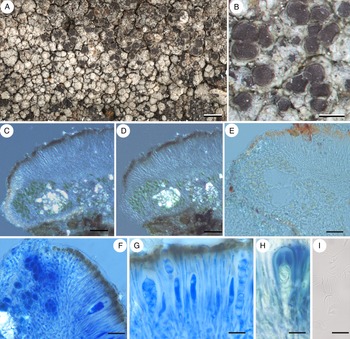
Lecanora zeorina (FR-0183014-isotype). A & B, lichen thallus habit and zeorine apothecia. C–E, vertical sections of apothecia in polarized light. C, in water, small crystals in amphithecial cortex, and medulla with large crystals, POL+, epihymenium with deep orange-brown pigment but no crystals, POL−. D, in K, cortical small crystals dissolved, amphithecial large crystal persistent, epihymenial pigment persistent. E, in N, cortical small crystals persistent, amphithecial large crystals dissolved, epihymenial pigment orange intensifying. F, proper margin (parathecium) with small crystals in lactophenol cotton blue. G, 8-spored, clavate and narrowly clavate asci in lactophenol cotton blue, paraphyses weakly anastomosing. H, Lecanora-type asci, in Lugol's iodine. I, filiform conidia. Scales: A & B = 1 mm; C–E = 50 μm; F–I = 10 μm. In colour online.

Thallus crustose, dispersed verrucose to areolate, or bullate areolate, sometimes with poorly developed marginal squamules, irregular in outline, upper surface pale greyish to whitish, somewhat cracked; cortex within small crystals, POL+, dissolving in K.
Apothecia zeorine to lecanorine, numerous, rounded to undulate, dispersed or very densely aggregated to coalescent, sometimes deformed by mutual pressure, subimmersed (when young) to sessile, 0.3–1.0 mm diam.; disc plane to moderately convex, deep reddish brown to blackish brown, somewhat shiny, epruinose; margin of two layers, the inner, slightly prominent, glossy and more or less concolorous with the disc, the outer persistent or excluded, even or prominent, entire or flexuose, and concolorous with the thallus; amphithecium present, with numerous algal cells and large crystals (POL+) insoluble in K (or occasionally partly dissolved in K, usually broken into several small pieces), soluble in N; cortex distinct, gelatinous or interspersed, filled with fine crystals soluble in K but remaining in N, 15–20(–25) μm thick; parathecium hyaline, consisting of thick-walled, apically somewhat radiating hyphae, 15–25(–40) μm thick, with fine crystals mostly in the outermost part which are soluble in K and insoluble in N; epihymenium deep orangish brown to dark brown, 10–20 μm high, with pigment not dissolving in K (sometimes becoming slightly more dark brown), orange intensifying in N, without crystals (POL−), sometimes capped with a layer of hyaline gel, c. 5 μm thick; hymenium colourless, 60–90 μm high; paraphyses septate, simple, c. 2 μm thick, tips expanded to 4 μm, surrounded by orangish brown pigment; hypothecium colourless, composed of anastomosing hyphae; asci clavate to narrowly clavate, Lecanora-type, 40–60 × 12–16 μm, 8-spored; ascospores simple, hyaline, ellipsoid to ovoid, (8.0–)9.0–13.0(–15.5) × (4.5–)5.5–7.5(–8.0) μm.
Pycnidia immersed, wall brown to olive-brown; conidia filiform, straight to curved, 20–25 × 1 μm.
Chemistry
Thallus K+ yellow, KC−, C−; atranorin and an unidentified compound at R f class 4–5 (A), 5–6 (B′), 5–6 (C), after charring yellow to orange-brown with orange halo in daylight and yellow to orange or brown with greenish halo under long-wave UV light by TLC.
Etymology
The specific epithet refers to its zeorine apothecia.
Distribution and ecology
This species occurs on sandstone and is currently known only from Sichuan Province in the south-west of China.
Notes
This species is characterized by its areolate to squamulose thallus, zeorine apothecia, large calcium oxalate crystals in the amphithecium and an epihymenium without crystals, a unique combination of characters within Lecanora s. str.
The zeorine apothecia of this species have a distinct proper margin protruding from the disc, and a thalline margin, which together look like two ‘rims’ around the apothecial disc (particularly evident in the holotype specimen). We also observed some lecanorine apothecia without a distinct protruding proper margin but a wide parathecium can always be seen in section. The term parathecium has been used as a synonym for ‘true exciple’ or ‘proper exciple’, as the inner apothecial margin in the phenotypic study of Teloschistaceae by Vondrák et al. (Reference Vondrák, Frolov, Arup and Khodosovtsev2013); it is a thin layer consisting of relatively thick-walled, radiating fungal hyphae lacking photobiont cells, adjacent to the hymenium and subhymenium, from which it can easily be distinguished by its negative iodine reaction (Miyawaki Reference Miyawaki1988; Guderley Reference Guderley1999).
Lecanora zeorina and L. crystalliniformis form a strongly supported group in the phylogenetic tree. Both have similar morphological characters (a somewhat areolate to squamulose thallus, large crystals in the amphithecium) and produce the same secondary metabolites. The new species differs in its zeorine apothecia, an epihymenium without crystals, a pigment insoluble in K and expanded paraphyses tips.
Additional specimens examined
China: Sichuan Province: Huili Co., on the way from Huili to Jiaopingdu, 26°21ʹ39.11ʺN, 102°19′19.20″E, 1875 m elev., on sandstone, 2019, Lisong Wang et al. 19-63051 (KUN-L-66521, FR-0183015); Huili Co., on the way from Huili to Jiaopingdu, 26°21′39.11″N, 102°19′19.20″E, 1880 m elev., on sandstone, 2019, Lisong Wang et al. 19-63070 (KUN-L-66540, FR-0183016).
Acknowledgements
We thank the Lichen Herbarium of the Kunming Institute of Botany for the loan of specimens, and Heike Kappes from the Grunelius-Möllgaard-Laboratory of the Senckenberg Research Institute for technical support. This work benefited from the sharing of expertise within the DFG priority program SPP 1991 ‘Taxon-Omics’, and financial support from DFG grant PR 567/19–1 to CP and the China Scholarship Council to LL.
Author ORCIDs
Lijuan Li, 0000-0003-1048-1971; Christian Printzen, 0000-0002-0871-0803.