Introduction
Small intestinal bacterial overgrowth (SIBO) is defined as any condition in which part of the small bowel harbours for a long time bacterial counts over 105 colony-forming units/ml (CFU/ml). Bacterial proliferation deprives the host of macro- and micronutrients. Reference Bouhnik, Alain and Attar1 In spite of being a common cause of malabsorption, it remains an under-recognized clinical syndrome in older people. The exact prevalence is unknown, with reports varying considerably from 2.5 to 90% in older adults with lactose intolerance. Reference Almeida, Kim and Stoita2
Risk factors and predisposition to SIBO
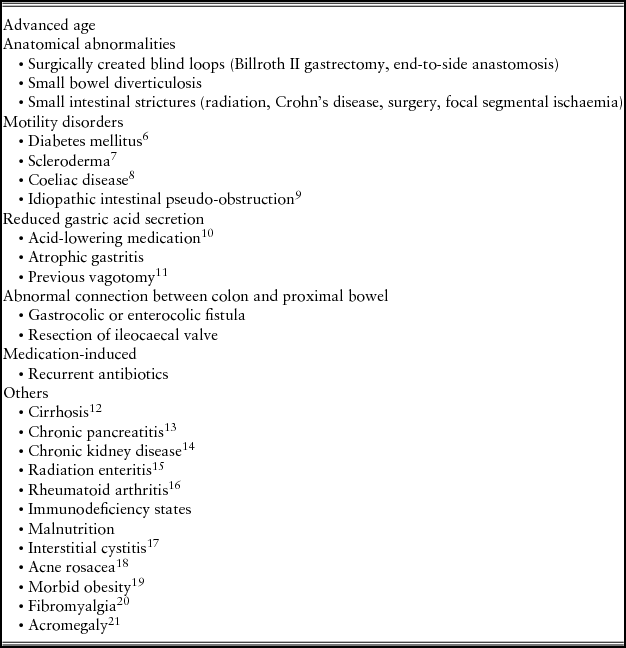
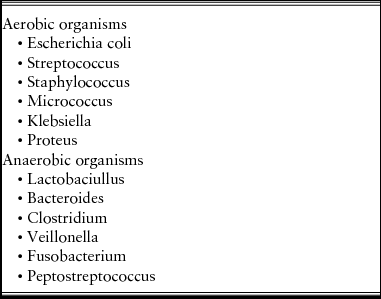
Advanced age is an independent risk factor for SIBO. It is not clear if overgrowth results from the ageing process itself and age-related changes in intestinal motility, or if it is a consequence of achlorhydria due to underlying gastric disease or use of acid neutralizing agents. Early studies found that SIBO was a common (and often unrecognized) cause of malabsorption in the elderly population and that many patients did not have an obvious predisposing factor, such as a blind loop. Reference McEvoy, Dutton and James3 More recent studies have reported SIBO in asymptomatic elderly people residing in the community. These patients, although asymptomatic, had lower weights and body mass indices (BMI) than expected, and treatment with antibiotics increased both weight and BMI. Reference Parlesak, Klein and Schecher4 Interestingly, Mitsui et al. reported SIBO (diagnosed by glucose hydrogen breath test) in 25.6% of disabled older adults, but none in healthy older adults. Reference Mitsui, Shimaoka and Goto5 Risk factors for SIBO are summarized in Table 1. The bacteria in SIBO are similar to those found in the normal colon and certain organisms are commonly responsible (summarized in Table 2).
Risk factors for development of SIBO

Organisms in SIBO

Effects of SIBO on intestinal structure
Histological appearance of the small intestine in SIBO is usually not significantly altered. However, in some cases SIBO is associated with subtotal villous atrophy and increased cellularity in the lamina propria, which may be confused with coeliac disease. Focal areas of ulceration and erosions also may be seen. The degree of mucosal inflammation can vary from mild to severe. Epithelial cell injury and inflammation may ultimately impair absorptive function. Electron microscopy studies of experimental animals with SIBO have described enterocyte abnormalities, such as vacuolization of microvillus membranes and mitochondrial swelling. Reference Toskes, Giannella and Jervis22
Mechanism of malabsorption
Impaired absorption of nutrients in SIBO results from either maldigestion in the intestinal lumen, or from malabsorption at the level of the intestinal microvillus membrane due to enterocyte damage. Carbohydrate malabsorption in SIBO results from the intraluminal degradation of sugars by enteric bacteria leading to the production of short-chain fatty acids, carbon dioxide, hydrogen and methane, which may be associated with acidic stools, abdominal distension and flatulence. Another mechanism that leads to carbohydrate malabsorption in SIBO is by reducing the brush-border disaccharidase levels. Reference Sherman, Wesley and Forstner23
Fat malabsorption results from bacterial deconjugation of bile acids and the toxic effect of free bile acids on the intestinal mucosa. Reference Tabaqchali, Hatzioannou and Booth24 Hydroxylated fatty acids (and free bile acids) stimulate the secretion of water and electrolytes, leading to diarrhoea. Fat malabsorption may lead to weight loss, steatorrhoea and deficiencies of fat-soluble vitamins A, D, E and K. Protein malabsorption probably results from decreased mucosal uptake of amino acids and the intraluminal degradation of protein precursors by bacteria. Reference Sherman and Lichtman25 SIBO may also be associated with a reversible form of protein-losing enteropathy. Vitamin B12 malabsorption results from anaerobes that can utilize vitamin B12 coupled to intrinsic factor. Reference Giannella, Broitman and Zamchek26 Malabsorption of vitamin B12 may result in anaemia and neurological disturbances.
Clinical features
Clinical features in SIBO can be variable ranging from the asymptomatic, to presence of only nutrient deficiencies, to extreme weight loss with failure to thrive. Classic manifestations include anorexia, bloating or flatulence, abdominal discomfort, pain and diarrhoea. Complaints in older patients may be atypical and may even resemble gradual deterioration in health, falsely attributed to ageing. Some patients may report improvement in abdominal complaints following a recent antibiotic course prescribed for an unrelated respiratory or urinary infection.
Patients with vitamin B12 deficiency can present with neurological symptoms, central or peripheral neuropathy, and symptoms of anaemia, such as fatigue, breathlessness and chest pain. Those with fat-soluble vitamin deficiency can present with night blindness (in vitamin A deficiency) and metabolic bone disease (in vitamin D deficiency). Osteoporosis is another well-recognized complication of SIBO.*Reference Stefano, Veneto, Malservisi and Corazza27, Reference Stotzer, Johansson and Mellstrom28
Diagnosis
The diagnosis of SIBO should be considered in any patient with malabsorption and a predisposing condition.
Aspiration
The gold standard test for the diagnosis of SIBO is aspiration of small intestinal fluid with culture and bacterial counts of the aspirate; presence of more than 105 CFU/ml of duodenal aspirate is considered diagnostic. However, it is time consuming, invasive and costly. Other potential problems with aspiration of small intestinal fluid include contamination of the aspirate with bacteria from the mouth, and technical difficulties with transport and culture of the aspirate.
Breath tests
Breath tests are simple and non-invasive, and therefore are more attractive than duodenal intubation or endoscopy for collecting intestinal aspirates. Moreover, older patients tolerate breath tests well. For reliable testing the patients should be advised to avoid high-fibre or carbohydrate-rich foods for at least a day prior to the test.
A glucose hydrogen breath test is safe and easy to perform in the out-patient setting. It evaluates carbohydrate malabsorption. Normally, glucose is absorbed completely in the upper small intestine; with bacterial overgrowth, however, the glucose is cleaved by bacteria into carbon dioxide and hydrogen. The hydrogen is measured in the exhaled breath (at baseline and then every 30 minutes for 2 hours); a rise of 20 parts per million (p.p.m.) above the baseline is regarded as diagnostic of SIBO. Fasting breath hydrogen levels of more than 20 p.p.m. also are considered positive. The lactulose hydrogen breath test is based on a principle similar to that of the glucose hydrogen breath test. Lactulose is a disaccharide that is not absorbed in the small intestine but is metabolized by bacteria in the proximal colon, producing a late peak in exhaled hydrogen. In the presence of bacterial overgrowth, an early hydrogen peak is observed.
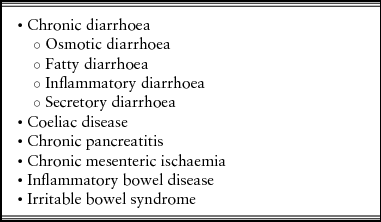
Additional tests to evaluate anaemia or nutrient deficiencies and their cause may be required; faecal fat collection may help confirm steatorrhoea; radiological tests may help diagnose anatomical abnormalities such as diverticulae or fistula. Differential diagnosis of SIBO is summarized in Table 3.
Differential diagnosis of SIBO

Treatment
Treatment of SIBO consists of a multimodal approach including treatment of the underlying disease, nutritional support and antibiotic therapy. SIBO due to sluggish motility should be treated with medications to enhance motility to eliminate and prevent relapse. Drugs that reduce motility (narcotics, benzodiazepines, anti-motility agents) commonly prescribed to elderly patients should be discontinued. Attention should be given to the patient's nutritional state and any vitamin deficiency should be corrected.
As prolonged or excessive acid suppression may be a contributing factor for the development of symptoms of SIBO, the use of acid suppressive medication should be minimized to the lowest possible dose for the condition being treated and for the shortest duration. Any predisposing anatomical or functional abnormality should be corrected when possible.
There are no controlled trials to guide the duration of treatment or management of recurrent SIBO and recommendations are generally based on clinical experience. Antibiotics that have been found to be effective include metronidazole, rifaximin, amoxicillin, amoxicillin-clavulanate, ciprofloxacin, tetracycline and cotrimoxazole. Therapy is usually given initially for two weeks and then clinical response is assessed; it may be useful to repeat a breath test or culture of small intestinal aspirate. Many patients with an underlying anatomical or motility disorder require permanent antibiotic treatment; in such patients, it is usual to rotate antibiotic treatment every two weeks or, alternatively, to give antibiotics for two of every four weeks. Continuous treatment with a single agent can lead to antibiotic resistance or to side-effects associated with long-term use, such as peripheral neuropathy in patients given metronidazole.
The somatostatin analogue octreotide stimulates intestinal motor activity when administered at low doses. It has been reported to be effective in SIBO associated with scleroderma. Reference Soudah, Hasler and Owyang29
Probiotic therapy is a logical and attractive approach to the management of SIBO. The impact of probiotic yogurt administration for 4 weeks was studied in healthy older community subjects; normalization of the various cytokine responses and modulation of activation markers in blood phagocytes became more apparent in the group with a positive breath test. Reference Schiffrin, Parlesak and Bode30
Conclusion
Elderly patients have a higher prevalence of malnutrition. SIBO is often an under-recognized cause of malabsorption in the older population, commonly mistaken for other disorders. In any cause of malnutrition or weight loss in an elderly patient that is not fully explained, it may be worthwhile to exclude the diagnosis of SIBO. Treatment not only has the potential to improve patients’ wellbeing and quality of life, but also avoids unnecessary costs and treatment for alternate erroneous diagnoses.
Conflict of interest
The author declares that there is no conflict of interest.