

As individuals enter the third decade of life, they are faced with new and unique challenges. Marriage has been universally found to meet emotional, economic, sexual, social, reproductive, and sexual needs (Papalia, Olds, & Feldman, Reference Papalia, Olds and Feldman2008). One of the most crucial factors in marriage is the belief that one's spouse is committed and desires a lasting relationship. Commitment is found to have a strong impact on the sustainability of a relationship. When someone perceives his or her spouse's commitment to be questionable, it can be a powerful predictor of the termination of a relationship (Baron, Briscombe, & Byrne, Reference Baron, Branscombe and Byrne2008). The failure of marriage often ends with separation of spouses in a divorce.
In most cultures, monogamy is the generally accepted norm, where commitment and intimacy are directed to only one partner (Jackman, Reference Jackman2015; Papalia et al., Reference Papalia, Olds and Feldman2008). Nevertheless, infidelity is common in marriage (Atkins, Baucom, & Jacobson, Reference Atkins, Baucom and Jacobson2001; Jackman, Reference Jackman2015). Although most cultures see unfaithfulness as a violation of rules and norms, many individuals are involved in affairs (Jackman, Reference Jackman2015). Infidelity is generally interpreted as a violation of the marital agreement, a betrayal of trust, as well as a threat to the marriage bond (Mao & Raguram, Reference Mao and Raguram2009).
Based on data from the Ministry of Religious Affairs, infidelity is one of the main reasons for divorce in Indonesia. This reason alone accounted for nearly 70% of divorces in Indonesia. Unfortunately, most divorce cases in Indonesia that are related to infidelity do not end amicably, due to cultural values. Indonesians view infidelity as a very shameful experience and tend to react strongly toward the other party. Therefore, the government has begun to enforce an obligatory premarital check-up and counselling for brides and grooms to be. One of the objectives of this policy is to ensure that each party understands the importance of fidelity and faithfulness in order to sustain the relationship. The identification of trends and factors predisposing individuals to infidelity is very important in understanding the signs of infidelity, which in turn provides a picture of a population at risk of being unfaithful (Whisman, Gordon, & Chatav, Reference Whisman, Gordon and Chatav2007).
Mark, Janssen, and Milhausen (Reference Mark, Janssen and Milhausen2011) stated that the predictors of infidelity could be divided into three major factors: demographic, interpersonal, and intrapersonal. Demographic factors that are usually associated with infidelity are age, gender, education, and so on. An interpersonal factor that is often associated with infidelity is marital satisfaction, which is the ultimate goal of every married couple (Khalatbari, Ghorbanshiroudi, Azari, Bazleh, & Safaryazdi, Reference Khalatbari, Ghorbnshiroudi, Azari, Bazleh and Safaryadi2013).
Watkins et al. (Reference Watkins and Boon2016) found that spouses with low relationship satisfaction, as well as a desire for closeness that could not be obtained from the current relationship, tended to feel interested in fostering relationships with others or having an affair. Furthermore, in the same study, low marital satisfaction was found to be associated with a more positive attitude toward infidelity.
The most important intrapersonal factor in predicting infidelity, according to Mark et al. (Reference Mark, Janssen and Milhausen2011), is the personality factor of the individual. Personality traits are defined as the dimensions of individual differences in the tendency to show consistent patterns of thoughts, feelings and actions (McCrae & Costa, Reference McCrae and Costa2003). The Big Five model from McCrae and Costa (Reference McCrae and Costa2003) is a widely accepted personality taxonomy across cultures (Larson, Reference Larson2014). Personality traits that are consistently found to be associated with infidelity are low levels of agreeableness and conscientiousness (Schmitt, Reference Schmitt2004). In a study of 10 regions of the world, Schmitt (Reference Schmitt2004) found that low levels of both agreeableness and conscientiousness were universally associated with infidelity in South-East Asia. Schmitt also found that both men and women with higher neuroticism tended to judge themselves as unfaithful to their partners. This is consistent with the findings of Whisman et al. (Reference Whisman, Gordon and Chatav2007), which showed that neuroticism had a significant positive association with infidelity. Low openness to experience was also found to be associated with infidelity in women from Oceania and Southeast Asia (Schmitt, Reference Schmitt2004). Schmitt also found that extraversion had a significant correlation with promiscuity.
In this study, the researchers aimed to investigate the role of the personality traits of neuroticism, agreeableness, conscientiousness, extraversion and openness to experience, as well as gender and marital satisfaction, in predicting attitudes toward infidelity.
Method
Participants
The participants in this study were 438 married young adult men or women, with an age range of 22–40 (M = 31.02). The study used the married individuals only as samples. Married people were chosen because they are legally bound to each other, where dating couples are not. Inclusion criteria were adults aged 20–40 years and who had been married for 1–15 years. Other characteristics of the participants were that they lived in Indonesia (in different cities) and had access to the internet. See Table 1 for an overview of the participants.
Overview of Participants

Procedure
Ethical clearance was obtained from the Ethical Committee at the Faculty of Psychology, University of Indonesia prior to the data collection process. The researchers collected the data through an online questionnaire using the G-Form program. Potential participants were invited via an online message that explained the objectives of the study, researchers’ information, and a link to the questionnaire. The online platforms used for the invitation were WhatsApp, LINE, Facebook, and Path. The participants were permitted to send the invitation to others. They were rewarded with a complementary top-up for their phone balance. The participants were asked to submit their phone number in a separate form that they received via a link that could only be opened after finishing the questionnaire. This online method was used to ensure the anonymity of the participants, considering the topic of this study might be considered a sensitive matter. Mark et al. (Reference Mark, Janssen and Milhausen2011) stated that sensitive issues such as infidelity might prompt the participants to give false positive responses, but this could be minimised by using the online method so that the participants would feel safer to answer the questions truthfully.
Measurement
Personality trait measurement. The instrument used to measure personality traits in this research was the NEO Five-Factor Inventory (NEO-FFI) developed by McCrae and Costa (Reference McCrae and Costa2003). This instrument measures each trait of the Big Five: neuroticism, extraversion, conscientiousness, openness to experience, and agreeableness. It consists of 60 items, with 12 items to measure each trait using a Likert-type scale consisting of both favourable and unfavourable items. One example of an item is ‘I like adventure’. Based on the adaptation of the measuring instrument NEO-FFI from Hutapea (Reference Hutapea2012), the obtained validity coefficients were within a range of 0.378–0.926 (p < .05). Based on the calculation of reliability using Cronbach's alpha, the obtained reliability index for each trait scale was as follows: .89 for the openness to experience scale, .86 for the conscientiousness scale, .86 for the extraversion scale, .90 for the agreeableness scale, and .91 for the neuroticism scale.
Measurement of marital satisfaction
Marital satisfaction was measured using the Evaluation and Nurturing Relationship Issues, Communication and Happiness (ENRICH) Marital Satisfaction Scale (Fowers & Olson, Reference Fowers and Olson1993), which consists of 15 items that measure marital satisfaction with a Likert-type scale, and it can be used in dyadically or individually. The remaining five items are on the Marital Conventionalisation Scale. This scale refers to the idealistic distortion dimension of marital satisfaction. It contains items with statements that refer to perfect marriage relationships, where such perfection is considered unrealistic. This scale was intended as a counterweight to the tendency of respondents to ‘fake-good’ in answering the ENRICH Marital Satisfaction Scale (Fowers & Olson, Reference Fowers and Olson1993). An example of an item is ‘I am happy with how me and my partner share our roles and responsibilities in our marriage’. An adaptation of the ENRICH Marital Satisfaction Scale was performed by Hajizah (Reference Hajizah2012), and obtained the validity index with a range of 0.2–0.547. The reliability testing was done using the Cronbach's alpha. The result of the calculation was .89, which demonstrates that this scale is reliable in measuring marital satisfaction.
Measurement of attitude toward infidelity
In measuring the participants’ attitudes toward infidelity, researchers used the Attitudes Toward Infidelity Scale developed by Whatley (Reference Whatley2006). This instrument consists of 12 items measuring participants’ attitudes, such as their views on the harmfulness of cheating, their chances of being involved in an affair when it is unknown by their partners, and so forth, using a Likert-type scale. An example of an item is ‘Infidelity never hurt anyone’. Higher scores on this scale show a more positive or accepting attitude toward the behaviour of infidelity. Whatley found the reliability of the scale was .866. Jackman (Reference Jackman2015) found also a similar result (.8) regarding the reliability of the scale.
Data Analysis
The data in this study were analysed statistically using SPSS version 23.0. This descriptive statistics method was used to get a general picture of the demographics of the study participants. In measuring the relationship between the variables, Pearson product moment correlation was used between each personality trait and marital satisfaction with attitude toward infidelity, which all yielded significant results. Therefore, a subsequent multiple regression analysis was conducted to find the contribution of personality traits and marital satisfaction in predicting attitudes toward infidelity, controlled by gender.
Results
Participant Overview
The description of the participants is presented in Table 1. Most of the participants were female (78%) and all of them live in the urban cities in Indonesia. The majority of the participants have been married for 1–5 years (45%).
The Role of Personality Traits, Marital Satisfaction, and Gender in Predicting Attitudes Toward Infidelity
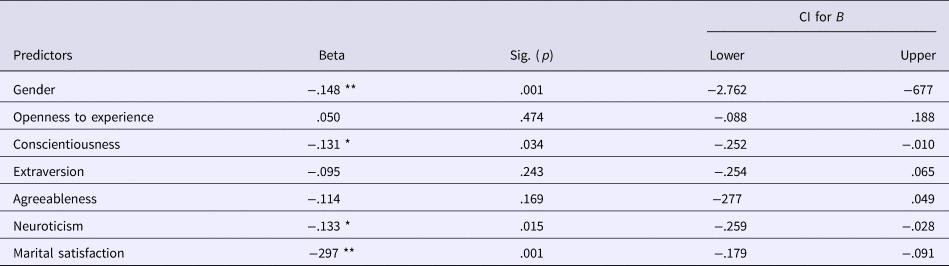
Based on a multiple regression analysis exploring the contribution of personality traits and marital satisfaction in explaining attitudes toward infidelity, the results shown in Table 2 indicate that simultaneously, personality trait, marital satisfaction and gender were able to significantly predict attitudes toward infidelity (R 2 = .166, p < .01). This illustrates that the total contribution of the overall predictor is 16.6% of the attitudes toward infidelity.
Results of Regression Test Gender, Personality Trait, Marital Satisfaction, and Attitudes Toward Infidelity

The results shown in Table 2 demonstrate that the trait of conscientiousness significantly predicted attitudes toward infidelity, with a value of B = -.112, p < .01. This shows that the higher the conscientiousness, the lower the attitude toward infidelity. Furthermore, the result shows that the role of neuroticism in predicting attitudes toward infidelity was also significant (B = -.133, p < .01) and that the higher the neuroticism, the lower the attitude toward infidelity. In line with the mentioned traits, marital satisfaction was also found to be a significant predictor (B = -.297, p < .01), meaning that the more satisfied people are with their marriage, the lower the attitude they have toward infidelity. Last but not least, gender was also found significant in predicting attitudes toward infidelity (B = -. 148, p < .01); males tended to have a more positive attitude toward infidelity.
Discussion
The results of the statistical analysis used for the study showed that overall, gender, personality traits and marital satisfaction were able to significantly predict attitudes toward infidelity. Significant predictors for infidelity were: males, low conscientiousness and low neuroticism traits, as well as low marital satisfaction. The findings on the role of personality traits in predicting attitudes toward infidelity can be explained by analysing the characteristics of each trait.
The Role of Conscientiousness in Predicting Attitudes Toward Infidelity
This finding is in line with various studies on personality and infidelity. Kraaykamp and Van Eijck (Reference Kraaykamp and Van Eijck2005) found that individuals with low conscientiousness (C) had greater willingness to break their daily routines. Moreover, individuals with low C were universally found to be more likely to engage in adultery (Schmitt, Reference Schmitt2004). Low C can manifest in spontaneous behaviour, impulsiveness, and hedonism (Pervin, Reference Pervin2003). These behaviours can interfere in the decision-making process and with emotional or physical relationships with other people, married or not. When faced with opportunities or ‘temptations’ to connect with others, individuals with low C tend to be less likely to think about the action's long-term impact. This is supported by the findings of Schmitt and Buss (Reference Schmitt and Buss2001) that individuals with low C tend to be more responsive to advances and to engage in dangerous sexual behaviours. If the individual does not view the negative side of the decision to engage in infidelity, he or she will tend to respond positively. Furthermore, a positive attitude toward infidelity can be reinforced by positive emotions following images of sexual or emotional satisfaction, as well as the pleasure gained from the affair. This attitude can be encouraged by opportunities for individuals to perform the behaviour (Langford, Reference Langford2003; Larson, Reference Larson2014; Watkins & Boon, Reference Watkins and Boon2016).
Individuals with high C have better inhibition toward cheating behaviour in order to sustain the marriage and prevent the negative consequences of infidelity such as the dissolution of marriage and losing custody of the child (Mao & Raguram Reference Mao and Raguram2009). Individuals with a high C tend to act in accordance with societal norms. They immediately see a breach of marital norms in cheating behaviour and develop a negative attitude toward the affair. Furthermore, commitment is important in maintaining a marriage, and commitment requires loyalty and faithfulness from each spouse. This is in line with the characteristics of people with a high C who are found to have a high level of commitment both in work and relationships (Pervin, Reference Pervin2003).
The Role of the Trait of Neuroticism in Predicting Attitudes to Infidelity
Neuroticism (N) was also found to be a significant predictor of attitudes toward infidelity. A positive attitude toward infidelity is accompanied by lower N. When compared with many other studies, the findings of this study illustrate the opposite direction of the association: Most studies have found a positive correlation between N and the attitudes toward infidelity.
Allen et al. (Reference Allen, Rhoaden, Stanley, Markman, Williams, Melton and Clements2008) found that participants with an infidelity experience tended to experience stress in their marriage, and the stress often resulted from poor communication between spouses. Spouses who perceived their communication with the partners as poor tended to respond more positively to affairs. The positive association between neuroticism and infidelity was also found in studies conducted by Whisman et al. (Reference Whisman, Gordon and Chatav2007) and Schmitt (Reference Schmitt2004), who found that men and women with higher neuroticism reported being unfaithful to their partner. Individuals who experience sexual anxiety are more likely to engage in extra-marital relationships because they are less worried about their sexual performance in these relationships (Mark et al., Reference Mark, Janssen and Milhausen2011).
Individuals with a high N were found to have more problems in their social relationships, including relationships with their married partners (Larsen & Buss, Reference Larson2014). Individuals with a high N can feel anxious when faced with the consequences of having an affair. They are anxious when imagining the disclosure of their affairs, as well as the consequences of divorce. The characteristic of high N makes them address the infidelity negatively, given the negative impacts and emotions they experienced when considering the affair. This attitude and anxiety can further prevent them from engaging in cheating behaviour, as it is reinforced by a sense of guilt that is a characteristic of this trait (McCrae & Costa, Reference McCrae and Costa2003).
The Role of Marital Satisfaction in Predicting Attitudes Toward Infidelity
Marital satisfaction is one of the common factors that have been found to predict a person's predisposition to involvement in an affair (e.g., Garg & Ruhela, Reference Garg and Ruhela2015; Mark et al., Reference Mark, Janssen and Milhausen2011; Whisman et al., Reference Whisman, Gordon and Chatav2007; Zare, Reference Zare2011). The results from a study by Larson et al. (Reference Larson2014) indicated that individuals with higher levels of marital satisfaction have a more negative attitude toward cheating behaviour. Considering the importance of marital satisfaction in a household, spouses who are satisfied with their marriage will certainly keep their commitment and loyalty to their partner. On the other hand, boredom felt by a spouse accompanies low marital satisfaction and is one of the factors that may drive the involvement in an affair (Garg & Ruhela, Reference Garg and Ruhela2015).
The Role of Gender in Predicting Attitudes Toward Infidelity
The results of the multiple regression analysis showed that gender has a significant role in predicting attitude toward infidelity. More positive attitudes toward infidelity were found among men, which aligns with findings of other studies that found significant differences in intentions and/or infidelity behaviour based on gender differences (Babin & Dindia, Reference Babin and Dindia2005; Mark et al., Reference Mark, Janssen and Milhausen2011; Tsapelas, Fisher, & Aron, Reference Tsapelas, Fisher, Aron, Cupach and Spitzberg2010; Zare, Reference Zare2011). Zare (Reference Zare2011) found that men had more positive attitudes toward infidelity than women, as well as higher intentions to engage in affairs. This finding is in line with the research of Allen and Baucom (Reference Allen and Baucom2004) and Atkins et al. (Reference Atkins, Baucom and Jacobson2001), which found more men were having extramarital affairs than women. In Indonesia, as men are often the breadwinner of the family and in charge of finances, they can be more susceptible to engage in extra-marital behaviour compared to women.
Conclusion
This study found that attitudes toward infidelity can be predicted by personality traits (conscientiousness and neuroticism), marital satisfaction and gender. In Indonesia, where the infidelity rate is very high and is the most prevalent cause of divorce, it is important to identify predictors of infidelity. Significant predictors of infidelity were being male, ]low level of neuroticism, low level of conscientiousness and low marital satisfaction. The findings contribute to the study of relationships in a collective culture country like Indonesia, especially as we found some conflicting results compared to previous studies that were conducted in the Western countries.