There has been heightened interest in recent years in the individual differences approach to the study of job performance (Barrick & Mount, Reference Barrick and Mount2005; Huang, Zabel, Ryan, & Palmer, Reference Janssen2014) and turnover intentions (Thoresen, Kaplan, Barsky, Warren, & deChermont, Reference Tsui, Nifadkar and Ou2003). Whereas most of the research in this area was previously concentrated on simply establishing the presence of some identifiable predispositions towards high/low work performance and turnover intentions, researchers have recently begun to explore in more detail the particular personality traits that may underlie these dispositional tendencies. Individual differences in affective tendencies are promising traits to examine because the effort that an individual puts into work and their unique work attitudes will produce different affective reactions (Cropanzano, James, & Konovsky, Reference Cropanzano, James and Konovsky1993; Yang & Diefendorff, Reference Yang and Diefendorff2009). In particular, negative affectivity (commonly abbreviated to NA), or the dispositional tendency of an individual to experience a variety of negative emotions across time and situations (Watson, Clark, & Tellegen, Reference Watson, Clark and Tellegen1988), has been considered as a focal individual difference variable when predicting job performance and turnover intentions (Thoresen et al., Reference Tsui, Nifadkar and Ou2003; Kaplan, Bradley, Luchman, & Haynes, Reference Kausar and Anwar2009; Johnson, Tolentino, Rodopman, & Cho, Reference Judge, Heller and Mount2010).
Using theoretical and empirical arguments, this manuscript challenges the conventional wisdom that NA only has a dysfunctional and linear effect (for an extensive discussion see Johnson et al., Reference Judge, Heller and Mount2010) on in-role job performance, here defined as job activities that contribute to the organization’s technical core and appear in one’s job description (Borman & Motowidlo, Reference Borman and Motowidlo1997), and turnover intentions, here conceptualized as an employee’s intention to leave the organization (Shore & Martin, Reference Simons and Peterson1989). First, drawing upon formal theories of self-regulation, including control theory (Carver & Scheier, Reference Carver and Scheier2011), we postulate that NA provides critical information about whether or not additional effort is needed to realize particular goals. Successful self-regulation requires careful information processing about self and the environment, particularly negative information (Wrosch, Scheier, Miller, Schulz, & Carver, Reference Wrosch, Scheier, Miller, Schulz and Carver2003; da Motta Veiga & Turban, Reference da Motta Veiga and Turban2014). Failing to assess or choosing to ignore negative information may have serious costs as it may indicate a lack of motivation to deal with the potential threats of goal achievement (Aspinwall, Reference Aspinwall1998). Borrowing from self-regulation theory, it is advocated that while NA can undermine work behaviour and attitudes, it can also be instrumental in achieving goals and thus have a decreased negative influence in shaping work behaviour (i.e., in-role job performance) and attitudes (i.e., turnover intentions). It could be argued that the negative, traditional view of NA, combined with the beneficial effects of NA, could translate into nonlinear relationships with the focal variables.
Second, apart from the theoretical argumentation that draws upon self-regulation, several studies have argued that the simple negative linear relationship between NA and performance and the positive linear relationship between NA and turnover intentions may be more complex (see da Motta Veiga & Turban, Reference da Motta Veiga and Turban2014). More specifically, several meta-analyses have challenged the traditional view of a simple linear straightforward association of NA with performance and turnover intentions (Thoresen et al., Reference Tsui, Nifadkar and Ou2003; Kaplan et al., Reference Kausar and Anwar2009). These studies have reported the existence of small-to-moderate correlations between NA and both outcome variables. These small-to-moderate correlations and the observation of a substantial degree of variance in these relationships that cannot solely be attributed to research design characteristics may indicate (1) the presence of curvilinear patterns (Connolly & Viswesvaran, Reference Connolly and Viswesvaran2000; Bowling, Hendricks, & Wagner, Reference Bowling, Hendricks and Wagner2008), (2) the oversight of potentially important moderators explaining these relationships (Tett & Burnett, Reference Tett, Jackson, Rothstein and Reddon2003; Chi & Yang, Reference Chi and Yang2015), (3) or the presence of moderated curvilinear effects.
Personality characteristics like NA often interact with the environment to produce complex patterns of behaviour (Tett & Burnett, Reference Tett, Jackson, Rothstein and Reddon2003). The data for this study were collected in Pakistan, a country that is characterized by highly stressful work conditions due to limited resources and excessive work overload. More specifically, to increase the generalizability of the study’s findings, data were gathered in two sectors that employ a large number of people in Pakistan: the healthcare and manufacturing/engineering sectors (OECD, Reference Parker and DeCotiis2013). There is intensified pressure on employees in both industries to perform consistently better, work longer hours, and do the same amount or even more work with a reduced staff (Caulfield, Chang, Dollard, & Elshaug, Reference Caulfield, Chang, Dollard and Elshaug2004; Dollard, Reference Dollard2006). These observations suggest that time-related stress is omnipresent in both sectors. By choosing employees who are at a high risk for stressful work conditions, we examine how employees with high NA, who already have scarce personal resources, behave under time pressures and constraints. In particular, we argue that time-related work stress is a key context variable that moderates the curvilinear relationship of NA with our outcome variables. More specifically, the effect of NA on job performance and turnover intentions is likely contingent upon the situational cues of time-related work stress – also referred to as ‘feelings of being under substantial time pressure’ (Parker & Decotiis, Reference Podsakoff, MacKenzie, Lee and Podsakoff1983; Kinicki & Vecchio, Reference Larsen and Ketelaar1994).
This study attempts to make several contributions to scholarly research on NA. First, due to its inherent negative dysfunctional connotation, traditional research on NA has been oblivious to the fact that NA can also have functional effects. With this inquiry, we challenge the traditional linear perspective of NA and advocate that the negative effects of NA on work behaviour and attitudes may decrease as NA increases, suggesting the presence of a curvilinear relationship. Second, we extend the literature on NA and its relationships with job performance and turnover intentions by accounting for the role of time-related work stress and how this boundary situational cue moderates the expression of dispositional NA.
Literature Review
NA and its relationship with job performance and turnover intentions
Work behaviours and attitudes largely reflect the manner in which an individual affectively responds to his or her work environment. In this study, we focus on the dispositional trait NA and challenge the traditional perspective that NA undermines job performance (Johnson et al., Reference Judge, Heller and Mount2010) and fosters turnover intentions (Thoresen et al., Reference Tsui, Nifadkar and Ou2003).
Characterized by feelings of subjective distress and unpleasant engagement (Watson & Clark, Reference Watson and Clark1984), meta-analysis demonstrated that this trait affect predicts work-related outcomes and reactions more strongly than any other dispositional characteristic (Thoresen et al., Reference Tsui, Nifadkar and Ou2003). Many mechanisms have been proposed to explain the harmful impact of NA within this prevailing stream of research that highlights the dark side of NA (Johnson et al., Reference Judge, Heller and Mount2010). Among these mechanisms are the role of self-doubt (Watson & Clark, Reference Watson and Clark1984; Thatcher & Perrewe, 2002), the resource depleting effect of negatively valenced emotions such as distress and anxiety (Spector, Reference Spector and Jex2003), the increased potential for interpersonal conflict with coworkers and supervisors (Spector & Jex, Reference Tett and Burnett1998; Chi & Yang, Reference Chi and Yang2015), and the role of self-regulating behavioural inhibition system (Gray, Reference Gray1970; Watson, Wiese, Vaidya, & Tellegen, Reference Watson, Wiese, Vaidya and Tellegen1999).
Another observation of mainstream research is that the majority of studies is based on the premise that NA has a linear relationship with job-related behaviours and organizational outcomes (Hogan, Reference Höge2005). In contrast, several meta-analyses have provided empirical evidence to question the linearity assumption between personality traits and job performance/turnover intentions (Tett, Jackson, Rothstein, & Reddon, Reference Thatcher and Perrewe1999; Judge, Heller, & Mount, Reference Kaplan, Bradley, Luchman and Haynes2002; Kaplan et al., Reference Kausar and Anwar2009). Despite this observation few scholars have speculated that the near zero-order correlations observed could be due to nonlinearity (Murphy, Reference Naseer, Raja, Syed, Donia and Darr1996). Building on these speculations, the remainder of this paper offers a theoretical argumentation and tests the nonlinear character of the relationships of NA with job performance and turnover intentions.
The curvilinear relationship with job performance
As previously highlighted, the predominant view in research is that NA is negatively related to performance (Johnson et al., Reference Judge, Heller and Mount2010). Individuals with high NA may be less motivated to engage in tasks because they pessimistically believe that their efforts are unrelated to performance and rewards (Connor-Smith & Flachsbart, Reference Connor-Smith and Flachsbart2007). Moreover, the challenges they encounter at their jobs may further deplete their motivation to accomplish work-related goals (Hobfoll, Reference Hofstede2002). By drawing from the principles of self-regulation theory, this study intends to cast a new light on the negative linear relationship between NA and performance (Carver & Scheier, Reference Carver and Scheier2011; da Motta Veiga & Turban, Reference da Motta Veiga and Turban2014). More specifically, individuals with high NA who worry about their poor job performance and are cognizant of the potential problems they face at their jobs (Gray, Reference Hamid, Malik, Kamran and Ramzan1987; Fortunato & Williams, Reference George and Brief2002) are more motivated to take positive actions to reduce the potential harmful consequences of poor performance (Watson et al., Reference Watson, Wiese, Vaidya and Tellegen1999).
A basic tenet of successful self-regulation involves protecting oneself from harm and, in order to achieve one’s goals, modifying one’s beliefs and actions to be in line with the demands of specific situations (Carver & Scheier, Reference Carver and Scheier2011). Self-regulatory tasks therefore encompass careful and veridical information processing about self and the environment (Wrosh et al., 2003; Carver & Scheier, Reference Carver and Scheier2011; da Motta Veiga & Turban, Reference da Motta Veiga and Turban2014). The behavioural inhibition system is a crucial self-regulation mechanism that suggests that people with high NA are more vigilant of their performance and will try to avoid the punishment that may accompany weak performance (Gray, Reference Hamid, Malik, Kamran and Ramzan1987; George & Zhou, Reference Gerber, Hartmann, Brand, Holsboer-Trachsler and Pühse2002). The increased vigilance that may be displayed by people with high NA is beneficial as they are faster at recognizing potentially worrisome or negative information than those with lower levels of NA (Watson & Clark, Reference Watson and Clark1984; Forgas, Reference Fortunato and Williams1998). Additionally, other studies have found that the strong negative moods that those with high NA experience enables them to perform better at tasks requiring systematic information processing (for reviews, see George & Brief, Reference George and Zhou1996; Schwarz & Bohner, Reference Shore and Martin1996). Elevated levels of NA facilitate a more externally oriented and systematic thinking style (Fiedler, Reference Forgas2000), help to avoid judgemental traps (Forgas, Reference Fortunato and Williams1998), and lead to more accurate judgements (Brief & Weiss, Reference Brief and Weiss2002). Therefore, as the level of NA increases, individuals may receive a signal that the situation is not good and that more effort is required, motivating them to invest more resources to avoid poor job performance (George & Zhou, Reference Gerber, Hartmann, Brand, Holsboer-Trachsler and Pühse2002). This hypervigilance, used to detect potentially negative information and harmful consequences of poor performance (Watson et al., Reference Watson, Wiese, Vaidya and Tellegen1999), creates the momentum needed to exert more effort to perform better and thus avoid potentially negative consequences.
In summary, there are two opposing mechanisms at work in shaping the relationship between NA and job performance. The first mechanism assumes that NA makes people pessimistic and makes them believe that it does not make sense to invest resources in accomplishing task-related goals. The second mechanism, based on the tenets of self-regulation theory, assumes that as NA increases, individuals become cognizant of the potential harmful consequences of poor performance (i.e., fear of job loss, poor performance appraisal, etc.) and that NA operates as a powerful motivator to avoid poor performance. Based on this interplay of opposing forces that shape the relationship between NA and work performance, we formulate the following hypothesis:
Hypothesis 1a: There is a curvilinear relationship between NA and job performance such that the relationship is initially negative but becomes weaker at elevated levels of NA.
The curvilinear relationship with turnover intentions
Based on self-regulation theory (Carver & Scheier, Reference Carver and Scheier2011; da Motta Veiga & Turban, Reference da Motta Veiga and Turban2014), it is also assumed that the negative appraisal of work and organization would result in attitudes and intentions directed towards overcoming the negative impact of these situations (i.e., turnover intentions). Leaving a job or organization is one example of how the avoidance motivation inherent to behavioural inhibition system is manifested (Gray, Reference Hamid, Malik, Kamran and Ramzan1987; Elliot & Thrash, Reference Fiedler2002). However, the self-regulating system that is activated by NA ultimately results in the avoidance of potentially harmful events such as leaving a job or organization (Watson et al., Reference Watson, Wiese, Vaidya and Tellegen1999). When behavioural inhibition system is highly activated, it leads to a higher sensitivity to novel events because of their uncertain and risky character (Carver, Reference Carver2006). More specifically, when the option of leaving a job or an organization is considered, the careful information processing capacity of people with high NA will allow them to be more sensitive to the uncertainty and risks associated with leaving a job and highlight the benefits of predictability, stability, and security that are inherent to staying at a job. As such, this study extends the traditional linear view between NA and turnover intentions by pointing out that beyond a certain level of NA, people become cognizant of the potential risks of turnover and this new awareness may override the previously harmful consequences of staying at the job. On the basis of the above, we formulate the following hypothesis:
Hypothesis 1b: There is a curvilinear relationship between NA and turnover intentions such that the relationship is initially positive but becomes weaker at elevated levels of NA.
Time-related work stress as a boundary condition
Time-related work stress or the pressure that results from insufficient time to complete job-related tasks is an undesirable work-related stressor that may have damaging effects on performance and turnover intentions (Kinicki & Vecchio, Reference Larsen and Ketelaar1994; Höge, Reference Huang, Ryan, Zabel and Palmer2009). Time-related work stress is endemic in today’s fast-paced organizational environments and is often manifested by complaints about role overload (Rubino, Perry, Milam, Spitzmueller, & Zapf, Reference Schwarz and Bohner2012). When role demands create the perception that there is insufficient time to complete the tasks at hand, individuals will experience stress that may hurt their job performance and lower positive job attitudes (Gilboa, Shirom, Fried, & Cooper, Reference Gray2008; Höge, Reference Huang, Ryan, Zabel and Palmer2009).
So far, we have argued that curvilinear relationships exist between NA and job performance (Hypothesis 1a) and between NA and turnover intentions (Hypothesis 1b). Similar to linear main effects, curvilinear main effects may have boundary conditions (e.g., Janssen, Reference Johnson, Tolentino, Rodopman and Cho2001). In this study, we argue that time-related stress is an important moderator of these curvilinear relationships. The assumption was that people with high NA are more cognizant of the harmful consequences that accompany poor performance and turnover intentions and, through a process of self-regulation, are more motivated to take positive actions to reduce these potentially harmful consequences (George & Zhou, Reference Gerber, Hartmann, Brand, Holsboer-Trachsler and Pühse2002; Carver & Scheier, Reference Carver and Scheier2011). However, this positive influence is only effective when there is access to sufficient cognitive resources (Hobfoll, Reference Hofstede2002). Self-regulation literature claims that sustaining high levels of performance and positive attitudes over time requires high levels of self-regulation resources even for the most capable individuals (Bandura, Reference Bandura1997). Beyond a certain point, people with high NA are hypothesized to perform better and are less likely to leave the company; however, when external pressures may interfere with self-regulation of job performance and turnover intentions (Carver & Scheier, Reference Carver and Scheier2011).
When people with high NA only experience limited time-related work stress, they are still able to allocate efficiently their scarce resources to task-related goals and thus perform better on the job (Watson et al., Reference Watson, Wiese, Vaidya and Tellegen1999; George & Zhou, Reference Gerber, Hartmann, Brand, Holsboer-Trachsler and Pühse2002). Research has also shown that people with high NA are more responsive to negative mood induction than those with low NA who are less responsive to positive mood induction (Larsen & Ketelaar, Reference Lazarus and Folkman1991). Consequently, employees with high NA will react more strongly to negative appraisals of their jobs as invoked by stressful work conditions. This vulnerability to stress interferes with their self-regulation of resources aimed at enhancing performance (Lazarus & Folkman, Reference Lebreton and Senter1984; Hobfoll, Reference Hofstede2002). For example, when employees under normal circumstances experience role overload, it already stretches their attention, effort, and drains the resources needed to cope effectively with time-related performance demands (Hobfoll, Reference Hofstede2002; Zohar, Tzischinski, & Epstein, Reference Zohar, Tzischinski and Epstein2003). In the case of employees with high NA, the resources to perform well on the job are already scarce, even under nonstressful work conditions (Watson & Clark, Reference Watson and Clark1984). Therefore, when NAs suffer from time-related stress, their self-regulation resources are depleted, subsequently attenuating their motivation to perform well. These observations suggest that time-related work stress operates as a boundary condition for the hypothesized curvilinear relationship between NA and in-role job performance. More specifically, the curvilinear effect will be less strong when experienced time-related stress is high. Accordingly, we hypothesize as follows:
Hypothesis 2a: The curvilinear relationship between NA and job performance is moderated by time-related work stress such that the relationship will be stronger when time-related work stress is low.
Further, time-related work stress will impact the relationship between NA and turnover intentions. In particular, we argue that the curvilinear relationship between NA and turnover intentions – that is, the relationship is positive at initial levels of NA but weakens at elevated levels – will be more pronounced when employees are under limited time-related pressures. Individuals with high NA are more focussed and motivated to perform better under normal stress-free conditions (da Motta Veiga & Turban, Reference da Motta Veiga and Turban2014). Thus, rather than exhibiting withdrawal behaviour, employees with high NA will stay at their jobs and will be motivated to demonstrate that they can be good performers. It is unlikely they will engage in typical avoidance behaviour because they realize that the cost of leaving their jobs may outweigh the cost of staying at their jobs (Carver & Scheier, Reference Carver and Scheier2011). However, when employees with high NA are exposed to increased stress or pressures, they begin to rely on avoidance strategies (Lazarus & Folkman, Reference Lebreton and Senter1984; Elliot & Thrash Reference Fiedler2002; Carver & Scheier, Reference Carver and Scheier2011). Employees with high NA who experience time-related work stress are less likely to focus on the benefits of staying at their jobs because the stress puts the job and organization in a more negative light, reinforcing the negative feelings of unpleasantness that characterizes staying at their jobs. Accordingly, we formulate the following hypothesis:
Hypothesis 2b and 2c: The curvilinear relationship between NA and turnover intentions is moderated by time-related work stress such that the relationship will be stronger when time-related work stress is low.
Method
Data collection and sample
Perceptions of time-related work stress can vary considerably across organizations. To capture maximum variance in perceived time-related stress, we collected data from several organizations. We collected data in two types of industries in order to balance the need for variability and access to research sites. Despite surface differences in work environments, the healthcare and manufacturing/engineering sectors were chosen because they are presumed to be stressful workplaces in Pakistan. Globalization, technological revolution, and changing demographics have caused increased demands on employees in these specific industries to perform better with less available resources (Caulfield et al., Reference Caulfield, Chang, Dollard and Elshaug2004; Dollard, Reference Dollard2006). All these factors have been previously identified as contributing to the creation of a stressful work environment (Dollard & Walsh, Reference Elliot and Thrash1999). Although we collected data from employees in high-risk occupations in two very different sectors, these differences in work context contribute to the heterogeneity of our data and increase our confidence in the generalizability of our findings.
We collected data via a field survey that was distributed by one of the coauthors on-site to employees working in the departments or regional offices of seven organizations in Lahore, the second largest city in Pakistan. The organizations surveyed were four medium–to-large-sized public hospitals, a paper and packaging manufacturing plant, a consumer electronics manufacturing plant, and a project engineering firm. Organizations were identified and invited to participate through the personal and professional networks of the author(s). Before collecting data, ethics clearance was received from both a university and on-site ethics committees from the participating hospitals. At the four hospitals, we collected data from nursing staff in the cardiac care units, and the gynaecology, general medical, and surgical wards. In the private sector firms, we surveyed technicians and engineers working in the production and process departments of the paper and packaging plant and the consumer electronics manufacturing firm, and the engineering management department of the project engineering firm.
All participating organizations in their respective sector were quite similar in terms of the size of the organization and the nature of the work. For example, all four hospitals were public sector nonprofit institutions. In comparison with public sector hospitals in more developed countries, the work context of public sector hospitals in Pakistan is highly stressful because of the scarce resources and high workload (Hamid, Malik, Kamran, & Ramzan, Reference Hobfoll2014). In addition to surveying public sector hospitals, we also targeted medium-sized companies from the manufacturing and engineering sectors because these sectors play an important role in the provision of employment in Pakistan (Ministry of Finance Pakistan, 2014). Due to the shiftwork nature of the work in these companies, employees experience highly stressful work conditions (Gerber, Hartmann, Brand, Holsboer-Trachsler, & Pushe, Reference Gilboa, Shirom, Fried and Cooper2010). In summary, within these stressful work contexts, we are thus able to study how workers’ dispositional tendency to evaluate situations in more or less negative terms may affect their performance and turnover intentions.
Our key variables of NA, time-related work stress, and turnover intentions were measured using self-reported data whereas in-role job performance was rated by supervisors. Since data about performance, turnover intentions, time-related work stress, and NA are topics that may be subject to social desirability bias, we applied standard practices used by similar studies performed in Pakistan to mitigate potential concerns that participants may have about the consequences of participation or nonparticipation (e.g., Butt, Choi, & Jaeger, Reference Butt, Choi and Jaeger2005; Raja & Johns, Reference Rubino, Perry, Milam, Spitzmueller and Zapf2010; Abbas, Raja, Darr, & Bouckenooghe, Reference Abbas, Raja, Darr and Bouckenooghe2014; Khan, Abbas, Gul, & Raja, Reference Kinicki and Vecchio2015). Participants were sent a cover letter explaining the purpose of the study, assuring them of the strictest confidentiality, and mentioning that participation was voluntary. The letter also included contact information of the principal investigator in case participants had questions about the study or wanted to share their feedback. Additionally, respondents were given the opportunity to withdraw from the study at any point in time. Although social desirability bias cannot be ruled out entirely, it is believed that the practices that were adopted reduced the potential concern for social desirability. Furthermore, the cover letter instructed the respondents to complete the self-report forms and return them directly to the researcher.
In terms of data collection, we requested that the immediate supervisor of each respondent rate their performance. Each supervisor had known his or her subordinate for more than 6 months and had done at least one performance appraisal for that subordinate. The supervisor rating form contained the name of the employee for whom it was being completed. Both the respondent and the supervisor did not have access to each other’s responses. Supervisor responses were collected 2–4 weeks after the employees returned their responses. We matched the unique questionnaire numbers and employee names to pair employee and supervisor responses.
A total of 450 surveys were randomly distributed to all potential participants in the seven organizations. Possible participants were selected by randomly choosing names from employee lists provided by the participating organizations’ HR departments. We received 280 paired usable responses, resulting in an acceptable response rate of 62%. More specifically, we received 54 out of 90 (60% response rate) paired responses from the cardiac units, 49 out of 80 (61% response rate) from the gynaecology wards, 32 out of 50 (64% response rate) from the medical wards, and 30 out of 50 (60% response rate) from the surgical wards from the four participating hospitals. Similarly, we received 64 out of 100 usable responses from the paper and packaging manufacturing plant (64% response rate), 23 out of 40 (58% response rate) from the electronics firm, and 28 out of 40 (70% response rate) from the project engineering firm.
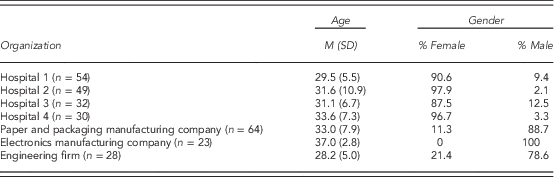
The mean age of the respondents across all seven organizations was 31.42 years (SD=5.19) and 59% of all respondents were female. Table 1 provides a breakdown of these demographic variables for all seven organizations. A more detailed analysis indicates that the average age of the respondents is very similar across the seven organizations; however, within the four hospitals, the similarity is even more pronounced. The difference in the percentages of male–female respondents in hospitals versus private sector companies is also noteworthyFootnote 1 .
Demographic characteristics by organization

Measures
This questionnaire was administered in English as it is the official language of correspondence in all offices and the language of instruction at all high schools and universities in Pakistan. Previous studies in similar fields have also used English questionnaires in Pakistan (e.g., Butt, Choi, & Jaeger, Reference Butt, Choi and Jaeger2005; Raja & Johns, Reference Rubino, Perry, Milam, Spitzmueller and Zapf2010; Abbas et al., Reference Abbas, Raja, Darr and Bouckenooghe2014; Khan et al., Reference Kinicki and Vecchio2015; Naseer, Raja, Syed, Donia, & Darr, Reference Ng and Sorensen2016). Measures of NA, time-related work stress, and turnover intentions were obtained through a self-reported questionnaire and the measure for job performance was obtained through a supervisor-reported questionnaire. Unless otherwise noted, a response scale anchored by 1=‘strongly disagree,’ to 5=‘strongly agree’ was used. We conducted confirmatory factor analysis including all four constructs (i.e., NA, time-related work stress, turnover intentions, and job performance) to ascertain the discriminant validity of these variables and common method variance bias (Podsakoff, MacKenzie, Lee, & Podsakoff, Reference Raja and Johns2003). A model including all four factors yielded satisfactory fit (χ2=920.29, df=344, p<.01; Root Mean Residual (RMR)=0.07; Root Mean Square Error of Approximation (RMSEA)=0.06; Confirmatory Fit Index(CFI) =0.90; Incremental Fit Index (IFI)=0.91). In addition, we followed the procedure recommended by Anderson and Gerbing (Reference Anderson and Gerbing1988) and compared a two-factor versus a single-factor forced model for every possible pairing of these variables. In every case, the χ2 value of the free two-factor model was significantly lower than the constrained single-factor model, lending further support for discriminant validity of variables. In addition, to rule out the potential for common method variance bias, we ran a model using the common latent factor method to capture the common variance among the variables that were measured using the same source. We compared the standardized regression weights from this model with the standardized regression weights of a model without a common latent factor. There were no large differences (>0.200), implying that the effect of common method variance was limited.
NA
A 10-item scale was used to measure the trait of NA (Watson, Clark, & Tellegen, Reference Watson, Clark and Tellegen1988). Respondents reported how they generally felt with regard to a list of ten negative emotions (e.g., hostile, nervous, and happy). Example items include the following: ‘To what extent do you generally feel this way’, that is, ‘How you feel on average for each of the following: ‘distressed’, ‘upset’, ‘hostile’, etc’. Cronbach’s α coefficient for NA was 0.82.
Time-related work stress
Parker and Decotiis (Reference Podsakoff, MacKenzie, Lee and Podsakoff1983) distinguished between the time-related dimension of work stress and the anxiety dimension. Due to the conceptual overlap between items of the anxiety dimension with NA, we decided to focus only on the time-related work stress dimension. This dimension of stress was measured with the 8-item subscale developed by Parker and DeCotiis (Reference Podsakoff, MacKenzie, Lee and Podsakoff1983). Example items include the following: ‘I have too much work and too little time to do it in’ and ‘I feel like I never have a day off’. Cronbach’s α coefficient for this scale was 0.75.
Turnover intentions
We measured turnover intentions using a 3-item subscale with a 7-point Likert type response anchor format (1=‘completely disagree,’ to 7=‘completely agree’) from the Michigan Organizational Assessment Questionnaire (Cammann, Fichman, Jenkins, & Klesh, Reference Cammann, Fichman, Jenkins and Klesh1979; Abbas et al., Reference Abbas, Raja, Darr and Bouckenooghe2014). Example items are as follows: ‘I will probably look for a new job next year’ and ‘I often think about quitting this job’. Cronbach’s α coefficient for this scale was 0.79.
Job performance
A 7-item measure rated by supervisors was used to measure in-role job performance (Williams & Anderson, Reference Williams and Anderson1991). Example items include the following: ‘meets formal performance requirement of the job’. Cronbach’s α coefficient was satisfactory (α=0.72).
Control variables
We controlled for respondents’ age and gender. Furthermore, we created three dummy coded variables to control for the effects of organization. The paper and packaging manufacturing firm, the consumer electronics manufacturing company, and the engineering firm were compared against a reference group that included the four hospitals. The four hospitals were treated as one category because the respondents were very similar in terms of demographic characteristics (age and gender). In addition, the nurses of all four hospitals were employed in similar units (cardiac care units, and gynaecology, general medical, and surgical wards).
Results
Data were collected from 280 employees across multiple departments; thus, the error terms are nonindependent, suggesting that hierarchical linear modelling would be an appropriate method of analysis. We conducted a number of analyses to check for the feasibility of hierarchical linear modelling. Our analyses showed that only 9.3% of the total variance explained in performance and 3.7% of the total variance explained in turnover intentions, respectively, could be attributed to group level effects, whereas 90.7 and 96.3% of the total variation could be accounted for by differences between individuals. We also found limited internal consistency in the individual performance and turnover intentions at the department level as illustrated by ICC(2). The values were 0.03 (performance) and 0.26 (turnover intentions), respectively, which is much lower than the threshold of 0.70 suggested by Lebreton and Senter (2008).
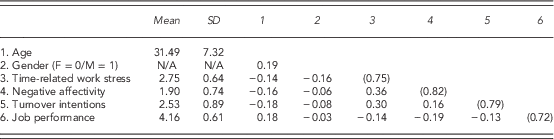
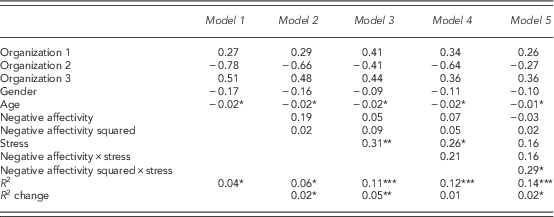
Based on these analyses, we decided not to conduct hierarchical linear modelling, and instead relied on polynomial regression analysis to test our hypotheses. Following Aiken and West (1991), all variables were standardized before running the regressions. Although multicollinearity did not appear to be an issue, we also calculated the correlations between the quadratic term of NA and our moderator variable of time-related stress (r=0.09, ns) in order to ensure that the power of moderated regression was not undermined (Cortina, Reference Cortina1993). Following Janssen (Reference Johnson, Tolentino, Rodopman and Cho2001), a multiple-step procedure was used to test for the curvilinear effects (Hypotheses 1a and 1b) and the moderator effects (Hypotheses 2a and 2b). In the first step, we entered the control variables for organization (dummy coded variables with ‘hospitals’ as a reference category), age and gender. Age and gender are basic demographic variables and have been considered in prior research on performance and turnover intentions (e.g., McEvoy & Cascio, 1989). In the second step, we added the main effect of NA and NA2 which allowed us to test the curvilinear relationship (Hypotheses 1a and 1b). To detect the moderator effect, ‘time-related work stress’ and the product term ‘NA×time-related work stress’ were, respectively, added in the third and fourth steps. In the final step, the quadratic–linear interaction term (NA2×time-related work stress) was added to check whether or not the curvilinear effect of NA on performance and turnover intentions was moderated by time-related work-stress (Hypotheses 2a and 2b) (Table 2).
Bivariate correlations and descriptive statistics

Note. n=280; α reliabilities in parentheses.
All correlations above 0.10 are significant at p<.05.
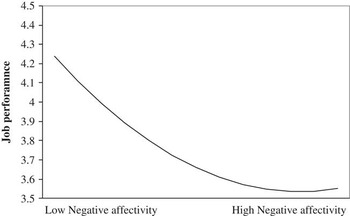
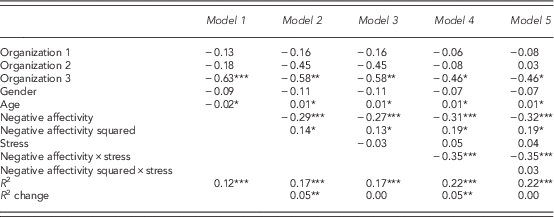
As displayed in Table 3, consistent with Hypothesis 1a, NA showed a curvilinear effect with performance (β=0.14, p<.05; see Model 2, Table 3). Based on Figure 1, performance was found to decrease rapidly for respondents with low-to-moderate levels of NA, whereas the negative effects were weaker beyond a certain level of high NA. The inflection point for NA was 0.84 (Z-value). This finding may signify a nonlinear relationship between NA and job performance, but may also reflect a rating bias such that supervisors are reluctant to provide especially low ratings of performance. Thus, there could be a floor effect where even though employees with especially high NA show poorer performance, supervisors do not distinguish between them when rating their performance. In order to rule out this possibility, we examined the distribution of the performance scores for all individuals who scored higher than the inflection point for NA. A closer analysis of the histogram showed that the data were normally distributed (Kolmogorov–Smirnov test for Hypothesis 0 was not rejected; p=.29). No support was found for Hypothesis 1b because no significant quadratic main effect was found for NA (see Model 2, Table 4).
Curvilinear relationship between negative affectivity and job performance

Regression results for job performance

Note. n=280; four organization dummy coded variables were used to control for its effects (organization 1=paper and packaging manufacturing firm, organization 2=electronics manufacturing firm, organization 3=project engineering firm, reference category=four hospitals); for gender 0=‘female’ and 1=‘male’.
***p<.001; **p<.01; *p<.05 (two-tailed tests).
Regression results for turnover intentions

Note. n=280; four organization dummy coded variables were used to control its effects (organization 1=paper and packaging manufacturing firm, organization 2=electronics manufacturing firm, organization 3=project engineering firm, reference category=four hospitals); for gender 0=‘female’ and 1=‘male’.
***p<.001; **p<.01; *p<.05 (two-tailed tests).
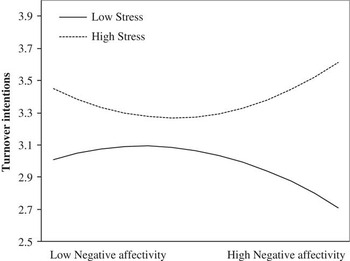
No support was found for Hypothesis 2a, yet we found a significant quadratic two-way interaction effect (NA2×time-related work stress) (β=0.29, p<.05; see Model 5, Table 3) on turnover intentions in support of Hypothesis 2b. The overall incremental variance explained by this model was significant (∆R 2=0.02, p<.05). To facilitate the interpretation of the quadratic–by-linear interaction effect, the interaction was graphed following procedures prescribed by Aiken and West (1991), in which turnover intentions for those with high (+1 SD) and low levels of time-related work stress (−1 SD) were graphed across high and low NAFootnote 2 . Figure 2 shows that the increasing effect of NA on turnover intentions is stronger at higher values of time-related work stress, whereas the declining effect of NA on turnover intentions is stronger at lower values of time-related work stress. Put differently, employees with high NA are less likely to leave the company when they are exposed to less time-related work stress, whereas they are more likely to leave the organization under high time-related work stress.
Moderating role of time-related work stress in the curvilinear relationship between negative affectivity and turnover intentions

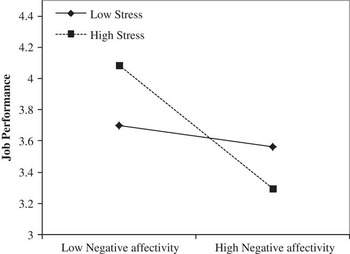
Finally, in addition to our hypotheses, we checked whether or not the linear main effect part for the relationship between NA and job performance was moderated by the level of time-related work stress experienced by the participants (β=−0.35, p<.001; see Model 4, Table 3). More specifically, the negative linear relationship between NA and job performance was reinforced when respondents also reported high levels of time-related work stress (see Figure 3). In addition, simple slope analysis showed that the negative linear main effect of NA on job performance was significant under the condition of high levels of stress (β=−0.45, t=−3.14; p<.01), but became nonsignificant under the condition of low levels of stress (β=−0.12, t=−1.56; ns). No significant linear interaction effect was found between NA and stress when the outcome variable was turnover intentions (see Model 4, Table 4).
Interaction effect of time-related work stress and negative affectivity on job performance

Discussion
Despite the mainstream perspective that NA has a dysfunctional effect on job outcomes, scholarly work remains ambiguous and sometimes counterintuitive about NA’s effect (Ng & Sorensen, 2009). Recent meta-analyses reveal that a substantial amount of variance in the relationships between NA and job performance and turnover intentions cannot be attributed to research artefacts (Thoresen et al., Reference Tsui, Nifadkar and Ou2003; Kaplan et al., Reference Kausar and Anwar2009), thus indicating that the nature of these relationships requires further in-depth examination.
In this study, we tested the curvilinear relationships between NA and job performance and turnover intentions among employees exposed to highly stressful work conditions. Also, we examined how these relationships are moderated by time-related work stress. Besides finding a strong significant linear negative relationship between NA and job performance, we observed a curvilinear relationship between NA and job performance in support of our hypothesis. As NA increased from low–to-moderately high levels, job performance showed a declining pattern. However, as NA continued to increase to higher levels, its harmful impact on job performance was less pronounced. In cases of elevated NA, people tend to be more receptive to negative information and are therefore able to use that information to improve performance, thereby avoiding the negative consequences of continued poor performance (Wrosh et al., 2003; da Motta Veiga & Turban, Reference da Motta Veiga and Turban2014). Although we did not find support for the curvilinear effect weakening at lower levels of time-related stress, we observed a moderating effect of time-related stress for the linear part of the relationship. More specifically, time-related work stress moderates the relationship between NA and job performance. Under conditions of low time-related work stress, the negative relationship between NA and performance was less strong. In support of self-regulation theory (Carver & Scheier, Reference Carver and Scheier2011), when employees with high NA experience less time urgency on the job in comparison with high time-related work stress, the former will perform better because they are better able to allocate their limited self-regulatory resources efficiently.
Finally, the curvilinear relationship between NA and turnover intentions was moderated by time-related work stress in support of our hypothesis. Under low time-related work stress, individuals with high NA were less likely to leave their organizations. Under high time-related work stress, individuals with high NA were more likely to leave the organization. Since employees with high NA have the predisposition to encode and recall negative information from their environment (Weiss & Cropanzano, Reference Weiss and Cropanzano1996; Watson et al., Reference Watson, Wiese, Vaidya and Tellegen1999), these individuals, when exposed to time-related stress on the job, may try to avoid these negative situations by engaging in withdrawal behaviour (Elliot & Thrash Reference Fiedler2002; Chiu & Francesco, Reference Chiu and Francesco2003).
The findings from this study have important implications for employees working in stressful workplaces. Management should invest resources in developing jobs and creating work contexts that allow for time-related demands to be altered, depending on an employee’s dispositional NA. Extra attention should also be given to employees with high NA because they are the ones who are most vulnerable to time-related work stress. Therefore, limiting tasks and projects with strict deadlines increases the likelihood that employees with high NA will perform better than if they feel the constant pressure of working against deadlines. In contrast to employees with high NA, employees with low NA require extra stimulation in the form of assignments or tasks that have time-related demands. It is not enough to assume that employees that score low on NA tend to perform better; organizations should also create a context where their employees are exposed to some challenging demands in order to help them thrive in the work environment. Management should also consider investing in training programs specifically geared towards improving time management skills among employees with high NA in order to help employees cope effectively with time-related pressures.
This study suggests that a one-size-fits-all management approach that seeks to create a work climate free of stress may be disadvantageous to companies because employees’ responses to stress may vary depending on their dispositional NA level. At the same time, our findings also provide management with some new and interesting insights concerning how withdrawal behaviour tends to be more pronounced among employees with higher NA under conditions of high time-related work stress. Since they are likely not to be the best performers under stressful situations, exposing this group deliberately to additional stress may actually be beneficial to an organization, as it enables HR to have more control over functional turnover. However, from a legal and ethical perspective, this may not really be an option. Therefore, it makes more sense to help employees with high NA direct their resources to perform better. Not only is this alternative both legal and more ethical, but it is also beneficial to employees. In actuality, these positive experiences that accompany improved job performance help to break the negative experience cycle of high NA (Thatcher & Perrewe, 2002), and enables the improvement of self-esteem and confidence.
Limitations and future research directions
We acknowledge that our study has some limitations that can offer opportunities for further research. First, the relatively moderate sample size (n=280) might be a weakness. The general preference in social sciences research is to draw conclusions from larger samples because of the associated higher statistical power. However, having a more modest sample size provides a more conservative statistical test of theoretical relationships; our finding of significant curvilinear effects and interaction effects corroborated the validity of our conceptual framework.
Second, because of the potentially sensitive nature of data and informal social categorization system in a country like Pakistan, potential concerns could be raised with regards to social desirability response bias. However, we are convinced that by adopting standard procedures used in similar studies in Pakistan we have reduced these concerns (e.g., Butt, Choi, & Jaeger, Reference Butt, Choi and Jaeger2005; Raja & Johns, Reference Rubino, Perry, Milam, Spitzmueller and Zapf2010; Abbas et al., Reference Abbas, Raja, Darr and Bouckenooghe2014; Khan et al., Reference Kinicki and Vecchio2015). More specifically, participation was voluntary, and participants received a cover letter that assured them of the confidentiality of their responses. Furthermore, they were provided with the contact information of the research team to remove any potential concerns participants may have about participation in this study. Finally, all respondents were given the opportunity to withdraw from the study at any point in time. By relying on these standard procedures, we feel confident that social desirability did not play a significant role in this study.
Third, an acceptable response rate is essential for the validity of the findings (see Baruch & Holtom, Reference Baruch and Holtom2008), but also equally important to evaluating findings is the nonresponse rate and how it may bias the study’s findings. According to Dillman (Reference Dillman1991), late respondents are similar to nonrespondents; therefore, late respondents can be used as a proxy of nonrespondents. Comparing the results of the group of early respondents with the group that only responded after being sent a follow-up reminder yielded no significant differences in responses, which we believe mitigates the potential for nonresponse bias.
Fourth, because our study is cross-sectional by design, no inferences about causality can be drawn. For example, a reciprocal relationship may exist between NA and job performance or NA and turnover intentions. That is, when an employee’s job performance is assessed by his/her supervisor, it may influence the employee’s feeling of self-efficacy, and therefore inhibit or strengthen their perception of the trait-like characteristic of NA. Future directions of research around this topic should include an experimental research design or longitudinal component in order to address these causality issues. Furthermore, a longitudinal approach taken to this research stream would allow for the capturing of more data points throughout a timeframe and help to understand fluctuations in how a state-like characteristic such as experienced stress may influence the relationship between NA and in-role job performance/turnover intentions.
Fifth, self-reported measures from time-related work stress, turnover intentions, and NA can inflate the observed relationships (Podsakoff et al., Reference Raja and Johns2003). However, we believe that method bias or self-report bias was not a serious threat because method bias attenuates observed interactions and curvilinear relationships suggesting that a high occurrence of method bias would have reduced the possibility of detecting significant interactions or curvilinear relations in our data set. Put differently, common method bias is less salient when respondents cannot easily guess the effects, which is the case with more complex interaction and curvilinear effects (Simons & Peterson, Reference Spector2000).
Finally, we measured in-role job performance with evaluations from supervisors. Although this helped to reduce same source concerns in predicting performance, it also exposed our study to supervisor-rater bias. Prior research has shown that performance ratings may be subject to supervisor-rater bias, so future studies could benefit from using objective performance measures whenever possible (Bommer, Johnson, Rich, Podsakoff, & MacKenzie, Reference Bommer, Johnson, Rich, Podsakoff and MacKenzie1995).
Despite the abovementioned limitations, this study also has significant strengths. The data for performance were not self-reported, which helped us to reduce the potential issues associated with common method bias (Podsakoff et al., Reference Raja and Johns2003). The majority of studies in this domain of research have been conducted in developed countries in North America and Europe. Although this study is not a cross-cultural study, theories and concepts largely developed in the United States should be tested in non-Western settings; otherwise, researchers and practitioners will have little confidence in their generalizability in other regions (Tsui, Nifadkar, & Ou, Reference Walsh and Dollard2007). This study provided us with an excellent opportunity to examine in Pakistan the applicability and validity of concepts that were largely established in Western developed countries.
Data were collected in Pakistan, a country with a low per capita income, high level of poverty, and high unemployment rates (OECD, Reference Parker and DeCotiis2013). Furthermore, the situation of the country is complicated with frequent waves of violence and terrorism. Given these environmental conditions, the work environment is probably more stressful in comparison with the average work context of an employee in a Western developed country (Kausar & Anwar, Reference Khan, Abbas, Gul and Raja2010). Overall, the lack of facilities and resources of organizations in Pakistan creates a highly stressful work environment. Especially in view of the country’s very high unemployment rates, employees are expected to cope with highly stressful situations in order to survive and thrive (Hamid et al., Reference Hobfoll2014). As a result of these extreme environmental work conditions, our findings may be somewhat more pronounced than if the study had been conducted in a Western context.
The fact that Pakistan is a collectivistic society (Hofstede, Reference Hogan1983) may also have yielded findings different from countries that adopt more individualistic values. In comparison with individualistic societies, employees with high NA in collectivistic societies may be less inclined to leave the company and focus their scarce self-regulating resources towards improving team performance instead of individual performance because they do not want to continuously disappoint their colleagues. Furthermore, with regards to perceived stress, it is likely that work stress is more pronounced in a culture with high power distance (e.g., Pakistan) as opposed to low power distance (e.g., United States). Despite seemingly overwhelming work demands, employees will continue to follow the norm by showing strong deference towards authority. In short, we believe that due to the specific nature of our data, future research would benefit from collecting cross-cultural data.
To conclude, we hope that this study and our findings will stimulate further investigation of the boundary conditions under which NA relates to various work-related outcomes (e.g., counterproductive behaviours, citizenship behaviours, etc.)