1. Introduction
The analysis of formal processes (recurrence, variation and contrast) has dominated the theoretical discourse in analysis of interval-based music. An overwhelming amount of attention has been directed to the analysis of pitch and rhythm patterns as elements of form-building. In order to analyse sound-based music we have developed methods of analysis that conceptualise and represent graphically that which makes syntactical sense in music-as-heard.
In our development of conceptual and graphical tools for the aural analysis of music, we have so far worked out five different areas of predefined (as opposed to emergent) form-building isotopies wherein formal structures can be identified in a manner that makes them applicable across stylistic borders. Two of these concern themselves with the subdivision of the musical whole into units (consecutive ones, called time-fields, and simultaneous ones, called layers). A third area is dynamic forms; here energetic patterns are analysed, particularly with regards to directionality/non-directionality (i.e. form-building functions). Next, the analysis of form-building processes is concerned with observations of similarity and contrast, thus a continuation of the ordinary thematic analysis. Finally, the analysis of form-building transformations focuses on patterns of complexity between form-building segments.
These categories of form-building can be accessed by a particular type of selective, taxonomic listening for relevant features.
By choosing the term isotopy (Greimas Reference Greimas1966) we point to the fact that, within the area selected for focus, structured opposites are being played out against each other while they at the same time are unified by virtue of belonging to the same musical ‘problem space’. Our transfer of the term isotopy into aural analysis has necessitated further modifications; in our context an isotopy is constituted through a particular, selective listening intention. Moreover, in music, unlike prose, pertinent isotopies may be found on all three levels of the musical discourse explained below, and in addition be a relevant concept for the analysis of music semantics. In music a polyphony of isotopies is the normal case.
This paper will present methods for the analysis of two form-building isotopies: time-fields and dynamic forms. Within each of these isotopies a number of concepts will be presented – far more than what is strictly needed to analyse the piece to which we have chosen to apply these methods. The point is to demonstrate that each isotopy consists of a number of paradigmatic possibilities, only a limited number of which is activated in a given musical syntagm.
2. The Organic conception of musical form
Musical form from the point of view of aural experience is the aurally perceived organisation of sound patterns into composite units displaying emergent, new patterns or structures. Qualities usually related to the anatomy of the moment (retention, primal-impression and protentionFootnote 1) are extended into a much larger timescale. For this to happen, large time segments must be condensed and kept in memory, so that, at any moment during the actual unfolding of music, present musical events are appreciated in light of a simplified memory of preceding segments. Such a summary will need to retain the features that are pertinent for clarifying its function in relation to the element unfolding in the present; this influences expectations and uncertainties with regard to what is to happen next.
In order for a larger temporal entity to lend itself to condensation, a slowly evolving background unifying the numerous sound-events of the foreground (or ‘surface’) is needed. Such a point of view was proposed by Heinrich Schenker, for whom the harmonic background provided the guarantee of musical coherence (Forte and Gilbert Reference Forte and Gilbert1982). Pierre Schaeffer pondered the possibility of the musical timbre (‘character’) taking the role of the integrating background in the novel musique concrète (Schaeffer Reference Schaeffer1966: 303).
Arnold Schoenberg, in his approach to organic musical form, was less concerned with the unifying function of the musical background, and more concerned with the integration of foregrounds shaping a comprehensible musical discourse based on constellations of musical values (such as pitch and rhythm forming motives).
Used in the aesthetic sense, form means that a piece is organized; i.e. that it consists of elements functioning like those of a living organism. Without organization music would be an amorphous mass, as unintelligible as an essay without punctuation, or as disconnected as a conversation which leaps purposelessly from one subject to another. (Schoenberg Reference Schoenberg1967: 1)
According to Schoenberg, form in this sense ensures intelligibility, logic and coherence, the very prerequisites of a comprehensible music. To be concerned with form is taking into account man’s limited powers of understanding; as he is unable to keep in mind very long time stretches, the musical discourse must be subdivided into manageable segments. However, these shorter segments must again be joined to the others in such a way that one segment presupposes the other; this is what one could generally call formal functions, in a similar sense to how harmonic functions are relationships between chords that join them into a greater whole (Schoenberg Reference Schoenberg1967: 20, 119).
Actually, classical western music grounds musical form doubly, using both foreground elements and background elements. Summarising Hans Keller’s theories on music, Ian Bent writes:
Keller spoke of musical thought as two-dimensional: that is having ‘background’ and ‘foreground’. The background proceeds by the law of identity, the foreground by the law of contradiction. Thus music has the quality, not open to logical thought, that something may both be and not be something. In context, Keller’s view of a piece of music (a piece, as with Schenker, that exhibits mastery) is of unity within diversity: of the constant ‘latent’ presence of a single basic idea, articulated in time as a succession of ‘manifest’ contradictions. The diversity of the foreground is meaningless unless it occurs against a background of unity. (Bent with Drabkin Reference Bent and Drabkin1998: 87)
At the basis of the study of organic form as an aural phenomenon is the subdivision of the music’s temporal unfolding into segments; we have termed such segments time-fields. A time-field is a subdivision of a larger musical entity into smaller, constituent units or segments that are perceptible as such to the listener. Accordingly, a time-field is composed of several sound objects, or of shorter time-fields (with a few special-case exceptions). Time-fields are related to the traditional concept of a musical phrase, period or sentence. Since the purpose of the present method of analysis is to cross over stylistic borders, we have chosen not to use these traditional terms exclusively as they may have quite specific definitions in their original context (see, e.g., Schoenberg Reference Schoenberg1967: 20 and 58).
Different musical theorists have had different approaches to the subdivision of music into units. The criteria according to which they subdivide the music vary greatly. Some find it necessary to use descriptive terms borrowed from the metrical feet of poetry (Cooper and Meyer Reference Cooper and Meyer1960). Much research builds on the method of linear and metric reduction adopted from Schenker, with approaches tied to the harmonic language of classical western music (Salzer Reference Salzer1962; Forte and Gilbert Reference Forte and Gilbert1982; Smith Reference Smith1996). Tenney and Polanski (Reference Tenney and Polanski1980) base their approach to segmentation on quantified gestalt laws. Lerdahl and Jackendoff (Reference Lerdahl and Jackendoff1983) expand these approaches with a method borrowed from structural linguistics and define a set of rules for predicting grouping and segmentation, and further studies have evaluated these theories (Deliège Reference Deliège1987; Smith Reference Smith2005). Nattiez (Reference Nattiez1975) and Roy (Reference Roy2003) find it necessary, in their insistence on the existence of a neutral level of music, to discuss all thinkable segmentations where neither the composer’s intention nor the listener’s response is taken into account, before deciding about an interpretation.
The present project considers music in its esthesic Footnote 2 aspect, and therefore the analysis of subdivisions is approached in a purely auditive way. Moreover, at the basis of our approach is a certain orientation towards the primary perceptive forces at work in the formation of gestalts. In addition there are criteria based on learnt codes, particular to a given style and a community of listeners; if the analyst does not master the codes at work in the music he analyses, he may lose essential elements in his analysis.
3. Preliminary considerations of aural analysis
In order to arrive at a consistent analysis of music by ear, we have sorted out a number of listening intentions and listening foci. At the start the use of reductive listening Footnote 3 is the intention to listen for how the sound-object is constituted. It is not essentially a music-oriented listening, but a useful intention for gaining conscious access to the foundational level of music-as-heard: the sound itself. We have called this foundational level level one.
A shift in listening intention will reveal a next level of organisation, that of sound-patterns (sound-events grouped or organised into greater units) or level two; this listening intention will be called taxonomic listening2. The third level is constituted by taxonomic listening3 which reveals the form-building patterns (the patterns produced by level 2 sound patterns or, occasionally, by long sound-events). The word sound-event is introduced as a neutral term for designating a sound, since ‘sound-object’ implies a specific constituting listening intention. The sound-patterns on level two which are constituted by another listening intention, that of taxonomic listening, are therefore made up not of sound-objects, but of sound-events. See figure 1.
Listening intentions on three levels of musical experience.

Recent research in cognitive psychology seems to confirm the validity of the tripartition presented above. Bob Snyder, after having explained the three processes in the human brain active in the process of memory, points out:
The three memory processes just described (echoic memory, short-term memory and long-term memory) are related to three different time levels of musical experience, which I will refer to, respectively, as the ‘level of event fusion’, ‘the level of melodic and rhythmic grouping’, and the ‘level of musical form’… The three types of processing define three basic time scales on which musical events and patterns take place. (Snyder Reference Snyder2000: 12–13)
The emphasis of traditional western music theory is on level two (intervals, chords, motives, rhythms, etc.), using methods to describe what can be characterised as an interval-based music. The piece we are analysing, however, could be categorised as sound-based music (Landy Reference Landy2007: 17). Sound-based music has often got a binary articulation, level one and two being more or less inseparable:

The level-two organisation of the values in sound-based music is of a different kind from the organisation in interval-based music that often contains hierarchies of values on level two. However, binary articulations can also be found in traditional music, both folk music and ancient classical music; here, level three may have a very rudimentary organisation and is best dealt with as a level-two phenomenon:

In acousmatic music, recognisable, recurring sound-characters (Thoresen Reference Thoresen2009) will often serve as form-building elements in the analysis of level-three formal processes (i.e. recurrence, variation and contrast). The elements we have included in an aural analysis of a piece of spectromorphological music (music in relative interval space) could then be:
Level 1+2:
• Spectromorphological transcription, using the categories and notation presented earlier (Thoresen Reference Thoresen2007b), preferably containing a discussion of choices made concerning the categorisations made.
• Identification of the basic characters of sound-patterns; i.e., establishing the basic families that present themselves and the range of their variation.
• Discussion of similarities/dissimilarities of the sound-characters and how they interrelate.
• Identification of the differential values within each character.
These steps have been covered in our earlier article (Thoresen Reference Thoresen2009). On the basis of this analysis, aspects of form may now be discussed:
Level 3:
• Identifying the time-fields (segments) and/or the layer structure of the piece.
• Listing of the more characteristic configurations of sound-events; these may be recurring features, characteristic gestures, or intensive or memorable moments.
• Developing a hypothesis of the pertinent form-building isotopy of the piece, after reflection on the memorised piece, and determining the more relevant analytical tools; to be chosen from a set of methods that have been developed for the analysis of form-building: form-building processes (recurrence, variation, contrast), form-building functions (i.e. dynamic form), and form-building transformations (Thoresen Reference Thoresen1988, Reference Thoresen2007a).
• A condensation of the form into a formula of essential features may be attempted.
A description of the aurally observable givens of the music enables the analyst to formulate hypotheses about the endosemantics of the music; such a formulation provides a basis for an exosemantic interpretation.Footnote 4 Such a perspective would add to the previous analyses, for example:
• Interpretation of gestures, form-building isotopies, or formulae with reference to extra-musical entities.
• Explicit identification of the kind of semiosisFootnote 5 that constitutes the basis of the analyst’s interpretation. We postulate four basic types of semioses (which may be combined in semiotic chains): causal inference (indexical signs), comparison (iconic signs), association (metonymic signs), and recognition (arbitrary signs).
• Identification of the preferred listening behaviour (we have added a number of such behaviours in addition to those identified by Delalande Reference Delalande1998). The listening behaviours we have identified are characterised by varying emphasis of the six factors involved in musical communication (addresser, addressee, context, message, contact and code (Jakobson Reference Jakobson1960: 353)).
4. A presentation of two form-building isotopies
4.1. Time-fields
In identifying the subdivisions of a piece of music the analyst has to take the point of view of a performer, conductor or the attentive listener, who more or less spontaneously will find that the music falls into phrases, segments, sections and so on. Accordingly, no set of pre-established rules or formal criteria are applied at the outset of the analysis; the subdivisions observed emerge as the combined result of musical gestalt-factors and cultural conventions, and are of course influenced by the analyst’s aural, musical maturity and his or her knowledge of relevant stylistic codes.
However, this process of more or less spontaneous segmentation is lifted to attention through a selective listening intention that sets the main focus of the analyst on a particular feature of the musical discourse. With a system of notation, the observations gained through the listening are then objectified. Features and patterns that initially went unnoticed now emerge, and subdivisions that seemed clear may after closer scrutiny seem ambiguous and will need further reflection and reasoning. The initial understanding will then often be challenged, and a phase of critical assessment of the findings may be necessary before settling on a solution or finishing an analysis.
4.1.1. The hierarchic organisation of time-fields
It is a characteristic of musical organisation, and of the organisation of verbal languages as well, that the temporal continuum can be conceived as a simultaneous hierarchy of units. In verbal languages, for instance, there is the sentence, which is subdivided into shorter clauses, the sentence itself being a constituent of longer units of discourse. Similarly, in classical western music, a hierarchy of units exists; these hierarchies are consistent in the sense that all hierarchical levels are complete, and that the end of the longer units are not overlapped by the shorter units. In contemporary, sound-based music of the spectromorphological kind, the consistency of the time-field hierarchies has often been lost or fragmented; nevertheless shorter or longer units play an important role also here. Moreover, a layer-analysis and a time-field analysis of this kind of music will often yield a similar result.
4.1.2. Time-field depth
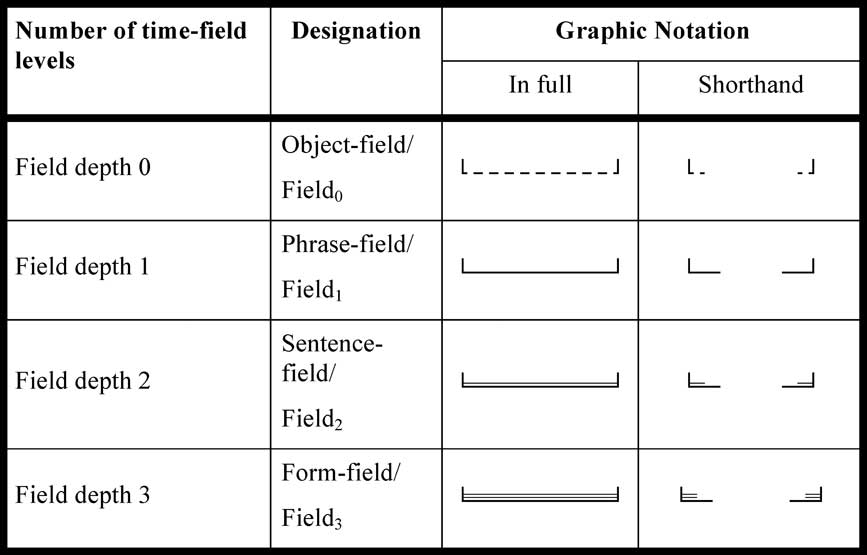
In order to accommodate music with highly varying hierarchic depth, one may simply number the ‘field depth’, beginning with the shortest level; see figure 2. In this way, the number of fields used can be adjusted to the nature of the music, or the particular focus of the analyst. In classical western music, whose hierarchies are much more stable in number and mutual functions, it may be possible to qualify the functions of different levels a priori, and to assign different designations for the fields on different levels. The smallest fields may then be called object-fields; they group one or more sound objects into a unit; they are usually the level of the motive. On the second level one may speak of phrase-fields; usually a small musical phrase or a partly completed portion of a larger musical sentence. One field level deeper one can identify the sentence-field: a unit consisting of a number of phrase fields, in classical music often terminated by a complete, authentic cadence. Finally, there is the level of the form-field, in which a constellation of several sentence fields forms a larger section of a composition.
Time-field depth.

4.1.3. Time-field conjunctions
By time-field conjunction is meant the manner in which time-fields on the same level of field depth are concatenated. Which level of time-field depth is to be subjected to this kind of analysis, and how many, may vary according to the musical context and the analyst’s focus of study. Generally, one will avoid making this analysis on the shortest time-fields, the object-fields. The study will be organised into two subcategories: time-field positioning and time-field demarcation.
4.1.4. Time-field positioning
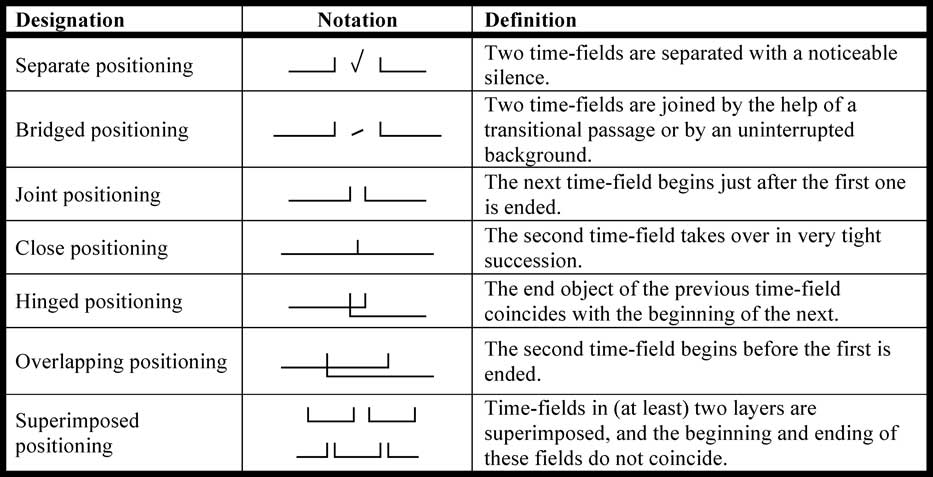
When analysing time-field positioning, the focus is on the proximity of fields: from fields separated by a silence, via the normal case of close succession, to overlapping position. Seven cases are proposed (figure 3).
Time-field positioning.

4.1.5. Time-field demarcation
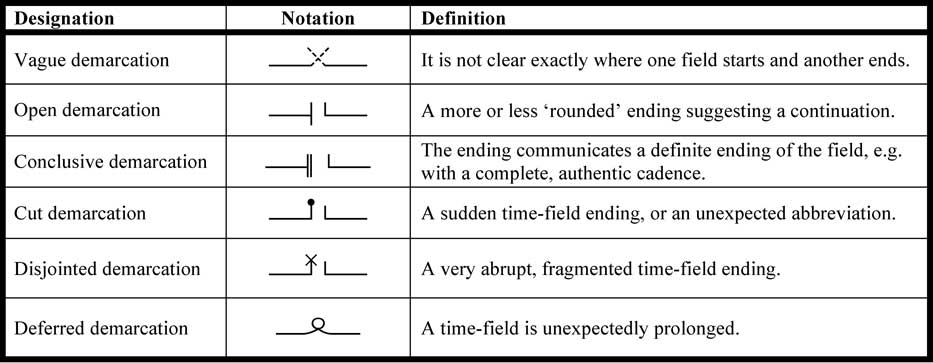
When analysing time-field demarcation the focus is on the ending of the time-fields. Six cases are proposed (figure 4).
Time-field demarcation.

4.1.6. Time-field focus
A shift of time-field focus occurs when the listener’s attention moves from one level of the time-field hierarchy to another. A time-field focus will be notated by a bold type notation. The marking of these attention shifts is especially useful in music that operates with hierarchically ordered, regular time-intervals.
4.2. Formbuilding functions: dynamic forms
The constituents of dynamic forms are the larger-scale directions in music. These are the form-building functions. Tendencies are first and foremost grounded in forces of energy that are at work within all three levels of the musical organism. On level one (that of sound objects) we trace the energy in terms of the intensity of the single sound and its energetic shape, on level two (that of elementary musical patterns) energy is traced both in terms of general dynamics (from pianissimo to fortissimo) and in terms of tempo (main pulse, temporal density of events). These primary energetic dimensions, moreover, can be supported by parallel developments in other musical dimensions such as tessitura, tonal modulations, articulation, and density of mass (e.g. the number of notes in a chord). When tendencies on levels one and two rise to shape the formal disposition of a piece we are dealing with dynamic forms on level three (that of form-building patterns).
The study of organic forms began only during the end of the nineteenth century, inspired by the works of Wagner and Bruckner. The pioneers were Lorenz, von Tobel and Kurth. Resent research exploring this dimension of music has been done by examining the concept of tension (Nielsen Reference Nielsen1983) and by linking this to the segmentation of music (Krumhansl Reference Krumhansl1996). Our approach to the analysis of dynamic forms will not be concerned with the description of the level one and two patterns in which the dynamic forms are grounded, but mainly focus on their emergent, overall design. In other words, this study represents the functions of dynamic forms as abstract, structural entities detached from their incarnation in a particular style and idiom. In doing so, we wish to uncover the energy architecture of the music.
4.2.1. The cardinal functions of dynamic form
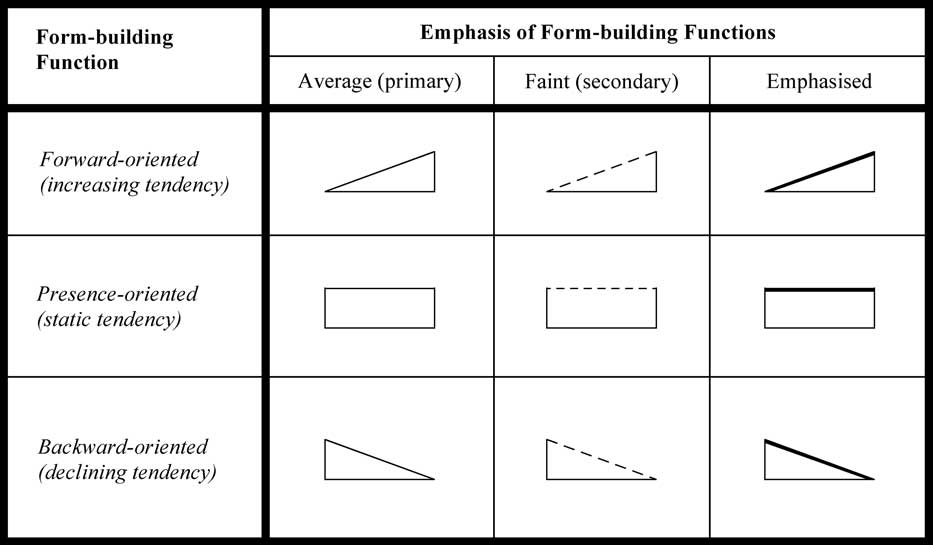
There are three form-building functions that define the cardinal points of a fully articulated dynamic form structure, all related to the emergent feature of directionality: these are forward-oriented, backward-oriented and presence-oriented functions (Thoresen Reference Thoresen1988, Reference Thoresen1987).
• The forward-oriented function is characterised by ‘proclining’ direction towards a future point in time and/or by an increasing tendency.
• The backward-oriented function is exactly the inverse: it is characterised by reclining direction away from a past point in time, and/or by decreasing tendency.
• The presence-oriented function is characterised by having a stable (or no) tendency, and, consequently, by being directed toward neither future nor past.
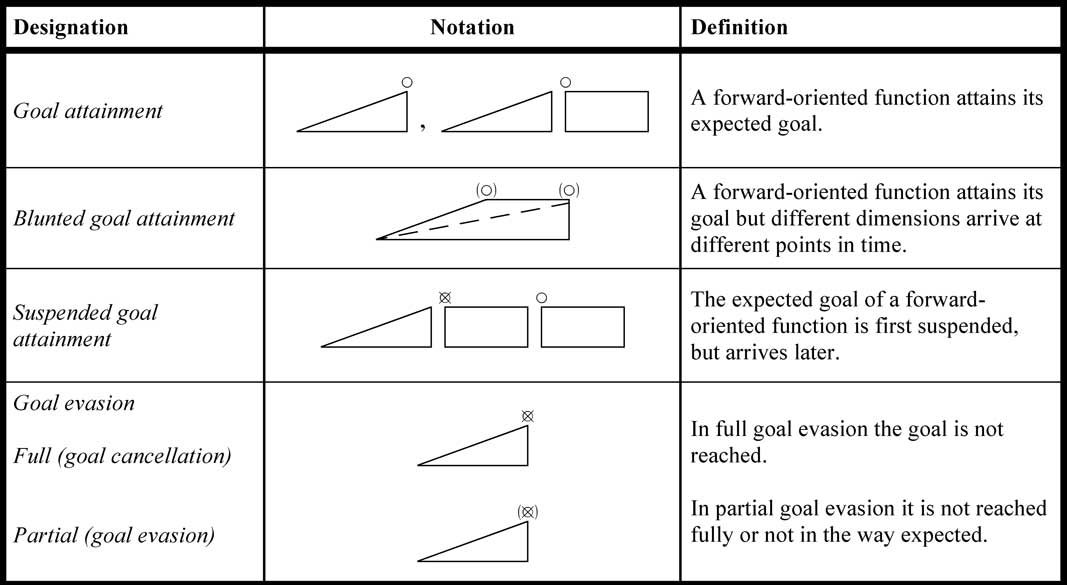
These functions may be represented with different emphasis or weight. Less emphasised functions may be called secondary when they are simultaneous with more predominant (primary) ones. The conceptual structure presented above will be rendered in a notation adapted to practical analysis. Figure 5 shows the graphic signs representing the basic functions. The variation of emphasis or clarity of the function is shown as well.
Form-building functions.

As overall tendencies are the result of synergy between several musical dimensions, the form-building functions may be more or less ambiguous. If they are extremely ambiguous, it will be impossible to determine the overall characteristic of the function in terms of the three cardinal functions above. This kind of vagueness may occasionally be the result of weak composing or performing. But it may also be an important and intended element in the musical discourse. We therefore need to mark out a fourth position in regard to the three cardinal positions. We would call this function neutral (figure 6). One important consideration in connection with directionality is that of goal attainment. A directed motion may or may not attain its goal. For analysis the signs in figure 7 are convenient.
The neutral position of the form-building functions.

Goal attainment/goal evasion.

4.2.2. The role of accents in articulating form-building functions
Accents may often be assigned a function that serves to articulate the dynamic form; when used for this purpose they, in fact, serve as a kind of musical punctuation. By accents we mean energy intensive impulses designed to catch the listener’s attention momentarily. The accent has to stand out from its surroundings in some respect, most often by being louder; having a more ample mass, a brighter spectrum or a sharper onset quality; and/or being longer than other elements in their context. Accents may serve rhythmical or expressive purposes; in our context we are particularly interested in those that through their position and prominence are of importance on the form-building level.
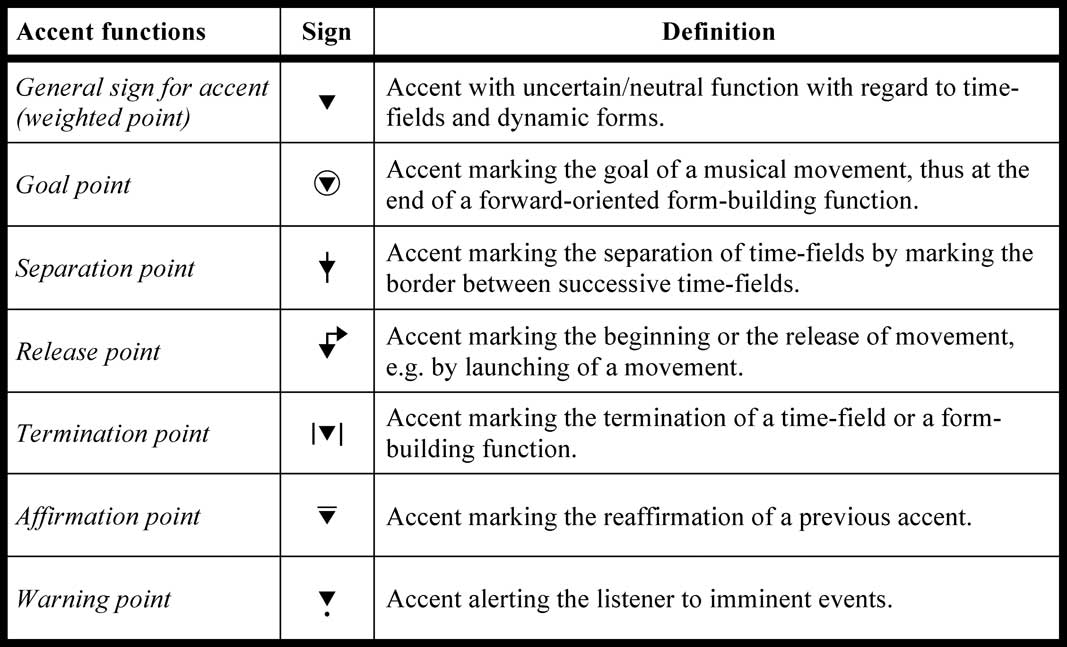
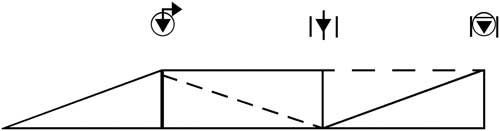
We have traced seven accent functions that are relevant to the articulation of dynamic forms and time-fields (see figure 8). Several functions of accents can combine; the notation is made such as to accommodate this (see figure 9).
Accent functions.

Combinations of accent functions.

5. Analysis of form-building patterns in Åke Parmerud’s Les Objets Obscurs
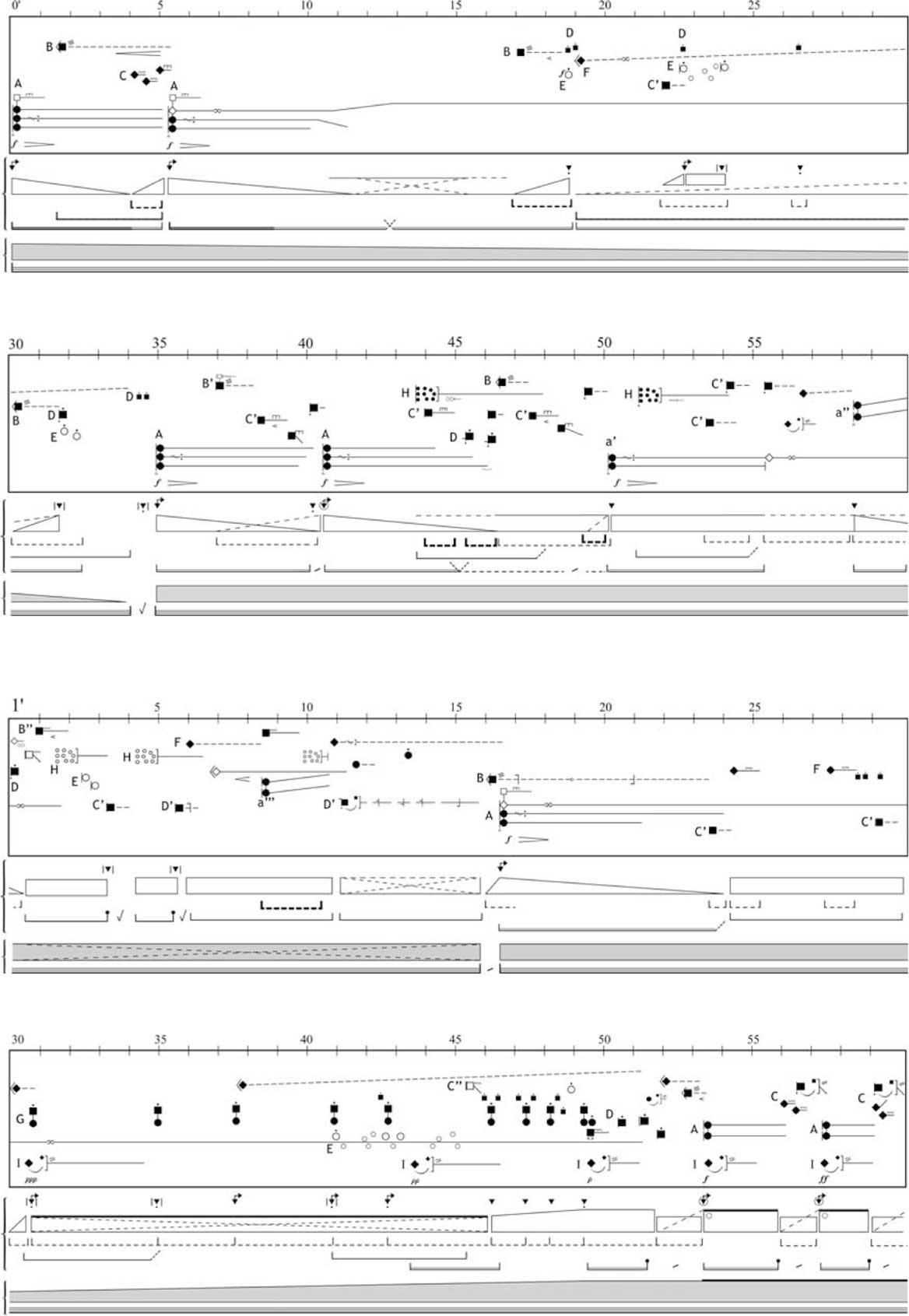
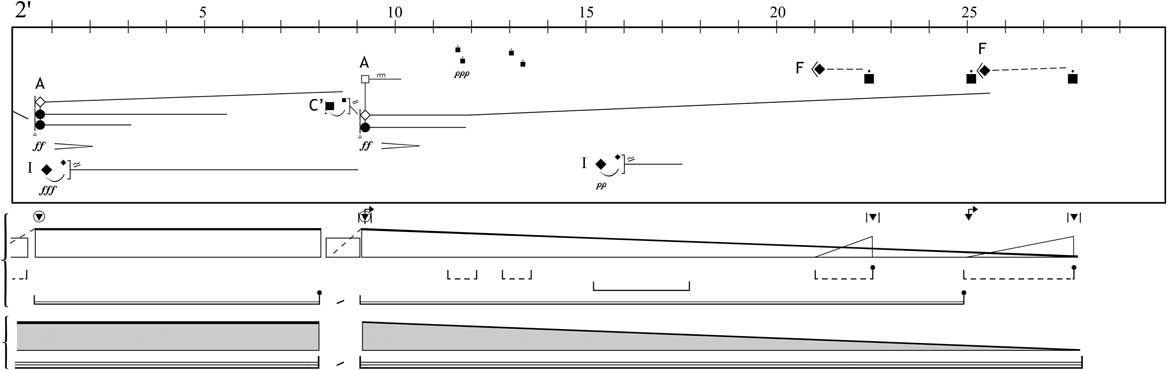
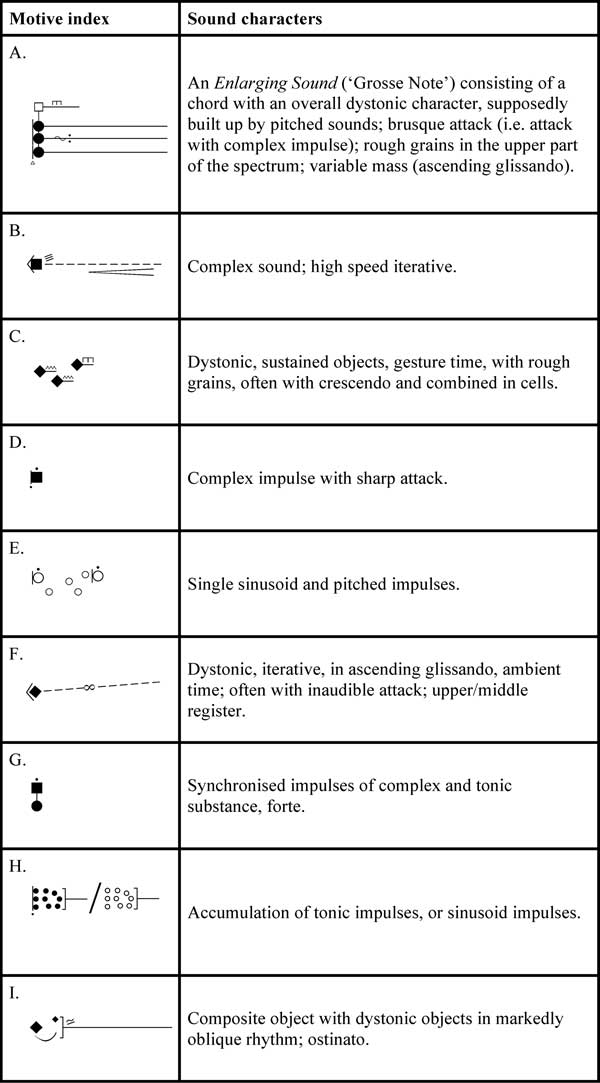
Figure 10 shows a spectromorphological transcription of the third section of Åke Parmerud’s Les objets obscurs, to which is added an analysis of the time-fields and dynamic forms (Movie example 1). In the case of the present piece, as is the case with a great deal of electroacoustic music, it is the integral sound-characters that take the role of the motive of traditional music. We have earlier (Thoresen Reference Thoresen2009) found nine integral sound-characters at work in the present piece (see figure 11).
Spectromorphological transcription, Les objets obscurs, 3rd section, with analysis.

(continued).

Sound-characters.

5.1. Observations deriving from the analysis
The piece seems to fall into four form-fields. The beginnings of these time-fields are clearly marked: it is the ‘core object’, the most pregnant element of the piece, indexed as sound-character ‘A’, that sets the release point of each time-field. The third and fourth form-fields are joined in the section where the core objects occur in rapid succession; this very intensive section comes after the forward-oriented ending of the third form-field and is rounded off with a backward-oriented form-field.
The nature of the time-fields is worth commenting on: in this piece, like in much electroacoustic music, a time-field is formed by the actual sounding presence of an integral sound-character; it may consist of a long object, or by shorter objects joined through temporal proximity. In contrast to a piece of tonal or post tonal music, the time-fields do not show a consistent hierarchy. There is only one type of time-field that has got a degree of durational regularity, namely the form-fields which serve to group the other, rather scattered time-field constellations. It should also be noticed that the second form-field is not formed with a single prolonged ‘A’ object; but since this exception constitutes its character, it is negatively dependent on the main ‘rule’. Apart from in the second form-field, ‘A’ with its long decay tends to support the form-fields by its prolonged presence and thus reinforce their cohesion.
Form-fields numbers 1, 2 and 3 seem to be approximately equally long, but between 3 and 4 a number of ‘A’ objects occur that disturb this even, slow rhythm of main events by three quick, consecutive attacks; the fourth form-field, the ending section of the piece, follows tightly after.
Each form-field, while always beginning the same way, has its distinctive way of evolving; and all but the fourth introduces a new integral sound-character.
• Form-field 1 presents the core sound-character (‘A’) twice. Time is given for absorption before sound-characters ‘B’, ‘C’, ‘D’, ‘E’ and ‘F’ are presented as fragmented points over a continuous, long background, deriving from the resonance of ‘A’.
• Form-field 2 begins with ‘A’ again. The tonic accumulation (sound-character ‘H’) is introduced as a new event. Shorter versions of ‘A’ are echoed in higher registers throughout the field, giving it a certain ascending character.
• Form-field 3 begins with a similar opening, then a new character, formed by combination of a complex and a tonic impulse, is introduced (‘G’). This character serves as a ‘warning accent’ alerting the listener to the beginning of yet another new sound-character, that of ‘I’. The sharp and distinctive quality of ‘G’, and its repetition in an irregular accelerando contribute to the forward-oriented tendency of this time-field. The tendency attains its goal at the end of the time-field at about 1′53″. Every new occurrence of ‘A’ is now prepared by ‘C’; this makes the occurrences of ‘A’ very emphatic. The feeling of a consummation of the piece is enhanced by the fact that ‘A’ and ‘I’ occur in exact synchrony. ‘I’ changes the time-directionality of ‘A’; usually ‘A’ is backward-oriented, but with the addition of ‘I’ it becomes presence-oriented. The forward-oriented tendency of form-field 3 is now symmetrically counterbalanced by a backward-oriented tendency in form-field 4, thus presenting for the first time a structural completion on the level of dynamic forms: forward-leaning tendency, goal attainment and presence orientation, backward-oriented tendency. This signals in a natural way that the musical flow is exhausted and thus comes to an end.
5.2. An overview of the dynamic form of the piece
By condensing the overall dynamic tendencies in each field (figure 12), one obtains an idea of the dynamic form of the work: first form-field reclining, second form-field presence oriented/neutral, third form-field forward-oriented towards the goal point of the piece; fourth form-field reclining. The completed structure of dynamic form leaves the listener with a sense of closure.
Condensation of the overall dynamic tendencies.

5.3. Form-building processes of Les objets obscurs
Form-building processes are concerned with observations of similarity and contrast, and is thus a continuation of the ordinary thematic analysis. In this case, it is the integral sound-characters that function as equivalents of themes or motives.
Among the sound-characters, it is ‘A’ that has a privileged position. Figure 13 shows how the sound-characters are distributed in the four form-fields of the piece. Two prominent sound-characters ‘A’ and ‘I’ are written in bold; square parenthesis and letters separated with a slash indicate that the characters may occur in different orders and combinations; the lower case ‘a’ refers to diminutive versions of ‘A’; and the straight lines framing two letters joined by a + sign indicate the superposition of two elements.
Occurrences of integral sound-characters.

A closer scrutiny of this scheme shows that the first three time-fields introduce new material, whereas the fourth does not. The scheme of the form-building processes can be further condensed by keeping the two prominent sound-characters (‘A’ and ‘I’) while reducing the other less important ones to ‘x’s (figure 14).
Occurrences of prominent integral sound-characters.

It is evident that ‘A’ begins all the major form-fields. The formal scheme, then, can be characterised as an anaphor, using a term from classical rhetoric that designates a structure in which every sentence or clause begins with the same, emphatic word(s). However, the regularity of this scheme is broken by ‘A’ being repeated inside the time-fields. This happens notably in the transition between the third and fourth form-field with climactic effect; but also to some extent in the second time-field, by the less emphasised ‘a’s.
5.4. Detailed studies of formal features related to introducing and ending elements
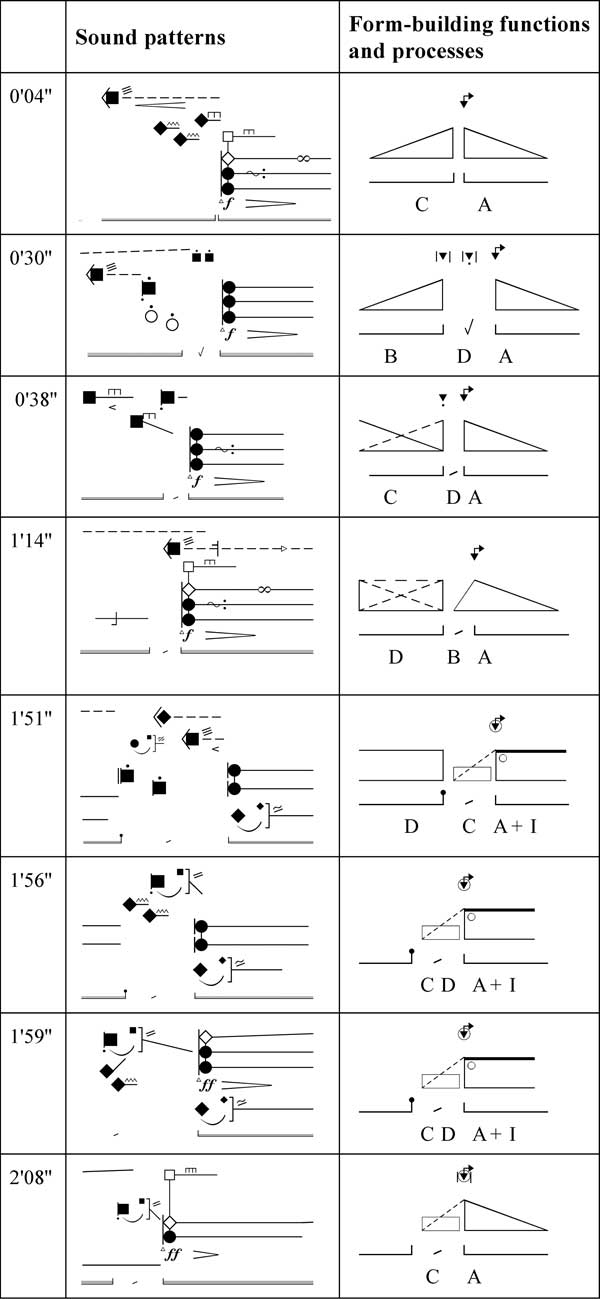
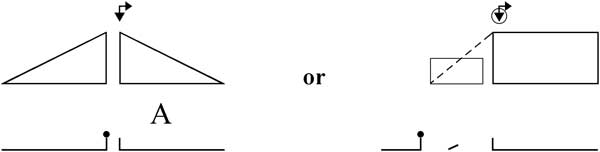
The capability of a musical language to create expectations based on the memory of preceding events is a decisive factor in the ability of the music to communicate with an audience, since it induces the possibility of active listener participation. Of particular interest are the ways in which restatements of the core character ‘A’ are prepared. Eight entries of sound character ‘A’ are studied more closely in figure 15. All cases are different in their sonic realisation; nevertheless, they show the same musical function of preparing the listener for being fully attentive at the moment ‘A’ enters. Figure 16 proposes a generalised formula for these important instances of the composition.
Entries of sound character ‘A’.

Generalised formula.

6. A semantic interpretation of Les Objets Obscurs
6.1. The composer’s perspective
The composer has presented his music as four riddles, each of which is stated verbally at the beginning of a movement of the piece. Each riddle invites the listener to guess what the sound sources of each piece are; the sounds of each section come from only one source, but they are of course transformed beyond immediate recognition. The riddle of the third part, the object of our analysis, is:
Convex bodies cast out in a series of collisions. Random movements over uneven surfaces. Something that is loved without loving. Something that is collected only to be dispersed.Footnote 6 (Parmerud Reference Parmerud1994)
The listener is thus encouraged to practise ‘indexical listening’; that is, to direct himself or herself towards identifying the physical events that caused the sounds that the composer so deftly has transformed. However, the solution to the riddle is banal and prone to diffuse all interest and excitement for the music as such: the answer is simply ‘marbles’! Nonetheless, what still remains is the very form of the riddle, the music itself. As Björn Billing puts it:
Parmerud lets the answers to the four riddles in ‘Les Objets Obscurs’ form a new riddle. This is odd in that it is its own answer, like the snake biting its own tail. A phenomenon that is closed but without an end, a ‘game where he who loses, wins, and where one both loses and wins with each throw’ (Derrida). The answer to the last, all-encompassing riddle, the form of existence of the hidden things, is: la musique! (Billing Reference Billing1992: 28)
6.2. Condensation of essential features: the metaphorical gesture
There is a recurring pattern in each of the four form-fields. Sound-character ‘A’ is introduced at the beginning of each form-field, often after a focalising preparation in the higher register. The attack of ‘A’ is complex, and is followed by an ascending tendency, and then a section with single, fragmented and scattered objects (the tendency towards scattering and fragmentation is most emphasised in the second form-field). Every recurrence of ‘A’ seems like a gathering, a collection of focus. The most intensive part of the piece, occurring just between third and fourth form-field, is a culmination of the tendency to gather and scatter very quickly. The short ‘upbeat’ gestures, followed by the deep, brusque accent of the sound-character ‘A’ that seems to explode and scatter, clearly show an analogy to a gesture of throwing objects on the ground, objects which then bounce and scatter. It can be no doubt that this musical gesture, condensed in figure 16, is modelled on the gestures connected with the gathering and throwing of marbles.
The composer has really been playing hide and seek with the listener: first he suggests that the listener pursue the question of what kind of hidden, concrete object is the physical source of the sounds. Then he dismisses that, presenting the music as the real riddle. However, this second riddle presents an abstract play of form-building elements that, while constituting their own logic and imparting comprehensibility to the music, eventually lead us to the realisation that the music may be conceived as a metaphor – an iconic sign. The constellation of sound-characters around ‘A’ is the vehicles of a metaphor whose tenor is the throwing; the constellation abstracted in figure 16 is not only a repetitive feature in the formal syntax of the music but a tertium comparationis.Footnote 7 This leads us away from a purely musical listening, back to the extramusical world where marbles are thrown, bounce and scatter only to be collected, and thrown again. Scattering vs. gathering seems to be an emergent isotopy, thematised as an endosemantic, contextual meaning of the music.
The riddle of the hidden objects have been driving us round in a circle: first it turned us towards a quest for the source of the sounds used to produce the sounds of the music – presumably a search for recognition of a characteristic timbre – then the second quest went into the music itself – its organisation on the level of sound-characters and form-building patterns. At the final point of distillation of the musical form, we discover the key to yet another hidden object – or rather a hidden gesture: that of the throwing of the marbles. And so the circle is closed: after discovering the throwing, we may return to the sound of bouncing marbles, and so on; or, to avoid being caught up in this endless circle, we may be moved to look behind the throwing gesture of the human agent, and catch a glimpse a human character, perhaps that of the composer, one that loves to hide himself behind the riddles by which he charms his audience.
Reflecting on the semioses that lead to the interpretation above, we find that the quest for the cause of the sounds (‘marbles’ – level 1) would be based on causal inference (the semiosis of indexical signs); the formal models identified result from taxonomic listening3; taking some of these models as signifiers, a signified of gathering and throwing marbles can be constituted through comparison (the semiosis of iconic signs).Footnote 8
7. Conclusion
The method for analysis of form-building structures proposed sets up correlations between, on the one hand, the perceptual reality in which organised sound unfolds in time and, on the other, an idealised, rational order that exists more or less in the mind of the analyst listener. This idealised order provides the analyst with tools, verbal and graphical, that are potentially useful for the description of order and pattern in music.
Our methods of form-building analysis provide a foundation of structurally ordered concepts that will help the analyst to present his observations in a communicable form. There will be several structural paradigms between which the analyst may choose, each of them again consistently transformable within its proper domain. These analytical structures have been designed to correlate with specific strata of aural musical patterns, and will thus have a defined relationship to perceptual reality. Accordingly, each structure is situated within a particular isotopy of the musical discourse, corresponding to a particular and consistent listening intention. The intrinsic order of each isotopy is structured as a coherent field of oppositions and gradations. Particular constellations, functions or transformations latent within such an isotopy may be selected in order to describe the features of particular musical patterns that may have been activated in a particular composition.
The main orientation of the analytical approach demonstrated is the explication of a taxonomic approach to listening centred on musical comprehension in its ‘material’ aspects; that is, musical elements and their organisation as observed from the listener’s perspective. A further discussion of pertinent intramusical relationships explicates the endosemantics of the music. A fully developed approach to the analysis of music-as-heard will in addition include observations on musical meaning in an exosemiotic perspective with a reflection on the semiosis through which the particular interpretation is constituted.