Implications
Post-weaning mortality from digestive troubles still remains a key problem in conventional breeding of rabbits. Dietary fibres recover more than 50% of feed for the growing rabbit. New criteria for fibre analysis in feeds were developed, and were related in several recent studies with the digestive physiology of rabbits and risk of digestive troubles. The present review aims to summarise these results through an extensive analysis of the literature. We also propose practical recommendation for fibre requirements in the feed of the growing rabbit to preserve the digestive health.
Introduction
The concepts on dietary fibres historically differ in animal feeding from those developed in human nutrition. For the latter, this is a rather modern concept, mainly developed in the 1960s (Hippsley, Reference Hipsley1953) in order to deal with several pathologies (colorectal cancer, obesity, etc.), regularly revisited (Trowell, Reference Trowell1978; De Vries, Reference De Vries, Prosky, Li and Cho1999; Elleuch et al., Reference Elleuch, Bedigian, Roiseux, Besbes, Blecker and Attia2011) and often restricted to the polysaccharides of the plant cell wall of fruits and legumes. In contrast, animal nutritionists deal with other ‘less-refined’ fibre sources, often from whole plants (forages, by-products of seed processing, etc.), and recover a larger range of chemical components, including other polymers such as polyphenolic (lignins, tannins) or polylipidic compounds (cutins).
At present, these two conceptions are converging, and dietary fibres are generally defined as polysaccharides and associated substances resistant to mammal enzyme digestion and absorption that can be partially or totally fermented in the gut. Champ et al. (Reference Champ, Langkilde, Brouns, Kettlitz and Collet2003) provided a concise synopsis of various views regarding the classification of dietary fibres. The overall tendency is towards an extension of the definition by including resistant starches as well as non-digestible oligosaccharides, and it was recently revisited by De Vries et al. (Reference De Vries2010) to develop an official enzymatic-gravimetric method that recovers all of the fibre components of the feed. At present, this topic is still subjected to very active research because of the complexity of the physical structure and chemical composition of the plant cell walls and also because of the wide and different physiological effects of the different constituents. The importance of dietary fibres in animal feeding is due to its influence on the rate of passage, mucosal functionality and its role as a substrate for gut microbiota that relate to performance and digestive health (Montagne et al., Reference Montagne, Pluske and Hampson2003).
First, we will briefly review the definition and structure of the main classes of cell wall constituents, followed by a short description of the analytical methods routinely used for dietary fibres in monogastric feeding. The adjustment of these fibre classes in rabbit feeding is essential to reduce the risk of digestive trouble after weaning.
Thereafter, the nutritional role of the different fibre fractions will be reviewed for the growing rabbit, including an analysis correlating digestive health and dietary fibre concentrations. Our meta-analysis will essentially take into account studies that do not use antibiotics, as the EC policy strongly recommends reduction of the use of antibiotics in animal breeding. Furthermore, in agreement with EC recommendations, a French national research programme (Ecoantibio 2017) strongly encourages any alternative to antibiotic therapy. The correct dietary fibre balance for the young rabbit is one possible alternative to preventive antibiotic therapy.
Brief overview of polymers of the plant cell wall: definition and analysis in monogastric feeds
Dietary fibres: a complex and evolving concept for a century
The concept of dietary fibres is larger than the botanical definition of the cell wall, as in animal nutrition it includes not only cell wall polysaccharides (cellulose, hemicelluloses, pectic substances, etc.) but also other components that are only fermented by the microbiota, such as oligosaccharides, gums, resistant starch, inulin, etc. According to their botanical origin, they may be associated with lignins and other non-carbohydrate components (e.g. polyphenols, waxes, saponins, cutin, phytates, resistant protein). Dietary fibres are often defined by nutritionists as the feed components that are resistant to mammal enzyme digestion and absorption, and that can be partially or totally fermented in the gut. This ‘catch-all’ definition thus includes resistant starch, oligosaccharides, fructans, protein linked to cell wall, etc. (De Vries and Rader, Reference De Vries and Rader2005). Another approximation is of dietary fibres for polygastric animals, defined by Mertens (Reference Mertens2003) as the indigestible or slowly digesting organic matter of feeds that occupies space in the gastrointestinal tract, mainly insoluble fibres. It excludes rapidly fermenting and soluble carbohydrates (oligosaccharides, fructans, etc.), and thus seems not convenient for monogastric animals. Accordingly, depending on the feeds classically used for one animal species or feeding system, the dietary fibre concept differs widely. An even broader definition may include synthetic non-digestible oligosaccharides (degree of polymerization (DP)>3, fructo-oligosacharides, polydextrose, etc.). Each definition is convenient for its own paradigm, sourcing from the botanical origin of fibres, which differed completely according to the final target for their physiological effects: human (legumes, cereals, fruits, etc.), ruminants (forages, straws, etc.) or monogastric animals (brans or by-products of cereals or seeds).
Main biochemical characteristics of dietary fibres for some classical feeds
Biochemical features of dietary fibres are one of the main factors responsible for variations in their physiological effects (e.g. digestion). Thus, it is important to give a short description of them to understand their effects on rabbit digestive health. Biochemical features of dietary fibres depend on many factors such as molecular weight, nature of monomers and types of linkages. With the exception of lignins, the cell wall constituents are predominantly polysaccharides composed of neutral and/or acidic sugars.
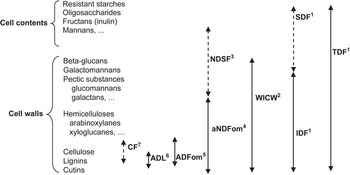
Given their location in the plant cell, there are two main groups of dietary fibre components (Figure 1): (1) the cell wall components with water-soluble non-starch polysaccharides (NSP; part of β-glucans, arabinoxylans, part of pectic substances, etc.) and the water-insoluble polymers including lignins, cellulose, hemicelluloses and pectic substances; (2) the cytoplasm of the plant cell with water-soluble and insoluble components, such oligosaccharides (DP<15), fructans, resistant starch and mannans. The water solubility of polysaccharides is generally defined on the basis of solubility in hot water (80°C).
Main fibre fractions and their quantification by some gravimetric methods used in animal feeding. (1) Total dietary fibre (TDF), insoluble dietary fibre (IDF; Mc Cleary et al., Reference Mc Cleary, De Vries, Rader, Cohen, Prosky, Mugford, Champ and Okuma2010, AOAC 985.29 and 991.43, including resistant starch); soluble dietary fibre is determined by difference (TDF−IDF) or directly with AOAC 993.19+991.42 for IDF; (2) water-insoluble cell wall (Carré and Brillouet, Reference Carré and Brillouet1989); (3) neutral detergent-soluble fibre (Hall et al., Reference Hall, Lewis, Van Soest and Chase1997); (4) neutral detergent fibre assayed with a heat-stable amylase and expressed free of ash, (5) ADF expressed free of ash; (6) ADL; (7) crude fibre (AOAC 962.10).

Water-soluble polysaccharides and oligosaccharides
These include several classes of molecules with a degree of polymerisation ranging from about 15 to more than 2000 (β-glucans). Most of them are precipitates in ethanol solution (80% v/v), as they have a low degree of polymerisation (lower than 40). Examples include soluble hemicelluloses such as arabinoxylans (in wheat, oat and barley≈20 to 40 g/kg dry matter (DM)) and β-glucans (in barley or oat≈10 to 30 g/kg DM), oligosaccharides such as α-galactosides (in lupin, pea or soya seeds, 50 to 80 g/kg DM) and soluble pectic substances (pulps of fruits or beets, from 100 to 400 g/kg DM). Fructans are usually those present in cereals, such as levans or inulin from chicory roots, and some of them can be even considered as oligosaccharides. Galactomannans are present especially in legume seeds. They are constituted of a backbone of mannose linked by β[1→4] with side chains of galactose. The number of branching points is frequently high, making them readily water soluble. Therefore, the analysis of water-soluble polysaccharides remains difficult, because of their highly variable structure, and no satisfactory method is at present available for the precise and routine determination of these compounds in animal feeds.
Pectic substances
They are a group of polysaccharides present in the middle lamellae and closely associated with the primary cell wall (young tissues) of dicotyledonous plants, such as in legume seeds (40 to 140 g/kg DM in soya bean, pea, faba bean, white lupin) and in fruits and pulps. Pectic substances correspond to several classes of polymers, including pectins (rhamnogalacturonan backbone and side chains of arabinose and galactose or xylose) and neutral polysaccharides (arabinans, galactans, arabinogalactans) frequently associated with pectins. Their extraction requires the use of a chelating agent such as ammonium oxalate or ethylene diamine tetraacetic acid. The latter is present in the solution for determining NDF; thus, pectins are not recovered in NDF analysis, as described below. Pectins of the middle lamellae serve as an adhesive in plant tissue, cementing plant cells together.
Cellulose
In contrast to hemicelluloses and pectins, cellulose is a homopolymer formed from linear chains of β[1→4] linked d-glucopyranosyl units, with a high DP (8000 to 10 000). Cellulose is only soluble in strong acid solutions (i.e. 72% sulphuric acid). Quantitatively, cellulose represents 400 to 500 g/kg DM in the hulls of legumes and oilseeds, 100 to 300 g/kg DM in forages and beet pulps and 30 to 150 g/kg DM in oilseeds or legume seeds.
Hemicelluloses
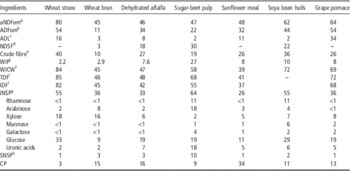
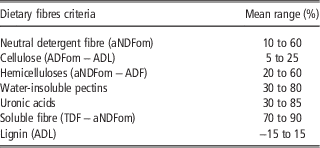
They are a group of several polysaccharides having a β[1→4] linked backbone of xylose, mannose or glucose residues that can form extensive hydrogen bonds with cellulose. Xyloglucans are the major hemicelluloses of the primary cell wall in dicotyledonous plants (vegetables, seeds), whereas mixed linked glucans (β[1→3,4]) and arabinoxylans are the predominant hemicelluloses in cereals seeds (the latter two include partly water-soluble and water-insoluble polymers as described above). Hemicelluloses include other branched heteropolymers (units linked β[1→3], β[1→6], α[1→4] α[1→3]) such as highly branched arabinogalactans (in soya bean), galactomannans (seeds of legumes) or glucomannans. Polymers formed of linear chains of pentose (linked β[1→4]), such as xylans (in secondary walls), or hexose, such as mannans (in palm kernel meal), are also considered hemicelluloses. Pentosans such as xylans and arabinoxylans are soluble in weak basic solutions (5% to 10%) or in hot dilute acids (5% sulphuric acid). Hexosans such as mannans, glucomannans or galactans can only be dissolved in strong basic solutions (17% to 24%). Quantitatively, hemicelluloses (estimated by difference between NDF and ADF, Table 1) constitute 100 to 250 g/kg of DM in forages and agro-industrial by-products (brans, oilseeds and legume seeds, hulls and pulps) and about 20 to 120 g/kg DM of grains and roots.
Fibres fraction (% DM) in raw materials classically used in rabbit feeds, according to several methods of analysis

a Neutral detergent fibre assayed with a heat-stable amylase and expressed free of ash.
b ADF expressed free of ash.
c ADL (Van Soest et al., Reference Van Soest, Robertson and Lewis1991).
d NDSF=neutral detergent-soluble fibre (Hall et al., Reference Hall, Lewis, Van Soest and Chase1997; Hall, Reference Hall2003).
e According to the Weende method (official AOAC method 962.10).
f Water-insoluble cell wall, including lignins (Carré and Brillouet, Reference Carré and Brillouet1989).
g Insoluble non-starch polysaccharides, not including lignins, determined by direct monomeric analysis of cell wall polysaccharides (Englyst, Reference Englyst1989; Barry et al., Reference Barry, Hoebler, David, Kozlowski and Gueneau1990).
h Water-soluble non-starch polysaccharides (Brillouet et al., Reference Brillouet, Rouau, Hoebler, Barry, Carré and Lorta1988; Englyst, Reference Englyst1989).
i Mc Cleary et al. (Reference Mc Cleary, De Vries, Rader, Cohen, Prosky, Mugford, Champ and Okuma2010).
j WIP=water-insoluble pectins (uronic acids+neutral sugars of pectins insoluble in hot water).
Lignins
They are polyphenolic compounds and can be described as a very branched and complex three-dimensional network (high molecular weight) built of three phenylpropane units (conyferilic, coumarilic and sinapyilic acid). Lignin networks tend to fix the other polymers in place, exclude water and make the cell wall more rigid and resistant to various agents such as bacterial enzymes. Most concentrate feeds and young forages contain <50 g lignins/kg. The degree of lignifications of the plant cell wall may reach 120 g/kg with ageing in forages, or up to 590 g/kg in grape-seed meal.
Other constituents
Also present in cell walls, but frequently in smaller quantities, minerals, such as silica, are essentially in graminaceous leaves. Phenolic acids are chemically linked to hemicelluloses and lignins in graminaceous plants. Some proteins are linked to cell walls through intermolecular bonds from amino acids such as tyrosine and thus resist standard extractions. In addition, plant epidermal cells may be covered by a complex lipid (cutin for aerial parts, suberin for underground structures), which could encrust and embed the cell walls, making them impermeable to water. Other phenolic compounds can also be mentioned, such as condensed tannins, which may exist in higher plants. They form cross-linkages with proteins and other molecules. They could be included in the sum of indigestible polysaccharides+lignins. However, condensed tannins, lignins and indigestible proteins are closely related because indigestible complexes of these substances are common in plants (Van Soest, Reference Van Soest1994). Moreover, according to the heat treatment applied to the raw material (drying by heating), Maillard reaction products are formed, thus adding to the lignin content, and also resistant starch fractions are formed adding to the fibre content. Similarly, extrusion may increase the content of soluble fibre according to the water content of the process used (FAO, 1998).
Analysis of the fibre fractions in animal feeds with relevance to rabbit nutrition
The wide diversity of plant cell walls implies that the analysis of different fibre fractions can be approached only by a combination of procedures. The fractionation procedures are thus varied and are developed according to the material tested. In animal feeding, they are essentially based on gravimetric methods (i.e. weighing a residue after hydrolysis of specific cell components). Detailed reviews have been published on this subject (Hall, Reference Hall2003; Mertens, Reference Mertens2003; De Vries and Rader, Reference De Vries and Rader2005). The methods mentioned in Figure 1 describe techniques of fractionation that are sufficiently precise and pertinent in a ‘routine’ laboratory to control the quality of the feed sources and give values of fibre parameters for implementing the databases for feed formulation.
Crude fibre and fibre fractionation with the Van-Soest procedures
Two centuries ago, Heinrich Einhof developed the so-called Weende method (in fact set up at Möglin in 1806, Germany, and not at Weende agronomy station) to isolate a ‘crude fibre’ residue in order to assess the nutritional value of ruminant feeds (forages and grasses). Over the years, many systems of analysis have been proposed for the replacement of the crude fibre method (official AOAC method 962.10); however, none have been successful in dislodging it as the official method and it is still used in animal feeding because it is highly reproducible, quick, simple and cheap. This technique extracts one fibrous residue after an acidic followed by a basic hydrolysis. The main drawback of the crude fibre method lies in the high variability in the chemical composition of its residues, because depending on the feed it can dissolve up to 60% cellulose, 80% pentosans and 95% lignins. For these reasons, this method is not able to explain the physiological effects exerted by most of the fibre sources on the animal digestive physiology. However, within a raw material, this method is very useful for verifying the content of lignin and cellulose compared with tables.
The main alternative to the crude fibre method is the sequential procedure of Van Soest developed in 1967 and successively updated (Mertens, Reference Mertens2003). The NDF method was designed to isolate a residue corresponding to insoluble dietary fibre (IDF) components of the plant cell walls by using a hot neutral detergent solution. Cellulose, hemicelluloses and lignins, as well as pectin substances, are partially solubilised. This method is criticised because of its variability among laboratories, especially when it is compared with the results obtained with other feed constituents. This variability is partially due to the different procedures used to perform it (with heat-stable amylase and/or sodium sulphite or not, ash free or not), but usually described with the same reference (Uden et al., Reference Uden, Robinson and Wiseman2005). For rabbit feeding, aNDFom is a standardised criterion that refers to NDF residue assayed with a heat-stable amylase and expressed exclusive of residual ash. The acid detergent fibre (ADFom corrected for residual ash; AOAC, official method 973.18) method isolates cellulose and lignins, the worst digested fibrous fractions, by a hot acid detergent solution. For complex feeds (such for monogastrics), it is designed to be performed after NDF analysis, because when it is performed directly it retains pectins. Similar to the crude fibre method, it was used to predict dietary energy values for some species, such as pigs and rabbits (Wiseman et al., Reference Wiseman, Villamide, De Blas, Carabaño and Carabaño1992). Finally, on the same sample the ADL method (Robertson and Van Soest, Reference Robertson and Van Soest1981) isolates lignin fractions by using a strong acid solution at room temperature. The main advantages of this sequential methodology are that it is possible to obtain an approximate estimation of lignin (ADL), cellulose (ADF−ADL) and hemicellulose (NDF−ADF) contents, it is relatively quick, simple and economical, it has an acceptable reproducibility when used as a standardised methodology (EGRAN, 2001), and it improves the fractionation of the cell wall.
These methods have been complemented by the estimation of the fibres dissolved by the neutral detergent solution (neutral detergent soluble fibre (NDSF); Hall et al., Reference Hall, Lewis, Van Soest and Chase1997) that mainly includes fructans, galactans, β-glucans and pectic substances. The NDSF is obtained gravimetrically as the difference between ethanol/water-insoluble residue and starch and NDF after correction for protein and ash. Therefore, the NDSF measurement may be affected by the accumulation of errors in the measurement of the different components, as well as the error linked to the value used for protein correction (Hall, Reference Hall2003). At present, the determination of NDSF is not adapted for routine analysis in animal feeding.
Water-insoluble cell wall (WICW), total dietary fibre (TDF) and soluble dietary fibres
Parallel to the difficulties in estimating the concentration of water-soluble polysaccharides, the concept of dietary fibres has emerged, first in human nutrition and now extended to other mammals (Trowell, Reference Trowell1978; De Vries, Reference De Vries2010), and has been assayed in the feeding of monogastric animals such as rabbits. For instance, in poultry feeding, the concept of water-insoluble cell wall ‘WICW’ (Figure 1) was developed to predict with one single criterion the metabolisable energy content of a feed (Carré, Reference Carré1990). WICW is a criterion obtained through a simple enzymatic-gravimetric procedure. It corresponds to lignins and polysaccharides that are water insoluble (Carré and Brillouet, Reference Carré and Brillouet1989) and not digested by poultry.
As the important nutritional distinctions between insoluble and soluble dietary fibre emerged, the AOAC official Method 985.29 was modified to allow the isolation and quantification of insoluble and soluble dietary fibre fractions. The distinction between these two fibre fractions is somewhat arbitrary and based on the solubility of the soluble fraction in a pH-controlled enzyme solution (as in the human alimentary system). The de facto defining method depends on the soluble fibre being precipitated in a mixture of 1 volume of aqueous enzyme solution and 4 volumes of 95% ethanol, a solution long used by analytical chemists to separate complex (high DP) from simple molecules (DP<15). Although this is the case in the method, the dietary definition per se does not imply insolubility or precipitation in aqueous ethanol as a requirement. The modified methodology was validated by collaborative study and adopted as the Official Method 991.42 (Insoluble Dietary Fibre in Food and Food Products). Later, in 1993, the Official Method 993.19 was adopted to determine soluble dietary fibre (Figure 1). This occurred after practical experience and improvements in techniques allowed the quantification of soluble fibre directly (see details further) as opposed to determining soluble dietary fibre as the difference between TDF (985.29) and IDF (991.42). Method 993.19 treats the filtrate of 991.42 with four parts alcohol to precipitate the soluble dietary fibre, which is then isolated and quantified gravimetrically.
Currently, TDF is primarily analysed by enzymatic-gravimetric methods (Table 1) based on AOAC procedures 985.29 and 991.43 that solubilise the different fibre fractions with enzymes and solvents and measure the weight of residues after these treatments (as reviewed by Bach Knudsen, Reference Bach Knudsen2001; De Vries, Reference De Vries2010; Elleuch et al., Reference Elleuch, Bedigian, Roiseux, Besbes, Blecker and Attia2011). Recently, these procedures (Figure 1) have been updated to also include non-digestible oligosaccharides and resistant starch (Mc Cleary et al., Reference Mc Cleary, De Vries, Rader, Cohen, Prosky, Mugford, Champ and Okuma2010). IDF could be quantified by the above-mentioned AOAC method for TDF, by avoiding the recovery of water-soluble structural polysaccharides (AOAC 991.42). IDF should correspond to polysaccharides that are slowly hydrolysed and fermented in the gut – that is, mostly lignins (indigestible), hemicelluloses and cellulose. In contrast, IDF should not include ‘soluble’ polysaccharides that are rapidly fermented (e.g. pectins, β-glucans, etc.) and highly digestible (at similar levels compared with starch or proteins).
When calculating the difference between the residue TDF and any measurement of ‘insoluble fibre’ (NDF, WICW), one can estimate this ‘soluble’ fibre fraction content (SDF). According to Van Soest et al. (Reference Van Soest, Robertson and Lewis1991), ‘soluble fibre’ may be obtained by subtracting the content of NDF (after corrections for ash and protein) from the TDF value, thus including NSP such as fructans, galactans, β-glucans and pectins. One of the problems encountered in calculating the difference between the two methods (e.g. TDF and NDF) is that for some raw materials we obtained negative values (such as for sunflower meals, Table 1). Soluble fibre content may also be calculated as follows: organic matter−(protein+fat+soluble sugars+starch+NDF).
As mentioned above, the soluble fibre content of a feed can be determined directly using the AOAC Prosky enzymatic-gravimetric procedure (Prosky et al., Reference Prosky, Asp, Scheweizer, De Vries and Furda1992; AOAC 993.19, used in conjunction with 991.42 for IDF). Carbohydrates are solubilised in phosphate buffer or MES (4-morpholine-ethanoesulfonic acid)/TRIS buffer, α-glucans are hydrolysed by amyloglucosidase, insoluble fibre is separated by filtration, and solubilised dietary fibre is precipitated with ethanol solution from the solvent extract and measured gravimetrically after correction for protein and ash contents. Inaccuracies in the SDF determination may arise from the partial degradation of carbohydrates, the incomplete extraction and/or precipitation with the addition of ethanol, the interference by other substances and from differences in the nature of the analysed feed (Theander, Reference Theander1995; Hall et al., Reference Hall, Lewis, Van Soest and Chase1997).
Besides, let us recall that for a biochemist the solubility of polysaccharide is related to its structure; they can be set regularly (insoluble) or irregularly (soluble) on the backbone or as side chains. For example, the presence of a substitution group such as COOH increases solubility. However, as the soluble and insoluble nature of dietary fibres involves differences in their technological functionality and physiological effects, the terms ‘soluble’ is frequently indifferently used for biochemical or physiological properties, and this causes some confusion for non-advertised readers.
Other approaches for cell wall polysaccharide analysis
Another approach for estimating dietary fibre is the analysis of the non-NSP and lignins. There are several methods available to estimate total, soluble and insoluble NSP (Bach Knudsen, Reference Bach Knudsen2001; De Vries and Rader, Reference De Vries and Rader2005), where the non-fibrous components are extracted by solubilisation, by enzymatic hydrolysis, or by combining both procedures. Once isolated, fibre residue can be quantified gravimetrically or chemically (hydrolysing the residue and determining its single constituents: sugars and lignins). According to these procedures, there are three types of methodologies: chemical-gravimetric, enzymatic-gravimetric and enzymatic-chemical. In this manner, TDF can be quantified (NSP and lignins) and separated into insoluble and soluble fibres (in aqueous solution) and its monosaccharide composition can be determined. The combination of the monosaccharide composition of fibres with additional chemical information may allow the description of better fibre structures that influence its physio-chemical properties, and accordingly the effects exerted on the digestive physiology and digestibility in animals. However, these methodologies are complex, expensive, with a relatively low reproducibility (especially for monomers determination), and difficult to implement as routine analysis.
Thus, the choice of which definition is to be used by the nutritionist depends on the type of information required (to relate to digestive processes, to predict the nutritive value, etc.), which can be determined using sophisticated extraction techniques; examples of fibre fractions in some feedstuffs are given in the Table 1. Finally, the enzymatic-gravimetric determination using the Van-Soest procedures is still (NDF, ADF, ADL) the simplest, most low-cost, rapid and reproducible method for analysing the fibre fractions that are slowly digested in the gut.
At present, to examine the effects of the highly digested fractions of the dietary fibres (water-insoluble pectins (WIP), β-glucans, water-soluble pectins, oligosaccharides, etc.), new criteria are assayed. One approach is to estimate this ‘soluble’ fraction by difference, from TDF criterion and a criterion for insoluble fibre (NDF). Although these ‘soluble’ fibre fractions remain hard to analyse in feed, their effects on the digestive physiology of the animal are presently subjected to many studies, and the results are summarised for rabbits in the following section.
Dietary fibres for the growing rabbit: role in nutrition and impact on digestive health
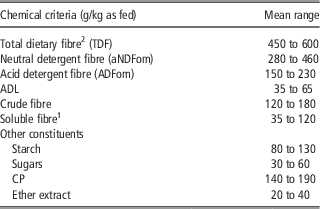
As a herbivorous animal, the rabbit is usually fed with diets containing at least 40% to 50% of fibres (Table 2). The importance of fibre in diet is because of its effects on intake, rate of passage and role as substrate for caecal microbiota (Combes et al., Reference Combes, Fortun-Lamothe, Cauquil and Gidenne2013). However, for the growing rabbit, one of the main challenges is to provide fibre recommendations for preventing digestive troubles and without a very large impairment of performance (growth, feed efficiency).
Fibre fractions and other main nutrients in a pelleted feed for the growing rabbit

Personal data.
1 Calculated as: OM−CP−EE−aNDFom−starch−sugars.
2 Mc Cleary et al. (Reference Mc Cleary, De Vries, Rader, Cohen, Prosky, Mugford, Champ and Okuma2010).
Dietary fibre level and intake regulation of the growing rabbit
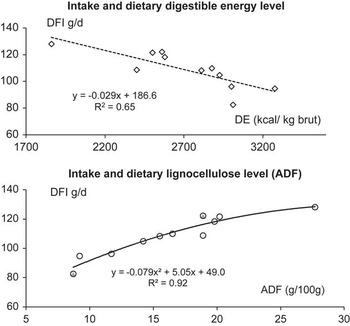
The domestic rabbit fed a pelleted balanced diet is able to regulate its feed intake to reach a constant DE (digestible energy) intake when the dietary DE concentration ranges between 9.0 and 11.5 MJ/kg (Figure 2, Gidenne et al., Reference Gidenne, Lebas and Fortun-Lamothea). However, a higher correlation is obtained with the ADF level when it is between 10% and 25% in the diet. However, fat dietary incorporation, although maintaining the dietary fibre level, increases the dietary DE level but leads to a slight reduction in feed intake. Finally, the voluntary feed intake is more related to the dietary ADF level because of the low digestion of this fraction, and probably because the ADF level also corresponds to a ‘ballast’ value that limits the intake. For instance, the replacement of starch by digestible fibre (DgF) fractions (hemicelluloses or pectins), without changing the ADF level, did not greatly affect the intake (Perez et al., Reference Perez, Gidenne, Bouvarel, Arveux, Bourdillon, Briens, Le Naour, Messager and Mirabito2000; Gidenne et al., Reference Gidenne, Mirabito, Jehl, Perez, Arveux, Bourdillon, Briens, Duperray and Corrent2004b). Further studies are required to assay the effects of other fibre fractions, such as the most ‘soluble’ ones, on intake behaviour. In return, when the dietary fibre level is very high (>25% ADF), the animal cannot increase its intake sufficiently to meet its energetic needs, thus leading to a lower growth rate, but without digestive problems.
Regulation of the feed intake of the growing rabbit according to the digestible energy (DE) or the ADF concentration of a pelleted balanced feed. DFI: daily feed intake measured between weaning (4 weeks) and 11 weeks of age.

Fibre digestion in the rabbit and hind gut microbial activity
Cell wall polysaccharides are hydrolysed and then fermented only by bacterial enzymes, whereas lignins and cutins are considered almost totally undegradable. In monogastric mammals, the fibres become an energy source from the activity of the microbiota that takes place mainly in the large intestine – caecum and proximal colon for the rabbit. However, the extent of fibre digestion is rather different according to the fraction (Table 3), ranging from 10% for cellulose to 90% for the most soluble fibre fractions (TDF−NDF, Trocino et al., Reference Trocino, Garcia, Carabaño and Xiccato2013). Obviously, the fibre digestion is lower than that of protein or starch, and increasing the dietary fibre levels leads to reduction in digestive efficiency.
Whole-tract digestibility coefficients for some fibre fractions in the growing rabbit

Personal data.
For the adult rabbit fed a high-fibre diet the energy provided by the caecal volatile fatty acids (VFA) absorption could represent up to 50% of the maintenance energy (Marty and Vernay, Reference Marty and Vernay1984; Gidenne, Reference Gidenne1994). However, increasing the fibre intake (and lowering that of starch) either increases or has no effect on the fibrolytic activity and caecal VFA concentration (ranging from 80 to 100 mM), whereas a lower butyrate molar proportion is generally observed. As the fibre digestibility is frequently not affected by the dietary fibre concentration, it may be assumed that the quantity of fibre entering the caecum is not a limiting factor for the fermentation processes, because the digesta retention time in the caecum is relatively short, allowing, predominantly, degradation of the more easily DgF fractions such as pectins or hemicelluloses.
The quality of fibres, particularly their fermentability, modulates the microbial activity. For instance, increasing the levels of pectins through the incorporation of beet pulp in the diet increases the VFA concentration in the caecum. In a collaborative study, Garcia et al. (Reference Garcia, Gidenne, Falcao, Cunha and De Blas2002) reported that caecal VFA level decreases with the degree of lignification of NDF, and that dietary uronic acid concentration (provided mainly by pulps) is positively correlated to the caecal VFA and pH. In association with changes in microbial activity, it is suspected that dietary fibre supply would be able to modulate the microbiota balance and diversity, as suggested by Combes et al. (Reference Combes, Fortun-Lamothe, Cauquil and Gidenne2013).
However, the extent of fibre digestion is ultimately determined by the time necessary for the microbiota to hydrolyse and ferment polysaccharides. As the retention time in the caeco-colic segment of the rabbit is relatively short (8 to 12 h, Gidenne, Reference Gidenne1997), only the most rapidly fermentable cell wall polysaccharides are highly digested (pectins, soluble fibre fractions), whereas lignocellulose is degraded to a smaller extent. For instance, when wheat bran and beet pulp replaced starch (with constant level of ADF), the whole-tract digestibility of the diet was not reduced (Gidenne and Bellier, Reference Gidenne and Bellier2000; Gidenne and Perez, Reference Gidenne and Perez2000). The utilisation of these fibre fractions for growth is particularly high and comparable to that of starch, as the replacement in a complete diet of 10 points of starch by hemicelluloses (NDF−ADF) and pectins did not affect the feed efficiency in the growing rabbit (Perez et al., Reference Perez, Gidenne, Bouvarel, Arveux, Bourdillon, Briens, Le Naour, Messager and Mirabito2000).
Gut microbial populations secrete enzymes capable of hydrolysing the main components of dietary fibres. Greater enzymatic activity for degrading pectins and hemicelluloses than for degrading cellulose has been detected in the rabbit caecal ecosystem (Marounek et al., Reference Marounek, Vovk and Skrivanova1995; Jehl and Gidenne, Reference Jehl and Gidenne1996). Accordingly, the digestion of hemicelluloses is higher than that of cellulose (Table 3), and smaller counts of cellulolytic bacteria were found in the rabbit caecum compared with xylanolytic or pectinolytic bacteria (Boulahrouf et al., Reference Boulahrouf, Fonty and Gouet1991).
The caecal VFA profile is specific to the rabbit (Gidenne, Reference Gidenne1997), with a predominance of acetate (77 mmol 100 ml−1 as average, and ranging from 65 to 87) followed by butyrate (17 mmol 100 ml−1 as average, and ranging from 6 to 28) and then by propionate (6 mmol 100 ml−1 as average, and ranging from 3 to 11). These molar proportions are affected by fibre levels. For instance, the proportion of acetate increases and that of butyrate generally decreases when the fibre levels increase, whereas propionic acid proportion was only positively correlated to dietary uronic acid concentrations (García et al., Reference Garcia, Gidenne, Falcao, Cunha and De Blas2002).
The development of new molecular tools to characterise intestinal microbiota is improving our knowledge about nutrition and digestive microbiota functions. For instance, the caecal microbiota is able to adapt very quickly (within 1 week) to changes in the dietary fibre levels (Michelland et al., Reference Michelland, Combes, Monteils, Cauquil, Gidenne and Fortun-Lamothe2011). Further studies are presently being conducted using high-throughput sequencing of the 16S rDNA and will provide new data about the relationship between microbiotas and dietary fibres (Combes et al., Reference Combes, Fortun-Lamothe, Cauquil and Gidenne2013).
Dietary fibres and digestive health of the growing rabbit
Digestive pathology of the growing rabbit is the major cause of loss after weaning. In French rabbit farms, the mortality rate from digestive disorders (colibacillosis and rabbit enteropathy) has ranged from 7% to 8% for the past 5 years (Coutelet, Reference Coutelet2013). Moreover, digestive disorders are responsible for important morbidity characterised by growth depression and poor feed efficiency. Until the 1980s, only the crude fibre criterion was used to define the fibre requirements for the growing rabbit, and the value ranged from 6% to 18% according to the authors. Consequently, the precise assessment of the fibre requirements with more ‘adequate’ criteria is essential to reduce the risk of digestive troubles without causing a very large impairment of growth and feed efficiency.
Digestive health assessment
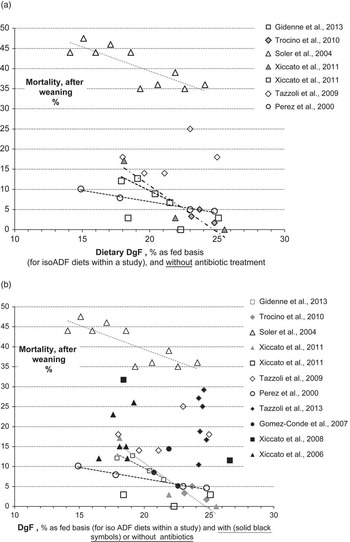
The classical indicator to evaluate the impact of a disease in groups of young domestic mammals is the mortality rate, but it appears to be too restrictive. Thus, morbidity indicator was developed for a more precise assessment of the sanitary status of the rabbit by including the incidence of clinical symptoms (Gidenne, Reference Gidenne1997). It could be combined with mortality to obtain the health risk index (‘HRi’=morbidity+mortality rate). This approach allows a more precise assessment of the health status of a group of animals, provided that a sufficiently large number of animals is assayed. For instance, to detect a significant 5% deviation between two mortality rates, more than 300 animals are required in each group (Gidenne et al., Reference Gidenne, Garcia, Lebas and Licois2010b). If the clinical symptoms are clear (diarrhoea, caecal impaction, stomachal borborigmus, etc.), the morbidity rate is relatively easy to measure; however, it depends on the frequency of the measurements within a time period. For instance, if the morbidity is checked daily, the measure is more precise and gives a higher value compared with a weekly control (Bennegadi et al., Reference Bennegadi, Gidenne and Licois2001). Moreover, when only reduction in growth rate is detectable, a threshold must be defined to categorise the animal as morbid or not, such as the average minus 2×standard deviation (signifying the 2.5% of animals with the lowest growth rate) or up to 3 s.d. However, it needs to use a large set of rabbits within a group to precisely define the mean and its range of variation. Besides, studying the effect of a nutrient on digestive health should be conducted without antibiotic treatment; otherwise, the result of mortality will not differ, or will differ only slightly, between treatments (see Figures 3a vs 3b). In contrast, a very high mortality from an outbreak (colibacillosis, etc.) invalidates the data, as the disease could crush any effect of the nutrient, and differences between two high mortality rates (Soler et al., Reference Soler, Blas, Cano, Pascual, Cervera and Fernandez-Carmona2004, Figure 3a) are not directly exploitable for field conditions.
Post-weaning mortality rate of the rabbit is globally reduced when digestible fibres (DgF) are added in iso-ADF diets and without antibiotic use (a). Adding studies using antibiotics (b) weakens the relationship. Data from six studies and 31 diets without antibiotics (a) and with antibiotics (b). Within a study, the DgF level varies, whereas the ADF level slightly varies. ADF=acid detergent fibre according to the Van-Soest sequential procedure (EGRAN, 2001), and DgF=(NDF−ADF)+WIP*. *WIP=water-insoluble pectins (Table 1). Mortality: from digestive disorders measured from weaning (28 to 35 days) to slaughter (63 to 77 days of age), on at least 40 rabbits/diet. According to studies, some WIP values were calculated by reformulation from feed ingredients.

Consequently thereafter, to correlate a nutrient dietary concentration to the mortality or HRi, we have selected studies according to these three criteria: sufficient number of rabbits (>40 within a group), no antibiotic treatment and no outbreak or very high mortality (>40%).
Fibres to starch intake relevance
The respective effects of fibres and starch on the incidence of diarrhoea in the growing rabbit have been subjected to many studies comparing the fibre : starch ratio, as in complete feed formulation one nutrient is substituted by another one. Consequently, when a study reported a positive effect of increased dietary fibre intake on digestive health, it was in fact difficult to exclude the effect of a reduced starch intake. We thus have to deal with two opposite hypotheses: are digestive troubles linked to a carbohydrate overload in the caecum? or linked to a fibre deficiency? (or both?). This question was elicited by studying the ileal flow of starch and fibres in the growing rabbit (5 to 9 weeks old). With high-starch diets (⩾30% starch mainly from wheat), the ileal starch digestibility was very high (>97%); the flow of starch remained under 2 g/day (intake≈30 g/day) in the ileum, whereas that of fibres was at least 10 times higher (≈20 g NDF/day) (Gidenne et al., Reference Gidenne, Pinheiro, Falcao and Cunha2000). Thus, an overload of starch appears very unlikely, as starch digestibility is over 95% already at 5 weeks of age (Blas and Gidenne, Reference Blas and Gidenne2010). Moreover, a large-scale study using a network of six experimental breeding units (GEC French group) demonstrated that only the fibre level plays a role in digestive trouble and not the starch level (Gidenne et al., Reference Gidenne, Mirabito, Jehl, Perez, Arveux, Bourdillon, Briens, Duperray and Corrent2004b). Furthermore, by comparing iso-fibre diets but with several starch sources varying in their intestinal digestion (maize, wheat, barley), Gidenne et al. (Reference Gidenne, Jehl, Perez, Arveux, Bourdillon, Mousset, Duperray, Stephan and Lamboley2005) observed no effect of starch ileal flow on diarrhoea incidence in the weaned rabbit. Fibre intake thus plays a major role in determining digestive trouble in the classically weaned rabbit (28 to 35 days old).
Thus in France, the GEC group has performed several large-scale studies to clearly validate the relationships between dietary fibre fractions and digestive health for the ‘classically’ weaned rabbit using an experimental design with a high number of animals per treatment (over 300 animals per treatment and four to six experimental sites). The relevance of the Van-Soest criteria was studied, as the crude fibre criterion was too imprecise for this purpose.
Quantity and quality of lignocellulose (ADFom)
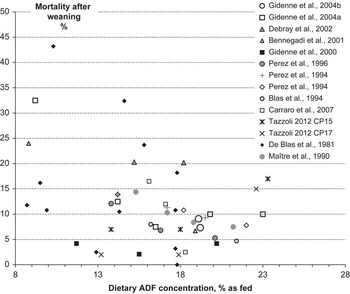
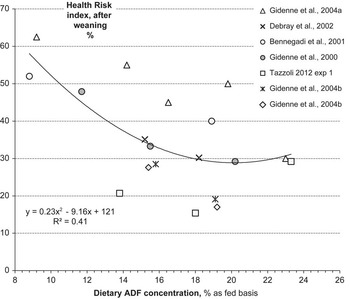
The beneficial effect of dietary lignocellulose (ADF) ingestion on the frequency of digestive disorders and mortality in fattening rabbits was first shown by Maître et al. (Reference Maître, Lebas, Arveux, Bourdillon, Dupperay and Saint Cast1990) using a large-scale experimental design (380 rabbits per diet, in five sites): from 15% to 21% d’ADF the mortality decreased linearly from 14% to 7%. The impact of ADF on mortality reduction after weaning was then confirmed by Perez et al. (Reference Perez, Gidenne, Lebas, Caudron, Arveux, Bourdillon, Duperray and Messager1994) with a similar design. The relationship between low fibre diets (<14% ADF) and a higher incidence of diarrhoea was also clearly established in the two studies, where the quality of fibres – for example, the proportions of fibre fractions as analysed through the Van-Soest procedure – was controlled (Blas et al., Reference Blas, Cervera and Fernandez-Carmona1994; Bennegadi et al., Reference Bennegadi, Gidenne and Licois2001). However, when correlating ADF dietary level to mortality rate (Figure 4), we showed that within a classical dietary ADF range (15% to 22%) the mortality rate varied greatly, even if within one study the ADF globally reduced the risk of mortality. When using the HRi to assess the health status, a similar trend is obtained; however, only 41% of the variations of HRi are explained by ADF (Figure 5). Thus, a single criterion such as the supply of lignocellulose (or crude fibre) is not sufficient enough to relate the fibre supply and the ‘level of security’ of a feed for the growing rabbit.
The rabbit post-weaning mortality decreases when the dietary lignocellulose (ADF) concentration increases, but with a highly variable impact within the classical dietary ADF range (15% to 22%). Data from 12 studies and 46 diets, without antibiotics, and varying in their ADF concentration.

The rabbit post-weaning health risk index (HRi: mortality+morbidity) decreases when the dietary lignocellulose (ADF) concentration increases, but with a variable impact within the classical dietary ADF range (15% to 22%). Data from six studies and 22 diets, without antibiotics, and varying in their ADF concentration.

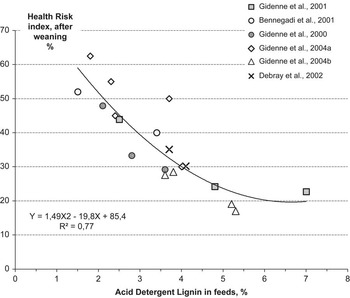
The first step is to determine whether, apart from the quantity of lignocellulose, the quality of the ADF – that is, the respective effects of lignins and cellulose (according to the Van-Soest procedure) – could have an impact on digestive health. Increasing the intake of lignins (criterion ADL) involves a sharp reduction in the feed digestibility associated with a reduction of the digesta retention time in the whole tract (−20%) and with a rise in the feed conversion ratio (Gidenne and Perez, Reference Gidenne and Perez1994). In parallel, a linear negative relationship (R 2=0.99, n=5 feeds) between ADL and mortality by diarrhoea was outlined for the first time (Perez et al., Reference Perez, Gidenne, Lebas, Caudron, Arveux, Bourdillon, Duperray and Messager1994). Increasing the intake of cellulose (ADF−ADL) also reduces the post-weaning mortality (Perez et al., Reference Perez, Gidenne, Bouvarel, Arveux, Bourdillon, Briens, Le Naour, Messager and Mirabito1996) and has less important impact than ADL with respect to the decrease in digestibility or that of retention time (Gidenne and Perez, Reference Gidenne and Perez1996). Moreover, an increase in the ratio of lignins/cellulose (L/C) is associated with a lower HRi (Gidenne et al., Reference Gidenne, Arveux and Madec2001). However, to date, no accurate and quick analytical method to determine lignin concentration is available. Consequently, estimating the amount of lignins in a raw material remains difficult, particularly in tannin-rich ingredients (grape marc, etc.), and caution must be taken to fit requirements. The favourable relationship between the dietary ADL level and HRi was then confirmed with other experiments, as shown in Figure 6, where 77% of the variations in the HRi are explained by the variation in dietary ADL. Globally, to reduce the risk of post-weaning digestive disorders, the lignin intake (ADL) for the growing rabbit can be assumed to be 5 to 7 g/day and that of cellulose from ∼11 to 12 g/day.
Increasing the dietary lignin level reduced the post-weaning digestive trouble incidence in the growing rabbits. ADL according to the Van-Soest sequential procedure (EGRAN, 2001). Health risk index=mortality+morbidity rate by diarrhoea, measured from 28 to 70 days of age, on at least 40 rabbits/diet. Data from six studies and 19 diets varying in their ADL concentration.

Role of fibre fractions that are more digestible than lignocellulose (ADF)
Hemicelluloses (aNDFom−ADFom), WIP or ‘soluble fibres’ (TDF−NDF) are rather better digested than cellulose or even lignins (Table 3). Did these fractions modulate the digestive health of the young rabbit? The first approach is to estimate the fibre fractions that are relatively digestible, and in a relatively high concentration in feeds, to reduce the analytical error and improve the prediction of HRi. Therefore, Gidenne proposed in 2003 a new ‘combined’ fibre criterion called ‘digestible fibres’ that corresponded to the sum of two fractions: hemicelluloses (analytical value=NDF−ADF, according to the sequential procedure of Van-Soest) and WIP (analysed or estimated, see Table 1). As the analysis of WIP is complex and not practical in a routine feed laboratory, it is frequently necessary to estimate the WIP value of raw materials from the literature (Bach Knudsen, Reference Bach Knudsen1997) or from the table of ingredients (Maertens et al., Reference Maertens, Perez, Villamide, Cervera, Gidenne and Xiccato2002). Some WIP values are given for main fibre sources in Table 1.
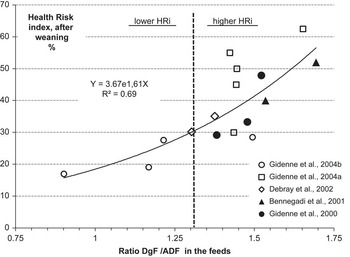
The DgF fraction plays a key role in digestive efficiency and digestive health, as it is rapidly fermented (compared with ADF) in a delay compatible with the retention time of the caeco-colic segment (9 to 13 h, Gidenne, Reference Gidenne1997). The favourable effect of the DgF, compared with starch intake, was first demonstrated by Perez et al. (Reference Perez, Gidenne, Bouvarel, Arveux, Bourdillon, Briens, Le Naour, Messager and Mirabito2000) with four iso-ADF diets: mortality was significantly reduced when DgF replaced starch. According to the analysis presented in Figure 3a, the post-weaning mortality rate of the rabbit is globally reduced when DgF are included in iso-ADF diets (without antibiotic use), as seen in four studies out of six, although a large variability remained among the studies. However, if results provided by studies using antibiotics are taken into account (6B), the mortality rate weakly differs for various DgF levels. A similar relationship is obtained when we related the criteria ‘TDF−ADF’ to mortality. The favourable effect of DgF (compared with starch) on health would originate from a stimulated caecal fermentative activity (Garcia et al., Reference Garcia, Gidenne, Falcao, Cunha and De Blas2002), and possibly from their moderate effect on the rate of passage (Gidenne et al., Reference Gidenne, Jehl, Lapanouse and Segura2004a). This relationship between DgF and digestive health status is improved by using the HRi (more precise than mortality rate). From a set of 15 diets (five studies), when ADF and the ratio DgF/ADF are varying within a study (Figure 7), we observed a close relationship (R 2=0.69) between the ratio DgF/ADF and the HRi. This suggests that a very high incorporation of DgF, with respect to lignins and cellulose, should be avoided to minimise the HRi during fattening. It is thus recommended that the ratio DgF/ADF remain under 1.3 for diets having an ADF level over 15% (see Table 4).
The health risk index (HRi) of the growing rabbit depends on the balance between low-digested (ADF) and highly digested (DgF) fibre fractions. Data from five studies and 16 diets, without antibiotics, varying in their ratio DgF/ADF (within a study dietary ADF is varying). ADF=Acid detergent fibre according to the Van-Soest sequential procedure (EGRAN, 2001), and DgF=(NDF−ADF)+WIP*. *WIP=water-insoluble pectins (Table 1); health risk index=mortality+morbidity rate by diarrhoea, measured from weaning (28 to 35 days) to slaughter (63 to 70 days), on at least 40 rabbits/diet.

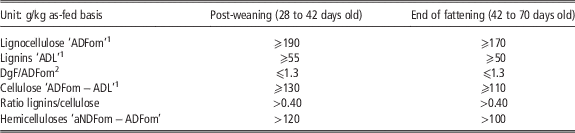
Fibre requirements to prevent digestive troubles after weaning, for the rabbit bred in conventional breeding systems

1 g/kg as-fed basis, corrected to a dry matter content of 900 g/kg.
2 Digestible fibre fractions=[hemicelluloses (NDF−ADF)+water-insoluble pectins].
Therefore, a balanced supply of low and high digested fibre fractions is required to reduce the risk of digestive trouble for the rabbit after weaning. When a sufficient supply of lignocellulose (at least 18%) is provided, it is advisable to replace some starch by DgF fractions. The HRi is improved, whereas the feed efficiency is weakly modified (Perez et al., Reference Perez, Gidenne, Bouvarel, Arveux, Bourdillon, Briens, Le Naour, Messager and Mirabito2000; Gidenne et al., Reference Gidenne, Mirabito, Jehl, Perez, Arveux, Bourdillon, Briens, Duperray and Corrent2004b; Tazzoli et al., Reference Tazzoli, Carraro, Trocino, Majolini and Xiccato2009; Trocino et al., Reference Trocino, Fragkiadakis, Majolini, Carabaño and Xiccato2011). Furthermore, a substitution of protein by DgF also led to a significant improvement in the digestive health status of the growing rabbit, without significant impairment in growth performance (Xiccato et al., Reference Xiccato, Trocino, Majolini, Fragkiadakis and Tazzoli2011; Gidenne et al., Reference Gidenne, Kerdiles, Jehl, Arveux, Eckenfelder, Briens, Stephan, Fortune, Montessuy and Muraz2013).
Quickly fermentable polysaccharides
These components correspond mainly to water-soluble polysaccharides (β-glucans and fructans) and oligosaccharides (DP>15) and also to WIP. They are not digested in the small intestine but are rapidly fermented and highly digested in the hindgut. For instance, fructans from chicory roots (inulin-rich ingredient) are almost totally digested and stimulate the caecal fermentation (Volek et al., Reference Volek and Marounek2011) without change in growth performances. According to Maertens et al. (Reference Maertens, Aerts and De Boever2004), synthetic fructans would be about half-digested before they enter the caecum, and they did not find higher caecal VFA level but only a higher butyrate proportion. Addition of inulin in the diet increased the caecal VFA concentration sharply (+30%) but failed to significantly reduce the mortality rate (21 to 77 days old) of the growing rabbits (Volek et al., Reference Volek, Marounek and Skrivanova2005 and Reference Volek, Marounek and Skrivanova2007). Another way of analysing the role of quickly fermented polysaccharides is by determining the NDSF residue (Hall et al., Reference Hall, Lewis, Van Soest and Chase1997), which corresponds to the polysaccharides soluble in the neutral detergent solution. Although the level of NDSF is moderate in rabbit feeds, a reduction in its level (12% v. 8%) may be unfavourable on the digestive health of early-weaned rabbits (Gómez-Conde et al., Reference Gómez-Conde, Perez de Rozas, Badiola, Perez-Alba, de Blas, Carabano and Garcia2009). In contrast, a higher level of NDSF may improve the mucosal morphology and functionality and its immune response (Gómez-Conde et al., Reference Gómez-Conde, Garcia, Chamorro, Eiras, Rebollar, De Rozas, Badiola, De Blas and Carabano2007). However, the NDSF criteria remain difficult to analyse, and precision is relatively low for complete feeds with low content of pectins or soluble fibres.
Accordingly, another approach is actually examined to estimate the content of the quickly fermentable fibres, or soluble fibres ‘SF’, by calculating the difference between the TDF and the aNDFom, with the latter being corrected for its CP content. Thus, SF would be easier to handle in a routine laboratory for feed analysis. It would recover the part of TDF that comprises the non-starch, non-NDF polysaccharides, including pectic substances, β-glucans, resistant starch, oligosaccharides, fructans and gums. The soluble fibre level is generally increased in a complete feed by supplying raw materials rich in pectins (beet pulps, citrus or apple pulp) or fructans (chicory pulp), and thus most of the studies in fact relate ‘pulp levels’ to performance of physiological data. Accordingly, the SF dietary level is positively related to the faecal digestibility of insoluble fibre fractions (NDF and ADF) and favours the microbial activity with higher fermentation levels and lower pH, as reviewed by Trocino et al. (Reference Trocino, Garcia, Carabaño and Xiccato2013). As a consequence, the soluble fibre level is likely to affect ileal and, especially, caecal microbiota (Gómez-Conde et al., Reference Gómez-Conde, Garcia, Chamorro, Eiras, Rebollar, De Rozas, Badiola, De Blas and Carabano2007 and Reference Gómez-Conde, Perez de Rozas, Badiola, Perez-Alba, de Blas, Carabano and Garcia2009) by modifying the amount and type of substrate reaching the caecum. These changes in microbiota may also modify the immune response observed in young rabbits fed soluble/insoluble fermentable fibres. However, regardless of the advantages and disadvantages of the different methods and calculation procedures, the choice of the method to quantify SF will depend on the correlation with in vivo data collected on animals, and particularly the impact on the digestive health.
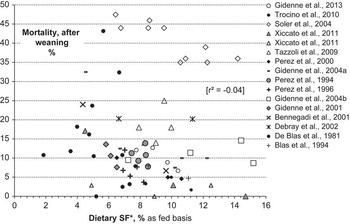
The analysis presented in Figure 8 shows that there is no clear global relationship between the soluble fibres, analysed as TDF-NDF, and the post-weaning mortality (r 2=−0.04), although a small tendency to a reduction in mortality might be observed. However, to look more precisely at this effect, we should select studies comparing diets having a similar level of ADF (or NDF), as shown in Figure 9. However, even for the six studies selected (same data set as for Figure 7) with iso-NDF diets we observed a very large variation in mortality for the same concentration of SF. Furthermore, for studies having a moderate mortality level (<15%), only two studies out of four related SF to mortality, and a low number of animals was often used.
The post-weaning mortality of the growing rabbits is weakly related to the dietary soluble fibre (SF*) level. Data from 16 studies and 78 diets, without antibiotics, and without selection for the fibre level. Mortality: from digestive disorders measured from weaning (28 to 35 days) to slaughter (63 to 77 days of age), on at least 30 rabbits/diet. *SF is defined as ‘TDF−aNDFom corrected for crude protein’, and according to studies values were analysed or calculated by reformulation from feed ingredients.

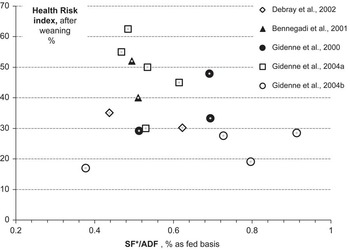
The post-weaning health risk index of the growing rabbits is not related to the SF*/ADF ratio. Data from five studies and 16 diets (see Figure 7), without antibiotics, varying in their SF/ADF ratio (within a study dietary ADF is varying). Health risk index=mortality+morbidity rate by diarrhoea, measured from weaning (28 to 35 days) to slaughter (63 to 70 days), on at least 40 rabbits/diet. *SF is defined as ‘TDF−aNDFom corrected for crude protein’, and according to studies values were analysed or calculated by reformulation from feed ingredients.

As for the criterion DgF, we calculated the ratio of SF on ADF for the same set of studies used for Figure 7. However, the relationship between HRi and the SF/ADF ratio is not significant here (R 2<0.10), although a tendency for a lower HRi is globally observed (Figure 9). This lack of relationship seems logical as SF did not include the hemicellulose fractions that are present in large amounts in rabbit feeds.
It is also possible to estimate the quickly fermentable fibres (or SF) ‘by difference’ with the following calculation: SF=(organic matter)−[NDF−(CP)−starch−sugars]. However, with the same set of six studies, the relationship with post-weaning mortality was not improved at all. Accordingly, criteria that quantify the quickly fermentable fibres or soluble fibres seemed not to improve the mortality prediction. Thus, it remains very risky to recommend an SF concentration in rabbit feeds in order to reduce the risk of digestive troubles. Nevertheless, it seems that over an SF level of 7% the mortality rate decreases, but in fact this level is generally reached in feeds that follow the current recommendations for ADF and DgF (Table 4). Moreover, criteria for quickly fermentable fibres correspond to a lower amount of fibre residue than for DgF criteria, and due to a higher analytical error this could add further imprecision in recommendations.
Therefore, more research is needed to elucidate the health response of rabbits to soluble-fibre intake, with large-scale studies comparing the health of large groups of rabbits (over 100). The main problem is to obtain an analytical method that is sufficiently robust (Xiccato et al., Reference Xiccato, Trocino, Tazzoli, Majolini, Carabaño, Villamide, García, Nicodemus, Abad, Blas, Cervera, Ródenas, Martínez, Falcao-E-Cunha, Bengala Freire, Maertens, Bannelier, Segura and Gidenne2012) and can be used routinely in feed control laboratories.
Dietary fibre recommendations to reduce the risk of digestive disorders in the weaned rabbit
We here propose a summary of the fibre requirement (Table 4) for post-weaned and growing rabbits. On the basis of the former chapter, to reduce the risk of digestive troubles after weaning, for conventional rabbit breeding systems, one criterion is not sufficient for fibre recommendations.
Three key points must be taken into account. The first criterion to be controlled is the level of ADF that should be over 19% in a completely pelleted feed (Table 4). Second, the quality of the lignocelluloses also plays a role in the digestive health, and the minimum level of lignins should be 5% in a feed. Third, the balance between the low-digested ‘ADF’ and highly digested fibre fractions should be respected: the ratio DgF/ADF should be under 1.3 to avoid an unbalanced intake of highly fermentable polysaccharides (pectins, β-glucans, etc.). Recent data on the role of ‘soluble fibre’ reveal contrasting results (inadequate number animal, use of antibiotics) and at present do not appear consistent enough to deserve a supplementary recommendation.
Conclusions and perspectives
The favourable impact of the quantity and quality of low-digested fibre fractions on digestive health has been demonstrated and fibre requirements are now more precise. However, the analysis of cell wall polysaccharides that are quickly fermented remains a challenge for the future. A criterion, such as TDF−aNDFom, needs to be validated in terms of reproducibility and repeatability for feed analyses. Its nutritional role (mucosa protection, etc.) and its relationship with the performance and digestive health of the young rabbit should be more deeply explored.
In perspective, the fibre requirements of the young rabbit before weaning should also be studied and specified. The nutritional preparation of the young before weaning is probably a key step in determining the digestive health of the growing rabbit. However, our knowledge of digestive maturation, including microbiota implantation in young rabbits, needs to be improved in order to provide new concepts for the nutrition of the young in relation to dietary fibres.
Acknowledgement
The authors thank the partners implicated in the French networks of experimental rabbit units (groupe GEC), the INRA rabbit experimental unit (PECTOUL), the ITAVI institute, J.M. Perez, F. Lebas, L. Lamothe and S. Combes (INRA Toulouse).