Introduction
People with dementia generally have poorer end of life (EoL) care compared to older people with cancer. They also have higher levels of untreated symptoms, experience greater level of suffering, and have an overall lower quality of life (Aminoff and Adunsky, Reference Aminoff and Adunsky2005; Congedo et al., Reference Congedo2010). People with dementia often have a diminished capacity and their ability to express their suffering and preferences of care can be compromised. As a result, healthcare decisions are usually made by family surrogates in consultation with health professionals. However, previous studies have found surrogate decision makers have, at best, a low likelihood of reflecting the person's decisions (Suhl et al., Reference Suhl, Simons, Reedy and Garrick1994; Ditto et al., Reference Ditto2001). Surrogates also tend to use a “best interest” perspective to take into account wider family wishes and health professional advice when the person's own preferences of care were often not known (Hirschman et al., Reference Hirschman, Kapo and Karlawish2006). Surrogates also experience unresolved emotions, feel unprepared, and lack the necessary support to make difficult decisions for EoL care (Forbes et al., Reference Forbes, Bern-Klug and Gessert2000). Physicians generally do not perform any better than family as surrogates and in fact have a tendency to significantly under-estimate patients’ quality of life compared to the patients themselves (Uhlmann et al., Reference Uhlmann, Pearlman and Cain1988).
In recent years, advanced care planning (ACP) has been promoted to give people a “voice” to express their views about future health decisions in preparation for when they can no longer communicate their wishes. ACP is grounded in the autonomous expression of a person's values but the primary challenge of its use in dementia care is that people with cognitive impairment may not have the capacity to participate in ACP discussions (Dworkin, Reference Dworkin1986; De Boer et al., Reference De Boer, Hertogh, Dröes, Jonker and Eefsting2010). Sudore et al. (Reference Sudore2017) recently published a consensus definition of ACP from a panel of multidisciplinary Delphi panel: ‘‘ACP is a process that supports adults at any age or stage of health in understanding and sharing their personal values, life goals, and preferences regarding future medical care. The goal of advance care planning is to help ensure that people receive medical care that is consistent with their values, goals, and preferences during serious and chronic illness.’’ However, the panel's definition of ACP focused only on adults who retain decision-making capacity (i.e. before losing capacity) (Sudore et al., Reference Sudore2017).
Since dementia is a progressive neurodegenerative condition where cognitive decline gradually erodes capacity, the process of ACP should ideally be offered prior to the onset of cognitive impairment; or at least when the cognitive impairment is relatively mild. However, capacity assessments have historically been limited by physician subjectivity and thus carried poor inter-rater reliability, lack of standardization, conflict within the professional role (doctor acting as both the assessor and carer), and the assumption that cognitive impairment equated to incapacity (Kitamura and Kitamura, Reference Kitamura and Kitamura2000; Sullivan, Reference Sullivan2004). Currently accepted criteria for a person to demonstrate capacity are an understanding of the issues; an appreciation of how this information applies to oneself and its effects on their future; the ability to outline the reasoning for their choices; and finally the ability to communicate their decision voluntarily and without internal or external coercion (Marson et al., Reference Marson, McInturff, Hawkins, Bartolucci and Harrell1997). The main parameters of capacity have also become accepted: First, it is now understood that capacity does not exist in a general sense, rather it is situation specific (Appelbaum and Grisso, Reference Appelbaum and Grisso1988). This categorical understanding allows a simple judgment of whether or not it exists for a particular decision. Second, the extent of capacity is proportional to the importance of the decision and is an assessment of where the person lies along this continuum of decisional ability that informs the assessor in their categorical judgment (Kim et al., Reference Kim, Karlawish and Caine2002; Sullivan, Reference Sullivan2004).
Standardized assessment tools (e.g. MacArthur Competence Assessment Tool-Treatment, MacCAT-T) have been developed to improve the validity and reliability of capacity assessment (Grisso and Appelbaum, Reference Grisso and Appelbaum1998). The vignette method has also been found to be valid and reliable when it is used in assessing the capacity of older people with dementia/cognitive impairment for decision making on medical treatment and research participation (Marson et al., Reference Marson, Ingram, Cody and Harrell1995; Kim et al., Reference Kim, Karlawish and Caine2002). In addition, the validity of the vignette method can be further strengthened if they are of personal relevance to the patient as not only do they need to cognitively process the information, they also need to feel an emotional connection to appreciate the information (Schmand et al., Reference Schmand, Gouwenberg, Smit and Jonker1999). Although training and the use of such tools cannot replace expert judgment, they can increase the quality of assessment and inter-rater agreement (Kim et al., Reference Kim, Karlawish and Caine2002; Moye et al., Reference Moye, Karel, Azar and Gurrera2004).
There has been no previous study using a standardized assessment tool to assess capacity for ACP. The primary aim of this study was to compare the performance of two capacity assessment tools for engaging older people in discussing ACP. The first tool was adapted from the MacCAT-T, and the second tool was based on two clinical vignettes. The secondary aim was to identify demographic variables and cognitive functions that may predict whether a person has capacity to engage in ACP. We hope a better understanding of the processes involved in ACP capacity assessment may encourage the uptake of ACP in older people with cognitive impairment, which allows a better planning for their future health care, including EoL care.
Methods
Ethics approval was obtained from the New Zealand Ministry of Health's Health and Disability Ethics Committee (Ethics reference: 12/NTA/34).
Settings and participants
A cross-sectional convenience sample of older people was recruited from two large retirement villages in Auckland, New Zealand, during December 2012 to September 2013. All residents of the retirement villages (and their next-of-kin) were sent invitation letters detailing the study.
The inclusion criterion was fluency in the English language and a Mini-Mental State Examination (MMSE) score of 24 or more. The exclusion criteria were a diagnosis of active psychotic or mood disorder, and no next-of-kin nominated or unavailable. Written informed consent was obtained from all participants. The research procedures were undertaken by a medical undergraduate researcher (supervised by OK and GC) in a private environment determined by the participants.
Data collection
1. Demographics: age, gender, ethnicity, and current level of care.
2. The MMSE to assess severity of global cognitive impairment (Folstein et al., Reference Folstein, Folstein and McHugh1973). The MMSE is scored out of 30 and a higher score suggests a better cognitive function. MMSE score of 23 or less is generally indicative of cognitive impairment. We decided to use a cut-off score of 24 because the process of ACP should ideally be offered prior to the onset of cognitive impairment or at least when the cognitive impairment is relatively mild.
3. Trail Making Test (TMT) Part A & Part B to assess degree of executive dysfunction (Reitan, Reference Reitan1958). TMT Part A measures the time (in seconds) participants need to connect 25 numbered circles in ascending order. In TMT Part B participants connect 13 numbers and 12 letters alternately in their numerical and alphabetical order.
4. Geriatric Depression Scale 15 items (GDS-15) to screen for depressive symptoms (Sheikh and Yesavage, Reference Sheikh, Yesavage and Brink1986). A score below 5 indicates the absence of clinically significant depressive symptoms; a score of 5–7 and 8–9 on the GDS-15 indicates mild and moderate depression, respectively. Scores of 10 or more indicate the presence of a severe depressive episode.
Capacity assessment tools
Two capacity assessment tools were used and the assessments were video-taped.
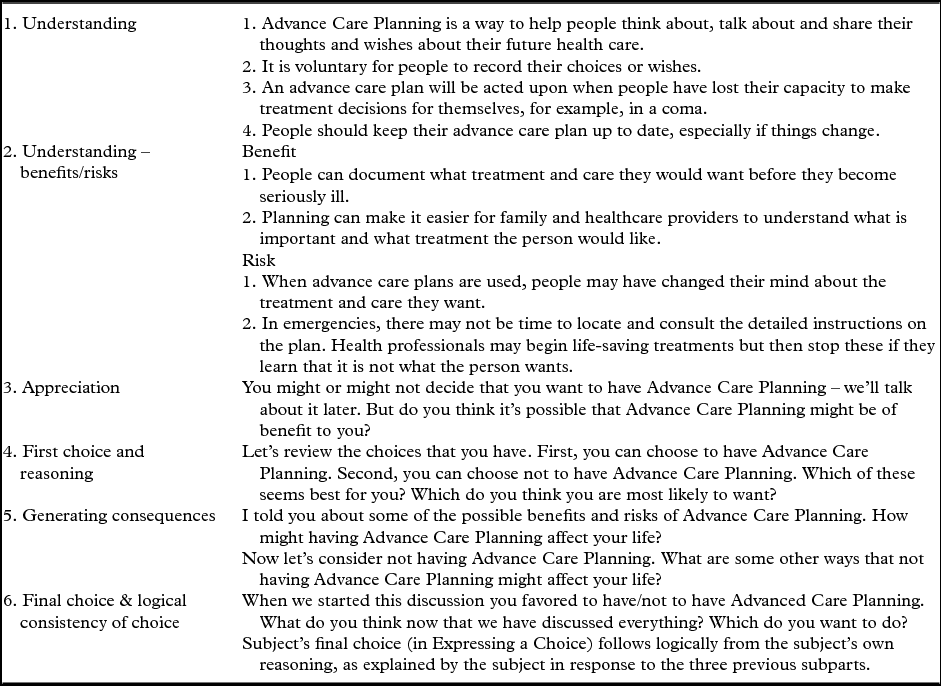
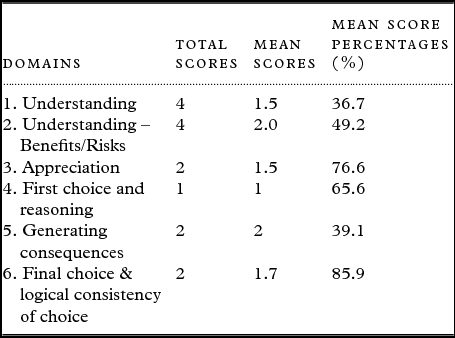
1. Advance Care Planning–Capacity Assessment Structured Clinical Interview (ACP–CAS). This tool was adapted from the MacCAT-T (Grisso and Appelbaum, Reference Grisso and Appelbaum1998). The MacCAT-T is a semi-structured interview that assists clinicians who are conducting assessments of patients' competence to consent to treatment. The process provides a patient with the information about medical/psychiatric condition that needs intervention, the type of treatment being recommended, its risks and benefits, as well as other possible treatments and their probable consequences. During this process, the MacCAT-T prompts the assessor to ask questions that assess the patient's understanding, appreciation, and reasoning regarding treatment decisions. The ACP-CAS aimed to assess the participant's understanding, appreciation, and reasoning regarding ACP. (Table 1) There are a total of six domains in the ACP–CAS and their sub-scores are presented in Table 4. It is important to acknowledge that as with the MacCAT-T, these sub-scores are only used a guide for research purposes; they are not used by the assessors when determining the overall capacity.
2. Advance Care Planning – Capacity Assessment Vignettes Method (ACP–CAV)
Advance care planning–capacity assessment structured clinical interview (ACP–CAS): an overview

Two vignettes (Box 1 and 2) were developed by the research team. Each vignette was followed by the same set of semi-structured questions (Box 3) to explore the person's capacity to make the relevant treatment decision.
Scenario 1
This is a purely hypothetical scenario.
One day you wake up in the morning with severe chest pains. You pressed the emergency bell in your room but you suddenly collapse and become unconscious. Your heart stops beating and you stop breathing. The nurse in charge of the facility called 111 for an ambulance. The ambulance officer diagnosed you with a heart attack.
Some people think about these things before they happen and want to have a choice. The ambulance officer could try to resuscitate you and to bring you back to life. This includes giving you electric shocks across your chest to start your heart beating again and placing a tube down your throat to do the breathing for you. There is a very small chance that resuscitation will be successful but it is unlikely that your health will return to its previous level. The ambulance officer could instead choose not to resuscitate you, to allow natural death, if she knew it was your choice.
Scenario 2
This is a purely hypothetical scenario.
Over the recent months you have lost a lot of weight and you have become very tired. You are taken to see your doctor who does some tests. The tests confirm you have stomach cancer. You will need an operation to remove the cancer. The operation is likely to be able to remove all the cancer. However, you will need a permanent feeding tube, which passes through your nose to your stomach, after the operation. Some people in a similar situation would choose against having an operation. In this case your care would focus on finding ways to keep you comfortable, which includes adequate pain relief and good nursing care.
Semi-structured questions for Scenario 1 and 2
1. Now please in your own words give a summary of this scenario.
2. What are the two treatment options available to you in this situation?
3. So, in this scenario you can either choose to have the resuscitation (operation) or no resuscitation (operation). Which of the two treatment options would you want if you were in this situation?
4. What are the reasons for you to choose to have/not to have resuscitation (operation)?
5. Can you see any problems if you choose to have/not to have resuscitation (operation)?
6. What will having (not having) resuscitation (operation) mean for you and your family?
7. Can you see any problems if you chose to have (not to have) resuscitation (operation)?
8. Can you repeat whether you want (do not want) resuscitation (operation) in this situation?
Judging capacity to engage in ACP and treatment decisions
Four specialist old age psychiatrists were involved in judging the participants’ capacity. They were blinded to the participants’ demographic variables and the results of their cognitive assessments and depression screen. The first pair of assessors (EC and JDJ) watched the videos of ACP–CAS and used the ACP–CAS tool separately and made an independent judgment (competent vs. not-competent) on the participants’ capacity for engaging in ACP discussions. A meeting was held to discuss any discordance with an aim to reach consensus on all cases. The percentage of inter-rater agreement was calculated based on the initial independent judgment by the two assessors. A similar process was undertaken by the second pair of assessors (MR and GC) when judging the ACP–CAV videos.
Statistical analysis
SPSS version 20.0 (SPSS Inc., Chicago, IL, USA) was used for statistical analysis. The binary outcomes (competent vs. not competent) on the ACP–CAS were used as the “gold standard”. Non-parametric tests were used. Mann–Whitney U-Test for continuous variables and χ 2 tests (two-sided) for discrete variables were used when comparing differences in participants who were competent and those who were not. Fisher-exact test was used for discrete variables when the cells contained less than five cases. A logistic regression was performed to determine whether the binary outcome was predicted by the following variables: MMSE, TMT A & B, and GDS-15. The binary outcomes of the ACP–CAV were measured against the ACP–CAS and presented in a 2 × 2 table.
The mean scores and mean score percentages for each of the six domains in ACP–CAS were calculated. These mean scores were used as a guide to determine which domain(s) our participants had the most difficulty with.
Results
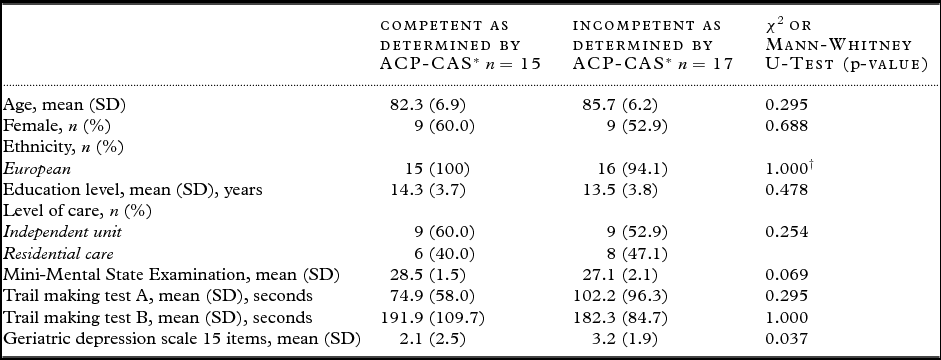
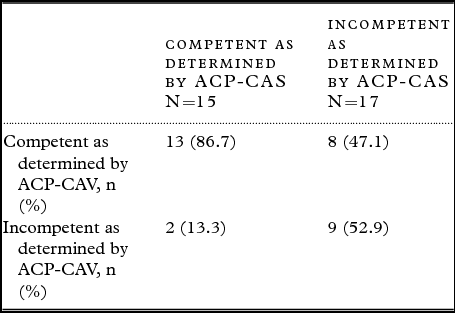
32 participants (14 males and 18 females) were included in the study. Their mean age was 84.1 years (SD = 6.7; range = 67–99). 31 (96.9%) self-identified as European and 1 (3.1%) as Māori. Their mean education level was 13.9 years (SD = 3.7; range = 7–21). Mean MMSE score was 27.8 (SD = 1.9; range = 24–30) and mean GDS-15 score was 2.7 (SD = 2.2; range = 0–10). 15 participants (46.8%) were assessed as competent using the ACP–CAS. Table 2 shows the results of the demographics, cognitive assessments, and depression screen of the participants who were assessed as “competent” and “not competent” according to the ACP–CAS. There was no statistically significant difference in the MMSE scores between the “competent” and “not competent” groups (MMSE = 28.5 vs. 27.1, p = 0.069). Similarly, there were no statistically significant differences in the performance of TMT Part A and B and the GDS scores between the two groups. The mean GDS scores in both groups were less than five (the usual cut-off point for significant depressive symptoms). Table 3 shows the results of the binary outcomes of the ACP–CAS when compared to those of the ACP–CAV. Using ACP–CAS as the gold standard, ACP–CAV was accurate in 68.9% of the cases. The inter-rater agreement between the two assessors was 82.4% and 68.8% for ACP–CAS and ACP–CAV, respectively, but agreement was reached for all cases following the consensus meetings.
Results of the demographics, cognitive assessments, and depression screen of the participants who were assessed as “competent” and “not competent” according to the ACP–CAS*

aACP–CAS = Advance Care Planning–Capacity Assessment Structured Clinical Interview.
bFisher's Exact Test.
Results of the binary outcomes of the ACP–CASa when compared to those of the ACP–CAVb

aACP–CAS = Advance Care Planning–Capacity Assessment Structured Clinical Interview.
bACP–CAV = Advance Care Planning–Capacity Assessment Vignettes Method.
The sub-scores of the six ACP–CAS domains are presented in Table 4 with the first domain “Understanding” of ACP having the lowest mean score percentage.
Total score, mean scores, and mean score percentages of the six ACP–CASa assessment domains

aACP–CAS = Advance Care Planning–Capacity Assessment Structured Clinical Interview.
Discussion
This study assessed the capacity of older people (with a MMSE score of 24 or above) to engage in the discussion of ACP. Using the ACP–CAS, a semi-structured interview based on the MacCAT-T as the gold standard, over half (53.1%) of the participants were considered lacking in capacity to engage in ACP. We found that our participants struggled the most with the “Understanding” domain (refer to Table 1), despite the principles of ACP being described in the participant information sheet as part of the informed consent process. Furthermore, the information was presented to them both visually and verbally at the time of the research assessment. It is possible that the information on ACP itself is too complex and led to this observed lack of capacity. In clinical practice, we may need to present and explain the ACP information to older people in such a way that they can understand it more clearly. For example, using visual aids or videos illustrating the ACP process, patient's journey and potential outcomes and benefits. It would also be important for clinicians to allow sufficient time for an older person to learn about ACP and have the opportunity to be engaged in a discussion to clarify any issues involved.
When comparing older people who were competent to engage in ACP and those who were not, no statistically significant difference was found in terms of their global cognition (as measured by MMSE) and executive function (as measured by TMT Part A and B). The competent group had less depressive symptomatology (as measured by GDS-15) than the incompetent group. Although this difference (mean GDS-15: competent = 2.1 vs. incompetent = 3.2) is statistically significant, a GDS-15 score below 5 indicates the absence of clinically significant depressive symptoms.
It has often been debated whether simple screening tests have a role in the initial assessment of capacity and the two that have been explored are the MMSE and simple executive function tests. Advantages of the MMSE are its ubiquity and ability to monitor progression in mild dementia. However, its sensitivity and specificity are affected in those with frontal lobe dysfunction who may have a normal MMSE or those with a low MMSE but preserved capacity in certain contexts (Schindler et al., Reference Schindler, Ramchandani, Matthews and Podell1995; Etchells et al., Reference Etchells1999; Kim et al., Reference Kim, Karlawish and Caine2002). One study that prospectively assessed patient-carer dyads found carer judgment of competency was predicted by MMSE<20, though associated factors included older patients and mounting carer stress (Pruchno et al., Reference Pruchno, Smyer, Rose, Hartman-Stein and Henderson-Laribee1995). Nonetheless most studies support the use of MMSE for screening purposes though acknowledge it should not be used alone due to its limited accuracy when people score in the middle range of 18–24 (Hirschman et al., Reference Hirschman, Xie, Feudtner and Karlawish2004; Gregory et al., Reference Gregory, Roked, Jones and Patel2007). The weakness of the MMSE may stem from its lack of elements that assess executive domains especially as intentionality and voluntariness are executive components vital to decisional autonomy and linked to incapacity in those with frontal lobe syndrome (Pachet et al., Reference Pachet, Astner and Brown2010). Studies which have included executive function in assessment of capacity assessments show stronger predictive correlation (Royall et al., Reference Royall, Cordes and Polk1997; Reid-Proctor et al., Reference Reid-Proctor, Galin and Cummings2001). Our study has added to the literature that MMSE/TMT cannot be reliably used to differentiate those older people with capacity, and those without, to engage in ACP.
A recent systematic review of ACP discussions with frail and older individuals, cognitive impairment, and a lack of decision-making capacity were felt to be one of the important barriers to EoL care discussions (Sharp et al., Reference Sharp, Moran, Kuhn and Barclay2013). Another systematic review found that a maximum of 36% of patients with cognitive impairment and dementia being admitted to a nursing home had capacity to participate in ACP (Robinson et al., Reference Robinson2012). Our study has highlighted that even for older people with a MMSE of 24 or higher, a good portion of them do not fully understand the ACP process. Therefore, in order to ensure an ACP is a valid document, clinicians should routinely explain the principles of ACP including its potential outcomes to older people. And if there is any concern about their understanding, further exploration and documentation of their capacity using the capacity assessment framework would be necessary.
The main limitations of this study are the small sample size and that participants were primarily European. Cultural sensitivities may result in some patients not wishing to engage in ACP discussions. Our results may not be generalized to other ethnic groups and older people living in other community settings. A further limitation is that we did not clinically assess our participants for dementia and depression using validated structured/semi-structured clinical interviews. We chose the MMSE cut-score of 24 as an inclusion criterion for older people because a MMSE score of 23 or less is generally indicative of cognitive impairment. Capacity is a functional test (Douglass et al., Reference Douglass, Young and McMillan2016) and older people with a diagnosis of dementia/depression can still retain the capacity to have an ACP discussion; therefore, including the diagnosis of dementia/depression would not have altered the outcomes of this study. The strength of this study is the analysis of the videos by a pair of specialist old age psychiatrists as this process can improve the reliability of capacity assessment.
A recent survey of New Zealand general practitioners (GPs) and hospital doctors indicated that respondents lacked confidence and knowledge about capacity assessment (Douglass and Young, personal communication). A significant portion of GPs (24.3%) and hospital doctors (30.1%) did not consider capacity assessments to be within their scope of practice. The survey also found 32% of GPs and 33% of hospital doctors were “not confident” to assess patients’ capacity to make a treatment decision to a standard that could be presented in court. When determining the capacity to engage in ACP, the ACP–CAV, and vignette-based method used in our study, were only accurate in 68.8% of the cases when compared to the gold standard. Until its accuracy is demonstrated in future research, the vignette method is not recommended to be used as a substitute for ACP capacity assessment. Sharp et al. (Reference Sharp, Moran, Kuhn and Barclay2013) reported a marked disparity between the majority of older individuals who would like the opportunity to discuss their EoL care and the minority that currently have this opportunity. Training clinicians involved in ACP to conduct capacity assessments with older people using the gold standard of semi-structured interviews may address the barrier and fear concerning the lack of decision-making capacity in older people and to encourage more discussion with those older people who are interested and competent to engage in ACP.
Conflict of interest
None.
Description of authors’ roles
All authors contributed to the study design. O. Kiriaev and G. Cheung were responsible for supervision of data collection, data analysis, and led on drafting the paper. E. Chacko, M. Ramages, J.D. Jurgens, and G. Cheung were involved in capacity assessment. All authors revised the draft and read the final version of the paper.
Acknowledgments
The authors would like to thank Jayden Batey for data collection as part of his medical student summer studentships at Auckland District Health Board in 2012/2013.