Introduction
According to the European Position Paper on Rhinosinusitis and Nasal Polyps (‘EPOS’), acute rhinosinusitis in children is defined as ‘inflammation of the nose and paranasal sinuses characterised by two or more symptoms, one of which should be either nasal blockage/obstruction or nasal discharge (anterior or posterior)’.Reference Fokkens, Lund, Mullol, Bachert, Alobid and Baroody 1 Acute rhinosinusitis has a duration of less than 12 weeks; a duration of 12 weeks or longer reflects chronic rhinosinusitis.Reference Fokkens, Lund, Mullol, Bachert, Alobid and Baroody 1
The European Position Paper reported an estimated prevalence of acute rhinosinusitis of 6–12 per cent, with no distinction between adults and children.Reference Fokkens, Lund, Mullol, Bachert, Alobid and Baroody 1 In contrast, other studies have found differences between adults and children. For example, in the Netherlands, in 2015, an incidence of 18.8 cases per 1000 per year in the general population was reported.Reference Hoffmans, Schermer, van der Linde, Bor, van Boven and van Weel 2 In a previous survey addressing children, acute rhinosinusitis was reported in 18 cases per 1000 per year in participants aged 12–17 years, similar to the incidence in the general population, but in 2 cases per 1000 per year in participants aged 0–4 years.Reference Uijen, Bindels, Schellevis and van der Wouden 3
Phase two of the International Study of Asthma and Allergies in Childhood (‘ISAAC’) reported that the prevalence of rhinoconjunctivitis and rhinitis without conjunctivitis varied widely among allergic rhinitis patients within the different countries studied (1.5–24.5 per cent and 1.4–45.2 per cent, respectively).Reference Weinmayr, Forastiere, Weiland, Rzehak, Abramidze and Annesi-Maesano 4 The relationship between rhinosinusitis and respiratory allergy is controversial, with some studies, but not others, suggesting an important role for allergy as a risk factor for chronic rhinosinusitis.Reference Leo, Piacentini, Incorvaia, Consonni and Frati 5
This study aimed to prospectively evaluate the incidence of acute rhinosinusitis during the grass pollen season in children with seasonal allergic rhinitis.
Materials and methods
Between 2010 and 2011, children with allergic sensitisation to grass pollen and rhinitis symptoms, but without rhinosinusitis symptoms, were selected. Exclusion criteria were: odontogenic causes of sinusitis, gross anatomical or congenital abnormalities of the upper airway, immunodeficiency, Down syndrome, cystic fibrosis, metabolic diseases, and ciliary dyskinesia. A group of children without inhalant allergies served as controls.
The children's parents were asked to complete a diary over a three-month period (April, May and June 2011) to report the symptoms experienced and the drugs used daily. We used the daily data to calculate the mean percentage of days with symptoms (or drug use) and the mean severity (or drug consumption) score (calculated only for those days with symptoms or requiring drug use) in children with and without endoscopically confirmed acute rhinosinusitis.
The symptoms indicative of acute rhinosinusitis, according to consensus documents, were: nasal blockage or stuffiness, nasal discharge, or post-nasal drip (mucopurulent or not); facial pain or pressure; headache; reduction or loss of smell; and cough.
Among the children with clinical symptoms, confirmatory diagnosis was made by nasal fibro-endoscopy, based on the observation of nasal polyps, mucopurulent discharge primarily from the middle meatus, and/or oedema or mucosal obstruction primarily in the middle meatus.Reference Fokkens, Lund, Mullol, Bachert, Alobid and Baroody 1 The endoscopic findings for each patient were graded according to a 0–3 scoring system, depending on the level of nasal polyps involvement, the severity of nasal mucopurulent discharge primarily from the middle meatus, and the degree of oedema or mucosal obstruction primarily in the middle meatus.
Skin tests
Skin prick tests were performed according to the European Academy of Allergology and Clinical Immunology guidelinesReference Dreborg, Backman, Basomba, Bousquet, Dieges and Malling 6 using standardised extracts (Stallergenes, Antony, France) of the common aeroallergens (grasses, parietaria, ragweed, artemisia, olive, birch, alder, Dermatophagoides pteronyssinus and D farinae, alternaria, aspergillus, and cat and dog epithelia).
The positive control was a 10 mg/ml solution of histamine dihydrochloride and the negative control was a saline solution. A positive skin prick test result was defined by the appearance of a wheal with an area larger than 7 mm,Reference Hoffmans, Schermer, van der Linde, Bor, van Boven and van Weel 2 with no reaction to the negative control.
Endoscopy
Nasopharyngeal endoscopy was performed using a 2.5 mm diameter fibre-optic, flexible nasopharyngoscope (Storz 11101 SK; Karl Storz, Tuttlingen, Germany). In all cases, the endoscopic evaluation included examination of the nasal turbinates and middle meatus, and the rhinopharynx to assess the adenoids and Eustachian tube orifice.
Statistical analysis
We compared acute rhinosinusitis prevalence among allergic children and controls by calculating the chi-square test values. Among allergic children, the average percentage of days with symptoms (or drug use) and the mean severity (or drug consumption) score (calculated only for those days with symptoms or requiring drug use), in children with and without endoscopically confirmed rhinosinusitis, were compared using the Wilcoxon-Mann-Whitney test. Data management and statistical analyses were performed with Stata statistical software, version 13 (StataCorp, College Station, Texas, USA).
Results
A total of 242 children with grass pollen induced allergic rhinitis were enrolled (173 males and 69 females), with a mean age of 13.2 ± 3.5 years (range, 6.1–18 years). The control group comprised 65 children (34 males and 31 females), with a mean age of 12.3 ± 3.2 years (range, 6.5–18 years).
In the allergy group, 17 children (7.0 per cent) were diagnosed with acute rhinosinusitis, as confirmed by nasal endoscopy, during the period from April to June. In the control group, 3 out of 65 children (4.6 per cent) developed acute rhinosinusitis. There was no difference between the two groups (p = 0.49).
Table I shows the demographic data for allergic children with and without acute rhinosinusitis. All allergic children with endoscopically confirmed acute rhinosinusitis had oedema and 71 per cent had discharge, but none had polyps.
Characteristics of allergic children with and without acute rhinosinusitis*

* Confirmed endoscopically. SD = standard deviation
In five children who were diagnosed with acute rhinosinusitis, endoscopy did not confirm the clinical diagnosis (false positive rate: 5 out of 225, 2.2 per cent).
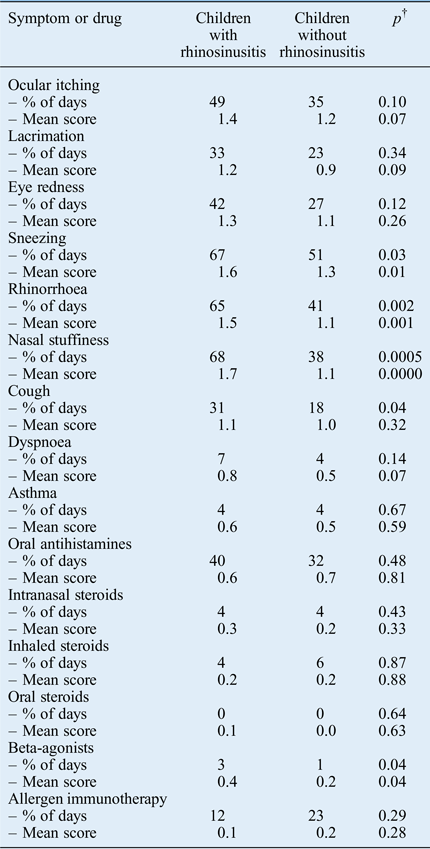
For most symptoms, children with acute rhinosinusitis had symptoms for a higher mean percentage of days and/or a higher symptoms score than children without acute rhinosinusitis (Table II). Oral antihistamine use was similar in the two groups of children, while for children with acute rhinosinusitis a slightly higher consumption of beta-agonists was reported.
Mean percentage of days with symptoms (or drug use) and mean severity score in allergic children*

Mean severity score calculated only for those days with symptoms.
* With and without endoscopically confirmed rhinosinusitis.
† Calculated using the Wilcoxon-Mann-Whitney test.
Discussion
The potential role of respiratory allergy in the development of sinusitis was first suggested in 1978, when acute rhinosinusitis was diagnosed in 53 per cent of allergic children.Reference Rachelefsky, Goldberg, Katz, Boris, Gyepes and Shapiro 7 However, the diagnosis was made using sinus X-ray, which is no longer admitted as a diagnostic tool for rhinosinusitis.Reference Fokkens, Lund, Mullol, Bachert, Alobid and Baroody 1 Ten years later, the issue was reappraised, assessing the occurrence of allergy in patients with verified acute maxillary sinusitis, which was found in 25 per cent of patients.Reference Savolainen 8 Furukawa, based on the analysis of such studies and a number of abstracts, concluded that ‘the literature supports that allergy is an important associated factor in sinusitis’.Reference Furukawa 9
Different results were reported when chronic rhinosinusitis was considered. Nguyen et al. examined the prevalence of chronic rhinosinusitis in children presenting to allergy clinics with respiratory symptoms lasting three months or more, and concluded that allergic rhinitis was not a risk factor associated with sinus abnormalities.Reference Nguyen, Corbett, Garcia, Eberly, Massey and Le 10 This was confirmed by another study in which the diagnosis of chronic rhinosinusitis was achieved by computed tomography scanning.Reference Iwens and Clement 11 In fact, the 1998 Practice Parameters on Diagnosis and Management of Rhinitis described the relationship between allergy and sinusitis as ‘in need of elucidation’.Reference Dykewicz and Fineman 12
In a study published in 2006, on 351 children with chronic rhinosinusitis as defined by European Position Paper on Rhinosinusitis and Nasal Polyps criteria, the prevalence of both sensitisation to at least one inhalant allergen (determined by skin tests) and high total immunoglobulin E was 29.9 per cent.Reference Leo, Piacentini, Incorvaia, Consonni and Frati 13 This figure is comparable to that of the general paediatric population (not including the results of routine investigations for allergy in children with chronic rhinosinusitis).Reference Leo, Piacentini, Incorvaia, Consonni and Frati 13 Still, the role of allergy was raised again in later studies.
A retrospective study reported a prevalence of allergic rhinitis of 27 per cent in chronic rhinosinusitis children.Reference Sedaghat, Phipatanakul and Cunningham 14 The authors concluded that allergy testing ‘should be strongly considered in all children with chronic rhinosinusitis’. Again, other surveys did not confirm such a suggestion. For example, in a 5-year analysis of cross-sectional data from 35511 participants, the mean prevalence of allergic rhinitis was 18.5 per cent for participants of all ages, but the correlation between sensitisation to aeroallergens and chronic rhinosinusitis was weak.Reference Ahn, Kim, Lee and Rhee 15
In a very recent review, Tint et al. highlighted the role of a number of co-morbidities in chronic rhinosinusitis, deeming that ‘allergy has been hypothesised to increase the risk of developing CRS [chronic rhinosinusitis] by inducing chronic inflammation and obstructing the sinus ostia’, but stated that the data on this topic had produced inconclusive results.Reference Tint, Kubala and Toskala 16
One study considered aspirin-exacerbated respiratory disease in a large group of patients.Reference Stevens, Peters, Hirsch, Nordberg, Schwartz and Mercer 17 When 171 patients with aspirin-exacerbated respiratory disease were compared to 459 patients with chronic rhinosinusitis alone, 300 patients with asthma alone, or 412 patients with both chronic rhinosinusitis and asthma, the prevalence of atopy was significantly higher in patients with aspirin-exacerbated respiratory disease (84 per cent) or asthma (85 per cent), than in patients with chronic rhinosinusitis (66 per cent). Furthermore, the prevalence of atopy in chronic rhinosinusitis patients was higher than that reported in the general population.Reference Stevens, Peters, Hirsch, Nordberg, Schwartz and Mercer 17
Regarding acute rhinosinusitis, only one recent study on the role of allergy is available.Reference Lin, Wang, Lee, Ku, Sun and Lu 18 All patients, consisting of 69 children aged 3–12 years, were followed up for a period of one and a half years. Of these, the 27 children (39.1 per cent) who had allergic rhinitis were more likely to develop acute rhinosinusitis than non-atopic children.Reference Lin, Wang, Lee, Ku, Sun and Lu 18
-
• Acute rhinosinusitis is a very common disorder in children
-
• The most common risk factor for acute rhinosinusitis development is viral upper respiratory infection
-
• The role of allergic rhinitis in acute rhinosinusitis development is not clear
-
• Allergy to grass pollen during exposure to the causative pollen is not an important risk factor for acute rhinosinusitis
We prospectively evaluated the incidence of acute rhinosinusitis during the grass pollen season in a population of 242 children with grass pollen induced allergic rhinitis. During the pollen season, 7.0 per cent of children had acute rhinosinusitis as assessed by nasal endoscopy, a rate very similar to the 4.6 per cent observed in the control group of children without an inhalant allergy. This shows that the risk of developing acute rhinosinusitis in children with allergic rhinitis caused by sensitisation to pollens is very low, and does not warrant performing examinations for acute rhinosinusitis. It is likely that the duration of allergic inflammation in a pollen season is not sufficiently prolonged to involve the paranasal sinuses. In children who developed acute rhinosinusitis, the scores for nasal symptoms, particularly sneezing, rhinorrhoea, nasal stuffiness and cough, were significantly higher in children with acute rhinosinusitis than in those without acute rhinosinusitis. Thus, the severity of symptoms should drive the choice to perform nasal endoscopy to disclose the disease.
Conclusion
The development of acute rhinosinusitis during the grass pollen season in children sensitised to grass pollen is very rare. Performing nasal endoscopy to detect possible acute rhinosinusitis in children with seasonal, pollen-induced rhinitis is warranted only in the presence of nasal symptom scores that indicate severe allergic rhinitis. However, such an observation cannot be translated to participants with longer exposure to allergens, particularly when the causative allergen sources are house dust mites. The possible higher risk of acute rhinosinusitis in this kind of allergy deserves to be investigated by specific studies.
Acknowledgement
The authors thank Stanley Norman for the English revision.