For two decades the literature on public policy has placed a strong emphasis on the role of policy feedbacks in explaining both public policy change and policy stability. Associated in particular with the work of Paul Pierson (Reference Pierson1993, Reference Pierson2000, Reference Pierson2004), and with progenitors including Douglas North (Reference North1990), this work has focused on how positive feedbacks from past choices imbed those policies in a country, resulting in stable policy regimes. As Pierson (Reference Pierson2004, p. 45) puts it, political processes can be ‘highly influenced by relatively small perturbations at early stages.’ However, ‘once actors have ventured far down a particular path, they may find it very difficult to reverse course. Political alternatives that were once quite plausible become irretrievably lost.’ (Pierson Reference Pierson2004:10–11).
The argument in this paper is that the literature has overemphasized positive feedbacks from policy. It is equally important to focus on negative policy feedbacks: consequences of policy that tend to undermine rather than reinforce the political, fiscal or social sustainability of a particular set of policies. The argument is not that negative policy feedbacks are always, or even usually dominant; it is rather that they are often extremely important, especially in explaining major shifts in policy regimes that are often explained in terms of exogenous shocks but actually are deeply rooted in existing policies.
This paper develops a general argument about negative feedbacks and then applies it to explain patterns of changes in public pension regimes in advanced industrial systems. Pension policy is an especially appropriate area for such an examination, because it is the one of the largest expenditures of governments and because it is one the sectors that Pierson has argued (Reference Pierson1994, Reference Pierson1996, Reference Pierson and Pierson2001; see also Myles and Pierson Reference Myles, Pierson and Pierson2001) is most affected by the policy regime-stabilizing impacts of positive feedbacks. Thus, a finding of substantial regime-changing negative feedback effects in this sector suggests that a broader rethink of ‘the new politics of the welfare state’ is in order (Pierson Reference Pierson1996; for more skeptical views see Bonoli and Palier Reference Bonoli and Palier2007; Overbye Reference Overbye, Arza and Kohli2007).
The first section argues that negative policy feedbacks are quite common, even when they do not lead to a major change in policy regime. The second section argues that when negative feedback effects are present, whether the policy regime is transformed depends on the balance of positive and negative effects, the availability of incremental reform options that make the negative effects of the current policy regime more bearable, and the availability of paradigmatic reform options (or regime transition options) that are feasible in both political and policy terms. Thirdly, the paper examines the concept of negative feedback effects to explain pension policy regime change, outlining the range of forces that constrain and facilitate regime change. Section 4 applies these concepts to national experiences with three different regime types – Bismarckian, Bismarckian Lite, and Mixed pension regimes – as a preliminary test of the fit of the theoretical framework with the data. The conclusion of the paper draws broader implications.
I. When (bad) Effect Becomes Cause
Pierson (Reference Pierson2000, Reference Pierson2004) argues that several mechanisms tend to create path dependence in policy choices, which in turn frequently results in stability in policy regimes. Policy choices involve sunk costs in building up organizational capacity, physical infrastructure and human capital. Adaptive expectations created as societal actors adjust their behavior to current policies also raise the political costs of policy regime change. Over time, programs develop constituencies whose power is reinforced by the status quo and who have a stake in it.
While positive policy feedbacks have become an established part of the political science literature, little sustained attention has been paid in recent years to the possibility that policy regimes may produce negative feedbacks too.Footnote 1 There is a clear recognition in the literature, however, that not all feedbacks from policy choices are positive and reinforce the status quo. Esping-Andersen's (Reference Esping-Andersen and Kitschelt1999) analysis of class development in the three worlds of welfare capitalism, for example, notes negative effects associated with each type of regime: very high budget costs for the Scandinavian social democratic model, social exclusion and high unemployment among younger workers in continental welfare states, and high income inequality in liberal welfare states. Critics of pre-1996 welfare policy in the United States argued that those policies had negative socio-economic consequences, such as rising rates of non-marital births and prolonged separation of low-skilled mothers from the labor force, which helped to undermine political support for those policies and led to adoption of much more work-oriented and punitive policies (Weaver Reference Weaver2000). Permissive policies toward air and water pollution, and more recently emission of greenhouse gasses, also led to negative feedbacks that eventually undermined those policies as harmful effects became more pronounced and societies no longer saw existing policies as inevitable or even sustainable.
Negative feedbacks take several forms. There may be problems that are recognized at the outset but seen as the unavoidable cost of retaining a policy that has several desirable attributes. In the case of pension policy, for example, reductions in individual savings may result from provision of pensions with high replacement rates. Negative feedbacks may also take the form of slow-developing consequences of a policy regime's internal logic that take a while to develop and/or become more severe over time, such as the rising costs of a Pay-As-You-Go public pension system as it is matures. Negative feedbacks may also give rise to changing political demands, such as the political mobilization of new groups that feel that they are ignored or harmed by the existing policy regime.
Most policy regimes produce both positive and negative feedbacks. Whether positive or negative feedbacks are dominant is an empirical question that can only be resolved through research. Overall, we would expect to observe positive feedback effects more frequently than negative ones because policy regimes that have very strong, immediate negative feedbacks presumably will not last long. Moreover, cross-national learning may help countries to avoid high-negative policy regimes. But negative feedback effects that are initially bearable irritants may remain in place for a long time – and may grow in their impact until they do undermine the stability of a policy regime. Indeed, attention to negative feedbacks can address one of the criticisms most commonly leveled at path dependence approaches: that it does a good job of explaining the durability of policy regimes, but must rely on exogenous factors to explain how major policy choices get made in the first place.
II. Paths And Forks Or Chutes And Ladders?
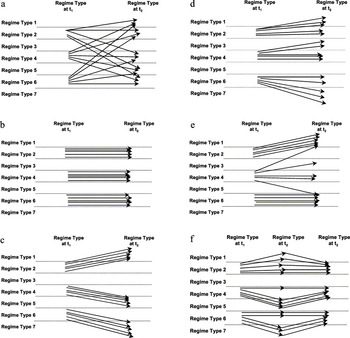
Conceptualizing different patterns of policy regime change and their relationship to positive and negative policy feedbacks is a useful first step because it generates a set of theoretical expectations that can be compared with real-world experience. Figures 1a–1f show different patterns of policy regime change consistent with different policy feedback effects. In all of the figures, each arrow represents the policy trajectory of one hypothetical country. In each of the figures, there are seven possible policy regimes, and each of our hypothetical countries begins at Time t1 in Policy Regimes 2, 4 or 6. How are these countries likely to evolve over time given different assumptions about policy feedback effects? If both positive and negative feedback effects from current policy are weak, we would expect that policy regimes at Time t2 would be fairly randomly distributed – there would be no clear pattern either of staying with the Time t1 regime or moving to specific other regimes. This situation, shown in Figure 1a, can be labeled unconstrained choice. In Figure 1b, there are extremely strong positive feedback effects, which prevent any exit from the policy regime in effect at Time t1. This can be called a Cul-de-sac model of policy regime choice. Figure 1c suggests a situation of very strong negative feedback effects resulting in absence of policy regime choice: in this case, each of the countries is forced to abandon its policy regime at Time t1 and replace it with a specific new policy regime. This pattern can be labeled Chutes and Ladders after the children's board game in which landing on a particular space requires them to move to another place on the board, with no discretion in where they move. Figure 1d shows a somewhat different pattern: moderately strong positive effects lead to constrained choice. Governments either stay with their current policy regime or move to one other policy regime; the range of choice of alternative regime is clearly dictated by what regime they began with at Time t1. This situation can be labeled a Paths and Forks model of regime change. Of course, different policy regimes may have different policy effects, as suggested by Figure 1e. Here countries with Policy Regime 2 at Time t1 are all forced by negative feedback effects to abandon it for Policy Regime 1 (Chutes and Ladders), while those beginning with Policy Regime 4 are relatively unconstrained in their choice of policy regime at Time t2, and those beginning with Policy Regime 6, presumably as a result of very strong positive feedback effects, do not exit at all (Cul-de-sac).
a Weak Feedback Effects and Unconstrained Choice. b Very Strong Positive Effects and Absence of Choice (Cul-de-sac). c Very Strong Negative Effects and Absence of Choice (Chutes and Ladders). d Moderately Strong Positive Effects and Constrained Choice (Paths and Forks). e Mixed Patterns. f Delayed Positive Effects that Permit Choice Initially but Force Reversal (Boomerang)

It is also possible that feedback effects may differ over time. If feedback effects from a policy regime are relatively weak in their early years but grow stronger over time, or may be positive at the outset but turn negative over time. Other patterns are also possible. For example, countries may be able to change policy regimes, but those regime changes may not be sustainable in the short or long run, forcing to shift back to the policy regime they had in place at Time t1. This possibility is suggested by the Boomerang pattern in Figure 1f.
The prospects for policy regime change depend on three broad factors, as outlined in the following hypotheses:
Hypothesis 1: Regime transition is more likely if (a) Policy feedback effects are dominated by multiple and substantial negative effects, (b) Incremental reform opportunities to address regime challenges are non-existent or limited and declining, and (c) At least one alternative policy regime is perceived by policymakers to be practical.
Hypothesis 2: Regime transition is less likely if (a) Policy feedback effects are predominantly positive, (b) Incremental reform opportunities are available, affordable and politically feasible, and (c) Regime transition opportunities are very limited or non-existent and/or impose high costs on powerful actors.
Each of these factors may vary substantially not just across policy sectors, but also across policy regimes within sectors, and over time for an individual policy regime.
BALANCE BETWEEN POSITIVE AND NEGATIVE FEEDBACK EFFECTS: Policy feedback effects may be of several types (see Pierson Reference Pierson1994). Political effects concern whether a program generates a growing support coalition and/or powerful interests that prefer a regime transition. Fiscal effects refer to demands on the government budget, notably whether a policy generates revenue to pay for programmatic costs. Social effects refer to costs and benefits that are imposed on groups in society. A negative shift on any of these dimensions may place reform on the agenda – though incremental reforms are likely to be considered before paradigmatic ones.
INCREMENTAL REFORM OPTIONS: Even when a policy regime has many obvious shortcomings and provides limited opportunities for incremental reforms, exit to another policy regime is likely to be constrained by sunk costs in the status quo and supportive constituencies for the status quo. But it can also be constrained by the availability of patches that make the negative effects more bearable. Rising programmatic costs, for example, may be addressable by finding new sources of funding or expanding existing sources that can be earmarked to support the policy regime. Giving some additional benefits to groups who are disadvantaged by the current policy regime may weaken political opposition.
REGIME TRANSITION OPTIONS: Restructuring reform also depends on the availability of exit opportunities to other regimes. In some cases, a particular set of policy mechanisms may simply not have been invented yet, or may not be widely known outside of early adopters. Some alternative policy regimes may be perceived as too costly in budgetary terms, others may be perceived as having unacceptable social costs, or require an administrative or capital market infrastructure that is inadequate in a particular country. Thus a policy regime transition may be blocked not because negative feedback effects are small, but rather because no alternative policy regime is perceived to be available, because alternatives are politically unfeasible or too expensive, or because those who would lose from a transition are well placed politically to block it. Moving to a single-payer system of health care financing in the United States, for example, is regarded by most analysts as technically possible but politically unfeasible. However, the set of regime transition options is not static: new policy options may be invented or learned from other countries. It is not clear, however, that having multiple regime transition options makes a change in policy regime more likely – if different options are perceived as more desirable by different groups, the result may be stalemate and absence of regime change.
In the real world, it is unlikely that any single pattern of feedback effects and regime transitions will dominate across all policy sectors, or even across all policy regimes in a single sector. Nor should we think that positive and negative feedback effects are the only causal forces that influence patterns of regime change stasis and change. But having a set of hypothesized relationships about feedback effects to compare with cross-national patterns of regime change over time can help to understand the political dynamics of regime change.
III. Pension Regime Change
Existing national policies affect the policy and political challenges that policymakers face in pension reform, the options for incremental reform and for transitions to other policy regimes that are likely to be available for policymakers, and the eventual timing and scope of pension reform.
Public pension programs differ, most notably in their methods of pension financing and establishing entitlement to benefits. Traditionally, pension programs have been divided into three basic types. Universal programs provide equal flat-rate benefits to all citizens. They are often financed in whole or in part by general tax revenues rather than payroll taxes. Means-or income-tested pensions (the former implies an assets test as well as an income test) are given only to persons with low incomes, and are usually financed primarily by general revenues. Social insurance pensions base benefit entitlement at least loosely on contributions history, and therefore give higher benefits to those with higher earnings and more years of labor force participation. They are generally financed wholly or in large part through payroll tax contributions by employees and/or employers.
Gøsta Esping-Andersen's classic categorization of welfare states draws on this three-fold distinction. He contrasts countries that have essentially flat-rate universal or citizenship pensions (e.g., New Zealand and through the 1950s, Sweden) with those in which pension benefits are linked to earnings and contributions, known as social insurance or Bismarckian pension systems (e.g., Germany, Italy and France) and liberal or residual pension systems, where the state sector provides a relatively modest share of income for most citizens. These countries rely heavily on private provision for retirement income. In some cases, notably Australia prior to the 1990s, income-or means-tested pensions are the primary form of public pension in liberal regimes. However, Esping-Andersen also includes the United States and Canada in this category, though both have primarily social insurance-focused pension system, albeit ones that are relatively ungenerous by European standards.Footnote 2
A tripartite distinction among public pension programs understates the diversity of public pension provision in advanced industrial countries. Virtually all rich countries have multi-tier pension systems, organized in a variety of ways. Canada has a contributory earnings-related tier on top of a universal pension, plus a significant income-tested tier, and Sweden's structure was similar until its 1990s reforms. A number of countries have added mandatory or quasi-mandatory individual account tiers to their pension systems. Workers and/or their employers contribute to these accounts, and withdraw them when they retire. In most cases, benefits in these individual account tiers are based on defined contribution principles, meaning that government does not guarantee benefit levels. Whatever contributions have accrued in a retiree's account prior to their withdrawal, along with earnings on those contributions, form the basis of a retiree's pension benefit.
In analyzing multi-tiered pension systems, it is useful to develop groupings of national pension systems that share some common characteristics in order to develop and test alternative explanations of why countries choose different policy reforms. The tripartite distinction between universal, Bismarckian (social insurance), and residual systems, for example categorizes pension regimes based on which tier is dominant in terms of financing and setting the dominant politics for the program. A tripartite categorization is inadequate to capture the complexity and diversity of modern pension systems, however. Liberal or residual regimes lumps together three very different sorts of systems: (1) regimes where means-tested pensions are the dominant or only tier, as well as (2) what Weaver (Reference Weaver, Bonoli and Shinkawa2005a; see also Bonoli and Shinkawa Reference Bonoli, Shinkawa, Bonoli and Shinkawa2005) has called Bismarckian Lite regimes – notably Canada and the United States – that are contributory and earnings-related, but offer lower replacement rates than continental social insurance systems, and (3) modern mixed regimes like Switzerland and Denmark. These three types of pension regime differ greatly in how they are financed and who benefits. More importantly, they differ in the policy feedbacks and challenges they face, as well as their durability, and regime transition opportunities. Means-tested pension regimes, for example, largely disappeared more than 50 years ago, with Australia as a straggler until it adopted a mixed regime in the 1990s.
The category of continental social insurance or Bismarckian regimes is also problematic. Here the problem is the invention of a new type of pension regime in the 1990s, the so-called Notional Defined Contribution (NDC) pension system that originated in Sweden and has been adopted with varying degrees of completeness in a number of other countries, usually as a replacement for defined benefit social insurance pension tiers (Holzmann and Palmer Reference Holzmann and Palmer2006; Williamson Reference Williamson2004; Brooks and Weaver Reference Brooks, Weaver, Holzmann and Palmer2006). While many variations are possible, the fundamental principle of NDC pensions is to base initial benefits on earnings over the entire course of a worker's earning life. Equally important, NDC pensions have built-in stabilizing mechanisms that adjust benefits both for current and future retirees downward automatically if life expectancy increases or economic growth is lower than projected. These stabilizers are – at least in a well-designed and consistently implemented NDC system – sufficient to make the system financially sustainable indefinitely with a stable contribution rate, because automatic adjustments are made on the benefit side. These automatic balancing features of NDC pensions have the potential to make cutbacks easier than in defined benefit social insurance programs, because cutbacks under NDC are gradual and automatic. Once the system is in place, cutbacks do not require an intervention by politicians and lead to voter retribution. Moreover, at the time an NDC pension system is enacted, it is impossible to predict exactly how big (if at all) cutbacks will be. All of these elements are likely to minimize the blame that makes politicians reluctant to cut pensions.
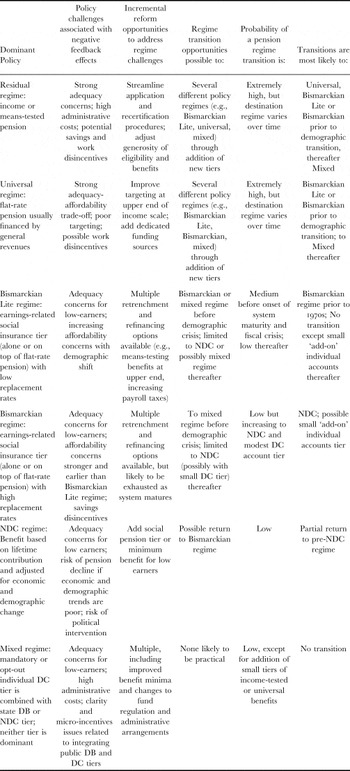
Table 1 develops a categorization of national pension regimes, based on which type of pension program is dominant in individual countries – that is, largest in terms of expenditure and/or in setting the dynamics of pension politics – using this broader categorization of pension policy regimes. These different pension regimes not only present distinctive negative feedbacks and resulting challenges to policymakers but are also likely to make certain reform options plausible in some countries and too costly in political, economic or social terms in others. From a policy feedbacks perspective, the most interesting question is how much choice policymakers retain given a specific set of negative feedback effects within a particular policy regime. Is a move beyond incremental reforms to a change in pension regimes possible? If regime change is considered, do policymakers face a fork in the path, while others find that they are trapped in a policy cul-de-sac? Or is their situation more akin to Chutes and Ladders, where prior policy regime choices compel a move to a specific new policy regime with no other options? Or do the incremental reform options and regime transformation opportunities associated with each pension regime vary, with some regime types offering multiple options for regime transitions while others offer no plausible exits? Still other regime transitions could be limited in time. For example, moves from universal pension regimes to Bismarckian ones are presumably more likely before fiscal and demographic strains became serious in the 1970s, making the costs of large earnings-related schemes more visible and less tolerable.
Factors affecting pension regime transitions in advanced industrial countries

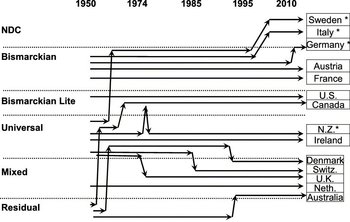
A number of changes in pension regimes have taken place over the past half century in the industrialized countries, generally after a series of incremental refinancing and retrenchment reforms have been undertaken and have proven insufficient to address financing problems (Bonoli and Palier Reference Bonoli and Palier2007). Patterns of pension regime change since 1950 for fourteen advanced industrial countries are shown in Figure 2, with each arrow representing a specific country. The following patterns stand out:
• Pension regime change is fairly common, with nine of fourteen countries in the sample having at least one. Only Canada, Sweden, Denmark and New Zealand have had more than one.
• Pension regime reversals (Boomerangs) are very rare with New Zealand's brief shift from universalism and return in 1974–75 as the only exception.
• Pension regimes differ significantly in their durability. Bismarckian Lite and mixed regimes have proven to be highly durable – essentially a policy regime cul-de-sac – at least given the currently available repertoire of regime transition options. Universal and residual regimes, on the other hand, virtually disappeared after World War II, with a pattern of multiple destinations that is consistent with the paths and forks model.
• Different types of regime transitions are concentrated in different periods. Since the mid-1970s, almost all pension regime transi tions have been to mixed regimes (coming primarily from what had been universal and residual regimes) or NDC regimes (from Bismarckian regimes).
• Large mandatory individual account tiers have been adopted in several wealthy countries with no prior public earnings-related pensions, such as Australia and Denmark.
• Over the past fifteen years, a number of countries with very expensive Bismarckian pension systems have added (usually small) individual defined contribution (DC) account tiers on top of a large state system (see Bonoli and Palier Reference Bonoli and Palier2007). In the case of Sweden, these individual accounts are mandatory, while in Germany they are quasi-mandatory. In both countries, these individual account tiers are designed to replace benefits as the state system is cut back, but the state system will remain dominant in both countries, so they are not a good fit in the mixed category. Countries that have added a significant mandatory or quasi-mandatory DC tier, but where a public DB or NDC tier remains dominant, are indicated with an asterisk on the country label in Figure 2.
Pension Regime Transitions

Comparing these patterns to the ideal types of policy regime change in Figure 1, it is clear that policy feedbacks dramatically constrain pension regime options. Some of these are consistent with the cul-de-sac model of maintaining the status quo pension regime by positive policy feedbacks. Mixed pension regimes, for example, appear to have limited opportunities for exit to another type of pension regime, at least given the current repertoire of available policy regimes. Other transitions appear to exhibit more of a paths and forks pattern (e.g., universal regimes and residual regimes, which had already largely emptied out by 1950). Although no regimes exhibit a pure Chutes and Ladders pattern (i.e., all cases of a particular regime exit to another specific regime) two of five cases of Bismarckian regimes have shifted toward NDC regimes, possibly presaging a more general shift. To understand these patterns, it is helpful to examine how the three factors outlined in the last section facilitate and constrain policy regime change.
THE BALANCE OF POSITIVE AND NEGATIVE FEEDBACK EFFECTS: Pension regimes pose a number of policy and political challenges that must be addressed simultaneously (Council of the European Union 2001; United Kingdom, Pensions Commission 2004:233). The most commonly cited are benefit adequacy, equity in the relationship between contributions and benefits received, and affordability in both the short and long terms. But pension systems confront other challenges as well, such as encouraging continued work and savings, especially when pension benefits are generous. Sending clear signals to workers about the consequences of their labor market and savings behavior is a related challenge; it is not enough that the incentives be there, they must also be accurately perceived. Limiting the risk of severe fluctuations in pensioner income over time and across cohorts is a particular challenge in systems with a large defined contribution individual account component. Administrative cost is another potential challenge in some pension regimes. The difficulty of addressing these challenges varies over time and across pension regimes, but almost all become more difficult to meet as populations age and the ratio of workers to retirees falls.
Different pension programs are likely to give rise to specific negative feedbacks, and thus force policymakers to confront distinctive political and policy challenges. In a multi-tiered pension system, the challenges associated with the dominant or defining tier of a pension regime are likely to be especially critical in a country's pension politics. The second column of Table 1 shows feedback effects and associated challenges that are especially likely to appear. For example, residual pension regimes, mixed regimes and Bismarckian Lite regimes usually pose a relatively light fiscal burden on government and are thus least likely to pose a major affordability challenge to government. But residual pension regimes are likely to pose complex administrative challenges associated with administering means tests, while mixed regimes pose potentially costly challenges in administering individual DC accounts. Mixed regimes may encourage economic growth by encouraging savings and investment, but are likely to provide inadequate benefits for those who have low-earnings over their lifetimes. Bismarckian regimes, on the other hand, are most likely to pose major affordability problems. Even if the negative feedbacks do not result in policy regime change, they are likely to set the agenda for policymakers and the terms of political debate.
The balance between self-undermining and self-reinforcing characteristics of a pension regime is likely to vary depending on the maturity of the pension regime and the strength of demographic pressures. In particular, Bismarckian pension regimes are likely to face increased financial sustainability pressures as they mature and the ratio of contributors to beneficiaries declines.
INCREMENTAL REFORM OPTIONS: Even if a particular policy regime generates multiple negative feedbacks, it may be able to avoid paradigmatic change through use of incremental retrenchment and/or refinancing reforms. The third column of Table 1 shows incremental reforms associated with each of the pension regime types discussed here. The high costs of a Bismarckian pension regime, for example, can be addressed through a combination of benefit cuts and increases in payroll taxes. Pressures for increased benefits for middle-and upper-income citizens in a residual system may be addressed by easing means-tests. But in some cases incremental reform options may be exhausted. Payroll tax increases may reach the limits of voters' and employers willingness to pay, for example. Only when incremental reform options are approaching exhaustion are regime transition options likely to move from the margins to the center of political debate (Weaver Reference Weaver, Arnold, Graetz and Munnell1998; Bonoli and Palier Reference Bonoli and Palier2007).
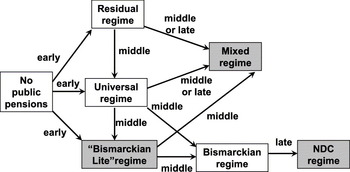
REGIME TRANSITION OPTIONS: The linked importance of policy feedbacks, incremental reform options and regime transition opportunities become clearer when we look in detail at specific pension regimes. The fourth and sixth columns of Table 1 show the broad repertoire of regime transition options that may be available to policymakers and the most likely regime transitions from each of those policy regimes. There are clear differences across pension regimes in both the challenges and alternatives available to policymakers. The interaction of negative feedback effects, paradigmatic reform options and regime transition options affects whether, when, and in what direction pension regime transitions occur. These relationships are summarized in Figure 3, which also shows whether specific regime transitions are likely to occur early in an industrialized country's welfare state development, in its middle stages, or relatively late (lateness is defined here both in terms of both the onset of major population aging and the onset of slower economic growth in the early 1970s).
Common Pension Regime Transitions
Most common timing of pension regime transitions is shown next to the corresponding arrow. Pension regimes with a low probability of regime exit in the current ‘late’ period of public pension development are shown with a shaded background

IV. Specific Regime Transitions
The interaction of feedback effects and reform options can be better understood by focusing in detail on specific regimes. The discussion here will focus on the three regime types that represent most of the cases in Figure 2 after the 1970s.
BISMARCKIAN PENSION REGIMES: Bismarckian pension regimes have several major negative feedback effects. First, Bismarckian regimes are especially likely to face problems of affordability as populations age and the ratio of workers to retirees falls, especially for those countries that have high contribution and replacement rates, long life expectancies and low fertility rates. Second, high payroll tax rates are likely to undermine economic competitiveness (Bonoli and Palier Reference Bonoli and Palier2007:556). Bismarckian regimes may also encourage early retirement, especially if they are accompanied by generous rules on early retirement or separate early retirement programs.
Initial governmental responses by governments in Bismarckian countries generally focus on incremental retrenchment and refinancing measures, especially technical changes that are less likely to be visible and incur blame (Pierson Reference Pierson1994; Weaver Reference Weaver, Arnold, Graetz and Munnell1998; Bonoli and Palier Reference Bonoli and Palier2007). Once incremental reforms have been exhausted, these countries may need to consider fundamental restructuring. Regime transition options for Bismarckian regimes are highly constrained, however. Addition of a large individual defined contribution account tier is generally thought to be impractical because of the double payment problem; debate is thus likely to focus around a small add-on to a still-dominant public social insurance system (Bonoli and Palier Reference Bonoli and Palier2007: 556). Nor is a shift to universal, residual, or Bismarckian Lite regimes likely to be practical, due to pension adequacy concerns. Thus, patching the existing Bismarckian regime or a shift to an NDC regime are the only remaining options – and the latter is a recent innovation that is only now being assimilated into governments' repertoire of available policy options.
The recent evolution of the Swedish and German pension systems is consistent with this analysis. Sweden's generous public pension system – until the late 1990s, a universal pension with earnings-related pension on top, plus an income-tested pension supplement for those with low earnings histories – was very effective at poverty reduction, but also very expensive. Sweden experienced an extremely severe fiscal and economic crisis in the early 1990s, with both unemployment and budget deficits soaring to unprecedented levels. Because both payroll taxes and the overall tax burden were very high, increasing further taxes was not seen as a viable option. Regime transition opportunities were quite limited.
Sweden initially turned to multiple rounds of incremental retrenchment in pension policy. After the election of a non-Social Democratic government in 1991, however, a multi-party negotiating process was initiated to plan a comprehensive reform. This process was continued by the Social Democrats when they returned to power in 1994 (Lundberg Reference Lundberg2003). The new Swedish pension system enacted in stages between 1992 and 2001 (Settergren Reference Settergren2003) is a major change in concept from the old one. The universal pension tier is being phased out, and a new earnings-related pension, based on NDC principles, will almost certainly be less generous than its predecessor over time as automatic longevity adjustments are phased in. As part of its comprehensive pension reform package, Sweden did add a small individual account tier, but the NDC tier clearly remains dominant.
Germany also faces a very serious aging challenge in the near term and an even greater one in the longer term, exacerbated by very low fertility rates. Germany relies overwhelming on a Pay-As-You-Go social insurance pension tier financed by a combination of payroll taxes and general government revenues. With pension payroll tax rates already approaching 20 per cent by the late 1980s plus additional subsidies from general revenues, pressures for retrenchment were enormous. Rising costs and payroll taxes led to multiple rounds of pension benefit retrenchment and refinancing, including cuts in early retirement benefits and increases in general revenue put into the system (Hinrichs Reference Hinrichs, Bonoli and Shinkawa2005).
As in the case of Sweden, Germany's regime transition opportunities were limited. A shift to an NDC system was compatible with the existing earnings-related system, but a move toward a large individual account DC would encounter severe double payment problem for transitional generations, given the high replacement rates and payroll tax rates of the current social insurance system. In 1997, the CDU/CSU government of Helmut Kohl responded to the severe financial and demographic challenges confronting its pension regime by putting in place a demographic factor that would have automatically lowered benefits as life expectancy rose, an essential element of an NDC pension regime. Targets were also set for both near term and longer term caps on payroll tax rates. However, the demographic factor was abolished after a new Social Democratic-Green coalition came to power in 1998, although the SPD-led government did enact other incremental cuts (Hering Reference Hering2008: 172). After a prolonged debate, a small new quasi-mandatory tax-advantaged individual account tier was enacted in 2001 to compensate for planned future declines in public system replacement rates. The Schröder government also re-enacted under the new label of sustainability factor most of the features of the demographic factor that the SDP initially revoked after coming to power. Thus, while Germany has not moved as far in restructuring its pension system as Sweden, it currently is a hybrid of Bismarckian and NDC systems, with a small DC add-on.
BISMARCKIAN LITE PENSION REGIMES: The United States and Canada have significantly lower contribution and replacement rates than most West European countries with Bismarckian pension regimes. Because these features have such important implications for systems' financial viability, for the types of reform initiatives that are likely to be considered and adopted, and for the nature of pension politics, the US and Canada will be treated here as a distinctive Bismarckian Lite pension regime.
Bismarckian Lite pension regimes face a somewhat different set of feedbacks and policy challenges than their continental Bismarckian cousins. Adequacy is likely to be a greater issue. Moreover, relatively low benefits mean that private pensions may play a larger role than in Bismarckian countries, creating problems of integration and lack of clarity about workers' total expected retirement income streams. Perhaps the most important difference from Bismarckian regimes, however, is in negative feedback effects with respect to affordability: Bismarckian Lite pension regimes face rising pressures to control pension expenditures and restrain payroll tax rate increases as populations age, but they are more likely to be able to manage these through incremental rather than through structural reforms – or at least hold out longer.
Bismarckian Lite pension regimes have multiple transition opportunities, though these are likely to become more constrained as economic and demographic constraints grow stronger. Shifts to universal or residual regimes are unlikely because of pension adequacy concerns and shifts to a Bismarckian regime are likely to be politically and fiscally feasible only before demographic pressures become strong. After the demographic transition, policymakers in Bismarckian Lite systems are likely to retain the option to shift to a mixed regime (especially if add-on) with higher payroll tax contributions, though this becomes more difficult as aging population taxes cause payroll taxes to rise. Shifting to an NDC regime is also an option. But the relatively modest pressures on these regimes also make it less likely that a regime transition will occur. Overall, we would expect Bismarckian Lite regimes to be cul-de-sacs, with low rates of transitions (if any) to other types of pension regime after the demographic transition and permanent austerity pressures hit. If transitions to an NDC regime do take place, they are likely to be later than in Bismarckian counterparts with similar demographic profiles.
Evidence from the United States and Canada supports the analysis outlined here, even though there are substantial differences between the two countries. The United States relies primarily on a social insurance tier (Social Security) with both contribution rates and benefits that are relatively modest by West European standards. Pension regime transitions in the US are inhibited both by the availability of incremental reform options and major difficulties with the most plausible regime transition options. Social Security did face serious financing problems in 1977 and in 1981–83, which were addressed through a combination of incremental benefit/eligibility cuts and revenue measures (Light Reference Light1995; Jacobs Reference Jacobs2008). There has been virtually no policy change in the program since that time (Weaver Reference Weaver, Bonoli and Shinkawa2005a). President George W. Bush in 2001 and 2005 attempted to put on the agenda proposals to allow Americans to opt to shift part of their Social Security contributions to individual accounts, creating a mixed policy regime. The idea failed to gain any traction with the public, let alone serious congressional consideration, in part because opting out would require either major cuts in guaranteed benefits or substantial borrowing to pay currently promised benefits under the Pay-As-You-Go system (Edwards Reference Edwards2007). A regime shift to an NDC system would be possible, but is inhibited not only by political barriers to creating an automatic cutback mechanism but also by internal cross-subsidies within Social Security's progressive benefit structure. Low-income recipients would be hurt by a shift to NDC unless new revenues were added to the system. Moreover, the long-term financial problems of the program remain fairly manageable – about 2 per cent of payroll over a 75 year projection periodFootnote 3 – so further incremental reform reforms may be sufficient to resolve those problems without shifting to a new pension regime. Thus, the United States is likely to remain a relatively stable Bismarckian Lite regime.
Like the United States, Canada confronts a demographic challenge that is more modest than in most other industrialized countries. Canada's public pension system is multi-tiered, with a quasi-universal (phased out at high incomes) flat-rate Old Age Security program and an income-tested Guaranteed Income Supplement, both financed by general revenues. In addition, there is a contributory, earnings-related Canada Pension Plan (Quebec operates a parallel and integrated Quebec Pension Plan) on top of OAS that is financed entirely by payroll taxes. Debate in the late 1970s and early 1980s over expansion of the Canada Pension Plan into a more generous Bismarckian system was stymied by provincial opposition (Béland and Myles Reference Béland, Myles, Bonoli and Shinkawa2005: 257–258; Banting Reference Banting1987, chapter 5). That narrow window for a regime transition from a Bismarckian Lite to a Bismarckian regime closed as financing problems emerged in the program in the 1980s.
Canada has experienced only very modest restructuring of its public pensions in recent years. Growing deficits in the Canada/Quebec Pension Plans were addressed by a 1997 agreement between Ottawa and most provincial governments that increased contribution rates substantially, with only modest (and hard-to-see because of their technical nature) cutbacks in benefits (Béland and Myles Reference Béland, Myles, Bonoli and Shinkawa2005; Little, 2008). Incremental reforms proved adequate to address systemic financing problems in the CPP.Footnote 4 Thus Canada, like the United States remains a very stable, though quite distinctive, variation on the Bismarckian Lite model.
MIXED PENSION REGIMES: Countries that did not develop a large public earnings-related pension tier prior to the 1970s faced continuing pressures to do so. But in the long absence of a state-mandated system, these countries developed a substantial occupational pension sector. Proposals for an expanded public pension system had to adapt to these developments, either by creating an opt-out from the state pension system when the latter was created, as in the UK, or by mandating universal coverage and increased standardization of private occupational pensions rather than an expanded state system, as in Denmark and Australia. Slower economic growth and higher unemployment after the first oil shock also made governments that did not already have a public earnings-related pension tier extremely reluctant to undertake the huge new spending commitments involved in adding one (Green-Pedersen and Lindbom Reference Green-Pedersen and Lindbom2006).
Mixed (i.e., having both substantial publicly-funded and mandatory or quasi-mandatory individual accounts) pension systems are especially likely to face heavy challenges of integrating public and private tiers in a way that provides transparency, equity and universal coverage. High administrative costs have been a particular problem with the individual accounts component of many mixed systems, especially for low-earners, and especially where administration of individual accounts is decentralized to employers and individuals (James, Smalhout and Vittas Reference James, Smalhout, Vittas, Holzmann and Stiglitz2001). Market and annuitization risks in individual account tiers is another problem in mixed regimes, as is benefit adequacy for low-earners.
While all of these challenges can be serious for governments operating mixed pension regimes, they are usually not regime threatening. Moreover, these governments usually have a number of incremental reform options available to them to address these challenges. Equally important in constraining restructuring regime change in mixed pension systems is the absence of plausible regime transition opportunities. A shift to universal, residual or Bismarckian pension regimes is implausible because of adequacy concerns and the heavy stakes of pension providers: any shift that involved dismantling individual accounts would almost certainly provoke a huge outcry from both account holders and fund providers. Thus, we expect that mixed pension regimes will stand-pat in terms of their overall pension regime structure, but they may experience substantial incremental change as policymakers struggle to address (and avoid blame for) negative feedback effects of mixed regimes.
All of these tendencies can be seen in the case of the United Kingdom (Taylor-Gooby Reference Taylor-Gooby, Bonoli and Shinkawa2005; Schulze and Moran Reference Schulze, Moran, Immergut, Anderson and Schulze2006). A quasi-universal flat-rate basic pension has long been the anchor of the UK's public pension system. A prolonged stalemate between Labour and the Conservatives delayed adoption of a State Earnings Related Pension Scheme (SERPS) until 1975. Because many workers were already covered by occupational pension schemes by this point, SERPS included an opt-out for approved occupational schemes rather than having them serve as an add-on to the state scheme. The Thatcher government also marginalized SERPS by lowering benefits and creating additional incentives to opt out into portable personal pensions.
The heavy role for occupational pensions in the UK has made it among the most affordable pension systems in industrialized countries from a government fiscal perspective. But the confusing array of pensions has led to a number of negative feedback effects. In particular, there are continued high levels of senior poverty as well as work and savings disincentives, and multiple pension streams for many seniors do not send clear signals to workers about what sorts of saving and labor market participation are required to generation a desired income stream in retirement.
The concentration of power in Britain's Westminster system has facilitated frequent tinkering with the UK pension system over the past quarter century. But a shift away from a mixed system has been inhibited by barriers to all alternatives and the imbeddedness of private pensions. Thus, while the UK pension system has been characterized by frequent incremental change, reforms that would change its fundamental character have not been on the agenda.
V. Conclusions And Extensions
This article has disentangled two claims about feedback effects that are often conflated: (1) the general argument that options for policy change depend on past policy choices and (2) a specific argument that this path dependence takes the form of positive feedback.
Another important contribution of this article is to focus attention on the availability of both incremental reforms and regime transition options, the interaction between the two, and the factors that affect the availability of each. Policy stability or only modest reform does not necessarily mean either that positive feedback effects are dominant or that negative feedback effects are weak or absent; it may mean that despite very strong negative feedback effects, there are no plausible regime transition options or that incremental patches are cheap and politically acceptable. Even policies with very high net costs can survive for quite some time without major reform, either as pressures for change run up against immoveable objects in the political system or as repeated tinkering keeps the situation barely tolerable.
With respect to pension regimes specifically, the analysis firstly suggests that the amount of pension regime change has been far more substantial over the past sixty years and even in the post-oil-shock era of permanent austerity than the standard tri-partite conceptualization of pension regimes leads us to perceive. More generally, this study makes clear that the amount of policy regime change that we perceive depends on the categories we use to classify policies. Second, there has been wide variation in both the extent and timing of change: some pension regimes have been much more susceptible to change than others, and some regime transitions are much more likely to occur before the fiscal and demographic shifts of the 1970s while others only occur afterwards. Third, the regime transitions that occur are clearly constrained in patterned ways: the destinations when a country exits a pension regime are far from random.
The acceptability of the status quo – or in the terminology used here, the strength of negative feedback effects and the availability of regime transition options – is a key to whether and what kind of pension policy regime change occurs (Jacobs Reference Jacobs2008). The repertoire of available regime transition opportunities is likely to shift over time, however, as both external conditions and the balance of feedback effects from a policy regime shift: most notably, pension system maturation and population aging both make it more difficult to shift to higher-cost pension regimes.
While negative feedback effects do a very good job of explaining regime transition agenda agendas for most countries and patterns of policy adoption, they are not sufficient by themselves to fully explain patterns of pension regime transitions. For example, some Bismarckian systems (e.g., Sweden) have shifted to an NDC-based pension regime, while others (e.g., France) have not – at least not yet. Still others (e.g., Germany and Italy) moved toward NDC but in a less complete form than in Sweden (on Italy, see Franco Reference Franco and Takayama2003; Ferrera and Jessoula Reference Ferrera, Jessoula, Bonoli and Shinkawa2005). New Zealand remains an outlier in relying almost exclusively on a universal tier as the core of its pension regime – though with the addition of a quasi-mandatory individual account tier, KiwiSaver, in 2006, that is beginning to change (Kritzer Reference Kritzer2007). Cross-national differences in regime transitions appear to depend in part on the strength of veto points and veto actors in individual political systems (Bonoli Reference Bonoli2000; Immergut and Anderson Reference Anderson, Immergut, Immergut, Anderson and Schulze2007), as well as the capacity of governments to develop formal or informal coalitions or cartels that reduce the likelihood that parties backing the restructuring will pay the political price in the next election (Myles and Pierson Reference Myles, Pierson and Pierson2001; Kitschelt Reference Kitschelt and Pierson2001; Weaver Reference Weaver, Schapiro and Skowronek2006; Hering Reference Hering2008). Cross-national learning effects (see for example Rose Reference Rose1993) are also clearly evident in some pension reform initiatives, such as Norway's use of a longevity factor similar to Sweden's in its recent pension reform (Andresen Reference Andresen2006). But understanding how negative feedback effects from specific pension regimes interacts with the availability of incremental reform options and regime transition options provides the best base explanation of pension regime stasis and transitions. Other explanatory factors can be added as supplements to this base.
The key insights of negative feedback effects on pension policy are readily generalizable to other policy sectors. Indeed, policymakers' and societal interests' efforts to cope with negative feedback effects is a major source of ongoing policy agendas. The recurrent struggles of US policymakers to control health care costs and reduce immense gaps in insurance coverage is a particularly obvious example of negative feedback effects of a policy regime. It also illustrates that incremental reform patches are likely to be tried before a regime shift is considered. Policy toward emission of greenhouse gasses is another sector where efforts to move beyond incremental policy shifts have encountered stiff opposition at both the national and international levels. Overcrowded roads and air pollution from cars and trucks do not necessarily cause road users to shift to other modes or governments to shift their transport funding priorities. In short, strong negative feedbacks and the availability of alternative policy regimes are not sufficient to lead to change, especially when those alternative regimes have high fiscal costs and strong political opponents, and multiple veto points make any change from the status quo difficult to achieve. Nonetheless, understanding negative feedbacks is critical to understanding when and how policy agendas shift and regime change occurs.
The author would like to thank Alan Jacobs, Daniel Beland, Christoffer Green-Pedersen and Stein Kuhnle as well as the anonymous reviewers for this journal for helpful comments on earlier drafts of this paper.