Introduction
Anhedonia – or a deficit in the ability to experience pleasure – is a core symptom of depression. This has generated a large literature examining the role of behavioral, physiological, and neural measures of various aspects of reward in depressed individuals (Forbes and Dahl, Reference Forbes and Dahl2005, Reference Forbes and Dahl2012; Goldstein and Klein, Reference Goldstein and Klein2014; Pizzagalli, Reference Pizzagalli2014; Proudfit et al., Reference Proudfit, Bress, Foti, Kujawa and Klein2015; Kujawa and Burkhouse, Reference Kujawa and Burkhouse2017; Keren et al., Reference Keren, O'Callaghan, Vidal-Ribas, Buzzell, Brotman, Leibenluft, Pan, Meffert, Kaiser, Wolke, Pine and Stringaris2018). For instance, depressed individuals exhibit aberrant reward-related behavior and neural activity when anticipating or receiving rewards (Pizzagalli et al., Reference Pizzagalli, Jahn and O'Shea2005, Reference Pizzagalli, Iosifescu, Hallett, Ratner and Fava2009; Forbes et al., Reference Forbes, Christopher May, Siegle, Ladouceur, Ryan, Carter, Birmaher, Axelson and Dahl2006; McFarland and Klein, Reference McFarland and Klein2009; Eshel and Roiser, Reference Eshel and Roiser2010; Robinson et al., Reference Robinson, Cools, Carlisi, Sahakian and Drevets2012; Stringaris et al., Reference Stringaris, Vidal-Ribas Belil, Artiges, Lemaitre, Gollier-Briant, Wolke, Vulser, Miranda, Penttilä, Struve, Fadai, Kappel, Grimmer, Goodman, Poustka, Conrod, Cattrell, Banashewski, Bokde, Bromberg, Büchel, Flor, Frouin, Gallinat, Garavan, Gowland, Heinz, Ittermann, Nees, Papadopoulos, Paus, Smolka, Walter, Whelan, Martinot, Schumann and Paillère-Martinot2015).
Aberrant reward-related behavior and neural activity may also indicate risk for depression (Forbes et al., Reference Forbes, Christopher May, Siegle, Ladouceur, Ryan, Carter, Birmaher, Axelson and Dahl2006; Luking et al., Reference Luking, Pagliaccio, Luby and Barch2016b; Kujawa and Burkhouse, Reference Kujawa and Burkhouse2017; Keren et al., Reference Keren, O'Callaghan, Vidal-Ribas, Buzzell, Brotman, Leibenluft, Pan, Meffert, Kaiser, Wolke, Pine and Stringaris2018). Offspring of depressed mothers exhibit a different pattern of neural activity during anticipation or receipt of reward compared to offspring of never depressed mothers (Gotlib et al., Reference Gotlib, Hamilton, Cooney, Singh, Henry and Joormann2010; McCabe et al., Reference McCabe, Woffindale, Harmer and Cowen2012; Luking et al., Reference Luking, Pagliaccio, Luby and Barch2016a). Moreover, longitudinal studies using electrophysiology and functional magnetic resonance imaging (fMRI) have found that blunted responsivity to rewards predicts increases in symptoms or onsets of depressive disorders (Hanson et al., Reference Hanson, Hariri and Williamson2015; Stringaris et al., Reference Stringaris, Vidal-Ribas Belil, Artiges, Lemaitre, Gollier-Briant, Wolke, Vulser, Miranda, Penttilä, Struve, Fadai, Kappel, Grimmer, Goodman, Poustka, Conrod, Cattrell, Banashewski, Bokde, Bromberg, Büchel, Flor, Frouin, Gallinat, Garavan, Gowland, Heinz, Ittermann, Nees, Papadopoulos, Paus, Smolka, Walter, Whelan, Martinot, Schumann and Paillère-Martinot2015; Nelson et al., Reference Nelson, Perlman, Klein, Kotov and Hajcak2016).
Event related potentials (ERPs), particularly the reward positivity (RewP; Proudfit, Reference Proudfit2015), provides an index of reward responsiveness. RewP is a positive deflection in the ERP signal following positive information (e.g. monetary gain) and is either reduced or absent when receiving negative information (e.g. monetary loss). Although previously referred to as the medial frontal negativity and feedback negativity, we refer to this ERP as the RewP as evidence suggests that this component is best characterized by a positive deflection in the ERP signal during reward trials that is diminished or absent in response to no reward. Supporting its construct validity, the RewP has been linked to behavioral and self-report measures of reward responsiveness and neural activation in reward-related regions like the ventral striatum (Carlson et al., Reference Carlson, Foti, Mujica-Parodi, Harmon-Jones and Hajcak2011; Bress and Hajcak, Reference Bress and Hajcak2013).
Children, adolescents, and adults with depression exhibit a smaller RewP to monetary reward compared to individuals without depression (Foti and Hajcak, Reference Foti and Hajcak2009; Bress et al., Reference Bress, Smith, Foti, Klein and Hajcak2012; Liu et al., Reference Liu, Wang, Shang, Shen, Li, Cheung and Chan2014; Belden et al., Reference Belden, Irvin, Hajcak, Kappenman, Kelly, Karlow, Luby and Barch2016). A blunted RewP has also been found in children and adolescents of depressed parents compared to offspring of non-depressed parents (Foti et al., Reference Foti, Kotov, Klein and Hajcak2011; Kujawa et al., Reference Kujawa, Proudfit and Klein2014). Longitudinal studies indicate that a blunted RewP predicts increases in depressive symptoms and first onsets of depressive disorders in adolescents (Bress et al., Reference Bress, Foti, Kotov, Klein and Hajcak2013; Nelson et al., Reference Nelson, Perlman, Klein, Kotov and Hajcak2016; Kujawa et al., Reference Kujawa, Hajcak and Klein2018).
This literature suggests that reduced reward responsiveness, as measured by RewP, could reflect a predisposition to depression (Kujawa and Burkhouse, Reference Kujawa and Burkhouse2017). If so, then whether or not individuals with a blunted RewP manifest depressive symptoms may depend on their exposure to life stress (Meehl, Reference Meehl1975; Auerbach et al., Reference Auerbach, Admon and Pizzagalli2014). Most theoretical and empirical work on stress and reward has focused on the deleterious effects of stress exposure on reward-related behavior and neural function (Willner et al., Reference Willner, Towell, Sampson, Sophokleous and Muscat1987; Bogdan and Pizzagalli, Reference Bogdan and Pizzagalli2006; Auerbach et al., Reference Auerbach, Admon and Pizzagalli2014). In contrast, there is a paucity of research regarding stress as moderating the effect of reward processing on depression. One recent study reported that the interaction between ventral striatal activity in a gambling task and stressful life events was associated with concurrent depression symptoms in youth (Luking et al., Reference Luking, Nelson, Infantolino, Sauder and Hajcak2018). Another study found that interactions of ventral striatal activity during a monetary incentive task with early and recent life stress were associated with concurrent anhedonic depressive symptoms in young adults (Corral-Frías et al., Reference Corral-Frías, Nikolova, Michalski, Baranger, Hariri and Bogdan2015). To our knowledge, only one longitudinal study has examined interactions between reward responsiveness and stress on depression. Retrospective reports of early childhood maltreatment and slower reaction time on a monetary incentive delay task interacted to predict subsequent depression symptoms in older adolescents (Dennison et al., Reference Dennison, Sheridan, Busso, Jenness, Peverill, Rosen and McLaughlin2016). The present study extends this literature by examining whether stressful life events moderate the effect of the RewP in late childhood on predicting depression symptoms in early adolescence.
When exploring stress as a moderator of the RewP in predicting depression, it is important to distinguish between independent and dependent life events (Brown and Harris, Reference Brown and Harris1978; Shrout et al., Reference Shrout, Link, Dohrenwend, Skodol, Stueve and Mirotznik1989). Independent, or fateful, events are stressors that occur irrespective of an individual's own behavior (e.g. illness of a family member; moving to a new city and school because of a parent's job). With dependent events, an individual's own behavior may play a role in generating the event (e.g. romantic relationship break-up; failing a class or losing a job). Both independent and dependent events predict depression (Kendler et al., Reference Kendler, Karkowski and Prescott1999, Reference Kendler, Gardner and Prescott2002; Hankin et al., Reference Hankin, Mermelstein and Roesch2007; Stroud et al., Reference Stroud, Davila, Hammen and Vrshek-Schallhorn2011; Vrshek-Schallhorn et al., Reference Vrshek-Schallhorn, Stroud, Mineka, Hammen, Zinbarg, Wolitzky-Taylor and Craske2015). However, the causal role of independent events is clearer, as dependent events may result from prior predispositions or symptoms that account for their relationship with depression (Kendler et al., Reference Kendler, Karkowski and Prescott1999; Hammen, Reference Hammen2006; Kercher et al., Reference Kercher, Rapee and Schniering2009; Kendler and Gardner, Reference Kendler and Gardner2010). There are also developmental considerations, as independent life events may play a greater role earlier in development, as children and younger adolescents have less control over their environments, and therefore fewer opportunities to ‘generate’ dependent events (Rudolph and Hammen, Reference Rudolph and Hammen1999; Rice et al., Reference Rice, Harold and Thapar2003; Hammen, Reference Hammen2006). In addition, children and younger adolescents may be more susceptible to stressors occurring to others on whom they depend (e.g. parental divorce or unemployment), which are generally independent of the youth's behavior.
In summary, few studies have examined the moderating role of stressful life events on reward processing in predicting depression, and to our knowledge none have used a neural measure of reward responsivity in a longitudinal design. The goal of this paper is to examine whether life stressors moderate the association between the RewP and depression symptoms from late childhood to early adolescence, which marks the beginning of the risk period for onsets of depression (Salk et al., Reference Salk, Hyde and Abramson2017). We assessed the RewP and depression symptoms in a sample of 9-year-old children. Three years later current depression and stressful life events over the past year were assessed. We hypothesized that stressful life events would moderate the effect of the RewP on future depression symptoms, such that adolescents with both a decreased RewP and greater stress would exhibit the largest increases in depressive symptoms from age 9 to 12. We also explored independent and dependent life events separately given the stronger causal inferences afforded by independent events and their relevance in childhood and early adolescence.
Methods
Participants were drawn from the Stony Brook Temperament study, a longitudinal examination of temperament and psychopathology (Klein and Finsaas, Reference Klein and Finsaas2017). Three-year-old children and their families (N = 559) were included if at least one English-speaking biological parent could participate and if the child did not have significant medical or developmental disabilities. Three years later, an additional group of six-year-olds from racial/ethnic minority groups (N = 50) were added to increase the sample's diversity. Parents provided consent and children provided assent to participate. Procedures were approved by the Stony Brook University Institutional Review Board.Footnote 1Footnote †
This study uses data from the age 9 and 12 assessments. Of the 470 children who participated at the age 9 assessment, we excluded 45 participants for poor quality RewP data, 2 with missing depressive symptom data from that wave, and 4 who had a lifetime DSM-IV diagnosis of MDD or dysthymia assessed via the Kiddie Schedule for Affective Disorders and Schizophrenia (Kaufman et al., Reference Kaufman, Birmaher, Brent, Rao, Flynn, Moreci, Williamson and Ryan1997), resulting in N = 419. An additional 34 participants did not attend the age 12 follow-up, 2 participants were missing depressive symptom data from that wave, and 13 were missing the UCLA Life Stress Interview (Hammen et al., Reference Hammen, Gordon, Burge, Adrian, Jaenicke and Hiroto1987), resulting in sample of 370. One additional participant with outlier data was removed, leaving a final sample of 369.
Of these 369 participants, 54.7% (n = 202) were male and 81.3% (n = 300) were non-Hispanic Caucasian. Participants with complete data had a mean age of 9.16 years (s.d. = 0.37) at baseline and 12.65 years (s.d. = 0.44) at follow-up. The 369 included participants did not significantly differ from the 101 excluded participants on sex, χ2(1, N = 470) = 0.003, p > 0.05 or racial/ethnic minority status, χ2(1, N = 470) = 3.15, p > 0.05. Excluded participants were slightly older at baseline, t (468) = 2.12, p = 0.03, hence age was used as a covariate in regression analyses.
Measures
Depression symptoms
At the age 9 and 12 assessments, children and both parents completed the Children's Depression Inventory (CDI; Kovacs, Reference Kovacs1992), a measure of depressive symptoms occurring during the past two weeks that is designed for ages 7–17. The 6-week test-retest stability of the CDI has been reported as 0.67 (Finch et al., Reference Finch, Saylor, Edwards and McIntosh1987). In our sample, internal consistency of the CDI was good (median α = 0.76, range 0.74–0.79 youth, mother, and father report at age 9; median α = 0.80, range 0.79–0.83 for age 12). The mean CDI scores at age 9 were 4.89 (s.d. = 4.14), 7.13 (s.d. = 4.80), and 7.13 (s.d. = 4.14) for youth, mother, and father reports, respectively. At age 12, the mean CDI scores were 4.53 (s.d. = 5.00), 6.88 (s.d. = 4.89), and 7.28 (s.d. = 4.88) for youth, mother, and father reports, respectively. Correlations between mother and father reports were r = 0.41 at age 9, and r = 0.50, at age 12. Correlations among child and parent reports at ages 9 and 12, respectively, were: mother-child r = 0.22 and 0.32; and father-child r = 0.14 and 0.34. The youth's, mother's and father's CDI reports were z-scored and averaged.Footnote 2 Participants were included if at least two informants completed the CDI. Of the 369 participants, 325 and 298 had data from all three informants at the age 9 and 12 assessments, respectively.
Life stress
At the age 12 assessment, children and a parent were each administered the UCLA Life Stress Interview (LSI; Hammen et al., Reference Hammen, Gordon, Burge, Adrian, Jaenicke and Hiroto1987). The LSI assesses episodic and chronic stressors involving the youth during the past 12 months by content domains including social life, friendships, family relationships, and work/school (for details, see Supplementary Materials). Events reported in this study occurred in the year prior to the age 12 follow-up and at least two years after the initial age 9 RewP assessment. Following Brown and Harris (Reference Brown and Harris1978), the interviewer presented a description of all events reported by the youth and/or parent and the circumstances surrounding the event without describing the participant's affective reactions to a team of raters for consensus ratings of objective threat using a 5-point scale ranging from 1 (‘minimal or no effect’) to 5 (‘great effect’). Raters also indicated the degree of behavioral dependence for each event using a 3-point scale ranging from 1(‘completely dependent’) to 3 (‘completely independent’). We summed the total number of events an individual experienced during the assessment interval. Events were counted as independent if behavioral dependence was rated as a 3 and dependent when given a score of 1. Events that were coded as 2 (ambiguous) were not included in either the dependent or independent categories. We then created separate continuous total scores of independent and dependent events by summing the total number events for each type. Previous reports have found inter-rater reliability regarding the impact of events and behavioral dependence to be excellent (r = 0.85 and 0.97, respectively; Rudolph and Hammen, Reference Rudolph and Hammen1999).
Reward task
The RewP was elicited using a computerized monetary reward task, which was described to participants as a guessing task where they could earn up to $5 (Foti and Hajcak, Reference Foti and Hajcak2009; Beldin et al., Reference Belden, Irvin, Hajcak, Kappenman, Kelly, Karlow, Luby and Barch2016). Participants were presented with two doors and instructed to select one by clicking the right or left mouse button, revealing whether the door yielded monetary gain or loss. Reward feedback was random and not dependent on the participant's choice. After selecting a door, a fixation mark appeared on screen for 1000 ms, which was followed by gain feedback indicated by a green arrow pointing up or loss feedback represented by a red arrow pointing down. Feedback displayed for 2000 ms. Participants completed 60 trials comprised of an equal number of gain and loss trials presented in a random order. Participants were told that gain trials yielded $0.50 to add to their total and loss trials would subtract $0.25. In our study, the split-half reliability of activity elicited during gain and loss trials was 0.79 and 0.63. In previous studies, the 2-year test-retest reliability of gain and loss trials was 0.64 and 0.67, respectively (Bress et al., Reference Bress, Meyer and Proudfit2015).
EEG data acquisition and processing
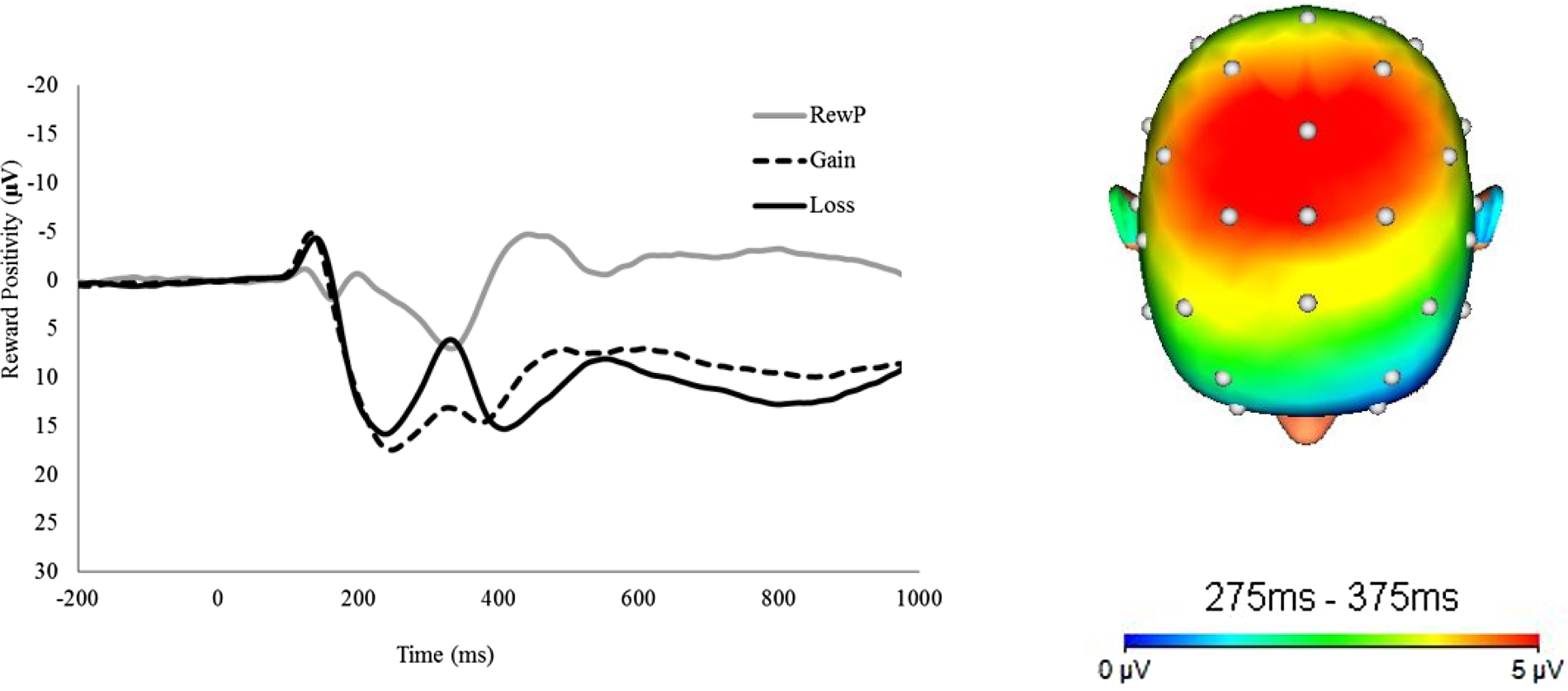
EEG was recorded using Biosemi with 34 channels based on the 10/20 system. Participants were fitted with a 32 channel Lycra cap with additional electrodes for Iz and FCz. Data were referenced to electrodes placed on the right and left mastoids during offline processing. Additional facial electrodes were placed above and below the left eye, to the left of the left eye, and to the right of the right eye in order to correct for eye blinks. The data was sampled at a rate of 1024 Hz. The data was further processed offline using Brain Vision Analyzer (Brain Products). Data was filtered using 0.01 and 30 Hz cutoffs. The data was segmented so that a trial began 500 ms before feedback onset and ended at 1000 ms after feedback onset. Artifacts were flagged if a voltage difference of 300 µV occurred within a given trial, the voltage changed more than 50 µV between data points, or there was a difference in voltage of less than 0.50 µV within 100 ms intervals. The data were then visually inspected to remove additional artifacts. Participants had on average 28.73 loss trials and 28.96 gain trails retained after artifact rejection. The 500 ms interval before feedback onset was used to baseline correct the data. Following recent papers (e.g. Kessel et al., Reference Kessel, Kujawa, Hajcak Proudfit and Klein2015), the RewP was formed by taking the average mean amplitude across gain trials and subtracting the average signal to loss trials occurring at 275–375 ms following task feedback. The RewP at FCz and Cz were pooled to reduce noise from a single electrode source, and because this is where the difference between reward and loss was maximal in the overall sample.
Data-analytic approach
We conducted descriptive statistics and bivariate correlation analyses among major study variables using SPSS version 22 (IBM). Descriptive statistics were used to illustrate the overall levels of depressive symptoms, life events, and values of the RewP for the sample. Bivariate correlations were examined amongst major study variables to show the relationships between variables and the stability of depressive symptoms from age 9 to 12. We then conducted hierarchical multiple regression analyses using Mplus version 8 (Muthén and Muthén, Reference Muthén and Muthén2017). All predictor variables including covariates (age, sex, and baseline age 9 depressive symptoms) were centered before being entered in the model. In the first regression, the interaction term was formed by taking the product of the centered life events and RewP scores. In the second regression, we created two interaction terms, the first comprised of the product of the centered dependent life events and RewP, and a second comprised of independent life events and the RewP. Simple slopes were plotted using the regression equation for the full sample and points to plot were selected based on 16th, 50th, and 84th percentile ranks.
Results
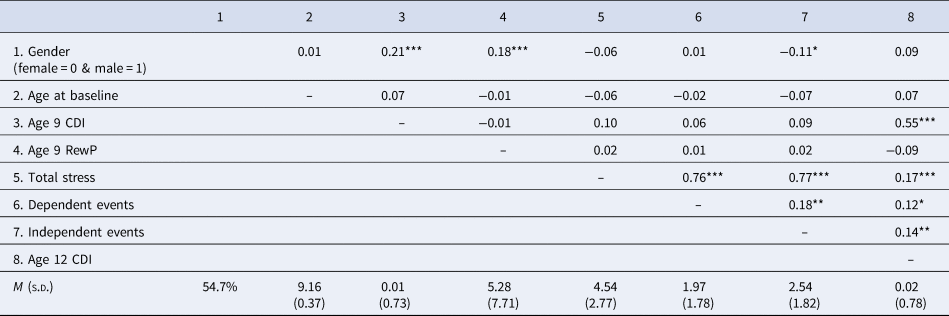
Descriptive statistics and correlations are presented in Table 1; Figure 1 depicts the RewP waveform and scalp distribution. Depression symptoms were moderately stable over time. The total number of stressful life events, as well as independent and dependent stressful life events, in the year prior to follow-up were associated with depression symptoms at age 12. At age 9, males experienced greater depression symptoms than females, but by age 12 this gender difference was non-significant. Consistent with prior analyses, the RewP was significantly larger in males (Kujawa et al., Reference Kujawa, Proudfit, Laptook and Klein2015). Females were significantly more likely to experience independent life events.Footnote 3
ERP waveform and RewP scalp distribution. FCz and Cz electrode channels were pooled to generate this waveform. The scale distribution of the RewP is depicted as the mean amplitude of gain trials subtracted from loss trials occurring at 275–375 ms following monetary feedback.

Correlations among major study variables

CDI, Children's Depression Inventory; RewP, Reward Positivity.
*p < 0.05; **p < 0.01; ***p < 0.00.
RewP and total stressful life events
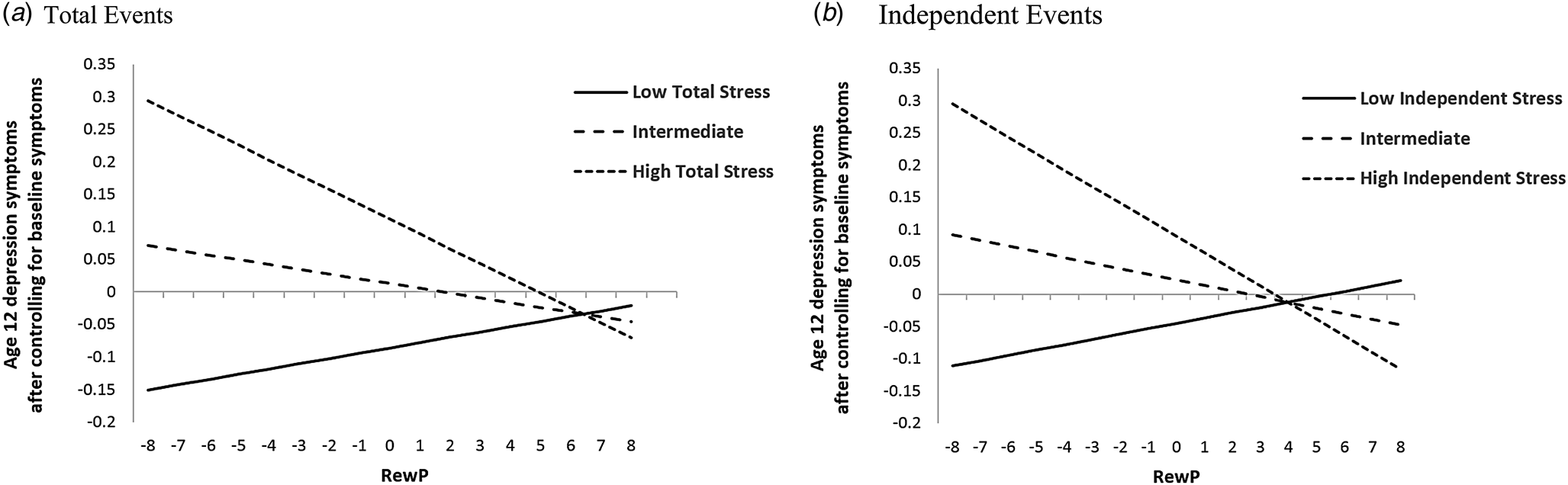
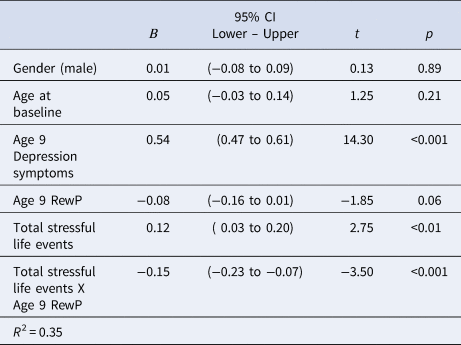
Multiple regression analysis was used to examine whether stressful life events in the year prior to the age 12 assessment moderated the effects of age 9 RewP in predicting depressive symptoms at age 12, adjusting for sex, age, and baseline depression. The RewP X total life stress interaction term significantly predicted depressive symptoms at follow up (Table 2). Simple slopes were calculated at low (16th percentile), intermediate (50th percentile), and high (84th percentile) values of total stressful life events, as shown in Fig. 2a. Simple slopes were significant at high levels of stress [b = −0.023, s.e. = 0.006, 95% CI (−0.034 to −0.011), p < 0.001], but were not significant at intermediate [b = −0.007, s.e. = 0.004, 95% CI (−0.016 to 0.001), p = 0.09] or low levels of total stressful life events [b = 0.008, s.e. = 0.006, 95% CI (−0.005 to 0.021), p = 0.21].Footnote 4
Depression symptoms at age 12 follow-up predicted by interactions between stress and RewP. CDI, Children's Depression Inventory; RewP, Reward Positivity. Simple slopes for total stressful life events and independent life events were plotted at the 16th, 50th, and 84th percentiles. CDI scores are calculated by a composite of z-scores based on youth and parent's report of depression symptoms and are adjusted for age 9 symptoms and covariates.

Age 12 depression symptoms predicted by an interaction between REWP and total stressful life events
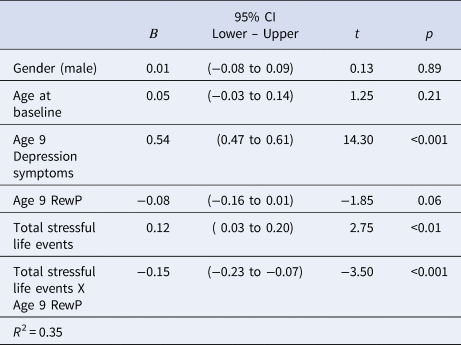
RewP, Reward Positivity
B is a standardized regression coefficient.
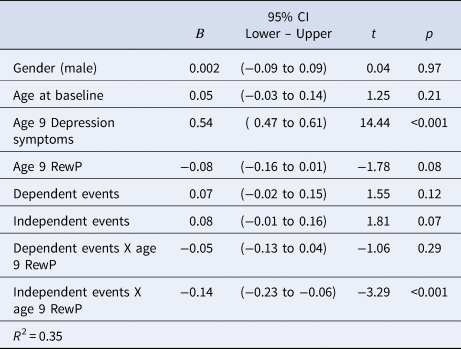
RewP, dependent, and independent stressful life events
Next, dependent and independent life events were entered simultaneously in a multiple regression model (Table 3). Neither the main effect for dependent events nor the RewP X dependent events interaction were significant. In contrast, independent life events significantly moderated the RewP-depression relationship. Simple slopes were calculated at low, intermediate, and high values (16th, 50th, and 84th percentiles) of independent life events, as shown in Fig. 2b. Simple slopes were significant at high [b = −0.026, s.e. = 0.007, 95% CI (−0.039 to −0.012), p < 0.001] and intermediate [b = −0.009, s.e. = 0.004, 95% CI (−0.017 to 0.00), p < 0.05] levels of independent stress, but were not significant at low levels of independent stress [b = 0.009, s.e. = 0.007, 95% CI (−0.003 to 0.021), p = 0.19].Footnote 5
Age 12 depression symptoms predicted by an interaction of RewP and independent and dependent life events
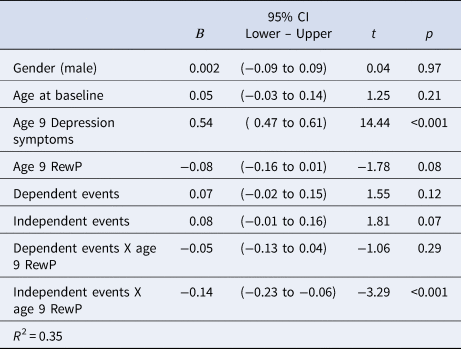
RewP, Reward Positivity.
B is a standardized regression coefficient.
Discussion
This is the first prospective study examining life events as moderating a neural measure of reward in predicting subsequent depressive symptoms. We found that episodic life events moderated the effects of the RewP on depression symptoms at follow-up, even after adjusting for baseline symptoms. Children with more blunted RewP and higher stress exhibited the greatest depression symptoms at follow-up in early adolescence. Additionally, independent stress specifically moderated the effects of the RewP on depression. These findings indicate that exposure to life stress influences whether blunted reward sensitivity will lead to greater depression in early adolescence, a period that marks the beginning of a rapid increase in rates of depression (Salk et al., Reference Salk, Hyde and Abramson2017). Moreover, these data suggest that a reward-based vulnerability to depression is evident as early as middle childhood, well before the post-pubertal surge in depression symptoms and diagnoses. Thus, there may be a window of at least several years for preventive interventions targeting blunted reward sensitivity.
Our results are consistent with the limited previous research examining the interaction between reward processing and stress on depression. Prior studies were mostly cross-sectional designs or relied on retrospective reports of early childhood stress (Corral-Frías et al., Reference Corral-Frías, Nikolova, Michalski, Baranger, Hariri and Bogdan2015; Dennison et al., Reference Dennison, Sheridan, Busso, Jenness, Peverill, Rosen and McLaughlin2016; Luking et al., Reference Luking, Nelson, Infantolino, Sauder and Hajcak2018). Most previous studies also used self-report questionnaires to assess life events, which have much lower validity than interview assessments (Harkness and Monroe, Reference Harkness and Monroe2016). Our study is novel in that we used a prospective, longitudinal design and a state-of-the-art semi-structured interview for life events. Additionally, we examined independent and dependent life events separately. This is important because independent events afford clearer causal interpretations, whereas associations between dependent events and depression may due to third variables such as genes, personality, cognitive style, or even prior abnormalities in reward processing (Kendler and Gardner, Reference Kendler and Gardner2010; Auerbach et al., Reference Auerbach, Admon and Pizzagalli2014). Interestingly, we found effects for independent but not dependent events despite consistent evidence for the depressogenic effects of dependent events in many studies of older adolescents and adults (Kendler et al., Reference Kendler, Karkowski and Prescott1999; Kendler and Gardner, Reference Kendler and Gardner2010). This may be because children and younger adolescents have fewer dependent events due to the social and familial constraints on their autonomy, and because they are more affected by stressors occurring to others on whom they depend (Rudolph and Hammen, Reference Rudolph and Hammen1999; Rice et al., Reference Rice, Harold and Thapar2003).
This study extends the broader literature and theoretical perspectives regarding stress and reward. The majority of previous research has focused on the effects of stress in disrupting reward systems (Auerbach et al., Reference Auerbach, Admon and Pizzagalli2014; Pizzagalli, Reference Pizzagalli2014), with studies observing reward-related changes in behavior and neural function following exposure to stress in rodents (e.g. Willner et al., Reference Willner, Towell, Sampson, Sophokleous and Muscat1987) and humans (e.g. Berenbaum and Connelly, Reference Berenbaum and Connelly1993). We instead took the perspective of a diathesis-stress model, where stress serves to activate pre-existing vulnerabilities, in this case blunted reward processing, which then leads to depression. However, finding that life events moderate the effect of the RewP on depression does not contradict previous studies. Rather, simultaneously incorporating the effects of prior stress on reward function along with the moderating effect of later stress on the relationship between reward processing and subsequent depression may yield a more dynamic and comprehensive account of the development of depressive disorders.
Previous work has demonstrated that the RewP is associated with concurrent depression (Foti and Hajcak, Reference Foti and Hajcak2009; Bress et al., Reference Bress, Smith, Foti, Klein and Hajcak2012; Liu et al., Reference Liu, Wang, Shang, Shen, Li, Cheung and Chan2014; Belden et al., Reference Belden, Irvin, Hajcak, Kappenman, Kelly, Karlow, Luby and Barch2016) and familial risk for depression (Foti et al., Reference Foti, Kotov, Klein and Hajcak2011; Kujawa et al., Reference Kujawa, Proudfit and Klein2014). However, there has been little attention to potential moderators, such as stressful life events, of the association between the RewP and depression. Consideration of moderators may clarify for whom and under what circumstances a blunted RewP leads to depression, indicating who may benefit most from preventive measures. Unlike some moderators (demographic characteristics, family history), one's capacity to cope with stressors is potentially modifiable and therefore a good target for prevention.
While this study extends the literature on the associations between reward processing, stress, and depression, it has several limitations. First, the ERP task used indexes reward as the difference between gain and loss trials, making it difficult to disentangle whether positive or negative feedback drives results. However, supplementary analyses4 suggested that response to gains may be driving the interaction with independent events. Second, the task uses monetary rewards; it is possible that other stimuli, like social reward, could yield different, perhaps stronger, findings. Third, we had to examine symptoms rather than episode onsets of depression due to low rate of depression diagnoses at age 12. However, it is increasingly recognized that depression exists on a continuum and that episodes represent relatively arbitrary demarcations (Watson, Reference Watson2005). Nevertheless, it will be important to follow this sample further into adolescence and adulthood to determine if the pattern of results holds for predicting depression diagnoses. Fourth, we only assessed life events that occurred 12 months prior to the follow-up, meaning that some life events occurring earlier in the three-year follow-up interval may not have been captured. Lastly, in adjusting for baseline symptoms, we may not have captured symptom increases occurring after the age 9 wave but before the events occurred. However, the fact that we observed effects for independent events indicates that even if symptoms had begun to increase prior to events, they did not play a causal role in the events' occurrence.
In summary, we found that episodic stressful life events moderated the effects of reduced reward responsiveness at age 9 on depression symptoms 3 years later, adjusting for baseline symptoms. Moreover, these findings were evident even when analyses were limited to independent events that could not have been influenced by the youth's behavior. Additional studies using reward paradigms that employ non-monetary stimuli, examine other developmental periods, and incorporate the effects of prior stress on reward functioning will help elucidate the complex relationships between reward processing, stress, and depression.
Supplementary material
The supplementary material for this article can be found at https://doi.org/10.1017/S0033291719001557
Author ORCIDs
Brandon L. Goldstein, 0000-0002-7003-2281