Introduction
Psychological stress can influence chronic disease processes as well as trigger the development of cardiovascular and cerebrovascular diseases. The Reiwa First Year East Japan Typhoon (Typhoon Hagibis) arrived in Japan on October 12, 2019. The typhoon caused immense damage in the Koshin, Kanto, and Tohoku regions, with 104 dead, 384 injured, and 3 missing persons across Japan by February 12, 2020. 1 It also caused a major flood disaster in Nagano City, flooding 1541 ha of land. By January 27, 2020, there were 2 deaths and 94 injured people reported in Nagano City. By February 29, 2020, 4074 houses were reported to be damaged, and many people were forced to live in shelters. 2
It has been reported that cardiovascular and cerebrovascular diseases tend to occur more frequently after a disaster. Reference Kario and Matsuo3–Reference Kario and Ohashi5 The incidence of cardiovascular diseases increased following previous large-scale disasters in Japan, such as the Hanshin-Awaji earthquake in 1995, Reference Suzuki, Sakamoto, Miki and Matsuo6–Reference Ogawa, Tsuji and Shiono8 the Niigata-Chuetsu earthquake in 2004, Reference Watanabe, Kodama and Okura9,Reference Watanabe, Kodama and Tanabe10 the Great East Japan Earthquake in 2011, Reference Aoki, Fukumoto and Yasuda11–Reference Aoki, Takahashi and Fukumoto14 and the Kumamoto earthquake in 2016. Reference Komorita, Fujisue and Sueta15 The Japanese Circulation Society has published guidelines for the prevention and management of cardiovascular diseases associated with disasters. 16 Many reports have described the occurrence of cardiovascular events related to large-scale disasters, particularly earthquakes, while little is known about the effects of middle-scale disasters related to floods.
The Shinsyu Assessment of Flood Disaster Cardiovascular eVEnts (SAVE) trial retrospectively enrolled 2426 patients hospitalized for cardiovascular and cerebrovascular disease in 5 hospitals associated with an emergency center in Nagano City from October 1 to December 31 (before and after the flood disaster) in 2017, 2018, and 2019. Reference Sunohara, Miura and Komatsu17 Most patients in the areas that were severely damaged by the collapse of the Chikuma River embankment visited these 5 hospitals. The results of the trial revealed that the incidence of heart failure, acute myocardial infarction (AMI), unstable angina, and cerebral hemorrhage increased during the 2 weeks immediately after the disaster. However, the SAVE trial included not only patients residing in a flooded district but also those residing outside the flooded district. Thus, it did not investigate the sole influence of the flood disaster. Accordingly, for the present study, patients who were hospitalized in a district flooded in 2019 were recruited from the cohort in the SAVE trial. The aim of the present study was to investigate the impact of Typhoon Hagibis on the incidence of cardiovascular and cerebrovascular diseases by making comparisons between the pre-disaster (2017 and 2018) and post-disaster (2019) periods for patients residing in a district affected by the flood in 2019.
Methods
Study Population
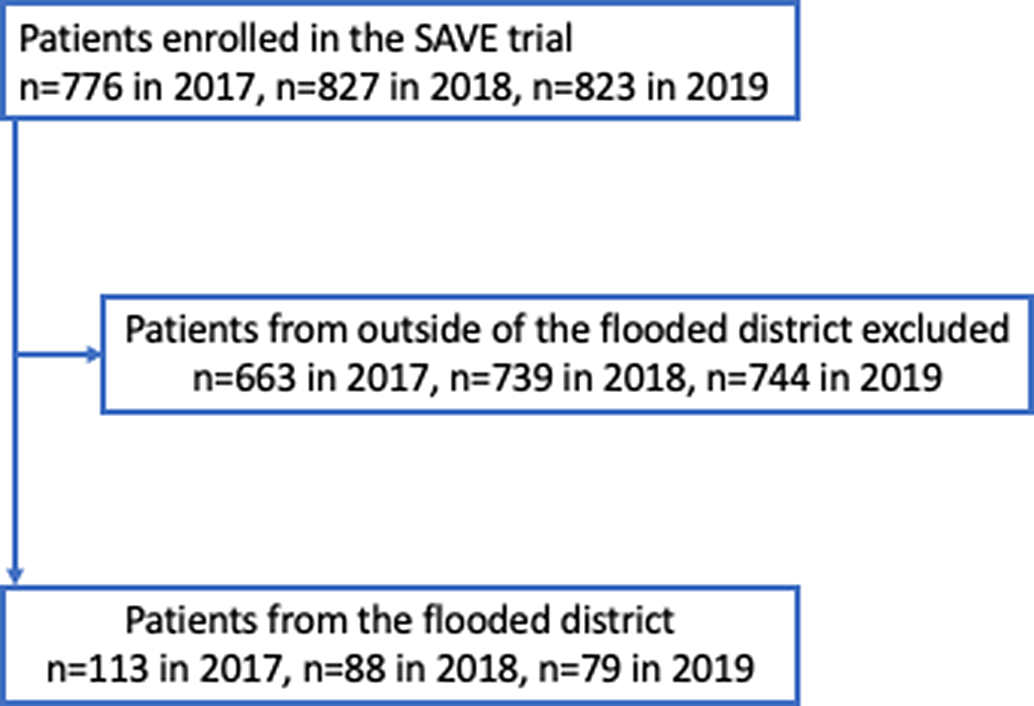
The SAVE trial retrospectively registered patients who were admitted for cardiovascular or cerebrovascular diseases at all 5 hospitals with emergency departments in Nagano City. In total, 280 patients who were hospitalized in a district flooded in 2019 were recruited from the SAVE trial (Figure 1); the patients were recruited from the same district for the same time period, October 12 to December 31, in 2017 and 2018 (the pre-disaster period) and in 2019 (the post-disaster period). In this flood disaster, the evacuation center was open until December 20, 2019; thus, the research period was set to almost the same period as when the evacuation center was open. In addition, since there was no previous study evaluating flood damage, a similar survey period in earthquake research in previous studies was used as reference. The baseline characteristics of patients and incidence of cardiovascular and cerebrovascular disease were then compared between the pre- and post-disaster periods. The patients were diagnosed with cardiovascular and cerebrovascular diseases by clinicians. Additional data on the dates of admission and discharge, sex, age, body mass index (BMI), place of residence, evacuation status, vital signs at examination, oral medication status, medical history, and nursing care level were also collected. For patients who died during hospitalization, mortality during hospitalization and the cause of death were investigated.
Participant flowchart. The SAVE trial enrolled all 2426 patients hospitalized for cardiovascular and cerebrovascular diseases in 5 hospitals in Nagano City that have an emergency center, from October 1 to December 31 after the flood disaster in 2019 and in the corresponding periods in 2017 and 2018. The SAVE trial included patients living within and those outside the flooded district; hence, the present study enrolled patients from the SAVE trial who resided only in the district flooded by the typhoon. A total of 280 patients were recruited from the same district for the same time period, October 12 to December 31 in 2017 and 2018 (the pre-disaster period) and in 2019 (the post-disaster period).

Definitions
Data on patient diagnoses were extracted from medical records. Patients admitted to the hospital were diagnosed by an inpatient doctor, whereas those who died in the emergency room were diagnosed by a doctor in the emergency room. Diagnoses were based on physical examination, electrocardiography, chest radiography, computed tomography scan, echocardiography, and blood examination. All diagnosed diseases were classified according to the International Statistical Classification of Diseases and Related Health Problems, 10th revision. The registered cardiovascular diseases included heart failure, AMI, unstable angina pectoris (UAP), deep vein thrombosis (DVT), pulmonary thromboembolism, takotsubo cardiomyopathy, atrial fibrillation, acute aortic dissection, and aortic aneurysm rupture, and the cerebrovascular diseases included cerebral hemorrhage and cerebral infarction. Diagnoses of UAP and AMI were made according to guidelines of the Japanese Circulation Society, and coronary angiography was performed. 18
A history of hypertension was defined by a clinical room blood pressure ≥140/90 mmHg, a home blood pressure ≥135/85 mmHg, or the use of oral antihypertensive drugs. The double product (DP) was calculated by multiplying the systolic blood pressure by the heart rate (mmHg/min). Skipped medication was defined when patients did not take the drug the day before visiting the hospital. A positive evacuation status was defined as a patient who evacuated without returning home for at least 1 day. The “flooded district” was defined in reference to the estimated area flooded in 2019, as released by Nagano City (https://www.city.nagano.nagano.jp/uploaded/attachment/334877.pdf), and this district was monitored for the pre- and post-disaster periods.
Statistical Analysis
Continuous variables were expressed as mean ± standard deviation. Continuous variables were compared using an unpaired t-test based on the normality of the data distribution. The Shapiro–Wilk test was used to test for normal distribution (P ≥ 0.05). Categorical variables were compared using the chi-square test. Statistical significance was set at P < 0.05. All tests were 2-tailed. All statistical analyses were performed using SPSS version 26 (IBM Corp, Armonk, NY, USA).
The Institutional Clinical Research Review Board of Nagano Municipal Hospital (reference no. 2019-50) and other participating hospitals approved the protocol of the present study, which was conducted in accordance with the principles of the Declaration of Helsinki. The requirement for written informed consent was waived because of the retrospective study design.
Results
Patient Characteristics
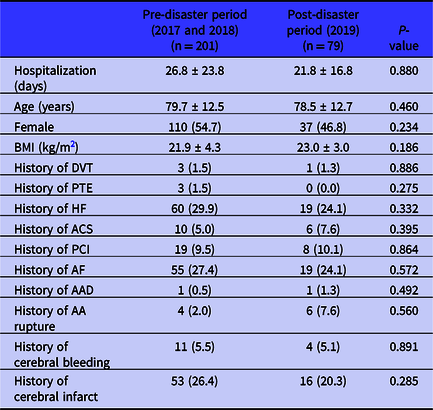
The total numbers of patients with cardiovascular and cerebrovascular diseases who were hospitalized from the flooded district in the pre-disaster (2017 and 2018) and post-disaster (2019) periods were 201 and 79, respectively. Data regarding the length of hospitalization, age, sex, BMI, and history of the disease are presented in Table 1. Seven patients (8.8%) had to live in an evacuation center during the post-disaster period. Patient characteristics did not differ significantly among the pre-disaster period, the time of the flood disaster, and the post-disaster period.
Patient characteristics

Data are presented as the mean ± standard deviation or n (%). A 2-sided, chi-square test was used for the comparison of categorical measures, and a t-test was used for the comparison of continuous measures.
AA rupture, aortic aneurysm rupture; AAD, acute aortic dissection; ACS, acute coronary syndrome; AF, atrial fibrillation; DVT, deep vein thrombosis; HF, heart failure; PCI, percutaneous coronary intervention; and PTE, pulmonary thromboembolism.
Status of Oral Medication
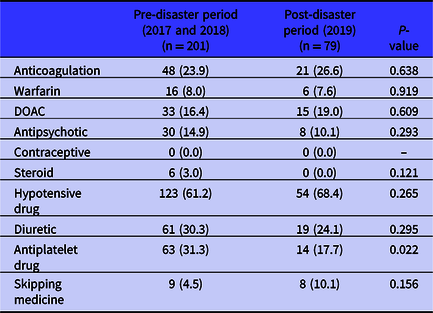
The status of orally administered and skipped medications was also investigated. The proportion of antiplatelet drug use before hospitalization was lower in the post-disaster period. The status of other oral medications did not differ significantly between the pre- and post-disaster periods (Table 2).
Status of oral medication

Data are presented as n (%). A 2-sided, chi-square test was used for the comparison of categorical measures.
DOAC, direct oral anticoagulants.
Number of Deaths and Cardiovascular/Cerebrovascular Disease in the Pre- and Post-Disaster Periods
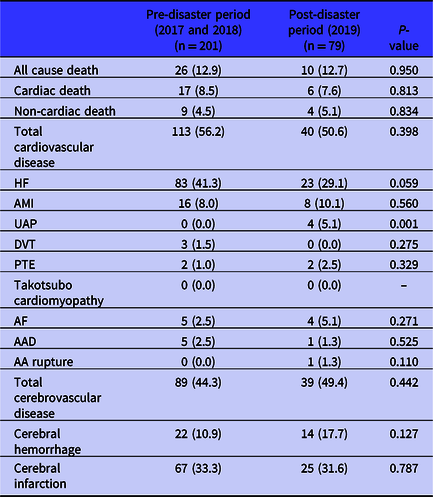
The number of deaths after the disaster (10 patients, 12.7%) was not significantly different from that before the disaster (26 patients, 12.9%). The occurrence of cardiovascular and non-cardiovascular deaths did not differ significantly between the pre- and post-disaster periods. Table 3 shows the total number of patients with cardiovascular diseases and cerebrovascular diseases and the number of patients with each specific disease. The total number of patients with cardiovascular and cerebrovascular diseases did not differ significantly between the pre- and post-disaster periods. The number of patients with UAP increased from 0 before the disaster to 4 after the disaster (P = 0.001). The number of patients with DVT did not differ significantly between the pre- and post-disaster periods.
Number of deaths and cardiovascular/cerebrovascular disease cases by pre- and post-disaster

Data are presented as n (%). A 2-sided, chi-square test was used for the comparison of categorical measures.
AA rupture, aortic aneurysm rupture; AAD, acute aortic dissection; AF, atrial fibrillation; AMI, acute myocardial infarction; DVT, deep vein thrombosis; HF, heart failure; PTE, pulmonary thromboembolism; and UAP, unstable angina pectoris.
DVT Screening at Evacuation Centers
From October 20 to 23 and from November 3 to 9 in 2019, 210 patients underwent DVT screening at evacuation centers in Nagano City, of whom 102 underwent lower extremity ultrasound. Of these 102 individuals, 6 had a lower limb thrombus and were instructed to visit a medical institution.
Vital Signs and Laboratory Data of Patients
The vital signs of the patients did not differ significantly between the pre- and post-disaster periods. However, the DP was significantly increased after the disaster (P = 0.011) (Table 4). In terms of laboratory data, the estimated glomerular filtration rate was significantly lower before the disaster than after the disaster. Other laboratory data did not differ significantly between the 2 periods (Supplemental Table 1).
Vital signs of patients on admission

Data are presented as the mean ± standard deviation (SD). A t-test was used for the comparison of continuous measures.
SpO2, oxygen saturation of the peripheral artery.
Discussion
The findings of this study are as follows: (1) In the area flooded by Typhoon Hagibis, the total number of patients with cardiovascular and cerebrovascular diseases in the post-disaster period (2019) did not increase significantly compared with the number in the pre-disaster period (2017 and 2018); (2) the incidence of UAP significantly increased in the post-disaster period; and (3) the DP at the time of hospitalization significantly increased in the post-disaster period.
It has been reported that cardiovascular diseases and related deaths occur more frequently after a disaster. Reference Kario and Matsuo3–Reference Kario and Ohashi5,Reference Kario19 Cerebrovascular diseases have also been reported to increase on account of stress caused by disasters. Reference Kario and Ohashi5,Reference Tsutsumi, Kayaba, Kario and Ishikawa20 It is assumed that this is due to the increase in blood pressure, endothelial cell dysfunction, blood viscosity, as well as platelet and hemostatic activation induced by the increase in sympathetic nerve activity after disasters. Reference Kario21,Reference Kario, Shimada and Takaku22 However, no significant difference was observed in the total number of cardiovascular and cerebrovascular diseases diagnosed in this study. In the SAVE trial, cases of UAP significantly increased at the 1.5- and 2-month marks, and cases of heart failure, AMI, and cerebral hemorrhage tended to increase within 2 weeks after the flood disaster. However, the total number of cases with cardiovascular and cerebrovascular diseases did not increase significantly compared with that reported in the previous 2 years. The reason for the lack of significant differences in the total number of cardiovascular and cerebrovascular diseases diagnosed in this study might be the small sample size and short observation period. In this study, as well as in the SAVE trial, the incidence of UAP increased significantly after the flood disaster (P < 0.05). Although significant differences were found, careful interpretation is needed because of the small sample size (n = 4). Moreover, although vital signs did not differ significantly before and after the disaster, the DP after the disaster was significantly increased relative to that before the disaster. DP is known to correlate with myocardial oxygen consumption, suggesting that the stress caused by the disaster may have caused the cardiac overload. Reference Xu, Zhan and Lu23 Therefore, it is necessary to carefully observe the occurrence of cardiovascular and cerebrovascular events, even in relatively small disasters. The exact reason for the increased UAP after the flood disaster is unknown, but it was hypothesized that moving to a temporary housing and long-term evacuation living was stressful, thus leading to increased UAP.
Increased platelet activity as well as an imbalance between coagulation and fibrinolysis are associated with the progression of venous thromboembolism (VTE). Reference Kario, Shimada and Takaku22 It has been proposed that, in a disaster, sympathetic nervous system activity induces a thrombotic tendency because of the enhanced ability of platelet aggregation. Reference Kario21 After a disaster, disaster victims tend to have difficulty moving, making them unable to perform daily activities. Decreased body activity causes the blood flow in the lower extremities to stagnate within the veins, resulting in venous embolism. Consequently, an increased incidence of VTE is associated with disasters. Therefore, screening for DVT as part of post-disaster care is important. Reference Sato, Sakamoto and Hashimoto24–Reference Shibata, Chiba and Sasaki26 In this study, the occurrence of VTE after the disaster was not increased relative to that before the disaster, and the following reasons are suggested for the lack of difference: First, the flooded district was limited in size, and the impact on transportation was relatively small; thus, it was possible for evacuees to live outside the evacuation center; second, DVT screening was actively carried out from the early stage of the disaster; third, cardboard beds were introduced to the evacuation center at an early stage; moreover, it is believed that efforts to raise awareness of DVT and DVT screening played an important role in the prevention of DVT in the aftermath of the flood disaster.
Limitations
The present study has several limitations. First, the sample size was small. Moreover, there are many confounding factors in the sample. Therefore, a multiple regression analysis should be conducted but has not been done due to the small sample size. Second, the study did not include disaster-related cardiovascular and cerebrovascular disease patients who visited hospitals other than the 5 major hospitals in Nagano City; thus, it is possible that not all disaster victims were included in this study. Furthermore, the most severely affected people might have moved to other cities. Third, patient backgrounds, such as medication status and history, were retrospectively investigated from the medical records, which may not contain accurate information. Moreover, the Disaster Cardiovascular Prevention score was not used in this study, as many cardiologists were not adequately prepared to respond to the disaster. 16
Conclusions
Despite the scale of Typhoon Hagibis, the overall incidence of cardiovascular and cerebrovascular diseases in the post-disaster period did not increase relative to that in the same period in the pre-disaster years. This sub-analysis of only flooded areas did not prove the impact of the typhoon.
Supplementary material
To view supplementary material for this article, please visit https://doi.org/10.1017/dmp.2022.16
Acknowledgments
We thank all the staff of the 5 hospitals in Nagano City for their cooperation with our research.