INTRODUCTION
The Ophichthidae is the most speciose family in the Anguilliformes, with 49 genera and over 200 described species, which are found in almost all tropical and subtropical marine habitats (McCosker, Reference McCosker1977). Eighteen genera and 27 species from this family have been recorded off the Brazilian coast (Menezes, Reference Menezes, Menezes, Buckup, Figueiredo and Moura2003).
As a result of a research project on the feeding ecology of two species of snappers, which was carried out by the junior author on the north-eastern Brazilian coast in 2005–2007, a small ophichthid was taken from the stomach of a 0.52 kg yellowtail snapper (Ocyurus chrysurus) captured 70 miles off the coast of Mucuri, Bahia, Brazil. In spite of the poor condition of this specimen, we found that it is different from all ophichthids known from the Brazilian coast, and it possesses some distinctive features of Gordiichthys leibyi McCosker & Böhlke, Reference McCosker and Böhlke1984.
Gordiichthys leibyi was formerly assigned only to the western North Atlantic, from the coasts of Florida and the Gulf of Mexico to Guyana (McCosker & Böhlke, Reference McCosker and Böhlke1984; Leiby, Reference Leiby and Böhlke1989; McCosker et al., Reference McCosker, Böhlke, Böhlke and Böhlke1989; McEachran & Fechhelm, Reference McEachran and Fechhelm1998; McCosker, Reference McCosker and Carpenter2003; Richardson & Cowen, Reference Richardson and Cowen2004, table 3; Ross et al., Reference Ross, Casazza, Quattrini and Sulak2007, table 1). Here, we report the first record of this species in the western South Atlantic.
MATERIALS AND METHODS
Morphometric and meristic procedures followed Böhlke (Reference Böhlke and Böhlke1989), but because the specimen is quite damaged, only some measurements were taken, as indicated below. Vertebral counts were taken by longitudinally dissecting the eel. Because the limits of many ophichthid genera are not unequivocally determined and recognition of some of these taxa is difficult, the specimen described in this study was compared with all the genera from the tribe Bascanichthyini sensu McCosker et al. (Reference McCosker, Böhlke, Böhlke and Böhlke1989) (in which Gordiichthys is currently included) that have been assigned to the Brazilian coast. Material from these genera is listed below in the text. Institutional abbreviations follow Eschmeyer (Reference Eschmeyer and Eschmeyer1998).
RESULTS
MATERIAL EXAMINED
MZUSP 103719, Brazil, 70 miles off the coast of Mucuri, Bahia, December 2005. Collected by Matheus Freire (taken from the stomach of a yellowtail snapper: Ocyurus chrysurus). This specimen is a mature female with large oocytes (0.6–0.8 mm) visible after dissection, in each side of the abdomen.
DIAGNOSIS
The specimen is recognized as Gordiichthys based on the following combination of characters: dorsal fin present, its origin behind the nape and before the gill openings, pectoral fin absent, gill openings low lateral, three supratemporal and two preopercular pores, and underside of snout grooved, with intermaxillary teeth protruding.
Besides G. leibyi, four species are currently included in this genus (see McCosker & Böhlke, Reference McCosker and Böhlke1984; McCosker et al., Reference McCosker, Böhlke, Böhlke and Böhlke1989; McCosker & Lavenberg, Reference McCosker and Lavenberg2001): G. combibus McCosker & Lavenberg, Reference McCosker and Lavenberg2001; G. ergodes McCosker et al., Reference McCosker, Böhlke, Böhlke and Böhlke1989; G. irretitus Jordan & Davis, 1891; and G. randalli McCosker & Böhlke, Reference McCosker and Böhlke1984, none of which has been previously recorded in the western South Atlantic. The specimen is diagnosed as G. leibyi based on the anterior nostrils not tubular, flush along the posteroventral edge and bordered by a shallow groove on the anteromedial edge (tubular in G. ergodes), the uniserial teeth on the jaws and vomer (biserial anteriorly in G. combibus), the intermaxillary rosette of four teeth (three teeth in G. irretitus and G. randalli), preanal vertebrae 97 (105–111 in G. irretitus), interorbital width 12.5% of the head length (6.4–10.1% of the head length in other Gordiichthys species), and the presence of minute papillae on the snout, nape, and lower lip (which occurs exclusively in this species).
DESCRIPTION
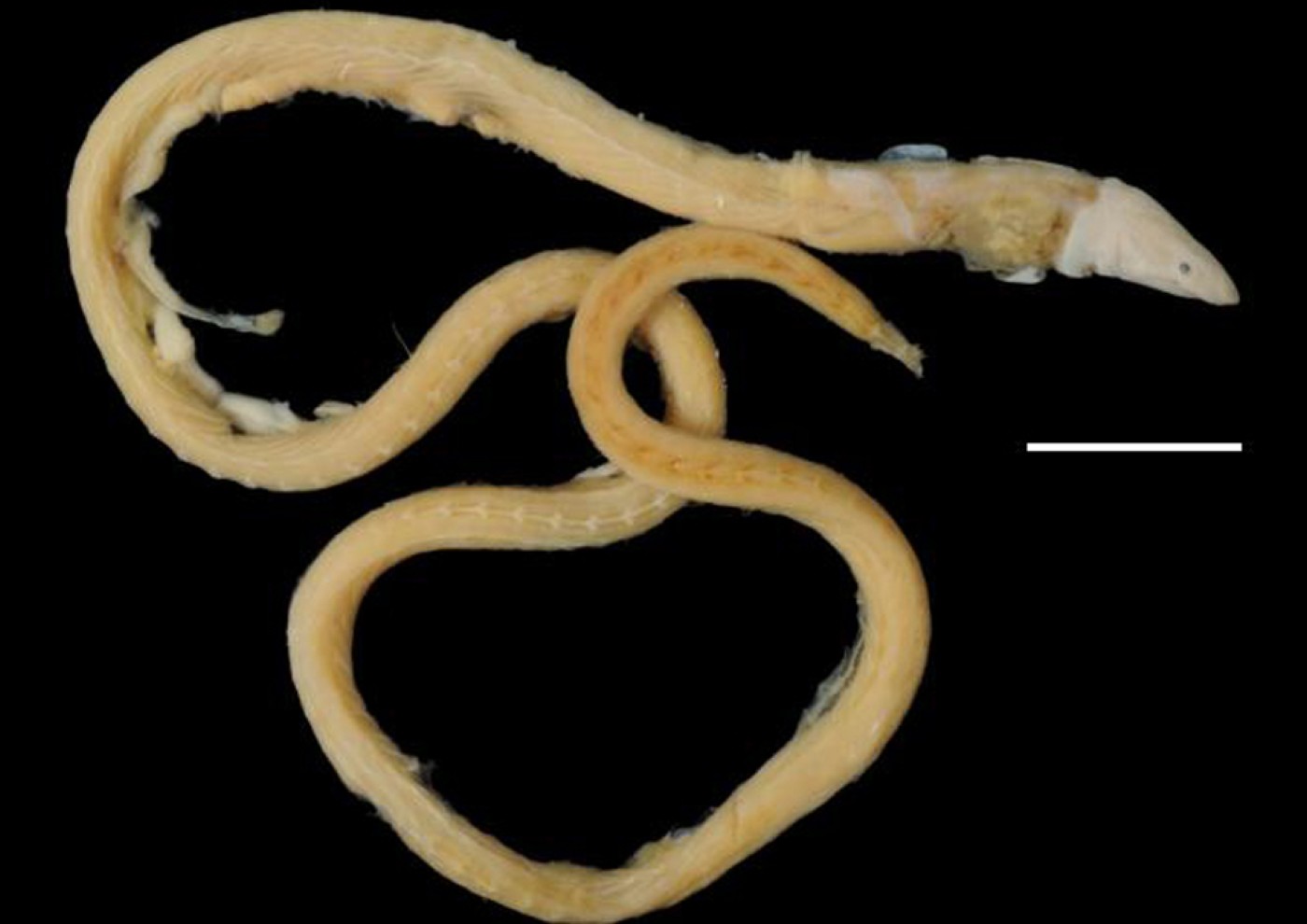
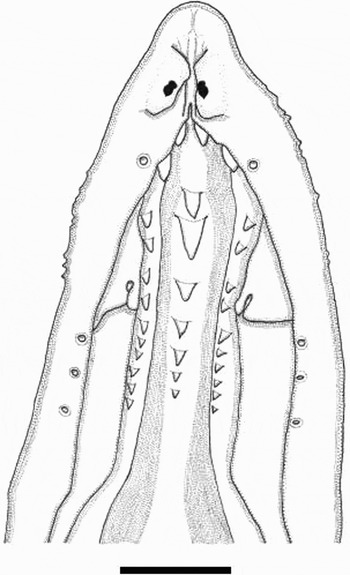
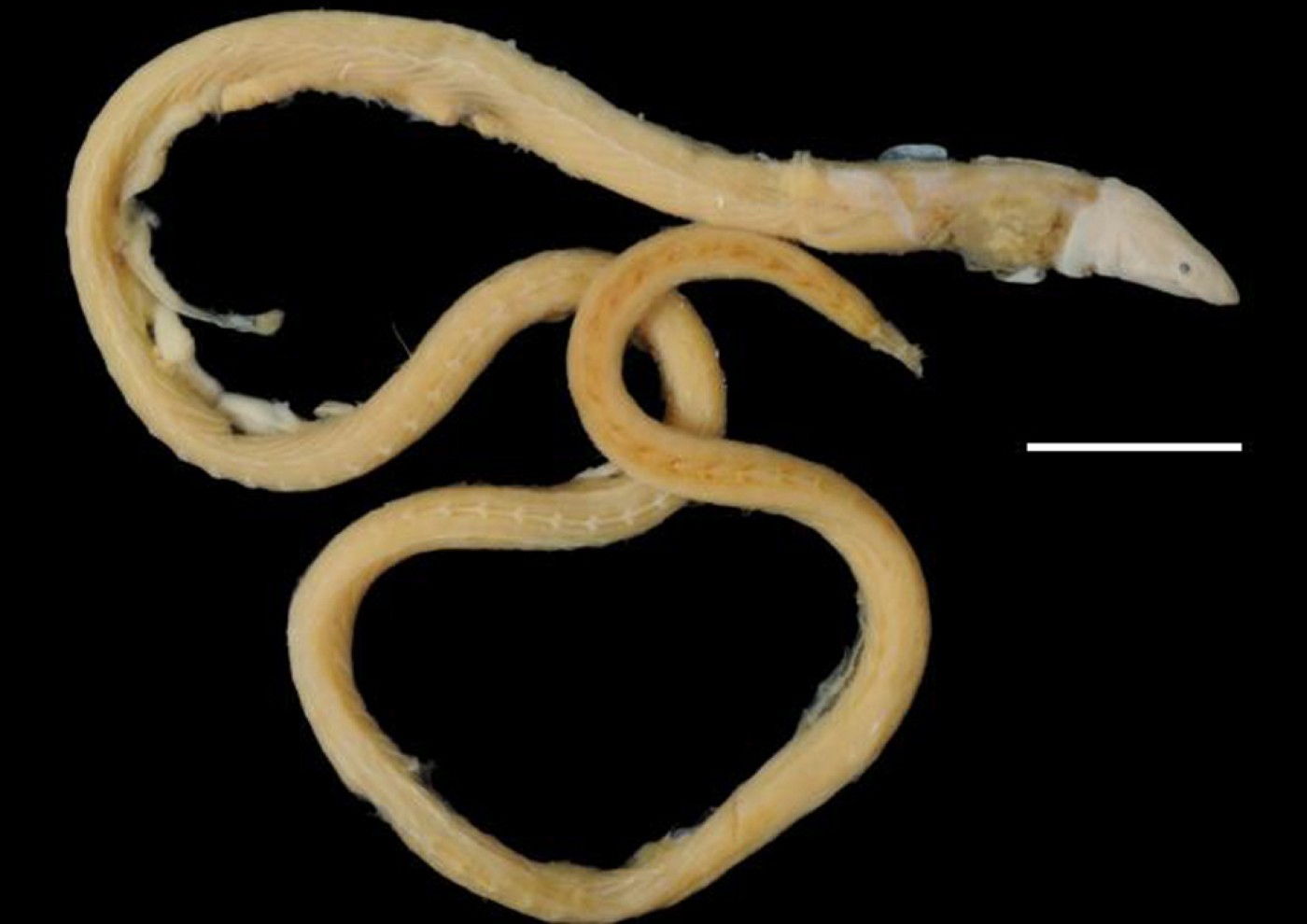
Specimen broken and partially digested (Figure 1); total length not measurable. Values in parentheses refer to measurements as a percentage of the head length. Preanal length 190 mm; head length 14.9 mm; snout 2.8 mm (19.0); snout to rictus 6.7 mm (45.0); upper jaw 4.7 mm (31.5); eye 0.8 mm (5.6), and interorbital 1.9 mm (12.5). Snout rounded at tip and conical when viewed from above, with a slender slit on its ventromedial surface from which the premaxillary teeth protrude; centre of eye approximately above midpoint of upper jaw; anterior nostrils not tubular, flush along posterolateral edge and bordered by a groove on anteromedial edge; nostrils approximately oval, not convoluted. Head densely covered with small narrow papillae. Head pores well visible, supraorbital 4 + 2, infraorbital 1 + 3, preoperculomandibular 5 + 2, supratemporal 3. Teeth on jaws uniserial, 10 maxillary teeth and 10 dentary teeth; four intermaxillary teeth in a rosette; 7 teeth on vomer in a uniserial row; intermaxillary and anterior vomerine teeth the largest (Figure 2); preanal vertebrae 97.
Gordiichthys leibyi, MZUSP 103719. Scale: 4 mm.
Gordiichthys leibyi, MZUSP 103719, detail of the head and the upper jaw in ventral view, showing the teeth on the upper maxillary and vomer. Scale: 16 mm.

DISCUSSION
The specimen examined in this study was in poor condition, so many of the characters important to the identification of Ophichthidae (e.g. structure of the tail) are destroyed. In spite of this, we could confidently ascribe it to Gordiichthys leibyi on the basis of the preanal vertebrae counts, the arrangement of teeth on the jaws and vomer, and the presence of papillae on the head.
Some differences in morphometric characters between the specimen examined and the known individuals of Gordiichthys leibyi were observed. Although the available material of this species is relatively sparse for an objective comparison of such discrepancies, these differences do not cast doubt on the identification of the specimen. The record of G. leibyi in the western South Atlantic indicates that the distribution of this species is wider than formerly known. It is possible that G. leibyi is actually widespread in the western South Atlantic, but the answer to this question needs to be better evaluated.
Comparative material examined
Bascanichthys paulensis Storey, 1939. 1, adult, 364.0 mm. MZUSP 12010, Brazil, Bahia, Ilha de Itaparica, Barra do Gil, 28 April 1973. Collected by C.E. Dawson and N. Menezes. Caralophia loxochila Böhlke, 1955. 3, adults, 90.6–278.8 mm. MZUSP 12014, Brazil, Bahia, Ilha de Itaparica, 24 August 1963. Collected by N. Menezes and C.E. Dawson. Gordiichthys leibyi McCosker & Böhlke, Reference McCosker and Böhlke1984. Holotype, 336.0 mm. ANSP 110147, United States, Florida, 30°05′N 80o41.5′W, depth 36 m, 4 April 1963. Collected by RV ‘Silver Bay’, Station 4843 (photographs in dorsal, lateral, and ventral views). Ichthyapus ophioneus Evermann & Marsh, 1900. 1, adult, 365.0 mm. MZUSP 12100, Brazil, Bahia, Arembepe, 26 August 1972. Collected by C.E. Dawson and N. Menezes. Phaenomonas longissima Cadenat & Marchal, 1963. 1, adult, 337.0 mm. MZUSP 12099, Bahia, Arembepe, 26 August 1972. Collected by C.E. Dawson and N. Menezes.
ACKNOWLEDGEMENTS
This paper benefited from the reviews of Janet W. Reid and two anonymous referees. The authors are grateful to José Lima de Figueiredo and Osvaldo Takeshi Oyakawa (MZUSP) for allowing access to the museum and the deposition of the specimen in the ichthyological collection of this institution, Matheus Freitas, Rodrigo Leão Moura and Ronaldo Bastos Francini-Filho (Conservation International, Caravelas) for technical support and valuable suggestions; and the institutions IBAMA, BP Conservation, and Projeto MMAs for supporting research projects on reef and commercial fish. Matheus Freitas assisted in the collection of the yellowtail snappers, and Mark Sabaj-Perez and Kyle Luckenbill (Academy of National Sciences of Philadelphia) kindly sent photographs of the holotype of Gordiichthys leibyi. The first author is currently funded by the Conselho Nacional de Desenvolvimento Científico e Tecnológico (CNPq), Distrito Federal, Brazil.