Introduction
Exposures and events at different stages of the life-course can contribute to the development of depression. The known risk factors include childhood abuse, interpersonal loss and stressful life events, low socioeconomic status and financial strain, low IQ and low education, unemployment and family dysfunction.Reference Papachristou, Frangou and Reichenberg1, Reference Colman and Ataullahjan2 Recently, low birth weight, often seen as a manifestation of (maternal) stress exposure during pregnancy, has also been suggested to be a risk factor for later depression, but the evidence is not conclusive. A meta-analysisReference Wojcik, Lee, Colman, Hardy and Hotopf3 based on 18 studies found that birth weight below 2500 g was associated with increased risk of depression and psychological distress [odds ratio (OR) 1.15 with 95% confidence interval (CI) 1.00–1.32]. The authors concluded, however, that this result may be explained by publication bias. Another meta-analysisReference Loret de Mola, de França, Quevedo Lde and Horta4 used a stricter definition of outcome, depression measured by self-rating scales or diagnostic interview, and found that the pooled effect of low birth weight on depression was OR=1.39 with 95% CI=1.21–1.60; no evidence of publication bias was found.
One of the most consistent biological findings in major depression psychiatry is hyperactivity of the hypothalamic–pituitary–adrenal (HPA) axis;Reference Pariante and Lightman5 but even without a fully developed psychiatric condition, there is a positive association between the extent of distress and HPA activation.Reference Miller, Chen and Zhou6 Accordingly, overstimulation of the HPA axis during fetal life, caused by poor nutrition or exposure to hormones such as cortisol during critical periods of development, is frequently proposed as the mechanism underlying the association between birth weight and later-life depressive symptoms.Reference Loret de Mola, de França, Quevedo Lde and Horta4, Reference Colman, Ploubidis, Wadsworth, Jones and Croudace7 As a result of these prenatal exposures, the stress response mechanisms of the fetus are hypothesized to be permanently altered, resulting in poor mental health throughout the life-course.
It has also been proposedReference Colman and Ataullahjan2 that it is not the fetal stress (and consequently low birth weight) per se, but a mismatch between fetal and later-life environment with respect to stress exposure that may be a risk factor for depression. According to this suggestion fetal stress exposure would be a resilience factor to subsequent stressors and only become maladaptive ‘if the adverse environment that existed during pregnancy does not persist’.Reference Colman, Ploubidis, Wadsworth, Jones and Croudace7
Typically, low birth weight (usually below 2500 g) is considered as the risk factor, and none of the studies in the meta-analysisReference Loret de Mola, de França, Quevedo Lde and Horta4 that looked into the linear effect of birth weight found an association with adult depression. Some studies have, however, found an inverse dose–response relationship between birth weight and depressionReference Colman, Ploubidis, Wadsworth, Jones and Croudace7, Reference Alati, Lawlor and Mamun8 or even suggested in addition that very high birth weight may be associated with depression.Reference Colman, Ploubidis, Wadsworth, Jones and Croudace7, Reference Herva, Pouta and Hakko9 Birth weight indeed cannot precisely reflect the actual conditions experienced prenatally. A newborn may be small because of a lower innate growth potential despite an optimal fetal environment; conversely, a large baby could still have suffered from fetal malnutrition that prevented it from reaching its full growth potential.Reference Dahly, Adair and Bollen10 Misclassification of the exposure to poor fetal nutrition is thus inevitable, and an association across the whole birth weight range might be expected. Furthermore, ponderal index or weight for gestational age would possibly be better measures of prenatal nutrition than the absolute birth weight, as these measures relate the reached weight at birth to the body length of the newborn, or length of gestation, respectively. However, adjusting for length of gestation seems to have only minor impact on the estimated association between birth weight and later depressiveness.Reference Alati, Lawlor and Mamun8, Reference Herva, Pouta and Hakko9, Reference Wiles, Peters, Leon and Lewis11, Reference Gale and Martyn12 Length of gestation is unknown and thus not accounted for in majority of the earlier studies.Reference Wojcik, Lee, Colman, Hardy and Hotopf3
It is not clear whether there are gender differences in the association between birth weight and depression. Some studiesReference Wiles, Peters, Leon and Lewis11 report stronger associations in men and othersReference Alati, Lawlor and Mamun8 in women. In the above-mentioned meta-analysisReference Loret de Mola, de França, Quevedo Lde and Horta4 the pooled effect of low birth weight on depression was lower for men than that of women, but the difference was not statistically significant.
Depressive symptoms may be stable, transient or relapsing and remitting, and a single ‘snapshot’ may not be sufficient to measure an individual’s experience of depression.Reference Wojcik, Lee, Colman, Hardy and Hotopf3 A potential association between birth size and later-life depression may thus not be apparent when a single measurement of depression is used, but may become manifest if the life-course profile is considered. Group-based methods such as latent class growth analysis (LCGA)Reference Jung and Wickrama13 allow summarizing the development of an outcome over time and thus capture the longitudinal profiles of depression, which thereafter can be related to potential risk factors by using regression techniques.
Overall, it is plausible that there is an association between birth weight and later-life depressiveness, even if some studies have failed to confirm it. It is, nonetheless, unclear whether there is a threshold of birth weight under which the risk of later depression increases, or if there is an association across the normal range of birth weights, and whether the association is different for men and women.
The aim of this study is to examine the association of size at birth with repeatedly measured depressive symptoms between ages 16 and 43 years in men and women. We will assess the possible mismatch effect of prenatal and later stress exposure by studying the simultaneous effect of size at birth and social adversities in adolescence on depressive symptoms across life-course. In a subset of the sample, we will assess whether prematurity is a confounder in the association between birth size and depressive symptoms.
Methods
Study population
The Northern Swedish Cohort consists of all students who attended, or should have attended, the last year of compulsory school in the town of Luleå in Northern Sweden in 1981 (age 16, most born in 1965); 1086 students were invited and 1083 participated. The participants have been followed regardless of where they have moved (in Sweden or abroad) in 1983, 1986, 1995 and 2008 (ages 18, 21, 30 and 43, respectively). Each time, they have filled in an extensive questionnaire covering different aspects of life, for example, participation in labour market, family situation, health and well-being, and life events. The baseline survey took place in classrooms and the follow-up surveys in classmate reunions, or if a subject was unable to attend, then either by post or telephone. In addition, birth certificates of the cohort members have been retrieved.
Response rate has been exceptionally high. Of the original cohort, 1071 were alive in 2008 and 1010 agreed to participate.Reference Hammarström and Janlert14 The cohort is fairly representative of Sweden as a whole with respect to sociodemographic and socioeconomic factors as well as health status.Reference Hammarström and Janlert14 Detailed description of the cohort is available.Reference Hammarström and Janlert14
In the current study, we used information from questionnaire data collected in 1981, 1986, 1995 and 2008, and birth certificates. The national Swedish Medical Birth Register was founded in 1973 and computerized data was thus not available for the cohort. Birth records were collected from hospitals around Sweden and manual coding of them was performed. In case birth certificates were not found, cohort members’ self-reported birth weight and length was used (1%). Last menstrual period was recorded in around half of the birth certificates and was used to calculate length of gestation. Self-reported length of gestation was not used.
Sample size
All 1066 participants with at least one available measurement of depressive symptoms score were included when retrieving trajectories of depressive symptoms score. Thus, the resulting trajectory solution is representative of the whole cohort, even of those with missing data on birth characteristics or other covariates.
When studying the associations between birth size and later depressive symptoms, we included cohort members with complete information on weight and length at birth, depressive symptoms score from all four occasions, as well as all covariates. We excluded multiple births (one set of triplets, 20 twins) from the analyses. Thus, the analytic sample consisted of 947 individuals.
In a supplementary analysis based on 512 individuals in the analytic sample with known length of gestation, we studied the role of prematurity in the association between birth weight and later-life depressiveness.
Measurements
Birth characteristics: Ponderal index was calculated as follows: (birth weight in kg)/(birth length in m)Reference Wojcik, Lee, Colman, Hardy and Hotopf3. It characterizes the ‘chubbiness’ of a newborn. Births before 37 completed weeks of gestation were considered premature.
In the regression models, birth weight and ponderal index were treated in three different ways: (1) as binary variables identifying around 5% smallest of the newborns (cut-point 2500 g for birth weight and 22 for ponderal index; (2) categorical variables, divided into five categories and (3) continuous variables.
Depressive symptoms: At the ages 16, 21, 30 and 43, depressive symptoms were measured with six questionnaire items, based on the following self-reported symptoms during the past 12 months: (1) sleeping problems (four response options ranging from ‘Never’ to ‘All the time’, coded 0–3), (2) poor appetite (three options ‘No’, ‘Yes, moderate’ and ‘Yes, severe’, coded 0–2), (3) general tiredness (0–2), (4) feeling down and sad (0–3), (5) dejected about the future (0–3), and (6) concentration difficulties (0–2). Response options ranging from 0 to 3 were recoded to 0–2 by combining the two middle categories and the final depressive symptoms score was constructed as the mean of the six symptoms.Reference Hammarström, Westerlund and Kirves15 It ranged from 0 to 2 with higher values indicating higher level of depressive symptoms, and was used as a continuous measure in the analyses. The questionnaire from age 18 included only five out of the six items and was thus not used. The measure has been evaluated and found to present with acceptable psychometric properties and invariance over time; Cronbach’s alpha coefficient was between 0.61 and 0.76 on all measurement occasions.Reference Hammarström, Westerlund and Kirves15
As a way to capture the life-course experience of depressive symptoms, we calculated the average value of depressive symptoms score across the four measurements for each individual. Moreover, we used LCGA and extracted life-course trajectories of depressive symptoms.
In the regression models depressive symptoms were analysed as values of the symptoms score separately at the ages 16, 21, 30 and 43; as the life-course average of the symptoms score between the ages 16 and 43 and as life-course trajectories of depressive symptoms score.
Parental socioeconomic status (SES): SES was defined as the highest of the mother’s and the father’s social class as reported by the adolescent at the age of 16, and categorized to higher non-manual, lower non-manual and manual workers. Parental SES was seen as a potential confounder in the association between birth size and later depressive symptoms.
Social adversities in adolescence: This was reported by the adolescents at the age of 16 and includes the following: (1) parental loss (having experienced parental separation/divorce, parents never living together, or death of either parent), (2) unemployment of a parent (at least one parent unemployed or on disability pension at the time of survey; housewives were classified as employed), (3) physical illness of a parent (ticked box for mother or father or both having a somatic illness), (4) mental illness or alcohol problems of a parent (ticked box for at least one parent having mental health complaints or alcohol problems or both), (5) residential mobility (having moved >2 times) and (6) residential crowding (not having an own room at the time of survey). All indicators were summed to obtain an index of social adversities (range 0–6) and dichotomized as low (0–1) v. high (⩾2) in the analyses. This variable was used as an indicator of chronic stress exposure in the adolescence and included in the analyses assessing the mismatch hypothesis.
Data analysis
Extraction of trajectories of depressive symptoms
We applied LCGAReference Jung and Wickrama13 and extracted latent trajectory classes of depressive symptoms score separately for men and women. LCGA allows to simultaneously characterize the long-term development within individuals, and the heterogeneity of developmental trajectories within the population. It identifies a low number of typical developmental trajectories of the outcome and allocates each individual to the trajectory class which best characterizes this individual’s development.
We considered growth trajectories with intercept, slope and a quadratic term, and tested models with 2–5 trajectory classes. We assumed the distribution of the depressive symptoms score to be censored normal.Reference Nagin16 The full-information maximum-likelihood method, assuming missing at random mechanisms, was used. In order to avoid local solutions that do not represent the global maximum of the likelihood, the analyses were repeated with increased number of random sets and start iterations, once plausible models were identified.Reference Jung and Wickrama13, Reference Muthen and Muthen17 The criteria for an appropriate class solution were lower values of the sample size adjusted Bayesian information criterion (BIC),Reference Wickrama, Conger and Abraham18 Aikaike information criterionReference Nylund, Asparouhov and Muthen19 indices relative to other models, high entropy values (indicating high classification certainty when values approach 1.00), and P values for the Lo–Mendell–Rubin (LMR) test, as well as high average posterior probabilities and class sizes that are sufficiently large for further analyses. We used all the criteria in combination when selecting the final model.
Association between size at birth and later depressive symptoms
We visualized the association by a series of box plots. Box plots were drawn for each of the four individual measurements of depressive symptoms score and across categories of birth weight. The lowest birth weight category of weights <2500 g was divided into two categories with cut-point at 2000 g, in order to reveal a possible association in the very low end of birth weight distribution.
We thereafter estimated a number of linear regression models. In each model the exposure variable was one of the different measures of size at birth and the outcome variable was depressive symptoms score (one of the four individual measurements, or the life-course average). All the analyses were stratified by sex and adjusted for parental SES at age 16. As a complementary step, mental illness or alcohol problems of a parent, item (4) in the index of social adversities described earlier, was added to the regression models. By adding this variable, we aimed to reduce the effect of possible genetic predisposition to psychopathology. Finally, in order to assess the possible mismatch effect of prenatal and later stress exposure, we added the interaction effect of birth size and social adversities in adolescence into the models.
The groups with known and unknown length of gestation were compared with t-tests (continuous variables) or χ 2-tests (categorical variables). In the subset of participants with known length of gestation, we then compared the results from linear regression models without and with adjustment for prematurity, respectively, thus studying the potential confounding effect of prematurity in the association between birth weight and later depressive symptoms.
Association between size at birth and trajectories of depressive symptoms
We calculated the average birth weight and ponderal index for each trajectory class retrieved by LCGA. As a complement to this simple description, we also estimated multinomial logistic regression models with the most likely latent class membership, weighted with the posterior probability of belonging to that class, as the outcome, and continuous birth weight or ponderal index as the exposure. The trajectory classes with lowest symptom levels through the follow-up were used as the reference categories.
Cross-tabulation of the binary or categorical birth size variables, and trajectory membership of depressive symptoms score resulted in small strata and it was thus not possible to use the dichotomized or categorical birth size variables in multinomial regression models.
The LCGA were run with Mplus version 7.11 (Muthen & Muthen 1998–2013). Exploratory and linear regression analysis and power calculations were performed with StataSE 14 (Stata Corp LP, College Station, TX, USA) and multinomial logistic regression with IBM SPSS statistics version 21.
Results
Description of the sample
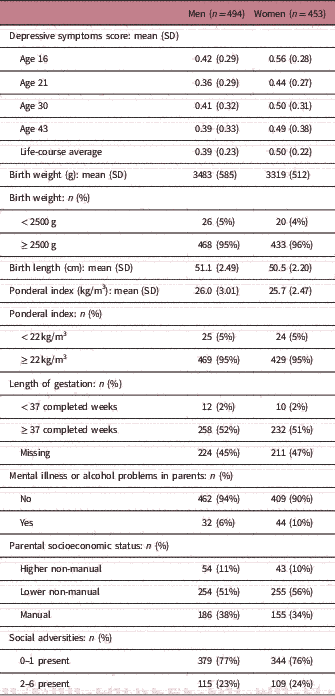
Table 1 shows the characteristics of the cohort members with complete data on all variables included in the regression models. On average, the depressive symptoms score was higher for women than men, and both sexes had the highest level at the age of 16 and lowest at the age of 21. Overall, depressive symptoms tended to be quite stable within individuals (correlation between any two consecutive measurements was above 0.40, and between the first and last measurement 0.26, P<0.001 for any pair of measurements). Mean birth weight was 3319 g for women and 3483 g for men, and approximately 5% of the sample had birth weight below 2500 g. No one in the sample had birth weight below 1500 g.
Description of the analytic sample, n=947

Trajectories of depressive symptoms
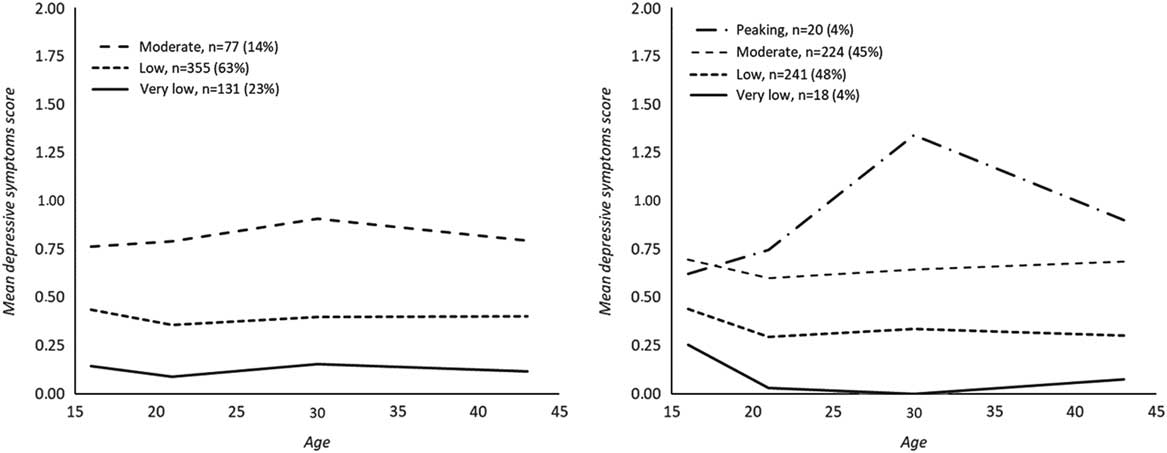
The longitudinal development of depressive symptoms score was best described by three linear trajectories for men and four quadratic trajectories for women (Fig. 1). These solutions showed the best combinations of low BIC values, sufficient class sizes, high entropy, parsimony and high posterior probabilities.
Trajectories of depressive symptoms score for men (left panel) and women (right panel) retrieved with latent class growth analysis

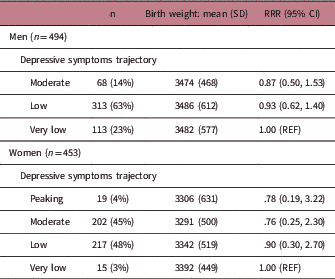
The observed stability of depressive symptoms score (as seen in Table 1) was reflected in the results of LCGA. For both men and women, three relatively stable trajectories were identified, together describing 100% (men) or 96% (women) of the sample. For women, there was a fourth trajectory, including 4% of the individuals, with symptoms score increasing between ages 16 and 30 and thereafter decreasing until the age of 43. The three stable trajectories were labelled as ‘very low’, ‘low’ and ‘moderate’ for both men and women. The ‘very low’ trajectory had a lower symptoms level and much lower prevalence (4% v. 23%) for women than for men. For both genders, the ‘low’ trajectory class was largest, which included 63% of men and 48% of women. The trajectory with highest symptoms level for men was ‘moderate’ and included 14% of the individuals. The corresponding trajectory for women included 45% individuals and was the second highest after the ‘peaking’ trajectory.
Birth weight as a predictor of depressive symptoms score
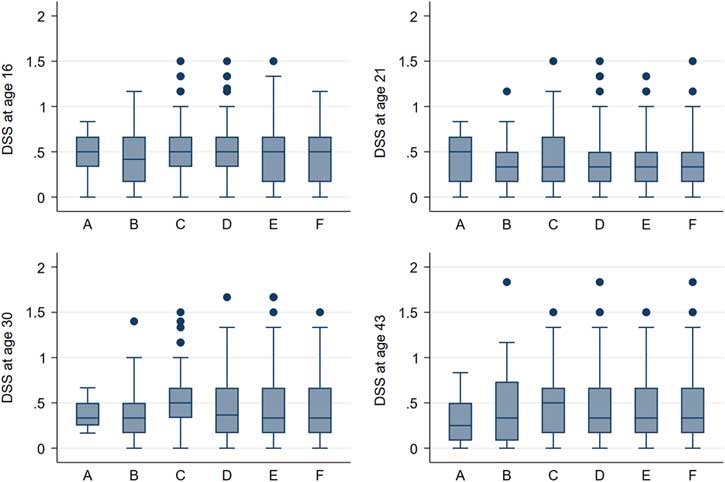
The distribution of depressive symptoms score at ages 16, 21, 30 and 43, within strata of birth weight, did not indicate any association (Fig. 2).
Box plots of depressive symptoms score for men and women combined (n=947) at age 16, 21, 30 and 43 across strata of birth weight. DSS, depressive symptoms score Categories of birth weight: (A) 1520–1999 g (n=13); (B) 2000–2499 g (n=33); (C) 2500–2999 g (n=155); (D) 3000–3499 g (n=319), (E) 3500–3999 g (n=302); (F) 4000–5200 g (n=129)

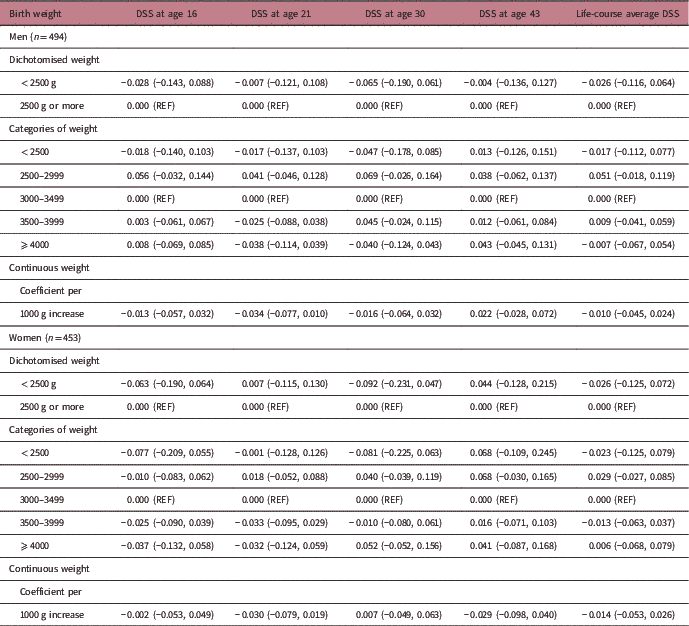
First, all the regression models were run with birth weight as the exposure variable, and then repeated with ponderal index as exposure variable. However, as there were no associations detected for any of the variables, only results for birth weight are presented (Table 2).
Difference in depressive symptoms score according to birth weight; coefficients and 95% confidence intervals estimated by linear regression

DSS, depressive symptoms score (possible values 0–2); REF, reference category
All the associations are adjusted for parental socioeconomic status when the participants were 16
Having a parent with mental illness or alcohol problems was associated with increased depressive symptoms score at age 16 (and not at other ages), but adjustments for this potential confounder made virtually no difference in the estimates (data not shown). Social adversities at the age of 16 were associated with increased depressive symptoms score throughout the follow-up, more strongly in men than in women. However, the interaction between low birth weight and social adversities was significant only for depressive symptoms score at age 43 in women, that is, in one model out of eight tested models and we see it as a chance finding (data not shown); moreover, in this model the main effects of both birth weight and social adversities were non-significant.
Association with trajectories of depressive symptoms score
In Table 3 the association of birth weight with trajectories of depressive symptoms score is presented. Note that while the trajectories were retrieved for 1066 individuals, the 947 cohort members with complete data on all variables were included in these analyses, the same subsample as for the above analyses presented in Table 2. Again, no associations were detected neither for birth weight nor for ponderal index as the exposure variable (data not shown for the latter).
Ratio of relative risks and its 95% confidence interval belonging to specific trajectory classes of depressive symptoms score per 1000 g increase in birth weight, calculated by multinomial logistic regression. The trajectories were retrieved separately for men and women

REF, reference category.
All the risk estimates are adjusted for parental socioeconomic status when the participants were 16.
The impact of prematurity on the association between birth size and depressive symptoms score
The subsample with known length of gestation (n=512) differed from those without recorded length of gestation (n=435) with respect to the following variables: they had lower depressive symptoms score at age 21 (0.38 v. 0.42, P=0.0295), higher birth weight (3447 v. 3356 g, P=0.0120) and birth length (51.0 v. 50.5 cm, P=0.0057); their parents were less often manual workers (31 v. 41%, P=0.0010) and they were less often exposed to more than one adversity in adolescence (17 v. 31%, P=0.0000). However, the association of birth size with depressive symptoms score in the subsample was similar to the main results, and adjustment for prematurity had no impact on the estimates (data not shown).
Discussion
In our analyses of the association between size at birth and depressive symptoms score between ages 16 and 43, we used a number of different approaches. We used different measures of size at birth (absolute weight, ponderal index) in order to capture different aspects of fetal growth and thus different possible underlying mechanisms. We treated the birth size variables in a variety of ways (as binary, categorical or continuous variable) in the regression models and thus tried to identify potential threshold effects and assess the shape of the relationship. Moreover, depressive symptoms score was treated as individual measurements at four different ages, as the life-course average, or as life-course developmental trajectories identified by LCGA. In a subset of the sample, we assessed the potential confounding effect of prematurity.
We did not find any relationship between weight or ponderal index at birth and our measure of depressive symptoms between ages 16 and 43 in any of the performed analyses. Adjustment for prematurity did not alter the results.
Our result replicate the null result found in a number of earlier studiesReference Herva, Pouta and Hakko9, Reference Gale and Martyn12, Reference Thompson, Syddall, Rodin, Osmond and Barker20 and are in line with the conclusion in one of the meta-analyses.Reference Wojcik, Lee, Colman, Hardy and Hotopf3 In contrast, another meta-analysis concluded that there is an association.Reference Loret de Mola, de França, Quevedo Lde and Horta4
Low power could be an explanation of null results. Compared to studies included in the meta-analyses,Reference Wojcik, Lee, Colman, Hardy and Hotopf3, Reference Loret de Mola, de França, Quevedo Lde and Horta4 our cohort is approximately median-sized and it may be too small, especially for the analyses involving trajectories of depressive symptoms score. Analysing men and women simultaneously in order to increase power did not alter the results (data not shown). With the characteristics of our data, 80% power, 5% level two-sided test and a simple linear regression model, we would need a sample of more than 1600 individuals in order to detect a change −0.034 in the depressive symptoms score (i.e. the size of the largest coefficient from the linear regression models relating continuous birth weight to continuous depressive symptoms score, see Table 2). The sample should be even larger for detecting smaller effects. It should, however, be noted that 1000 g is equal to almost two standard deviations of the distribution of birth weight, while 0.034 units is less than 10% of the standard deviation of depressive symptoms score; thus the effect would not be of high clinical significance even if it was statistically significant. Moreover, all the point estimates from linear regression models were close to zero and without apparent patterns, for example, a consistent trend across the five birth weight categories. For men, birth weight below 2500 g was even associated with a slight decrease in depressive symptoms all through follow-up (all coefficients negative). For women, the coefficients seemed to fluctuate quite randomly around zero.
Poor measurement of the exposure (birth size) or the outcome (depressive symptoms) may be a reason for not finding any association between the two. Data on birth weight and length comes from archived birth certificates and is probably quite reliable. Moreover, size at birth has shown to predict salivary cortisol levels in adulthood in both men and women, and triglycerides in women in the same data material.Reference Gustafsson, Janlert, Theorell and Hammarström21, Reference Gustafsson, Janlert, Theorell, Westerlund and Hammarström22 Our measure of depressive symptoms is not a validated instrument as questionnaire-based measures on depressive symptoms in the youth were not available at the study start. It may, however, be considered to have good content validity as the items represent common depressive symptoms. The measure has acceptable factor structure that is invariant over timeReference Hammarström, Westerlund and Kirves15 and has been associated with, for example, pain trajectories,Reference Leino-Arjas, Rajaleid and Mekuria23 structural and functional aspects of social supportReference Almquist, Landstedt and Hammarström24 and youth civic engagement.Reference Landstedt, Almquist, Eriksson and Hammarström25
Lack of adjustment for a negative confounderReference Mehio-Sibai, Feinleib, Sibai and Armenian26 might push the unadjusted estimate closer to the null. However, adjustment for SES (which is to some extent associated with many unmeasured confounders, e.g. those related to mother’s health behaviours during pregnancy), parental mental health problems or prematurity hardly affected the estimates. In previous studies,Reference Alati, Lawlor and Mamun8 adjustment for tobacco use and alcohol use in pregnancy did not explain the studied association. We conclude that our results are probably biased due to unmeasured confounders but do not believe that the bias is large enough to explain the null results.
Our cohort is relatively homogeneous in many aspects (birth year, place of living during school years etc.) and may lack heterogeneity that would disclose an association between birth size and depression. On the other hand, if there is a true biological association between birth size and later depression, the homogeneity could even be seen as a strength.Reference Rothman, Gallacher and Hatch27
The cohort was recruited at the age of 16 and the composition could be affected by selective survival of low birth weight babies related to time and place. At the time the cohort was born, in 1965, maternal and neonatal care were much less developed than today and the survival rate of infants with small birth weight lower, compared to cohorts born in later years but also around the same time in the larger cities in Sweden. Cohort members with birth weight under 2500 g were underrepresented at follow-ups at the age of 16 and 26 in a British cohort born 1970.Reference Gale and Martyn12 Less than half of extremely low birth weight (<1000 g) babies survived to hospital discharge between 1977 and 1982 in Canada, and those who survived had twice the odds of having a clinically significant psychiatric problem around age 30, compared to the normal birth weight controls.Reference Van Lieshout, Boyle, Saigal, Morrison and Schmidt28 As our cohort was selected at age 16, we lack information about the size of the underrepresentation of those born preterm and with low birth weight. However, all cohort members recruited at age 16 had birth weight above 1500 g, and the positive selection of survivors may be one explanation to the lack of associations in our study.
On the other hand, the cohort participants grew up in a developed country where the child and school health services have been extensively developed and are freely available for everyone. Thus, the lack of associations between low birth weight and depressive symptoms could partly be explained by the policies of the Swedish welfare society in successfully buffering the adverse effects of low birth weight.
In the systematic reviewReference Loret de Mola, de França, Quevedo Lde and Horta4 there was weaker association between birth weight and depression in individuals younger than 40 years and stronger in individuals older than 40 years. We did not see any tendency of increasingly stronger associations from earlier to later measurements when considering the individual depressiveness symptom scores. However, the latest measurement comes from age 43 and there is a possibility that this age is still too low.
The association between birth size and later depression is inherently confounded. Birth size is affected by many factors such as length of gestation, heritability of body size, placental function, nutrition of mother (both in an absolute sense and regarding specific micronutrients), and depression and stress in mother. If the cause of low birth weight also is associated with depression, there will be an association. For example, if the mother is depressed during pregnancy, the offspring may be small at birth, and may at the same time have inherited a disposition to depression, but is probably also exposed to maternal depression/stress that will continue after birth. Thus, the mechanism of reproduction of depression in the next generation does not go merely through fetal life but also includes cultural and social transmission.
Strengths and weaknesses
Our analyses were based on an age-homogenous, population-based cohort with prospective follow-up until 43 years of age and almost no attrition. Birth data was retrieved from contemporaneous birth records. Depressive symptoms were measured repeatedly and LCGA allowed us to identify longitudinal profiles of depressive symptoms. The analyses were adjusted for social background, and, to some extent, for genetic liability of psychopathology in the family. In a subset we could control for the effect of prematurity.
Our measure of depressive symptoms is not a clinical diagnosis of depression, but the scale has acceptable psychometric properties. A major limitation is the lack of some potential confounders (maternal smoking, depression around pregnancy and childbirth) in the data material.
Conclusions
We could not detect any association between size at birth and adult depressive symptoms in neither men nor women. This might be explained by the context where this cohort was born and grown up.
Acknowledgements
The authors would like to thank all the participants of the study.
Financial Support
The study has been financed by Formas dnr 259-2012-37. Financial support was also provided by the fund for Cutting Edge Medical Research granted by the County Council of Västerbotten dnr VLL-355661.
Conflicts of Interest
None.
Ethical Standards
The study has been approved by the Regional Ethical Review Board in Umeå.