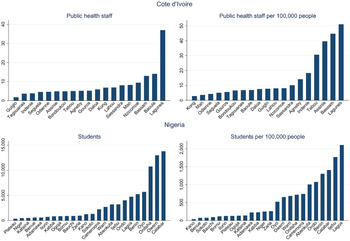
Colonial investments impacted past and contemporary political and economic development (Huillery Reference Huillery2009), but we have little systematic evidence about their origins and spatial distribution.Footnote 1 Combining multiple existing and original data sources, I present novel evidence that public investments – defined as government expenditures on public services – were very unequally distributed within sixteen British and French colonies in Africa.Footnote 2 Investments in some districts were orders of magnitude larger than in other districts in the same colony, even taking population into account (Figure 1). Inequalities were large for all three main types of investments in both empires – education, infrastructure, and health.Footnote 3 Why did European administrators invest much more in some districts than others?
Investments by district in two colonies (1910–1939 average)
Note: the left graphs show the raw number of public health staff and students per colonial district. The right graphs adjust those numbers per 100,000 people. The order of districts in the right graphs changes somewhat but the level of inequality remains very similar. Public health staff are African and European doctors and nurses. Students comprise all those enrolled in secondary schools, primary government schools and, in British colonies, aided missions (missions that received public subsidies).

Many scholars have emphasized differences in colonial institutions to explain variation in colonial and long-term development (Lange Reference Lange2004; Mahoney Reference Mahoney2010). For instance, Acemoglu, Johnson and Robinson (Reference Acemoglu, Johnson and Robinson2001) argue that colonies with more European settlers developed better institutions (such as better property rights) that favored long-term economic development. While important, these are colony-level explanations that cannot explain within-colony variation. A few have examined interesting instances of as-if random institutional variation within a colony, notably borders (Cogneau, Mespl and Spielvogel Reference Cogneau, Mespl and Spielvogel2015; Dupraz Reference Dupraz2019; Lee and Schultz Reference Lee and Schultz2012). More generally, however, colonial institutions and investments are not random but endogenous even within a colony (that is, causality runs both ways). For instance, more direct rule is correlated with higher investments (Berger Reference Berger2009). Hence, colonial institutions are better conceived as a proximate cause of colonial investments.
Perhaps to bypass this endogeneity, some have shown that areas with higher pre-colonial political centralization (a pre-colonial institution) are more developed today. Effects of pre-colonial political institutions (kingdoms) on current outcomes include higher ‘light density at night, paved roads, immunization, literacy and [lower] infant mortality rates’ (Bandyopadhyay and Green Reference Bandyopadhyay and Green2016, 471).Footnote 4 In principle, these findings could result from these areas receiving higher colonial investments. For instance, the British used the sociopolitical structure of the Buganda Kingdom and invested more there than anywhere else in Uganda. However, they invested less in the Hausa States of Northern Nigeria, which were more politically developed than the South pre-1900 (Lugard Reference Lugard1922). My data reveals that, on average, investments were rarely higher in more pre-colonially centralized areas.
Departing from institutional explanations, I argue that the economic logic of European expansion since the 1500s better explains why infrastructure, education and health investments were so unequal. My argument and empirical evidence are more closely aligned with the view of colonialism in Africa as an exploitative enterprise (Mamdani Reference Mamdani1996; Suret-Canale Reference Suret-Canale1971; Young Reference Young1994). Natural resources are often seen as central to that enterprise.Footnote 5 Wantchekon and Stanig (Reference Wantchekon and Stanig2015, 5), for example, show that ‘colonial infrastructure [in Africa] can be predicted […] by the presence of extractive resources (mines and quarries) but not by soil quality’. I also find that natural resources predict infrastructure, but the effect is modest and does not extend to education and health (non-extractive investments).
Instead, I show that pre-colonial coastal trade is the main reason why the colonial state invested much more in some districts than in others. Early commerce provides a common origin to infrastructure, education and health investments in both empires before colonial institutions took shape, which is consistent with historical accounts of commerce in the Atlantic and Indian oceans (Curtin et al. Reference Curtin1995; Hourani Reference Hourani1995, 83). I identify the effect of early trade by using natural harbors and capes as an instrumental variable.Footnote 6 Early explorers and traders in the Age of Sail (1550s to 1850s) possessed very limited information about the territory (Foster Reference Foster1967). Geographic ‘locational fundamentals’ (Davis and Weinstein Reference Davis and Weinstein2002) such as natural harbors and capes influenced where they landed and therefore the location of early trading posts. This early Triangle trade, of which slavery was an important component, in turn explains later colonial settlement and investments.Footnote 7 The long-term consequences of other pre-colonial trade systems, notably the trans-Saharan trade and Arab trade in the East, and of commercial export agriculture are beyond the scope of this article, which is focused on the effects of African–European trade on colonial investments.
I find that the relevance of pre-colonial commerce extends beyond coastal hubs. Geodesic distance from pre-colonial trading centers helps explain the limited diffusion of investments: ‘Originating in ‘nodes’ or ‘central places’, modernity then spreads or ‘diffuses’ into the more remote regions of the territory’ (Bates Reference Bates1974, 464). Diffusion is limited, however, because colonialism in East and West Africa was short-lived compared to other regions, such as Southern Africa and South Asia, where trading companies had a long-lasting influence on economic development and interethnic tolerance (Gaikwad Reference Gaikwad2014; Jha Reference Jha2013).Footnote 8
I argue that two mechanisms or agents help explain why pre-colonial trading areas and areas near them received higher investments: (1) colonial administrators piggy-backing on pre-colonial commerce to allocate investments and (2) European settlers influencing the administrators' decision making. European settlers can be better understood as agents who responded to existing investments and shaped subsequent ones than as a root cause of variation in investments or institutions. In contrast to most American colonies, settlers came to East and West Africa largely after 1900, centuries after trade on both coasts had begun, and numbered fewer than 10,000 before 1940 in all sixteen colonies under study except for Kenya. ‘Europeans tended to settle in more prosperous pre-colonial areas’ (Huillery Reference Huillery2010, 263) and lobbied for higher investments (Gardner Reference Gardner2012). These were often areas near pre-colonial trading posts, where basic infrastructure already existed and thus where further development was cheaper, an important criterion for administrators of cash-strapped colonial states.
This article makes two main contributions. First, it identifies the central role of pre-colonial commerce in colonial-era development even in the extractive context of East and West Africa, where commerce was much less developed than in India (Gaikwad Reference Gaikwad2014; Jha Reference Jha2013) or China (Jia Reference Jia2014). I also present some evidence that pre-colonial trade increases current development, and that colonial investments fully mediate that long-term effect. Secondly, the article contributes a new dataset spanning sixteen colonies of two empires to show that investments were highly unequal between as well as within colonies. Combined, these findings highlight the economic rather than institutional origins of uneven development.
Geography and Pre-Colonial Trade: The Importance of Locational Fundamentals
‘It is not an exaggeration that between 1550 and 1800 Europeans learned virtually nothing new about the lands beyond the African coastline. […] By 1875, in fact, European possessions in Africa still only comprised the coastal forts and trading stations and a few tiny colonies.’
Foster (Reference Foster1967, 45, 51)
Locational fundamentals (for example, natural harbors and capes) are observable geographic characteristics of a territory that ‘change little over time even if their economic meaning evolves. For example, there are advantages of being near a river [or] on the coast, on a plain instead of a mountain or desert, etc.’ (Davis and Weinstein Reference Davis and Weinstein2002, 1270). Locational fundamentals are important for understanding early spatial patterns of economic activity in pre-industrial contexts, where geography greatly affects mobility and economic activity (Diamond Reference Diamond2005).
Early European exploration and commerce in Africa was difficult because much of the Western and Eastern coastline did not possess geographic features that were amenable to docking ships.Footnote 9 For instance, much of the Windward and Gold Coasts in present-day Cote d'Ivoire and Ghana are comprised of shallow waters (Curtin et al. Reference Curtin1995). Given the absence of man-made docks, Europeans landed where coastal geography was favorable. Europeans observed variation mostly in geographic characteristics because knowledge of socioeconomic and other characteristics of the territory was very limited until the nineteenth century (Chi-Bonnardel Reference Chi-Bonnardel1973; Foster Reference Foster1967).
Geography was especially important during the Age of Sail (1500s-1800s), when navigation technology depended more on environmental factors and wind patterns compared to the Age of Steam (1800s-) (Feyrer and Sacerdote Reference Feyrer and Sacerdote2009). Hence, the few natural harbors and capes that existed were valuable to European explorers and traders, including slave traders (Figure 2).Footnote 10 These places often became centers of commerce between the 1500s and late 1800s; Europeans – and also Arabs in the cases of North and East Africa – sold clothes, guns and other manufactured goods in exchange for African slaves as well as raw mineral and agricultural commodities including gold, ivory, copper and palm oil. For instance, Europeans landed in three places as they descended through the Northwest African coast. One was Ras Nouadhibou (Cap Blanc), currently on the border between the Western Sahara and Mauritania. They also established trade in what would later become the cities of Saint Louis and Dakar in Senegal. The former is located in the Senegal River mouth and the latter is a cape (Cap-Vert).
Timeline of major colonial events in East and West Africa
Note: dates are approximate. Pre-colonial trade and colonization periods vary between colonies.

There are some caveats to this simple economic geography logic. The focus on the impact of African–European coastal trade on colonial investments places the trans-Saharan trade system beyond the scope of the argument and the data even though it was important for the pre-colonial politics and economics of West Africa (Curtin et al. Reference Curtin1995; Fenske Reference Fenske2014). Further, Europeans were not the first to explore and trade in East Africa, a region that had for centuries been part of commercial networks in the Indian Ocean (Hourani Reference Hourani1995, 83). Nonetheless, an equivalent logic applies there. Early centers of Arab-African trade were also defined by geographic features, especially natural harbors (for example, Mombasa), that Europeans readily leveraged when they arrived in the 1500s.
Ultimately, early trade in both East and West Africa resulted from a combination of geographic constraints and economic incentives. The most prominent economic incentive was the shipment of millions of Africans to be sold as slaves in world markets, primarily in the Americas. The legacy of pre-colonial trade is, to a large extent, the legacy of the slave trade. The economic benefits of slavery for the European and African merchants selling them were so great that some important pre-colonial trading posts (such as Ouidah in Benin) were established in the shallow waters of the Winward and Gold Coasts, where smaller boats would transport slaves to trading posts with more favorable geographies that could accommodate larger boats (for example, Dakar in Senegal) – showing the interaction of geographic incentives and economic constraints. But economic incentives were not limited to slaves. Even before the ‘commercial transition’ away from slaves and into ‘legitimate trade’ in commodities in the 1800s (Frankema, Williamson and Woltjer Reference Frankema, Williamson and Woltjer2018), other trades were important enough to have regions named after them: the Gold Coast (present-day Ghana), the Ivory Coast and the Pepper Coast (present-day Liberia). Trade in Saint Louis (Senegal) included animal skins and gum arabic from acacias; beads were a valued currency; and the presence of natural resources in a few areas, notably the gold mines of Ghana (formerly the Gold Coast), led to the British disruption of a trans-Saharan trade that had existed for centuries (Young Reference Young1994, 134). Even there, the British first landed in Cape Coast, suggesting that the combination of geography and economic incentives shaped trade.
Horowitz (Reference Horowitz1985, 151) approximates the economic geography argument presented here when he describes interactions in the early colonial period between Europeans and local populations in Africa and Asia: ‘Groups located near the colonial capital, near a rail line or port, or near some center of colonial commerce – the sitting of which was usually determined by capricious factors, such as a harbor or a natural resource to be exploited – were well situated to take up opportunities as they arose.’ In brief, before Europeans conquered Africa and established colonial institutions, geography prompted an early divergence between areas in or near commercial centers and those areas that were not.
Early Trade and Colonial Investments
Proximity to trading centers remained advantageous during the colonial period. As Europeans increased their effective control of the colonies by the turn of the twentieth century, trading posts remained central points for the international shipment of goods produced elsewhere in the colony, which strengthened linkages to the international economy (Laitin Reference Laitin1982). Lagos and other early commercial centers such as Abidjan and Freetown became colonial capitals, adding a political dimension to their economic pre-eminence within the colony. These capitals were not chosen for their central location within the colony (as would later be the case in independent Nigeria and Cote d'Ivoire) because colonial borders were barely defined. They were chosen because of their existing infrastructure. And while colonial economic activity extended to many regions in each colony, many important public investments in hospitals and schools remained in or near centers of pre-colonial commerce, such as the École William Ponty in Gorée (Senegal) and Fourah Bay College in Freetown (Sierra Leone).
Colonial administrators invested in education and health for several reasons unrelated to pre-colonial trade,Footnote 11 but the location of twentieth century investments often followed early investments near trading posts because colonial officials could rely on existing infrastructure and hence on lower costs. The districts of Dakar and Saint Louis in Senegal, early settlements because of their geography, illustrate this pattern. Saint Louis' harbor was the center of early trade between French companies and the Wolof since the 1600s and, Saint Louis being the capital of Senegal, Governor Faidherbe developed it further in the 1800s. Dakar, notably its island of Gorée, was infamous for being a slave trading post. Dakar eventually replaced Saint Louis as the economic center of Senegal, and by 1902 it was also the political center as the capital of the federation of French West Africa. Nonetheless, Saint Louis remained a trading center and an important educational center where students were educated, by force if necessary, in public schools such as the School for Sons of Chiefs. The continued importance of both cities led Governor Faidherbe to build a railroad connecting them, thereby compounding the advantage of these two cities over other parts of the colony.
Path Dependence and Increasing Returns
Path-dependent patterns analogous to those described above have been theorized elsewhere (Pierson Reference Pierson2000), originally in Krugman's (Reference Krugman1991) application of increasing returns theory to economic geography.Footnote 12 Similarly, each colony had only a few central districts with extensive infrastructure; most of their territories constituted an agricultural or pastoral periphery with limited colonial state reach (Herbst Reference Herbst2000; Jackson and Rosberg Reference Jackson and Rosberg1982). The initial costs of investments in a new location, including transportation costs, were compounded by uncertainty about their future profitability because of deficient knowledge of the hinterland even after Europeans defined the colonial borders.
These reasons also suggest an account for the diffusion of investments, namely that investments in the colony might decrease as distance to early commercial centers increases. We know that, in developed countries, ‘agglomeration economies attenuate with distance’ (Rosenthal and Strange Reference Rosenthal, Strange, Henderson and Thisse2004, 2120). This logic may readily extend to colonies in their early stages of state formation and development given limited state capacity and the inability of both British and French colonial states to establish any important European presence in peripheral regions. Indeed, inequality between districts within colonies increased during the colonial period, which is consistent with a logic of increasing returns (Appendix E). Of course, there are exceptions to the logic of increasing returns and agglomeration economies. Nairobi replaced Mombasa as the capital of Kenya in the early 1900s, despite it being in a pre-colonially peripheral region, in part because of favorable agricultural factor endowments in central Kenya. The ‘White Highlands’ in central Kenya, so-called because of the high number of settlers, led this region to become a second center of political and economic power alongside coastal Mombasa. Rather than considering geography as fate, I emphasize that locational fundamentals powerfully shaped early commerce and subsequent colonial investments.
Colonial Administrators and Settlers as Mechanisms
The explanation thus far has been largely devoid of agency. Here, I argue that colonial administrators and European settlers are two mechanisms that link the historical account, which emphasizes economic geography, with the subsequent allocation of investments within colonies. The agency of administrators and settlers was especially important in a context where, unlike Weberian states, colonial institutions (rules) to allocate public investments were ill defined.Footnote 13
Colonial administrators faced important budget constraints that forced them to concentrate investments in the colonial core, where some basic infrastructure already existed, rather than the periphery. East and West African colonies were ruled on the cheap (Herbst Reference Herbst2000). British and French colonial officials routinely applied to their respective ministries for subsidies to complement revenues from tariffs and taxes. However, the metropole strove to reduce the quantity of funds available to colonial governments, especially of grants-in-aid (Constantine Reference Constantine1984, 14, 84; Gardner Reference Gardner2012, 9), because London and Paris wanted these colonies to be self-sufficient. ‘The concerns of British parliamentarians that the Empire would become a drain on the British Treasury’ led ‘the imperial government to delegate the costs and financial risks of imperial expansion whenever possible’ (Gardner Reference Gardner2012, 18). Similar to Britain, only ‘in the aftermath of World War II [did] France abandon the requirement that colonies should pay for themselves and began assuming the cost of some public programs’ (Lawrence Reference Lawrence2013, 118).Footnote 14 Until then, public revenue raised by the colonial state was largely limited to trade tariffs and taxes imposed on Africans, including regressive head taxes (Hopkins Reference Hopkins1973).
In addition to meager budgets, financial aid from the metropolitan was often earmarked for military purposes until 1945 and colonial rule was often improvised, decentralized and tentative (Darwin Reference Darwin2012; Delavignette Reference Delavignette1968; Huillery Reference Huillery2009). These three considerations left little room for long-term and detailed investment strategies, as I discuss in Appendix B.1. Instead, administrators leveraged existing infrastructure, often in or near early trading centers, thereby maintaining or even increasing within-colony inequalities during the colonial period (Appendix E).
Settlers constitute a second mechanism to understand investment allocation and the persistent divide between the core and periphery of each colony. The needs of the local population were not a major concern: colonial officials on the ground responded more to their superiors than to the colonized; that is, there was some upward accountability but no downward accountability. By contrast, the needs of the settler population were taken more seriously. For instance, some settlers in Kenya created the European Taxpayer's Protection League to shift the tax burden further away from Europeans to the local population (Gardner Reference Gardner2012, 98), thereby benefiting from public investments without paying for them. Many of these resided in the aforementioned White Highlands, the region in central Kenya that generated much of the colony's revenue from tea, coffee and other crops. Like in Kenya, Europeans only began to settle in East and West Africa in the late 1800s and early 1900s. Unlike in Kenya, most of them settled in the incipient cores of the colonies such as the Four Communes in Senegal, the Freetown colony in Sierra Leone and Lagos Colony in Nigeria. This consolidated early commercial centers as the colonial centers of political and economic activity.
It would be facile to consider public investments as simply a function of settler demands. The interests of the British Colonial Office or the French Ministry of the Colonies did not always coincide with those of settlers, itself a diverse group comprising traders, farmers, missionaries and sundry Europeans (Darwin Reference Darwin2012). For example, granting additional land to European settlers risked further alienating the local population. Nevertheless, I argue that Europeans settled strategically in core locations overall, thus leading to the feedback loop effect that is characteristic of increasing returns by influencing the subsequent allocation of colonial investments in infrastructure (to export their goods), education (to educate their offspring) and health (to enjoy decent health care). I turn to historical data to present a descriptive analysis of the spatial distribution of colonial public investments and then proceed to test these arguments quantitatively.
Data Sources
This article presents extensive data collection on investments at the colonial district level for French West Africa – collected by Huillery (Reference Huillery2009) – and for the main eight British colonies under the Colonial Office – original data collection. The sixteen colonies are Benin (formerly Dahomey), Burkina Faso (Upper Volta), Cote d'Ivoire, Ghana (Gold Coast), Guinea, Kenya, Malawi (Nyasaland), Mali (French Soudan), Mauritania, Niger, Nigeria, Senegal, Sierra Leone, Tanzania (Tanganyika), Uganda and Zambia (Northern Rhodesia). One important advantage of focusing on these colonies is their rather homogeneous institutional structure within each empire (Appendix B). Unlike French Algeria or British Southern Africa, most of East and West Africa was not integrated into the French and British empires until late in the nineteenth century. Due in part to their similar colonial experience, all sixteen colonies became independent around 1960.
Another important advantage is that record-keeping procedures were very similar within each empire, since administrators reported to the Ministry of the Colonies in Paris and the Colonial Office in London. Huillery (Reference Huillery2009) collected the original French records for multiple years in the 1910–1939 period.Footnote 15 I collected British colonial records from 1915, 1920, 1927, 1928 and 1938 as a function of the availability of disaggregated data. They often contain detailed information on demographics, education, health, infrastructure investments and other activities (Figure A.16 shows a page of a British Blue Book and a page of a French Compte Définitif). I georeferenced colonial investments by taking advantage of detailed colonial maps with district boundaries (Figure A.17).Footnote 16 I also constructed a variable coding whether the district had a railroad using a 1941 map of Africa (Army Map Service 1941).
Colonial records are not without problems, however. Data on infrastructure, health and education are organized by town or district in some years but aggregated by colony in others, which does not allow for subnational analysis. Records also contain gaps, such that some data are available in some years but not in others. Further, population censuses were far from accurate in the early colonial period, when colonial administrators sometimes engaged in educated guesses (Cooper Reference Cooper2005; Frankema and Jerven Reference Frankema and Jerven2014). British and French investment records may contain measurement error as many other historical records but, assuming they do, there is no evidence to my knowledge that this possible error is systematic or that it affects some districts within a colony more than others, which would be the main concern for a study that leverages within-colony variation.
To explain colonial investments, I collected a set of sources that provide information on the physical, geographic, social and economic characteristics of each district. Appendix F provides a colony-by-colony discussion of coding decisions and lists the sources used to code pre-colonial trading posts, natural harbors (bodies of water that are protected and deep enough to furnish anchorage) and capes (large promontories extending into a body of water). Coastal districts with a natural harbor, a major cape or a major pre-colonial trading post equal 1 for the respective variable and 0 otherwise. They are coded as including a pre-colonial trading post (indicator equals 1) if they satisfy at least one of two conditions: (1) 250 or more slave ships sailed from pre-colonial trading posts/forts located in that district (for example, Ouidah in Benin) or (2) the district includes an important pre-colonial post that traded commodities (for example, Saint Louis in Senegal).Footnote 17 Given the lack of detailed trade volume data for each location, these criteria focus on major trading posts and purposely exclude minor ones. To explain investment diffusion, I calculated the geodesic distance from each district capital to the closest trading post. I also coded the first pre-colonial trading post in each colony, coastal or inland, to examine investment diffusion in the full sample.
I also draw on Murdock's (Reference Murdock1959) dataset of pre-colonial ethnic group characteristics because it provides useful proxies of pre-colonial political institutions and development that may affect investments, such as intensity of agriculture, settlement patterns, the size of local communities and level of political centralization.Footnote 18 I coded two additional pre-colonial ethnic characteristics. One consists of two indicator variables that code whether the district was located in a pre-colonial kingdom or in an acephalous society (Encyclopedia Britannica 2020; Olson Reference Olson1996), thereby extending Huillery's coding for French districts to British ones. The other is an ordinal variable for low, medium or high historical presence of Islam (Bartholomew Reference Bartholomew1913) because a higher presence of Islam may favor indirect rule and possibly reduce investments.
The dataset also contains geological and geographic covariates that may affect levels of investment. Colonialism in East and West Africa was extractive, so I geocoded two maps on natural resources because their presence may especially increase infrastructure investments. Hubert's (Reference Hubert1922) map (Figure A.8) is likely the most comprehensive early map for West Africa. Kuhne (Reference Kuhne1927) provides a detailed worldwide map. I complement these two main sources with an early publication by the United States Geological Services (USGS 1921) that also has world coverage but is much less detailed (cf. Appendix G). Huillery (Reference Huillery2010) collected several geographic attributes for French districts, such as distance between the district capital and the coast and the presence of navigable rivers, which I complement with a map by Hammond (Reference Hammond1921). I extend those variables to include British districts and code additional ones that could affect colonial investments. Altitude, for instance, is a rough proxy for disease environment, notably for malaria (World Health Organization 2016). I use a map of malaria prevalence around 1900 (Lysenko and Semashko Reference Lysenko, Semashko and Lebedew1968) and tsetse fly data from the Food and Agriculture Organization (Alsan Reference Alsan2015). Tropical Africa was ‘often referred to as the white man's grave’, so historical disease prevalence is important because it could reduce investments systematically (Darwin Reference Darwin2012, 138).
Descriptive Statistics
I present some descriptive statistics that further motivate the article and confirm that within-colony inequality across districts was high. Infrastructure investments equal the sum of public expenditures in construction, transportation, sewage and electricity. Such expenditures in a district-year were 50,000 FRA on average, in 1910 French francs (Table A.1). Levels vary widely by colony (Figure A.9) and public investments are positively correlated.Footnote 19 For example, infrastructure and health investments by district are correlated at ρ = 0.51 in British districts and ρ = 0.55 in French districts (Figure A.1).
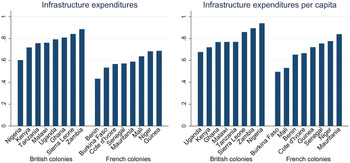
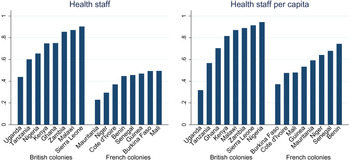
I quantify inequality in infrastructure, education and health investments by computing Gini indices by colony (Figure 3). These are calculated using investment levels by districts (Figures A.10–A.15). Gini indices typically use individual income to measure economic inequality, where 0 means perfect equality and 1 perfect inequality. If investments were perfectly equal across districts, the Gini index would be 0. If one district received all investments, it would be 1. The literature often computes regional Gini indices or the Williamson Coefficient of Variation (Díez-Minguela et al. Reference Díez-Minguela2017; Milanovic Reference Milanovic2016), but one limitation of this approach is that districts are not individuals. Thus regional inequality measures have to be treated with caution because they can be altered by redrawing regional boundaries.Footnote 20
Infrastructure Gini indices by colony (1910–1939 average)

Education Gini indices by colony (1910–1939 average)

Health Gini indices by colony (1910–1939 average)
Note: the 48 Gini indices are calculated using district-level investments (rather than individual income, unavailable at the time) as the units of analysis.

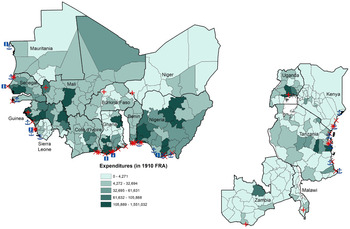
Overall, Figure 3 shows that inequality between districts was around 0.7 in British colonies and 0.5 in French colonies, higher than contemporary regional inequalities in many countries (Díez-Minguela et al. Reference Díez-Minguela2017; Milanovic Reference Milanovic2016). District inequality in infrastructure expenditures is around 0.7 in the average British colony and around 0.6 in the average French colony. They are usually at or above 0.4 for education (proxied by students per district) and health (doctors and nurses per district). The lower inequality in French compared to British colonies could be the result of redistributive federal budgets in French West Africa, while between-colony variation could be the result of many colony and imperial factors beyond the scope of this article. Figure 6 shows the distribution of infrastructure investments alongside pre-colonial trading posts (both coastal and the first one in each colony), natural harbors and capes. Overall, the map suggests that infrastructure investments were higher along the coast and especially in areas with pre-colonial trade (even if some districts such as Freetown in Sierra Leone or Dakar in Senegal are hard to see because their area is small) and that investments tend to diffuse to districts neighboring those with pre-colonial trade.Footnote 21
Geography, pre-colonial trade, and public infrastructure expenditures by district (1910–1939)
Note: this map shows the level of public infrastructure expenditures by district (1910–1939 average), the location of pre-colonial trading posts in coastal colonies (X), the location of the first pre-colonial trading post in each colony (+), and the location of natural harbors (anchors) and capes (lighthouses). I displace natural harbors and capes slightly in the map to facilitate visibility.

Results
The results are structured in four parts. I first examine the impact of pre-colonial trade on colonial investments in coastal colonies, where accidented geography provides exogenous variation in the establishment of pre-colonial trading posts. Next, I consider alternative explanations. I then analyze the diffusion of colonial investments within colonies and whether district inequalities increased, remained stable or decreased between 1910 and World War II (1939). Finally, I investigate the importance of pre-colonial trade and colonial investments for contemporary economic development.
I begin by modeling the first-stage effect of geography on pre-colonial trade and the reduced-form effect of geography on colonial investments (Table 1):
 $$\log ( Y_{ij}) = \beta _0 + \beta _1G_{ij} + L^T\beta _{2k} + N^T\beta _{3k} + S^T\beta _{4k} + \eta _j + \epsilon _{ij}$$
where Y is a vector including a pre-colonial trade indicator and four colonial investments in district i in colony j (1910–1939 average): infrastructure expenditures (adjusted to 1910 French francs), an indicator for the presence of a railroad in the district (measured in 1941), the number of students and the number of health staff. Infrastructure, education and health are logged to increase normality. G stands for natural harbors and capes, L denotes other locational fundamentals (the presence of a navigable river, indices for rugged terrain, tsetse fly and malaria), N for natural resources (indicators for the presence of noble and base metals and a soil quality index), and S for colonial district African population, area and pre-colonial socioeconomic characteristics (ethnic diversity, Islam prevalence, intensity of agriculture, settlement patterns, pre-colonial political centralization and indigenous slavery). All models include colony fixed effects (η) that account for time-invariant differences between colonies, such as differences in levels of investment, colonial state institutions and reliability of records.Footnote 22
First-stage effect of geography on pre-colonial trade and reduced-form effect of geography on colonial investments (1910–1939 average)

Note: robust standard errors in parentheses. The first-stage models show that districts with a natural harbor or cape were more likely to have a center of pre-colonial trade. The reduced-form models show that districts with a natural harbor or cape received higher investments in all investments except for railroads, as expected. Outcomes are logged to reduce dependence on extreme observations because investment distributions are unequal. The number of observations varies by colonial investment because the dataset lacks student data for Mauritania and public health staff data for Conakry. The Angrist-Pischke first-stage F-statistic is between 22 and 26 across models, above the Stock and Yogo convention of 10 for weak instruments. Controls include the presence of a navigable river, indices for rugged terrain, tsetse fly and malaria, indicators for the presence of noble and base metals, a soil quality index, African population, and area and district socioeconomic characteristics (ethnic diversity, Islam prevalence, intensity of agriculture, settlement patterns, pre-colonial political centralization and indigenous slavery). †p < 0.10, *p < 0.05, **p < 0.01
The two-stage least squares (2SLS) models instrument pre-colonial trade. The exclusion restriction claim is that natural harbors and capes affect colonial investments because they enabled pre-colonial trade in the first place and not through other means. The exclusion restriction only needs to hold conditional on the controls listed in Table 1, although many of these controls are post-treatment. Early pre-colonial trade undoubtedly enabled later colonial trade, investments in forts and European settlement – all of which are likely mechanisms of persistence (I explore some of these possible mechanisms below). In other words, the impact of pre-colonial trade likely traveled through many channels. The main claim is that, at the outset, natural harbors were helpful because they facilitated the anchorage of European sailboats that engaged in trade. The model is as follows:
 $$T_{ij} = \gamma _0 + \gamma _1G_{ij} + L^T\gamma _{2k} + N^T\gamma _{3k} + S^T\gamma _{4k} + \eta _j + \nu _{ij}$$
 $$\log ( Y_{ij}) = \beta _0 + \beta _{IV}\hat{T}_{ij} + L^T\beta _{2k} + N^T\beta _{3k} + S^T\beta _{4k} + \eta _j + \epsilon \smallint _{ij}, \;$$
where all notation is analogous to Equation 1 and indicator T is the presence of a pre-colonial trading post.
The results from Table 1 strongly suggest that accidented geography affected the location of posts (first-stage Models 1 to 3) and that it also affected infrastructure, education and health investments (reduced-form Models 4 to 7).Footnote 23 Next, I estimate the effect of pre-colonial trading posts on colonial investments using ordinary least squares (OLS) models alongside the second stage of the 2SLS or instrumental variable (IV) models. Since the outcome is logged to reduce right-skew, the percent change in Y can be interpreted as 100β IV. The presence of a pre-colonial trading post increases expenditures in infrastructure and the number of students by about 200–300 per cent and the number of health staff by around 125–275 per cent, depending on the specification. The magnitude varies little depending on the set of controls. Adding post-treatment variables slightly reduces effect sizes, but the effects remain stable across specifications (Table A.7). Because missions were central to education, especially in British colonies and before 1945, I show that the results on education proxied by the number of students also apply if we instead use the number of missions as the outcome (Table 2 and Table A.19).
Second-stage results for the effect of pre-colonial trade on colonial investments (1910–1939 average)

Note: robust standard errors in parentheses. The table presents OLS results alongside 2SLS (IV) results. The controls are identical to those listed under Table 1. †p < 0.10, *p < 0.05, **p < 0.01
Pre-colonial trade does not increase the likelihood of having a railroad. This null finding matters for two reasons. First, it suggests that pre-colonial coastal trade cannot explain inland transportation infrastructure, thereby qualifying its importance. Secondly, the finding is consistent with recent research documenting that colonial railroads were affected by, and in turn affected, the location of primary commodity production (cash crops), urban development, and mining and military developments (Jedwab and Moradi Reference Jedwab and Moradi2016, 275; Roessler et al. Reference Roessler2016). My cross-sectional identification strategy cannot capture these dynamic inland developments during the colonial period.
The models could suffer from two related concerns: spatial dependence and the fact that natural harbors, capes and pre-colonial trading posts in coastal colonies are located along the coast. I therefore first restrict the models to examine only coastal districts. While the sample size decreases and an analysis limited to coastal districts cannot adequately test for other competing explanations, as I do below, it makes for a better comparison from an econometric standpoint. Table A.14 shows that the results for infrastructure, education and health are very similar – which is reasonable since variation in pre-colonial trade from the main models stems from coastal districts.Footnote 24 The second concern is spatial clustering resulting from the coastal concentration of the main variables of interest. To alleviate these concerns, I rerun the main results with Conley standard errors (Figure A.2) and use wild cluster bootstrapped standard errors, rather than regular clustered standard errors given the small number of colonies (Figure A.3).
Whether I include all districts in coastal colonies (Table 3) or only coastal districts (Table A.14), estimate sizes for IV models are larger than for OLS models. These often differ because, using experimental language, β OLS ideally estimates an average treatment effect on the full sample, while β IV ideally estimates a local average treatment effect on the subsample of compliers. Some places, such as Mombasa in Kenya (instrument equals 1) and Ouidah in Benin (instrument equals 0), might arguably be always-takers. Others, such as Dar-es-Salaam in Tanzania (instrument equals 1) or Pujehun in Sierra Leone (instrument equals 0), might arguably be never-takers. Because colonial investments would have been higher for always-takers regardless of the value of the instrument, the effect for the subset of compliers might be larger than the effect for the whole sample. In other words, the increase in β IV with respect to β OLS may be reasonable because, having examined the set of potential always-takers, compliers and never-takers, the IV likely reduces selection.
Diffusion of investments (1910–1939 average) across districts within coastal colonies

Note: robust standard errors in parentheses. †p < 0.10, *p < 0.05, **p < 0.01
Finally, I conduct Oster's test to examine how susceptible my results may be to selection on unobservable variables. Unobservable variables would need to be 2 to 2.3 times as important as observables for the effect of pre-colonial trade on infrastructure, education and health to become zero (Table A.6). As I explain in Appendix A.1, this is unrealistic because of the long list of observables and because the effect only goes to 0 with extremely high R 2.
Other Geographic and Pre-colonial Explanations
I consider some plausible alternative and complementary explanations to pre-colonial trade in a simple OLS framework (Table A.22). Only two clear patterns emerge. First, African population is positively correlated with investments. This association could be driven by reverse causation – that is, locals migrating to more developed districts. Secondly, the table presents a coherent account of railroads. They were built in districts without rivers, since the two are substitutes; in districts with natural resources, supporting an extractive logic; and in districts that were less malaria prone, less ethnically diverse and more populated.
Geographic variables other than those listed above seem to have a limited role in explaining colonial investments in infrastructure, health and education – although the analysis here is simply correlational. For instance, distance to the coast, a standard control, is negative across investments as expected but not always significant. Infrastructure expenditures are 68 per cent higher and railroads more likely in districts with noble metals (gold, silver) or diamonds.Footnote 25 However, the association does not extend to non-extractive investments (education and health) or even base metals, a less valuable but abundant type of metal in West Africa (Figure A.8). The effects of disease environment also appear to be modest overall. Malaria, the prevalence of which was more common further inland, seems to deter the construction of colonial railroads and reduce infrastructure expenditures in coastal colonies.
Pre-colonial institutional and socioeconomic characteristics differed between ethnic groups and could affect investments. First, and perhaps surprisingly, higher pre-colonial political centralization (Murdock Reference Murdock1959) does not increase investments. Alternative specifications using pre-colonial kingdom and acephalous society indicators are not significant either, and bivariate correlations are usually below 0.1. Pre-colonial kingdoms provide better public services and are more developed today (for example, Michalopoulos and Papaioannou Reference Michalopoulos and Papaioannou2013), but higher levels of colonial investments are not the mechanism.
Secondly, Europeans might have invested less in ethnically diverse districts if these were more difficult to govern. Using Murdock's (1959) map of ethnic homelands, I construct an index of ethnic fractionalization at the district level and find that it only reduces the likelihood of a railroad in the district.Footnote 26 Thirdly, a simple ordinal measure for prevalence of Islam (minority, mixed or majority) suggests that more Muslim districts have fewer students but not lower infrastructure expenditures or health personnel. The finding is consistent with arrangements by which the colonial and local authorities agreed to limit Western education in predominantly Muslim regions, such as Mauritania and Northern Nigeria. Finally, hostile districts received fewer settlers (Huillery Reference Huillery2010), so they may have also received fewer investments. I find very modest support for this hypothesis (Table A.23). These patterns of largely null results are very similar between empires, although I discuss a few differences in Appendix D.2.
These largely null results fail to find support for, rather than disprove, the competing explanations above because of their correlational nature. However, they strongly suggest that pre-colonial trade is an important determinant of investments both absolutely (its effect size is large) and relative to other possible explanations.
Diffusion and Persistence of Colonial Investments
How did investments diffuse within East and West African colonies from early trading enclaves to the rest of the colony? Diffusion patterns may help us better understand the origins of spatial inequality (Bates Reference Bates1974) and the ‘ethnic distribution of colonial opportunity’ (Horowitz Reference Horowitz1985). Colonial state expansion was progressive and limited because of European financial and manpower constraints (Young Reference Young1994). In developed countries, agglomeration economies tend to extend beyond initial enclaves and to attenuate with distance (Rosenthal and Strange Reference Rosenthal, Strange, Henderson and Thisse2004). Following that logic, and to the limited extent that investments spread across districts, I examine whether early trade was relevant or instead its importance was circumscribed to these colonial development hubs. I examine diffusion for coastal colonies below, and for non-coastal colonies in Appendix D.2. I use linear models of the form:
 $$\log ( Y_{ik}) = \beta _0 + \beta _1T + \beta _2DT + \beta _3DC + \beta _4P + \beta _5E + \eta _k + \epsilon _{ik}$$
where Y is the investment of interest, T is an indicator for pre-colonial trade post, DT is the distance between the district capital and the nearest pre-colonial trading post, DC is the distance between the district capital and the coast, P is logged population, E is the logged number of Europeans, and η are country fixed effects. I include a pre-colonial trading post indicator and the standard coastal distance measure to examine variation between districts without a trading post that is not already explained by coastal distance. I use geodesic distances between district capitals advisedly because doing so eliminates the endogeneity of man-made transportation infrastructure and local geography such as hills and rivers.
Increasing distance from a pre-colonial trading post reduces all types of investments (Table 4). The results are not identified but suggest that the limited diffusion of colonial investments we observe is partly a function of early trade, consistent with Gaikwad's (Reference Gaikwad2014) findings in India, even after controlling for coastal distance. The negative effect of increasing distance from early trade likely goes through many channels, one of which could be European settlers. They chose districts that were centers of economic activity, which may compound the advantages of early trading locations (such as Dakar and Lagos) and of their surroundings (Thies and Abeokuta, respectively). European settlers are associated with higher investments, even controlling for African population, and reduce the effect of trade, which supports the idea that they are a relevant mechanism (Table 5).Footnote 27 Distance from a pre-colonial post remains negative but is smaller across investments, consistent with the idea that settlers influenced the diffusion of investments. Hostility to the colonizers reduced the number of settlers (Huillery Reference Huillery2010), but does not affect their mediating role (Table A.24). I present analogous results for non-coastal colonies in Appendix A.3.
European settlers as a colonial investment diffusion mechanism

Note: robust standard errors in parentheses. †p <0.10, *p < 0.05, **p < 0.01
Impact of pre-colonial trade and colonial investments on current development, proxied by average nightlights by district (1992–2012, logged)

Note: robust standard errors in parentheses. See Figure 1 for first-stage results. The outcome is logged nightlight density averaged by district across three years (1992, 2002 and 2012). The controls are identical to those listed under Table 1, including district area and colonial district population in the 1920s-1930s. Table A.14 adds a coastal district indicator as a robustness check. †p < 0.10, *p < 0.05, **p < 0.01
I move beyond the cross-sectional results presented thus far to show that investments across districts do not converge and sometimes diverge even further during colonial times (Appendix E).Footnote 28 Serial correlations show that inequalities persist in both empires for the three main public investments (infrastructure, education and health), especially in education and infrastructure (Figures A.6 and A.7). To examine whether these disparities decrease or increase, I use autoregressive models in the case of French West Africa (Tables A.25–A.27) where, albeit unbalanced, the data are a panel. I find that initial disparities in education and health either remain constant or increase, while the results are mixed for infrastructure. Within-colony inequality may have increased even further during the ‘developmental phase of colonialism’ (1945–1960), which witnessed a large increase in investments in both empires (for example, Boone Reference Boone1992, 55).Footnote 29
In sum, these exercises do not disentangle the mechanisms of persistence cleanly, as future research should. However, they show that the importance of early trade extends beyond initial enclaves, that disparities in public investments tend to remain stable or increase, and that European settlers help explain this feedback loop of weakly increasing investment disparities within colonies. These findings indicate that pre-colonial trade underpins Horowitz's (Reference Horowitz1985, 151) ‘ethnic distribution of colonial opportunity’ and spatial inequality (Bates Reference Bates1974) during colonialism and even today, as I discuss briefly below.
Effects of Trade and Investments on Current Development
Before concluding, and while not the focus of this article, I provide some evidence that pre-colonial trade and colonial investments underpin spatial inequality and levels of economic development today. Table 3 shows that pre-colonial trading posts increase current development levels, as proxied by nightlights, whether we use OLS or 2SLS models. Notice that the demands on the conditional exclusion restriction are the same whether the outcomes are colonial investments or current level of development because pre-colonial trade is temporally prior to both. The main difference is that more mechanisms may account for the effect of early trade on current development, notably colonial investments. In fact, that is precisely what Table 3 shows: the long-term effect of pre-colonial trade on current development is fully mediated by colonial investments. It is no longer significant once we account for colonial investments, which are post-treatment (the same applies if we split the models by empire, cf. Table A.13).Footnote 30
The findings in Table 3 point to the continued relevance of colonial investments for development, expanding the evidence provided by Huillery (Reference Huillery2009) for French districts to British districts. Shifting the focus away from colonial institutions to explain colonial investments in turn provides us with a better understanding of why current levels of development remain so unequal within East and West African countries.
Conclusion
Colonialism in the twentieth century shook the African continent in myriad ways. Unlike most explanations, which focus on the colonial era, I go further back in time to argue that pre-colonial trade patterns explain why colonial investments were higher in some districts than in others, which in turn helps explain uneven economic development today. The within-colony design increases comparability by accounting for colony-level factors, while instrumenting pre-colonial trade with natural harbors and capes – observable geographic characteristics that were important in the Age of Sail – increases confidence in the causality of the results.
This economic emphasis on the role of early trade for development – and ultimately on geographic characteristics that favor it – shifts the focus away from explanations centered on colonial institutions, which were endogenous to investments, and from pre-colonial institutions, which rarely affected investments. Most prior studies of colonial institutions explain how colonial decisions were made, but an economic logic is better placed to explain where investments were made.
These findings speak to the importance of pre-colonial trade for long-term development not just in South Asia and China (Jha Reference Jha2013; Jia Reference Jia2014) but also in Africa, a much more extractive context. The slave trade in particular had nefarious consequences at the point of origin or extraction (Nunn and Wantchekon Reference Nunn and Wantchekon2011). Perversely, it increased development at the African point of destination.
The positive effect of early trade on public investments is not circumscribed to early enclaves: infrastructure, education and health investments decrease the further a district is from a pre-colonial trading post. Findings in developed countries showing that ‘agglomeration economies attenuate with distance’ (Rosenthal and Strange Reference Rosenthal, Strange, Henderson and Thisse2004, 2120) may extend to colonies in their early stages of state formation and development. Investment inequalities between districts do not diminish during the 1910–1939 period: locations with an early advantage became centers of economic activity and benefited from complementarities among investments. The pattern is consistent with a logic of increasing economic returns (Krugman Reference Krugman1991), albeit in a political context (Pierson Reference Pierson2000): instead of firms in a private market, the agents are administrators allocating public finances. I suggest that autonomous administrators piggy-backing on pre-colonial commerce and European settlers demanding investments are two mechanisms or agents that help explain the effects of early trade investments.Footnote 31
One caveat is that colonial railroads, a major inland investment, do not result from coastal trade. This null result qualifies my path-dependent findings: colonial transportation infrastructure was probably more affected by factors such as colonial markets for primary commodities (Boone Reference Boone1992; Jedwab and Moradi Reference Jedwab and Moradi2016, 275; Roessler et al. Reference Roessler2016). Another important caveat is that I cannot fully disentangle the mechanisms of persistence. Future research, perhaps using case studies or micro-level data, could address that shortcoming.
Some scholars have emphasized that colonial institutions underpin current (under)development in Africa and Latin America. More recently, some have noted the importance of colonial-era investments, especially in human capital (including missionaries). More broadly, by showing that colonial and even current regional economic inequality can be traced back to pre-colonial trade and colonial investments, my findings provide a basis for Horowitz's (Reference Horowitz1985, 151) ‘ethnic distribution of colonial opportunity’ – that is, some groups benefited more from, or were less harmed by, colonialism than others. For instance, in 1960 ‘the Kakwa and Lugbara [in Northwestern Uganda] had between them a single student enrolled in Makerere University [the first university in East Africa]. The Baganda [in Central Uganda], though only 16 per cent of the population, comprised nearly half’ (Horowitz Reference Horowitz1985, 151, 239). This unequal treatment applied to other domains such as labor practices (Cooper Reference Cooper1996) and conscription.Footnote 32 I recast this ‘ethnic’ distribution of colonial opportunity to underscore its commercial origins, thereby contributing to an economic account of the origins of regional and ethnic inequality (Bates Reference Bates1974; Robinson Reference Robinson2014).
Future research should further examine and even reassess the implications of colonial investments given the sheer extent of the inequalities uncovered and given that, as I show above, they affect development even today. Many have emphasized the inimical legacy of ‘weak institutions’ and of Africa's artificial colonial borders for political conflict and nation building. In addition, highly unequal investments by unaccountable colonizers may explain some of the difficulties that post-independence political elites have encountered in the process of state formation and nation building (Miguel Reference Miguel2004; Paine Reference Paine2019). In particular, they may help explain the prevalence of regional and ethnic competition instead of ideological competition and class-based coalitions. I do not claim that a more equal distribution of investments would have led to higher development overall, but the patterns observed here have hindered inclusive development in African countries. Put differently, some of Africa's post-independence difficulties may have lessened, given equally weak states with equally artificial borders, if colonial investments had been more proportional to the population or redistributive. Rigorous examination of these potential implications of investments will contribute to an active research agenda on development and state formation in Africa and beyond.
Acknowledgements
For useful feedback, I thank Torben Behmer, Carles Boix, Nikhar Gaikwad, Omar Garcia Ponce, Elliott Green, Bill Guthe, Phil Keefer, Evan Lieberman, Isabela Mares, Brandon Miller de la Cuesta, Gautam Nair, Costantino Pischedda, Marc Ratkovic, Frances Rosenbluth, Tsering Wangyal Shawa, Leonard Wantchekon, Jennifer Widner, and seminar participants at the Contemporary African Political Economy Research Seminar at New York University, at the Politics and History Network Annual Meeting, and at various seminars at Princeton University. Three anonymous reviewers provided excellent comments. I am grateful to Elise Huillery for sharing relevant data. Jeremy Darrington helped me locate multiple data sources, while Sahshe Gerard, Seth Merkin Morokoff, Luise Zhong and Bruno Schaffa provided excellent research assistance. Financial support from the Mamdouha Bobst Center for Peace and Justice and the Princeton Institute for International and Regional Studies, both at Princeton University, and the Program on Ethics, Politics, and Economics at Yale University is gratefully acknowledged.
Data availability statement
Data replication sets are available in Harvard Dataverse at: https://doi.org/10.7910/DVN/WZI2BZ,
Supplementary material
Online appendices are available at https://doi.org/10.1017/S0007123420000678.