Introduction
With an annual incidence of 200–500 per 100,000 children (Kraus, Reference Kraus1995), traumatic brain injuries (TBI) are the leading cause of long-term disability in children and adolescents, with serious effects on the lives of patients and their families (Feigin et al., Reference Feigin, Theadom, Barker-Collo, Starkey, McPherson, Kahan and Ameratunga2013). Although 80–90% of all pediatric TBI cases are of mild severity, this large population has been neglected in research for a long time, due to the assumption that mild TBI (mTBI) is a “benign” injury, without any cognitive sequelae (Carroll et al., Reference Carroll, Cassidy, Peloso, Borg, von Holst, Holm and Pépin2004; Menascu & MacGregor, Reference Menascu and MacGregor2007; Yeates, Reference Yeates2010a). Even though this assumption is supported by meta-analyses and reviews, there is a high variability within outcome studies after mTBI (Babikian & Asarnow, Reference Babikian and Asarnow2009; Carroll et al., Reference Carroll, Cassidy, Peloso, Borg, von Holst, Holm and Pépin2004; Satz et al., Reference Satz, Zaucha, McCleary, Light, Asarnow and Becker1997).
Cognitive outcome after mTBI has been controversially discussed in the literature. Various possible explanations for the inconsistencies in results have been debated, such as divergent definitions of mTBI, the use of different types of control groups (healthy or with other injuries), different types of outcome measures (performance-based testing vs. parent questionnaires) as well as the lack of adequate control of pre-injury factors that might influence outcome (Asarnow, Satz, Light, Lewis, & McCleary, Reference Asarnow, Satz, Light, Lewis and McCleary1995; Babikian, & Asarnow, Reference Babikian and Asarnow2009; Babikian et al., Reference Babikian, Satz, Zaucha, Light, Lewis and Asarnow2011). These points will be outlined in the following sections.
There is compelling evidence that children after mTBI suffer from an array of post-concussive symptoms (PCS) that include somatic (e.g., headache, blurry vision, nausea), cognitive (e.g., attention and memory problems, reduced processing speed), behavioral (e.g., sleep difficulties), and emotional (e.g., mood lability, aggressive behavior) complaints (Mittenberg, Wittner, & Miller, Reference Mittenberg, Wittner and Miller1997; Taylor et al., Reference Taylor, Dietrich, Nuss, Wright, Rusin, Bangert and Yeates2010; Yeates et al., Reference Yeates, Taylor, Rusin, Bangert, Dietrich, Nuss and Jones2009). Compared to healthy controls as well as to children with orthopedic injuries, children after mTBI exhibit more PCS following the injury that typically recede within the first months after the injury (Barlow et al., Reference Barlow, Crawford, Stevenson, Sandhu, Belanger and Dewey2010; Rieger et al., Reference Rieger, Lewandowski, Callahan, Spenceley, Truckenmiller, Gathje and Miller2013; Sroufe et al., Reference Sroufe, Fuller, West, Singal, Warschausky and Maio2010; Taylor et al., Reference Taylor, Dietrich, Nuss, Wright, Rusin, Bangert and Yeates2010; Yeates et al., Reference Yeates, Taylor, Rusin, Bangert, Dietrich, Nuss and Jones2009). Although most parents of children with mTBI do not report elevated PCS after the post-acute period of 3 months, roughly 10% of children after mTBI exhibit persisting PCS (Barlow et al., Reference Barlow, Crawford, Stevenson, Sandhu, Belanger and Dewey2010; Taylor et al., Reference Taylor, Dietrich, Nuss, Wright, Rusin, Bangert and Yeates2010). A recent study investigating predictive factors of PCS after pediatric mTBI demonstrated that a variety of non-injury child and family factors were substantially associated with persistent PCS, while injury related factors were only significant predictors in the acute period (McNally et al., Reference McNally, Bangert, Dietrich, Nuss, Rusin, Wright and Yeates2013). This result suggests that, depending on the time point after the injury, physiological and psychological factors might differentially influence the development of PCS.
Persisting PCS often cover cognitive problems, especially attention and memory impairments (Taylor et al., Reference Taylor, Dietrich, Nuss, Wright, Rusin, Bangert and Yeates2010). These reported cognitive impairments correspond with recent performance-based studies in children after mTBI in which, compared to healthy non-injured control children, subtle impairments in verbal memory, selective attention, working memory, or switching were identified (Anderson, Catroppa, Morse, Haritou, & Rosenfeld, Reference Anderson, Catroppa, Morse, Haritou and Rosenfeld2001; Babikian et al., Reference Babikian, Satz, Zaucha, Light, Lewis and Asarnow2011; Catale, Marique, Closset, & Meulemans, Reference Catale, Marique, Closset and Meulemans2009; Loher, Fatzer, & Roebers, Reference Loher, Fatzer and Roebers2014; Scherwath et al., Reference Scherwath, Sommerfeldt, Bindt, Nolte, Boiger, Koch and Petersen-Ewert2011). Selective attention as well as the executive functions working memory and switching are higher-order cognitive functions and strongly related to verbal memory capacities (Duff, Schoenberg, Scott, & Adams, Reference Duff, Schoenberg, Scott and Adams2005). It is assumed that these complex functions are slightly impaired in children after mTBI, compared to healthy children.
However, when comparing neuropsychological outcome in children after mTBI to that of children with “other” injuries, studies report comparable or even better neuropsychological performance in mTBI patients (Babikian et al., Reference Babikian, Satz, Zaucha, Light, Lewis and Asarnow2011; Maillard-Wermelinger et al., Reference Maillard-Wermelinger, Yeates, Gerry Taylor, Rusin, Bangert, Dietrich and Wright2009; Rieger et al., Reference Rieger, Lewandowski, Callahan, Spenceley, Truckenmiller, Gathje and Miller2013). In a comprehensive neuropsychological outcome study of Babikian et al. (Reference Babikian, Satz, Zaucha, Light, Lewis and Asarnow2011), children after mTBI performed similarly to children with orthopedic injuries (OI), but worse compared to healthy children. The authors interpreted the comparable performance between mTBI and OI children in terms of a general injury effect, pointing to a potential influence of pre-injury differences. Since injuries like mTBI or OI do not often occur at random, there is some evidence which suggests that injured children are more likely to have a history of pre-existing behavioral or learning problems and often have lower socioeconomic backgrounds (Asarnow et al., Reference Asarnow, Satz, Light, Lewis and McCleary1995; Durkin, Davidson, Kuhn, O’Connor, & Barlow, Reference Durkin, Davidson, Kuhn, O’Connor and Barlow1994; Ramsay et al., Reference Ramsay, Moreton, Gorman, Blake, Goh, Elton and Beattie2003). To control for such pre-existing systematic differences as well as for characteristics associated with traumatic injuries (e.g., hospitalization), it has been suggested to compare outcome of children after mTBI to children with a different injury not involving the head (Yeates, Reference Yeates2010b).
Besides choosing an appropriate control group, it is highly important to detect pre-injury risk factors like attention or learning problems that might aggravate cognitive problems after childhood TBI. It was shown that pre-injury risk factors lead to more pronounced impairments in cognition, daily functioning or elevated cognitive PCS after the injury (Babikian, MacArthur, & Asarnow, 2013; Bonfield, Lam, Lin, & Greene, Reference Bonfield, Lam, Lin and Greene2013; Farmer et al., Reference Farmer, Kanne, Haut, Williams, Johnstone and Kirk2002; Fay et al., Reference Fay, Yeates, Taylor, Bangert, Dietrich, Nuss and Wright2010; Yeates et al., Reference Yeates, Armstrong, Janusz, Taylor, Wade, Stancin and Drotar2005). Some of these findings were explained using the theoretical construct of cognitive reserve capacity that refers to the ability to optimize cognitive performance through differential recruitment of brain networks (Satz, Reference Satz1993; Stern, Reference Stern2002). According to this theory, possessing intact cognitive abilities is a resource, protecting against the effects of a TBI, while pre-injury problems may reduce cognitive resources after an injury and thus contribute to an impaired outcome. To date, only few studies have investigated and demonstrated the negative effect of pre-injury risk factors on outcome after pediatric mTBI (Babikian et al., Reference Babikian, McArthur and Asarnow2013; Bonfield et al., Reference Bonfield, Lam, Lin and Greene2013; Fay et al., Reference Fay, Yeates, Taylor, Bangert, Dietrich, Nuss and Wright2010), and to the best of our knowledge, no published study examined the role of pre-existing attention problems on neuropsychological outcome after pediatric mTBI. Because pre-injury attention problems moderate outcome after more severe TBI (Yeates et al., Reference Yeates, Armstrong, Janusz, Taylor, Wade, Stancin and Drotar2005), it is important to examine whether pre-injury attention problems might influence as well cognitive outcome in children after mTBI.
Summarizing, cognitive outcome in children after mTBI is controversially discussed among researchers. Although some of the inconsistencies are explained by the type of control group, there seems to exist a correspondence between the reported attention and memory impairments in performance-based tests and observed continuing PCS like inattentiveness or forgetfulness in children after mTBI. Because memory, attention, and executive functions are not only crucial for academic achievement, but also for social life, problems in these higher-order cognitive functions might impede various aspects of daily life (Heim & Keil, Reference Heim and Keil2012; Roebers, Röthlisberger, Cimeli, Michel, & Neuenschwander, Reference Roebers, Röthlisberger, Cimeli, Michel and Neuenschwander2011; Smallwood, Fishman, & Schooler, Reference Smallwood, Fishman and Schooler2007). Consequently, it is important to study the post-acute trajectory of such susceptible cognitive functions to increase the possibility of detecting problems as early as possible.
Thus, the main aim of our short-term longitudinal study presented here was to examine PCS as well as attention, executive function, and verbal memory in the post-acute period after mTBI and OI. According to the literature we hypothesized that parents of children with mTBI will observe more PCS than parents of children with OI. Furthermore, we hypothesized that children after mTBI show a similar neuropsychological outcome as children after OI. In addition to these main hypotheses, we explored the association of pre-injury and current everyday attention problems on neuropsychological outcome in children after mTBI.
Methods
The study was approved by the Ethics Committee of the University Children’s Hospital in Bern and by the Bernese Cantonal Ethics Committee. All caregivers provided informed written consent before participation, consistent with the Code of Ethics of the World Medical Association (Declaration of Helsinki).
Participants and Sample Attrition
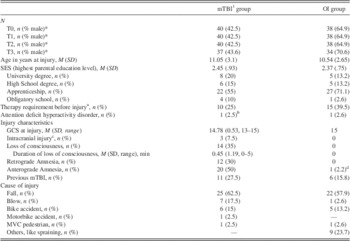
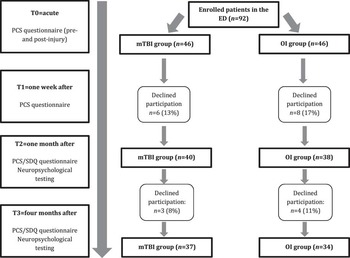
German-speaking participants between 6 and 16 years of age were recruited for this study between February 2012 and September 2012 (for children after OI, we extended the recruitment period to April 2013 to have similar subsample sizes) in the Emergency Department (ED) of the University Children’s Hospital in Bern, Switzerland. Inclusion criteria were (a) the diagnosis of an mTBI, confirmed by an emergency physician and defined according to the American Congress of Rehabilitation Medicine (ACRM, 1993); and (b) no pre-existing psychiatric or neurodevelopmental diseases (except for ADHD, known to be more common in children sustaining an injury, DiScala, Lescohier, Barthel, & Li, Reference DiScala, Lescohier, Barthel and Li1998). Consistent with the ACRM (1993), we defined mTBI with an initial Glasgow Coma Scale (GCS) of 13–15, as deriving from a traumatically induced physiological disruption of brain function, as manifested by at least one of the following symptoms: loss of consciousness <30 min, duration of post-traumatic amnesia (PTA) (<24 hr), any alteration in mental state at the time of the accident, with possible focal deficits of transient nature. Inclusion Criteria for the OI were (a) fractures of the non-dominant upper extremity or of the lower extremity below the knee or soft wound tissue wounds requiring surgical intervention, (b) no head involvement as well as no injury of the dominant upper extremity (because children were tested with speed dependent neuropsychological tasks 1 month after the injury) and (c) the absence of pre-existing psychiatric or neurodevelopmental disease (except ADHD, for the same reason as above, DiScala et al., Reference DiScala, Lescohier, Barthel and Li1998). A total of 92 children (46 children per group) were recruited for this study. Between the ED visit and the first neuropsychological testing session, six children (13%) of the mTBI group and eight children (17%) of the OI group declined further participation. Between the first and second neuropsychological assessment, three children (8%) of the mTBI group and four children (11%) of the OI group declined further participation. Overall, the dropout rate was comparable to other studies (e.g., McCullagh & Feinstein, Reference McCullagh and Feinstein2003) and a retrospective analysis concerning the participation rate revealed similar participation rates (mTBI: 46%, OI: 30%) to a study by Yeates et al. (Reference Yeates, Taylor, Rusin, Bangert, Dietrich, Nuss and Jones2009). All participants who completed the first neuropsychological assessment were included in data analyses. While all children in the mTBI group were inpatients and hospitalized for GCS supervision, seven children after OI (18%) were not inpatients and were released after initial treatment in the ED had been completed. Descriptive information of both groups is shown in Table 1.
Demographic and injury characteristics of both groups

Note. 1mTBI: mild traumatic brain injury; *p<.05. OI=orthopedic injury; T0=acute; T1=1 week following the injury; T2=1 month following the injury; T3=4 months following the injury; SES=socio-economic status (highest parental education level); GCS=Glasgow Coma Scale; MVC=motor vehicle collision.
a “Therapy requirement” summarizes the following therapies: medication (Ritalin), speech therapy, psychomotor therapy, occupational therapy, any kind of math/literacy intervention and special school support.
b This child required stimulant medication.
c All intracranial injuries were extra cerebral.
d This child had a toe fracture, without any evidence for an additional mTBI.
Procedure
Figure 1 illustrates the study design of our prospective short-term longitudinal study with four time-points (acute=T0, 1 week after the injury=T1, 1 month after the injury=T2, and 4 months after the injury=T3). In the ED, parents were asked to fill out questionnaires to rate acute PCS (T0 post-injury) as well as the presence and severity of these symptoms for the time before the injury (T0 pre-injury) (Gioia, Schneider, Vaughan, & Isquith, Reference Gioia, Schneider, Vaughan and Isquith2009). Furthermore, parents were asked to fill out the same questionnaire at all other time points. At T2 and T3, comprehensive neuropsychological assessments were performed, with a counterbalanced task order using alternate versions of the tests at T3, if available. Children were tested individually in a quiet room by a child neuropsychologist (M.S.) or by a trained psychology graduate student. Assessment duration was approximately 90 min each time. Regular breaks were offered and at the end of testing sessions, children were allowed to pick a small gift as reward for their participation.
Flow chart with the design and drop-out rate of the short-term longitudinal study.

Measures
At T2 and T3, participants performed neuropsychological tests to assess verbal learning and memory, executive functions (working memory and switching), selective attention, nonverbal intelligence, and processing speed. Raw scores of the tests were transformed into age-corrected standard scores (SS) or percentiles (PR), as requested by the respective test manual.
Verbal learning and memory performance was assessed with the German Version of the Rey Auditory Verbal Learning Test (RAVLT, Helmstaedter, Lendt, & Lux, Reference Helmstaedter, Lendt and Lux2001). The dependent variables were verbal learning (the sum of the recalled words over the five learning trials) and verbal memory (delayed recall). We used an alternate list of words at T3.
Working memory was assessed using the backward digit recall task of the Working Memory Test Battery (WMTB-C, Pickering & Gathercole, Reference Pickering and Gathercole2001).
Switching was assessed using the fourth condition (number-letter switching) of the Trail Making Task of the Delis-Kaplan Executive Function System (D-KEFS, Delis, Kaplan, & Kramer, Reference Delis, Kaplan and Kramer2001). This test could only be conducted with children aged 8 years and older. The dependent variable was time for completion.
Selective Attention was measured with the Conners’ Continuous Performance Test (CPT, Conners, Reference Conners2004). The dependent variables were the errors of omission (number of targets to which the individual did not respond) as a proxy for inattention/inhibition and the errors of commission [number of times the individual responded to a nontarget (“X”)] as a proxy for impulsivity (Epstein et al., Reference Epstein, Erkanli, Conners, Klaric, Costello and Angold2003).
Processing speed was measured using the Processing Speed Index score of the German version of the Wechsler Intelligence Scale for children (WISC-IV, Petermann, & Petermann, Reference Petermann and Petermann2007).
Nonverbal Intelligence was assessed using the Test of Nonverbal Intelligence (TONI 3, L. Brown, Sherbenou, & Johnsen, Reference Brown, Sherbenou and Johnsen1997), a language and motor-free measure of intellectual functioning.
Socio-behavioral strengths and difficulties were measured with the Strength and Difficulties Questionnaire (SDQ, Goodman, Reference Goodman1997), rated by parents at T2 and T3. Subscale scores above three (conduct problems), four (peer problems), five (emotional symptoms), six (hyperactivity/inattention), or below five (prosocial behavior) are considered abnormal. Our dependent variables were the raw scores of all five subscales.
Post-concussive symptoms were rated by parents and children using a translated and slightly adapted version of the Post-concussion symptom inventory (PCSI, Gioia et al., Reference Gioia, Schneider, Vaughan and Isquith2009). It consists of 29 items that have to be rated on a Likert Scale (0–3, never/seldom/sometimes/often), covering physical, cognitive, sleep-related, and emotional symptoms which have been derived from factor analytic approaches (Gioia, Vaughan, & Isquith, Reference Gioia, Vaughan and Isquith2011). To attain more information on cognitive items, we added the following cognitive items from the Health and Behavior Inventory (HBI, Ayr, Yeates, Taylor, & Browne, Reference Ayr, Yeates, Taylor and Browne2009): “easily distracted” / “forgetful” / “difficulties to complete a task” / “difficulties to stay focused on a task”. For this study, we used the sum of all PCS items of the parent ratings similar to other studies (e.g., Rieger et al., Reference Rieger, Lewandowski, Callahan, Spenceley, Truckenmiller, Gathje and Miller2013). Furthermore, we concatenated the parent-rated cognitive items covering everyday attention problems (concentration problems / easily distracted / difficulties to execute an order / difficulties to complete a task / difficulties to stay focused on a task), creating the variable everyday attention problems. Internal consistency was strong for the total scale as well as for the subscale everyday attention problems (α=.87–.91). Furthermore, test–retest reliability of the everyday attention problems subscale (Pearson r between T2 and T3, r T2,T3=.65, p<.001) was acceptable and there were hints for convergent validity (Pearson r between the parent-rated SDQ subscale hyperactivity / inattention and the everyday attention problems subscale, r T2=.57, p<.001; r T3=.70, p<.001) in children after mTBI. For one analysis, we dichotomized the variable everyday attention problems into presence of pre-injury everyday attention problems (sum of the attention items ≥1) and into absence of pre-injury everyday attention problems (sum of the attention items=0).
Highest level of education in the family was used as a proxy for socio-economic status (SES) and was coded using the following scale: 1=obligatory schooling, 2=high school/on the job training, 3=college degree, 4=university/graduate degree.
Statistical Analyses
For the statistical analyses we used the Statistical Package for Social Sciences software for Windows, version 21 (SPSS IBM, New York). Demographic characteristics were compared using two-tailed independent samples t tests (age at injury, nonverbal IQ) and nonparametric Pearson Chi-square test (χ 2 , for gender, SES, previous mTBI, and pre-injury therapy requirements). Before our analysis, we executed exploratory analyses to identify possible confounding covariates. Due to our gender imbalance, we included gender as covariate because there is evidence that gender has a moderating effect on neuropsychological outcome and may influence PCS rating in parents (Donders & Woodward, Reference Donders and Woodward2003; Taylor et al., Reference Taylor, Dietrich, Nuss, Wright, Rusin, Bangert and Yeates2010). In a first step, repeated-measures analyses of covariance (ANCOVAs) (Group×Time, controlled for gender) were performed to investigate the influence of the injury group and time on the parental rating of PCS and everyday attention problems. Because Mauchly’s test of sphericity was violated in these analyses, we adapted the degrees of freedom (df) using the Huynh-Feldt correction. To follow-up on the very recent assumption that emotional symptoms may be associated with persistent PCS (Donlon, & Jones, Reference Donlon and Jones2014), we additionally performed a hierarchical regression analysis to explore the contribution of demographic variables, injury group, pre-injury PCS, and emotional symptoms at T3 (SDQ subscale) on PCS at T3. In a second step, repeated-measures ANCOVAs (Group×Time, controlled for gender) were used to test the influence of injury group and time on neuropsychological and socio-behavioral outcome. To measure associations between everyday attention problems and neuropsychological performance, cross-sectional two-sided partial Pearson correlations (controlled for gender and pre-injury everyday attention problems) were computed for T2 and T3. In a last step, independent samples t tests were computed to investigate the influence of pre-injury attention problems on neuropsychological outcome in children after mTBI. Statistical significance was defined as p<.05, however, in the case of multiple comparisons (correlations and independent samples t tests), we applied the Bonferroni correction with a modified p-value. Effect size is reported as Cramer V, r, or partial Eta2 (η p 2 ) values.
Results
Descriptive Data
Descriptive and injury-related characteristics of both groups are presented in Table 1. Injury severity of our mTBI group was very mild, with a mean GCS of 14.8 and only a third of participants suffered from a short period of unconsciousness (≤5 min). Both groups were comparable concerning age at injury, t(76)=.77, p=.44, SES, χ 2 (3)=3.04, p=.39, nonverbal IQ, t(76)=1.90, p=.06, previous mTBI, χ 2 (1)=1.89, p=.17 and pre-injury therapy requirement, χ 2 (1)=1.87, p=.17. At T2, χ 2 (1)=4.25, p=.04, V=.23 as well as at T3, χ 2 (1)=5.38, p=.02, V=.28, there was a gender imbalance between both groups with significantly more male participants in the OI group, compared to the mTBI group. Furthermore, three children had intracranial injuries (subarachnoid hemorrhage, epidural hematoma), confirmed by an acute CT. Although the presence of intracranial lesions is related with worse neurobehavioral outcomes (Williams, Levin, & Eisenberg, Reference Williams, Levin and Eisenberg1990), we included these children because they were eligible patients. Furthermore, our results did not change when excluding these three cases with intracranial injuries.
Change of Post-concussive Symptoms in the Post-acute Period
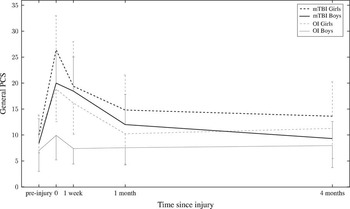
Changes in the sum of PCS across all assessments (T0–T3) are shown in Figure 2. Repeated-measure ANCOVA revealed no main effect of time, but a main effect of injury group, F(1,65)=4.72, p=.03, η p 2 =.07 (parents of children after mTBI > parents of children after OI) and an interaction effect of time x injury group, F(2.56, 166.49)=2.87, p=.04, η p 2 =.04. Parents of children after mTBI observed more PCS acutely compared to 4 months after the injury. Furthermore, the covariate gender was significantly related to PCS, F(1,65)=5.29, p=.03, η p 2 =.08, revealing that parents of girls observed more PCS than parents of boys. Cross-sectional ANCOVAs indicated that parents of children after mTBI rated more PCS at T0 post-injury, F(1,75)=11.12, p=.001, η p 2 =.13 and at T1, F(1,75)=6.08, p=.02, η p 2 =.08. At all other time-points, there were no differences between groups.
Development of post-concussive symptoms across all time points, rated by parents (M, SD).

A hierarchical regression analysis investigating the independent contribution of injury group, pre-injury PCS as well as emotional symptoms on PCS beyond the acute period (controlling for demographic variables in the first step) indicated that only pre-injury PCS (β=.21; p<.05) and emotional symptoms at T3 (β=.68; p<.001) significantly predicted PCS at T3 (F(6,60)=11.26; p<.001; R 2 =.53).
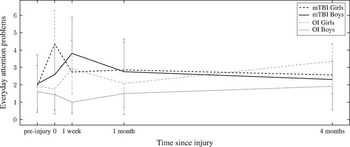
Changes in everyday attention problems across all assessments (T0–T3) are illustrated in Figure 3. Repeated-measure ANCOVA revealed no effect of time or injury group on everyday attention problems.
Development of everyday attention problems across all time points, rated by parents (M, SD).

Neuropsychological Outcome 1 Month (T2) and 4 Months (T3) following the Injury
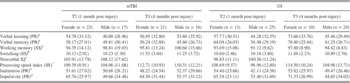
Descriptive data of the neuropsychological assessments at T2 and T3 are reported in Table 2. Repeated-measures ANCOVA revealed a significant time effect for processing speed, F(1,67)=4.42, p=.04, η p 2 =.06, meaning that both groups improved their processing speed between T2 and T3 (p<.001). Furthermore, the covariate gender, F(1,67)=5.90, p=.03, η p 2 =.02 was significantly related to processing speed, revealing that girls showed a quicker processing speed than boys. Concerning all other neuropsychological functions, there were neither main effects (injury group or time) nor interaction effects found. At both time-points, the means of all participants were within the normal range.
Neuropsychological test performance for both groups at one (T2) and four (T3) months post-injury (M,SD)

Note. mTBI=mild traumatic brain injury; OI=orthopedic injury; M=mean; SD=standard deviation; PR=Percentile; SS=Standard Score; IQ=Intelligence Quotient.
a Due to language problems, one boy in the mTBI group could not be tested with the verbal learning and memory as well as working memory test at both time points.
b This test could only be conducted with children aged 8 years and older, leading to a smaller n in the single cells (T2: mTBI: n=30; OI: n=28; T3: mTBI: n=27, OI: n=26).
c Nonverbal IQ was only tested at T2.
d For both variables, inattention and impulsivity, high percentage values mean a worse attention performance.
*Significant main effect of time (p<.05).
Socio-behavioral Outcome 1 Month and 4 Months following the Injury
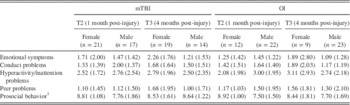
The socio-behavioral outcome (SDQ subscale scores), rated by parents, is shown in Table 3. Repeated-measures ANCOVA revealed no changes over time or differences between groups. At both time-points, means of all participants were within the normal range.
Socio-behavioral strengths and weaknesses for both groups at one (T2) and four (T3) months post-injury (M (SD))

Note. No significant main effects.
1 Only for the prosocial behavior subscale: Low raw scores point to higher problems, meaning less prosocial behavior. mTBI: mild traumatic brain injury. OI: orthopaedic injury.
Relation between Everyday Attention Problems and Neuropsychological Performance
Correlation coefficients between neuropsychological performance and parent-rated everyday attention problems are shown in Tables 4 and 5. One month after the injury (T2) (Table 4), there were generally small-sized, insignificant correlations between everyday attention problems and selected neuropsychological functions in both groups.
Correlation coefficients between neuropsychological performance and parent-rated everyday attention problems one month after the injury

Note. No significant correlations (p<.05, Bonferroni corrected) were found.
1 Uncorrected correlations.
2 Partial correlations (controlled for gender and pre-injury everyday attention problems).
3 For both variables inattention and impulsivity, high percentage values mean a worse attention performance. mTBI: mild traumatic brain injury. OI: orthopedic injury.
Correlation coefficients between neuropsychological performance and parent-rated everyday attention problems four months after the injury

Note. *p<.05 (Bonferroni corrected).
1 Uncorrected correlations.
2 Partial correlations (controlled for gender and pre-injury everyday attention problems).
3 For both variables inattention and impulsivity, high percentage values mean a worse attention performance. mTBI: mild traumatic brain injury. OI: orthopedic injury.
Four months after the injury (Table 5), there were again generally small, insignificant correlations in children after OI. In children after mTBI, however, there was a significant, large-sized negative correlation between verbal learning and everyday attention problems. The medium-sized correlation between working memory and everyday attention problems (p=.01) fell short of the significance threshold (p<.008) after controlling for gender and pre-injury attention problems. The associations between the performance-based selective attention measures (inattention and impulsivity) and the ratings of everyday attention problems were small and insignificant for either testing session.
Influence of Pre-injury Everyday Attention Problems on Neuropsychological Performance in Children after mTBI
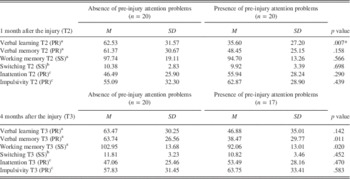
The influence of pre-injury attention problems on neuropsychological outcome in children after mTBI is shown in Table 6. On a descriptive level, children after mTBI with pre-injury attention problems showed at both time points a worse neuropsychological performance compared to children after mTBI without pre-injury attention problems. At T2, children with pre-injury attention problems showed a significantly worse learning performance than children without pre-injury attention problems, t(37)=2.86, p=.007, r=.43. At T3, children with pre-injury attention problems showed a worse verbal memory (t(34)=2.69; p=.01; r=.42) and working memory (t(34)=2.44; p=.02; r=.39) performance with medium effect sizes; however, after applying the Bonferroni correction, these results became insignificant.
Neuropsychological performance (M, SD) at T2 and T3 of children after mTBI without and with pre-injury everyday attention problems

Note. *p<.05 (Bonferroni corrected). PR=percentile; SS=Standard Score; T2=1 month following the injury; T3=4 months following the injury.
a Due to language problems, one child of the mTBI group could not be tested with the verbal learning and memory test as well as with the working memory test at both time points.
b This test could only be conducted with children aged eight years and older, leading to a smaller n in the single cells (T2: no pre-injury attention problems: n=16, with pre-injury attention problems: n=14; T3: no pre-injury attention problems: n=16, with pre-injury attention problems: n=11).
c For inattention and impulsivity, high percentage values mean a worse attention performance.
Discussion
The aim of this study was to examine neuropsychological functions as well as PCS in the post-acute period in children after mTBI in comparison to children after OI. According to earlier studies, parents of children after mTBI observed significantly more PCS, particularly in the acute stage and 1 week following the injury (Barlow et al., Reference Barlow, Crawford, Stevenson, Sandhu, Belanger and Dewey2010; Sroufe et al., Reference Sroufe, Fuller, West, Singal, Warschausky and Maio2010; Taylor et al., Reference Taylor, Dietrich, Nuss, Wright, Rusin, Bangert and Yeates2010). Furthermore, our analysis revealed that gender influenced the parental reporting of PCS, replicating the previous finding that female adults or children report higher PCS after mTBI than males do (McNally et al., Reference McNally, Bangert, Dietrich, Nuss, Rusin, Wright and Yeates2013; Ponsford et al., Reference Ponsford, Cameron, Fitzgerald, Grant, Mikocka-Walus and Schönberger2012).
The initial sharp increase of reported PCS after mTBI may reflect acute temporary neurochemical abnormalities following mTBI, including the release of excitatory neurotransmitters, changes in glucose metabolism, and impaired axonal function (Giza & Hovda, Reference Giza and Hovda2001). During this initial period, any physical or cognitive activity constitutes an additional neurometabolic demand on the recovering and vulnerable brain (Sady, Vaughan, & Gioia, Reference Sady, Vaughan and Gioia2011). Given that a high activity level during recovery is associated with higher symptom ratings and longer symptom duration in students, it might be essential to avoid physical and cognitive over-exertion in the initial recovery phase (Brown et al., Reference Brown, Mannix, O’Brien, Gostine, Collins and Meehan2014; Majerske et al., Reference Majerske, Mihalik, Ren, Collins, Reddy, Lovell and Wagner2008; Sady et al., Reference Sady, Vaughan and Gioia2011). Furthermore, it seems crucial to prevent second head injuries during recovery because repeated head injuries are associated with prolonged recovery and complications (Eisenberg, William Meehan, & Mannix, Reference Eisenberg, William Meehan and Mannix2013; Simma, Lütschg, & Callahan, Reference Simma, Lütschg and Callahan2013). As a consequence, physical and cognitive activity levels should be managed carefully during the first weeks after an mTBI (Kirkwood et al., Reference Kirkwood, Yeates, Taylor, Randolph, McCrea and Anderson2008; Sady et al., Reference Sady, Vaughan and Gioia2011).
One and 4 months after the injury, there were no group differences in the parental rating of PCS between children after mTBI and OI. Of interest, our data indicated that ongoing emotional symptoms and pre-injury PCS, but not injury group, were significant predictors of ongoing PCS 4 months after the injury, supporting the finding that certain non-injury child and family factors may be associated with persistent PCS, while injury related factors are only significant predictors in the acute period (McNally et al., Reference McNally, Bangert, Dietrich, Nuss, Rusin, Wright and Yeates2013). Since the contribution of injury characteristics on long-term PCS tends to decline over time (McNally et al., Reference McNally, Bangert, Dietrich, Nuss, Rusin, Wright and Yeates2013; Ponsford et al., Reference Ponsford, Cameron, Fitzgerald, Grant, Mikocka-Walus and Schönberger2012), the appropriateness of the term post-concussive symptoms, suggesting a neurological basis, is being questioned for persisting symptoms after the post-acute period (Donlon, & Jones, Reference Donlon and Jones2014). Hence, further research is needed to improve the understanding of the etiology of PCS, specifically regarding the differential influence of injury and non-injury related factors on long-term PCS.
Consistent with previous studies, our results showed that socio-behavioral and neuropsychological outcome were comparable between children after mTBI and OI in the post-acute period (Asarnow et al., Reference Asarnow, Satz, Light, Lewis and McCleary1995; Babikian et al., Reference Babikian, Satz, Zaucha, Light, Lewis and Asarnow2011; Maillard-Wermelinger et al., Reference Maillard-Wermelinger, Yeates, Gerry Taylor, Rusin, Bangert, Dietrich and Wright2009; Rieger et al., Reference Rieger, Lewandowski, Callahan, Spenceley, Truckenmiller, Gathje and Miller2013). With the exception of an improved processing speed over time, no further group or time changes were found. Although recent studies (Anderson et al., Reference Anderson, Catroppa, Morse, Haritou and Rosenfeld2001; Catale et al., Reference Catale, Marique, Closset and Meulemans2009; Loher et al., Reference Loher, Fatzer and Roebers2014) detected subtle impairments in attention and executive functions compared to healthy control children, these group differences, however, seem to disappear when comparing the outcome to another injury group. The finding of a similar cognitive performance between children after mTBI and OI was recently interpreted as general injury effect which is hypothesized to originate from systematic pre-injury differences and/or the experience of sustaining an injury among injured children (Babikian et al., Reference Babikian, Satz, Zaucha, Light, Lewis and Asarnow2011). Thus, it seems crucial to compare cognitive outcome after pediatric mTBI with a carefully selected control group. Another injury group enables to separate specific head injury effects from a general injury effect to determine the pure effect of the head injury. Moreover, the additional use of healthy children as a second control group would be helpful to better estimate the degree of impairment compared to non-injured children.
Despite the lack of significant group differences concerning neuropsychological outcome in the post-acute period, 4 months after the injury, we found group-specific medium-sized associations between elevated parent-rated everyday attention problems and reduced working memory as well as verbal learning performance in children after mTBI, replicating a recent finding of an adult mTBI study (Dean & Sterr, Reference Dean and Sterr2013). Although children after mTBI were not rated as having more everyday attention problems compared to children after OI, their ongoing everyday attention problems were related to their neuropsychological performance, while this association was less pronounced in children after OI.
Moreover, not only persistent, but also pre-injury everyday attention problems negatively influenced neuropsychological outcome in children after mTBI. Thus, our findings are similar to previous studies which have shown that pre-injury risk factors may accentuate weaknesses after pediatric mTBI (Babikian et al., Reference Babikian, McArthur and Asarnow2013, Bonfield et al., Reference Bonfield, Lam, Lin and Greene2013; Fay et al., Reference Fay, Yeates, Taylor, Bangert, Dietrich, Nuss and Wright2010). Although our exploratory analyses indicated only few moderate-sized effects, our findings suggest that pre-injury attention problems may act as a risk factor for cognitive outcome in children after mTBI. According to the cognitive reserve capacity hypothesis (Stern, Reference Stern2002), pre-injury attention problems might indicate a reduction in cognitive resources, putting children with pre-injury attention problems at a higher risk for cognitive difficulties after a TBI.
Thus, it is highly important to detect pre-injury risk factors like attention problems that might influence cognitive functioning after childhood mTBI. Considering our cognitive outcome, reduced neuropsychological performance was associated with pre-injury as well as with current everyday attention problems. Because pre-injury and follow-up ratings of everyday attention problems were moderately correlated, it may be assumed that most children with attention problems already have shown attention impairments before the injury. Thus, an acute rating of pre-injury attention skills might help at an early time point to select children who are likely to show ongoing attention problems and who are at risk for neuropsychological impairments after mTBI.
The following limitations of this study should be mentioned: First, our sample was relatively small and our mTBI group was very mildly injured, possibly limiting the generalization of our results. Second, our PCS questionnaire is a translated and slightly adapted version of the PCSI (Gioia et al., Reference Gioia, Schneider, Vaughan and Isquith2009), without Swiss norms. However, because the PCSI questionnaire is a valid instrument, with strong psychometric properties (Sady, Vaughan, & Gioia, Reference Sady, Vaughan and Gioia2014), we do not expect significant differences when using it with Swiss children, especially when focusing on general PCS, a “simple” measure of PCS that was also investigated in earlier studies (Barlow et al., Reference Barlow, Crawford, Stevenson, Sandhu, Belanger and Dewey2010; Sroufe et al., Reference Sroufe, Fuller, West, Singal, Warschausky and Maio2010; Rieger et al., Reference Rieger, Lewandowski, Callahan, Spenceley, Truckenmiller, Gathje and Miller2013). Nevertheless, we are aware that our general PCS outcome may be simplified since there is evidence that a sum score of PCS covers multiple factors with different trajectories (Ayr et al., Reference Ayr, Yeates, Taylor and Browne2009; Taylor et al., Reference Taylor, Dietrich, Nuss, Wright, Rusin, Bangert and Yeates2010). Moreover, the use of a non-validated everyday attention subscale is problematic, even though acceptable basic psychometric properties were given. Third, SES data were collected at the first neuropsychological assessment. As a consequence, we could not compare included participants with patients who declined or refused participation to detect systematic demographic differences. Additionally, given that higher physical and cognitive activity during recovery is associated with higher symptom ratings, resulting in a prolonged recovery, it would have been beneficial to have inquired physical and cognitive activity levels following the injury that might have influenced recovery and outcome in our study.
To conclude, our results with a very mild mTBI sample support the assumption that mTBI is a “benign” injury, even in the post-acute period (Babikian et al., Reference Babikian, Satz, Zaucha, Light, Lewis and Asarnow2011; Carroll et al., Reference Carroll, Cassidy, Peloso, Borg, von Holst, Holm and Pépin2004). Parents of children after mTBI initially observed a sharp increase in the number of PCS, which regressed over the first few weeks. Therefore, treating physicians should inform parents and teachers about typical symptoms that may occur in the first weeks following an injury to help adapting the child’s schedule and activities. Comprehensive information is not only important to prevent excessive physical and cognitive strains after the injury (Sady et al., Reference Sady, Vaughan and Gioia2011), but also to minimize parental stress and optimize coping with the incident (Ponsford et al., Reference Ponsford, Willmott, Rothwell, Cameron, Ayton, Nelms and Ng2001). Although there were no post-acute neuropsychological or socio-behavioral differences between children after mTBI and OI, our findings indicate that current and pre-injury everyday attention problems were negatively associated with neuropsychological performance in children after mTBI. Thus, future research should focus on further cognitive and socio-emotional risk factors that might influence neuropsychological outcome after pediatric mTBI.
Acknowledgments
This work was financially supported by following foundations: the Johanna Dürmüller-Bol Foundation, the Batzebär Foundation of the University Children’s Hospital of Bern, and the Anna Müller-Grocholski Foundation. There are no conflicts of interest. Portions of this research were presented at the Mid-Year Meeting of the International Neuropsychological Society (INS) in Amsterdam, 2013 as well as at the Annual Meeting of the INS in Seattle, 2014. We thank all parents and children for participating in this research project. In addition, we thank the Psychology graduate students Venera Gashaj, Sandra Hartmann, and Elisabeth Ruprecht for helping with data collection. Besides, the authors express gratitude to the anonymous Reviewers for their helpful suggestions and thank Thomas Mettler for support with data plotting.